
How to Reintroduce Foods After an Elimination Diet Safely
This post contains affiliate links. As an Amazon Associate, we earn from qualifying purchases.
To reintroduce foods after an elimination diet, add one food back at a time, start with a small portion at one meal and a larger one the next, then assess over about a day. The VA Whole Health protocol says to try elimination for at least 10 days, if not 2-4 weeks; set a pet trial’s wait window before any challenge.
An eight-week trial that ends with a cat still getting chicken-flavored chews has tested nothing. The reintroduction phase is where that error finally surfaces, because the first challenge food either provokes a reaction or it doesn’t, and a contaminated baseline makes both answers worthless. This is why knowing how to reintroduce foods after an elimination diet matters.
What follows covers the timing each published protocol uses, the order to bring foods back, what counts as a real challenge portion, and the hidden proteins that quietly end a trial early.
Key Takeaways
- One food at a time is the structure Ohio State and the Arizona protocol recommend; the EoE protocol allows an abbreviated approach that adds back less likely foods together, trading certainty for speed.
- Wait before judging a reintroduced protein in a pet trial, and record reactions as they appear.
- Treats and flavored medications are the most common reason a trial fails before the challenge phase even starts.
- Never reintroduce a food that caused anaphylaxis. The VA and Arizona protocols both draw that line hard.
- Keep a written diary, because a two-week wait will flatten your memory of what happened on day four.
Why Reintroduction Is the Part Most Trials Get Wrong
A trial with no planned challenge phase is a diet, not a test.
The VA Whole Health clinician’s guide is direct about the purpose: the food goes back in specifically to see whether symptoms return, and the whole exercise is described as an “n of 1” trial, per the VA clinician’s guide to elimination diets. One animal, one variable, one result.
That framing dictates everything downstream. If two foods go back in the same week, the result is a coin flip wearing a lab coat. Ohio State’s Razan Hallak, a registered dietitian in gastroenterology, calls the elimination-then-challenge sequence “the tried-and-true method” for identifying a food sensitivity, and the reason it works is that nothing else moves at the same time.
Reintroduction works by provoking a response under controlled conditions. A single food is added back at a measured dose while everything else stays constant, so any change in symptoms can be attributed to that food rather than to season, environment, or a dozen simultaneous diet changes made in the same week.
For a cat or dog, holding those conditions is harder than it sounds. A hydrolyzed diet only works when it is the sole protein source in the bowl, which is the same logic that governs a strict elimination diet for cats. One stray chew breaks it.
Where this goes sideways: Starting the challenge phase while the pet still gets flavored chews or fish-oil capsules. Those carry enough protein to keep a reaction going through the whole trial, and the result is a false negative that sends you back to the starting line eight weeks later.
How Long Should You Wait Between Reintroduced Foods?
Published protocols disagree, and the spread is wide enough that picking one without knowing why is how people end up repeating a trial.
The VA guide adds the food in a small quantity at one meal and a larger quantity the next, then pulls it back out after a day until every other eliminated food has been tested. The University of Arizona’s integrative medicine center gives a food three days before calling it tolerated. The eosinophilic esophagitis protocol published in Clinical Gastroenterology and Hepatology wants at least one serving of the challenge food per day for at least four to six weeks before an endoscopy.
| Source | Elimination phase | Wait before judging a food |
|---|---|---|
| VA Whole Health | At least 10 days, ideally 2-4 weeks | About a day (small meal, then larger) |
| Arizona integrative medicine | 3 weeks minimum | 3 days with no symptoms |
| Ohio State (Hallak) | 1 to 3 months | Gradual portion increase, one food at a time |
| EoE protocol (2023) | At least 6-8 weeks | 4-6 weeks of daily servings, then biopsy |
Why the protocols disagree
The gap comes down to what each one is measuring. Human EoE research needs biopsy confirmation because symptoms and disease activity routinely diverge. A pet trial measures skin and gut signs, which show up faster and are visible from the outside, so the window can be shorter.
For a pet, pick a wait window before the first challenge and record reactions as they appear, which is the how to reintroduce foods after an elimination diet question. Rushing the window doesn’t speed the trial up. It just produces a result you’ll have to re-run.
Pick your wait window before the first challenge, write it on the calendar, and don’t shorten it because the pet looks fine on day two. A reaction that arrives on day nine is still a reaction.
If your pet is moving onto a new diet at the same time, handle that separately from the challenge. A cat food transition is a tolerance question, not a trigger question, and running both at once muddies both.
The Reintroduction Order: Least Likely Trigger First
Animal milk accounts for up to 90% of identified EoE triggers, and wheat for up to 75%, according to the 2023 practical guide for eosinophilic esophagitis diet therapy. That single fact sets the order for everything else.
The EoE protocol brings foods back in this sequence: seafood, then nuts, then soy, then egg, then wheat, then milk, though for cats and dogs the culprit ranking runs differently. Least likely first, most likely last. The logic is that a reaction to a rare trigger tells you something useful without burning your best hypothesis on day one.
For cats and dogs, the culprit ranking runs differently. Chicken and fish are the usual offenders in cats. Beef and chicken lead in dogs. So the practical order inverts the human one:
- Start with the protein your pet ate least often before the trial began.
- Work toward chicken and fish last in cats, and beef and chicken last in dogs.
- Hold the carbohydrate sources for a separate pass if the protein challenges come back clean.
A novel protein cat food is only useful here if the protein is genuinely novel to that animal. Kangaroo is novel to a cat that has eaten chicken and fish its whole life. It is not novel to a cat that has been on a boutique kangaroo diet for two years, which is one reason those formulas make poor diagnostic tools.
Fair warning: exotic proteins get marketed as allergy solutions when they’re really just unfamiliar. If the manufacturer can’t tell you how the line is cleaned between runs, the protein isn’t the only variable you’re testing.
What a Real Challenge Portion Looks Like
Three things define a legitimate challenge when you compare a how to reintroduce foods after an elimination diet: dose, duration, and a clean baseline. Miss any one and the result is noise.
Dose is where the published guidance gets thinnest. No authoritative source gives a numeric starting amount, which is a real gap in the literature. The VA guide says small quantity at one meal, larger at the next. Ohio State says gradual increase of the consumed portion.
That last point matters more than the portion size itself. An under-dosed challenge can produce a false negative, and a false negative is worse than no answer because it closes the file.
Before you start: A challenge food can trigger a reaction fast, and the reaction can escalate. Keep the trial diet on hand so you can pull the pet back to baseline the same day, and know your emergency clinic’s hours before the first challenge meal, not after. If there is any history of swelling, hives, or breathing change with a food, this is a veterinary decision, not a kitchen one.
The four-step challenge sequence
- Confirm the baseline is clean. Skin and stool should be at their best before any food goes back in. Starting a challenge on a pet that’s still itchy means you can’t tell a new reaction from the old one.
- Feed a small portion of one protein at one meal. A small portion of cooked chicken or a few pieces of kibble is enough to start. Skipping the small step and going straight to a full bowl removes your chance to catch a fast reaction at a manageable size.
- Increase at the next meal, then hold and watch. Keep everything else identical. Changing the base diet mid-challenge destroys the comparison, and you’ll have to restart.
- Record what you saw and when. Date, food, amount, and symptom. A reaction logged as “seemed itchy” is useless in three weeks. A reaction logged as “chin scabs on day 4, gone by day 7” is data.
If the pet flares on the first challenge, stop there and go back to the trial diet until the skin or gut settles. Then decide whether to re-challenge or accept the result.
Which Hidden Proteins Quietly End a Trial?
Flip the bag over. The front of a “chicken-free” formula is a marketing document, and the ingredient list is where the trial actually lives.
Chicken fat and poultry digest are the two most common offenders. Both are rendered or hydrolyzed to varying degrees, both can carry enough protein to matter in a sensitive animal, and both appear well down a list where most owners stop reading. A limited-ingredient diet that lists “chicken fat” in position eight is not a chicken-free diet for challenge purposes.
Here is where to look:
- Treats. Two or three chicken-based freeze-dried nibbles a day is enough. A pet on a hydrolyzed diet plus chicken treats is on a very expensive chicken diet, and the trial is over before it began.
- Flavored medications. Chewable tablets, liver-flavored pills, and fish-oil capsules all carry protein. Ask the vet for unflavored or compounded versions before day one, not after week six.
- Dental chews and pill pockets. Same problem, larger dose.
- Flavored toothpastes and water additives. Easy to forget because they aren’t food.
If you’re adding anything new to the bowl during a trial, treat it like a challenge itself. The rules for new treats for dogs apply double during an elimination diet, because a treat introduced casually in week three becomes an unexplained variable in week nine.
The part nobody mentions: A single exposure can keep inflammation running for up to two weeks, per Ohio State’s clinical guidance. That means one stolen bite of the wrong food can invalidate a fortnight of careful work, and you won’t know it happened until the challenge results come back scrambled.
When Symptoms Are the Wrong Signal
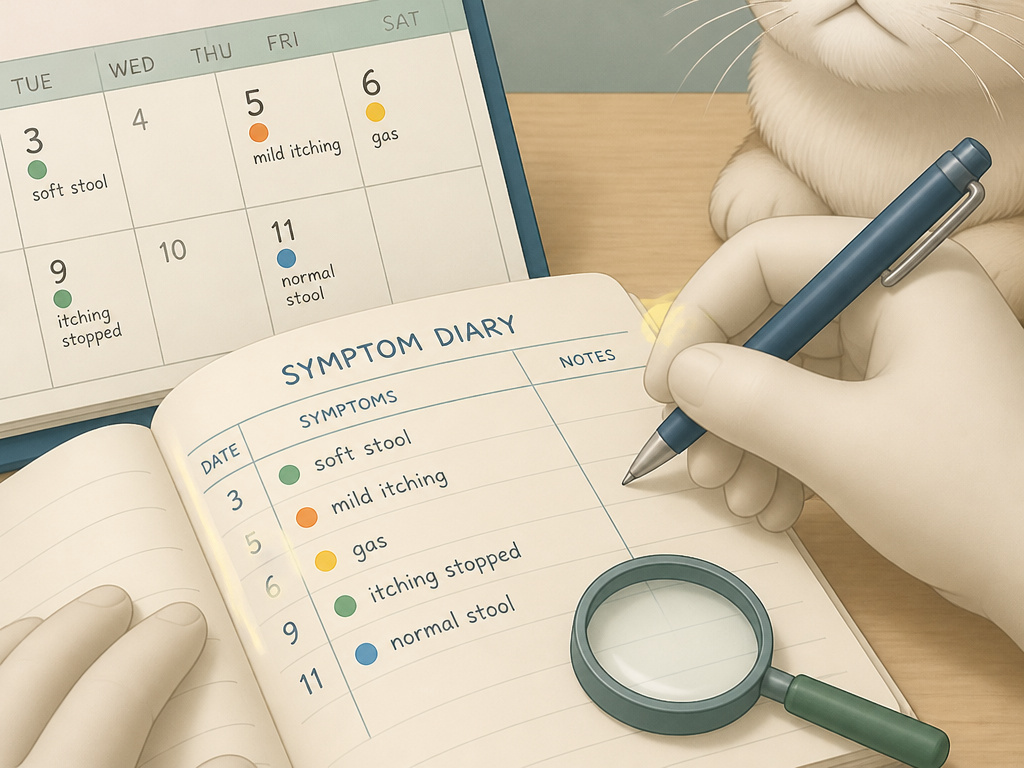
A cat scratches its chin raw on day four of a chicken challenge, then stops by day six. The owner writes “no reaction” because the skin looked better by the weekend, and the trial moves on with a wrong answer.
That pattern is exactly what the EoE literature warns about. The 2023 protocol states plainly that symptoms are often discordant with underlying disease activity, and that relying on symptoms alone can produce false trigger identification and unnecessarily prolonged dietary restriction. In that disease, endoscopy with biopsy is the gold standard, and reintroduction can’t even begin until remission is confirmed that way.
Pets aren’t people, and you’re not going to endoscope a cat after every challenge. But the underlying warning transfers. Symptoms are a lagging indicator. The chin looks worse on day four and better on day six because inflammation rises and falls on its own schedule, not because the food was fine.
In the EoE data, most patients have between one and three food triggers, and up to half have more than one. That’s the reason a single clean challenge doesn’t close the case. If your pet has food allergies in cats that flare on more than one protein, you’ll find that out by running challenges in sequence, not by running one and stopping.
What to record instead of a verdict
Write down what you observed and when, and leave the interpretation for later. A symptom diary that says “day 3: soft stool, day 5: normal, day 9: soft again” tells you something. A diary that says “seemed okay” tells you nothing, and it’s the version most people keep.
I’ve reviewed trials where the owner was certain the food was fine because the itching stopped. The notes showed it stopped on day six and came back on day eleven, after the challenge window had already closed. Details matter more than the summary.
When Should You Not Reintroduce a Food at Home?
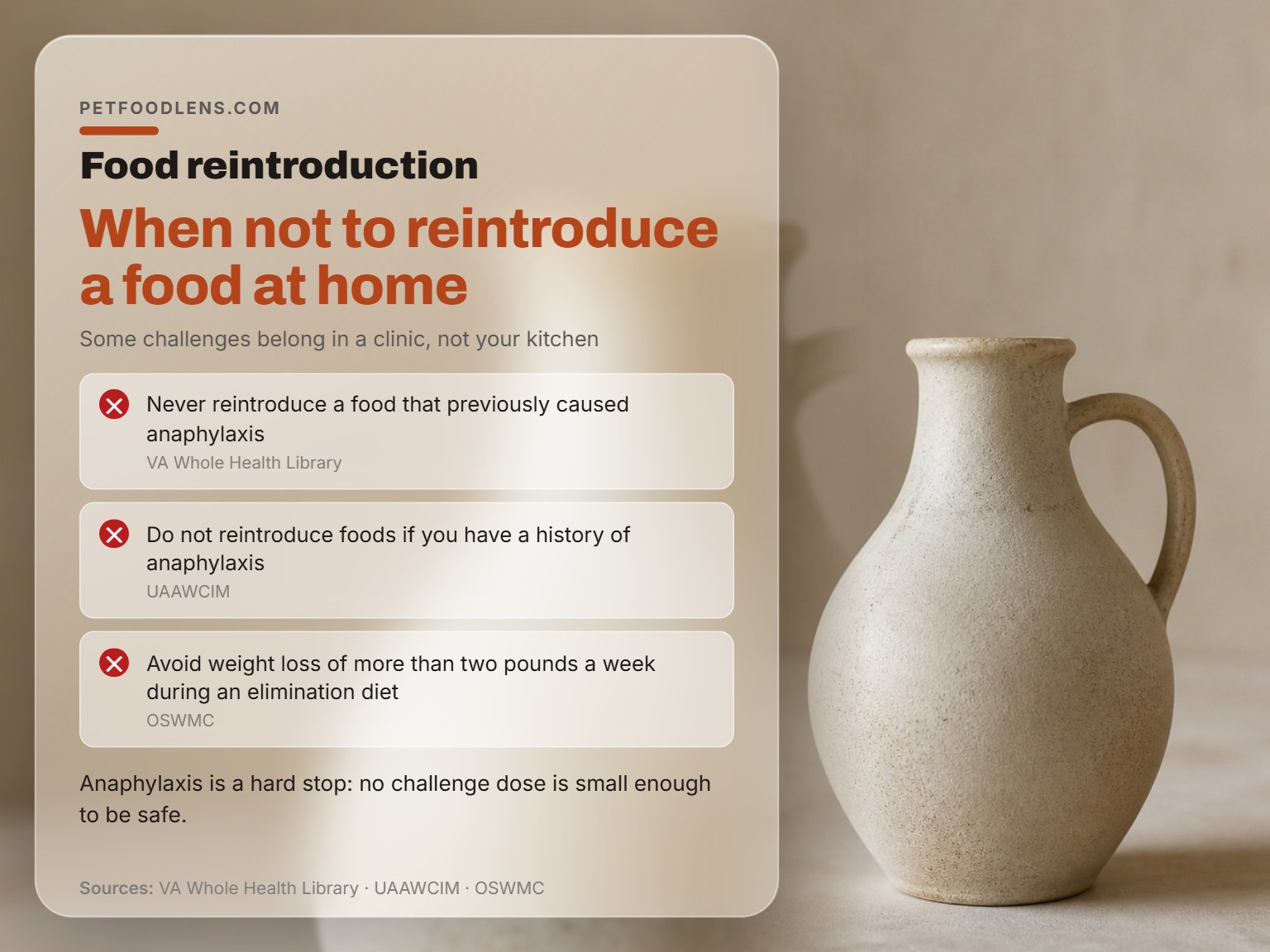
Some challenges belong in a clinic. A review of diets for food allergy diagnosis and management notes that allergens are reintroduced during a food challenge in a hospital setting because of the risk of severe reactions, while EoE reintroduction may be done at home for foods avoided under non-IgE-mediated allergy.
The hard stop is anaphylaxis. Both the VA guide and the Arizona protocol say never reintroduce a food that previously caused an anaphylactic reaction, though for EoE, food reintroduction may be done at home for foods avoided for non-IgE-mediated allergy. That is not a judgment call and there is no challenge dose small enough to make it safe.
Ohio State lists other groups who aren’t good candidates for an elimination diet at all: people who are underweight, pregnant, lactating, growing children, adolescents, frail elderly, or being treated for an eating disorder. The pet equivalent is narrower but real. A pet with a serious concurrent illness, or one already losing weight, shouldn’t be on a restrictive protocol without veterinary supervision.
Watch the scale during a pet trial. Ohio State flags weight loss of more than two pounds a week in humans as something to avoid during an elimination diet. A cat losing weight steadily through an eight-week trial is a cat that needs a vet visit before the next challenge, not after.
If you’re weighing whether to run a challenge on a pet with a known reaction history, food allergies in dogs covers the testing side, and the elimination diet for dogs walkthrough covers the phase that comes before this one.
Frequently Asked Questions
How long should an elimination diet last before you start reintroducing foods?
It depends which protocol you follow. The VA Whole Health guide says at least 10 days, ideally 2-4 weeks. The University of Arizona center says 3 weeks. Ohio State puts the elimination phase at one to three months. The EoE protocol requires at least 6-8 weeks before assessment. For pets, the wait window should be set before the first challenge.
Can you reintroduce more than one food at a time?
Ohio State and the Arizona protocol both say one food at a time for best results, while the EoE protocol allows an abbreviated approach that adds back less likely foods together. The EoE protocol allows an abbreviated approach where less likely foods go back together, such as nuts and fish, but still requires the four most common triggers (milk, wheat, egg, soy) to be introduced individually. Grouped challenges save time and cost you certainty.
How soon does a reaction show up after a challenge food?
For IgE-mediated allergy, symptoms usually appear within 2 hours of eating. For more severe non-IgE-mediated allergies such as FPIES, symptoms arrive after 2-4 hours. In pet trials, reactions can take time to appear, which is why a defined wait window exists.
Do you need a vet or dietitian for a reintroduction?
Ohio State strongly recommends working with a registered dietitian throughout the process. For pets, the equivalent is a veterinary nutritionist or your regular vet, particularly if the animal has a reaction history or a concurrent condition. The order of reintroduction depends on why foods were avoided in the first place.
What happens if the pet reacts to the first challenge food?
Stop the challenge and return to the trial diet until the skin or gut settles. Don’t move on to the next protein while the animal is still reacting, because you’ll have no clean baseline to judge it against. Once settled, decide whether to re-challenge that food to confirm or accept the result and move on.
The Bottom Line
Before you feed a single challenge meal, write the calendar. Pick the protein, pick the date, pick the two-week window, and write down what you’re going to record each day. That one piece of paper is the difference between a trial that answers a question and eight weeks that answer nothing.
Here’s the part that gets skipped in every guide I’ve read: the challenge phase tests your record-keeping as much as it tests the food. A reaction you didn’t write down didn’t happen, as far as the next decision is concerned.
This all changes if the pet has ever had swelling, hives, or breathing trouble after eating. In that case the challenge doesn’t happen at home at all. It happens in a clinic, with someone who can manage what follows.
For everything else, the plan is boring and it works: one protein, two weeks, everything else held constant. Read past the front of the package, and let the calendar tell you what the food did.
