
Raw Feeding Guide for Beginners: What the Data Shows
This post contains affiliate links. As an Amazon Associate, we earn from qualifying purchases.
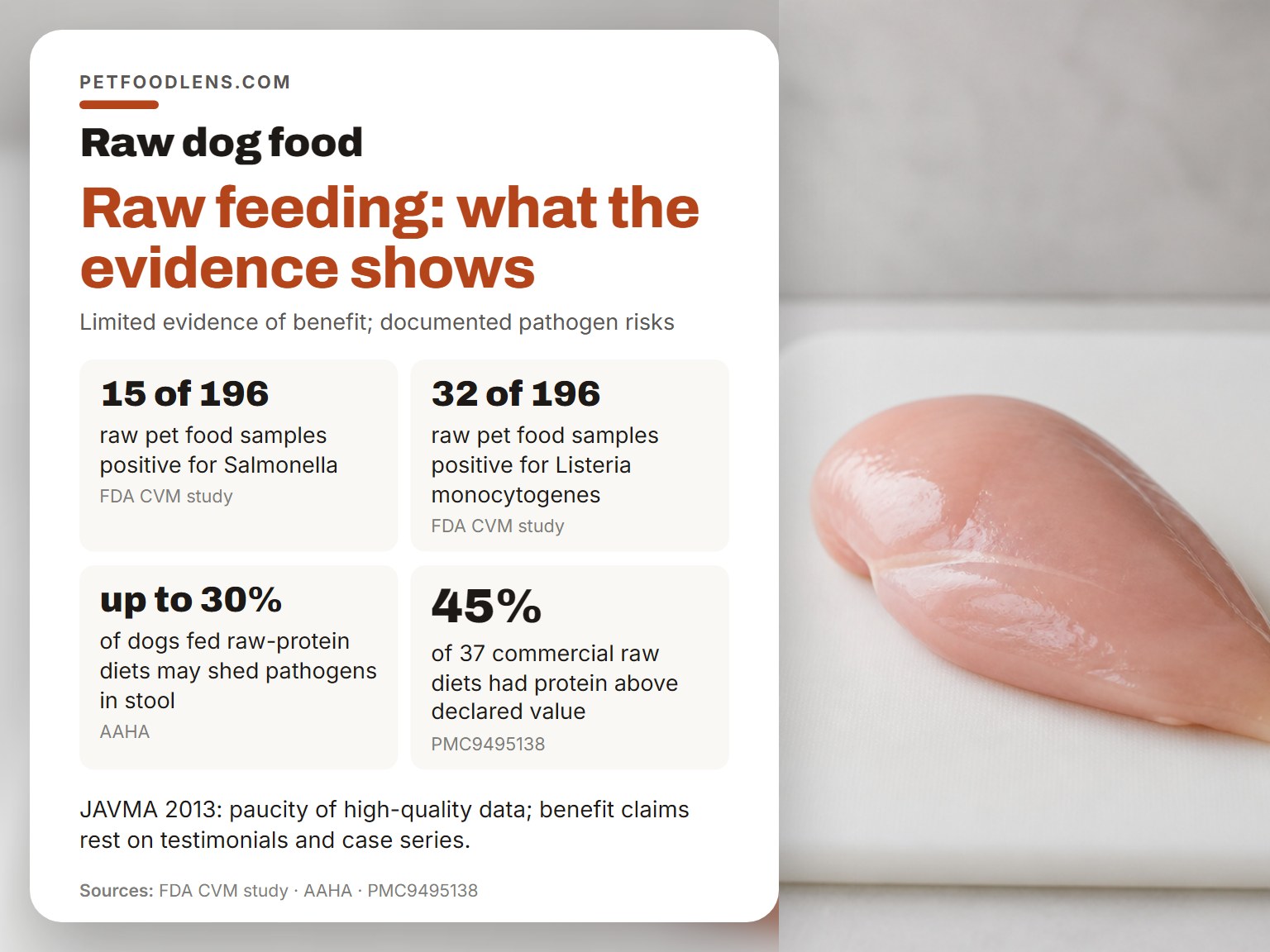
A raw feeding guide for beginners should start with the official position, so here it is: AAHA, AVMA, FDA CVM and CDC all advise against feeding raw pet food. In FDA’s 196-sample raw study, 15 tested positive for Salmonella and 32 for Listeria monocytogenes.
That Listeria count is the part FDA’s own researchers flagged as new ground. Renate Reimschuessel, a veterinarian at the Center for Veterinary Medicine, said the center had not investigated the occurrence of Listeria in pet food before this study, then noted that “quite a large percentage of the raw foods for pets we tested were positive for the pathogen Listeria monocytogenes.” That is a regulator describing a fresh finding in flat language.
What follows is the practical version: what counts as raw, what the sample data actually shows, where the agencies and the raw brands split, and the handling steps FDA publishes for people who feed it anyway.
Key Takeaways
- CDC, FDA CVM, AAHA and AVMA all advise against raw feeding. That is a four-organization position, not one blogger’s grudge.
- 15 of 196 raw samples carried Salmonella and 32 carried Listeria monocytogenes in FDA’s two-year sampling project.
- Up to 30% of raw-fed dogs may shed pathogens in their stool, per AAHA, which puts other pets and people in the house in the path.
- Freeze-dried raw is exempt from FDA’s frozen-chain rule under GFI #122. Frozen raw is not.
- A household with a child under 5, an adult 65 or older, a pregnant person, or an immunocompromised member is exactly the group CDC flags as highest risk.
What Counts as Raw Pet Food?
Flip the bag over and look for one word: raw. CDC says that is the simplest way to identify these products, and it beats squinting at the front panel for a picture of a chicken.
Raw pet food is animal protein that has not been cooked or heated to a temperature high enough to kill germs. CDC lists four retail forms: raw, raw frozen, freeze-dried (frozen and then dried in a vacuum), and dehydrated (dried using warm air). The category includes treats and toppers, not only complete meals.
The CDC raw pet food fact sheet lays out the four forms and the ingredient list on a single page. Here is how they differ in practice:
- Raw frozen. The format FDA actually sampled. Usually sold as frozen tubes of ground meat or sausage, which means it owns a shelf in your freezer and a thawing schedule in your week.
- Freeze-dried. Frozen, then dried in a vacuum. Shelf-stable, and the only form FDA’s guidance exempts from the frozen chain.
- Dehydrated. Dried with warm air. CDC still files it under raw, because warm air is not cooking.
- Raw, straight from the grocery store. Uncooked chicken or beef sold for people, portioned out for a pet. No package claim, no feeding chart, no testing program behind it.
Common ingredients run to uncooked muscle meat, uncooked organ meat, uncooked bones, uncooked eggs, and unpasteurized milk. The two recipe camps, BARF vs prey model, both sit inside that list.
One more thing CDC adds, because the marketing leans on it hard: compared to wolves, pet dogs prefer and need foods lower in protein and higher in fat and carbohydrates. The ancestral framing does not survive contact with the animal in your kitchen.
The FDA Sample Numbers That Reframe the Debate
Over 1,000 pet food samples went through FDA’s Center for Veterinary Medicine between October 2010 and July 2012. Only 196 of them were raw.
Raw food was not in the first year of the study. CVM added it in year two, bought the products online from different manufacturers, and had them shipped directly to six participating laboratories. The packages were usually frozen tubes of ground meat or sausage, which is what most of this category looks like on a freezer shelf: a hard, matte cylinder with a film of frost on it.
| Food type | Samples tested | Salmonella positive | Listeria positive |
|---|---|---|---|
| Raw pet food | 196 | 15 | 32 |
| Dry cat food | 120 | 1 | 0 |
| Jerky treats | 190 | 0 | 0 |
| Dry exotic animal food | 190 | 0 | 0 |
The FDA raw pet food diet warning is the plainest read of that table. Raw product was more likely to carry disease-causing bacteria than the other categories tested, and Listeria was the bigger problem, not Salmonella.
Reimschuessel’s summary of what it meant is worth keeping in front of you: the study “identified a potential health risk for the pets eating the raw food, and for the owners handling the product.”
What the Study Does Not Tell You
It does not give a per-brand contamination rate. It does not tell you whether the tub in your freezer is one of the 15 that tested positive. And because the samples were usually frozen tubes, the results describe that format best, not every freeze-dried or dehydrated product on a shelf.
So the number to carry around is a category-level fact: raw food is the category where FDA found the positives, and nobody can tell you which tub.
Where the Agencies and the Raw Brands Actually Disagree
Four organizations that rarely line up agree on this one. AAHA, AVMA, FDA’s Center for Veterinary Medicine and CDC do not recommend feeding raw protein diets to pets, and the AAHA raw-protein diet guidelines lay out that position.
The disagreement concerns what to do next.
| Question | Public health position | Raw brand position |
|---|---|---|
| Feed raw at all? | CDC, FDA, AAHA, AVMA: no | Dr. Marty’s guide: yes, with a 6-day transition |
| Thawing method | FDA: refrigerator or microwave | CDC: refrigerator only |
| Freeze-dried raw | FDA GFI #122: exempt from frozen chain | CDC: freeze until use, no exemption stated |
| Evidence of benefit | JAVMA 2013: testimonials and case series | PMC review: limited evidence of benefit |
Dr. Marty’s Nature’s Blend starter guide is the clearest example of the other side. It assumes raw feeding is appropriate and hands you a schedule: replace 25% of the dog’s old food on days 1 to 3, then 50% on days 4 to 6, mixing evenly in the bowl. It also frames the switch as moving from “fast food” to fresh healthy meals.
That is a commercial document, not a safety review. It covers how fast to change the bowl. It does not cover how to keep Listeria out of your refrigerator.
Where this goes sideways: Reading a brand’s transition schedule as if it were a risk assessment. The schedule tells you how to change the food over six days. It says nothing about the pathogen load, and the two questions are unrelated.
CDC’s own line on this is blunt. Raw pet food is not necessarily healthier. Both raw and cooked food can be made with high-quality or low-quality ingredients, and both can be nutritionally balanced or inadequate. The format is not the quality signal.
How Do You Handle Raw Food Without Contaminating the Kitchen?
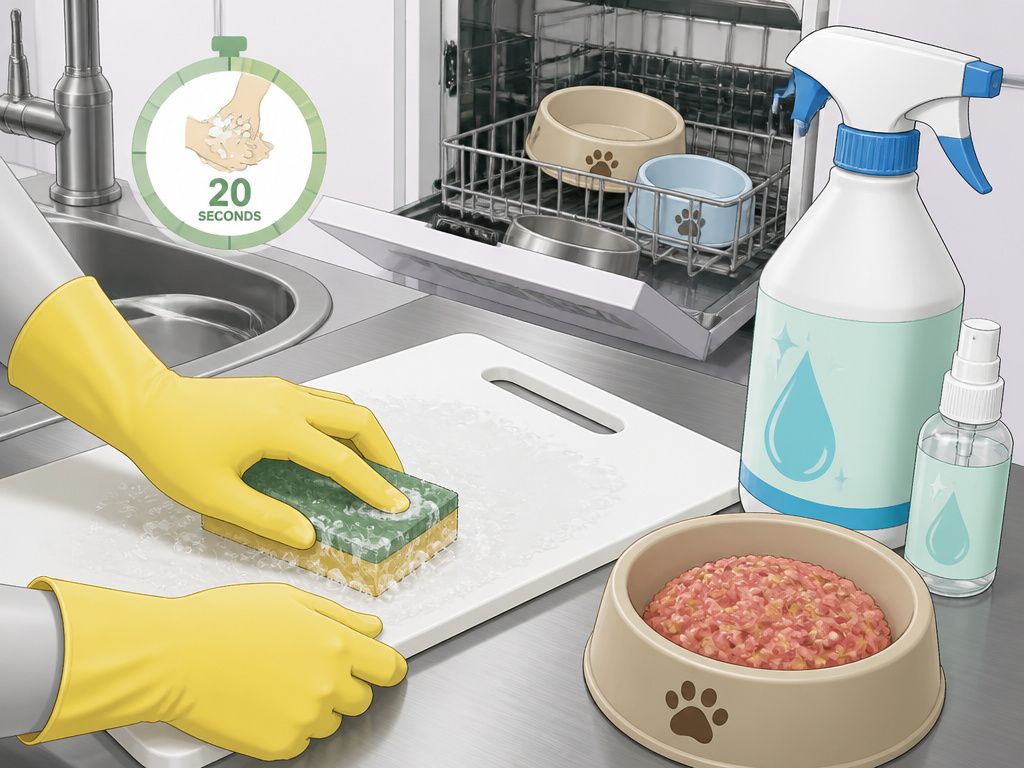
Before you start: Raw pet food carries Salmonella and Listeria that a freezer does not remove, and FDA notes you can infect yourself by touching your mouth during prep or after handling a contaminated utensil. Mix a bleach solution before you open anything (1 tablespoon per quart of water, or 1/4 cup per gallon), and wash your hands for at least 20 seconds, before and after.
Here is the sequence FDA and CDC describe, in the order you actually do it:
- Wash your hands for at least 20 seconds, before and after. Soap and water, both sides of the fingers. Skip the before-wash and you carry whatever was on the bag handle straight to the fridge door.
- Keep it frozen until you are ready to use it. CDC is explicit here: freeze it until you thaw it.
- Thaw in the refrigerator, or in the microwave if you follow FDA; CDC says refrigerator only. Never on the countertop and never in the sink. A tube left on the counter goes soft on the outside hours before the core gives, so the outer layer sits warm while the middle is still solid.
- Do not rinse the raw meat. FDA says the juices splash and spread bacteria to nearby food and surfaces. The rinse does nothing useful and moves the contamination around.
- Wash surfaces with hot soapy water, then disinfect. The dilution is 1 tablespoon of bleach per quart of water, or 1/4 cup per gallon for a bigger batch. The solution smells like a swimming pool, and that is the point: you want to see it go on wet and cover the whole surface.
- Run bowls, utensils and cutting boards through the dishwasher after each use. FDA lists countertops, the inside of the refrigerator and the inside of the microwave as surfaces to think about, and utensils, feeding bowls and cutting boards as the objects.
- Do not kiss the pet around its mouth, and do not let it lick your face. FDA flags this specifically for right after the pet has eaten raw food.
The raw feeding safety for dogs question comes down to that list more than any product choice. And if you want the short version of how to handle raw dog food safely, it is steps 1, 5 and 6 done every single time, not just on the days you remember.
Wash your hands like you just handled raw chicken, because you did. Twenty seconds, soap, both sides of the fingers, and the same routine before you open the bag.
Storing and Thawing: The Two Rules Beginners Break First
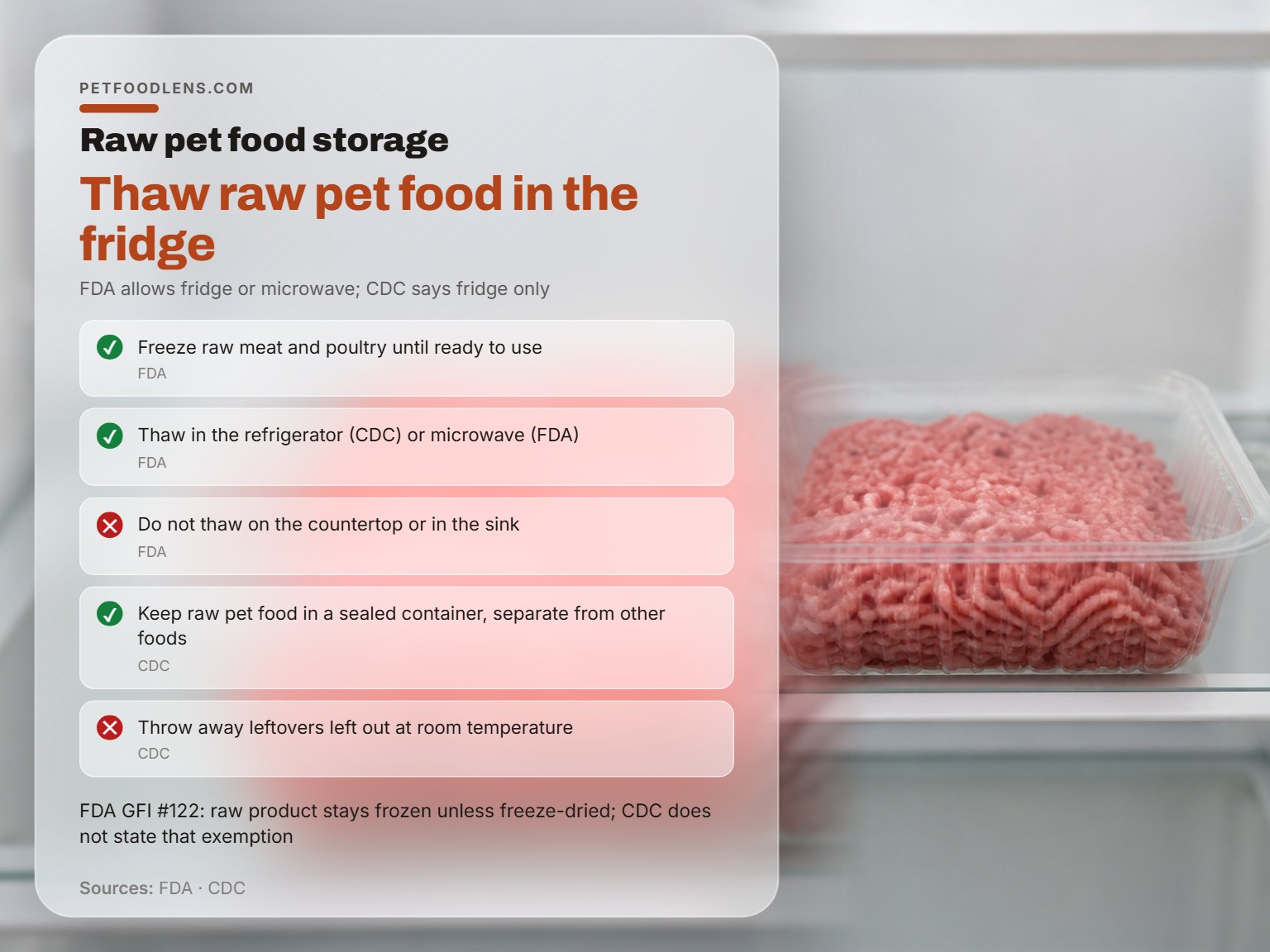
Two rules cover almost every storage mistake in this category, and both come from the same FDA page.
Freeze raw meat and poultry until you are ready to use it. FDA says thaw it in the refrigerator or the microwave, not on the countertop and not in the sink, while CDC says refrigerator only, so if you want the version both agencies will sign off on, use the fridge.
Storage has one more layer. CDC says to keep raw pet food in a sealed container in the freezer and in the refrigerator, separate from other foods, and to throw away leftovers that have been out at room temperature. There is no salvage step for a bowl that sat out.
Common mistake: Thawing in the sink “just for an hour.” The hour becomes four, the outside of the package is at room temperature the whole time, and the core is still hard when you check it. FDA’s instruction is not a preference.
The Freeze-Dried Exemption
FDA’s Guidance for Industry #122 says raw product should remain frozen at all times prior to use unless it is freeze-dried. That single clause is the difference between a bag that lives in your cupboard and a bag that lives in your freezer.
CDC’s fact sheet does not state that exemption. It says to freeze raw pet food until you are ready to thaw and use it. So the two documents part ways on freeze-dried product, and the FDA guidance is the one that names the exception.
If freezer space is the deciding factor, freeze-dried is the only form that does not need one. That is the practical comparison between freeze-dried and frozen raw. Dehydrated sits in the middle: dried with warm air, still classified as raw by CDC, and not covered by the freeze-dried exemption in GFI #122.
The question of how to store raw pet food gets easier once you know which form you are holding.
What a Raw Feeding Guide for Beginners Usually Skips
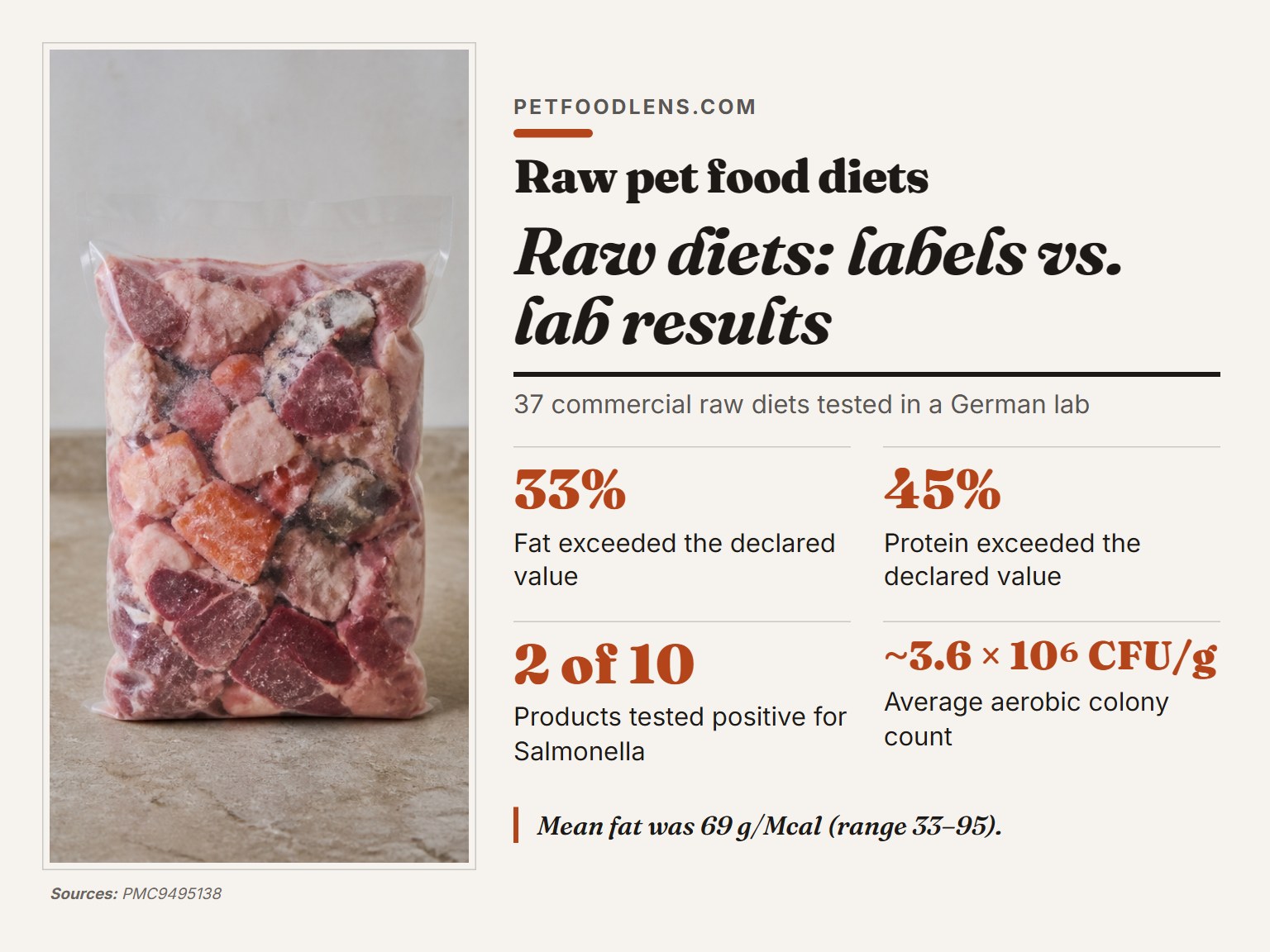
Thirty-seven commercial raw diets went to a German lab, and the label was wrong on a lot of them.
Fat exceeded the declared value in 33% of the 37 products. Protein exceeded the declared value in 45%. Mean fat content came in at 69 g/Mcal, with a range of 33 to 95, which is a spread wide enough that “raw diet” describes almost nothing specific about the fat level.
Hygiene did not improve the picture. Salmonella turned up in 2 of the 10 products tested for it, and aerobic colony counts averaged about 3.6 million colony-forming units per gram.
One finding is genuinely useful for anyone choosing a protein: frozen poultry and carcass-based products had higher Enterobacteriaceae counts than beef, horse or lamb products, at p = 0.003. That makes sense mechanically. A poultry carcass carries gut contents, and grinding spreads them through the whole batch rather than leaving them on the surface.
I read the back of a few tropical fish flake tubs the same way I read cat food bags, and the lesson transferred cleanly. “Protein 40%” on a flake tub tells you nothing without knowing the source. Same with raw: the percentage is the headline, the ingredient order is the story.
A balanced raw diet is a separate question from a safe one. The German data says both are live issues, because the label and the lab did not agree on a third to nearly half of the products tested.
Does Raw Feeding Actually Deliver the Benefits People Claim?
I once compared a bag’s feeding chart against a calculated resting energy requirement for several foods. The chart came out higher for a typical indoor, neutered dog. Raw brands publish charts too, and the same arithmetic applies to them.
The evidence question is where this gets thin. The JAVMA raw meat diet risks review from 2013 describes a paucity of good data from high-quality studies, and notes that benefit claims rest on testimonials and case series, while a later current evidence raw meat diets review is a little more open, reporting limited evidence that raw meat-based diets may support healthy body weight and condition, improved stool quality, and changes in the gut microbiome.
Limited is the operative word in both. Neither document says the benefits are established.
Dr. Marty’s Six-Day Transition Schedule
The commercial protocol is the most concrete thing in this whole category, so here it is as written. Days 1 to 3: replace 25% of the dog’s old food with Nature’s Blend, combined evenly in the bowl. Days 4 to 6: replace 50%. For a healthy adult dog, split the daily amount into two servings, morning and evening. For puppies, the guide says to talk to your vet about specific feeding guidelines.
If you want the longer version of how to transition a dog to raw food, that schedule is the starting point most brands use. Cats are a different conversation, and how to transition a cat to raw food has its own timing because cats resist diet changes harder than dogs do.
Whatever the schedule says, the chart on the package is an estimate. My own comparison put bag charts above a calculated requirement for an indoor, neutered dog, and the charts also list ranges by weight bracket, so a dog at the top of a bracket gets fed like the next size up. That is where how to portion raw food for dogs becomes a calculation rather than a scoop.
Easy to miss: A feeding chart is a starting estimate, not a prescription. If your pet gains weight on the chart amount, the chart is the thing to adjust, and a modest trim is a reasonable first move to discuss with your vet.
Who Should Not Feed Raw at All
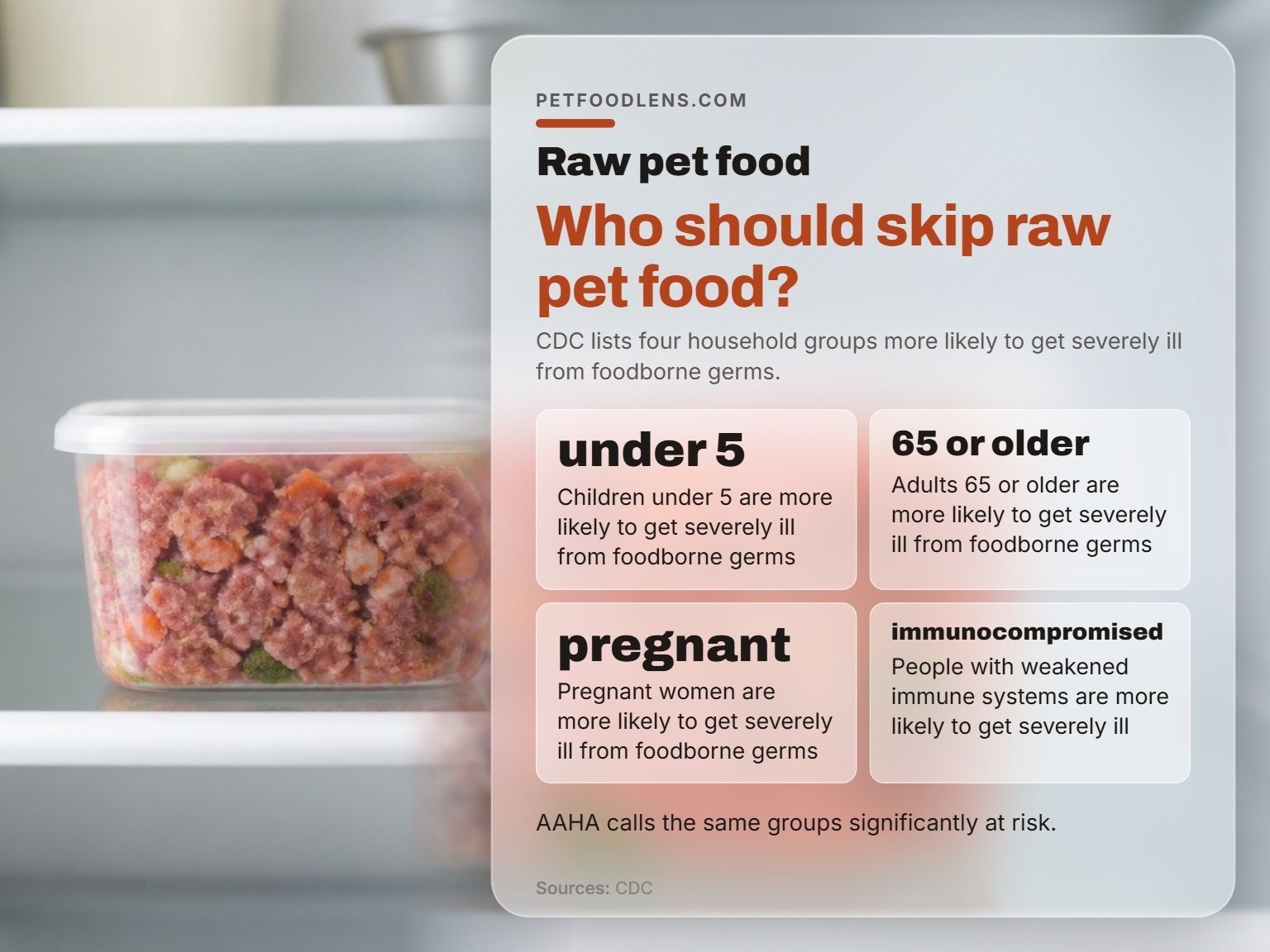
Some households should not have raw pet food in the refrigerator at all, and CDC names exactly who.
Skip this if: Anyone in your home is under 5, 65 or older, pregnant, or immunocompromised. CDC lists all four as more likely to get severely ill from foodborne germs, and AAHA calls the same groups significantly at risk. That is a household decision, not a pet decision.
The Household Question to Ask First
CDC frames it as a set of questions worth answering before you buy anything. Is anyone in your household, or anyone your pet interacts with, more likely to get very sick from foodborne germs? Is your pet more likely to get sick, meaning puppies, kittens, or a pet with a weakened immune system or other health conditions?
AAHA adds the part people skip: healthy pets may not show signs of illness when they have ingested these bacteria. A dog can look completely normal and still be shedding. AAHA puts that figure at up to 30% of raw-fed dogs shedding pathogenic organisms in their stool, which contaminates the environment for humans and other animals.
I spend most of my time on cats, and multi-cat households are where I see this go wrong most often. One cat eats the other’s food, the diets get muddled, and nobody can tell afterward which bowl caused the symptom. Separate feeding spots and separate times fix most of it, and it taught me to ask about the household before I ever look at a label.
The raw food pros and cons come down to that same split: a possible nutritional upside that the literature calls limited, against a pathogen risk that four agencies treat as settled.
Frequently Asked Questions
Is raw pet food safer than kibble?
No agency says that. FDA’s sampling found raw pet food was more likely to be contaminated with disease-causing bacteria than the other categories tested, and CDC states plainly that raw pet food is not necessarily healthier. Both raw and cooked food can be balanced or inadequate.
Does freezing raw pet food kill Salmonella?
Freezing is not cooking. CDC defines raw pet food as product that has not been heated to a temperature high enough to kill germs, and a week in the freezer does not change that. That is why the handling steps apply to frozen product too.
How long can raw pet food sit out at room temperature?
CDC’s instruction is to throw away leftovers that have been out at room temperature. There is no salvage window and no re-chill step in the guidance. If it sat out, it goes in the bin.
Is freeze-dried raw food the same as raw frozen?
They are different forms with different storage rules. FDA’s GFI #122 says raw product should stay frozen at all times before use unless it is freeze-dried, which is the one exemption in the guidance. CDC’s fact sheet does not state that exemption.
Can I feed raw food if I have both a dog and a cat?
The species question is separate from the safety question. What matters is whether anyone in the household falls into CDC’s higher-risk groups, and whether you can keep the raw product sealed and separate from other food. If both answers are fine, the handling rules are the same for either species.
Do I need to wash my hands after just touching the bag?
FDA’s instruction is to wash for at least 20 seconds after handling raw pet food and after touching surfaces or objects that came into contact with it. The outside of a package that held raw product counts.
The Bottom Line
Here is the practical takeaway. If anyone in your house is under 5, 65 or older, pregnant, or immunocompromised, CDC’s own risk list says raw pet food does not belong in your kitchen, and no transition schedule changes that arithmetic.
If you are going to feed it anyway, the first thing to do this week is clearing a shelf in the refrigerator that nothing else touches, and mixing a quart of bleach solution so it is already there when you need it.
I will say plainly what I am not: I know commercial cat food far better than I know dogs, and I am not a clinical nutritionist for cats with kidney disease or diabetes. A raw feeding guide for beginners cannot hand you a green light that four agencies have declined to give. What it can do is tell you where the numbers came from, which tubs were tested, and which questions to ask a company before you trust its bag.
Read past the front of the package. The back is where the disagreement actually lives.
