
Taurine for Cats Explained: What Labels Leave Out
This post contains affiliate links. As an Amazon Associate, we earn from qualifying purchases.
Taurine for cats explained in one line: it’s an essential amino acid that cats can’t make enough of, it comes only from animal protein, and the body doesn’t store it, so it has to arrive in the bowl every day. A complete cat diet is built to cover it. A homemade or boutique diet often isn’t.
That storage gap, part of the taurine for cats explained picture, explains the timing. A cat holds only a small working pool of taurine at any moment, so a diet running short takes months to produce a visible problem, and the cat looks normal the entire time. VCA Animal Hospitals puts the lag at several months, and notes it varies with life stage.
What follows is the physiology, the two published adequacy figures that don’t agree with each other, the label traps that hide a shortfall, and the point where a supplement starts earning its place.
Key Takeaways
- Taurine comes only from animal protein. No plant source exists, so a diet built on plant protein can’t cover the requirement no matter how the front of the bag reads.
- The body doesn’t warehouse it. Small working pool, daily need, no stockpile to draw down during a stretch of poor eating.
- Deficiency takes several months to show. Retinal damage and heart muscle weakening both develop quietly, and the eye lesion doesn’t reverse once it forms.
- Published adequacy figures disagree. Roughly 500 mg/kg dry matter in one paper, 1200 mg/kg for expanded dry food in another, and diet type decides which applies.
- A healthy cat on a complete food doesn’t need a supplement. Vets recommend one for cats with health problems, or cats not getting most of their nutrition from a complete commercial diet.
What Taurine Actually Does in a Cat’s Body
Bile acid conjugation is the job that eats most of a cat’s taurine supply, and it’s why the requirement never drops to zero. Digestion runs on bile acids, and the liver has to attach taurine to them before they can do their work.
Taurine is conjugated with bile acids in the liver, and the cat has no glycine fallback for that reaction. The same molecule is also required for normal retinal photoreceptor maintenance and for cardiac muscle cell function, which is why a shortfall shows up in the eye and the heart, often months before an owner notices anything.
The bottleneck sits in two enzymes, the taurine for cats explained detail that matters most. Cats run low on cysteine dioxygenase and cysteinesulfinic acid decarboxylase, the two steps that would otherwise let them build taurine from cysteine and methionine. Low enzyme activity means low output, so the diet has to close the gap. A 2023 amino acid review in PMC lays out that enzymatic basis plainly, and it’s the cleanest explanation of why cats sit in a different category from dogs.
Taurine was confirmed as an essential nutrient for the cat back in 1978, and the feline taurine biosynthesis study traces what happens when the supply runs out during development.
Four systems feel a shortfall first:
- The retina. Photoreceptors degenerate, and the loss starts in the area a cat uses to fix on movement.
- The heart muscle. Cells weaken and the chamber dilates, which shows up as a cat that tires faster than it used to.
- Pregnancy. Small litters, low birth weights, fetal abnormalities.
- Growth in kittens, which slows before anything else is obvious.
Arginine sits in the same conversation and gets skipped just as often. Arginine for cats covers why a single-protein recipe can fail on more than one amino acid at once.
How Much Taurine Does a Cat Actually Need?
There isn’t one number, and any source handing you a single figure is smoothing over a real disagreement. The two most-cited adequacy figures differ by more than a factor of two, and both are still in circulation.
Burger and Smith (1982) put adult maintenance at roughly 500 mg taurine per kg of dry matter. Morris, Rogers and Pacioretty (1990), working out of UC Davis, put 1200 mg per kg of dry matter as the figure that appears adequate for expanded dry foods, and they tie the minimum to diet type rather than treating it as a universal constant.
The gap has a cause. Food processing affects taurine levels, and increased dietary fiber reduces absorption, so a dry food has to be formulated above the biological floor to land on it. VCA notes both effects in the same paragraph, which is why the two published numbers aren’t interchangeable.
A number on a bag is a formulation target, not a measurement of what the cat absorbed. Processing and fiber both take a cut between the mixer and the bowl.
A 1978 study in the Journal of Nutrition is the third data point, and it’s the one that established taurine as an essential nutrient for the cat.
Why a Complete Food Can Still Come Up Short
A complete and balanced claim is a formulation statement, and formulation statements have failed in the field before. That’s uncomfortable, and it’s documented.
Since the late 1980s all diets formulated for cats are supplemented with enough taurine to meet the normal cat’s needs, according to VCA Animal Hospitals, though Pion et al. 1987 reported 21 cats eating commercial cat foods that developed echo-confirmed myocardial failure. That’s the industry position, and for the large majority of cats it holds up.
The counter-case is Pion et al. (1987) in Science. Twenty-one cats eating commercial cat foods developed echo-confirmed myocardial failure, which means the label guarantee did not prevent deficiency in that cohort. Pion et al. 1987 reported the myocardial failure as a reversible cardiomyopathy. Both things are true at once: supplementation works broadly, and a guarantee printed on a bag is not a measurement of the cat in front of you.
Reading the Guaranteed Analysis
Here’s the sequence I run on any bag I haven’t seen before:
- Find taurine in the guaranteed analysis, not just the ingredient list. A word in the ingredient panel tells you it was added. A percentage or a mg/kg figure tells you how much. Skip this and you’re trusting a mention.
- Check the life stage statement. A food formulated for all life stages has to clear growth and reproduction, which is a higher bar than adult maintenance. Feed an adult-only formula to a pregnant queen and you’ve removed the margin.
- Look at how the animal protein is split. Chicken, chicken meal, and chicken by-product meal listed as three separate items can push total animal protein lower than the front of the bag implies.
- Check the fiber level. Higher dietary fiber reduces taurine absorption, so a high-fiber weight-loss formula is the last place to accept a vague claim.
Step four is the one people skip, and it’s the one that matters most on a diet food. Read past the front of the package.
Where this goes sideways: Reading the ingredient list and stopping there. Taurine shows up in the added-nutrients tail on most labels, so its presence tells you almost nothing about the level, and a cat can run short on a food that names it.
Processing losses hit extruded kibble hardest, which is why the adequacy figure for dry cat food with taurine sits so far above the biological floor. Cat food with taurine is a shorter list than the shelf suggests once you require a stated level rather than a mention.
Signs of Taurine Deficiency in Cats, and Why They Take Months
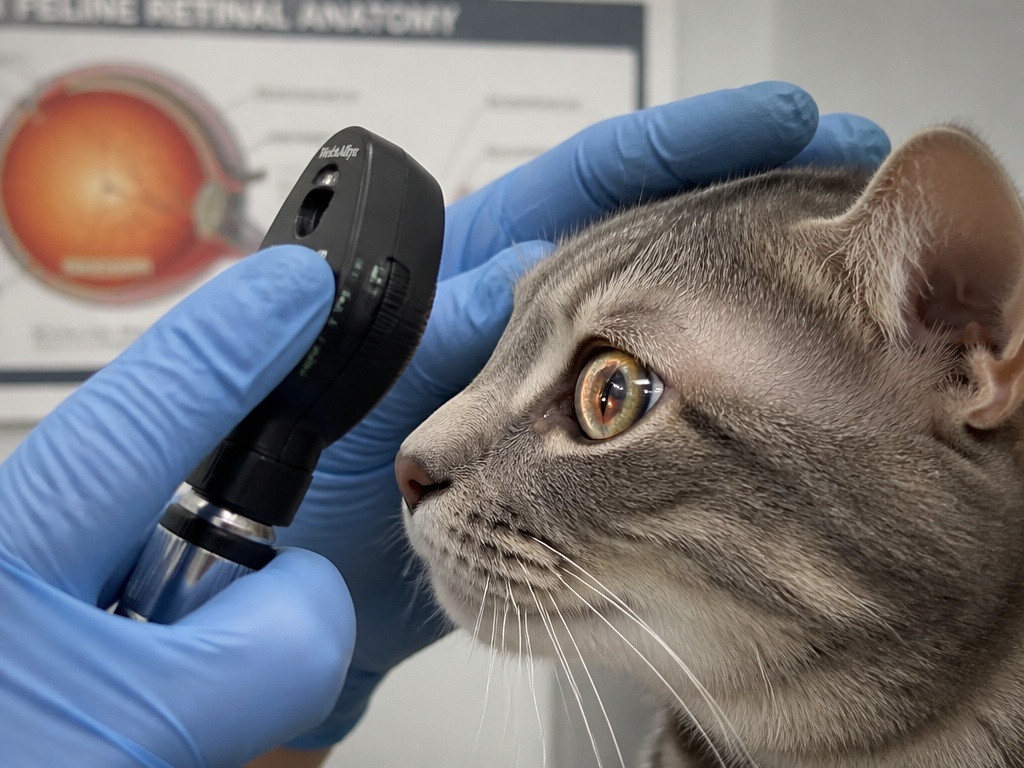
Several months is the usual lag before anything shows, and that delay is why the problem gets missed. VCA notes the timeline depends on the cat’s life stage, which means a growing kitten and an adult cat don’t decline at the same rate.
The eye is usually where it gets caught, and only by accident.
Feline Central Retinal Degeneration
Rods and cones degenerate along with the tapetum lucidum underneath them, and the change starts at the area centralis. Under an ophthalmoscope that lesion reads as a bright, mirror-like patch, which is a strange thing to see in a cat that still seems to be getting around the house fine.
That’s the insidious part. The PMC feline nutritional problems review describes the degeneration as progressive and easy to miss until the damage is advanced and irreversible, and it states the lesion is not reversed by taurine supplementation, while VCA Animal Hospitals says supplementation may slow or stop progression but is usually not successful in reversing the damage. The remaining retina may be saved from further loss, and that’s the realistic goal.
Dilated Cardiomyopathy
Weakened heart muscle cells let the chamber dilate, and the cat slows down in a way owners read as aging. Pion et al. Reported in Science in 1987 that this form of myocardial failure reversed with oral taurine, and VCA notes supplementation is usually effective when the disease is caught early.
Caught late, it’s a different conversation.
Recognizing taurine deficiency in cats early is mostly a matter of knowing which systems fail first and in what order.
Pregnancy and growth carry their own risk. Low taurine in a queen produces small litters, low birth weights, or fetal abnormalities, and kittens on a deficient diet grow slowly. There’s a neurological finding behind that: taurine deficiency in the developing cat leaves the cerebellar external granule cell layer persisting past the point where it normally disappears.
I don’t wait for a murmur to ask about diet. If a cat has been on a homemade or boutique food and nobody can tell me the taurine level, that conversation happens at the next visit, not the one after.
The part nobody mentions: VCA Animal Hospitals says supplementation may slow or stop progression of retinal degeneration but is usually not successful in reversing the damage, while PMC1790081 states the FCRD lesion is not reversed though the remaining retina may be saved from further degeneration.
Plasma or Whole Blood: Which Sample Actually Tells You?
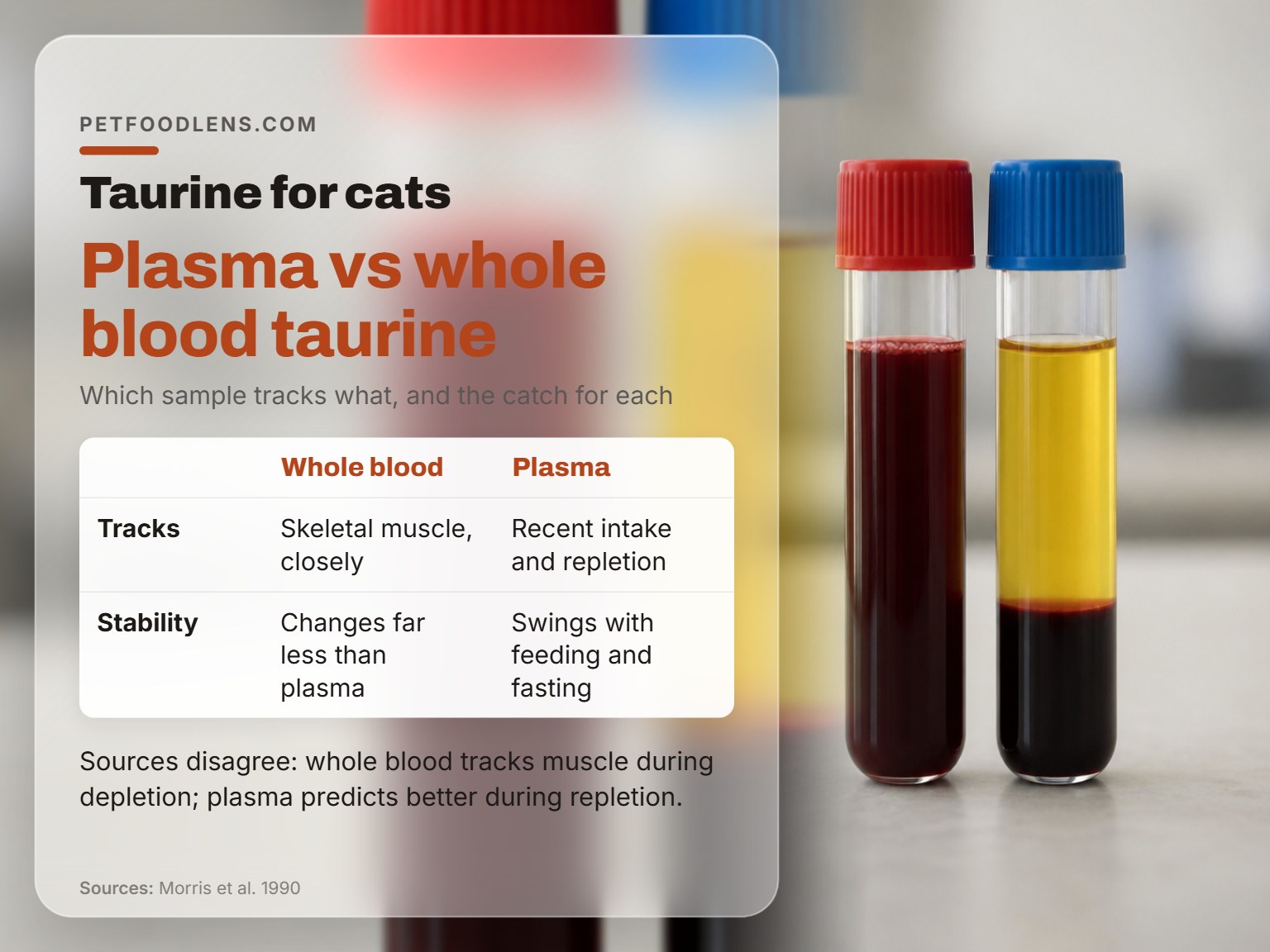
The two matrices disagree, and the disagreement isn’t cosmetic. It changes what a single blood draw can tell you.
Morris et al. (1990) found plasma taurine swings widely with feeding. Give a cat a canned diet high in taurine and plasma rises after the meal. Withhold food and it drops markedly. Whole blood moves far less on a percentage basis, and muscle taurine tracked whole blood more closely than plasma in the same body of work.
The later kinetics research complicates that. The PubMed taurine depletion kinetics work splits the answer by phase: whole blood tracks skeletal muscle better during depletion, while plasma predicts better during repletion.
| Sample | What it tracks | Catch |
|---|---|---|
| Whole blood | Skeletal muscle, closely | More stable, but no agreed marginal cut-off |
| Plasma | Recent intake and repletion | Swings with feeding and fasting |
| Muscle biopsy | The tissue pool itself | Impractical for routine checks |
Morris et al. Are explicit that too few samples have been analyzed to define a marginal whole-blood level, while VCA Animal Hospitals implies clinical use of whole-blood values by noting the veterinarian may want to monitor whole blood levels of taurine. That’s an honest gap in the literature, and it’s worth knowing before you treat a number as a verdict.
Plasma taurine also climbs slowly once a cat is back on an adequate diet, slower than whole blood does, so a recheck taken too early can look discouraging while the cat is genuinely recovering.
When Supplementation Makes Sense, and When It Doesn’t
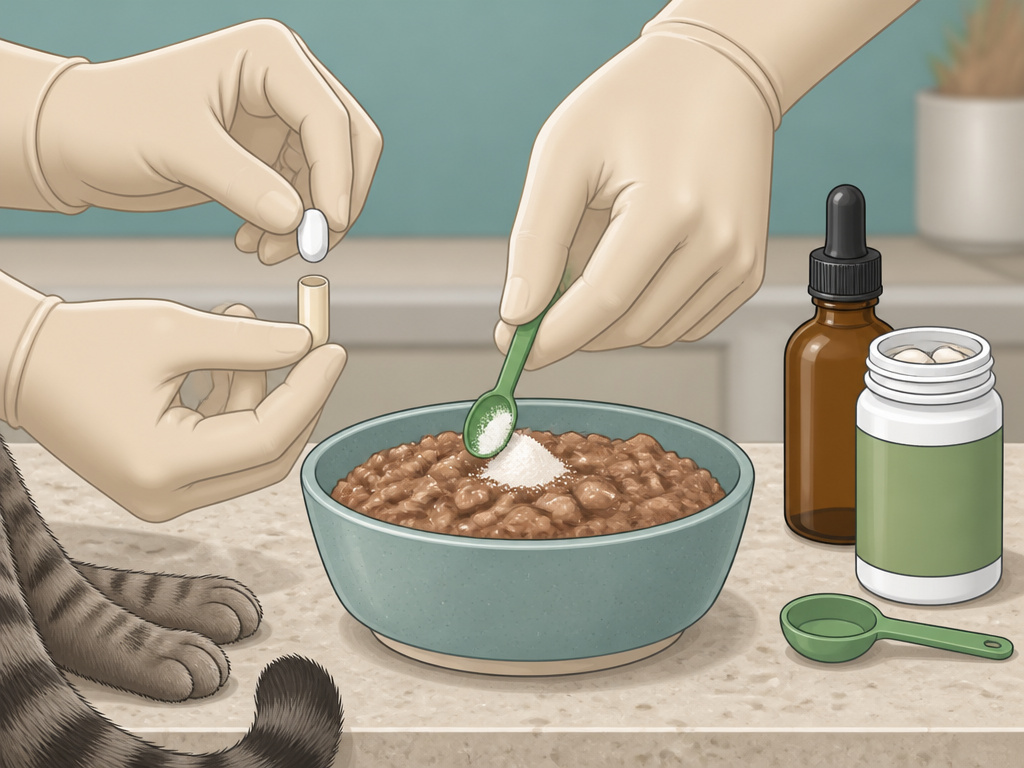
A cat comes in for a routine visit, the owner mentions the food is now homemade, and the question lands: does this cat need a pill?
VCA’s position has two halves, and both get quoted out of context. A healthy cat eating a high-quality commercial food appropriate to its life stage doesn’t require supplementation. Supplemental taurine is recommended for cats with health problems, or cats not getting most of their nutrition from a high-quality commercial diet.
Both statements come from the same handout, and they describe two different cats.
Taurine is also used as part of treatment for dilated cardiomyopathy, retinal degeneration, epilepsy, and fatty liver disease. In DCM the response is usually good when it’s caught early. In retinal degeneration the realistic outcome is slowing progression, not restoring lost vision.
Before you start: Taurine is sold over the counter, which makes it easy to treat as harmless. Measure liquid taurine doses carefully. Serious reactions are rare, but the instruction is to stop the supplement and call the vet immediately rather than waiting out the week.
Supplement Forms and Brand Names
- Tablet and capsule. Easiest to dose precisely, hardest to get into a cat that has opinions about pills.
- Powder. Mixes into wet food, and the dose is only as accurate as your scoop.
- Liquid. Measure it carefully. This is the form where eyeballing goes wrong.
- Every form is given by mouth.
VCA lists Formula V and Dyna-Taurine as brand names, and notes that supplement quality varies significantly between manufacturers. Your vet may have a preferred manufacturer, and that preference is worth asking about rather than guessing at.
Give it with or without food. If a cat vomits on an empty stomach, give the next dose with food, and give it for the full course the vet prescribed even after the cat looks better. Your vet may also want to monitor whole blood levels rather than assume the supplement is working.
Most cats end up getting it folded into canned food, and wet cat food with taurine is the format that hides a powder best.
Homemade, Vegan, and Boutique Diets: Where Taurine Falls Through
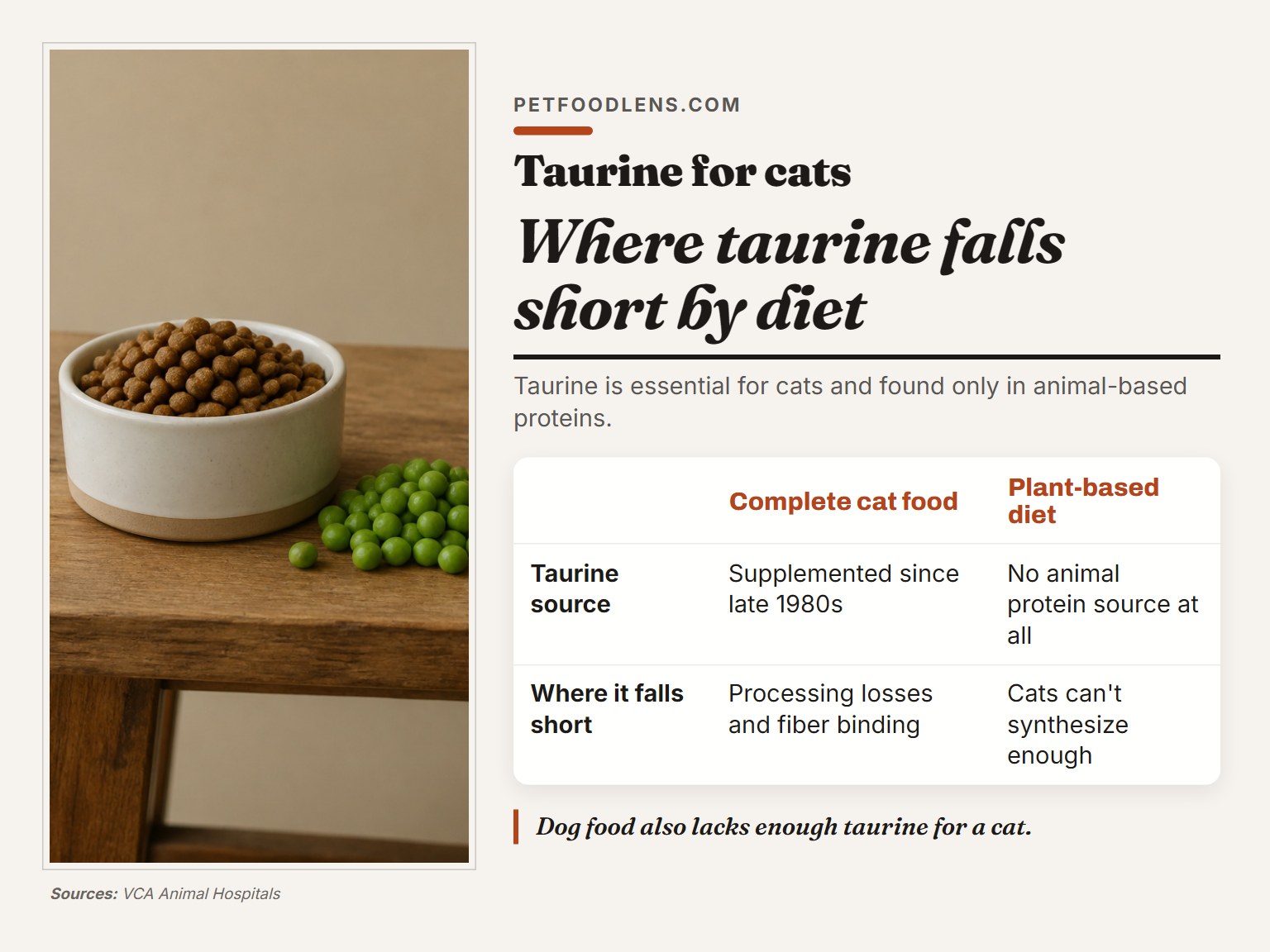
Three diet patterns account for most of the taurine questions I get, and each one fails in a different place.
Getting homemade cat food right is a nutrient-by-nutrient job, not a matter of browning some chicken and adding a supplement on top. The recipe is only as good as its animal protein and whatever taurine gets added deliberately.
Plant-based is the one with no path at all. Taurine is found exclusively in animal-based proteins, and cats can’t synthesize enough to cover bile acid conjugation and tissue demand. Most breeds of dog can thrive on a properly balanced taurine-free vegetarian diet. Cats can’t, and the vegan cat food argument runs into that wall every time.
Boutique formulas are the murkiest, because the taurine level depends on how much animal protein actually made it into the mix. A recipe built on chicken meal and a recipe built on a novel meat plus plant filler can carry the same front-of-bag promise and very different taurine loads.
| Diet type | Taurine coverage | Where it can fall short |
|---|---|---|
| Complete commercial cat food | Supplemented to meet normal needs since the late 1980s | Processing losses and fiber binding |
| Dog food | Not enough taurine for a cat | Every meal, every day |
| Homemade | Only what the recipe supplies | Recipes without animal protein or added taurine |
| Plant-based | No animal protein source at all | Cats can’t synthesize the difference |
The dog row deserves its own sentence. Dog food doesn’t contain enough taurine to meet a cat’s requirement, and a two-species household running both animals off one bag is running the cat short. Taurine for dogs is a separate question, though VCA lists cocker spaniels, golden retrievers, Labradors, Newfoundlands, Dalmatians, Portuguese water dogs, and English bulldogs as breeds where deficiency also turns up.
Frequently Asked Questions
Does my cat need a taurine supplement?
Only if the diet isn’t covering it. VCA’s guidance is that a healthy cat eating a high-quality commercial food appropriate to its life stage doesn’t need one. Supplementation is recommended for cats with health problems, or cats not getting most of their nutrition from a complete commercial diet.
Can cats get taurine from plants?
No. Taurine is found exclusively in animal-based proteins. Dogs can thrive on a properly balanced taurine-free vegetarian diet because they synthesize enough to meet demand. Cats can’t, which is why plant-only diets run short.
How long does taurine deficiency take to develop?
Several months, depending on the cat’s life stage. That lag is why owners rarely connect the food to the problem, and why the retinal changes are often advanced before anyone looks.
Is too much taurine dangerous for cats?
VCA reports no problems associated with excessive dietary taurine in cats and describes supplementation as relatively safe. Quality still varies between manufacturers, so the source matters more than the dose ceiling.
Does processing destroy taurine in cat food?
Food processing affects taurine levels, and increased dietary fiber reduces absorption. That’s part of why the dry-food adequacy figure sits so far above the biological floor for adult maintenance.
Can I just feed dog food?
No. Dog food doesn’t contain enough taurine to meet a cat’s normal requirement, and the shortfall compounds daily because the body doesn’t store a reserve to draw on.
The Bottom Line
Here’s the trigger I’d use. A cat that has been on a homemade, raw, or boutique diet with no stated taurine level in the recipe or on the bag is a cat worth asking the vet about at the next visit.
One step for this week: find taurine in the guaranteed analysis rather than the ingredient list. If it’s only a word in the tail of the panel, you know exactly what you’re working with.
Everything above stops at the edge of clinical nutrition. A cat with kidney disease, diabetes, or an existing heart condition needs a veterinary nutritionist’s numbers, and that’s the honest limit of what label reading can tell you from the outside of the bag.
