
Taurine for Dogs Guide: Reference Ranges and Dosing
This post contains affiliate links. As an Amazon Associate, we earn from qualifying purchases.
Taurine for dogs is judged on blood numbers, not bag claims, as our taurine for dogs guide explains. The UC Davis Stern Lab treats whole blood above 250 nmol/mL as normal, 200 to 250 as marginal, and below 200 as low enough to warrant an echocardiogram. Plasma runs on a separate scale, where normal is above 70 nmol/mL.
The two scales measure different things, and that gap is where owners get lost, as the taurine for dogs guide explains. Whole blood holds taurine inside red cells and gives a stable long-term average. Heparinized plasma shows the circulating pool at the moment of the draw, which moves around.
What follows is the whole picture: the three published reference intervals and why they disagree, the cut-offs that trigger a cardiology referral, the breeds that need the tighter band, and the exact protocol the Stern Lab uses once DCM is confirmed.
Key Takeaways
- Whole blood and plasma use different cut-offs, 250 versus 70 nmol/mL, and reading one against the other’s scale produces a false normal.
- Below 200 nmol/mL whole blood or 60 nmol/mL plasma is the Stern Lab trigger for an echocardiogram by a board-certified veterinary cardiologist.
- The published ranges disagree. Stern sets normal above 250; the PLOS One golden retriever interval starts at 213; Furlanello’s multi-breed interval starts at 148.
- Dosing is for diagnosed DCM, not for a number that looks a bit low: 1000 mg every 12 hours above 50 lbs, 500 mg every 12 hours below.
- Recheck at three months, and expect 6 to 12 months for the steady improvement the Stern Lab describes.
What Whole Blood Taurine Measures That Plasma Misses
A taurine result means nothing until you know which sample type produced it, a point the taurine for dogs guide makes clear.
Whole blood taurine is the most reliable marker of long-term taurine status because the concentration stays stable through short-term fasting. Heparinized plasma reflects the circulating pool at the moment of collection. Serum is unsuitable for either purpose, because clotting releases taurine from platelets and falsely elevates the result by a margin wide enough to hide a real deficiency.
That last sentence is the one that costs people money. A serum result can come back looking comfortable in a dog that is genuinely depleted, because the clotting process dumped platelet taurine into the tube before it was spun down.
The canine taurine physiology research is direct about the hierarchy: whole blood for the long-term picture, heparinized plasma for the current circulating pool, serum for neither. If your clinic sends serum, ask for a redraw before you accept the interpretation.
Practical version: whole blood tells you what the dog has been holding over weeks. Plasma tells you what was moving through the bloodstream that morning. They answer different questions, and they don’t convert into each other.
Why the Taurine Reference Ranges Don’t Agree
Three published intervals, three different lower limits, and nobody refereeing.
| Source | Dogs studied | Whole blood (nmol/mL) | Plasma (nmol/mL) |
|---|---|---|---|
| Stern Lab (UC Davis) | Golden retrievers | Normal above 250 | Normal above 70 |
| PLOS One 2020 (Ontiveros) | 43 goldens, traditional diet | 213 to 377 | 63 to 194 |
| Furlanello et al. | 120 dogs, 41 breeds | 148 to 495 | 42 to 183 |
| Delaney et al. | 131 dogs, multi-breed | Mean 266 | Mean 77 |
Read the first two rows together and the problem is obvious. Stern calls 200 to 250 marginal. The PLOS One breed-specific interval puts 213 inside the normal band for golden retrievers. A dog at 220 nmol/mL is simultaneously marginal and normal depending on which paper the lab cites.
The plasma taurine reference ranges study doesn’t contradict Stern so much as measure a different population with a different assay. Analytical platform, sample handling, and breed mix all shift the endpoints. The Frontiers review says exactly this and warns against leaning on a single fixed cut-off.
A reference range is a description of the dogs that were sampled, not a law of nature. Ask which paper your lab’s range came from before you argue with the number.
Here’s what that means in practice. If your dog lands in the 200 to 250 whole-blood band, you are in the zone where the two most-cited sources genuinely disagree. That’s a conversation with a cardiologist, not a decision you make from a printout.
The Taurine Levels That Should Trigger an Echocardiogram
One number decides whether your dog gets a cardiac ultrasound.
| Status | Whole blood (nmol/mL) | Plasma (nmol/mL) | Source |
|---|---|---|---|
| Normal | Above 250 | Above 70 | Stern Lab |
| Marginal | 200 to 250 | 60 to 70 | Stern Lab |
| Reduced | Below 200 | Below 60 | Stern Lab; Frontiers review |
| Critically low | Below 150 | Below 40 | Frontiers review |
The UC Davis taurine recommendations lay out the two-tier response. Below 200 whole blood or 60 plasma, an echocardiogram by a board-certified veterinary cardiologist is indicated, and a diet change follows the echo. In the marginal band, the echo is recommended rather than indicated, and if it isn’t done, a diet change is still advised with a taurine recheck at three months.
Why the echo comes before the diet change
The order matters more than it looks. Change the diet first and you’ve removed the baseline the cardiologist needs to judge whether the diet was ever the problem. The Stern Lab sequence is deliberate: measure, image, then change.
The part nobody mentions: A dog can have measurable echocardiographic abnormalities with no cough, no exercise intolerance, and nothing you’d notice across the living room. The PLOS One authors found deficiency and echo changes in dogs with no clinical signs at all, which is the entire argument for testing rather than waiting for symptoms.
If DCM is diagnosed, the picture widens. The attending cardiologist may prescribe a range of cardiac medications, and supplementation with oral taurine plus l-carnitine is recommended alongside them. Dog food for heart problems covers a broader set of conditions than DCM alone, so keep the diagnosis specific when you go shopping.
Does Your Breed Need a Tighter Taurine Range?
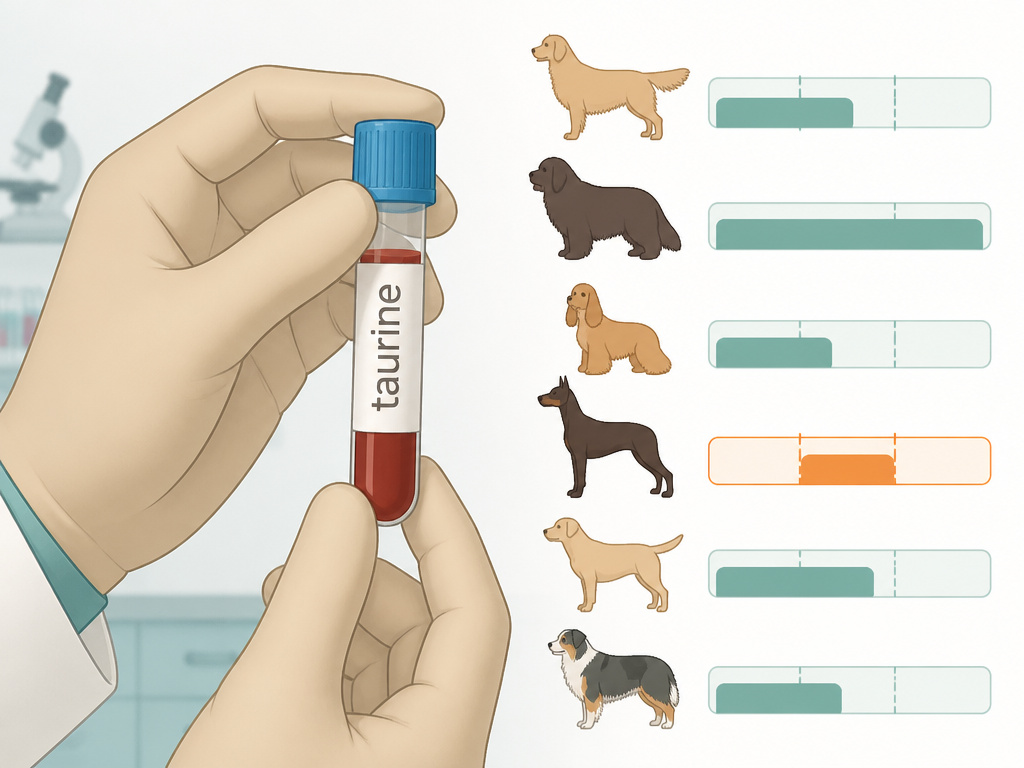
Breed changes the number you should be aiming at, not just the number you’re compared against.
The Stern Lab built its golden retriever ranges and then said to consider them for other known taurine-sensitive breeds, naming Newfoundlands and American Cocker Spaniels. VCA’s client handout lists a longer set: cocker spaniels, golden retrievers, Labrador retrievers, Newfoundlands, Dalmatians, Portuguese water dogs, and English bulldogs.
- Golden retrievers and Newfoundlands — the two breeds the Stern Lab explicitly extends its tighter ranges to.
- American Cocker Spaniels — in one cited trial, affected dogs averaged 15 nmol/mL plasma, and combined taurine plus carnitine supplementation improved echo parameters enough that cardiovascular medications could be discontinued.
- Doberman Pinschers — DCM prevalence above 50%, per the Frontiers review. Different genetic story, same practical urgency.
- Labradors versus Australian shepherds — 294.6 versus 222 nmol/mL whole blood in the Delaney data, a gap the authors put at p=0.0003.
That last bullet is the part that gets skipped. Breed differences in taurine aren’t noise; they’re large enough to be statistically robust in a modest sample. A Labrador and an Australian shepherd eating identical food can sit in different parts of the reference range and both be fine.
The physiology backs it up. Large-breed dogs synthesize taurine at markedly lower rates than small breeds, and the enzyme activity that drives synthesis is high early in life and declines with age. A nine-year-old giant breed is working with less manufacturing capacity than a two-year-old of the same size.
Why Dogs Aren’t Cats on Taurine
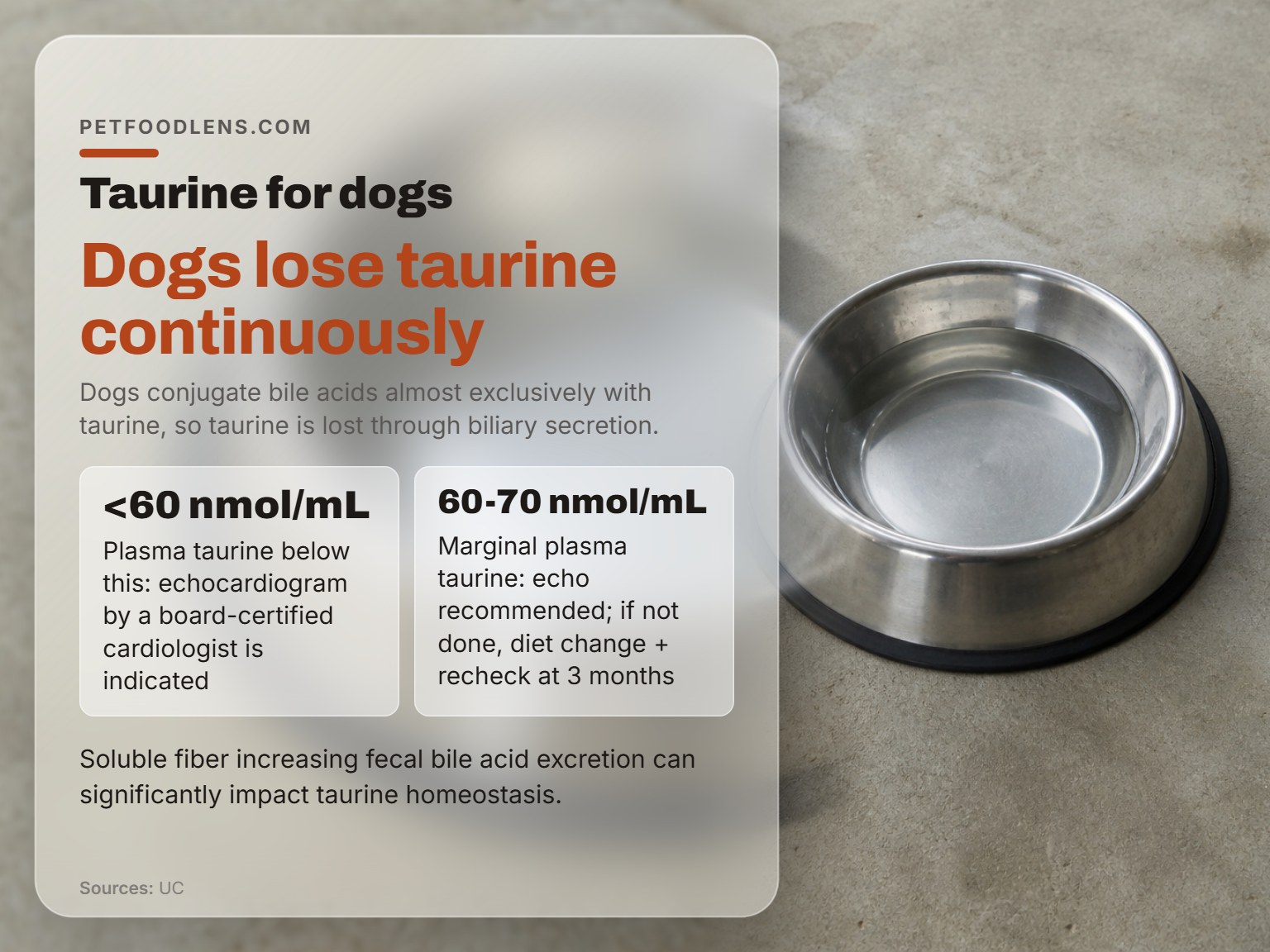
Dogs synthesize their own taurine. That single sentence has caused more confusion in this category than any claim printed on a bag.
It’s true, and it’s incomplete. Dogs conjugate bile acids almost exclusively with taurine, which means they lose taurine continuously through biliary secretion in a way species that can use glycine don’t. Soluble fiber in the diet increases fecal bile acid excretion, and that pulls taurine status down further.
I used to tell owners that dogs weren’t a taurine conversation at all. Then I spent a stretch of time working through sulfur amino acid digestibility on formulas that looked fine on paper, and I stopped saying it. Large breeds on lamb-and-rice or high-legume diets are the cases where I now want to see the methionine plus cysteine numbers before I say anything reassuring.
That’s the honest version of the grain-free argument. Some of those formulas were adequate on the guaranteed analysis and still looked marginal once you accounted for how much of the sulfur amino acid content the dog could actually use.
The diet-associated DCM review splits the condition into two forms worth keeping separate in your head. Genetic, or primary, DCM comes with breed predisposition and often low blood taurine. Diet-associated DCM can hit breeds nobody expected and can show up with normal or only mildly reduced taurine. Same disease name, different mechanism, different response to supplementation.
One more thing worth knowing: in canine heart failure models, taurine supplementation suppresses excessive RAAS activation, reduces angiotensin II, decreases afterload, and prolongs survival. That’s a mechanism, not a marketing claim.
What the Diet Studies Actually Found, and Where They Conflict
Twenty-four golden retrievers, all eating commercial diets their owners had every reason to trust.
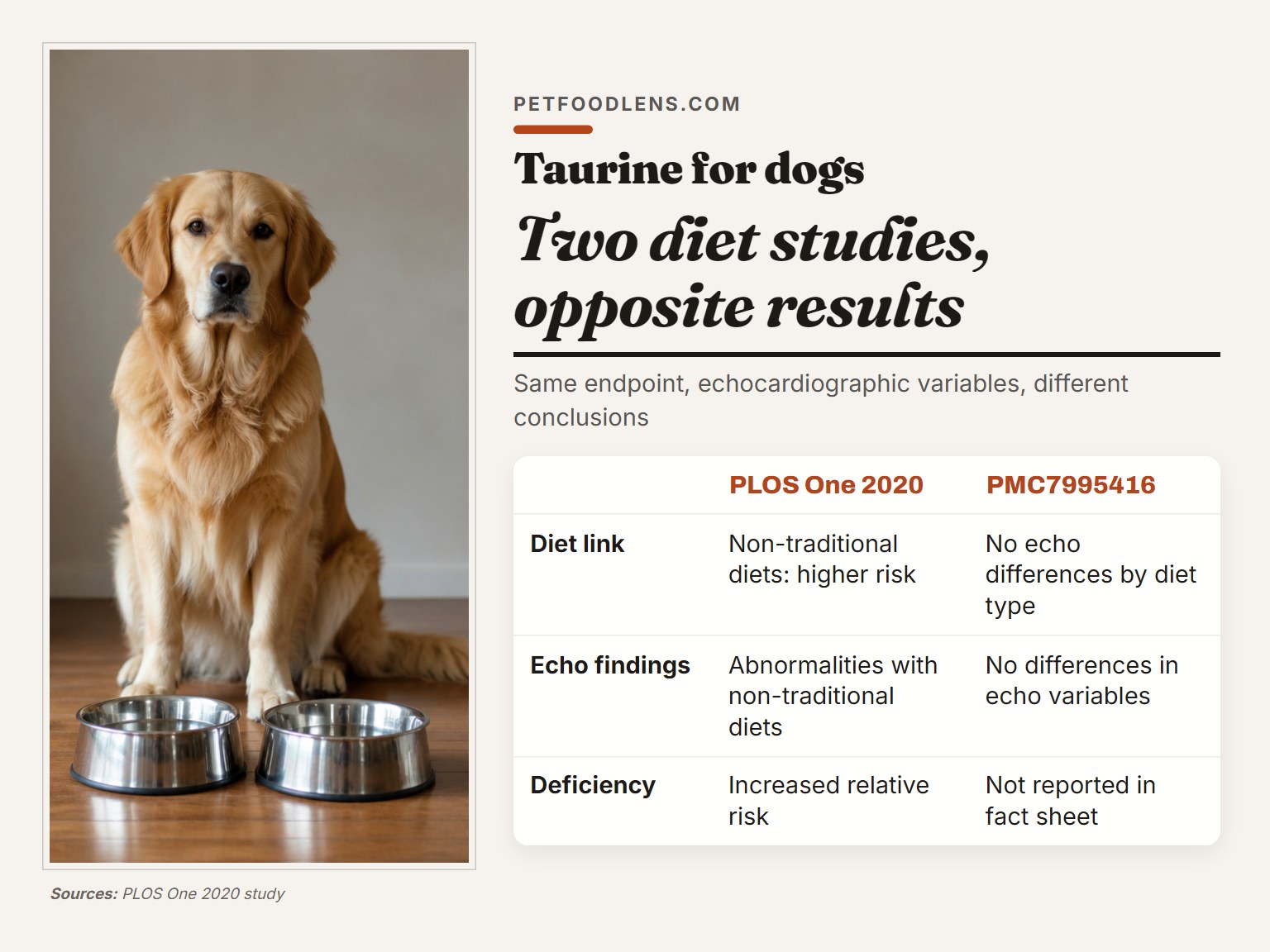
That 2018 case series, a golden retriever taurine deficiency study published in PMC, described 24 goldens with taurine deficiency and DCM on commercial diets. The PLOS One work that followed found non-traditional diets, the grain-free and legume-containing ones, associated with increased relative risk of both deficiency and echocardiographic abnormalities.
Where the two diet studies split
Then there’s the study that doesn’t fit the narrative. A four-breed investigation in PMC7995416 reported no differences in echocardiographic variables between dogs eating different diet types.
Two well-run studies, opposite conclusions on the same endpoint. Neither has been retracted, and pretending one of them doesn’t exist is how you end up overconfident.
My read, and it’s a read rather than a finding: diet type is probably a coarse proxy for something finer, likely total sulfur amino acid supply and digestibility rather than grain or legume content as such. That would explain why some grain-free formulas produced disease and others didn’t.
Read past the front of the package. The EU authorises taurine as a feed additive for dogs and cats at up to 0.2% of complete feedingstuffs, which is a formulation tolerance, not a therapeutic dose. It tells you what’s legal in a diet. It tells you nothing about what to give a sick dog.
I’ve watched owners switch to a boutique grain-free formula to solve a taurine worry and land on a diet with a thinner amino acid profile than what they left. The label said grain-free. Nobody checked the methionine.
When a diet change is genuinely called for, I’d start with a line that employs board-certified veterinary nutritionists and publishes a way to reach them. Hill’s Science Diet, Royal Canin, and Purina Pro Plan all fit that description. A heart-healthy dog food chosen on nutrient profile beats one chosen on the front-of-bag story every time.
Once a dog tips into congestive heart failure, the calorie and sodium conversation changes again on top of the taurine one.
Taurine Dosing When DCM Is Diagnosed
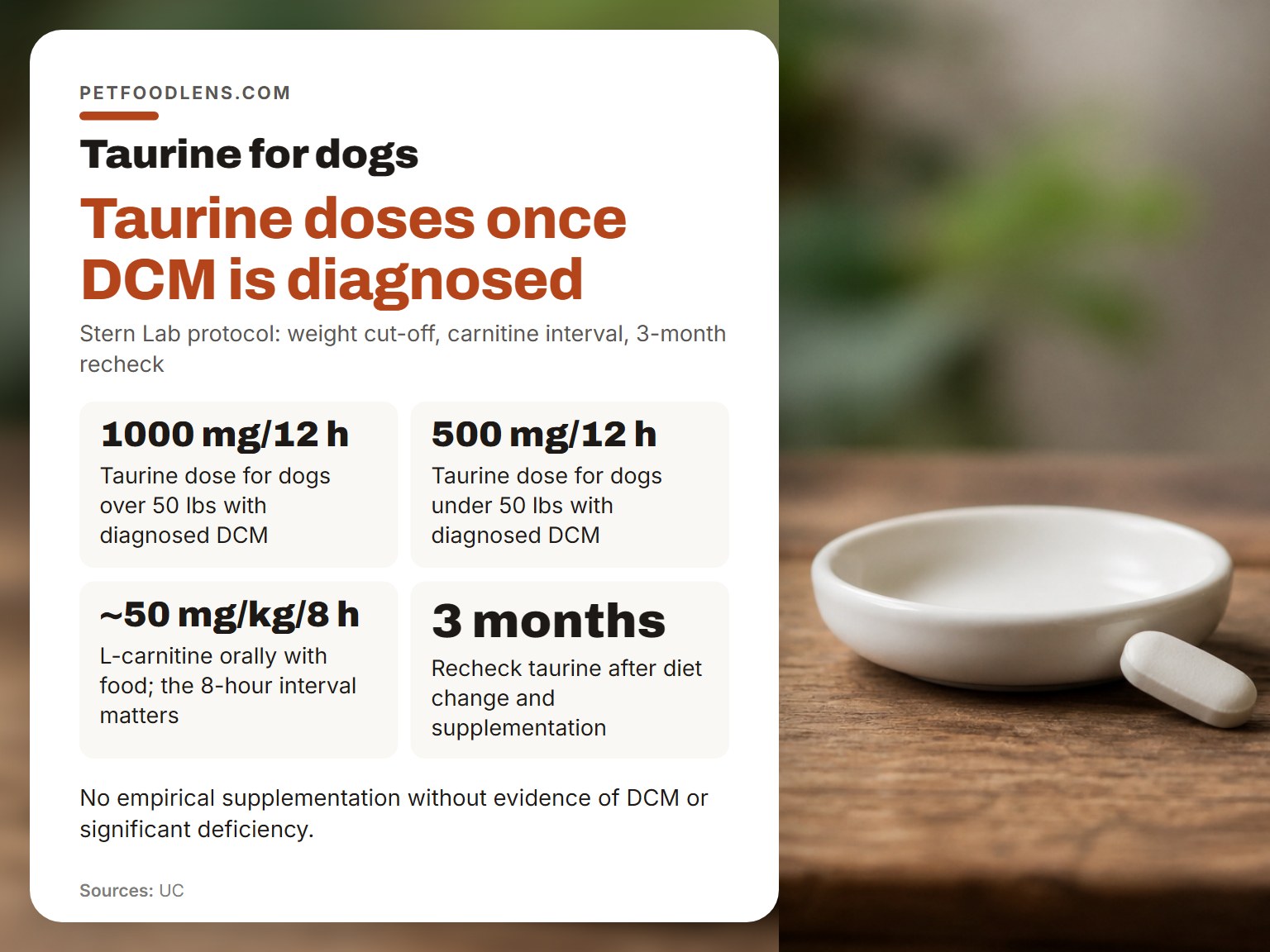
Three numbers, one weight cut-off, and a three-month recheck.
The Stern Lab does not recommend empirical supplementation of taurine or l-carnitine in dogs without evidence of DCM or significant deficiency. Once DCM is diagnosed, the protocol is specific.
Before you start: These doses apply to a dog with a confirmed DCM diagnosis, prescribed by the attending cardiologist. Taurine at 1000 mg every 12 hours in an undiagnosed dog buys nothing and delays the workup that would actually help. L-carnitine runs at roughly 50 mg/kg with food every 8 hours, and the interval matters as much as the amount. Never taper a cardiac medication because the dog seems brighter; that decision belongs to the cardiologist.
- Get the echocardiogram first. Dosing before imaging means you’re treating a disease the dog may not have, and the Stern Lab is explicit that empirical supplementation isn’t the path.
- Change the diet after the echo, not before. Doing it first destroys the baseline the cardiologist needs to interpret the scan.
- Start taurine at 1000 mg every 12 hours for dogs over 50 lbs, or 500 mg every 12 hours for dogs under 50 lbs.
- Add L-carnitine at roughly 50 mg/kg orally with food, every 8 hours. Compressing that into twice a day changes the exposure the protocol was built around.
- Recheck taurine at three months on the new diet and supplementation schedule.
- Expect a slow curve. Many golden retrievers with taurine-deficient DCM in the Stern Lab’s study improved steadily over 6 to 12 months.
That last point is where expectations break. Owners who expect a better echo at week four are measuring on the wrong clock. The recheck at three months is a checkpoint, not a finish line.
Carnitine carries its own constraints, and the L-carnitine for dogs guide covers form and timing in more detail than fits here.
Should You Supplement a Dog With Normal Taurine?
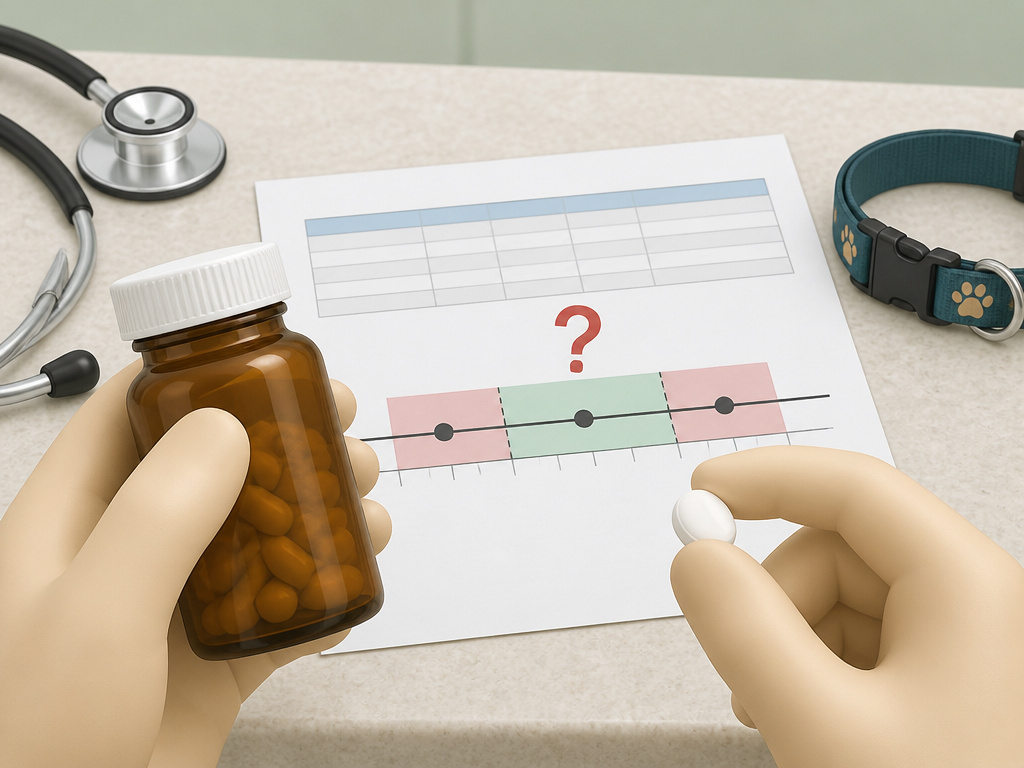
This is the one place where the two leading sources genuinely pull in different directions, and I won’t pretend otherwise.
The Stern Lab position is conservative: no empirical taurine or l-carnitine supplementation without evidence of DCM or significant deficiency. The Frontiers review takes a preventive angle, arguing that for breeds with a known genetic predisposition, keeping taurine in the upper half of the reference range is a prudent clinical strategy.
Both positions are defensible. They’re answering different questions. Stern is asking what to do with a patient in front of them. Frontiers is asking what a breeding programme or a lifelong feeding plan should aim at.
There’s also a trial result that complicates the enthusiastic reading. In 14 dogs with congestive heart failure that were already taurine-replete, two weeks of oral supplementation raised whole blood taurine from a median of 408 to 493 nmol/mL at P=.006, but only lowered angiotensin II, with a heterogeneous response across the other markers measured. Correcting a deficiency and topping up a replete dog are not the same intervention.
My honest limit here: I know commercial cat food far better than I know dog cardiac nutrition, and this is a question for a veterinary cardiologist who can see the dog. Feeding a dog with heart disease is a separate skill from dosing a supplement, and the two interact in ways that depend on the individual case.
Where this goes sideways: Supplementing a dog that hasn’t been tested. You get a normal-looking dog, a relieved owner, and a cardiac workup delayed by months. The Stern Lab thresholds exist precisely so that decision gets made on a number.
How to Give Taurine: Forms, Timing, and What to Watch
Taurine comes as a tablet, capsule, powder, or liquid, and all four go in by mouth.
Either form works; the delivery method is what determines whether the dose actually lands.
- Give with or without food. If vomiting happens on an empty stomach, move future doses to mealtime.
- Measure liquids properly. A kitchen spoon isn’t a measuring device, and the volume changes with how level the pour is. Draw the dose into an oral syringe instead.
- Finish the prescribed course, even after the dog seems better. Cardiac remodeling doesn’t stop because the dog is brighter.
- Stop and call the vet if adverse signs develop. Serious reactions are rare, but that’s the instruction.
Your veterinarian may want to monitor whole blood taurine levels during treatment, which is another reason the sample type from the first section matters. A clinic checking plasma against a whole-blood target will get a misleadingly low read.
Here is the practical takeaway. The supplement is the easy part. Getting the right sample, the right reference range, and the right diagnosis in that order is what actually decides the outcome.
Frequently Asked Questions
What is a normal taurine level for a dog?
It depends which source you follow. The Stern Lab sets normal whole blood above 250 nmol/mL and normal plasma above 70 nmol/mL. The PLOS One breed-specific interval for golden retrievers is 213 to 377 nmol/mL whole blood, and Furlanello’s multi-breed interval runs 148 to 495. Ask which reference your lab uses before interpreting a result.
Can I give my dog taurine without testing?
The Stern Lab advises against empirical supplementation in dogs without evidence of DCM or significant deficiency. The main argument is sequencing: a supplement given before a workup can make an owner feel the problem is handled while a cardiac evaluation gets postponed. Test first, then decide.
How long does taurine take to work in dogs with DCM?
The Stern Lab reports slow and steady improvement over 6 to 12 months in many golden retrievers with taurine-deficient DCM. Taurine levels themselves are typically rechecked at three months after the diet change and supplementation begin. Cardiac recheck schedules are set by the attending cardiologist based on the echocardiographic findings.
Is taurine safe for dogs?
VCA describes taurine as considered safe with no known risk factors, and serious adverse reactions as rare. That said, VCA also advises stopping the supplement and contacting your veterinarian immediately if certain adverse signs develop, and giving it for the entire prescribed period rather than stopping when the dog improves.
Do grain-free diets cause taurine deficiency?
The evidence is mixed and shouldn’t be flattened. PLOS One 2020 associated non-traditional, legume-containing diets with increased relative risk of deficiency and echo abnormalities. A separate four-breed study found no differences in echocardiographic variables between diet types. Diet type is likely a proxy for sulfur amino acid supply and digestibility rather than a cause in itself.
Should I test my dog if he seems completely fine?
That’s the case the PLOS One authors specifically flagged: deficiency and echocardiographic abnormalities were identifiable in the absence of clinical signs. If your dog is on the taurine-sensitive breed list and eating a legume-heavy or lamb-and-rice formula, a whole blood taurine is a reasonable ask even with no symptoms.
The Bottom Line
Here’s the trigger I’d hand any owner. If your dog is a golden retriever, Newfoundland, American Cocker Spaniel, Labrador, Dalmatian, Portuguese water dog, or English bulldog, and it’s eating a legume-heavy or lamb-and-rice formula, ask for a whole blood taurine before you ask for anything else. Not a serum taurine. Whole blood.
The concession: if your dog is a small mixed-breed on a mainstream chicken-and-rice diet with a normal cardiac exam, none of this is your problem, and chasing a taurine number will cost you a vet visit and some anxiety for nothing. The breed and diet combination is what makes the test worth ordering.
One last thing. The Stern Lab asks owners to report cases of taurine deficiency, DCM, or sudden cardiac death to the FDA. That reporting channel is how the reference ranges get better. If you end up on the wrong side of this, use it.
