
How Much Fiber Does a Dog Need? The Label Won’t Say
This post contains affiliate links. As an Amazon Associate, we earn from qualifying purchases.
How much fiber a dog needs has no fixed answer. AAFCO sets no minimum fiber requirement, and fiber supplies less than 5% of a dog’s energy needs. The label reports a maximum crude fiber figure, not a total.
The crude fiber assay measures cellulose and a little lignin, then stops. It misses a large share of insoluble fiber and all of the soluble fiber. So the how much fiber does a dog need question aside, the number printed on the bag is a rough ceiling, and it is not a total you can compare across brands.
What follows: what AAFCO actually requires, why the crude fiber figure misleads, the grams-per-100-kcal numbers that do let you compare, and the beet pulp ceiling where extra fiber starts costing your dog calories.
Key Takeaways
- AAFCO sets no minimum fiber requirement for dogs. The guaranteed analysis reports a maximum crude fiber value on an as-fed basis.
- Crude fiber misses a large share of insoluble fiber and all soluble fiber, so the label figure is not a total.
- Compare diets in grams of total dietary fiber per 100 kcal, not as-fed percentages, or wet and dry foods become incomparable.
- Excess dietary fiber could reduce mineral absorption, dilute caloric concentration, and in some instances cause diarrhea.
- Fiber helps specific problems (large bowel diarrhea, weight management, stool quality) far more than it helps a healthy dog on a complete diet.
What AAFCO Actually Requires on a Dog Food Label
AAFCO requires one fiber number on a dog food label, and it is a maximum, not a minimum.
The AAFCO guaranteed analysis requires a maximum crude fiber value expressed on an as-fed basis. Crude fiber quantifies cellulose and some lignin but excludes a large portion of insoluble fiber and all soluble fiber, so the labeled figure understates the total fiber fraction in the diet and cannot be compared across wet and dry formats.
The guaranteed analysis sits in a small box on the back of the bag, usually under the ingredient list, in a font that makes you tilt the bag toward the kitchen light. Read past the front of the package. The front tells you a story. That box tells you what was measured.
Here is the part that trips people up. A maximum is a legal ceiling, not a measurement. A 2013 analysis found the reported maximum crude fiber exceeded the measured crude fiber in both dry and canned foods. So the number is not even an accurate ceiling.
| Label Element | What It Reports | What It Misses |
|---|---|---|
| Maximum crude fiber | Cellulose plus some lignin, on an as-fed basis | Most insoluble fiber, all soluble fiber |
| Total dietary fiber (rare) | Insoluble fiber plus most soluble fiber | Oligosaccharides |
| Fiber per 100 kcal (rarer) | Fiber scaled to energy density | Still method-dependent |
The types of fiber in a diet behave differently enough that lumping them into one number was always going to lose information.
Common mistake: Comparing the crude fiber percentage on a canned food to the crude fiber percentage on a kibble. The canned figure sits on a much wetter basis, so the two numbers describe different amounts of food.
Why the Crude Fiber Number Understates Real Fiber
The crude fiber versus total dietary fiber study laid out the gap plainly: the crude fiber method does not capture a large portion of insoluble fiber and captures no soluble fiber at all. Total dietary fiber captures both, though standard TDF analysis still misses oligosaccharides.
That is not a small correction. The crude fiber method does not measure a large portion of insoluble dietary fiber nor any soluble dietary fiber, so it is not an accurate measure of total fiber when you consider how much fiber does a dog need.
Here is where the professionals disagree, and it matters for how you read a bag.
| Question | Position A | Position B |
|---|---|---|
| Reporting method | AAFCO requires maximum crude fiber | Fahey et al. 2019 and JAVMA reviewers argue for total dietary fiber |
| Minimum fiber level | AAFCO sets no minimum for dogs or cats | Fiber deficiency matters relative to the animal’s need |
| Practical ceiling | Excess fiber is not a concern on complete and balanced diets | Beet pulp above 7.5% of dry matter cut metabolizable energy in one trial |
Nobody has resolved that first row. AAFCO still requires crude fiber. The academics still argue it is the wrong metric. Both positions are live, and any article that tells you one side won is selling you something.
The measured numbers give you a sense of the spread. Canned food is meaningfully more soluble-fiber-rich.
I read cat labels for a living. Dog food uses the same guaranteed analysis format, so the reading method transfers cleanly. The species data does not, and I will flag that where it matters.
Where this goes sideways: Treating the crude fiber percentage as a total. A canned diet can post a low crude fiber figure while delivering more soluble fiber than a kibble with double the number.
How Much Fiber Does a Dog Need by Diet Class
So what number do you actually aim for? There is no single one, because fiber need tracks the problem you are solving.
That spread is not noise. It maps to diet class:
AAFCO sets no minimum fiber requirement for dogs, though fiber deficiency can cause gastrointestinal and systemic health concerns relative to the animal’s need. The JAVMA review is direct about this: fiber deficiency and excess are not major clinical concerns for most healthy dogs fed commercial food, and no published studies document fiber-related deficiencies developing on balanced diets.
The fiber management of canine GI disease literature is where the therapeutic numbers come from, and they are specific to the condition being managed.
Fiber deficiency, where it exists, is relative to need rather than absolute. It shows up in dogs that need more fiber to manage gastrointestinal dysfunction, not in dogs eating too little of it by some universal standard.
If weight is the reason you are reading this, the weight management dog food comparison is a better starting point than a fiber percentage.
The Beet Pulp Ceiling: What Happens Past 7.5%
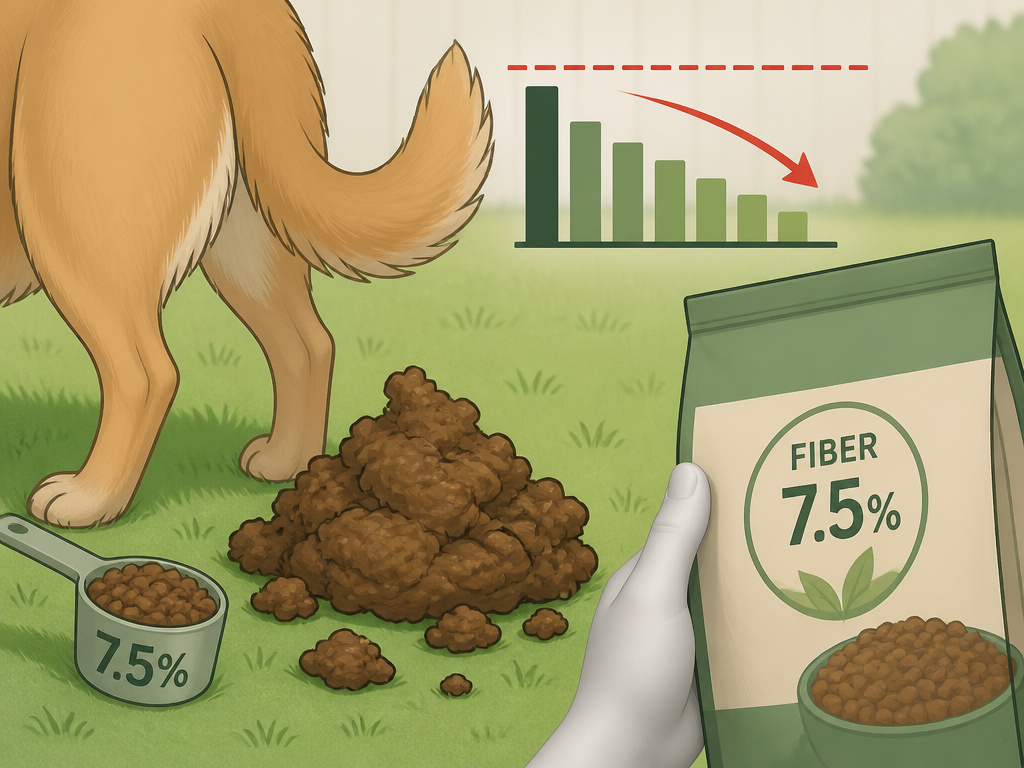
Past that, you are buying stool volume with calories.
A dog on too much fiber tells you on the lawn before it tells you anywhere else. The stool goes loose, then bulky, and the trips outside multiply.
I would not chase a fiber number upward on a healthy dog. The dose-response data shows the stool changes arrive before any benefit does, and the calorie dilution is real and measurable.
The JAVMA review adds a caveat worth holding onto: fiber’s effect on gut transit is not completely predictable from fiber type. Atypical responses happen when you change fiber concentration. Your dog may not read the study.
Worth knowing before you start: More fiber is not a dial that only turns one direction. Past the point where stool quality improves, the next increments cost digestibility.
When More Fiber Helps: Diarrhea, Weight, and Stool Quality
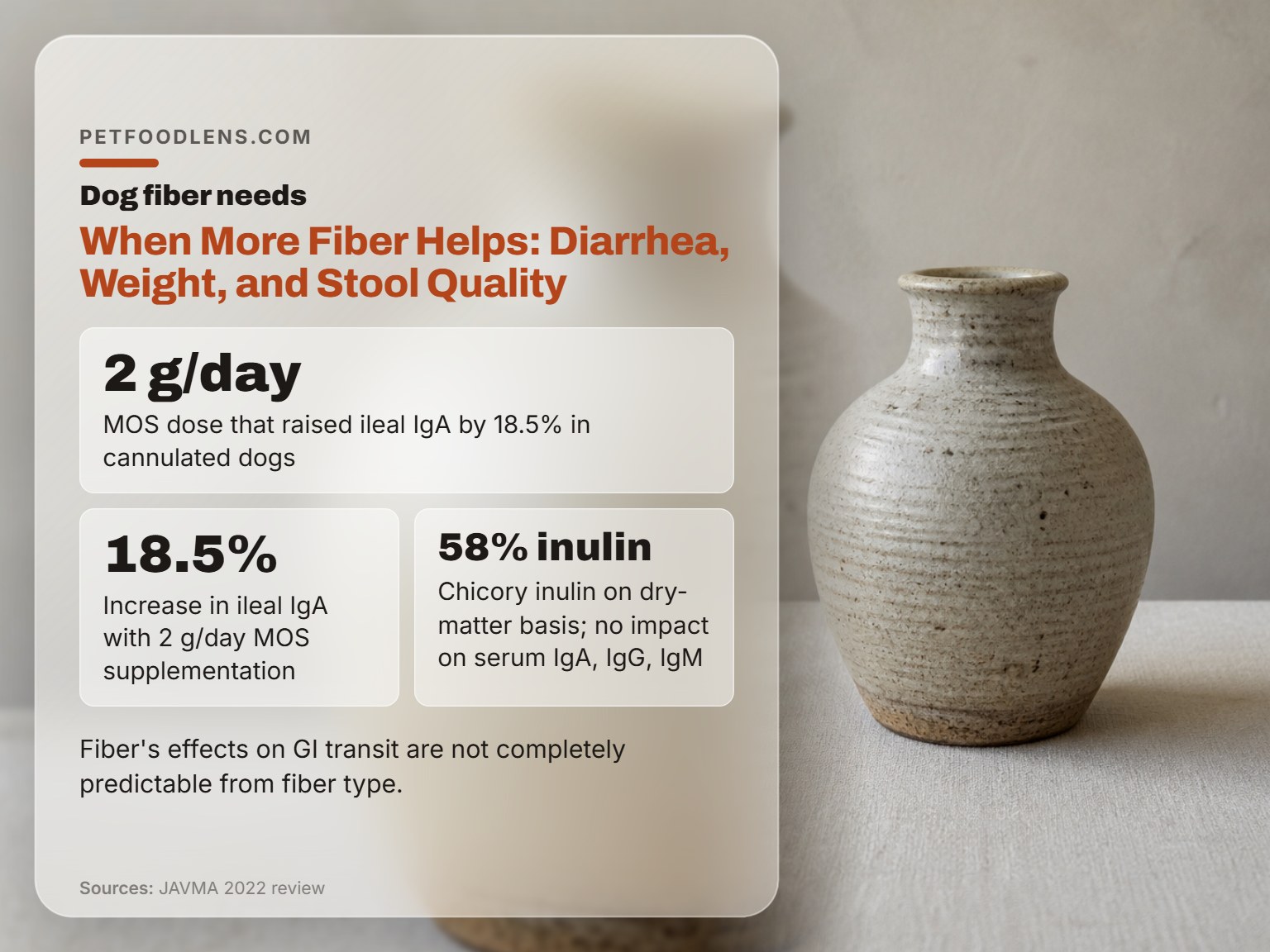
A shelter dog with acute large bowel diarrhea is the case where fiber earns its keep.
That is a real separation, and the fiber for large bowel diarrhea in dogs trial is the reason mixed soluble and insoluble sources show up together in therapeutic formulas.
The Colitis Trial Numbers
The high-fiber diet in that trial was not a single fiber. It was a blend, and the blend is the point. Insoluble fiber adds bulk and speeds transit. Soluble fiber ferments into short-chain fatty acids that feed colonocytes. One without the other does a partial job.
The alternative fiber sources pet food review covers the range of ingredients formulators pull from when they build that blend.
Psyllium: The Dose Nobody Agrees On
That is a 24-fold spread.
Canned pumpkin is the other common home addition, and the pumpkin for dogs breakdown covers what it actually delivers.
The part nobody mentions: A psyllium dose that works for one dog does nothing for the next.
If the problem is constipation rather than diarrhea, the fiber logic flips. The dog food for constipation comparison covers the insoluble-heavy end. If the goal is simply better stool formation, dog food for firm stools is the narrower question.
Those are starting points for a conversation with your vet, not a substitute for one.
Skip this if: Your dog is healthy, eating a complete and balanced diet, and producing normal stool. Adding fiber here solves a problem you do not have and risks the calorie dilution above.
Fiber for Dogs vs Cats: Where the Numbers Diverge
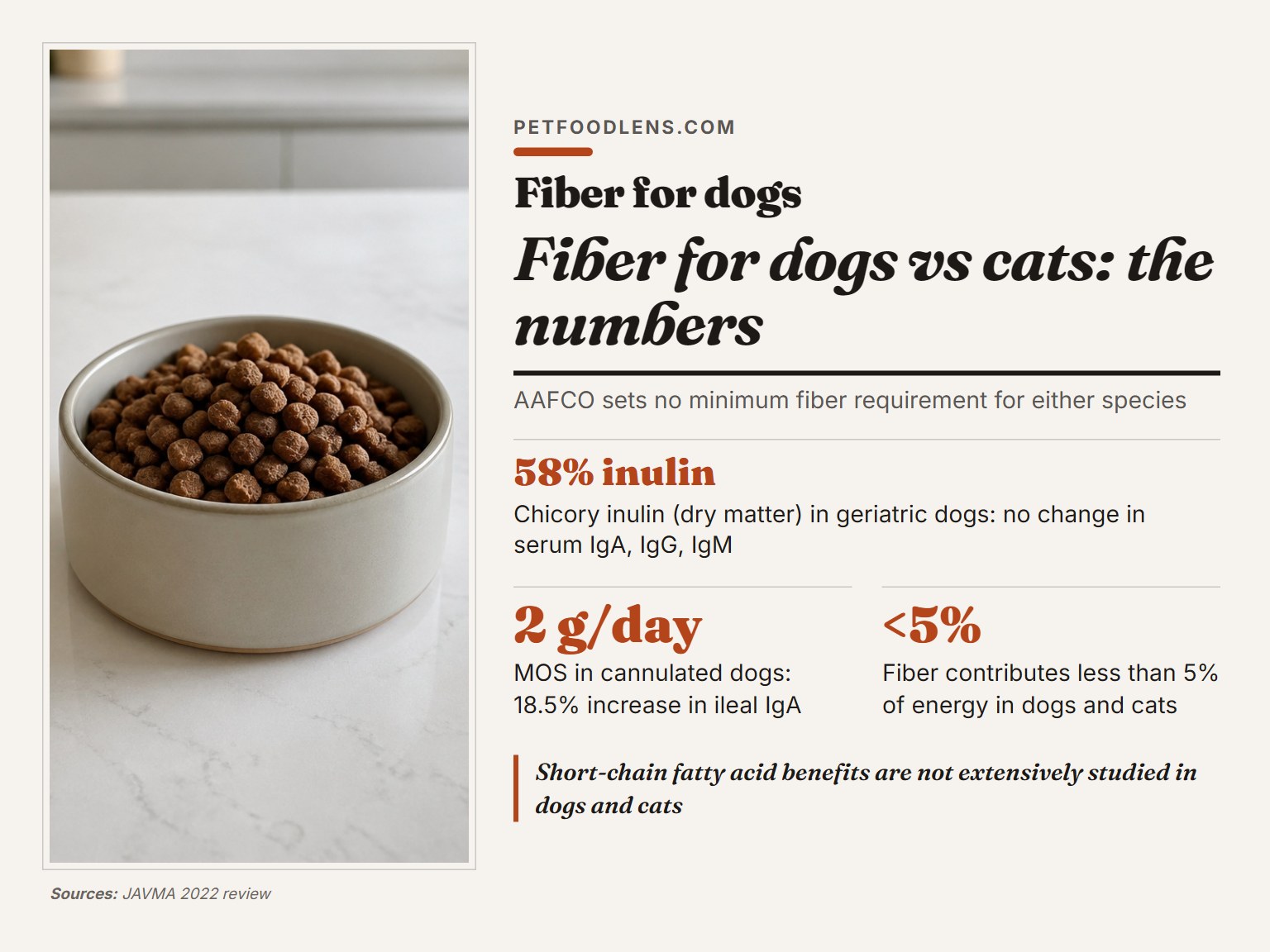
The cat numbers are not the dog numbers.
AAFCO sets no minimum fiber requirement for either species, so that part carries across. The therapeutic targets do not:
My own background is cat formulations. I will say plainly that I am more confident in the feline figures than the canine ones, and the numbers above are exactly why the two should stay separate in your head. The fiber for cats figures are lower across every therapeutic class.
One more piece of honest uncertainty: the systemic benefits of short-chain fatty acids have been studied extensively in humans and not extensively in dogs and cats. Anyone who tells you the gut-health case for fiber in dogs is settled is ahead of the evidence.
The prebiotic data is preliminary too. Chicory at 58% inulin on a dry matter basis and MOS supplementation in geriatric dogs had no impact on serum IgA, IgG, or IgM. A separate group found 2 g/day of MOS produced an 18.5% increase in ileal IgA in cannulated dogs. Those are early results, and the review says so.
How to Compare Two Bags Without Being Fooled
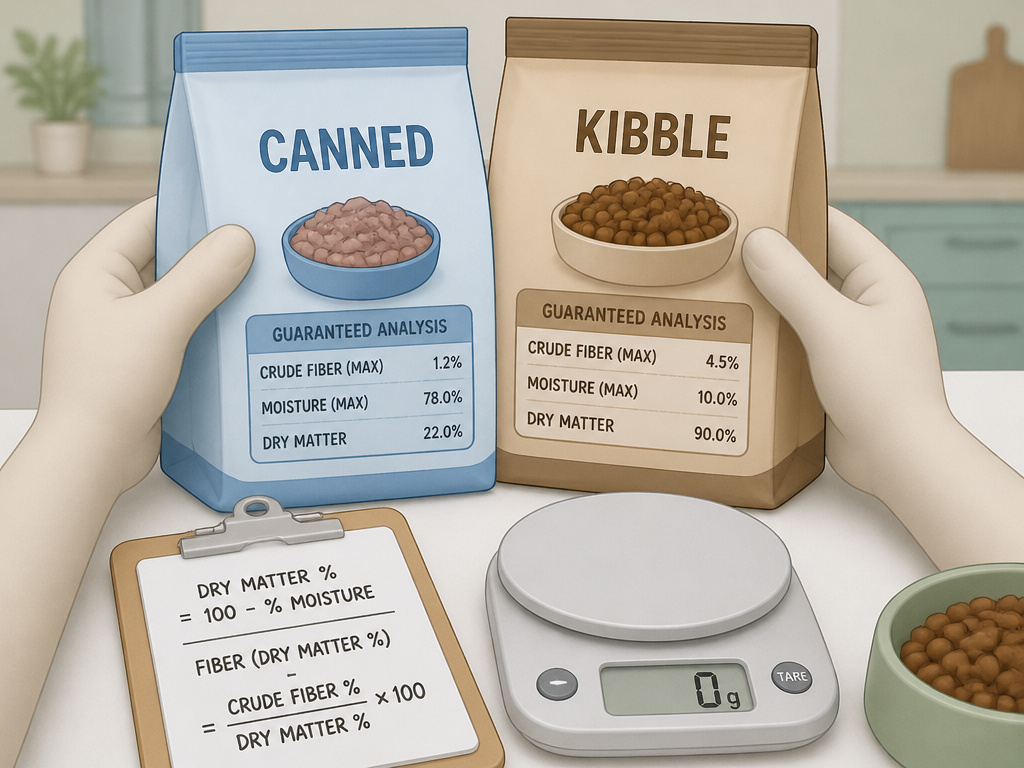
Four steps, in this order.
- Read the guaranteed analysis and note the maximum crude fiber figure. Skipping the word “maximum” is how people end up treating a legal ceiling as a measurement.
- Convert to dry matter. Divide the crude fiber percentage by (100 minus the moisture percentage) and multiply by 100. Skip this and a 6% canned food and a 6% kibble look identical when they are not.
- Ask the manufacturer for a total dietary fiber figure. Most publish one in a technical report on request. If a company will not tell you, that tells you something.
- Compare in grams per 100 kcal. This is the only basis that survives a wet-versus-dry comparison, and it is the basis the JAVMA review recommends.
The Dry Matter Conversion
The canned food wins on crude fiber and you would never know it from the as-fed labels.
That conversion is also why the high-fiber dog food lists you see online are hard to use as-is. Most rank by as-fed percentage, which mixes formats.
If you want the shortlist approach instead of the math, the high fiber dog food roundup sorts by diet class, which is closer to how the numbers actually work.
Easy to miss: Fiber concentration in a finished diet drifts as formulations change.
Frequently Asked Questions
Does a dog need fiber in its diet?
Not in the sense of a required minimum. AAFCO sets no minimum fiber requirement for dogs, and fiber supplies less than 5% of a dog’s energy needs, so it is not classified as an essential nutrient. That said, fiber does real work in specific situations, particularly large bowel diarrhea and weight management.
What percentage of fiber should dog food have?
There is no universal percentage, and as-fed percentages are the wrong unit anyway. Commercial diets range from 0.1 to more than 11 grams of total dietary fiber per 100 kcal depending on diet class. Maintenance formulas sit near the bottom of that range, weight management diets near the top.
Is higher fiber dog food always better?
No. The JAVMA review notes that excess fiber can reduce mineral absorption, dilute caloric concentration, and cause diarrhea, though this is not expected on complete and balanced commercial diets. The JAVMA review also notes that excess fiber can reduce mineral absorption and cause diarrhea, though this is not expected on complete and balanced commercial diets.
How do I add fiber to my dog’s diet?
Talk to your vet first, because the right source depends on the problem. Canned pumpkin and psyllium are the two most common home additions, and Introduce any addition gradually and watch stool quality.
Can too much fiber hurt a dog?
It can dilute calories, reduce mineral absorption, and cause diarrhea. Excess fiber can dilute calories, reduce mineral absorption, and cause diarrhea. For a healthy dog on a complete diet this is unlikely to matter, but for a dog already losing weight or eating poorly, it does.
The Bottom Line
If the stool is loose and the dog is otherwise bright and eating, the first move is a call to your vet, not a scoop of psyllium.
The one habit worth building: stop reading the crude fiber number as if it were a total. It is a maximum, it is measured by a method that misses most of what fiber actually is, and it cannot be compared across wet and dry food without a dry matter conversion.
Everything above assumes a dog eating a complete and balanced commercial diet. If your dog is on a prescription formula for kidney disease, diabetes, or a diagnosed gastrointestinal condition, the fiber target belongs to your vet, not to a label. That is the edge of what I can tell you honestly, and it is a real edge.
Flip the bag over one more time. The number you want is probably not printed there.
