
Weight Management Dog Food Guide: Read the Back First
This post contains affiliate links. As an Amazon Associate, we earn from qualifying purchases.
The weight management dog food guide you actually need starts with calories per cup or can. Dry canine weight-loss diets run 217 to 440 kcal per cup, and 42 of 72 diets in a 2010 JAVMA audit exceeded the AAFCO calorie ceiling for light foods.
That ceiling matters because AAFCO only requires a stated calorie content on foods carrying terms like lite, light, low calorie, or reduced calorie. Everything else can leave the number off the label entirely.
What follows: how to find the number, how to convert it across wet and dry, how to run the RER math the guidelines actually recommend, and the two places where the published sources flatly contradict each other.
Key Takeaways
- At least 90% of daily calories should come from a complete diet, with treats and extras capped at 10% or less, per the 2021 AAHA guidelines.
- Bag charts can run higher than calculated resting energy for a neutered indoor dog.
- Dry weight-loss diets ranged 217 to 440 kcal/cup in a 2010 audit, so a “cup” is not a fixed amount of food.
- Purina OM feeds to current weight; WALTHAM says feed to ideal weight. Those two instructions produce different scoops from the same bag.
- Recalculate intake every 4 weeks and recheck body condition on the schedule for your dog’s S.H.A.P.E. Category, because the dog’s requirement drops as the dog does.
What a Weight Management Dog Food Label Actually Tells You
Flip the bag over and check for a kilocalorie statement. On plenty of weight management products it is simply absent.
AAFCO requires a stated calorie content only on products labeled lite, light, low calorie, less calorie, or reduced calorie, and those foods must meet a maximum kilocalorie-per-kilogram limit. Weight management, overweight, and calorie reduction are unregulated terms, so those labels carry no calorie mandate. Among 72 weight-loss diets audited in 2010, 58% exceeded the AAFCO light-food calorie ceiling.
That is the whole problem in three sentences. The word “weight management” on a bag is a marketing claim, not a regulated nutrient standard.
The 2010 commercial weight loss diet calorie density audit measured what owners were actually buying. The spread was enormous.
| Diet type | Calorie density range | Median |
|---|---|---|
| Dry dog food | 217-440 kcal/cup | 301 kcal/cup |
| Canned dog food | 189-398 kcal/can | 310 kcal/can |
| Dry cat food | 235-480 kcal/cup | 342 kcal/cup |
| Canned cat food | 78-172 kcal/can | 146 kcal/can |
Read the dry dog row again. Two bags both labeled for weight loss differ by more than 200 kcal in a single cup. A 200 kcal swing per cup is a large difference in a single cup.
That range is wide enough that picking a weight management dog food guide by brand name alone is a coin flip. Most of that spread sits in dry dog food for weight management, where kibble size and density change how much a cup actually weighs.
One more thing about the bag itself. A storage bin that has held kibble for months builds a tacky yellow film on the walls and a sharp crayon-and-paint smell. Fresh food poured on top of that meets oxidized fat on day one. Wash the bin with hot soapy water between bags and let it dry completely.
Why Does the Bag Chart Feed My Dog More Than He Needs?
The first time I ran a bag chart against calculated resting energy for a neutered indoor dog, the chart came out higher. Not one brand. Several. The bag is a starting estimate, and it is a generous one.
Before you start: A plan that drops below the calculated resting requirement needs veterinary sign-off, especially in a dog with high blood lipids, where the Purina OM label caps initial use at 2 months. Aim for 1 to 2% of body weight per week. Faster than that is a reason to call the clinic, not a reason to celebrate.
The 2021 AAHA nutrition and weight management guidelines are direct about this. Owners should ideally perform resting energy requirement and maintenance energy requirement calculations rather than relying only on package feeding directions.
There is a reason the bag can be loose. AAHA notes that AAFCO does not standardize the calculation process behind those feeding directions. Two manufacturers can start from different assumptions and both print a legal chart.
The Weight-Bracket Trick
Charts list ranges by weight bracket, and a dog at the top of a bracket gets fed like the next size up. Nobody mentions that part.
Four things push the printed number upward:
- Bracket rounding. Dogs of different weights often share a row.
- Activity assumptions. Charts assume more movement than a couch dog gets.
- Neutering status. Fixed dogs need fewer calories, and the chart does not ask.
- Treat blindness. The chart covers kibble only, never the biscuit at 3pm.
The work of adjusting dog food portions starts with a number the bag will not give you.
Common mistake: Trusting the top of the weight bracket. Feed to the bottom of the range for your dog’s weight and recheck body condition in four weeks. If the ribs get easier to feel, the lower number was right.
The Current-Weight vs Ideal-Weight Split Nobody Warns You About
Two sources that both know what they are doing tell you to calculate the same scoop from opposite starting points.
Purina PRO PLAN Veterinary Diets OM bases its feeding guide on the dog’s current weight. The WALTHAM Pocket Book of Healthy Weight Maintenance says to feed according to the ideal weight rather than the current weight.
| Source | Basis | What it means at the bowl |
|---|---|---|
| Purina PRO PLAN Veterinary Diets OM | Current weight | Scoop shrinks only when the dog does |
| WALTHAM Pocket Book | Ideal weight | Scoop starts smaller from day one |
| AAHA 2021 | Calculated RER/MER | Number comes from the clinic, not the bag |
Neither is wrong. They answer different questions.
Purina OM’s current-weight approach is a gentler entry, while WALTHAM’s ideal-weight approach starts the deficit on day one. The dog gets a portion close to what it has been eating, then the amount steps down as the weight comes off. That is why the OM label says to recalculate intake every 4 weeks.
WALTHAM’s ideal-weight approach front-loads the deficit, while Purina OM’s current-weight approach steps the portion down as the dog loses weight. The dog starts eating less on day one, which produces faster early loss and more complaining at the bowl.
Which Basis to Use for Your Dog
Purina OM would start with current weight for a dog that has been on the same food for years and gets anxious about portions, while WALTHAM would start with ideal weight. WALTHAM would start with ideal weight for a dog that has gained steadily and has no other health issues, while Purina OM would start with current weight.
Either way, a weight reduction dog food chart is a starting point, not a prescription. Write down the number you chose and the date you chose it.
Then leave it alone for four weeks.
How Many Calories Should a Dog Actually Get?
Three published anchors exist for the same decision, and they do not agree with each other.
- AAHA 2021: mean intake achieved during 12 weeks of weight loss was 63 kcal/kg^0.75, plus or minus about 10.
- International trial protocol: initial energy set at 60 to 80 kcal/kg^0.75 per day.
- Label directions, 2010 audit: dogs recommended 0.73 to 1.30 times resting energy requirement, median 1.00.
Resting energy requirement is the calories a dog burns doing nothing at all. Maintenance energy requirement is that number scaled up for normal daily activity. The gap between the two is where most feeding arguments live.
Where the Three Numbers Disagree
The trial number is a protocol, so it describes what researchers set at the start. The AAHA figure describes what dogs actually averaged over 12 weeks, which is lower because requirements fall as body mass falls.
The label range is the widest of the three.
The international canine weight loss study is the reason I trust the lower end. It enrolled 926 dogs. Median starting body condition score was 8 on a 9-point scale. Mean loss was 11.4% over 3 months, and 97% of the dogs lost weight.
Here is the order I use:
- Pull the calorie number off the label or request it from the manufacturer. Skipping this leaves you guessing at density.
- Convert to one unit. Per cup, per can, or per kilogram of food. Mixing units is how portion errors start.
- Calculate resting requirement and multiply by an adult-neutered factor from your clinic. Skipping this is how the bag chart wins by default.
- Compare the two numbers and start at the lower one. Starting high wastes four weeks.
- Recheck at 4 weeks and adjust. A plateau means the plan needs recalculating.
Rule of thumb: If the bag and the math disagree, run the math for four weeks and let the ribcage settle the argument.
One more finding from that trial worth knowing. Intact dogs lost more than neutered dogs, and females lost more than males. In North and South American dogs, females lost 11.5% against 9.1% for males. The same protocol produced different results by sex and by region.
Your dog is not an average. The averages just tell you where to start.
What the 2025 Macronutrient Numbers Say, and What AAHA Won’t Commit To
The Animals 2025 meta-analysis put numbers on five thresholds for a hypocaloric dog diet, and they are worth writing down.
- Energy density under 3.275 kcal/g
- Protein above 25%
- Fat below 10%
- Total fiber above 12%
- Nitrogen-free extract below 40%
Nitrogen-free extract is the carbohydrate fraction calculated by subtraction. It is the number that separates a high-protein weight loss food from a low-fat one padded with starch.
The low-calorie dog food shelf is where those thresholds get tested. Plenty of products hit the calorie target and miss the protein one.
Here is the honest gap. The 2025 paper states plainly that as of publication there is no standardized guideline on optimal macronutrient levels for canine weight-loss diets.
So you have one peer-reviewed meta-analysis with specific numbers and one consensus guideline that declines to give any. I use the 2025 numbers as a target and the AAHA position as a reminder that the individual dog still decides.
This is also where I get skeptical of a category. Over-the-counter limited ingredient foods are the ones I trust least. Some of those labels list multiple animal proteins, and nothing on the bag suggests cross-contact controls in the plant. For a real elimination trial you want a veterinary hydrolyzed or novel-protein diet with one protein and one carbohydrate.
A bag labeled limited ingredient is not a weight loss plan. It is a label.
Why a Cup of Dry Food and a Can of Wet Food Don’t Compare
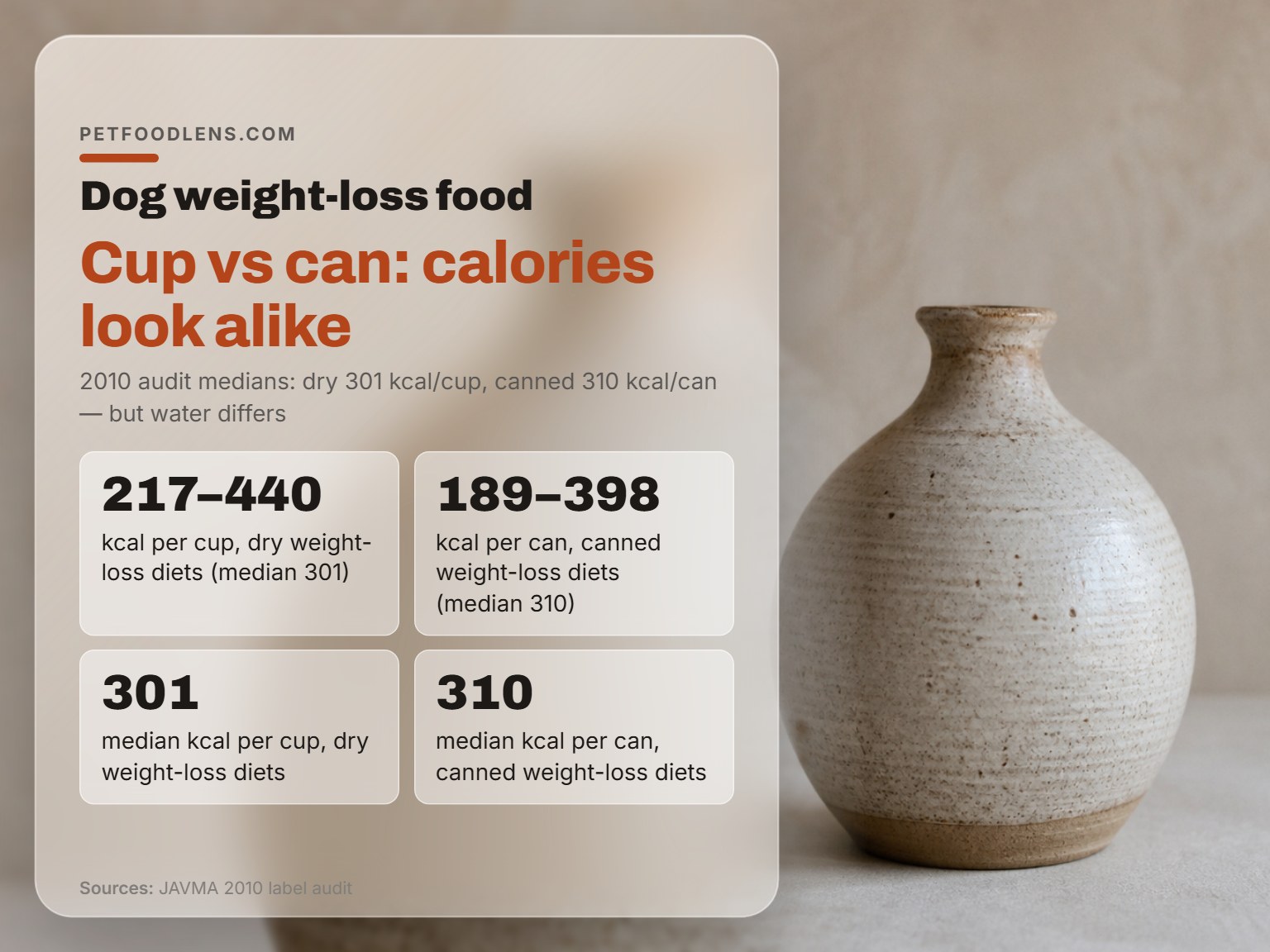
A cup of kibble and a can of wet food are measured on different scales, and the label does not reconcile them for you.
Canned dog diets in the same 2010 audit ran 189 to 398 kcal per can, with a median of 310. That median is close to the dry median of 301 per cup, which fools people into thinking the two formats are interchangeable.
They are not. A can holds a lot of water. Most wet dog food for weight loss looks low in protein on the guaranteed analysis for exactly that reason.
I still convert every comparison to dry matter, and I have done it for years. It removes the water weight and lets two very different foods be compared fairly. It is the single habit that has prevented the most errors in my work.
The arithmetic is dull and takes a minute. Divide the percentage on the label by the dry matter fraction. Divide the percentage on the label by the dry matter fraction to convert protein to a dry matter basis.
The part nobody mentions: A wet food and a dry food can be the same diet once you correct for moisture. Comparing the two percentages straight across is the most common label error I see.
Two formats, one number. Convert first, then argue.
Treats, Chews, and the 10% Rule You Can’t Calculate
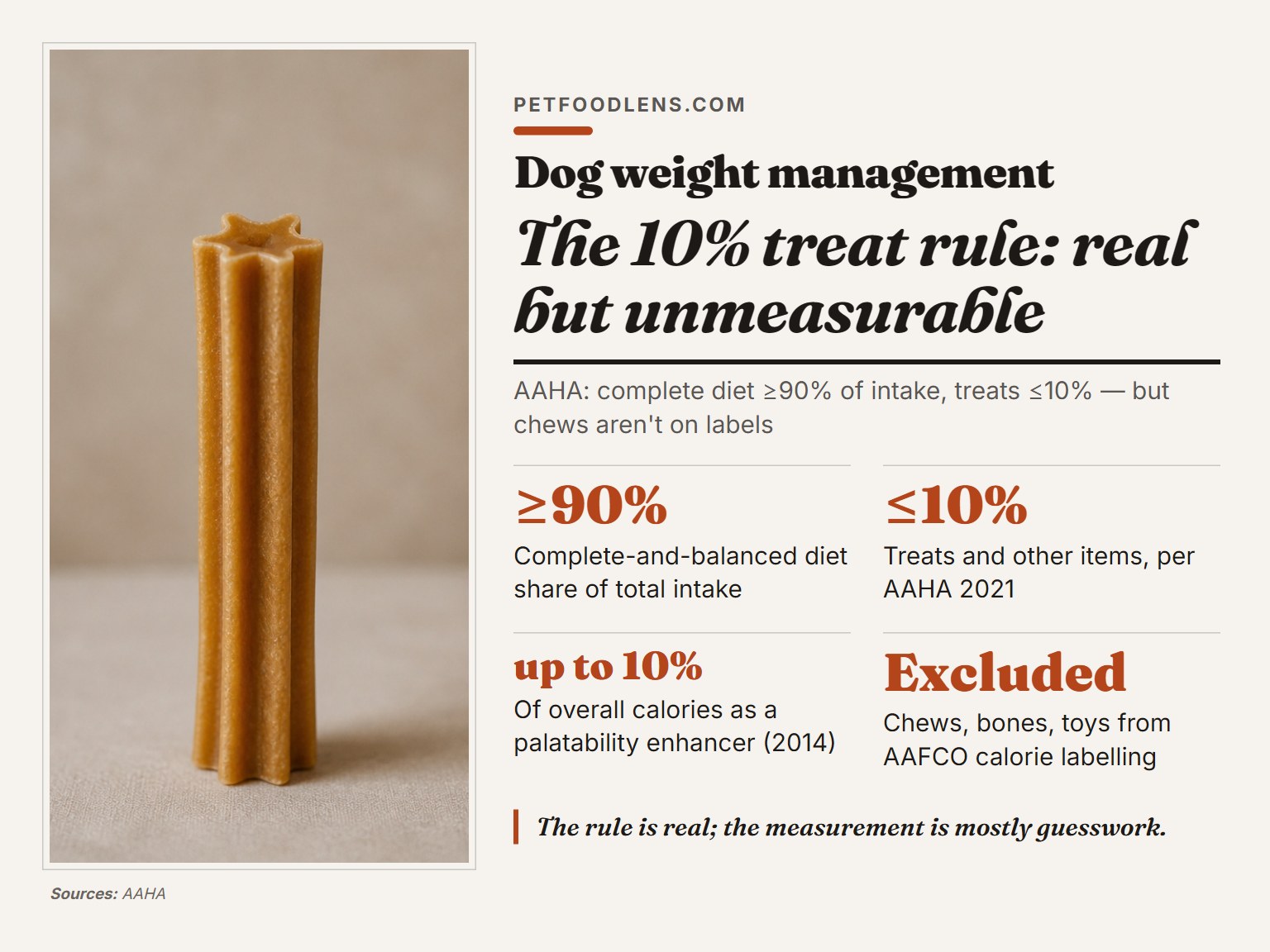
The 10% treat rule is the easiest part of weight management to state and the hardest to actually measure.
AAHA 2021 sets the split clearly: a complete and balanced diet should make up at least 90% of total intake, with treats and other items limited to 10% or less. The 2014 guidelines allow up to 10% of overall calories as a palatability enhancer.
Then the arithmetic falls apart. AAFCO calorie labelling excludes chews, bones, and toys, so the 10% cannot be calculated from packaging alone. Supplements are worse. Their calorie content may require contacting the manufacturer directly.
So the rule is real and the measurement is mostly guesswork.
Where this goes sideways: Counting a dental chew as “not really a treat.” A daily chew can eat into the daily allowance for a dog on a weight plan, and the scale shows it.
The 2014 AAHA weight management guidelines suggest low-starch vegetables for a dog that begs. That is a real substitution, not a slogan. A low-starch vegetable is a low-calorie substitution that takes the same time to eat.
If you want a packaged option, the low-calorie dog treats category has improved, but read the kilocalorie line per piece before you decide a handful is harmless.
Fair warning: the treat allowance is where most stalled plans actually stall. Not the kibble.
When to Stop DIYing It and Call the Vet
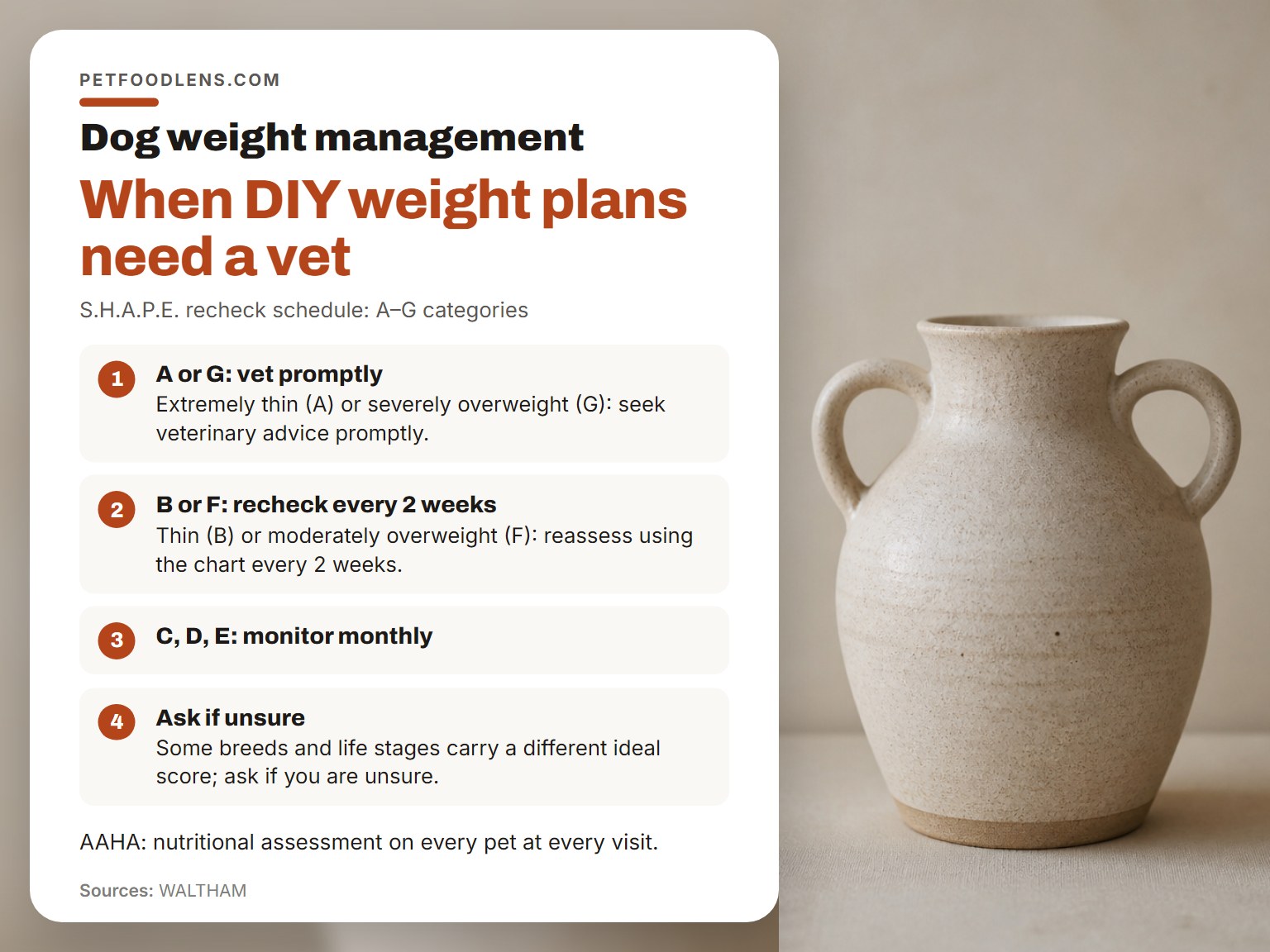
A home plan stops being safe the moment the dog’s body condition moves faster than the plan intended, or stops moving at all.
The WALTHAM S.H.A.P.E. Guide classifies pets into seven categories, A through G, and it is built for owners with no prior training. Run your fingertips against the direction of the coat along the ribs. On an ideal dog you feel the ribs under a thin layer with light pressure. On an overweight dog you press to find them.
The S.H.A.P.E. Recheck Schedule
- Category A (extremely thin): seek veterinary advice promptly.
- Category B (thin): reassess every 2 weeks.
- Category C (lean): increase food slightly, monitor monthly.
- Category D (ideal): monitor monthly.
- Category E (mildly overweight): avoid excessive treats, monitor monthly.
- Category F (moderately overweight): reassess every 2 weeks.
- Category G (severely overweight): seek veterinary advice promptly to start a weight loss plan.
Some breeds and life stages carry a different ideal score, so ask if you are unsure.
AAHA wants a nutritional assessment on every pet at every visit, and treats nutrition as the fifth vital assessment alongside temperature, pulse, respiration, and pain. The FDA pet nutritional assessment guidelines summary points back to that same framework.
I am not a veterinarian and I cannot diagnose or manage a medical condition. My comparisons come from labels and published data, not from lab testing, so I cannot verify what is actually inside the bag.
Once the weight is off, the job changes. The switch to weight maintenance dog food is where regain happens, because the scoop that produced loss is now a surplus.
Frequently Asked Questions
How much weight should a dog lose per week?
The Purina OM feeding guide targets 1 to 2% of body weight loss per week. In the international trial, mean loss was 11.4% over 3 months. Faster loss than the 2% ceiling is a reason to check in with your vet.
Is a bag feeding chart wrong?
It is a starting estimate, and a generous one. In my comparisons the chart ran above calculated resting energy for a neutered indoor dog. AAHA recommends running the calculation rather than relying only on package directions.
Do I feed to current weight or ideal weight?
Purina OM bases its guide on current weight. WALTHAM says to feed to ideal weight. Purina OM’s current-weight guide gives a gentler start with a step-down every 4 weeks, while WALTHAM’s ideal-weight approach starts the deficit on day one. WALTHAM’s ideal-weight approach starts the deficit on day one, while Purina OM’s current-weight guide steps the portion down as the dog loses weight.
Why is calorie content missing from some bags?
AAFCO only mandates a stated calorie content on products using terms like lite, light, low calorie, less calorie, or reduced calorie. Weight management and overweight are unregulated terms, so those labels carry no calorie requirement.
Can I just feed less of my dog’s normal food?
You can, with a catch. Cutting volume cuts calories and also cuts every nutrient in the bag. That is why AAHA frames the target as at least 90% of intake from a complete and balanced diet rather than simply less of the same thing.
How often should I recalculate the portion?
Every 4 weeks, per the Purina OM label, or every 2 weeks if your dog sits in S.H.A.P.E. Category B or F. Requirements fall as body mass falls, so a portion that worked in month one is a surplus by month three.
The Bottom Line
One trigger is worth memorizing. If your dog drops more than 2% of body weight in a single week, stop the plan and call your vet. That is faster than the 1 to 2% weekly target the Purina OM guide uses, and it usually means something other than the diet changed.
The weight management dog food guide part of this is the easy half. Read the calorie line, convert to dry matter, run the resting energy math, and write the date on the number you chose.
The hard half is the four-week recheck, run honestly, with your hands on the ribs instead of your eyes on the bowl.
And one concession. Everything above assumes a dog with no other diagnosed condition. Add pancreatitis, kidney disease, or a thyroid problem and the calorie math gets overruled by clinical judgment. That is a conversation for your vet, not for a label.
