
Meat Meal vs Whole Meat in Pet Food: What Labels Hide
This post contains affiliate links. As an Amazon Associate, we earn from qualifying purchases.
Meat meal vs whole meat in pet food is a water question first. Whole meat runs about 70% moisture; rendered meat meal about 10%, so meal packs more protein into every pound of dry food. Peer-reviewed assays still put fresh meat ahead on soluble protein and digestibility. Which one wins depends on the rest of the bag.
That 70-to-10 gap is why an ingredient list can look like it favors whole meat and still mislead you. Ingredients get weighed before cooking, so a chicken entry near the top is mostly water going into the mixer. The finished kibble tells a different story than the panel does.
What follows walks the actual AAFCO wording, the soluble-protein numbers behind the disagreement, and the four checks I run on a bag before it goes in my cart.
Key Takeaways
- Whole meat is about 70% moisture and rendered meal about 10%, so Ohio State VMC and Whole Dog Journal hold that meal contributes more protein per pound of finished kibble, while PMC7916219 measured higher soluble protein in fresh meat per 100 g dry sample.
- In a bag listing both, Whole Dog Journal’s label math holds that the meal is doing most of the protein work, while Ohio State VMC and PMC7916219 measure fresh meat differently on protein concentration.
- Peer-reviewed assays disagree: fresh chicken beat chicken meal on soluble protein, 14.6 vs 8.6 grams per 100 grams of dry sample.
- The AAFCO definition excludes added hoof, horn, hair, and hide trimmings, so the “filler” line doesn’t survive the wording.
- Meal-free is a recipe description, not a quality grade. Whole Dog Journal notes those formulas lean harder on plant protein to hit the same number, while PMC9219525 concluded fresh-meat-based formulations are the preferable choice.
What the AAFCO Definitions Actually Say
The AAFCO meat definition was adopted in 1938. The meat meal definition didn’t arrive until 1972, and it was re-adopted in 1993.
AAFCO defines meat meal as the rendered product from mammal tissues, excluding any added blood, hair, hoof, horn, hide trimmings, manure, stomach and rumen contents beyond amounts that occur unavoidably in good processing practice. The material is cooked, dried, and ground, with most of the fat removed. Both definitions describe animal tissue destined for animal food.
Meat gets the tighter definition. It’s clean flesh from slaughtered mammals, limited to striate muscle: skeletal muscle, tongue, diaphragm, heart, esophagus. The accompanying fat, skin, sinew, nerve, and blood vessels come along with it.
Both definitions require that a named product correspond to its name. That’s why named meat ingredients like chicken meal or salmon meal carry their own entries, while a bare “meat meal” names no species at all.
What rendering does physically is simple. Raw trim goes in wet and pink. What comes out of the dryer is a tan, granular meal that pours like coarse sand and smells faintly sweet, closer to cooked liver than to raw meat.
Why Whole Meat Looks Bigger on the Label Than It Is
Water is doing the heavy lifting on that ingredient list.
Whole meat sits at roughly 70% moisture. Rendered meal gets driven down to about 10%, which is why it holds on a shelf for months without spoiling. Same animal, very different weight on the scale.
| Form | Moisture | What it does to the list |
|---|---|---|
| Whole meat | ~70% | Weighs heavy before cooking |
| Rendered meal | ~10% | Concentrated and shelf-stable |
| Meat in pet food | varies | May be as little as 8% protein |
Ingredients are listed by pre-processing weight. A chicken entry at position one is mostly water going into the mixer, so it can’t be supplying the majority of the protein in the finished bag.
That’s the mechanism behind the whole trick. The list is honest about weight and silent about what survives the dryer.
This is the same reason I convert everything to a dry matter basis before I compare two bags. Label percentages are as-fed, and a wet food and a dry food aren’t in the same units until you do the arithmetic.
Easy to miss: A bag that lists chicken first and chicken meal fourth is usually a meal-forward formula. The water in the chicken pushed it up the list, and the meal is doing the work.
Does Meat Meal Actually Supply More Protein?
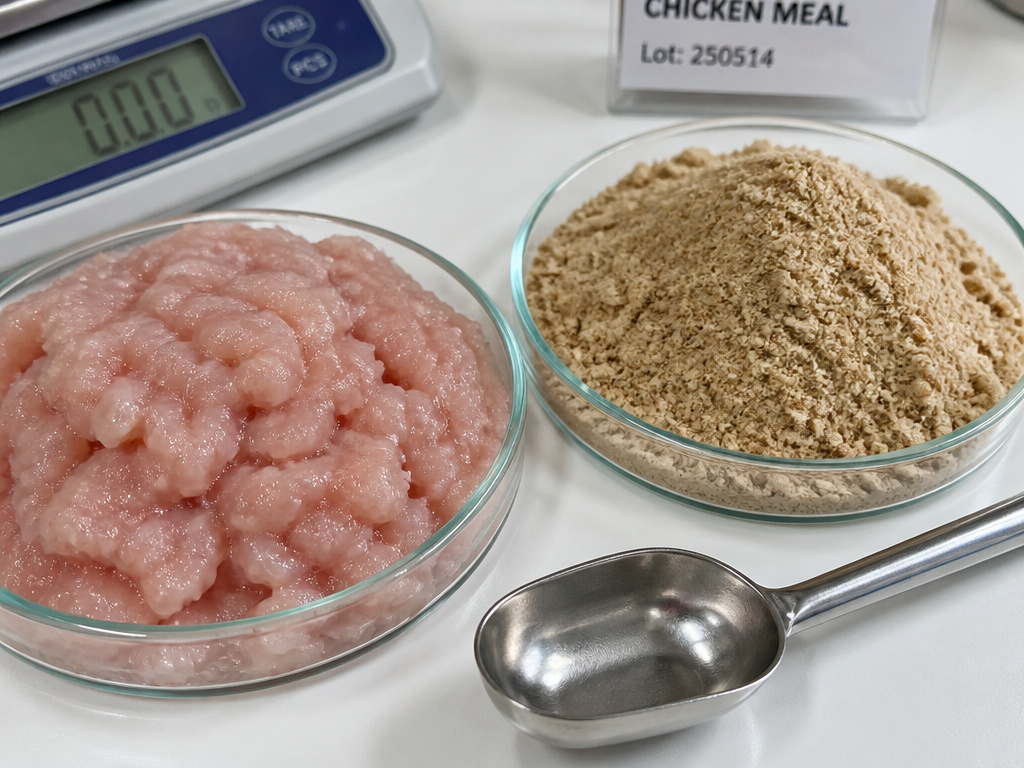
One peer-reviewed assay says the opposite of the label math, and it’s worth sitting with that for a minute.
Researchers measured soluble protein per 100 grams of dry sample across chicken, pork, and salmon, in both fresh and meal form. Fresh meat came out ahead every time.
| Protein source | Fresh meat (g/100 g dry) | Meat meal (g/100 g dry) |
|---|---|---|
| Chicken | 14.6 | 8.6 |
| Pork | 15.1 | 6.2 |
| Salmon | 13.7 | 7.9 |
That comes from a protein raw material quality evaluation in the journal Animals, where the authors concluded that fresh meats appear to be higher-quality ingredients on bioavailability and digestibility measures.
So how do you square that with the moisture argument? They’re answering different questions.
Soluble protein measures how readily the protein goes into solution, which those authors used as a quality marker. The label math measures how much protein by weight lands in the finished kibble. A fresh meat can win the first test and still lose the second.
The salmon row behaves like the rest: fish meal is concentrated and shelf-stable, and it sits well below fresh fish on soluble protein.
Where Meat Meal vs Whole Meat in Pet Food Gets Complicated
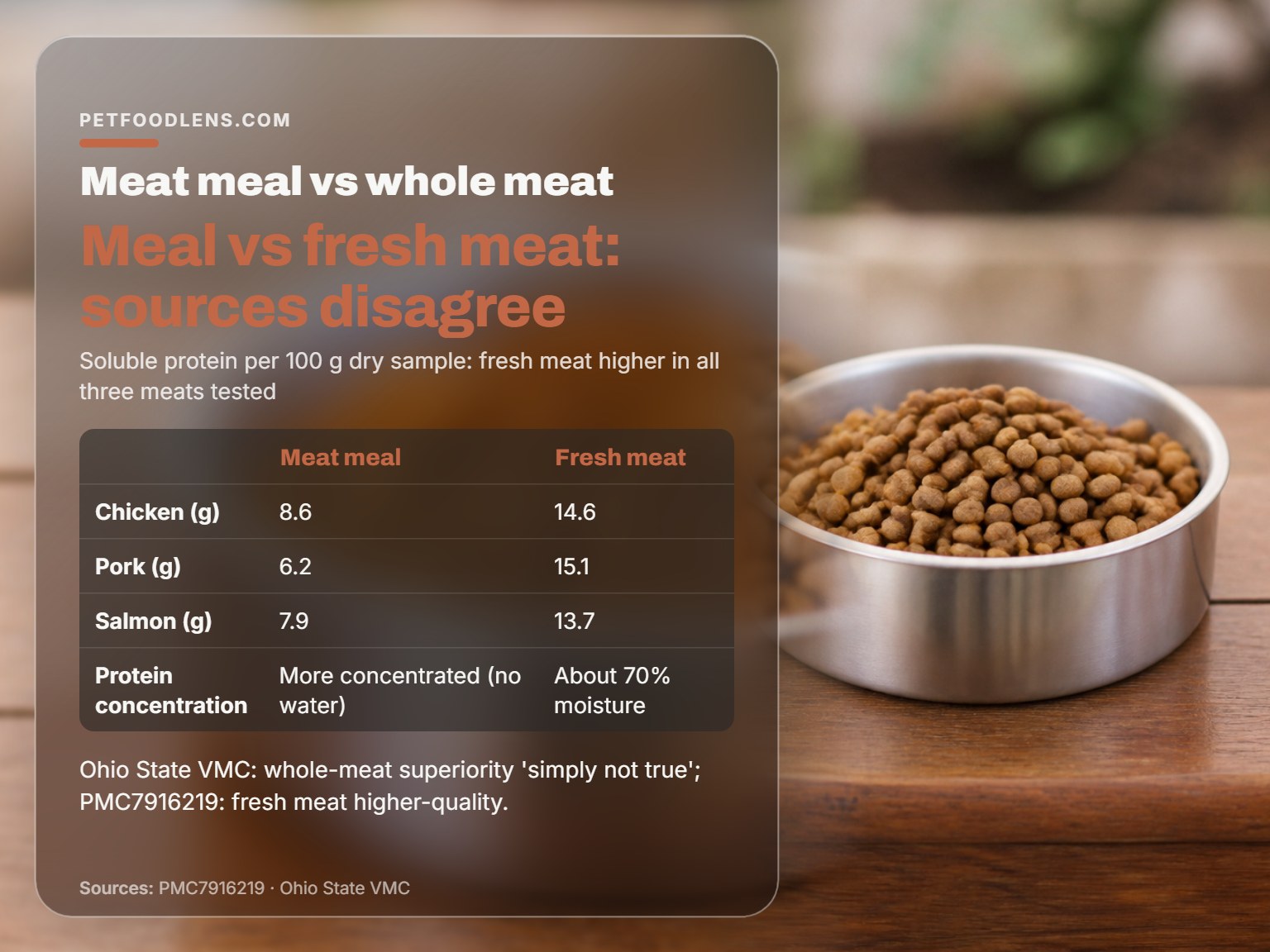
Two credible camps have looked at the same question and landed in different places.
| Source | Position | Basis |
|---|---|---|
| Ohio State VMC | Meal can be excellent, economical, concentrated protein | Ingredient definitions and origin quality |
| PMC7916219 | Fresh meat is higher quality | Soluble protein, bioavailability, digestibility |
| PMC9219525 | Fresh-meat-only kibble preferable | Over 90% in vitro digestibility, more taurine and amino acids |
The Case for Meal
The Ohio State pet food myths guide doesn’t hedge. It calls the belief that whole meat beats meat meal on the name alone “simply not true,” and says origin decides quality. A well-sourced meal, in that framing, is a concentrated and economical protein source.
The Case for Fresh Meat
The bench work isn’t guessing either. A separate study found fresh-meat-only kibble had the highest soluble protein, more essential and branched-chain amino acids, more taurine, and in vitro digestibility above 90% of its dry weight. Those authors called the fresh-meat formulation the preferable choice.
Both are describing something real. The veterinary source is talking about what meat meal from a good-quality provider contributes to a formula. The assay work is talking about what the raw material measures before it ever hits the mixer.
A raw and rendered animal by-products review in The Journal of Nutrition covers the same ground for dog diets if you want the longer version.
I’ve stopped treating this as a winner-take-all argument. The label math favors meal and the bench work favors fresh meat, and both are measuring something. Anyone who tells you one side is settled is selling a bag.
What Meat Meal Does Not Contain
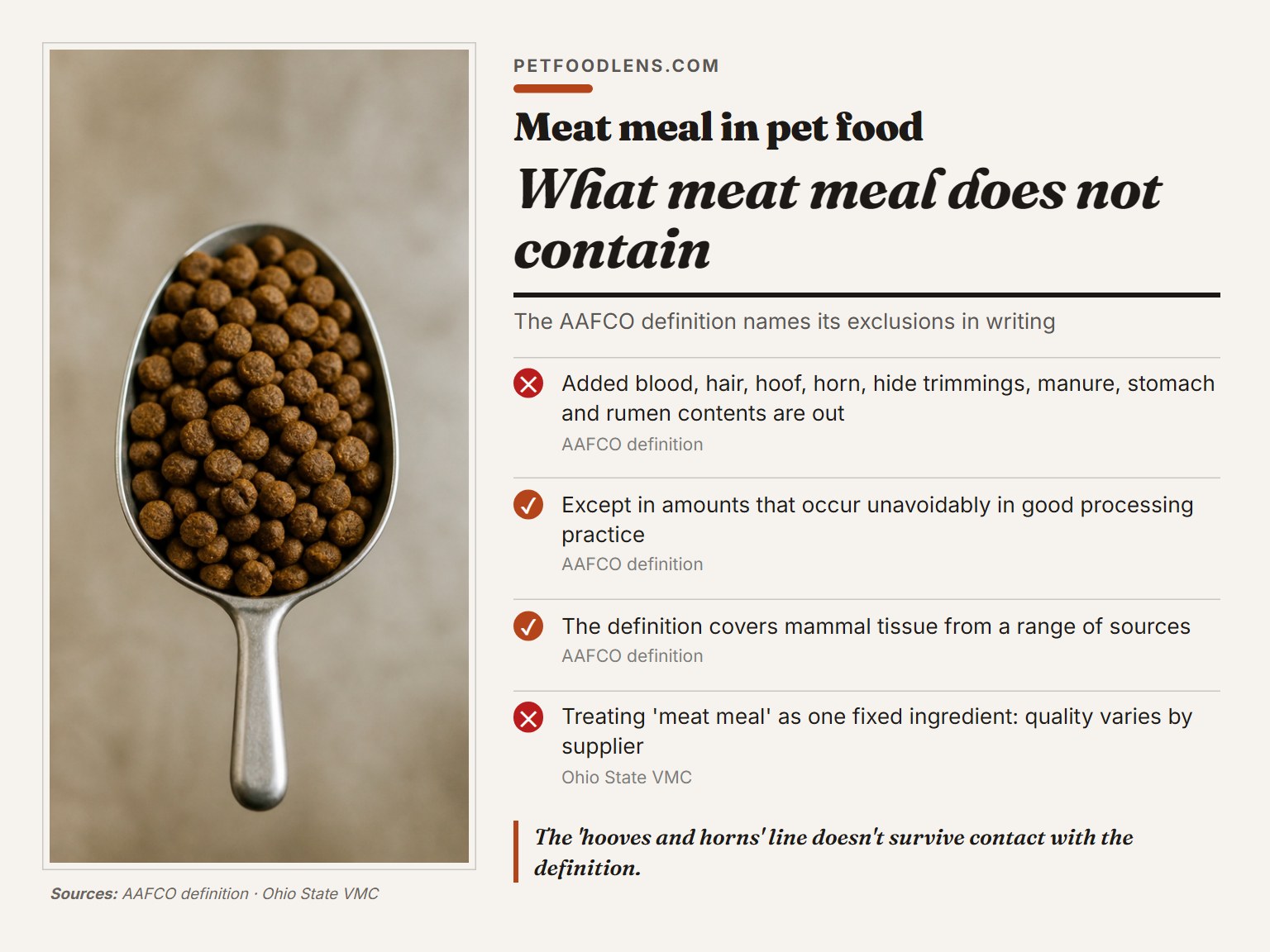
The AAFCO meat meal definition names its exclusions in writing.
Added blood, hair, hoof, horn, hide trimmings, manure, stomach, and rumen contents are all out, except in amounts that occur unavoidably in good processing practice. That’s the text itself, not a marketing summary of it.
So the “hooves and horns” line that gets repeated in comment sections doesn’t survive contact with the definition. What the definition does allow is mammal tissue from a range of sources, which is exactly why supplier quality matters so much.
The same guilt-by-name reflex shows up with by-products, and it deserves the same scrutiny rather than a flinch.
Where this goes sideways: Treating “meat meal” as one fixed ingredient. The definition covers mammal tissue generally, and meal quality varies by supplier. The bag won’t tell you which supplier you got.
Why “Meal-Free” Bags Aren’t Automatically Better
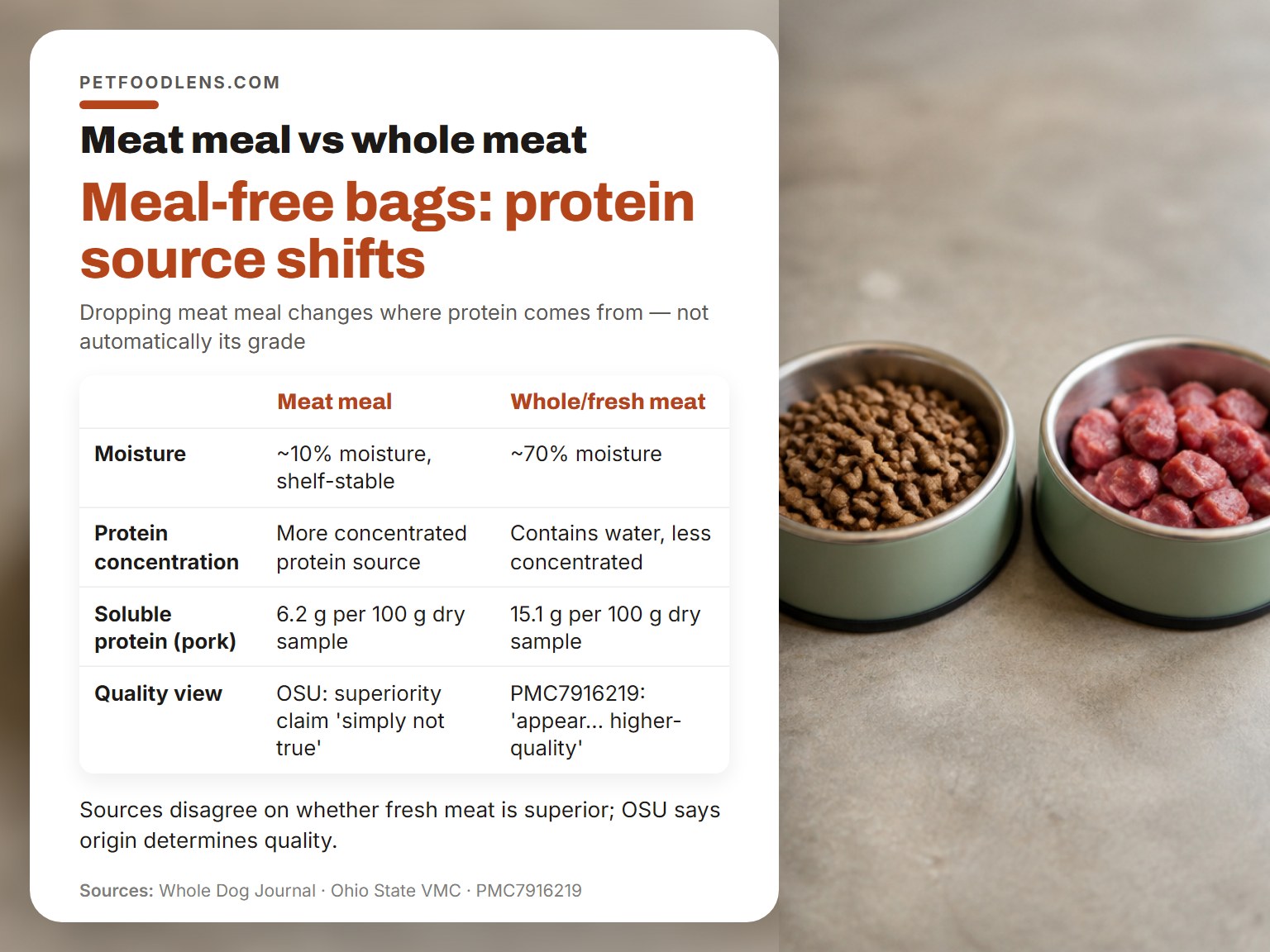
A formula with no meat meal still has to hit a protein number on the guaranteed analysis, and plants are how a lot of them get there.
Whole Dog Journal makes the point directly: meal-free dry foods frequently over-represent plant-sourced proteins, which carry a less desirable amino-acid profile for dogs, while PMC9219525 concluded fresh-meat-only kibble was the preferable choice. Dropping the meal changes where the protein comes from. It doesn’t automatically upgrade it.
The Split-Ingredient Tell
Watch for ingredient splitting on these bags. The pattern looks like this:
- Peas, pea protein, and pea fiber logged as three separate lines.
- A fresh meat at position one that is roughly 70% water.
- Plant proteins carrying the number, which Whole Dog Journal flags as a poorer fit for dogs.
- Rice swapped for potato and sold as an upgrade.
Meal-free describes the recipe. It says nothing about the grade.
Does This Play Out Differently for Cats?
Partly, and the difference shows up in the minerals more than the protein.
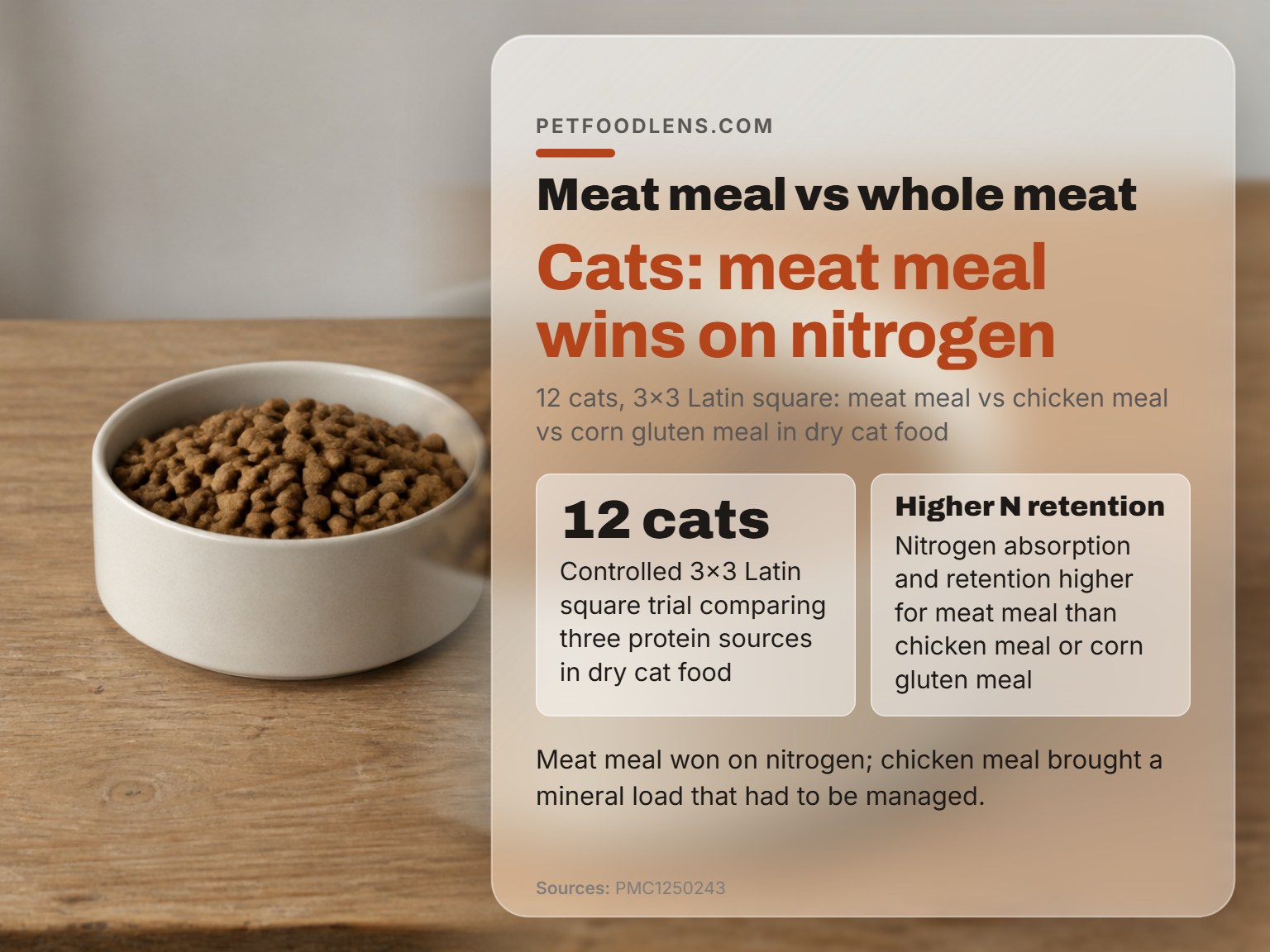
A controlled trial with 12 cats on a 3×3 Latin square design compared meat meal, chicken meal, and corn gluten meal in dry cat food. Meat meal produced higher dry-matter digestibility than corn gluten meal, plus higher nitrogen absorption and retention than either of the other two. The authors judged meat meal superior to corn gluten meal as a protein source.
That same trial is indexed as a meat meal feeding study abstract on PubMed.
There’s a wrinkle worth knowing. Chicken meal carries higher calcium and phosphorus than meat meal, which required some manipulation of dietary base excess to hold the urinary acid-base balance in range. The corn gluten meal group actually had lower urinary pH, lower struvite activity product, and fewer struvite crystals.
So the ranking isn’t a clean sweep. Meat meal won on nitrogen. Chicken meal brought a mineral load that had to be managed.
If you’re feeding a cat and weighing this out, a meat-based cat food still has to clear the same label checks as anything else. The form of the meat is one variable, and the rest of the formula is the bigger one.
Judge a cat food on the whole formula, not the one ingredient you recognize. Meat meal vs chicken meal is a mineral question as much as a protein question.
How to Read the Bag in 60 Seconds
Four checks, in this order.
- Find the AAFCO nutritional adequacy statement. It tells you which life stage the food is complete for. Skip it and you’re guessing whether “adult” on the front matches the feeding directions on the back.
- Note where meat and meal sit, then regroup the split ingredients. If peas, pea protein, and pea fiber all appear, count them as one entry before deciding what the main ingredient is.
- Convert the guaranteed analysis to dry matter. Two bags can both say 32% protein and mean very different things once you compare protein percentages on the same basis.
- Check whether the company publishes feeding trials. Ohio State recommends buying from a well-known company that stands behind its product with feeding trials and evidence.
Where People Get Stuck
Step three is the one that gets skipped. Converting to dry matter takes about thirty seconds with a calculator, and it’s the only way to put a canned food and a kibble on the same line.
That’s four checks and about a minute of work. The label doesn’t hide any of it. It just arranges it so you won’t look.
So Which One Should You Actually Buy?
Buy the formula your animal does well on, from a company that can show its work.
Meat meal vs whole meat in pet food is a smaller decision than the marketing around it suggests. If a bag lists both, Whole Dog Journal’s label math holds that the meal is probably carrying the protein load, while PMC7916219 measured higher soluble protein in fresh meat; the fresh meat is contributing water and a nicer front panel.
My own shortlist is boring: Royal Canin, Hill’s Science Diet, and Purina Pro Plan. That’s a preference, and I’ll say so plainly. Ohio State’s advice is to buy from a well-known company that stands behind its product with feeding trials and evidence, and those are the three I reach for when someone asks me to name names.
What I’d check before anything else:
- A named animal protein in the first three ingredients, in either form.
- A guaranteed analysis you’ve already converted to dry matter.
- An AAFCO statement that matches your animal’s life stage.
- A company that answers the phone when you call.
Skip this if: Your cat is on a prescription diet for kidney disease, urinary crystals, or a diagnosed food allergy. Nothing here overrides a therapeutic formula, and swapping one out on the strength of a label reading can undo months of management.
Skip the premium you’re paying for “fresh chicken first” on a dry food. That’s my read.
Frequently Asked Questions
Is meat meal worse than whole meat?
Not on the name alone. Ohio State’s veterinary guide says that belief is “simply not true” and that origin determines quality. Peer-reviewed assays do measure fresh meat higher on soluble protein and digestibility, so the honest answer is that the two sides are measuring different things.
Does meat meal contain hooves and horns?
The AAFCO definition excludes added hoof, horn, hair, hide trimmings, and manure, apart from unavoidable traces in good processing practice. The claim gets repeated because the word “meal” sounds industrial. The written definition doesn’t support it.
Why do some vets say meat meal is fine?
Because Ohio State VMC holds that a well-sourced meal is a concentrated protein source with most of the water and fat removed and can be included in larger quantities than whole meat in a dry formula, though PMC7916219 and PMC9219525 measured fresh meat higher on soluble protein and digestibility. That’s the position in Ohio State’s ingredient explainer, and it’s about what the material contributes to a finished recipe.
Is fresh meat better for cats than meat meal?
The cat trial data doesn’t settle it. Meat meal beat chicken meal and corn gluten meal on nitrogen absorption and retention, but chicken meal’s higher calcium and phosphorus required management of the urinary acid-base balance. Fresh-meat-only kibble in a separate study carried more taurine and amino acids.
Should I avoid meat meal if my dog has allergies?
I can’t answer that from a bag, and neither can a label. Diagnosed food allergies need a veterinarian’s workup, and the ingredient list won’t tell you which protein is the problem. That’s a conversation for your vet, not a label-reading exercise.
The Bottom Line
The trigger I’d give anyone: if a bag’s first ingredient is a fresh meat and there’s no meal anywhere on the list, look hard at positions three through six before you pay extra. That’s usually where the plant protein is doing the work the front panel is taking credit for.
This all assumes a healthy adult animal. If your cat has kidney disease, diabetes, or a diagnosed food allergy, the form of the meat is academic and the prescription is the answer. I’m not a vet, and I can’t manage those diets from a label.
Read the guaranteed analysis before the front of the bag. The front is a story about a farm. The back is a spreadsheet, and the spreadsheet is the part that feeds your animal.
