
High-Protein Dog Food Pros and Cons: What the Trials Show
This post contains affiliate links. As an Amazon Associate, we earn from qualifying purchases.
High-protein dog food delivers more protein per calorie, which supports lean muscle and helps overweight dogs feel full. But in a 2020 trial, healthy beagles fed 45.77% protein on a dry-matter basis for 90 days showed rises in serum and urine markers tied to inflammation and kidney stress. The pros are real. So are the caveats.
Dry-matter basis is the phrase that matters most here. A 30% protein claim on wet food means something different from 30% on kibble, because moisture dilutes the percentage. Convert both to the same moisture-free footing and the number on the front of the bag either holds up or it doesn’t. Understanding high-protein dog food pros and cons starts with this dry-matter comparison.
The rest walks through what the feeding trials actually measured: the muscle and satiety benefits, the kidney and gut signals that gave researchers pause, why protein source can matter more than protein percentage, and the specific situations where a high-protein bag is the wrong pick.
Key Takeaways
- 45.77% protein for 90 days raised inflammation and kidney-stress markers in 30 healthy beagles, per a 2020 trial.
- Protein source changes the gut outcome: chicken by-product meal produced lower digestibility and higher fecal ammonia than wheat or corn gluten in a 2023 study.
- Weight-loss evidence is mixed: one trial favored high-protein/high-fiber for satiety, another found plain high-fiber beat high-protein/high-fat in 73 home-setting dogs.
- Kidney risk is associative, not proven: the causal test was run in uninephrectomized geriatric dogs, a different population from your healthy adult.
- Dry-matter basis is the only fair way to compare a canned food to a kibble.
What “High-Protein” Actually Means on a Dog Food Label
The label term ‘high-protein’ has no legal definition, so the number itself is the only thing worth reading. The label term has no legal definition, so the number itself is the only thing worth reading.
Dry-matter basis expresses a nutrient as a percentage of the food after all moisture is removed. Dry-matter basis expresses a nutrient as a percentage of the food after all moisture is removed.
That conversion is not academic. The front-panel protein number often does not match the dry-matter number calculated from the guaranteed analysis. The gap usually arises because the bag is quoting as-fed.
AAFCO sets the floor, not the ceiling. The protein requirements for dogs published by AAFCO sit at 22% for growth and reproduction and 18% for adult maintenance on a dry-matter basis. Anything above that is a formulation choice, not a nutritional requirement.
Here is the order I run when I pick up a new bag:
- Find the guaranteed analysis, not the front panel. The guaranteed analysis is the legal minimum, and it’s the only number a manufacturer has to defend.
- Note the moisture percentage. If it’s above 20%, the food is wet or fresh and every other percentage needs conversion.
- Convert protein, fat, and fiber to dry-matter basis before comparing anything.
- Check the AAFCO adequacy statement. “Formulated to meet” and “feeding trial” are different levels of proof.
- Read the first five ingredients in order. That’s where the protein source actually lives.
Skipping step 3 is the single most common error I see. An owner compares a low-protein canned food to a higher-protein kibble, concludes the kibble is “more protein,” and misses that the canned food may be higher on the same footing.
The Real Benefits: Muscle, Satiety, and Weight Loss
Muscle retention is the strongest argument in the high-protein dog food pros and cons for an overweight dog. When a dog loses weight on a calorie-restricted diet, some of that loss comes from lean mass unless protein intake stays high enough to protect it.
A 24-week restricted-feeding study followed 12 spayed female dogs and recorded a 31.2% loss of initial body weight at 1.43% per week, with body condition score down 2.7 units and fat mass down 3.1 kg. That’s a large, well-tracked loss. The study didn’t isolate protein level as the driver, but the standard practice of feeding higher protein during weight loss exists precisely to protect the lean mass that fat loss doesn’t touch.
Satiety is the second benefit, and it has a timing surprise. A dog on a properly formulated high-protein, high-fiber diet often leaves food in the bowl. That’s not a problem. It’s the reduced voluntary intake showing up in your kitchen, and it’s the mechanism Weber et al. Measured in 2007.
The high-protein vs moderate-protein comparison matters here because the satiety effect isn’t linear. Pushing protein higher doesn’t double the fullness signal. It flattens out, and the extra protein gets fermented in the colon instead of used.
What the benefits actually look like on a bag:
- Lean mass retention during calorie restriction, which is the strongest evidence-backed reason to feed higher protein.
- Reduced voluntary intake on a high-protein, high-fiber formula, measured in a controlled trial.
- Better compliance on a weight-loss diet, because the dog stops begging as hard.
- A shinier coat in some dogs, though the evidence for that is thinner than the marketing suggests.
I spent years assuming the protein percentage on the front of the bag was the whole story. Then I started pulling ingredient panels and found high-protein foods where the bulk of the protein came from pea protein and potato concentrate rather than animal sources. The number looked the same. The food wasn’t.
Does High Protein Cause Kidney Damage in Dogs?
The honest answer to the high-protein dog food pros and cons is that we have association, not causation, in healthy dogs. That distinction matters because it’s the difference between “watch this” and “stop feeding it.”
What the 2020 Metabolomics Trial Found
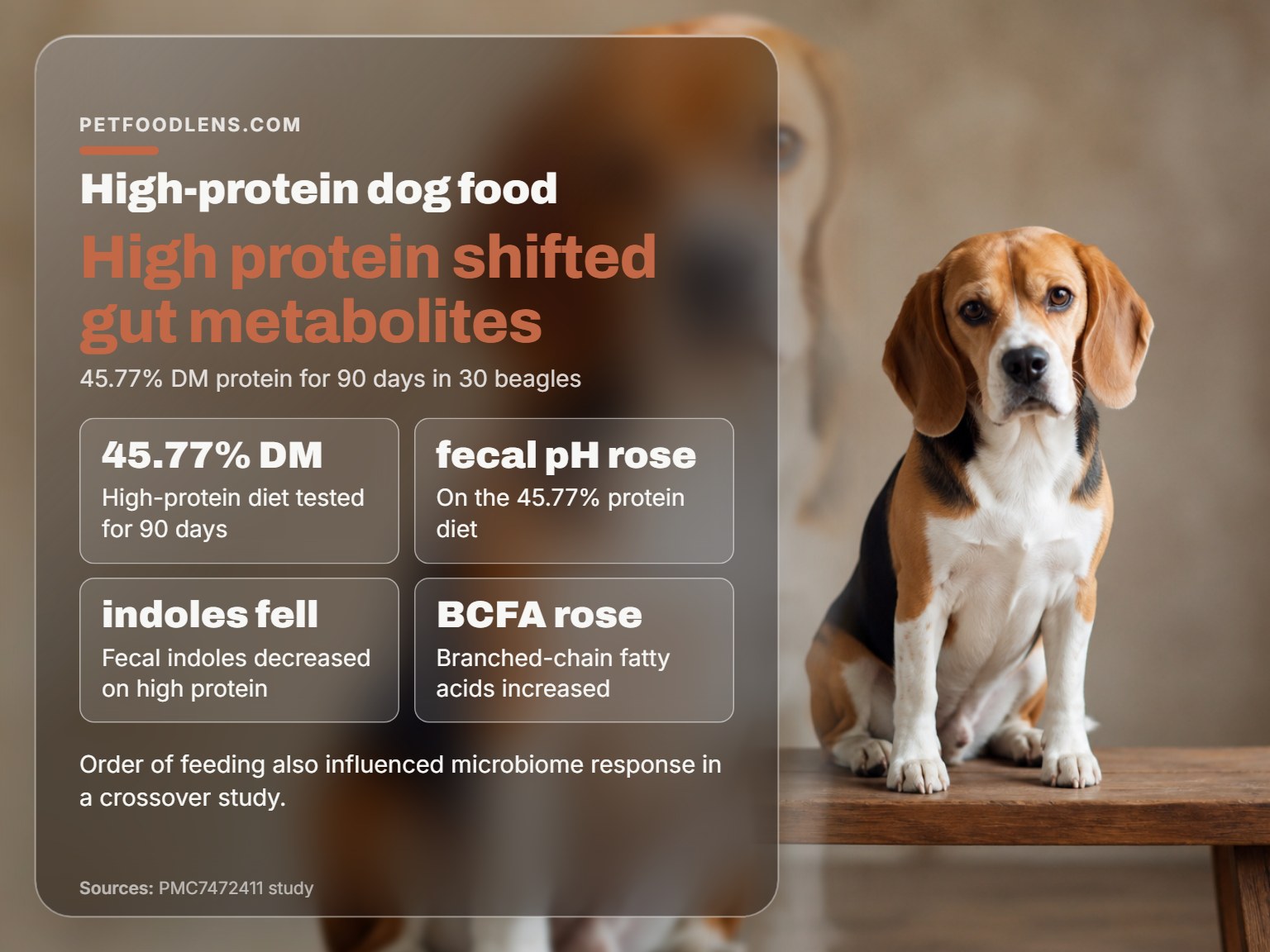
The 2020 study in PMC tracked 30 beagles (15 neutered males, 15 spayed females, aged 2 to 9 years, mean weight 11.3 kg) through 90-day periods at three protein levels: 18.99%, 25.34%, and 45.77% on a dry-matter basis. On the 45.77% diet, serum and urine markers of inflammation (9,10-DiHOME and 12,13-DiHOME) rose, along with kidney-dysfunction markers including urea and several indole sulfates. One-carbon metabolites fell, fecal pH rose, and branched-chain fatty acids climbed.
That’s a real signal. It’s also a biomarker shift, not a diagnosis. The study didn’t follow the dogs long enough to see clinical kidney disease, and it didn’t establish that the shift would progress. The protein levels and gut microbiome study is worth reading in full before you draw a conclusion from the abstract.
The causal question was tested separately, in a much narrower population. The aging and dietary protein in geriatric dogs research used uninephrectomized geriatric dogs, meaning dogs that had one kidney surgically removed and were already old. That’s a disease-model intervention, not a healthy-adult feeding trial. The two studies don’t answer the same question, and merging them into “high protein causes kidney disease” is a category error.
Before you start: A dog with diagnosed kidney disease, pancreatitis, or a history of calcium oxalate stones needs a vet-formulated diet, not a bag swap. High-protein foods can worsen all three. If your dog is on a prescription diet, do not switch without the prescribing vet’s sign-off.
Protein Source Matters More Than Protein Percentage
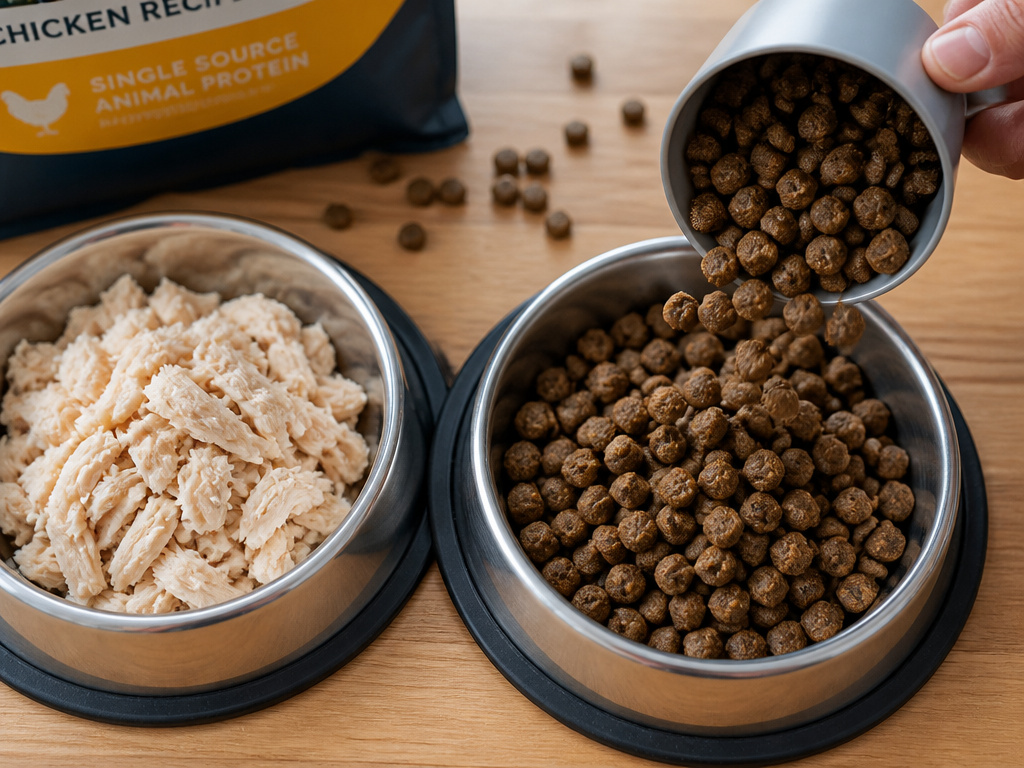
Chicken by-product meal and deboned chicken sit at opposite ends of the digestibility chart in a 2023 Journal of Animal Science trial. Same protein percentage, different physiological outcome.
The trial used 12 spayed female beagles (9.9 kg, 6.3 years) in a 4×4 Latin square with four isonitrogenous extruded diets: deboned chicken (DC), chicken by-product meal (CBPM), wheat gluten meal (WGM), and corn gluten meal (CGM). Each period ran 22 days of adaptation plus 5 days of fecal collection plus 1 day of blood collection.
Chicken Meal vs Fresh Chicken: The Digestibility Gap
The CBPM diet produced lower organic matter, crude protein, and energy apparent total tract digestibility than every other diet tested. It also produced higher fecal indole than the wheat gluten diet and higher fecal ammonia than both the wheat and corn gluten diets.
The PMC study on high-protein diets in dogs concluded that deboned chicken provided the highest quality protein without additional amino acid supplementation. That’s the quality winner. But the same paper reported that animal-based diets (both DC and CBPM) produced higher fecal proteolytic metabolites than the plant-based wheat gluten meal, even though DC scored highest on protein quality.
Quality and gut outcome point in different directions. That’s not a contradiction. It’s a reminder that “high protein” is a category, not a guarantee.
| Protein Source | Digestibility | Fecal Ammonia | Quality Verdict |
|---|---|---|---|
| Deboned chicken (DC) | Highest of the four | Higher than plant-based | Highest quality, no AA supplementation needed |
| Chicken by-product meal (CBPM) | Lowest of the four | Higher than WGM and CGM | Adequate but less digestible |
| Wheat gluten meal (WGM) | Mid-range | Lower than animal-based | Lower proteolytic load |
| Corn gluten meal (CGM) | Mid-range | Lower than animal-based | Lower proteolytic load |
I’ve watched owners pay more for a bag that lists “fresh chicken” first, when the same formula’s chicken meal contributes more actual protein per cup. Fresh chicken is mostly water before cooking. Chicken meal is already concentrated. If you’re comparing two bags by the first ingredient, you’re comparing water content, not protein.
The best high-protein dog food roundup covers the specific formulas in more detail.
Why High-Protein Diets Sometimes Backfire in the Gut
Picture a dog on a high-protein kibble whose stool goes soft, then firms up. That pattern shows up in the trial data, and it has a mechanism.
When protein escapes digestion in the small intestine, it reaches the colon and gets fermented by bacteria that produce ammonia, branched-chain fatty acids, and indoles. Those are the proteolytic metabolites. They’re not inherently harmful, but they shift the colonic environment away from the saccharolytic (carbohydrate-fermenting) pattern that produces short-chain fatty acids like butyrate.
A high-protein kibble that’s fermenting hard in the colon produces stool that smells sharply of ammonia, not the usual earthy odor. That’s the smell test, and it’s more reliable than most owners realize.
The 2020 metabolomics trial recorded exactly this shift: fecal pH rose, indoles and short-chain fatty acids fell, and branched-chain fatty acids climbed on the 45.77% diet. The dietary protein impact on dog microbiomes is the paper to read if you want the metabolite-by-metabolite detail.
The Order-of-Feeding Problem
The high protein versus hydrolyzed diet crossover study added a wrinkle that most “diet X causes Y” claims ignore. In a crossover design where dogs were fed sequentially through high-protein, hydrolyzed-protein, and high-fiber diets, the fecal microbiome response was influenced by the order in which the diets were fed.
That’s a design artifact, but it’s also a real-world phenomenon. If your dog transitions from a high-fiber food to a high-protein food, the microbiome shift you see on day 30 is partly the new diet and partly the departure from the old one. Owners who switch foods every few months and blame the newest bag for every stool change are reading noise as signal.
What most people get wrong: Blaming a single bag for a gut upset that started three foods ago. Crossover trials show order effects can influence the microbiome response. Give a new food time before you draw a conclusion.
If you’re shopping dry foods specifically, the high-protein dry dog food picks are a reasonable starting list. The formulas that combine animal-based protein with a moderate fiber source tend to produce fewer of the proteolytic signals above.
High-Protein vs High-Fiber for Weight Loss: Which Wins?
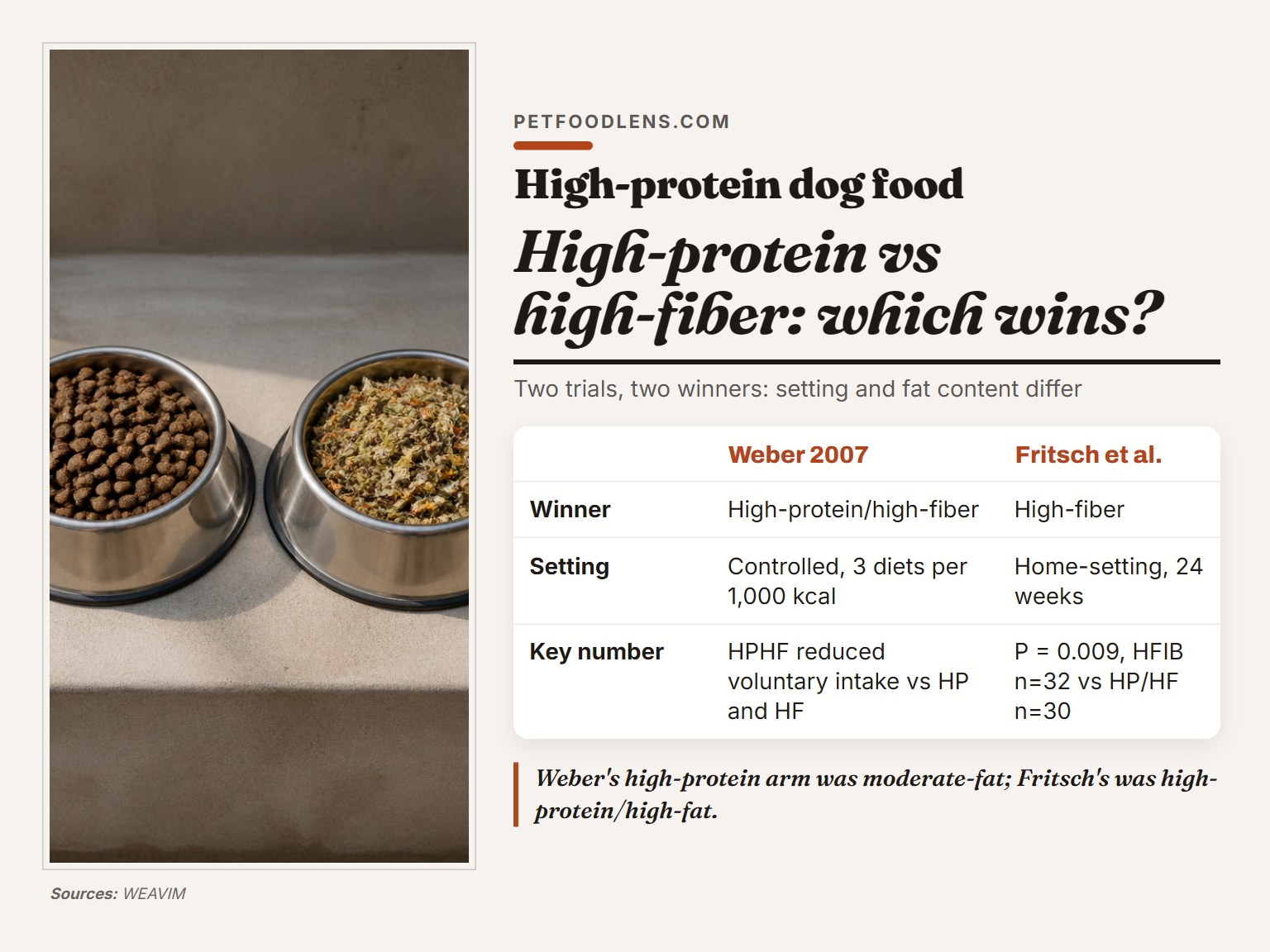
Two well-designed trials, two different winners. That’s not a research failure. It’s a real disagreement about which lever matters most.
Weber et al. (J Vet Intern Med, 2007) tested three diets specified per 1,000 kcal: high-protein/high-fiber (103 g protein + 60 g fiber), high-protein (104 g protein + 35 g fiber), and high-fiber (86 g protein + 87 g fiber). Protein digestibility ran 81.1% on both high-protein arms and 77.7% on the high-fiber arm. The high-protein/high-fiber diet reduced voluntary intake versus the other two and improved compliance.
Fritsch et al. (J Am Res Vet Med) ran a 24-week randomized blinded home-setting trial in 73 client-owned dogs. A high-fiber food produced more weight loss than a high-protein/high-fat food, at P = 0.009, with 32 dogs on the high-fiber arm and 30 on the high-protein/high-fat arm.
| Trial | Winner | Population | Key Number |
|---|---|---|---|
| Weber 2007 (J Vet Intern Med) | High-protein/high-fiber | Controlled, 3 diets per 1,000 kcal | Reduced voluntary intake vs HP and HF |
| Fritsch et al. (JARVM) | High-fiber | 73 home-setting dogs, 24 weeks | P = 0.009, HFIB n=32 vs HP/HF n=30 |
The difference is fat content and setting. Weber’s high-protein arm was moderate-fat. Fritsch’s was high-protein/high-fat. In a home setting where owners control portions loosely, the extra fat calories in the high-protein/high-fat food likely erased the protein advantage. In a controlled setting where intake is measured, the protein-and-fiber combination held up.
That’s the honest reading. If you’re feeding a home-setting weight-loss diet and portions are eyeballed, high-fiber alone may beat high-protein/high-fat. If you’re measuring portions and want satiety, high-protein/high-fiber has the edge.
The high-protein high-fiber weight loss study tracked 12 spayed females through 24 weeks of restricted feeding and recorded a 31.2% body weight loss, 1.43% per week, with body condition score down 2.7 units and fat mass down 3.1 kg. Despite large taxonomic shifts in the gut microbiome, the researchers did not observe dysbiosis in the overweight dogs. Compositional change is not the same thing as disease.
I won’t recommend a high-protein/high-fat food for a home-setting weight-loss plan. The Fritsch data is too clean on that point. If you’re not measuring portions, high-fiber does more work than protein percentage.
For owners who prefer wet food, the high-protein wet dog food options deliver the moisture benefit alongside the protein. That combination is worth more than the protein number alone.
When High-Protein Dog Food Is the Wrong Choice
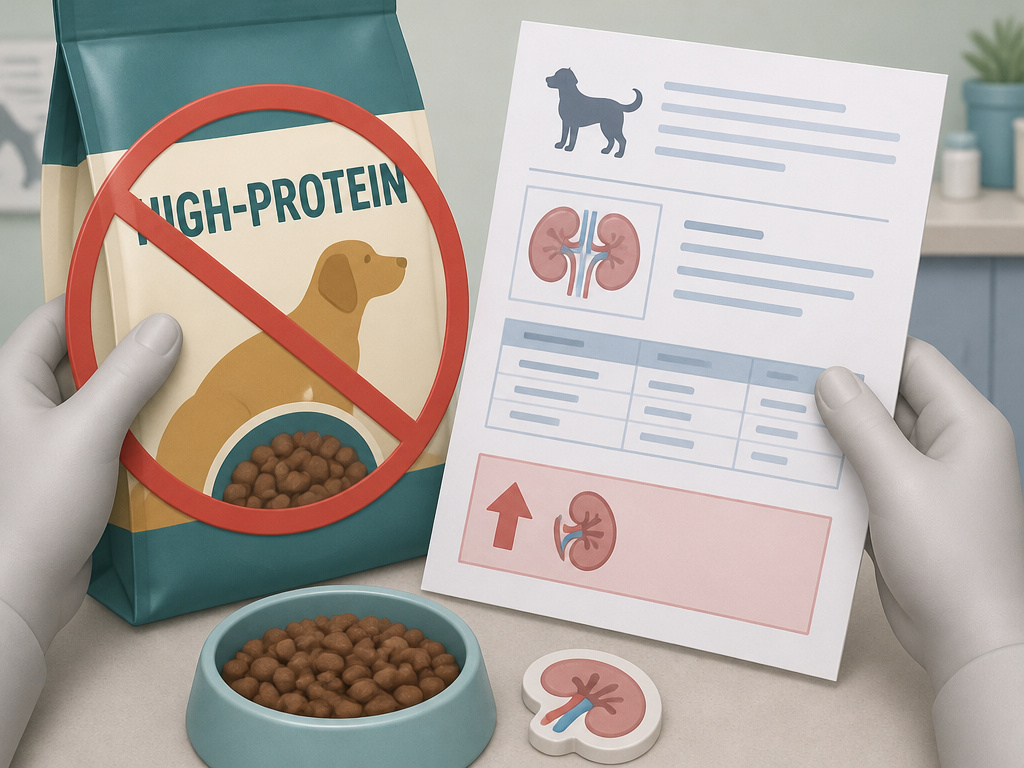
Advanced kidney disease is the clearest case. A dog with diagnosed kidney disease needs a vet-formulated diet, not a bag swap, and the “high-protein” badge on the front of the bag should be read against the diagnosis the vet has already given.
Skip high-protein if any of the following apply:
- Diagnosed chronic kidney disease. A vet-formulated diet is needed, and a high-protein bag works against it.
- A history of pancreatitis. High-fat and high-protein often travel together, and the fat load is the bigger trigger.
- Calcium oxalate stone history. A vet-formulated diet is needed, not a bag swap.
- A senior dog with unmanaged comorbidities. The geriatric kidney question is real, even if the causal evidence is thin.
- A dog who’s already at ideal weight with no muscle-loss risk. The benefit of pushing protein higher is small in a dog that isn’t losing weight.
I’m not a veterinarian, and I can’t diagnose kidney disease. What I can do is read a label against a diagnosis the vet has already given. If the vet says “moderate protein,” a 45% dry-matter kibble is the wrong bag regardless of how good the ingredient panel looks.
The rule I use: protein percentage is a tool, not a virtue. A moderate-protein food that matches your dog’s life stage and health status beats a very-high-protein food that doesn’t, every time.
Frequently Asked Questions
Is high-protein dog food bad for senior dogs?
Not automatically. The geriatric kidney concern comes from a study in uninephrectomized dogs, which is a different population from a healthy senior. A healthy older dog with normal kidney values can usually stay on a moderate-to-high protein diet. A senior with diagnosed kidney disease should be on a vet-formulated restricted-protein diet.
How much protein does a dog actually need?
AAFCO sets the minimum at 22% dry-matter for growth and reproduction and 18% for adult maintenance. Most active adult dogs do well between 25% and 30% dry-matter. Performance and weight-loss diets push higher, but the benefit of very high protein is not well established in healthy dogs.
Can high-protein food cause diarrhea in dogs?
It can, especially during the transition. Higher protein means more substrate for colonic fermentation, which raises proteolytic metabolites and can soften stool for the first few weeks. A gradual transition period usually resolves it. Persistent diarrhea past 8 weeks warrants a vet visit, not another food swap.
Is grain-free the same as high-protein?
No. Grain-free is a marketing category, not a protein claim. Many grain-free dog foods swap corn for peas, potato, or tapioca, and the protein percentage barely moves. Read the guaranteed analysis, not the grain-free badge.
Should I switch my dog to high-protein food for weight loss?
Only if you’re measuring portions. The Fritsch trial found that a plain high-fiber food beat a high-protein/high-fat food in home-setting dogs. The Weber trial found high-protein/high-fiber reduced voluntary intake in a controlled setting. If you’re eyeballing portions, high-fiber is the safer bet. If you’re weighing food, high-protein/high-fiber is a reasonable choice.
The Bottom Line
The threshold I’d use: if your dog is a healthy adult at ideal weight with normal kidney values, a food above the AAFCO adult maintenance minimum covers the muscle and satiety benefits without pushing into the 45.77% territory where the 2020 trial saw those biomarker shifts. At very high protein levels, you need a specific reason (intense performance, diagnosed muscle loss, a vet’s instruction) to justify the extra load.
That’s a concession to the data, not a retreat from it. I still think protein percentage matters. I just think it matters less than protein source, total calorie balance, and whether the food matches the dog in front of you. A moderate-protein food built on deboned chicken and chicken meal may outperform a very-high-protein food built on plant protein concentrates in most dogs, and it’ll do it without the colonic ammonia load.
Start with the label, not the slogan. Convert to dry-matter, check the AAFCO statement, and read the first five ingredients in order. If the bag passes those three checks and matches your dog’s health status, the protein percentage is a detail. If it fails any of them, the percentage on the front is the least interesting number on the package.
