
How to Attract Hummingbirds to a Feeder: Step-by-Step
This post contains affiliate links. As an Amazon Associate, we earn from qualifying purchases.
To attract hummingbirds to a feeder, mix 1 part refined white sugar to 4 parts water, hang it in shade near trees, and clean it every other day (the Smithsonian’s schedule; NWF says daily or every other day in hot weather). Skip red dye. Place the feeder within 3 feet of a window or past 25 feet to cut collision risk.
That ratio is the one number every agency I checked agrees on. The Smithsonian, University of Illinois Extension, and Cornell Lab all land on the same 1:4 sugar-to-water proportion. Cornell adds a cold-weather exception the others don’t mention, and I’ll get to that.
What follows covers the parts the ratio can’t: feeder type, exact placement distance from glass, the cleaning schedule that keeps mold out of the sugar water, and the how to attract hummingbirds to a feeder question of why red dye in the nectar is a marketing decision rather than a bird one.
Key Takeaways
- Mix 1 part sugar to 4 parts water by volume. Cornell allows up to 1/3 cup sugar per cup water only in cold, rainy weather.
- Clean every other day per the Smithsonian, while the National Wildlife Federation says daily or every other day in hot weather.
- Skip red dye in the nectar. All three agencies I checked say it adds nothing and can harm birds.
- Hang within 3 feet of glass or past 25 feet. The 3-25 foot band is the collision danger zone per NWF.
- Pick a feeder you can fully disassemble. Cornell calls easy cleaning the single most important feature.
The 1:4 Ratio and Why Stronger Mixes Backfire
The 1:4 ratio is the one number every agency I checked agrees on. The Smithsonian, University of Illinois Extension, and Cornell Lab all recommend 1 part sugar to 4 parts water by volume. Cornell phrases it as 1/4 cup sugar per cup of water, which is the same thing.
The 1:4 sugar-to-water ratio by volume is the mix the Smithsonian, University of Illinois Extension, and Cornell Lab all recommend. A stronger mix ferments faster in warm weather, and fermented sugar water grows mold that can harm hummingbirds. Clean feeders and fresh solution are the two variables that matter most.
A stronger mix doesn’t feed birds better. It ferments faster because the extra sugar feeds yeast and bacteria more quickly. That’s why Cornell caps the standard mix at 1/4 cup per cup and only allows the stronger version in cold weather.
Cornell does allow two exceptions. In cold, rainy weather, you can go up to 1/3 cup sugar per cup of water. If insects are a problem, 1/5 cup per cup of water may discourage them without losing the birds. Both are Cornell’s guidance specifically, not the other agencies’.
Here’s how to make a batch:
- Bring water to a boil. Cornell specifies unsoftened, non-distilled water. Softened tap water carries extra sodium; distilled water lacks minerals hummingbirds get elsewhere.
- Stir in refined white sugar at 1 part sugar to 4 parts water. A quarter cup of sugar per cup of water is the same ratio.
- Stir until dissolved, then cool to room temperature. NWF says let it cool before filling the feeder.
- Store leftovers in the fridge for no more than one week. Smithsonian and NWF both cap it at a week. Throw it out if you see mold.
Stick to refined white sugar. The Smithsonian specifies refined white, and Cornell specifies granulated cane sugar. If you want the full walk-through on batch sizes and storage, this how to make hummingbird nectar guide covers it step by step.
How Often to Clean a Hummingbird Feeder?
The Smithsonian says every other day, and the National Wildlife Federation says daily or every other day in hot weather. Those aren’t the same schedule, and the gap matters when it’s 95 degrees outside.
Here’s how the three retrievable sources line up:
| Source | Hot weather | Milder weather |
|---|---|---|
| Smithsonian National Zoo | At least twice a week | Once a week |
| National Wildlife Federation | Daily or every other day | About every three days |
| Cornell Lab of Ornithology | “Fairly often” (no interval given) | Same |
The Smithsonian’s baseline is every other day, with a floor of twice a week in summer and once a week in cooler weather. NWF escalates to daily cleaning in heat and stretches to about every three days when it’s mild. Cornell doesn’t publish an interval, just “fairly often.”
My take: follow the tighter schedule. If the Smithsonian says twice a week and NWF says daily in heat, cleaning daily in hot weather costs little and removes the risk. The cost of getting it wrong is a mold bloom that can harm the birds.
I won’t run a hummingbird feeder through a heat wave on a twice-a-week schedule. The Smithsonian number is a floor, not a target. In hot weather, I clean daily and refill with fresh solution.
The Deep Clean for Mold
If you see black specks, cloudy water, or slime on the feeding ports, you’re past a routine clean. NWF recommends a 1:2 vinegar-to-warm-water soak for a few hours, then a thorough rinse and refill. Hot water, a weak vinegar solution, and a bottle brush handle the routine clean. Skip soap entirely; NWF warns it leaves a residue that can harm birds.
Cornell’s test is simpler. If you can’t reach every inside surface with a bottle brush, the feeder will foster bacteria and fungi. That’s the feature to check before you buy, not after.
A feeder that’s about to go bad can look fine from a distance. Up close, the water has a faint cloudiness and the ports feel slick.
Which Feeder Type Actually Works?
Buy a feeder you can take completely apart. Cornell calls easy cleaning the single most important feature, and after that everything else is preference.
| Feeder type | Best for | Watch out for |
|---|---|---|
| Basin or saucer | Discouraging wasps | Holds less nectar |
| Tube | Visibility and capacity | Harder to clean ports |
| Bottle with bee guards | Cheap entry point | Yellow guards attract wasps |
Basin Feeders
Basin feeders hold the sugar water in a shallow dish with feeding ports on top. Cornell recommends them specifically because the nectar sits too far inside for wasps to reach, while hummingbird tongues have no trouble.
A basin feeder that disassembles for cleaning is the classic example.
Tube Feeders
Tube feeders hang vertically with ports along the side. They’re easy to see from a window and hold more nectar, which is good if you have a lot of birds and bad if you have two. NWF recommends a feeder the birds empty in about 2-3 days; a feeder that takes much longer is too big.
I’d rather have a feeder that comes apart easily than one that holds a large volume.
Saucer Feeders
Saucer feeders are basin feeders by another name, and the distinction is mostly marketing. What matters is whether the lid comes off and whether a bottle brush fits through the ports. Choose a saucer feeder whose lid comes off and whose ports a bottle brush fits through.
If you’re comparing specific models, this best hummingbird feeder breakdown covers the trade-offs between basin, tube, and saucer designs.
Where Should You Hang a Hummingbird Feeder?
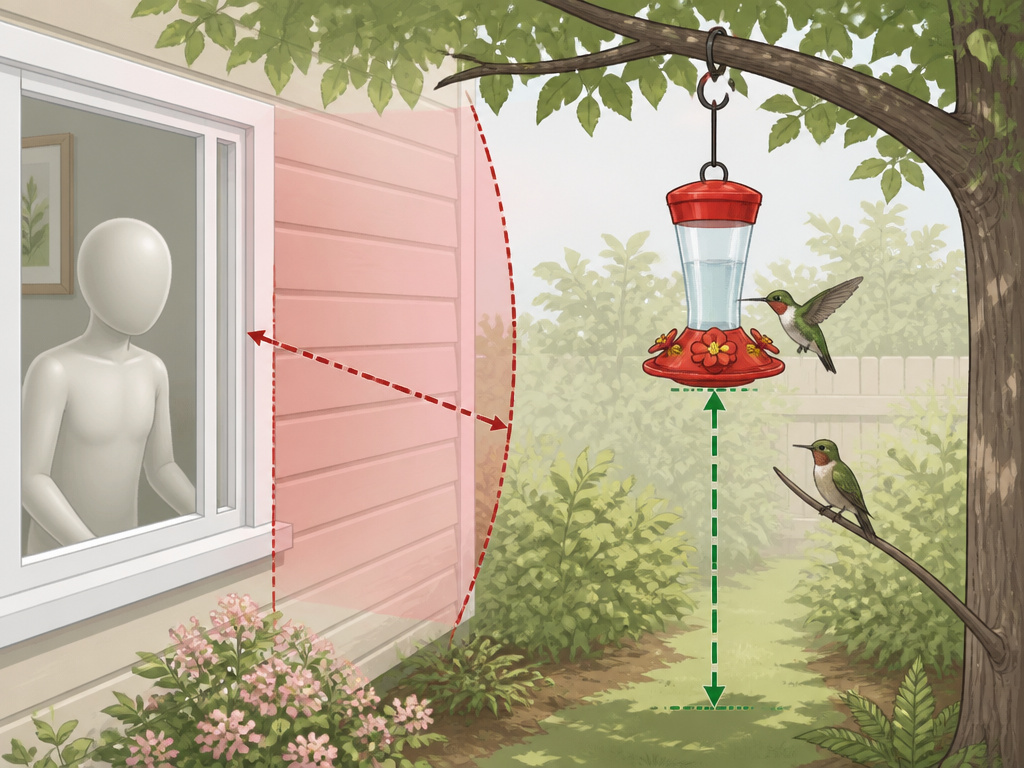
For how to attract hummingbirds to a feeder, hang it in shade, near trees, and either within 3 feet of a window or past 25 feet. That last number is the one most people get wrong.
NWF identifies the 3-25 foot band from a window as the high-risk collision zone. Birds approaching the feeder at speed don’t see the glass until it’s too late. Within 3 feet, they’re close enough to notice the window and slow down. Past 25 feet, they have time to adjust.
Illinois Extension adds a height rule: at least 4 feet above the ground, out of reach of cats and snakes. The Smithsonian says place the feeder near trees, because hummingbirds are territorial and like to perch nearby to chase off intruders.
Here’s the placement checklist:
- Shade, not full sun. Illinois Extension says sun speeds fermentation. The Smithsonian says shade.
- Within 3 feet of glass or past 25 feet. The 3-25 foot band is the collision zone.
- At least 4 feet off the ground. Keeps cats and snakes out of reach.
- Near a tree or shrub for perching. Hummingbirds rest between feeds.
- Visible from a window you actually look out of. NWF recommends a spot where you can observe activity.
Pick a spot in shade, not full sun. You want the feeder visible from a window you look out of, with a tree or shrub nearby for perching.
The birds found it, but the owner couldn’t see them from the house, which defeats half the point. This feeder placement guide covers the sight-line question in more detail.
Keeping Wasps, Ants, and Bullies Away
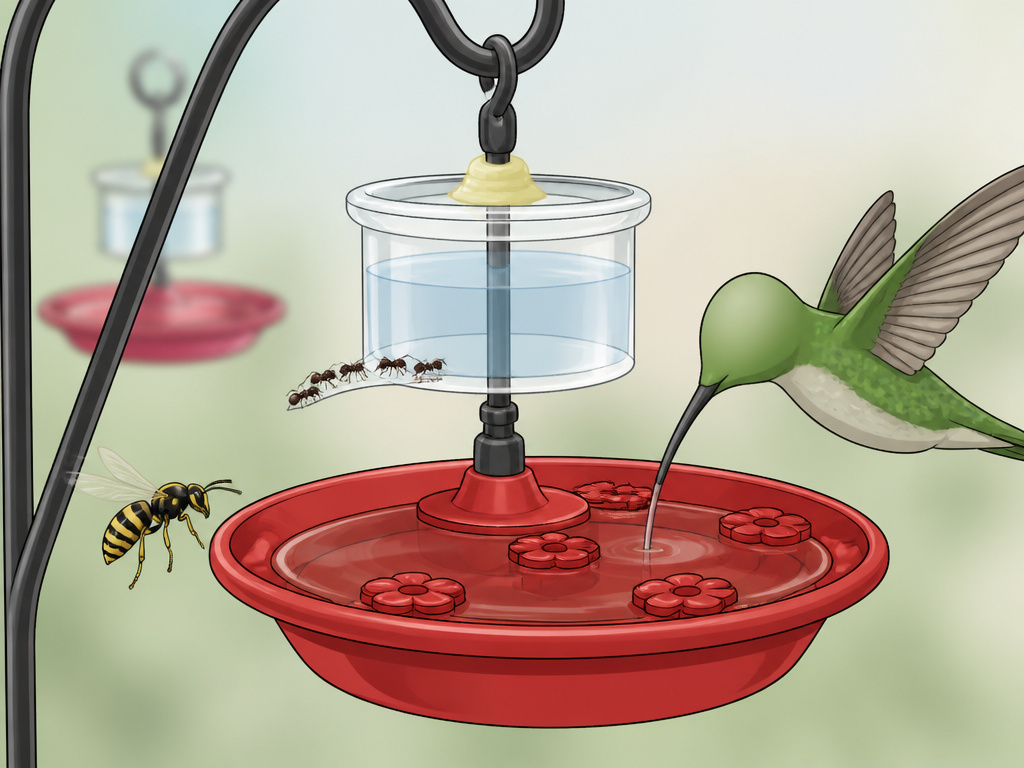
Cornell has the best wasp advice I’ve seen: skip the yellow bee guards. Yellow jackets are attracted to yellow, so a yellow guard on the feeder ports can pull more wasps in than it keeps out.
Basin feeders are the better structural fix. The sugar water sits deep enough inside the dish that a wasp’s body can’t reach it, while a hummingbird’s long tongue can.
For ants, Cornell recommends filling ant moats with plain water. The moats also help chickadees and other small birds that drink from them. A dab of petroleum jelly around the hanging wire keeps crawling insects from reaching the feeder. If ants are already a problem, this keep ants out of bird feeders guide walks through the full setup.
For bullies, Illinois Extension says hang multiple feeders around the yard. A single dominant male can lock out every other bird at one feeder; multiple feeders spread around the yard split his attention.
If wasps are the main problem and you want to solve it at the feeder level, this keep bees away from hummingbird feeders guide covers the design trade-offs.
How to Attract Hummingbirds to a Feeder: Mistakes to Avoid
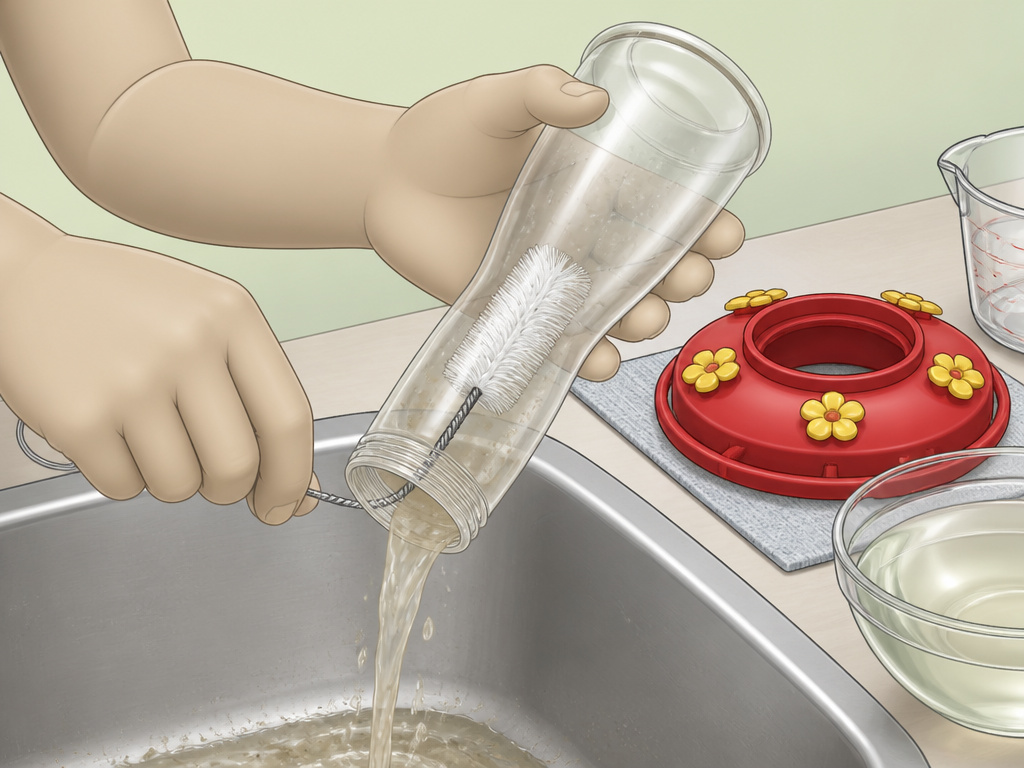
Common mistake: Topping off the feeder without cleaning it. Over time, the bottom of the feeder becomes a fermenting layer the birds drink through. Empty it, scrub it, refill it.
The Red Dye Question
All three agencies say skip red dye in the nectar. The Smithsonian says it isn’t necessary and could be harmful. NWF says never use red nectar solutions. Illinois Extension says it adds no nutritional value.
The red on the feeder housing is a different question. Cornell and NWF both say a feeder with red parts helps birds find it, because hummingbird-pollinated flowers are often red. Illinois Extension says hummingbirds key on bright reds, pinks, lavenders, and blues, and are less attracted to white or yellow blossoms.
Topping Off Without Cleaning
This is the mistake I see most often. A feeder that gets topped off repeatedly without a scrub has a layer of old sugar water at the bottom that’s fermenting under the fresh stuff. The birds drink from the ports, which are at the top, so the owner never sees the problem.
Empty the feeder, scrub it, rinse it, refill it. Every time.
Placing the Feeder in Full Sun
Illinois Extension says sun speeds fermentation. The Smithsonian says shade. A feeder in direct afternoon sun will spoil faster than the same feeder in dappled shade, and the cleaning schedule that works in shade will fall short in sun.
Frequently Asked Questions
Can I use honey or raw sugar instead of white sugar?
No. Stick to refined white sugar. The Smithsonian specifies refined white sugar, and Cornell specifies granulated cane sugar. Honey isn’t on either list.
How long does homemade nectar last in the fridge?
One week, per both the Smithsonian and NWF. Throw it out sooner if you see mold.
Should I put red food coloring in the nectar?
No. All three agencies I checked say skip it. The Smithsonian says it isn’t necessary and could be harmful; NWF says never use red nectar; Illinois Extension says it adds no nutritional value.
How high should I hang a hummingbird feeder?
At least 4 feet above the ground, per Illinois Extension, to keep cats and snakes out of reach. Pair that with the window rule: within 3 feet of glass or past 25 feet, per NWF.
Do I need to take my feeder down in the fall to let hummingbirds migrate?
No. The Smithsonian calls this a myth. Hummingbirds migrate on an internal clock regulated by day length, not by food availability. Leaving a clean feeder up longer does no harm and can help stragglers.
Why are wasps all over my feeder?
Likely the feeder design. Cornell says yellow bee guards can attract yellow jackets, and tube feeders let wasps reach the ports. Basin feeders put the sugar water far enough inside that wasps can’t reach it. If you want the full federal and academic picture on backyard feeding, the USFWS backyard birds publication covers the broader context.
The Bottom Line
If you do one thing this week, throw out whatever is in the feeder now and scrub it with hot water and a bottle brush. The ratio gets all the attention, but the cleaning schedule is what determines whether birds keep coming back. A feeder cleaned on a tight schedule with a 1:4 mix will outperform a feeder cleaned less often with a perfect mix, every time.
This all assumes you can commit to the schedule. If you travel for extended periods in summer, a hummingbird feeder is probably the wrong choice for your yard. The birds will find it, drink from it, and then the sugar water will sit and ferment while you’re gone.
For the primary guidance, the Smithsonian hummingbird nectar recipe and the National Wildlife Federation feeder guide are the two documents I’d read first. The University of Illinois hummingbird tips cover the planting side, and the Missouri Extension hummingbird publication is another regional resource worth checking for Midwest arrival dates.
The practical takeaway: mix it 1:4, hang it in shade, clean it every other day, and skip the red dye. Everything else is a detail.
