
How to Make Hummingbird Nectar: The 1:4 Ratio Explained
This post contains affiliate links. As an Amazon Associate, we earn from qualifying purchases.
To make hummingbird nectar, stir 1 part plain white sugar into 4 parts water until the sugar dissolves. Use pure white cane sugar, skip the red dye, and refrigerate any leftover batch for no more than one week. That 1:4 ratio is the recipe published by the Smithsonian’s National Zoo and Texas Parks and Wildlife.
A hummingbird burns through that sugar water at a rate that sounds invented. Audubon puts the daily intake at half the bird’s body weight in nectar and insects, refueling every 10 to 15 minutes. Your feeder is a gas station on a highway with no other exits.
What follows walks the parts that actually change the outcome: the how to make hummingbird nectar ratio, the sugar, the boil question, the cleaning clock, and the feeder position that keeps birds off your window glass.
Key Takeaways
- 1 part sugar to 4 parts water is the base ratio that the Smithsonian and Texas Parks and Wildlife both publish.
- Skip the dye. Both the Smithsonian and the Hummingbird Society call red coloring unnecessary and potentially harmful.
- Change the feeder often in warm weather, and expect a full-sun feeder to turn in one to two days.
- Refrigerated nectar keeps one week, and any sign of mold ends it early regardless of the calendar.
- Pure white cane sugar only. Brown, raw, and organic sugars carry molasses, and the iron in molasses is toxic to hummingbirds.
How to Make Hummingbird Nectar: Getting the Ratio Right
Four organizations publish a hummingbird nectar recipe, and three of them land on the same numbers.
The base hummingbird nectar ratio is 1 part white sugar to 4 parts water by volume, which works out to 1 cup of sugar in 4 cups of water. The mixture is stirred until the sugar dissolves, with no dye added and no additional ingredients. Leftover batches are stored refrigerated and used within one week.
The Smithsonian’s National Zoo and Texas Parks and Wildlife both print that 1:4 mix. The International Hummingbird Society writes it the other way around, 4 parts water to 1 part sugar, which is the same recipe read backwards.
Cornell Lab of Ornithology takes a different angle. Its Cornell Lab nectar recipe article describes flower nectar as roughly comparable to a quarter to a third cup of sugar per cup of water.
Here is how the published numbers stack up.
| Source | Ratio | Distinguishing Note |
|---|---|---|
| Smithsonian’s National Zoo | 1 part sugar : 4 parts water | No boiling needed |
| Texas Parks & Wildlife | 1 part sugar : 4 parts water | Boil to slow fermentation |
| International Hummingbird Society | 4 parts water : 1 part sugar | Drops to 3 parts water in winter |
| Cornell Lab of Ornithology | 1/4 to 1/3 cup sugar per cup water | Varies with weather |
What Cornell’s Numbers Actually Mean
A quarter cup of sugar in a cup of water is 1:4. A third cup is closer to 1:3. So Cornell’s range runs from the standard mix upward, and the familiar 1:4 sits at the weak end of it.
That matters in heat. Cornell advises nothing stronger than a quarter cup per cup during hot, dry weather, when birds risk dehydration. In cold, rainy spells it allows up to a third cup.
Mixing is quick. Do it in this order.
- Measure 1 part sugar into 4 parts water. Eyeballing runs the mix strong, and a strong mix works against birds in hot weather.
- Stir or shake until the sugar fully dissolves. Undissolved crystals sink to the bottom of the feeder and sit there feeding nothing.
- Refrigerate the extra, one week maximum. Past that, the Smithsonian says to throw it out.
- Fill only what the birds will drink in a few days. Nectar still sitting after three days means the feeder was too full.
Keeping it fresh is where most feeders fail.
The Sugar Itself: White, Granulated, Nothing Else
Plain granulated cane sugar is the right product under a boring name.
The International Hummingbird Society is specific about this. The sugar must be pure white, not brown, raw, or organic, because those retain trace molasses. Molasses carries iron, and iron is toxic to hummingbirds at anything beyond the tiniest monitored amounts.
That is the mechanism worth understanding. Refined white sugar has had the molasses stripped out during processing. Raw and organic sugars have not, so the iron rides along into the feeder.
Smithsonian adds a second exclusion. Powdered sugar, also called confectioners’ sugar, often contains cornstarch, so it does not belong in a feeder.
What to leave in the cupboard:
- Brown sugar: molasses residue and an iron load.
- Raw or “natural” sugar: same problem, friendlier label.
- Organic sugar: the Hummingbird Society names this one directly.
- Powdered sugar: cornstarch, per the Smithsonian.
- Red dye: unnecessary and potentially harmful, per both organizations.
I’d rather see a feeder sit empty for an afternoon than see it topped up with raw sugar because that was what the cupboard had. The iron in molasses is the one mistake a hummingbird can’t taste and you can’t see.
The full list of what to put in a hummingbird feeder is two items long. Water and white sugar.
Buy the cheapest bag of white sugar on the shelf and you have bought the correct product. The expensive bags are not better here.
Should You Boil Hummingbird Nectar?
The Smithsonian’s National Zoo says boiling is unnecessary, while Texas Parks and Wildlife says to boil the mixture to slow fermentation.
Both are published by credible institutions, and they do not reconcile.
The Smithsonian hummingbird nectar recipe says to stir or shake until the sugar dissolves and stop there. The TPWD hummingbird feeding FAQ gives the opposite instruction, with fermentation named as the reason. Audubon uses boiling water to dissolve the sugar in the first place.
Texas Parks and Wildlife’s stated reason is fermentation, the same process that turns nectar cloudy and then sour. A boil knocks back the microbes that start it.
So the practical split is about storage, not about safety.
Boil when you plan to store the batch. Skip the boil when you are mixing a single feeder’s worth and changing it tomorrow.
My rule follows the same line. A big batch that goes into the fridge gets boiled. A cup mixed for tomorrow morning does not.
Worth knowing before you start: Boiling does not extend the Smithsonian’s one-week refrigerator limit. A boiled batch still gets thrown out after seven days, and sooner if mold shows.
How Long Does Hummingbird Nectar Last?
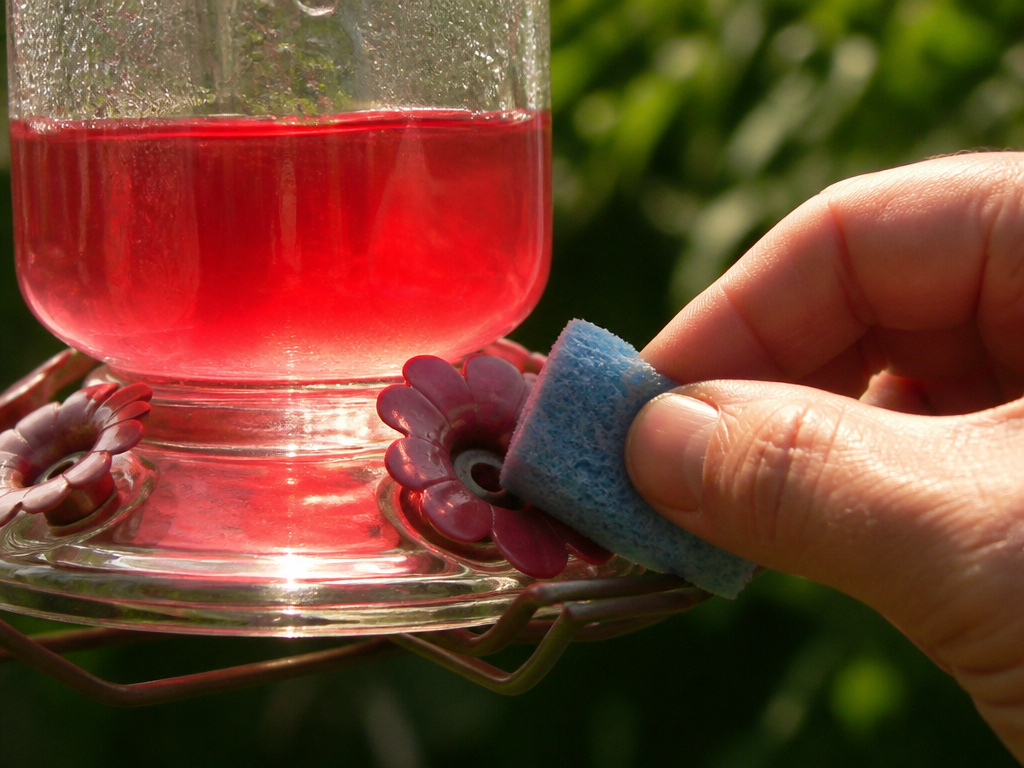
Three days is the International Hummingbird Society’s warning number. If nectar is still in the feeder after three days, you are putting in too much.
Storage and feeder time are two different clocks, and mixing them up is common. In the fridge, sugar water keeps for no more than one week, per the Smithsonian. Any mold in that container means the whole batch goes, even on day two.
In the feeder, the clock runs faster.
| Condition | Change Interval | Source |
|---|---|---|
| Shaded feeder, mild weather | Every other day | Smithsonian |
| Summer heat | Every other day, more often in a heat wave | Smithsonian |
| Full sun all day | One to two days | International Hummingbird Society |
| Still full after three days | Fill less next time | International Hummingbird Society |
The Three-Day Rule
Cloudy liquid or visible mold means washing the feeder right away, per the Hummingbird Society. It also means the schedule slipped. Their point is blunt: clean often enough that a feeder never reaches that state.
A feeder in full sun all day may not stay suitable for more than a day or two, per the Hummingbird Society. A feeder hanging in full sun all day may not stay suitable for more than a day or two, per the Hummingbird Society.
That is the honest version of the how often to change nectar question. Sun exposure shortens the interval more than air temperature does.
Feeder Placement and the 25-Foot Window Rule
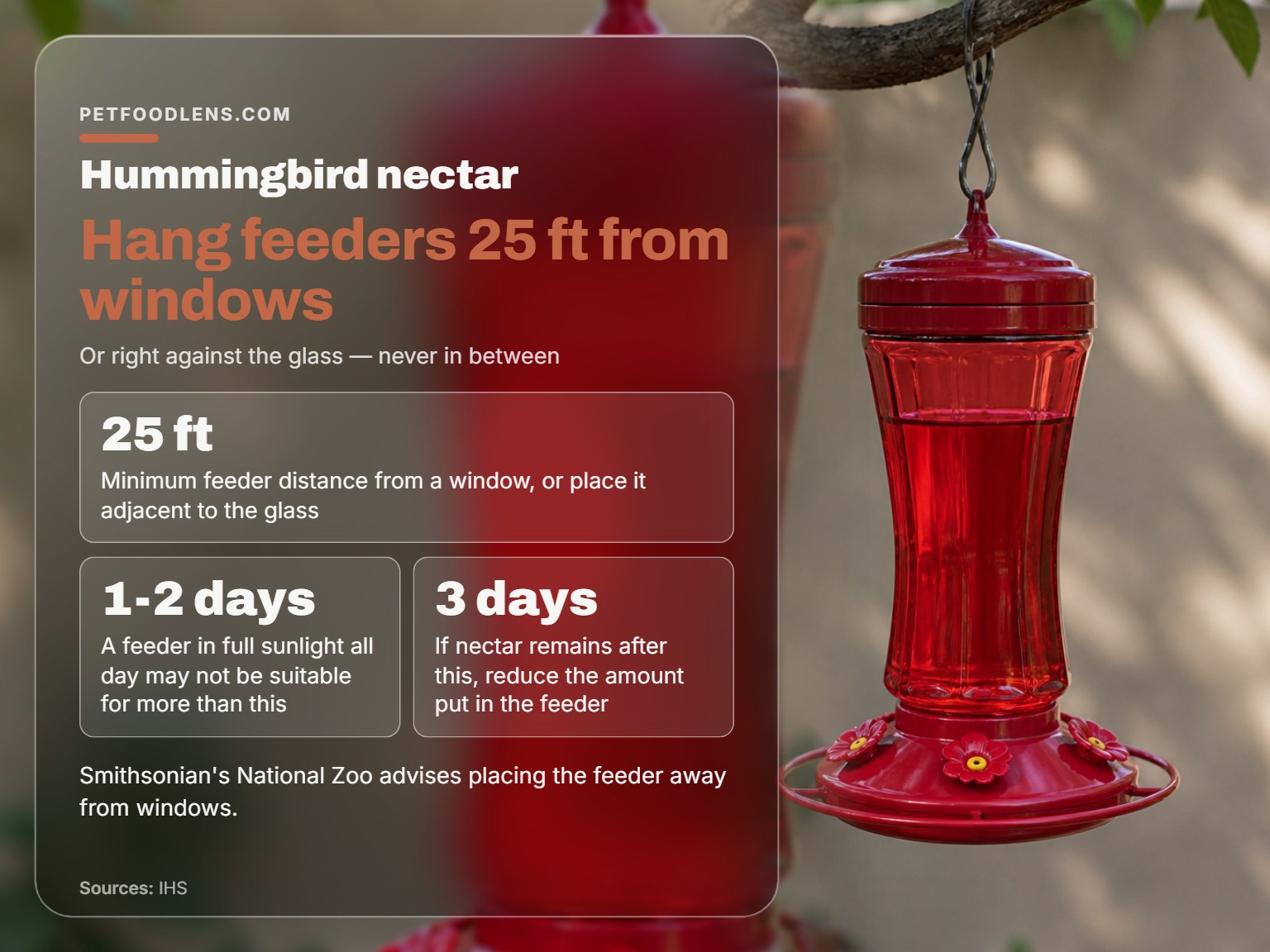
Window collisions are one of the major killers of hummingbirds, according to the International Hummingbird Society feeding guide. That single fact drives the placement rule.
The International Hummingbird Society’s rule is specific: hang the feeder at least 25 feet from the window, or right up against the glass, not in between, while the Smithsonian’s National Zoo advises placing the feeder away from windows. A feeder parked in the middle distance is the setup that produces strikes, because a bird leaving it builds speed before it sees the reflection.
The Smithsonian’s placement advice covers the rest. Shade, away from high-traffic areas, near trees where birds can perch and watch the feeder.
Picking a Feeder That Doesn’t Drip
A shallow saucer feeder with the ports sitting above the nectar line is exactly the design the Hummingbird Society asks for. Drips attract ants, bees, and wasps, and ports above the pool stop the drips.
Basic red feeders cover the budget end. Check one thing before you hang it: red parts, ports above the liquid, and no white or yellow shell.
- Ports above the pool of liquid: fewer drips, fewer ants.
- Red, not white or yellow: white and yellow feeders pull ants, bees, and wasps.
- Red ribbon or a silk flower if the feeder has no red on it at all, per Texas Parks and Wildlife.
- Two feeders instead of one if you have a crowd, which cuts territorial squabbling.
Easy to miss: A feeder hung close to an active nest invites territorial fights. The Hummingbird Society warns those fights can endanger the nest itself.
If wasps have already found your feeder, the fix is usually a bee deterrent plus a shorter fill, not a new location. And if birds are not showing up at all, the problem is often planting rather than the feeder itself, which is why the attract hummingbirds checklist starts with flowers.
Winter, Heat, and the Ratio Changes Nobody Agrees On
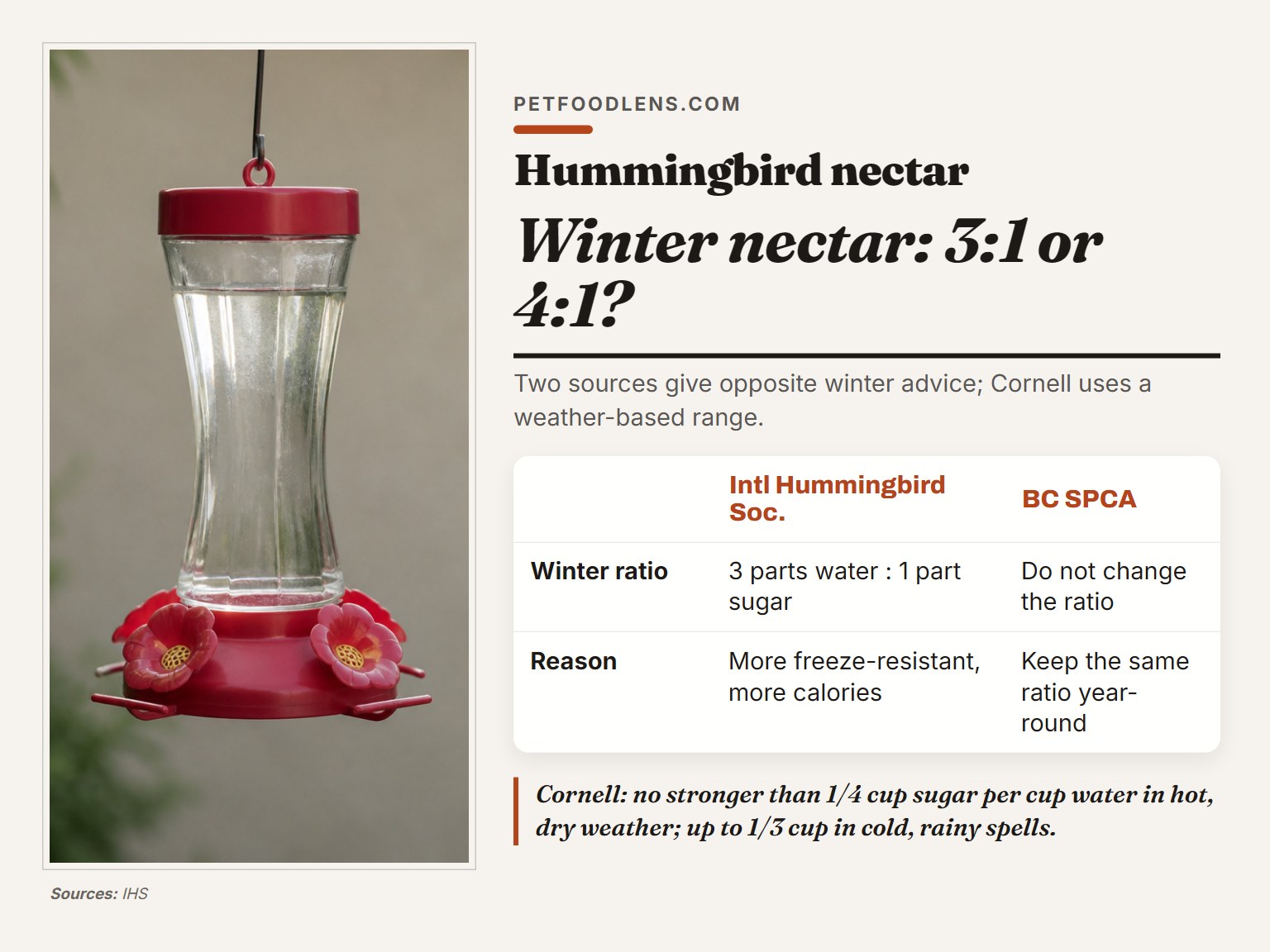
Two organizations publish opposite winter advice, and both are worth reading.
The International Hummingbird Society says to reduce the water to 3 parts in winter, making the mix 3 parts water to 1 part sugar, while the BC SPCA says not to change the ratio at all. Its reasoning: the higher sugar content resists freezing slightly better and delivers more calories for birds staying warm.
The BC SPCA says not to change the ratio at all, even in winter.
Cornell sits between them with a weather-based range: no stronger than a quarter cup of sugar per cup of water in hot, dry weather, and up to a third cup per cup during cold, rainy spells.
I would not call any of the three wrong. The disagreement is about how much freeze protection is worth the trade in calories, and nobody has published a number that settles it.
Cold Snaps: The Freeze Problem
Their recommendations:
One myth worth clearing: leaving feeders up late in fall does not stop migration. The Smithsonian is direct about it. Hummingbirds run on an internal clock set by day length, not by your feeder.
If you would rather not mix at all, homemade vs store-bought nectar comes down to cost and control. Homemade wins on both, and it takes less time than reading the label on a bottle.
Frequently Asked Questions
Should I add red food coloring to the nectar?
No. The Smithsonian says red dye is unnecessary and could be harmful, and the Hummingbird Society makes the same point with a useful detail: nectar in flowers is clear. The color that attracts birds is in the petals, not the sugar water. Red parts on the feeder do that job.
Can I use tap water for hummingbird nectar?
The Smithsonian says tap water is fine. The Hummingbird Society recommends spring or purified water and specifically warns against distilled. That is a real disagreement between two credible sources, so use the water you would drink yourself and don’t overthink it.
What happens if I leave nectar in the feeder too long?
It ferments and grows mold. The Hummingbird Society says to wash the feeder thoroughly the moment the liquid looks cloudy or mold appears, and to clean often enough that it never gets there. Fermented nectar also stops attracting birds.
Is it bad to make the mix stronger in winter?
The Hummingbird Society endorses 3 parts water to 1 part sugar in winter for extra calories and slight freeze resistance. The BC SPCA says not to change the ratio at all. Cornell allows up to a third cup of sugar per cup of water in cold, rainy weather, which lands close to the Hummingbird Society’s version.
Do I need to take my feeder down in fall so the birds migrate?
No. The Smithsonian calls that a myth. Migration is triggered by changing day length, not by a food source that stays out. Leaving a feeder up longer can help late stragglers and does no harm.
Before You Go
Here is the trigger I would actually watch: if you cannot commit to changing the feeder every other day through the hottest stretch of summer, don’t hang one. A feeder that sits for a week is worse for birds than an empty hook.
The rest of how to make hummingbird nectar is short enough to memorize. One part white sugar, four parts water, stirred until it dissolves, no dye, one week in the fridge.
The part that decides whether your feeder helps or hurts is the cleaning clock and the placement. Get those two right and the recipe takes care of itself.
