
Mealworms for Birds Guide: What to Feed and When
This post contains affiliate links. As an Amazon Associate, we earn from qualifying purchases.
Every mealworms for birds guide lands on the same three rules: offer small amounts year-round, clear everything by dusk the same day, and never let worms become the whole diet. The RSPB exempts mealworms from its 1 May to 31 October pause on seeds and peanuts because animal protein lifts chick survival.
That exemption is narrower than it sounds. The RSPB pauses seeds and peanuts from 1 May to 31 October, while mealworms, fat balls and suet can keep being offered in small amounts year-round, a point the mealworms for birds guide makes clear. Everything else about them, including how much and how often, is a judgment call the guidance hands back to you.
What follows covers the seasonal calendar, the live-versus-dried argument (which is a real argument, not a settled one), the quantity figures each organisation actually publishes, and how to stop a tub of live worms turning into a tub of dead ones.
Key Takeaways
- Small amounts, all year. Mealworms, fat balls and suet stay on the RSPB’s approved list through the summer pause on seeds and peanuts.
- Clear the dish by dusk. Leftovers on the ground can be picked up by hedgehogs, which is why the RSPB says mealworms should be eaten or cleared away by dusk the same day.
- Sources disagree on dried worms for chicks: the Southern California Bluebird Club says dehydrated mealworms should not be fed to chicks, Badger Run Wildlife Rehab says both forms work though live are better for babies, and the RSPB says dried mealworms can be soaked in spring and summer to make them easier for nestlings to eat.
- Rearing and holding are opposite jobs. 25-30 °C breeds worms; 8-10 °C keeps bought worms alive.
- No bluebirds in your garden means no bluebirds at your dish, no matter how much you spend on worms.
What a Mealworm Actually Is, and Why the Name Misleads
Tenebrio molitor is a beetle. The wriggly thing in the tub is its larva, and that single fact explains most of the care advice that follows.
Mealworms are the larvae of Tenebrio molitor, the yellow mealworm beetle, not worms at all. A less common species, Tenebrio obscura, produces a smaller larva and is sometimes sold alongside it. Both are beetle larvae that live in damp grain and cereal stores, which is why a tub of bran keeps them alive.
A second species, Tenebrio obscura, turns up in some supplies and runs smaller. The BTO notes it as a less common alternative, and if you’re buying by weight the size difference matters more than the name on the tub.
Nutrition is where the sources part company, and it’s worth knowing both positions before you spend anything, as any mealworms for birds guide will tell you. Really Wild Bird Food puts live mealworms at roughly 50 percent protein and 50 percent water. Badger Run Wildlife Rehab calls them a supplement rather than a high-value food, on the grounds that wild insects are nutritionally superior. Both statements can sit together: a 50/50 split is respectable, and it still isn’t a caterpillar.
The Cornell Lab’s All About Birds mealworm overview adds the point that gets skipped. Mealworms are only as healthful as the diet they were raised on. The NY State Bluebird Society notes that dry cat food can be added to the grain to enhance the protein value of the mealworms for bluebirds.
When Should You Feed Mealworms to Garden Birds?
Mealworms never come off the menu. The RSPB’s seasonal rule pauses seeds and peanuts from 1 May to 31 October, and mealworms, fat balls and suet are explicitly exempt from that pause.
The BTO frames the same window slightly differently: feed seeds and peanuts November to April, pausing during May to October. That’s month-level rather than date-level, and it’s the kind of small wording gap worth noticing if you’re the sort of person who reads the back of the bag before the front.
| Period | Seeds and peanuts | Mealworms | Fat and suet |
|---|---|---|---|
| 1 November to 30 April | Full range, per RSPB | Small amounts, per RSPB | Small amounts, per RSPB |
| 1 May to 31 October | Paused, per RSPB and BTO | Small amounts, per RSPB and BTO | Small amounts; BTO flags heat |
| Hot weather, any date | Paused in summer anyway | Small amounts, cleared by dusk | Cornell: raw suet winter only |
The energy math changes in cold weather and during feeding migrating birds, when a bird burns through reserves faster than it can replace them. That’s the case for fat products. It’s also why the summer caveat on suet matters, which I’ll get to.
Two things stay constant across every season. Food should be eaten within the window the guidance gives, and water hygiene gets the same attention as food hygiene.
Live or Dried: Which One Actually Works?
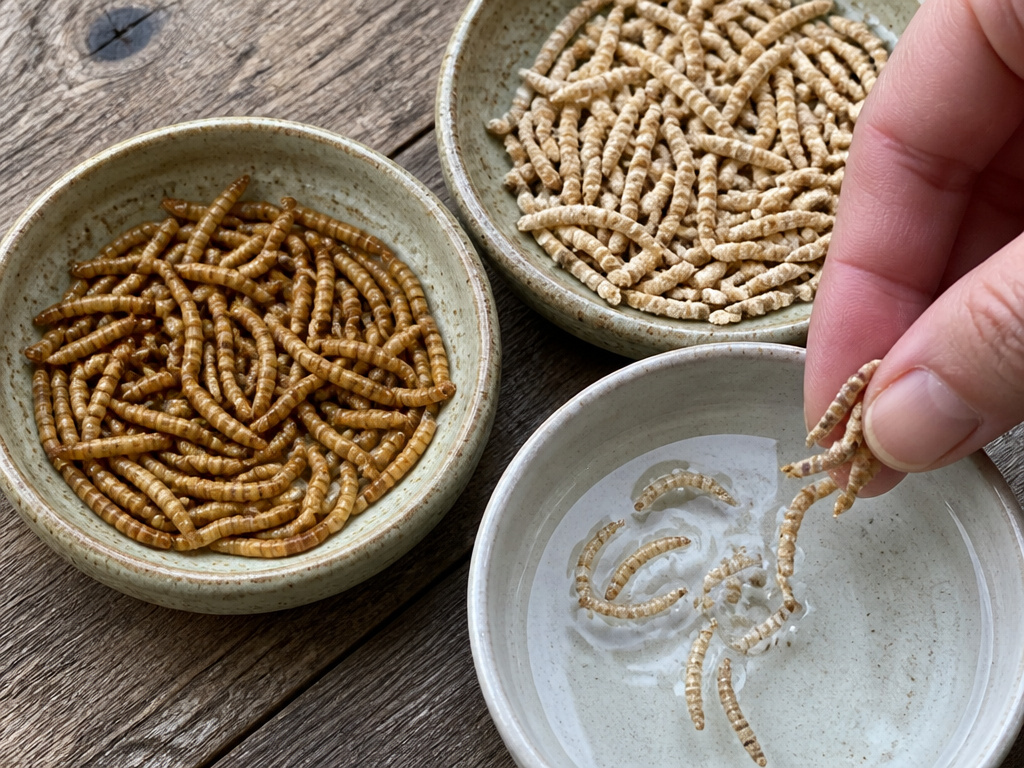
Anyone who tells you dried mealworms are useless hasn’t read the Badger Run paper. Both forms work. The fight is about chicks, and it’s sharper than the official guidance admits.
| Form | Best use | Main drawback | Who says so |
|---|---|---|---|
| Live | Nestlings, fussy insect-eaters | Cost, spoilage, storage | SCBC, Badger Run, RSPB |
| Dried | Convenience, winter top-ups | Harder for small chicks | SCBC, Badger Run |
| Soaked dried | Nestling season compromise | Extra prep step | RSPB |
Three positions exist and none of them is a fringe view. The Southern California Bluebird Club states flatly that dehydrated mealworms should not be fed to chicks, because live insects are the only source of water for chicks. Badger Run Wildlife Rehab says the idea that dried worms must be rehydrated before eating is false, that any rehydration happens internally, and that both forms work well while live is easier on young digestive systems. The RSPB sits in the middle: in spring and summer, dried mealworms can be soaked in water to make them easier for nestlings to eat.
Here’s how I’d read that spread. If you’re feeding adults and fledged birds, dried is fine and cheaper. If you’re feeding a box of nestlings, the Southern California Bluebird Club says dehydrated mealworms should not be fed to chicks, while Badger Run Wildlife Rehab says both forms work and the RSPB says dried mealworms can be soaked in spring and summer to make them easier for nestlings to eat. The Badger Run mealworm response is worth reading in full if you’ve seen the social media posts claiming mealworms kill baby birds.
Dried worms also need a look before they go out. If you want the practical version, how to feed dried mealworms covers soaking and portioning. Mealworms are one entry in a wider insect-based bird food category, and the same seasonal logic applies across all of it.
Common mistake: Putting out a full tub of dried worms in June and leaving them. Dried worms can absorb moisture from damp ground and go musty, so clear what isn’t eaten by dusk.
How Many Mealworms Should You Put Out?
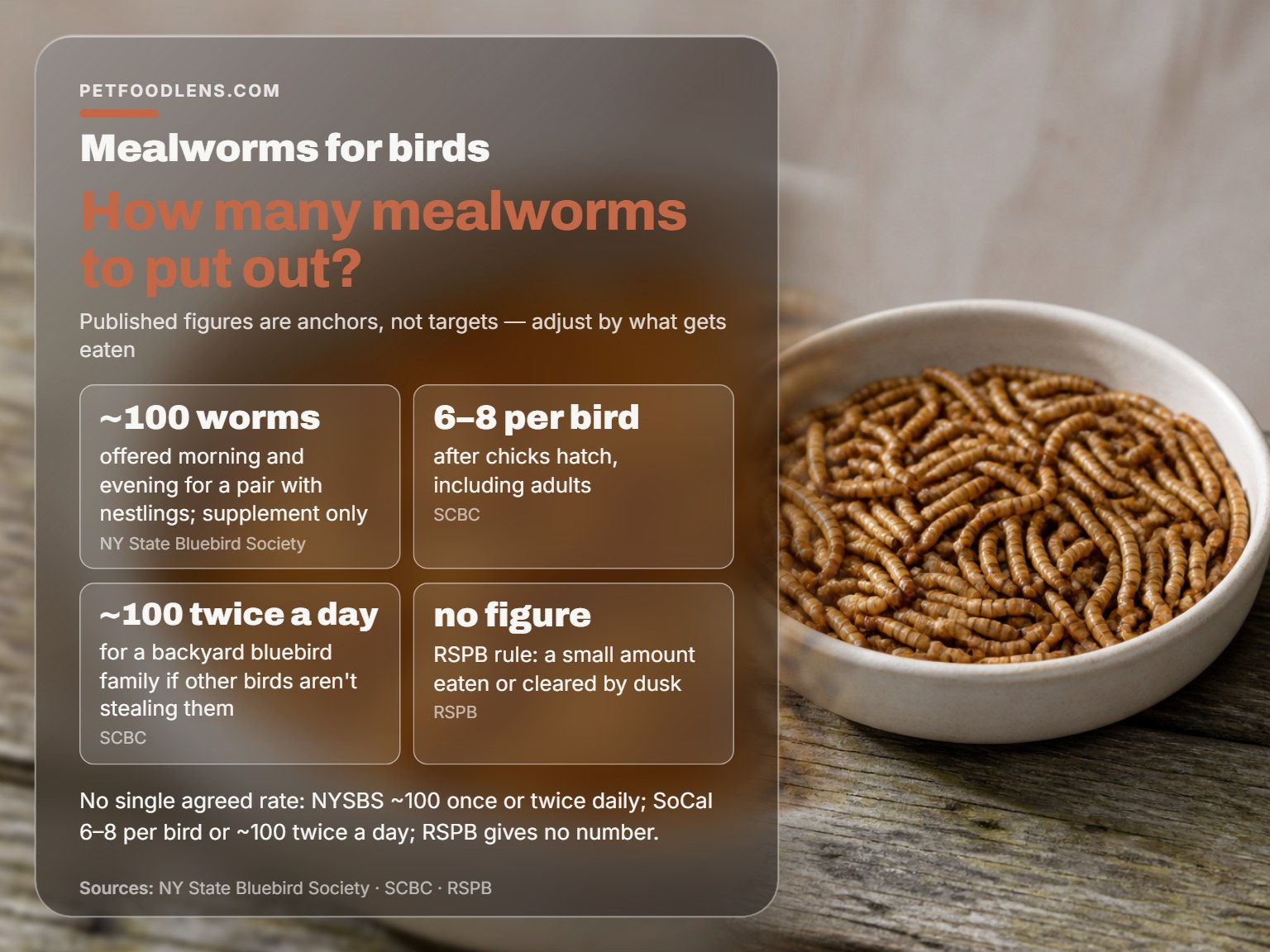
The number on the tub is a starting point, not an instruction. It was calculated for a garden nobody has ever seen.
People ask whether they can follow the printed feeding figure exactly, and I tell them to treat it as a starting point and adjust by watching what actually gets eaten over a few weeks. Same principle here. The published figures are anchors, not targets.
The Numbers Each Organisation Publishes
- The NY State Bluebird Society calls a hundred or so worms, offered morning and evening, adequate for a pair with a box of nestlings, as a supplement rather than a staple.
- The Southern California Bluebird Club suggests about 6-8 per bird including adults once chicks have hatched, and roughly 100 twice a day for a backyard bluebird family where other birds aren’t stealing them.
- The RSPB gives no figure at all, only the rule that it should be a small amount eaten or cleared by dusk.
There’s no single agreed rate, and the NYSBS mealworm fact sheet is the most useful of the three because it explains what the number is for: topping up a pair that’s already finding food, not replacing what they’d catch themselves.
If you take mealworms away for a week, the birds don’t starve. They go back to hunting. The RSPB pauses seeds and peanuts from 1 May to 31 October, while mealworms can still be offered in small amounts year-round.
Bluebird numbers are where this gets specific, and if that’s your target species, food for bluebirds narrows the quantity question further. For everyone else, a shallow dish with a modest scoop, refilled once or twice a day, is the whole method.
Three Places the Official Guidance Genuinely Disagrees
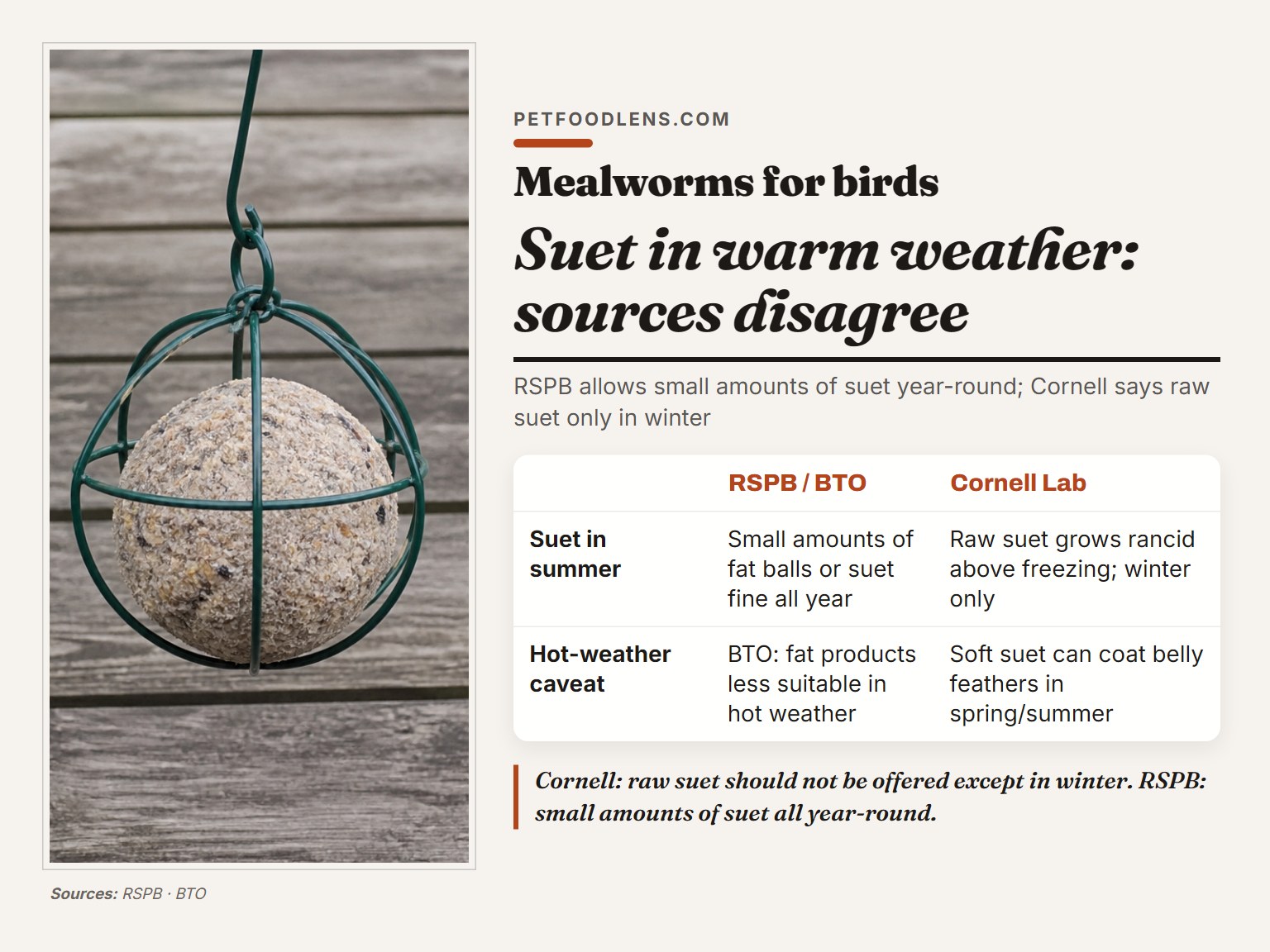
Three topics in this guidance don’t resolve cleanly, and pretending otherwise would be doing you a disservice.
Suet in Warm Weather
The RSPB says small amounts of fat balls or suet are fine all year. The BTO continues year-round provision but notes fat products are generally less suitable in hot weather. The Cornell Lab is bluntest of the three: raw suet grows rancid quickly above freezing and shouldn’t be offered except in winter, and soft suet can coat belly feathers, which is a real danger in spring and summer when incubating birds may get egg pores clogged.
The reconciliation is straightforward once you separate the products. Cornell warns that raw suet grows rancid quickly above freezing and should not be offered except in winter, and that soft suet can coat belly feathers in spring and summer. If you’re offering raw suet in July, you’re on your own.
Scattering on the Ground
The RSPB says it’s safe to scatter mealworms for ground-feeding birds like Blackbirds and Robins, provided the amount is small and cleared by dusk the same day. The Southern California Bluebird Club warns that worms dig into soil, and moulds in damp soil can cause illness in birds, recommending a dry shady spot or a dish instead.
Both are describing the same risk from different angles. The RSPB’s rule manages it with quantity and timing. The SCBC’s rule manages it with the surface. Use a dry spot and clear by dusk and you’ve satisfied both.
Feeding After Fledging
The RSPB recommends small amounts year-round because animal protein boosts chick survival. The Southern California Bluebird Club warns that generous provisioning after fledging is risky, because parents lose the drive to hunt and birds picking worms off the ground are more vulnerable to hawk attacks.
That last point has nothing to do with nutrition and everything to do with behaviour. It’s also the reason the SCBC advises against always putting worms in the same spot.
The BTO feeding garden birds report is where the underlying thinking sits.
How to Keep Live Mealworms Alive Until You Use Them
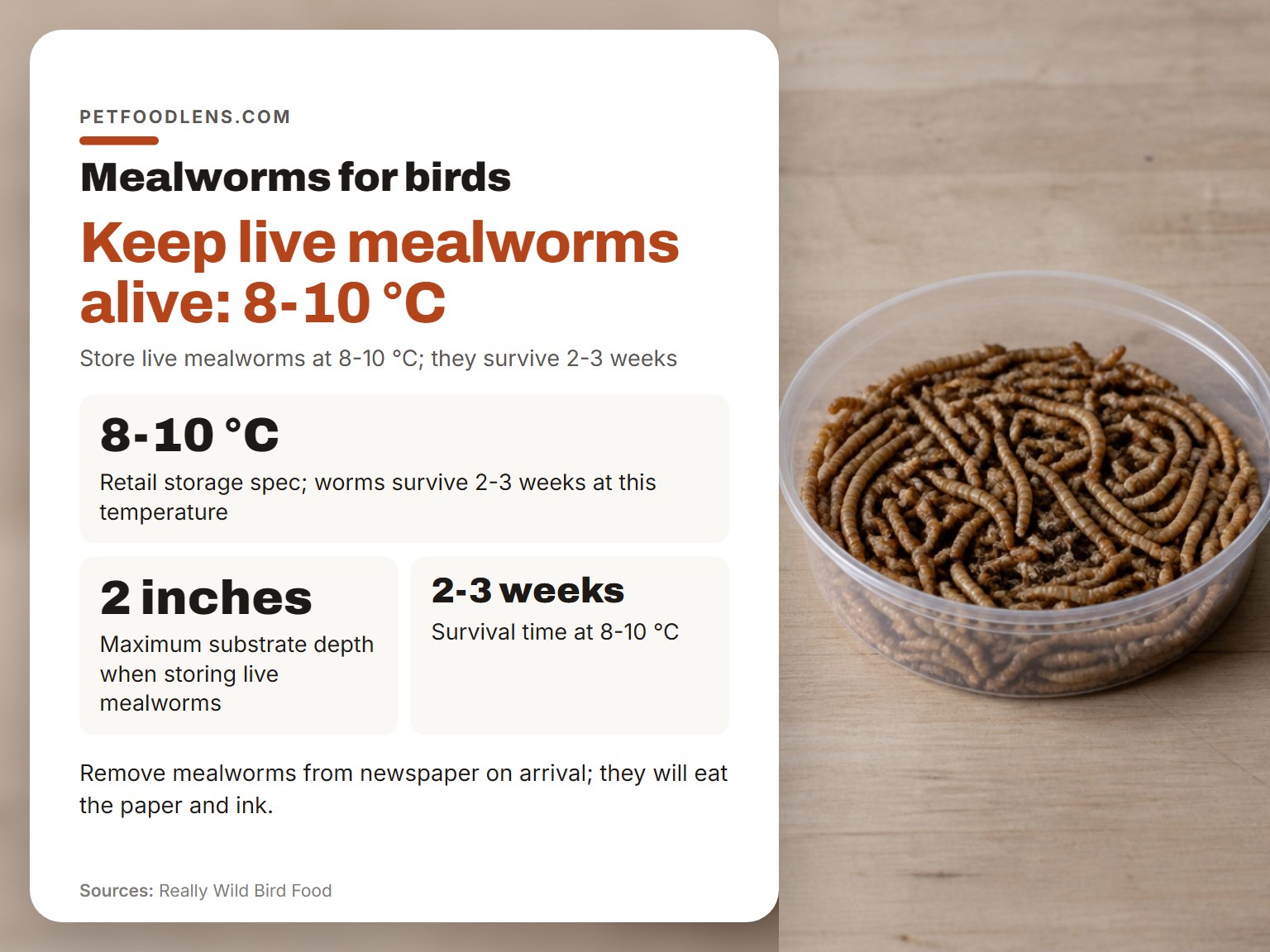
Ever opened a tub a week after delivery and found half of it dead? It’s almost always temperature or moisture, and both are fixable.
Live worms arrive in newspaper wads, and Cornell warns that they’ll eat the paper and the ink if you leave them in it. Tip them out as quickly as possible on arrival, because they will eat the paper and ink.
Storage for bought worms is cool and shallow:
- 8-10 °C is the retail storage spec, and worms survive 2-3 weeks at that temperature.
- Substrate depth should stay at 2 inches maximum.
- The NY State Bluebird Society goes colder, keeping worms in the refrigerator for a few weeks up to several months, with vegetable matter removed first.
- The SCBC refrigerates medium worms specifically to stop growth and put them into dormancy.
Note what that means. Cold storage is a pause button, not a larder.
| What you see | Likely cause | Fix |
|---|---|---|
| Worms dying within days of arrival | Warm, damp, crowded tub | Hold at 8-10 °C, substrate 2 inches deep |
| Grey fuzz on the bran | Too much moisture | Cut back to occasional carrot slices |
| Faint ammonia smell | Frass build-up | Sift the grain, wash the container |
| Culture stalled, nothing growing | Too cold | 25-30 °C for breeding, not storage |
| Worms turning to pupae fast | Warm storage | Refrigerate to slow development |
That ammonia smell is the tell. It shows up before anything looks wrong, and by the time the bran darkens you’ve already lost a week.
Raising Your Own: Container, Temperature, and the Four-Month Wait
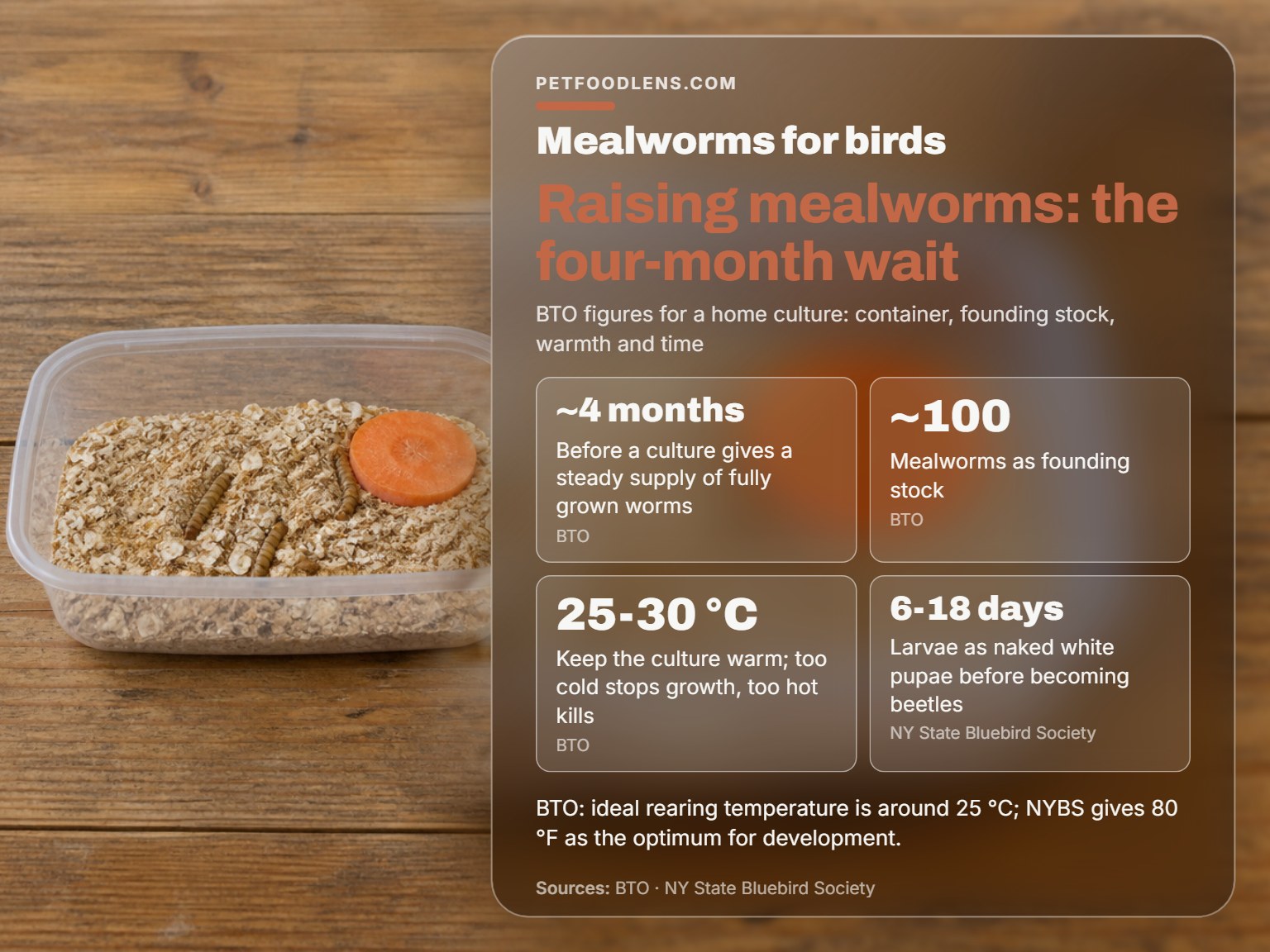
Four months. That’s how long the BTO says a new culture takes before it produces a steady, continuous supply of fully grown worms.
Before you start: a wet culture grows mould, and the BTO names mould as a real problem for mealworms, so add moisture occasionally rather than daily. Frass builds until a faint ammonia odour appears, at which point the grain needs sifting and the container washing. Wash your hands afterwards, because a tub that grows worms will grow other things too.
The container spec varies by source, and any of these will work:
- Container: the BTO suggests plastic buckets or large round biscuit tins at least 25 cm in diameter and 20 cm deep, with holes or a mesh lid for ventilation. The NYBS suggests a shallow plastic container of 2-5 gallons with a screen or perforated metal lid. Cornell uses an ice cream bucket or dishpan. Skip the ventilation and the culture suffocates.
- Substrate: a 2-3 cm layer of bran and/or rolled oats per the BTO, or an inch or two of dry oatmeal or wheat bran per Cornell. Skip it and the worms have nothing to eat or burrow into.
- Founding stock: about 100 mealworms, bought rather than caught. The BTO says it takes four months or so before a culture starts to produce a steady supply of fully grown mealworms.
- Temperature: 25-30 °C per the BTO, with around 25 °C ideal. The NYBS gives 80 °F as the optimum for development. Go too cold and they stop growing and breeding; go too hot and they die.
- Moisture: carrot slices occasionally, per the BTO, or a piece of potato, apple or banana peel about once a week per the NYBS. Overdo it and you get mould, which the BTO names as a real problem for mealworms.
- Surface for beetles: pieces of sacking, broken egg carton or dry bread, so adults have somewhere to gather and lay.
The BTO mealworms feeding guide is the fuller version of that, written by someone who has kept a culture going for years.
Then you wait. Larvae metamorphose into naked white pupae for 6-18 days and then into beetles, and adult beetles lay their eggs 9-20 days after emergence and then die. None of that is fast, and the four-month figure is the one that catches people out.
Feeder Placement and Hygiene That Actually Cuts Disease Risk
Placement does more disease work than any product you can buy. The RSPB’s hygiene guidance is specific: move feeders to a different spot every week to stop contaminated debris building up underneath, and keep them out from under roosts and trees where droppings fall.
For mealworms specifically, the SCBC recommends a shallow dish with vertical sides of about ¾ inch, in a shady spot where birds already perch, removed whenever you can’t keep an eye on it. Cornell adds a detail that’s easy to miss: if you’re using a small acrylic window feeder with drainage holes, plug them, because mealworms squeeze through surprisingly tiny spaces.
Feeder design matters for who gets the food. The SCBC recommends a bluebird mealworm feeder placed in a shady spot where birds usually perch. If larger birds are already dominating, the worms are gone before your target species arrives.
Easy to miss: feeding on open ground in autumn and winter, when groups are larger, lets droppings containing parasites contact the worms. The SCBC’s fix is smaller amounts in more locations rather than one big dish.
Ground feeding is fine for Robins and Blackbirds, and if that’s who you’re feeding, food for robins covers what else belongs on the menu. The one rule that survives every source: clear what isn’t eaten by dusk.
If you’re trying to attract bluebirds to feeders in the first place, the NYBS is blunt about the odds. If you’ve never or rarely seen a bluebird in your yard, they probably won’t show up just because you put worms out. What will happen is that every other bird in the garden finds them first.
Frequently Asked Questions
Should I stop feeding mealworms in summer?
No. The RSPB’s summer pause covers seeds and peanuts only, from 1 May to 31 October, and mealworms are explicitly exempt because animal protein supports chick survival. The BTO takes the same position. Keep the amounts small and clear leftovers by dusk.
Can birds eat dried mealworms straight from the bag?
Adults and fledged birds can. For nestlings the sources disagree: the Southern California Bluebird Club says dehydrated worms shouldn’t be fed to chicks at all, while Badger Run Wildlife Rehab says both forms work and the rehydration claim is a myth. The RSPB’s middle path is to soak dried worms in spring and summer to make them easier for nestlings to swallow.
How long do live mealworms last?
At 8-10 °C they survive roughly 2-3 weeks, according to retail storage guidance. The NY State Bluebird Society puts refrigerator storage at a few weeks up to several months, provided you remove vegetable matter first. Keep substrate depth to a maximum of 2 inches.
Do leftover mealworms harm hedgehogs?
The RSPB says mealworms should all be eaten or cleared away by dusk the same day, especially if scattered on the ground, to prevent leftover mealworms being consumed by hedgehogs. The rule applies most strictly to worms scattered on the ground, where a hedgehog can find them after dark.
Will mealworms bring bluebirds to my garden?
Only if bluebirds are already nearby. The NY State Bluebird Society states that if you’ve never or rarely seen one in your yard, they won’t appear just because food is out. Other birds will find the dish first and empty it.
The Bottom Line
Here’s the trigger that decides whether any of this is worth your money: if you have never seen a bluebird in your garden, don’t buy mealworms hoping to change that. The NYSBS is unusually direct about this. Feed the birds you already have, and if a bluebird turns up, you’ll know.
For everyone else, the first step is small and unglamorous. Put out a modest scoop tomorrow morning, then go back at dusk and see what’s left. If there’s anything in the dish, halve it. That one adjustment, repeated over time, will help you match the amount to what your garden’s birds actually eat.
The four-month figure for a home culture is real, and so is the cost of ignoring it. Start a tub in spring if you want worms by autumn, since the BTO says a new culture takes four months or so to produce a steady supply.
Marketing is not nutrition, and a tub of worms is no different from a bag of kibble in one respect: the label tells you what went in, not what came out. Watch what the birds do with it.
