
Suet for Birds Pros and Cons: The Real Trade-Offs
This post contains affiliate links. As an Amazon Associate, we earn from qualifying purchases.
The suet for birds pros and cons are straightforward: rendered beef fat brings woodpeckers and nuthatches to the yard and delivers dense energy, but it goes rancid in heat and sun-warmed suet mats feathers. In cool weather with a hanging feeder and weekly cleaning, the pros outweigh the cons.
Beef suet melts at 21°C, about 70°F, per a 1975 paper in Bird Banding. That number explains most of the suet for birds pros and cons disagreement in the guidance: sources that say “year-round” assume a rendered, melt-resistant cake, and sources that say “withdraw in summer” assume raw fat in ambient heat.
What follows: the case for suet, the case against, the seasonal split between Iowa State and the RSPB, and the feeder setup that decides whether you help birds or hurt them.
Key Takeaways
- Rendered fat beats raw chunks in warm weather; raw suet goes rancid and prepackaged cakes can harbor mold and bacteria.
- Hanging feeders over flat trays, per the RSPB, because flat surfaces raise disease transmission risk among finches.
- Weekly cleaning is the floor, and more often in hot weather.
- Summer suet is contested: Iowa State says withdraw mid-June to mid-September, the RSPB says offer small amounts year-round, and Cornell says use no-melt cakes in shade.
- Peak suet use is May, not winter, per Stanford, which stacks melt risk with peak feeding demand.
The Case for Suet: 80 Species and Dense Energy
Beef suet brings 80 species of birds into backyards, per a Stanford ornithology essay, including woodpeckers, nuthatches, chickadees, titmice, wrens, and even orioles.
Suet is rendered beef fat, typically from around the kidneys, cooled and formed into cakes. Rendering melts the fat so it can be combined with seed, mealworms, or peanut butter. The finished cake delivers dense calories that insect-eating birds need when natural prey is scarce, particularly through winter and the breeding season.
One in three North American households feeds birds, providing an average of 60 pounds of supplemental seed each year, per Stanford. Nearly 53 million Americans feed wild birds, per Cornell Lab, and the wild-bird-feeding industry estimates about four billion pounds of seed are used per year.
Suet reaches the birds that cling to bark and probe for insects, which is why, when you weigh the suet for birds pros and cons, woodpeckers and nuthatches show up at a suet cage before they show up at a seed feeder.
The label says more than the slogan. Read the front of a suet cake wrapper and you’ll see “high energy” and “premium” and a woodpecker photo. None of that tells you the fat source. RSPB Super suet is one brand that explicitly states no chalk or calcium carbonate filler, which is the kind of claim worth checking on any cake you buy.
If you want a wider comparison of what goes into a feeder, the best bird food breakdown covers seed mixes and suet side by side.
Can You Feed Suet in Summer?
Three sources, three different answers, and none of them are wrong.
Iowa State University Extension says suet can go rancid in the hottest months and is not ideal from mid-June to mid-September. University of Florida IFAS says suet cakes can be left out year-round, though high-fat cakes can melt in Florida heat. The RSPB says suet can be offered throughout summer, but only in small amounts birds can finish before the food spoils, and in hot weather you should choose a melt-resistant product and position the feeder out of direct sun.
Cornell Lab’s David Bonter splits the difference by format. Unrendered chunks of raw suet from a grocery store become rancid in warm weather. Prepackaged suet cakes can melt in the heat and harbor mold and bacteria. No-melt cakes are rendered multiple times so they stay solid at higher temperatures, and a shady spot helps.
The summer question isn’t a yes-or-no. It’s a question about which format you’re feeding and where the feeder sits.
| Source | Summer Stance | Reason Given |
|---|---|---|
| Iowa State Extension | Withdraw mid-June to mid-September | Rancidity risk |
| University of Florida IFAS | Leave out year-round | Melt risk, but acceptable |
| RSPB | Offer year-round, small amounts | Finish before spoilage |
| Cornell Lab (Bonter) | Use no-melt cakes, shade | Raw suet goes rancid; cakes mold |
| BTO/RSPB review | Continue year-round with caveat | Fat less suitable in heat |
That’s the whole disagreement.
Bottom line: the RSPB and Cornell say that if you’re feeding a rendered, melt-resistant cake in shade and cleaning weekly, summer suet is defensible, while Iowa State advises withdrawing suet from mid-June to mid-September. If you’re hanging a raw chunk in full sun and walking away for a week, Iowa State’s window is the safer rule.
For more on cold-weather feeding, the winter bird feeding guide covers the seasonal setup that most sources agree on.
The Case Against: Rancidity, Mold, and Feather Damage
A suet cake left in July sun goes soft on top, then greasy at the base, then sour. That smell is the fat turning.
Cornell Lab notes that some molds produce aflatoxin, which is fatal to birds, and there’s no way to tell whether the mold on your seed or suet is that type. Salmonellosis spreads through food contaminated with droppings from a sick bird. The RSPB says to remove any suet that becomes soft, rancid, or spoiled, and to clean feeders at least once a week, more often in hot weather.
Signs a cake is past its window:
- Soft to the touch, gives like cold butter under a fingertip
- Sour or paint-like smell
- Greasy streaks running down the cage
- Visible fuzz or dark patches on the surface
Common mistake: Leaving a suet cake in the same spot until it’s gone. The RSPB recommends moving feeders and cleaning them weekly, because seed hulls and droppings build up under a fixed feeder and turn it into a transmission point.
Fat balls in nylon mesh are a separate problem. The RSPB says not to feed them at all, because birds can become trapped in the mesh.
If you’re also putting out seed, the sunflower seeds for birds pros and cons breakdown covers which formats attract finches, the group most vulnerable to trichomonosis.
Does Suet Actually Harm Woodpeckers?
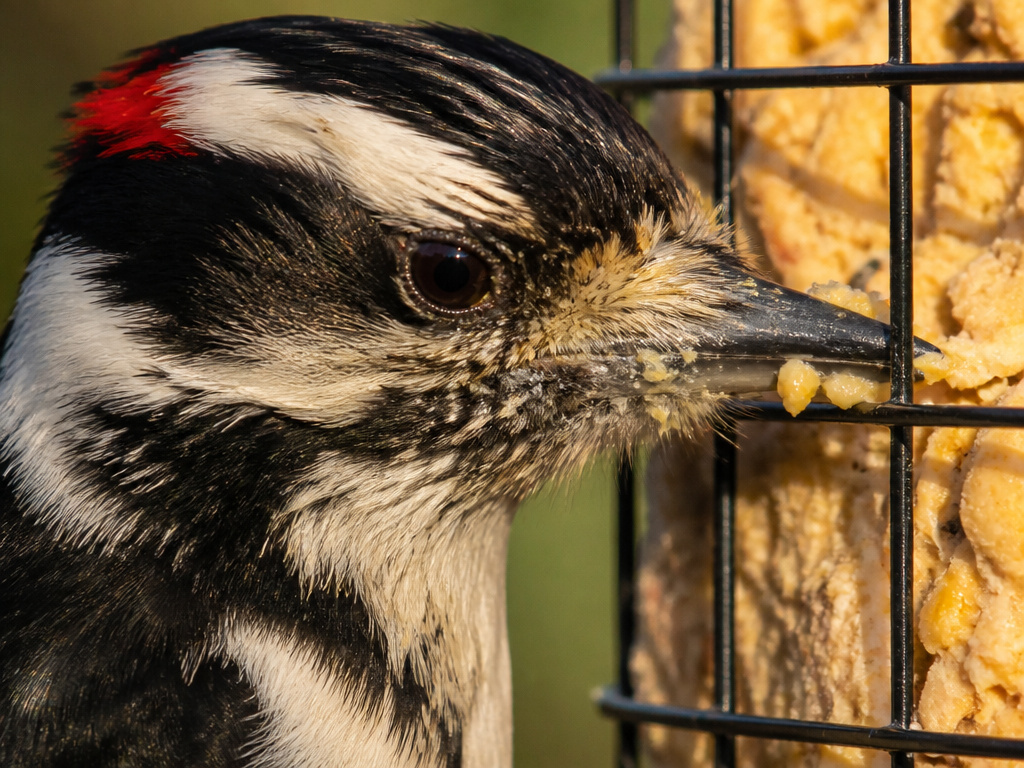
34 Downy Woodpeckers captured May through July at suet-free control sites showed zero bare faces.
The study that keeps coming up is Jackson and Hoover 1975, published in Bird Banding. The authors documented bare facial areas on Downy and Hairy Woodpeckers at year-round suet feeders, almost exclusively in May, June, and July. All but two of the affected birds were female. Jackson examined specimens of each species and found none in this condition.
The mechanism is straightforward. Sun-warmed suet mats feathers, which can cause reduced insulation and waterproofing, inflamed or infected follicles, and loss of facial feathers. Birds that press their faces into soft suet pick up the fat on the feathers around the bill and eyes.
What the 1975 Study Found
The full record, as summarized in the research brief:
- Bare faces appeared almost exclusively in May, June, and July.
- All but two of the affected birds were female.
- 34 Downies at suet-free control sites showed zero bare faces.
- Jackson examined specimens of each species and found none in this condition.
Why the Effect Was Sex-Biased
The study doesn’t fully explain why females were affected more than males, but the timing lines up with nesting. Peak suet use in May coincides with nesting energy demand and melt temperatures, which stacks the two risk factors in late spring rather than midsummer.
I keep coming back to this study because it’s the only one in the corpus with a control group. The study documents a specific failure mode. A soft, sun-warmed cake at a year-round feeder is a different object than a firm, rendered cake in shade.
Flat Feeders vs Hanging Feeders: The Disease Question
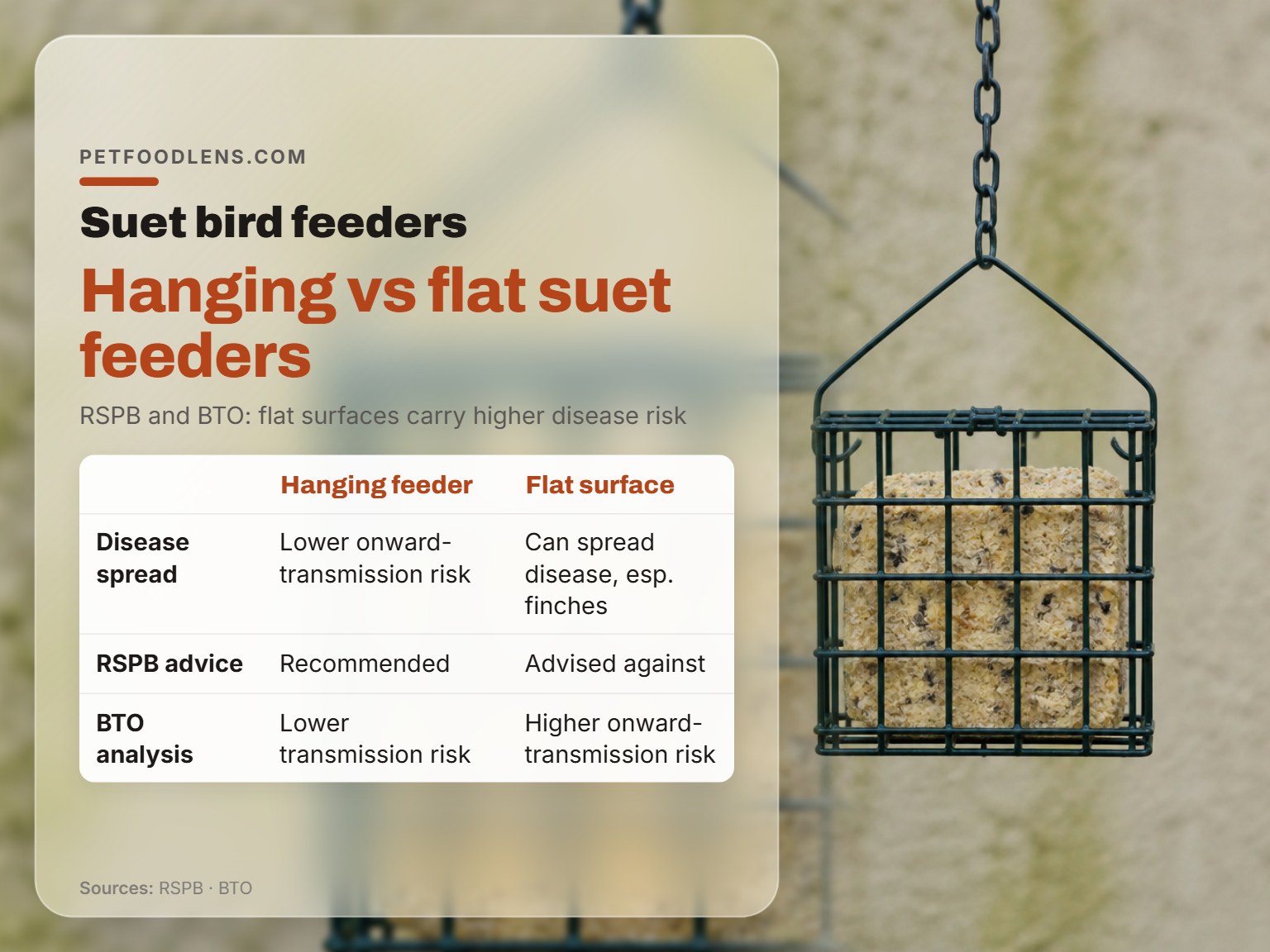
The RSPB and BTO advise against flat feeders, though Iowa State lists trays as a popular suet feeder without warning against them.
The RSPB says to offer suet in a hanging feeder rather than on a bird table, tray, or other flat surface, because flat surfaces can spread disease, especially among finches. BTO’s Hugh Hanmer analysis found that trichomonosis-driven adult-survival declines were more pronounced in residential settings, and flat-surface feeders carry higher onward-transmission risk than hanging feeders.
Hanging feeders aren’t just tidier. They change the geometry of transmission: birds approach one at a time instead of standing in a crowd.
Iowa State lists cages, logs, bags, and trays as popular suet feeders without warning against trays. UF/IFAS doesn’t address surface type at all. That’s silence rather than disagreement, but it matters: the RSPB and BTO are the two sources with a formal disease review behind them.
A log feeder with 1 1/2-inch bored holes, plus smaller 1/2-inch holes between them for nuthatches and downy and hairy woodpeckers, is a middle path. It’s not flat, and it’s not a wire cage.
The 4-Part Suet Feeder Setup That Keeps Birds Healthy
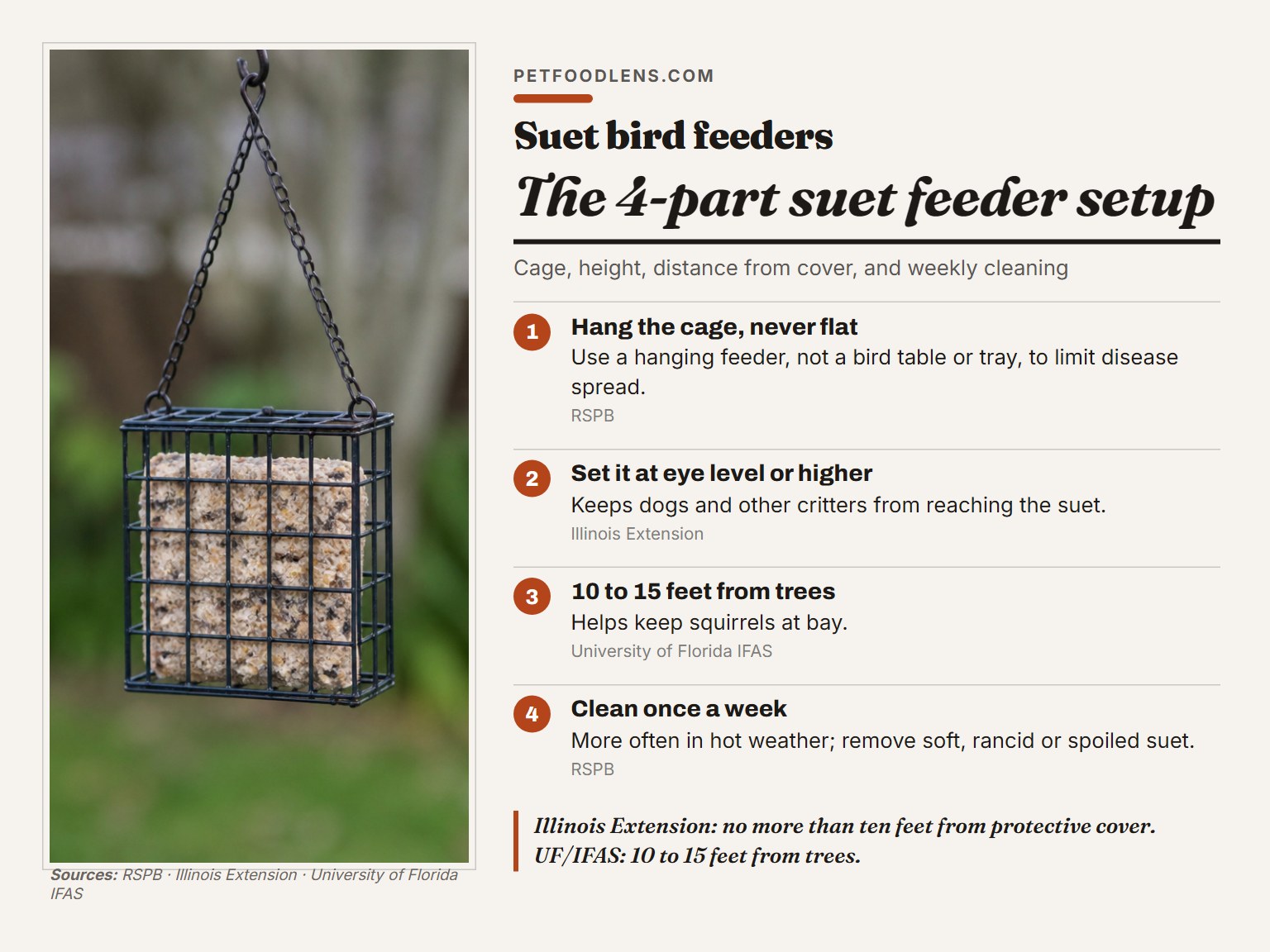
A suet feeder setup has four moving parts: the cage, the height, the distance from cover, and the cleaning schedule.
- Cage: hanging, not flat, per the RSPB disease guidance
- Height: eye level or higher, per Illinois Extension, to discourage dogs and other critters
- Distance: 10 to 15 feet from trees to slow squirrels, but close to shrub cover for birds
- Cleaning: once a week, more often in hot weather
Height, Distance, and the Squirrel Problem
Illinois Extension recommends keeping suet feeders at about eye level or higher. Place feeders no more than ten feet from protective cover. UF/IFAS recommends at least 10 to 15 feet from trees to help keep squirrels at bay.
Those two pieces of advice pull in opposite directions. The resolution: put the feeder close to a shrub or tree line for bird cover, but far enough from a launch point that a squirrel can’t jump directly onto it. A baffle or a squirrel-proof feeder closes the gap.
Close the gap.
The Weekly Clean (and When to Do It Twice)
Clean the feeder thoroughly once a week, or more often during hot weather, per the RSPB. Remove any suet that becomes soft, rancid, or spoiled. If you see sick birds, move the feeder and wash it, per Cornell Lab, so seed hulls and droppings don’t build up.
If you’re choosing a feeder, the suet feeder pros and cons comparison covers cage, log, and tail-prop designs. For a roundup, the best suet feeders list includes hanging cages and upside-down-only models that deter starlings.
Homemade Suet vs Store-Bought: Which One Actually Delivers
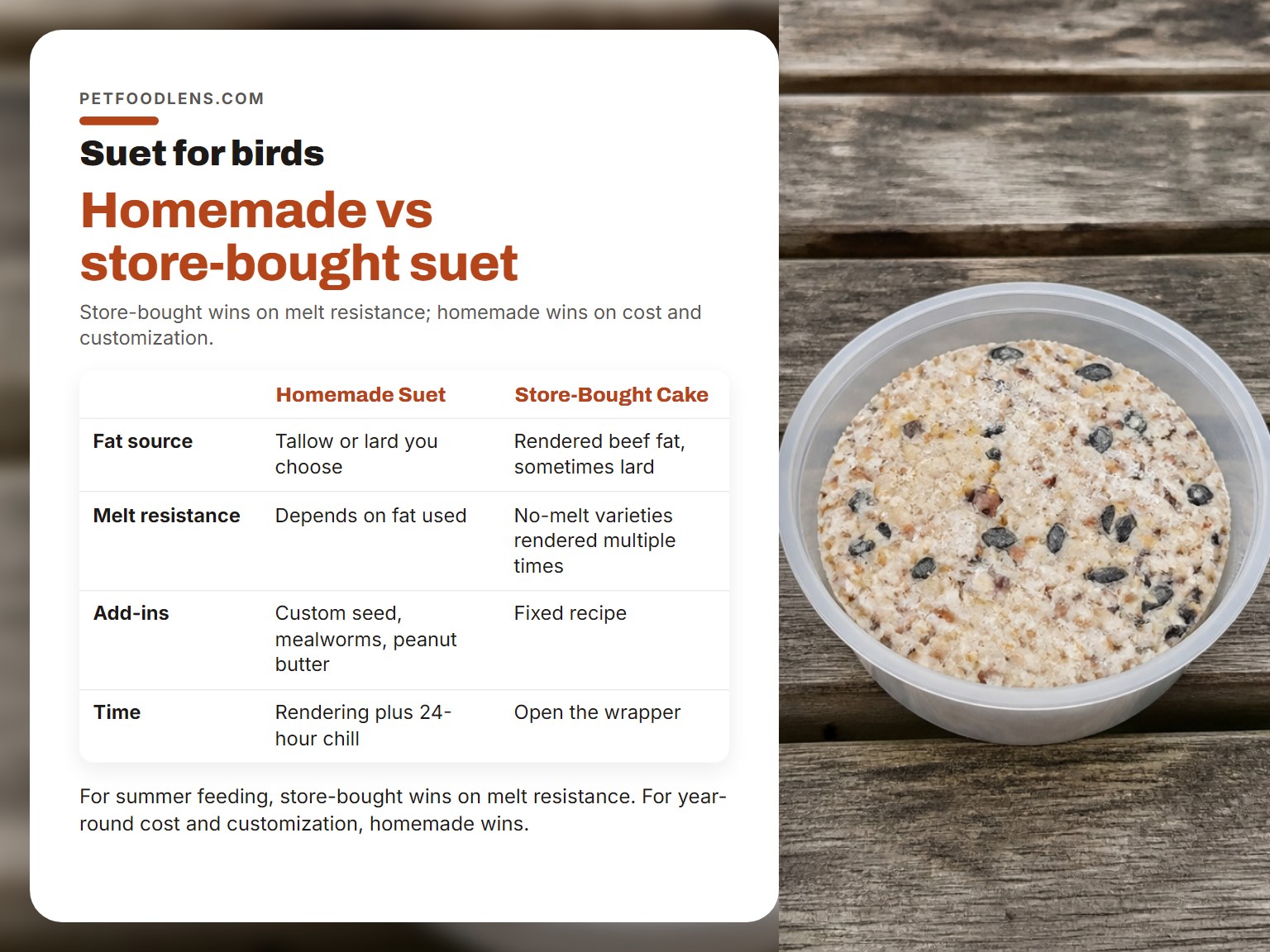
Two paths: melt your own tallow on the stove, or buy a rendered cake.
Homemade gives you control over the fat source and the add-ins. Iowa State’s method is simple: slice the fat into 1- to 2-inch cubes, pulse it to a sawdust-like consistency in a food processor, and melt it on very low heat. Never use higher temperatures to hurry the process, because it can scorch or cause a serious fire. Add about two cups of birdseed or a custom dry mix to each container. Filling plastic containers about an inch deep gives roughly the dimensions of a commercial cake.
Before you start: Melting fat on a stove is a fire risk. Keep the heat on the lowest setting, never leave the pot unattended, and keep a lid nearby. Hot fat also burns skin on contact, so ladle it slowly and keep kids and pets out of the kitchen.
The Iowa State Extension suet cake guide walks through the full method, and the UF/IFAS DIY suet guide covers a lard-and-peanut-butter version. UF/IFAS also notes that lard gets softer in the heat more quickly than true suet, so true suet from a butcher is the better option if you can get it.
The 5-Step Rendering Method
- Slice the fat into 1- to 2-inch cubes and pulse to a sawdust-like consistency.
- Melt on very low heat, stirring as it comes to temperature.
- Add about two cups of birdseed or dry mix per container.
- Pour the fat between containers and stir to combine.
- Cool on a baking sheet, then cover and refrigerate or freeze.
If you won’t use the blocks within the week, Iowa State recommends the freezer rather than the fridge. UF/IFAS recommends refrigerating homemade cakes for about 24 hours so they harden.
| Factor | Homemade Suet | Store-Bought Cake |
|---|---|---|
| Fat source | Tallow or lard you choose | Rendered beef fat, sometimes lard |
| Melt resistance | Depends on fat used | No-melt varieties rendered multiple times |
| Add-ins | Custom seed, mealworms, peanut butter | Fixed recipe |
| Time | Rendering plus 24-hour chill | Open the wrapper |
| Consistency | Varies batch to batch | Predictable |
For summer feeding, store-bought wins on melt resistance. For year-round cost and customization, homemade wins.
Store-bought has one advantage that matters in summer: the no-melt varieties are rendered multiple times, which is what keeps them solid at higher temperatures. If you want a shortcut, a rendered cake such as RSPB Super suet is the practical choice. A standard hanging cage is the shape most feeders use, and it fits either cake.
Simple enough.
For more on feeder selection across seasons, the winter bird feeders guide covers cold-weather setups.
Frequently Asked Questions
Is suet good for birds?
Yes, in the right conditions. Suet is dense rendered fat that brings 80 species of birds into backyards, per Stanford, and it’s particularly useful when insects are scarce. The caveats are heat, hygiene, and format: raw suet goes rancid, flat feeders spread disease, and sun-warmed suet can mat feathers.
Can I feed suet in summer?
It depends on which source you follow. Iowa State says withdraw mid-June to mid-September. The RSPB says offer small amounts year-round in a melt-resistant product, in shade. Cornell Lab recommends no-melt cakes and a shady spot. If you feed in summer, the RSPB and Cornell advise a rendered cake kept shaded and cleaned weekly, while Iowa State advises withdrawing suet from mid-June to mid-September.
What is the difference between suet and lard?
Suet is the fat from around the kidneys of cows, and lard is rendered pork fat. UF/IFAS notes that lard gets softer in the heat more quickly than true suet, so true suet is the better choice for warm-weather feeding. Many commercial suet cakes use lard as a base.
Why do woodpeckers get bare faces at suet feeders?
Jackson and Hoover 1975 documented bare facial areas on Downy and Hairy Woodpeckers at year-round suet feeders, almost exclusively in May, June, and July. Sun-warmed suet mats feathers, which can cause reduced insulation, inflamed follicles, and feather loss. The effect was overwhelmingly female.
Should I use a flat feeder or a hanging feeder?
Hanging, per the RSPB. Flat surfaces can spread disease, especially among finches, and BTO’s Hugh Hanmer analysis found higher onward-transmission risk at flat-surface feeders. A log feeder with bored holes is a middle path.
How often should I clean a suet feeder?
At least once a week, per the RSPB, and more often during hot weather. If you see sick birds, move the feeder and wash it, per Cornell Lab, so droppings and hulls don’t concentrate in one spot.
The Bottom Line
One rule most suet guides skip: if your cake goes soft to the touch, it’s done. A firm cake gives slightly under a fingertip. A spoiled one gives like cold butter, and by the time it smells sour you’ve already lost a week.
The threshold I’d use: if the daytime high approaches 70°F and the feeder is in direct sun, switch to a no-melt cake or move the feeder into shade. If you can’t do either, follow Iowa State’s window and pull the suet from mid-June to mid-September.
For the reader who wants one answer: a rendered, melt-resistant cake in a hanging cage, cleaned weekly, works year-round per the RSPB and Cornell, though Iowa State advises withdrawing suet from mid-June to mid-September. That’s the setup the RSPB and Cornell converge on, though Iowa State advises withdrawing suet from mid-June to mid-September.
And if you want the wider feeding picture, the Stanford birds feeding essay is the best single overview of what supplemental feeding does to bird populations. The Illinois Extension winter suet article covers the cold-weather case in more detail, and the USF study on suet and woodpeckers is the primary source for the feather-loss findings above.
