
Pelleted Bird Food Pros and Cons: What the Evidence Shows
This post contains affiliate links. As an Amazon Associate, we earn from qualifying purchases.
Pelleted bird food pros and cons split cleanly: pellets deliver consistent nutrition a bird can’t pick apart, while seed mixes let birds choose high-fat items and skip vitamin A, calcium, and lysine. Pellets vary in quality, cost more per bag, and can take time to convert a stubborn bird.
The pelleted bird food pros and cons question is the part that gets flattened in most discussions. Merck’s veterinary manual states plainly that pelleted diets differ in content and quality and must be evaluated individually, which makes “pelleted” a format on a bag rather than a promise about what’s inside it.
What follows walks the actual trade-offs: what pellets fix, where they miss, which four numbers on the panel are worth checking, and where the veterinary references disagree with each other.
Key Takeaways
- Pellets remove choice, and that’s the point. Dvm360 and the Ghent study hold that formulated pellets eliminate selective feeding so the nutrient profile eaten matches the panel, though the Geckodan paper notes birds will still selectively consume inappropriate components when given the chance.
- Merck’s vitamin A target for pellets is 5,000-8,000 IU/kg of feed, and the manual says to avoid higher. Topping a pellet diet with a vitamin supplement is a second dose, not insurance.
- Mixing pellets into seed usually fails quietly. Merck notes extra items shouldn’t disturb the nutritional balance, and birds pick around what they don’t recognize.
- Crumbles are a maintenance diet unless you buy a breeder formula. Breeding birds still need supplements on top, per the finch nutrition literature.
- Species breaks the rule. Lories and lorikeets run on protein as low as 3-5%, and hyacinth macaws need nuts at roughly 15% of the daily diet.
What Pelleted Bird Food Actually Does Better
Consistency is the entire pitch, and it survives scrutiny. Merck’s veterinary manual states that pelleted and extruded diets produced for parrots have tremendously improved nutritional intake and subsequent health and quality of life.
Extrusion cooks a blended mash under heat and pressure, then forces the mash through a die that sets final shape and density. Every pellet in the bag carries the same formula, so a bird eating one pellet and rejecting the next still consumes an identical nutrient profile. The format removes choice from the equation.
That last sentence is the whole argument. Seed mixes hand the bird a decision it isn’t equipped to make well. The Geckodan finch paper puts it bluntly: birds aren’t generally capable of selecting their own balanced diets and will over-consume high-fat seeds, not because those seeds taste better but as an attempt to make up energy missing elsewhere.
The pellets vs seed mix comparison lands differently once you look at what seed is actually short on. Merck lists vitamin A, protein (specifically lysine and methionine), calcium, and other nutrients as deficient in seed. A seed-only diet is what the manual calls suboptimal regardless of supplementation.
| Dimension | Seed mix | Pelleted diet |
|---|---|---|
| Vitamin A | Lacks carotenoid precursors | Formulated to 5,000-8,000 IU/kg |
| Calcium and amino acids | Short on calcium, lysine, methionine | Blended to a target level |
| Fat control | High-fat seeds eaten first | Fixed by the formula |
| Selective feeding | Bird sorts out the sunflower | No choice available |
| Cost per bag | Lower | Higher, per the Ghent study |
The downstream picture is worse than “a bit deficient.” Laurie Hess, DVM, writing for dvm360, links chronic seed overconsumption to hypovitaminosis A, hypocalcemia, hypovitaminosis D, hypercholesterolemia, hypertriglyceridemia, obesity, arthritis, and fatty liver disease. She flags atherosclerosis as particularly common in older seed-eating Amazon, African grey, and Quaker parrots.
Where Pellets Fall Short
A pellet bag can be nutritionally lazy. Merck’s line about evaluating pellets individually isn’t a hedge; it’s a warning that the category ranges from carefully formulated to barely adequate.
Cost is the first honest drawback in any pelleted bird food pros and cons. The Ghent study notes feed cost is usually higher for pellet diets than seed mixtures. The Geckodan paper counters that crumbled diets have 60% less waste than seed because there are no husks, which narrows the gap but doesn’t erase it.
Then there’s the droppings question, which nobody warns new owners about. Ghent’s authors report that excreta firmness is sometimes lower on pellets, possibly from higher moisture content or lower water-binding capacity, and they flag the generally higher sodium content in pellet diets as a likely contributor.
Where this goes sideways: Switching a bird straight to pellets and judging by droppings alone. Looser droppings are a documented pellet effect, so a bird that looks “sick” on day three may just be on a new diet. Watch weight instead.
The other limitation is completeness. The Geckodan finch paper is direct about it: a crumble-based diet is a maintenance diet only unless a specific breeder crumble is selected, and extra supplements still need to be fed to breeding birds. Merck makes the same point from a different angle, noting that excessive vitamins such as vitamin A, often offered to birds already on pellets, can have equally detrimental effects.
So the honest list of pellet drawbacks:
- Higher cost per bag, partly offset by lower waste.
- Initial refusal, which is documented and normal rather than a sign the food is wrong.
- Looser droppings in some birds, tied to moisture and sodium.
- No guarantee of quality, since pellets vary and Merck says to judge them individually.
- Not automatically complete for breeding birds, which need a breeder formula or supplements.
Which Nutrients Do Pellets Get Right, and Where Do They Miss?
Merck gives specific targets, and they’re worth knowing because they let you audit a bag instead of trusting it.
| Nutrient | Target | Source |
|---|---|---|
| Vitamin A | 5,000-8,000 IU/kg of feed | Merck |
| Vitamin D3, grey parrot, no sunlight | 500-1,000 IU/kg oral | Merck |
| Fat | 5-12% of diet, by species | Merck |
| Protein, budgerigar and cockatiel | 7-12% | Merck |
| Protein, grey and Timneh parrots | 10-15% | Merck |
| Protein, breeding passerine pellets | 18-22% | MSD |
The vitamin A figure is where most of the trouble lives. Merck says higher amounts should be avoided, and adds that a pelleted diet should contain multiple carotenoids and vitamin A precursors with a minimum level of preformed vitamin A.
Vitamin D has its own ceiling. Merck notes that macaws are sensitive to excessive dietary vitamin D and may develop soft tissue calcification and renal failure. Vitamin D3 levels that may be toxic for poultry begin at 5,000 IU/kg of feed, though some studies suggest up to 40,000 IU/kg may be safe.
Vitamin A at 5,000-8,000 IU/kg of feed is the target, and Merck says to avoid higher. Adding a vitamin supplement on top of a diet already at that level is a second dose of the same nutrient, not extra coverage.
Sunlight matters here too, and it’s the piece indoor birds miss. Merck explains that UVB light in the 285-315 nm range converts 7-dehydrocholesterol in skin to vitamin D3, and recommends direct sunlight with heat precautions or a properly used UVB bulb. Sunlight through glass doesn’t count.
Choosing a food format comes before choosing a brand, because the format sets what’s even possible. A seed mix can’t hit a vitamin A target it never formulated for.
Does Mixing Pellets Into Seed Balance the Diet?
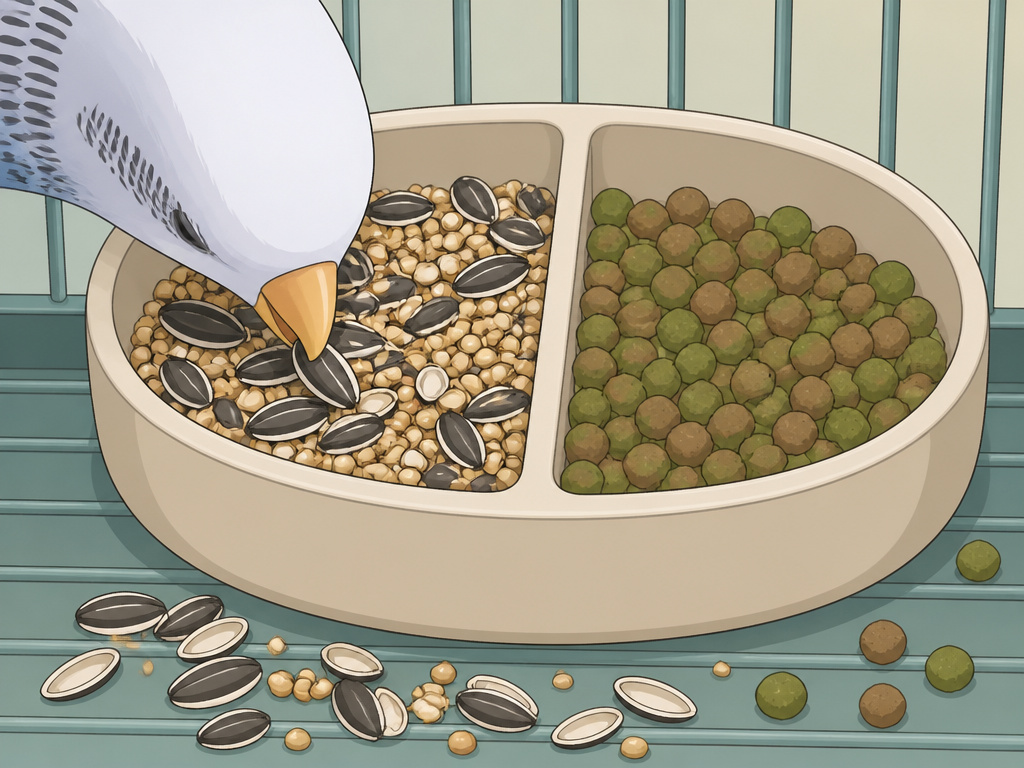
Stirring pellets into the seed bowl is the most common compromise, and it’s the one that fails most quietly. Merck advises that extra items shouldn’t disturb the ingredient and nutritional balance of the diet. A mixed bowl does exactly that, because the bird decides the ratio.
Hess describes the mechanism in dvm360: adding produce and table foods to a formulated diet lets pets pick out only the familiar foods and skip the formulated product. The same logic applies to seed. The Geckodan paper is even more direct, arguing that providing a seed mix in its own dish offers no specific benefit because it just makes an inappropriate diet easier to eat.
There’s a related mistake worth naming. Coating seed with vitamins doesn’t work, because most pet birds hull the seed before swallowing the kernel, so the vitamin coating ends up on the cage floor. Adding vitamins to drinking water is worse: Hess notes it may deter a bird from drinking and lead to dehydration.
Easy to miss: A bowl that goes down evenly is the only evidence that a mix is working. If the seed disappears and the pellets sit, you’re running a seed diet with pellet garnish.
The pellet percentage matters more than which pellet you choose. Hess puts table foods and produce at no more than 25-30% of the total diet when a formulated product is the base, and warns that nutrient dilution is more common when formulated products make up less than 50%.
Merck notes that extra food items should not disturb the ingredient and nutritional balance, though some special food items in limited quantities have shown health benefits, while Hess holds that table foods and produce should ideally be no more than 25–30% of the total diet. Blueberries are the example given, with the caveat that fresh beats thawed because the anthocyanin content drops when berries are frozen. Both positions agree on the principle: extras shouldn’t knock the base diet out of balance.
The Label Test: Four Numbers That Separate One Pellet From Another
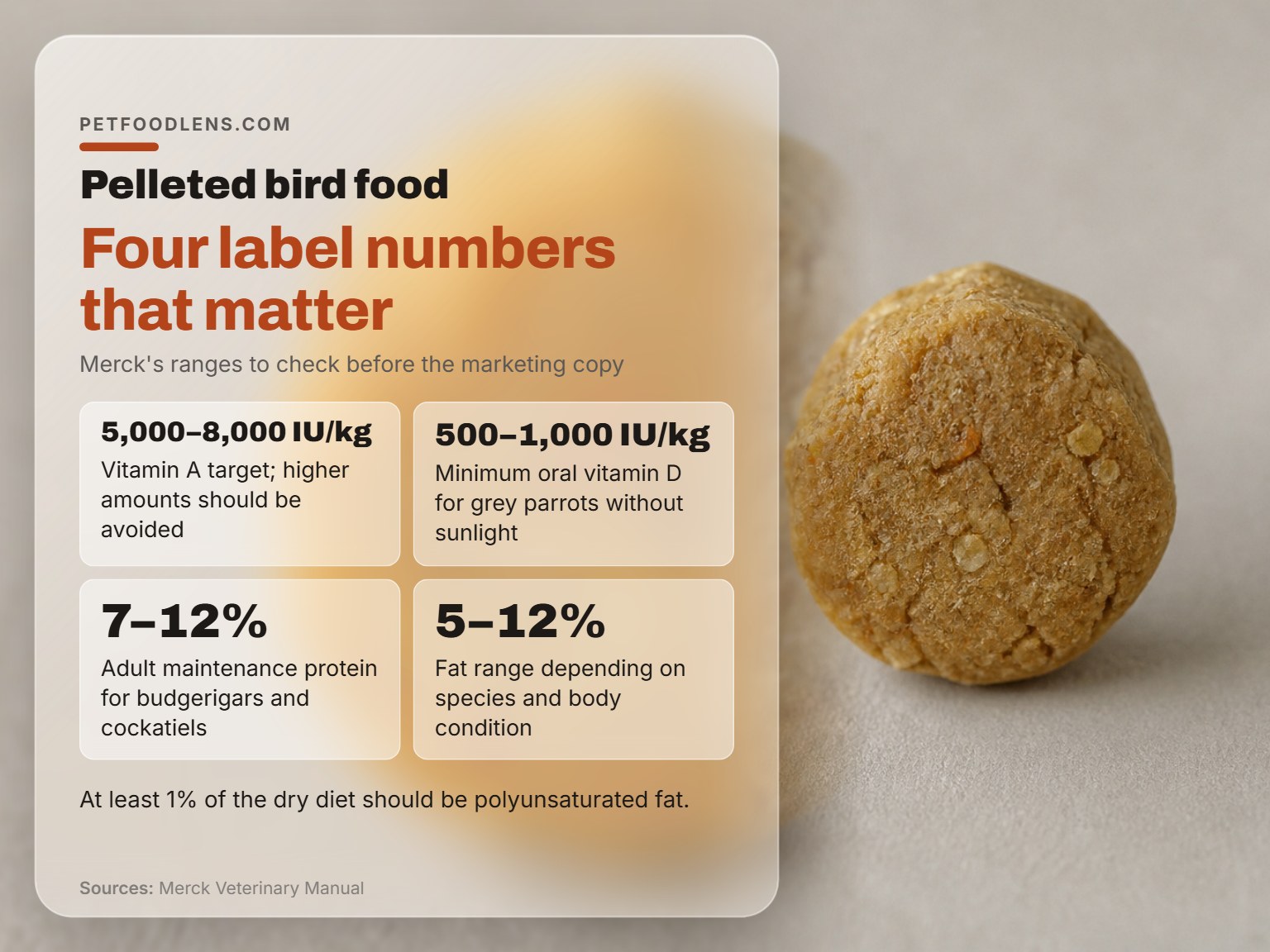
Merck’s guidance gives you four figures to check before the marketing copy matters. Read the back first.
- Vitamin A, in IU/kg. Merck’s target is 5,000-8,000. A number far above that is a reason to put the bag down, not a reason to pay more.
- Vitamin D3, in IU/kg. Grey parrots without sunlight need roughly 500-1,000 IU/kg orally, and macaws are documented as sensitive to excess.
- Crude protein, as a percentage. Match it to the species. Budgerigars and cockatiels sit at 7-12%, grey and Timneh parrots at 10-15%, and breeding passerine pellets run 18-22%.
- Crude fat, as a percentage. Merck’s range is 5-12% depending on species and body condition, with at least 1% of the dry diet as polyunsaturated fat.
Reading bird food labels is the same skill I use on the cat aisle, and the failure mode is identical: the front of the bag sells a story and the panel tells you what’s actually in the pot.
Versele-Laga is the clearest example of a manufacturer putting the number in the product name. The Ghent trial describes Nutribird P15 at 15% protein and P19 at 19%, which is exactly the kind of disclosure that lets you compare without a phone call.
Merck also draws a distinction worth knowing: extruded pellets come in different shapes and sizes for maintenance versus breeding purposes. Shape is a size decision, not a nutrition decision.
There’s a separate list of ingredients to avoid worth checking against any bag, and one item on it is specific to this category. Merck notes that monkey chow biscuits, long fed to psittacines as part of a complete diet, are nutritionally incomplete, and some brands harbor bacteria or promote excessive gram-negative bacterial growth.
How to Convert a Bird Without a Hunger Strike
A grey parrot that has eaten nothing but sunflower seed for years will not touch a pellet because it looks like a pellet. That refusal is documented, not personal. Ghent’s authors list initial reluctance toward new food items as a real drawback of pellet diets, while noting that several conversion strategies have been shown to be safe and successful.
Hess adds the practical half: birds often don’t recognize formulated products as food, and many owners give up before the bird changes its mind. A pellet conversion that moves too fast is the usual reason it fails.
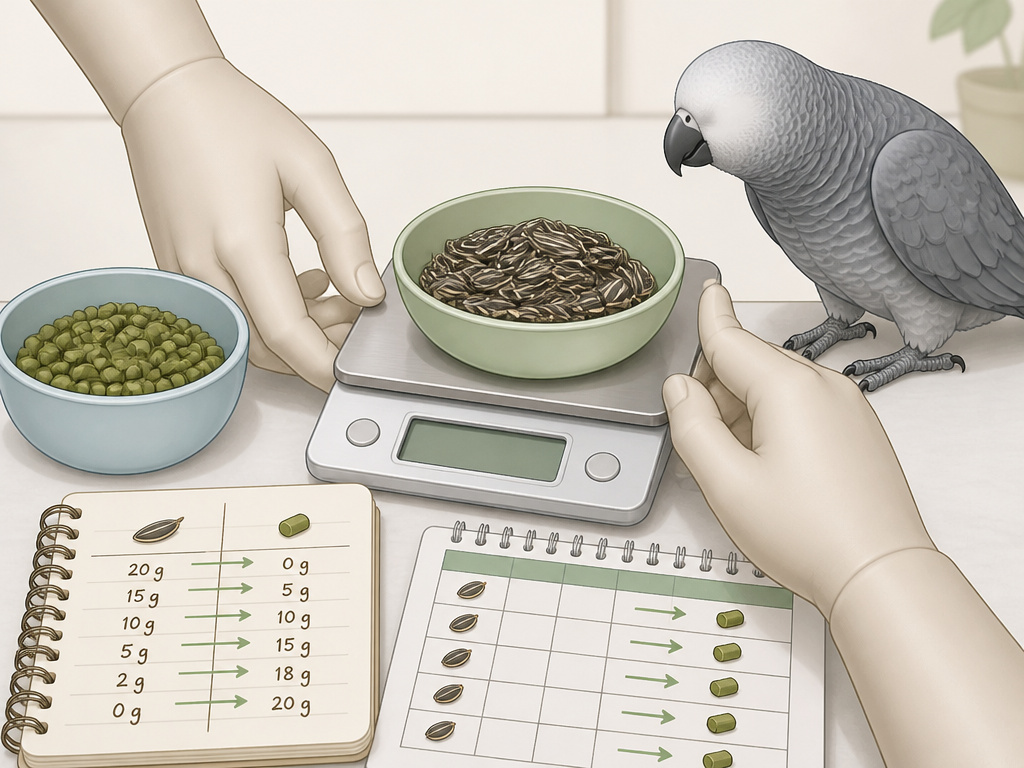
Plan the diet transition in weeks, and work in this order:
- Weigh the bird and the food offered before you change anything. Skipping the baseline means you can’t tell a slow conversion from a bird losing weight, and you’ll panic at the wrong moment.
- Keep the old food present while the new food appears. Pulling seed entirely on day one is how birds end up hungry, stressed, and louder than you thought possible.
- Offer pellets in a separate dish, at the time of day the bird expects food. Same dish, same slot, and most birds treat the pellet as a foreign object for the first week.
- Shrink the seed portion gradually. Going from full seed to full pellet too quickly usually produces a bird that eats nothing and an owner who caves.
- Judge by weight and droppings, not by enthusiasm. A bird can eat pellets reluctantly and still be fine. A bird that drops weight is telling you to slow down.
Hess makes the same point, noting that not all methods work for all types of birds.
When Pellets Are the Wrong Answer
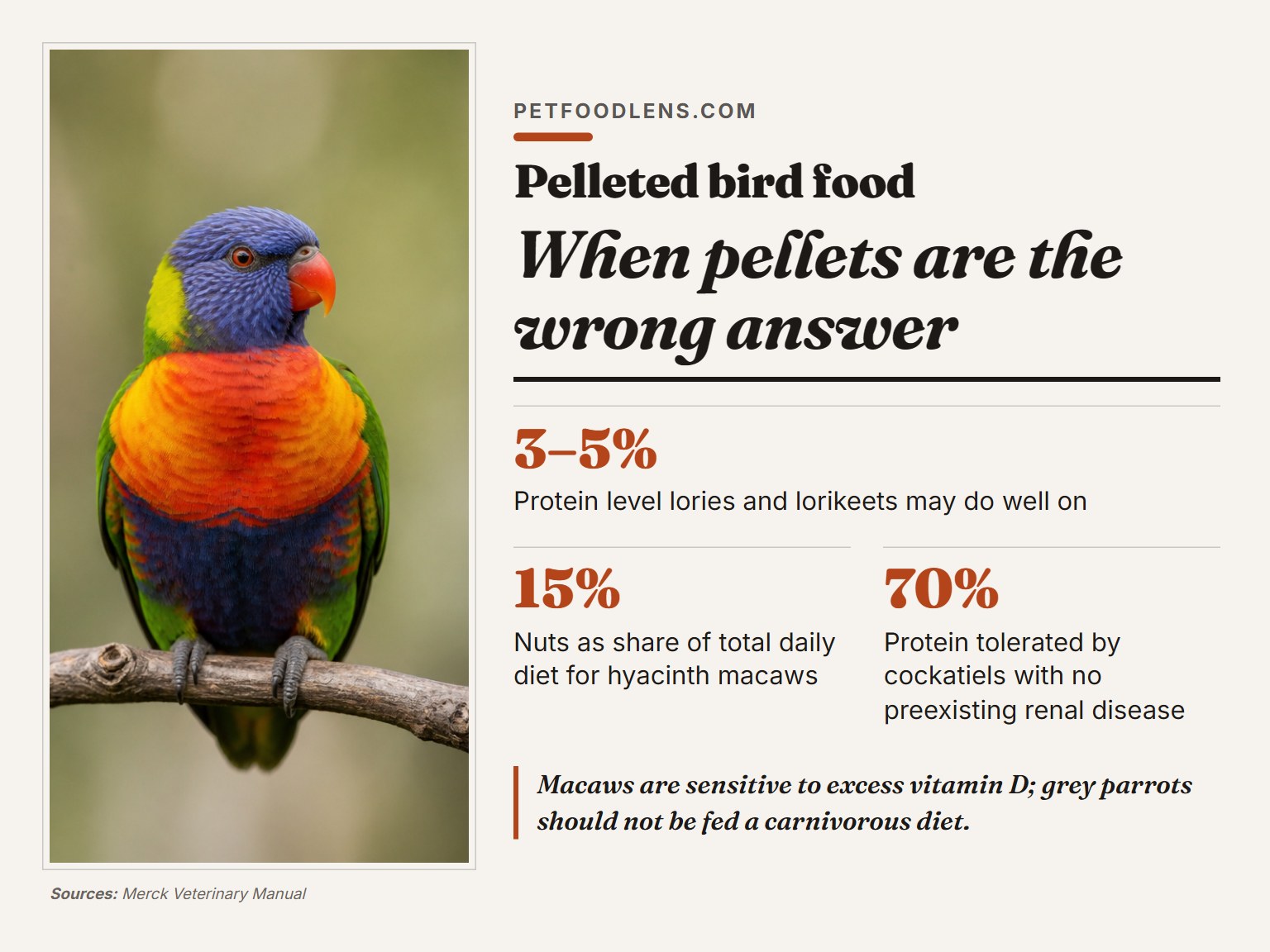
Two species groups break the pellet rule outright, and both are common enough that you might own one.
Lories and lorikeets are the first. Merck notes nectar-feeding lories and lorikeets may do well on easily digestible protein at levels as low as 3–5%. Their protein requirement can run as low as 3-5%, which is nowhere near a standard psittacine pellet.
Hyacinth macaws are the second. Merck states they need more dietary fat than other psittacines, and the way to deliver it is nuts at roughly 15% of the total daily diet. A low-fat maintenance pellet isn’t the right base for that bird.
Beyond species, there are conditions where a pellet diet needs supervision rather than enthusiasm:
- Macaws and vitamin D. Merck documents sensitivity to excess dietary vitamin D, with soft tissue calcification and renal failure as outcomes.
- Grey parrots and iron. Merck says feeding a carnivorous diet should be prevented because it causes iron storage disease in grey parrots, which are predominantly herbivorous.
- Breeding birds. The Geckodan paper is explicit that crumbles are maintenance only unless a breeder crumble is selected, and supplements are still required.
- Blue Gouldian finches. Vitamin A toxicity has been implicated in deaths of this colour mutation, suggesting a genetic predisposition to kidney damage.
- Birds with preexisting kidney concerns. Merck notes that when increased dietary protein is indicated, it should be increased gradually to avoid renal damage. Cockatiels with no preexisting renal disease tolerated protein up to 70% with no impairment, which is not a licence to try it on a compromised bird.
One genuine disagreement between the two major veterinary references is worth flagging rather than smoothing over. On grit, Merck states that grit is not needed by psittacines that remove seed hulls before ingestion. The MSD manual, covering passerines, says soluble grit such as oyster shell or cuttlebone should be provided to canaries and finches as a calcium supplement, particularly during egg-laying. Both can be right: the psittacine argument is about mechanical digestion, and the passerine argument is about calcium.
Frequently Asked Questions
Are pellets better than seed for parrots?
For most psittacines, yes, with conditions. Merck describes pelleted and extruded diets as having tremendously improved nutritional intake and health outcomes, and describes strictly seed diets as suboptimal regardless of supplementation. The conditions are that pellets vary in quality and must be evaluated individually, and that some species need a different base entirely.
Do birds get bored on an all-pellet diet?
The boredom objection is contested rather than settled. The Ghent study’s authors note the concern that pellets reduce feeding time and cause boredom or overfeeding, then cite Wolf et al. (2002), who found similar time budgets for feeding behaviour on pellets compared with seed mixes. Hess notes that owners often add produce to relieve boredom, which then lets birds pick out only familiar foods.
Can I just mix pellets into the seed?
It usually doesn’t balance anything. Merck advises that extra items shouldn’t disturb the ingredient and nutritional balance of the diet, and the Geckodan paper argues that offering seed separately simply makes an inappropriate diet easier to eat. If the seed disappears and the pellets remain, the bird is still on a seed diet.
How much of a bird’s diet should be pellets?
Hess puts table foods and produce at no more than 25-30% of the total diet when a formulated product is the base, and flags nutrient dilution as more common below 50% formulated. The Geckodan finch paper suggests at least 50% crumbles as a starting point, with 80-90% more realistic for some cabinet-bred or indoor aviary birds.
Do I need to give grit with pellets?
For psittacines that hull their seed, Merck says no. For canaries and finches, the MSD manual recommends soluble grit such as oyster shell or cuttlebone as a calcium source, especially during egg-laying. The two recommendations address different birds and different problems.
Are all pelleted diets nutritionally complete?
No. Merck states that pelleted diets differ in content and quality and must be evaluated individually. The Geckodan paper adds that crumble diets are maintenance only unless a breeder formula is chosen. Hess’s position is that formulated products plus a smaller amount of fresh produce provide complete and balanced nutrition, which is a statement about a well-formulated pellet, not about every pellet.
The Bottom Line
If your bird is already on a pellet, holding weight, and producing reasonable droppings, most of this article doesn’t apply to you. Don’t fix what’s working.
Here’s the one thing worth doing this week. Pick up the bag you’re feeding now and find the vitamin A figure. If it’s inside 5,000-8,000 IU/kg, you’re in Merck’s range and you can stop reading labels for a while. If the panel doesn’t state it, or states something well above that, you’ve learned more from the back of the bag than the front will ever tell you.
One concession, because it’s real: the research base here is thinner than it looks. The Ghent crossover trial ran on eight African grey parrots, which is enough to show a direction and not enough to settle a species. Anyone who tells you the pellet question is closed is selling something, and it’s probably a bag.
