
How to Sprout Seeds for Birds: A Safe 4-Day Method
This post contains affiliate links. As an Amazon Associate, we earn from qualifying purchases.
To sprout seeds for birds, start with untreated seed from a supplier that certifies it pathogen-free, treat it before soaking, then rinse and drain until small white tails appear. Kansas State University Extension names the seed itself as the typical contamination source in sprout outbreaks, which is why the treatment step matters more than the container.
A seed coat is a rough, porous surface, and anything living on it gets a warm, wet, dark place to multiply for the three to four days a batch sits on the counter. That’s the window the extension service is warning about. The seed treatment and the rinse schedule are the two levers that actually move the risk.
What follows covers the seed worth buying, the two treatments the extension service lists, the soak and rinse schedules where the sources openly contradict each other, and the point at which a batch belongs in the bin.
Key Takeaways
- The seed is the usual contamination source. Buy certified pathogen-free seed from a supplier that says so in writing.
- 3% hydrogen peroxide at 140F for 5 minutes is the extension-service treatment; undiluted store-bought vinegar for 15 minutes is the alternative.
- Rinse schedules range from every 4 hours to twice a day. The manufacturer’s 12-24 hour interval is the outlier and the least conservative.
- Four days is the ceiling. China Prairie’s instructions say not to leave sprouts longer than that.
- Small white tails, not green leaves. No source in this group endorses waiting for long green shoots.
The Seed Is Where Most Sprout Problems Start
Seed carries whatever was on it in the field, and a warm jar gives it four days to grow.
Kansas State University and University of Missouri Extension state it directly: in most outbreaks associated with sprouts, the seeds are typically the source of the bacterial contamination. Raw or lightly cooked sprouts are a common source of foodborne illness in the United States, particularly Salmonella and E. Coli O157:H7.
The CDC’s position, as that extension sheet relays it, is that anyone who chooses to eat sprouts should cook them thoroughly. The same sheet advises young children, elderly people, and anyone with a weakened immune system not to eat raw sprouts at all.
In most sprout-associated outbreaks, the seed is the contamination source rather than the sprouting jar. Warm, humid germination conditions suit any bacteria already present on the seed coat. Home growers therefore start with seed certified pathogen-free and treat it before soaking. Surface structure varies by species, so a treatment validated on one seed may underperform on another.
For a bird, the arithmetic is the same. The seed goes into a dish the bird eats from, and the warm damp conditions that germinate it also grow whatever came in on the coat, which is the how to sprout seeds for birds question in miniature.
Sprouting seed differs from garden seed in that it has not been treated with fungicides, and the article is explicit that you should confirm the seed is untreated before you buy it. The same piece recommends seed with the highest germination rates, because the seeds that never sprout are the most likely to spoil during the process.
A bag of low-viability seed is a bag of future mush.
What to check before you pay:
- Certified pathogen-free, in writing, on the supplier’s spec sheet rather than a word on the front of the bag.
- Untreated. No fungicide coating, which is standard on garden seed and absent from proper sprouting seed.
- A stated germination rate, because the ungerminated fraction is what spoils first.
- A supplier who knows what Sprout Safety Alliance training is.
Kansas State names two US suppliers that have completed that training: International Sprout Supplier (sproutnet.com) and Caudill Seeds (caudillsprouting.com). If you’re buying in bulk, those are the two names the extension sheet puts forward.
Read the back first. A mix whose first three ingredients are all sunflower variants is telling you what the bag is built around.
There’s a regulatory tell here too. In Kansas and Missouri, selling sprouts requires a license even when you sell direct to consumer or in small quantities, and growers must attend Sprout Safety Alliance training. That’s how seriously the seed side of this is treated by people who’ve watched the outbreak data.
How to Sprout Seeds for Birds: Treat the Seed First
Two treatments carry an extension service’s backing, and the longer one takes fifteen minutes.
Before you start: 3% hydrogen peroxide heated to 140F will scald skin on contact, so clip a clean thermometer to the pan and keep your face back from the steam. The bleach used later for jars is plain, unscented laundry bleach, never a splash-free or scented version. Rinse every container with clean water before seed goes back into it.
Kansas State calls seed treatment to reduce pathogens highly recommended for home sprouters and a requirement for commercial growers, per the Sprouting Seeds at Home Safely guide. That’s a stronger recommendation than most home sprouting content carries.
The Hydrogen Peroxide Method
- Heat 3% hydrogen peroxide to 140F and confirm it with a clean, accurate thermometer. Skip the thermometer and you’re guessing at the one variable the method depends on.
- Lower the seed in a mesh strainer into the solution and hold it there for 5 minutes. Shorter contact leaves the surface contamination you started with.
- Swirl the strainer at 1-minute intervals. Seed that sits still gets uneven contact, and the grains pressed against the mesh get more than the ones in the middle.
- Discard the solution after each batch. Its effectiveness drops fast, so a second batch in the same pan gets a weaker treatment than the first.
- Test germination on a small batch first if you’re working with a seed type you haven’t treated before. Surface structure varies by species, and a method that works on one seed may not work as well on another.
The Vinegar Method
The alternative in the same sheet needs no thermometer: soak the seed in undiluted store-bought vinegar for 15 minutes. That’s the whole procedure. It’s a reasonable choice if you’re treating a small amount and don’t want a pan of hot peroxide on the counter.
Here’s where the sources part company. Wombaroo’s sprouting guide and China Prairie’s instructions contain no pathogen-reduction seed treatment at all. China Prairie’s only antimicrobial step is a rinse with FRESH Stabilizer, a grapefruit bioflavonoid product mixed at 1 1/2 tsp per gallon of distilled water (and sold by China Prairie, which is worth noticing). That’s a different approach from a validated pathogen-reduction treatment, and two manufacturers and one extension service are describing different levels of risk control.
How Long Should You Soak Seeds Before Sprouting?
China Prairie recommends 8 hours, Wombaroo allows 5 to 24 hours, and AFA Watchbird says to soak overnight in tepid water.
Wombaroo gives a range of 5 to 24 hours, less in hot climates, until the seeds swell and soften. China Prairie is tighter: 8 to 10 hours for micrograin or psittacine mixes, with a note not to soak more than 12 hours and a recommended 8. AFA Watchbird simply says to soak overnight in tepid water.
I default to eight hours and stop there. China Prairie caps the soak at 12 hours and Wombaroo allows up to 24, and when two manufacturers disagree by a factor of three, the shorter soak is the one I’d defend. Warm water plus seed plus time is the same recipe that grows bacteria.
There’s a practical reason the upper bound matters beyond contamination. AFA Watchbird notes that smaller seeds such as alfalfa and broccoli expand by up to four times their volume after soaking, while larger seeds such as mung, bean, and lentil double in size.
Soak a full jar of alfalfa and you’ll be sweeping it off the counter by morning.
Which seed you’re soaking changes the timing more than the clock does. Sprouting legumes for birds runs faster than most grains, and sprouting whole grains for birds needs the full soak before the tails show.
Rinse Frequency: Four Sources, Four Answers
Four sources, four rinse schedules, and the manufacturer is the outlier.
Kansas State wants the jar under flowing cool water at least three times a day, or every four hours, to wash away moulds and bacteria. Queenslander Aviaries says at least four times a day and adds the detail that matters: the seed must drain properly before it goes back to its spot. Wombaroo says every 12 to 24 hours, more often in hot climates. China Prairie says twice daily is enough if you’re sure the water is pure.
| Source | Soak | Rinse | Ready in |
|---|---|---|---|
| Kansas State/MU Extension | Overnight | Every 4 hours, or 3x daily | 3-4 days |
| Wombaroo | 5-24 hours | Every 12-24 hours | 2-3 days |
| China Prairie | 8-10 hours, 12 max | Twice daily if water is pure | 2 days at 65-70F |
| Queenslander Aviaries | Not specified | At least 4x daily | When tails emerge |
| AFA Watchbird | Overnight, tepid water | Not specified | 3-6 days |
China Prairie’s caveat is the one worth sitting with. Their instructions argue that frequent rinsing with water that isn’t clean may itself be the cause of a contamination problem, which runs opposite to the extension service’s logic. Both positions assume something different about your tap.
Kansas State/MU Extension recommends rinsing every four hours or at least three times a day, Wombaroo every 12 to 24 hours, China Prairie twice daily if water is pure, and Queenslander Aviaries at least four times a day. That’s my call. The disagreement is real, and anyone who tells you there’s one settled rinse interval hasn’t read all four documents.
Temperature Decides the Timeline
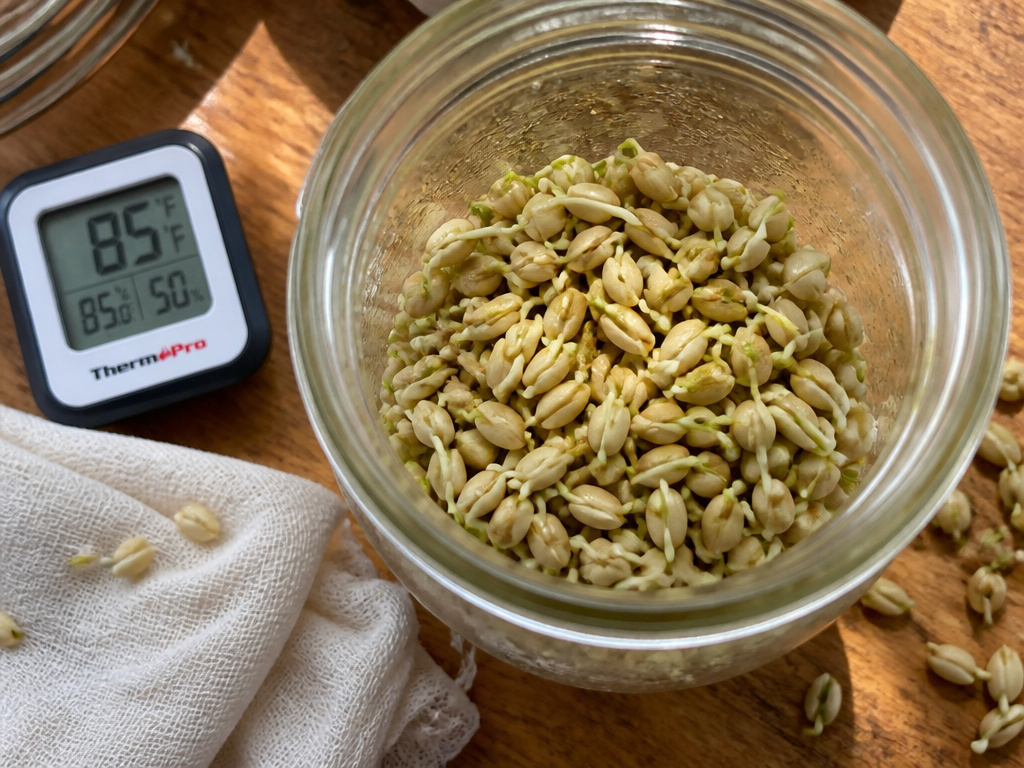
China Prairie publishes a temperature-to-time table that most sprouting guides leave out entirely.
Their figures: at 65 to 70F, a batch is ready two additional days after draining. Above 80F, it’s ready after an additional 24 hours. At low temperatures it takes up to four days total. And the hard ceiling sits over all of it, because their instructions say not to leave sprouts longer than four days.
| Condition | Time to ready | Source |
|---|---|---|
| 65-70F room temperature | 2 additional days after draining | China Prairie |
| Above 80F | 24 additional hours | China Prairie |
| Low temperatures | Up to 4 days total | China Prairie |
| About 25C | Optimum germination temperature | Wombaroo |
| About 70F room | Hold this, or skip summer sprouting | Kansas State/MU |
Wombaroo gives about 25C for optimum germination, and it says to soak for less time and rinse more often in hot climates. Kansas State says it is not wise to attempt sprout production in summer unless the room can be held at about 70F, while Queenslander Aviaries suggests staying on soaked seed through extreme heat and China Prairie notes that above 80F a batch is ready after an additional 24 hours.
Where this goes sideways: A kitchen at 85F in July cuts the window to 24 hours and cuts the margin with it. Kansas State says don’t sprout in summer without a room at about 70F, and Queenslander Aviaries suggests staying on soaked seed until the heat breaks.
A batch running too warm goes sour before it looks wrong. China Prairie says a sour or acid smell should be investigated. Trust the nose on that one.
When Are Sprouts Ready to Feed?
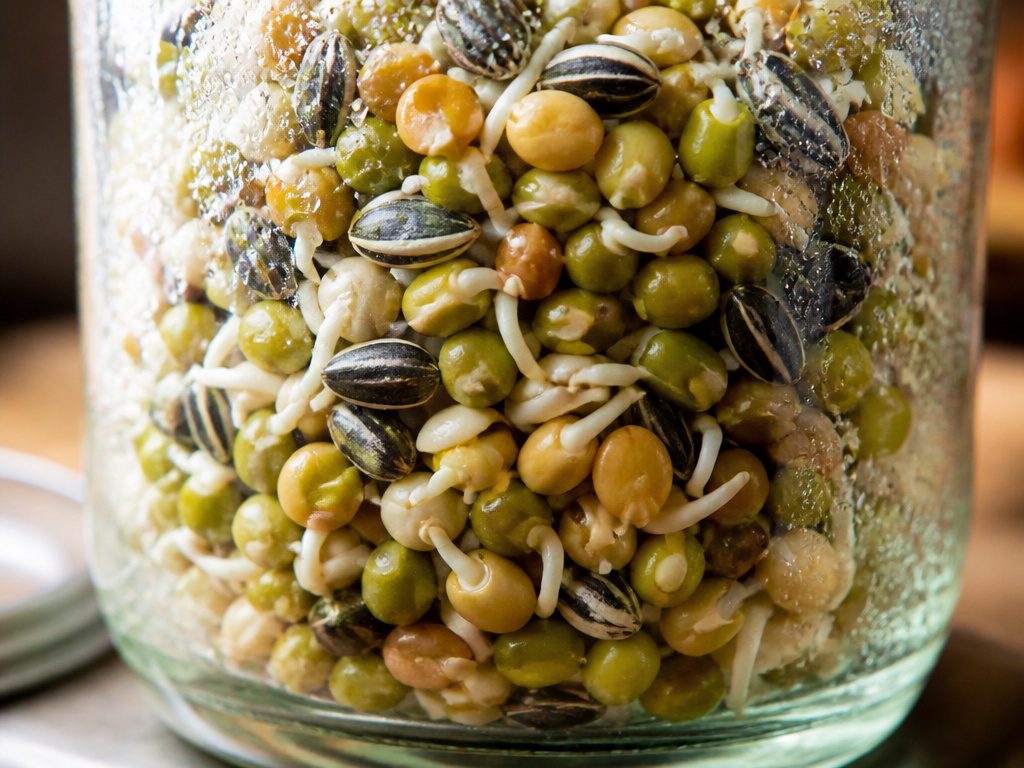
Day three, the mung beans have tails and the sunflower hasn’t moved.
That’s normal. Queenslander Aviaries notes that sunflower is one of the last seeds to get going, which is why a mixed batch finishes unevenly and why you shouldn’t judge the whole jar by the slowest seed in it.
China Prairie is the most specific on the harvest point: only small white sprout tails, not green leaves, and ready when 60 to 70 percent of the ingredients show white tails. Their reasoning is that the nutritional transformation happens on first emergence. Wombaroo feeds at a few millimetres. Queenslander Aviaries says tails emerging is enough and you don’t need long shoots.
Kansas State sits at the other end, describing sprouts one to two inches long after three to four days at room temperature. AFA Watchbird lands in the middle, saying sprouts are best eaten soon after the first leaves appear, with beans and lentils harvested before the leaves emerge at all.
China Prairie, Wombaroo and Queenslander Aviaries stop at the tail stage, while Kansas State describes sprouts one to two inches long and AFA Watchbird says sprouts are best eaten soon after the first leaves appear. The one that goes to one or two inches is describing a different harvest, and no source in this group endorses waiting for long green shoots.
Species timing varies more than the calendar suggests. AFA Watchbird puts most vegetable seeds at three to six days, beans at one to three days to produce a root, and onion or garlic at up to two weeks for an edible sprout. If your mix has onion seed in it, the rest of the jar will be past its best before that seed does anything.
Feed too early and you’ve got wet seed. Feed too late and you’ve got a vegetable the bird won’t touch. The gap between sprouted seed versus dry seed is bigger than the water weight suggests, and it’s the reason the harvest stage matters at all.
Cleaning the Jar and Keeping What You Grow
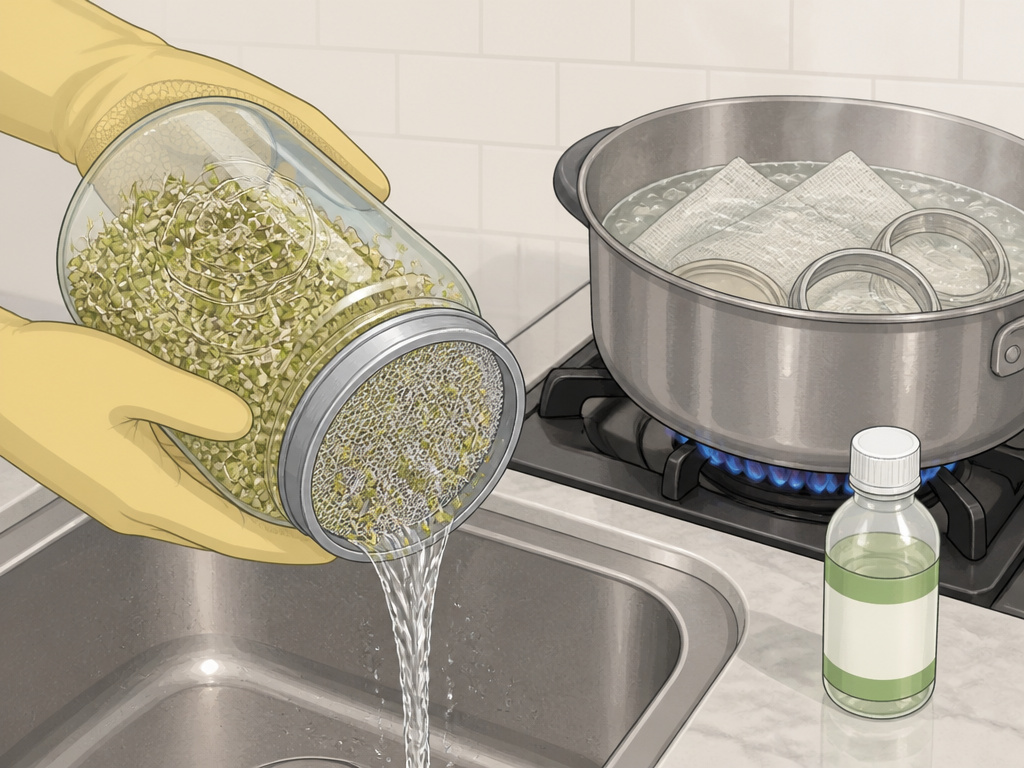
Three things carry a batch from jar to bowl: a clean container, a drain, and a cold fridge.
Sanitizing the Jar
Kansas State gives two routes. The first is a bleach soak: 3/4 cup of plain, unscented laundry bleach per gallon of water, or 3 tablespoons per quart, soaking the container for at least 5 minutes, then rinsing with clean water. The second is boiling in tap water for 10 minutes. Cheesecloth and mesh screening used in the jar get boiled too, not just rinsed.
Wombaroo’s alternative is a bird-safe disinfectant, specifically a diluted chlorhexidine solution such as Multi-Clens at 5mL per 10 litres of water, mixed to the label’s instructions.
Kansas State also says to sprout well away from food preparation areas, pets, and high household traffic. That’s a placement rule, and it’s the one most home setups break first.
Draining and Storing
China Prairie’s geometry is worth copying: drain for 1 to 2 hours, then lay the jars on their sides so air circulates, and rotate them to fluff twice a day. Three one-quart mason jars with sprouting lids suits one to six birds.
Queenslander Aviaries states the principle behind all of it. Sprouting seed should be damp with air moving around it, not sitting in water between rinses.
Storage life is another place the sources don’t agree. Wombaroo says refrigerated sprouted seed keeps up to two days. Queenslander Aviaries says a clean covered container in the fridge and use within a few days. China Prairie gives no post-harvest refrigeration figure but caps total growth at four days.
| What you see | Likely cause | What to do |
|---|---|---|
| Sour or acid smell | Bacterial growth | Investigate; discard if in doubt |
| Grey, black or white fuzz | Mould | Discard the batch |
| Slimy or gluggy seed | Contamination | Discard; sanitize the jar |
| No tails after 4 days | Old or non-viable seed | Discard; buy higher-germination seed |
| Green leaves | Left too long | Feed earlier next batch |
Dry seed storage is separate and easier. Queenslander Aviaries recommends keeping sprouting seed cool and dry, with freezer storage for the long term, and China Prairie says to freeze any product for at least three days if you find moths or grain weevils. Bird seed storage gets more detail than I can fit here.
The fridge buys you two days on Wombaroo’s count, and storing fresh sprouts safely matters more than most people treat it.
Feeding Sprouts Without Unbalancing the Diet
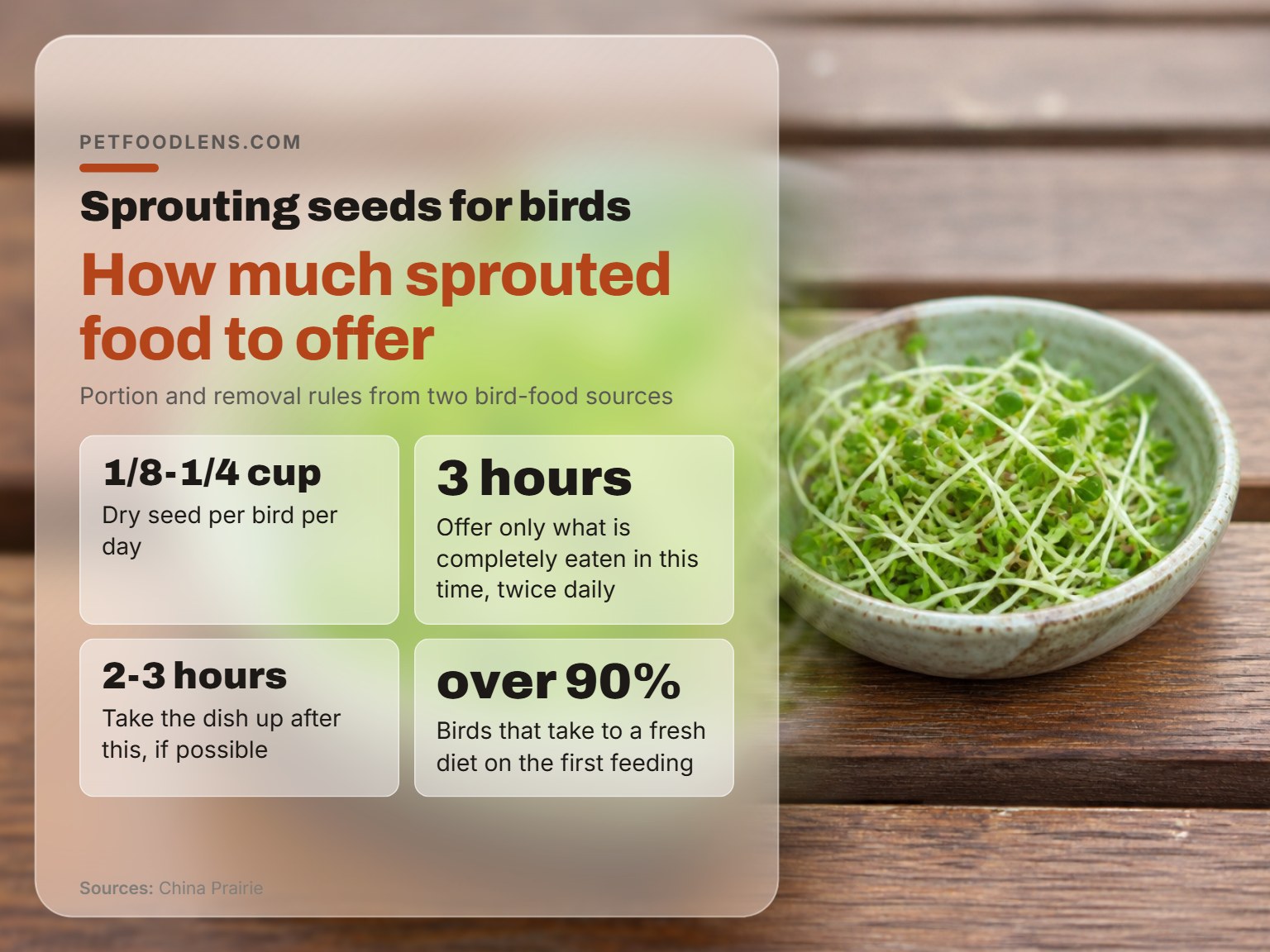
Sprouts go further than most people expect, and that’s exactly why the portion matters.
China Prairie’s ration is 1/8 to 1/4 cup of dry seed per bird per day, with a starting figure of 1/4 cup of dry grains for a Grey Parrot-sized bird. Their feeding rule belongs on the jar lid: offer only what will be completely eaten in three hours, assuming twice-daily feeding, and take the dish up after 2 to 3 hours if you can.
Queenslander Aviaries ties the amount to the bird and the rest of its diet, and says to remove anything uneaten after a few hours. Two sources, same instinct. The food comes out.
Common mistake: Topping up the dish while the husks are still in it. The bird has eaten and what’s left is shell, so a refill hides how much is actually going in and leaves fresh food sitting under dry.
China Prairie reports that over 90 percent of birds take to a fresh diet on the first feeding.
Four rules that keep the routine honest:
- Mix sprouts into chop at serving time, not into a tub that sits in the fridge, per Queenslander Aviaries.
- Measure the dry seed before you soak it. A quarter cup of dry grain is a portion; a quarter cup of soaked grain is mostly water.
- Take the dish up after 2 to 3 hours, even if there’s still food in it.
- Keep the sprouting jar away from the feeding area where you can manage it.
Sprouts are a component, and the rest of the bowl still has to do its job. Sprouts go on top of that base.
I’m not fond of sunflower-heavy mixes, and I’ll say why plainly: a bag can hold eight ingredients and still be built around the two cheapest ones. That’s my read of the label, and it’s an opinion rather than a manufacturer’s claim.
Supplementing a seed-based diet is the next layer if the bird is already on a seed mix, and the health risks of a seed-only diet are worth understanding before you decide how much of the bowl sprouts should occupy. Balancing a bird diet comes down to proportions across the week, and sprouts are one line item in it.
Frequently Asked Questions
Can I sprout the seed mix I already feed my bird?
Only if it’s untreated and has a high germination rate. AFA Watchbird notes that sprouting seed differs from garden seed because it hasn’t been treated with fungicides, so confirm that first. The same article recommends seed with the highest germination rates, since ungerminated seed is the most likely to spoil. A mix built for feeding dry isn’t automatically a mix built for sprouting.
Do I have to treat the seed with hydrogen peroxide?
Kansas State calls pathogen-reduction treatment highly recommended for home sprouters and a requirement for commercial growers, with 3% peroxide at 140F for 5 minutes or undiluted vinegar for 15 minutes. Wombaroo and China Prairie publish no pathogen-reduction step at all. That’s a genuine split in risk posture, and the extension service is the more cautious of the two positions.
Why did my sprouts smell sour?
China Prairie describes a wet-leather or earthy smell as normal and a sour or acid smell as something to investigate. Wombaroo adds that contaminated seed smells off and looks gluggy, and says that if you’re in doubt, don’t feed it. Sliminess or any grey, black, or white mould means the batch goes in the bin.
How long do sprouted seeds keep in the fridge?
Wombaroo says up to two days. Queenslander Aviaries says a clean covered container and use within a few days, discarding sooner on slime, visible mould, discolouration, or an unusual smell. Wombaroo says up to two days, while Queenslander Aviaries says a clean covered container and use within a few days.
Can I sprout seed in summer?
Kansas State says it isn’t wise to attempt sprout production in summer unless the room can be held at about 70F. Queenslander Aviaries suggests staying on soaked seed through extreme heat. China Prairie takes a different tack, noting that above 80F a batch is ready after an additional 24 hours. If you do sprout in heat, shorten the schedule rather than extending it.
How much sprouted seed should a bird get?
China Prairie’s figure is 1/8 to 1/4 cup of dry seed per bird per day, with 1/4 cup of dry grains as a starting point for a Grey Parrot-sized bird. Offer only what will be eaten in three hours, twice daily, and take the dish up after 2 to 3 hours. Queenslander Aviaries says the amount depends on the bird and the rest of its diet.
The Bottom Line
One trigger worth setting before you start: if your kitchen sits above 80F for most of the summer, don’t build a sprouting routine around it. Kansas State says don’t sprout without a room at about 70F, and Queenslander Aviaries stays on soaked seed through a heatwave. Soak overnight, feed in the morning, and pick the habit back up in September.
Your first step is smaller than most guides suggest. Buy one small bag of certified pathogen-free seed from a supplier who will say those words, treat a quarter cup of it with vinegar for 15 minutes, and run a single jar for four days before you buy any equipment at all.
The part I can’t give you is species-specific. My depth is in formulation and ingredient quality, and avian clinical nutrition is a different discipline. If your bird has a diagnosed liver or kidney issue, the sprout portion is a question for an avian veterinarian, and no rinse schedule on this page substitutes for that answer.
That’s how to sprout seeds for birds without turning the kitchen counter into a bacteriology experiment: get the seed right, treat it, rinse on a schedule you’ll actually keep, and stop at four days.
