
Safflower Seeds for Birds Pros and Cons: Worth It?
This post contains affiliate links. As an Amazon Associate, we earn from qualifying purchases.
Safflower seeds for birds trade one thing for another: a hard white shell and bitter taste that grackles, starlings, and by most accounts squirrels leave alone, in exchange for a seed only a shorter list of birds will open, led by cardinals, titmice, chickadees, finches, doves, and grosbeaks. Allow a week or more for acceptance.
The shell is what buys the quiet. A cardinal’s conical bill crushes a safflower hull without effort, while a starling works at the same hull and gives up. That difference in bill geometry is the whole case for the seed, and it’s also why safflower disappoints people who buy it for the wrong yard. Weighing safflower seeds for birds pros and cons comes down to which species your yard attracts.
What follows is the honest ledger: which birds actually eat it, what it does and doesn’t do about squirrels, whole versus hulled, and the serving method that shortens the wait.
Key Takeaways
- Cardinals, titmice, chickadees, finches, doves, and grosbeaks eat safflower; grackles, starlings, and blackbirds leave it alone.
- Expect several days to a week or more before picky birds try it, and don’t top off the feeder while you wait.
- Platform and hopper feeders with a tray suit safflower’s size, per Birds & Blooms and Old Potter’s Co., though Pennington notes cardinals will also use tube feeders with reasonably large perches.
- Hulled safflower reaches smaller-billed birds and leaves almost no mess, but replace it every 10 to 14 days in warm weather.
The Hard White Shell Is the Whole Story
The shell is the entire product.
Safflower arrives as a small white hull, slightly smaller than a sunflower seed, with a bitter coating that most birds can taste and few enjoy. Under that hull sits a kernel Birds & Blooms describes as extremely high in protein and fat. The bitterness does the work. It filters the guest list.
Safflower seed carries a hard white hull over a kernel high in protein and fat, and the whole seed runs slightly smaller than a sunflower seed. The bitter coating on that hull narrows the list of birds willing to open it, and the same bitterness is what most sources credit for keeping squirrels and starlings at a distance.
The Merck Veterinary Manual’s entry on nutritional diseases of pet birds puts safflower higher in fat than sunflower, which runs against the common assumption that sunflower is the richer seed. Pennington’s claim is narrower and easier to check: black oil sunflower delivers the most energy per pound of any typical birdseed.
Safflower’s history isn’t about birds at all. It was cultivated for red dye as far back as ancient Egypt. The Feedipedia safflower seed profile covers its composition as a feed ingredient if you want the agricultural version of the same story.
One more thing worth knowing before you buy: Pennington notes that only a small percentage of people feeding birds offer safflower. Unfamiliar food gets ignored. That single fact explains most of the safflower seeds for birds pros and cons reports you’ll find online.
Safflower Seeds for Birds: Pros and Cons That Hold Up
Cardinals sell this seed, and cardinals are also why it flops in some regions.
The birds that reliably eat it
Northern cardinals top every list, and they’re the species most often photographed working a safflower hull. Tufted titmice, chickadees, house and purple finches, woodpeckers, and several kinds of grosbeaks also eat it, according to Birds & Blooms. Cornell Lab of Ornithology, quoted in an Extension response, adds doves and native sparrows and notes that the thick shell is genuinely hard for some birds to open at all. Mass Audubon frames safflower as a ground-feeding favorite, naming cardinals and sparrows specifically.
The pros, stripped of the bag copy:
- A feeder that stays fuller longer, because the birds that empty a sunflower feeder in an afternoon won’t fight you for this.
- Cardinals, reliably, which is the reason most people buy the bag in the first place.
- Almost no mess from the hulled form, which leaves virtually no mess beneath the feeder.
The birds that leave it alone
The Missouri Department of Conservation bird feeding page makes the same point from the other direction: if starlings are a problem at your feeders, try putting out safflower, since starlings generally do not eat them.
House sparrows are the exception worth knowing. Old Potter’s Co. Notes they’ll occasionally eat safflower but strongly prefer millet, milo, and cracked corn, which is exactly what cheap mixes are full of.
| Bird group | Eats safflower? | Feeder that suits it |
|---|---|---|
| Cardinals, titmice, grosbeaks | Yes, readily | Platform or hopper with a tray |
| Chickadees, finches, nuthatches | Yes | Tube or hopper |
| Doves and native sparrows | Yes, mostly on the ground | Low tray or scattered seed |
| Grackles, starlings, blackbirds | Generally no | Not a factor |
| House sparrows | Occasionally, reluctantly | Prefer millet and cracked corn |
If cardinals are the bird you’re actually buying for, the safflower seeds for birds pros and cons comparison covers what else they take beside safflower. Safflower is one entry in a longer list, and the types of bird seed breakdown is where to see how it stacks up against nyjer, millet, and sunflower.
Do Safflower Seeds Really Keep Squirrels and Starlings Away?
Do safflower seeds actually keep squirrels off the feeder? The answer depends on which source you trust, and they don’t agree.
Birds & Blooms states plainly that safflower seeds deter squirrels and bully birds. Pennington softens it to “according to many sources,” which cites a reputation rather than a test. Mass Audubon gives the most useful version: the bitter taste makes safflower unpalatable to squirrels, although they can develop a taste for it. Three sources, three confidence levels, one seed.
Starlings are a cleaner case. Birds & Blooms says grackles, starlings, and blackbirds actively avoid safflower. The Missouri Department of Conservation recommends safflower specifically because starlings generally don’t eat it. Old Potter’s Co. Agrees on grackles and starlings, then adds the caveat that house sparrows will occasionally eat it.
Treat safflower as a filter, not a fence. It changes who shows up at the feeder. It doesn’t lock anyone out.
I’d trust Mass Audubon’s phrasing over the confident version, because it accounts for the squirrel that learns. A squirrel already visiting your feeder may test safflower, and Mass Audubon notes they can develop a taste for it.
If squirrels are the actual problem, the bird seed squirrels don’t like comparison is a better starting point than any single seed. And if you want a mechanical answer rather than a botanical one, Mass Audubon’s bird feeding guidance covers feeder options beyond seed choice.
Whole or Hulled: The Choice That Changes Your Mess and Your Refill Schedule
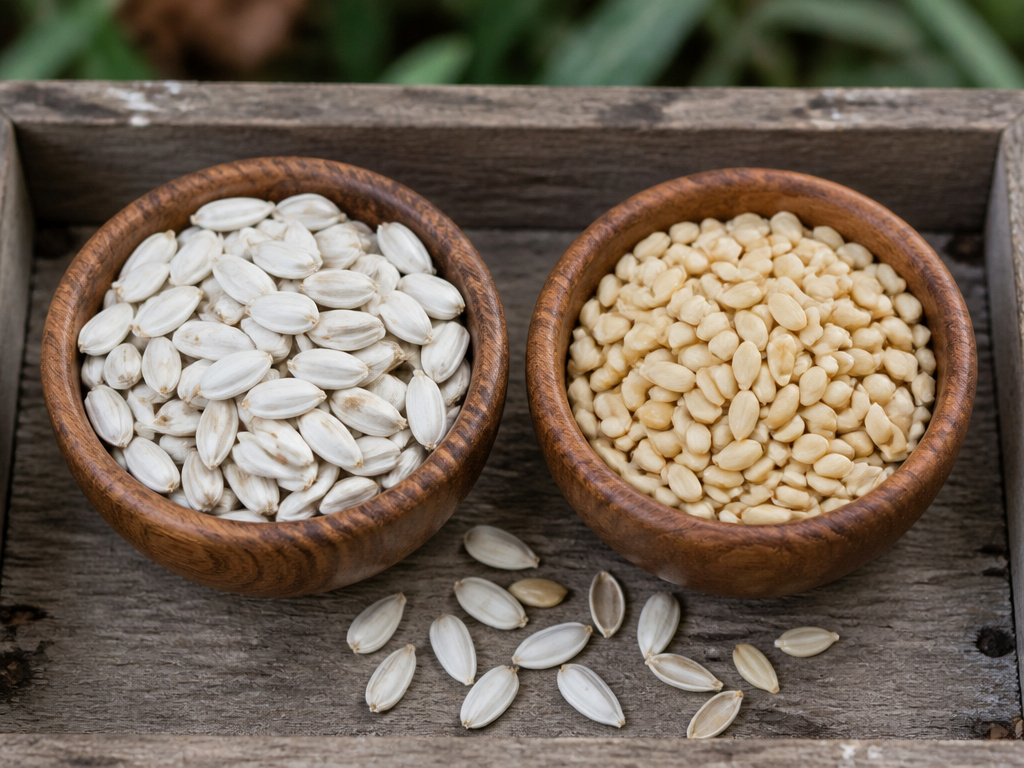
Two forms of safflower reach the shelf, and they behave nothing alike.
Whole safflower: the default
Whole safflower is the standard, widely available form, still inside its hard white shell. Strong-billed birds open it without trouble. Old Potter’s Co. Notes the shells are small and light, and most blow away or break down quickly, so the hull pile under the feeder stays modest.
Hulled safflower: wider reach, shorter shelf life
Hulled safflower has the shell removed, which opens the seed to smaller-billed species that couldn’t crack it otherwise. It leaves almost no mess beneath the feeder. The trade-off is real: hulled seed costs more, and with no shell protecting it, it goes stale or molds faster in humid weather. Old Potter’s Co. Recommends replacing it every 10 to 14 days in warm months.
Stale seed can smell off, and hulled safflower gets there first because nothing is standing between the kernel and the air. Hulled safflower gets there first because nothing is standing between the kernel and the air.
| Form | Birds it reaches | Mess under the feeder | Refill interval in warm weather |
|---|---|---|---|
| Hulled | Wider range, including smaller-billed species | Virtually none | Replace every 10 to 14 days |
Which form you buy depends on your guest list. If your yard runs to chickadees and finches, hulled is the version that reaches them, and the best safflower seed for birds rundown sorts the options by bill size. Whole safflower’s closest competitor is sunflower seeds for birds, which most birds take more readily and which squirrels take more readily too.
How to Serve Safflower So Cardinals Find It in Under a Week
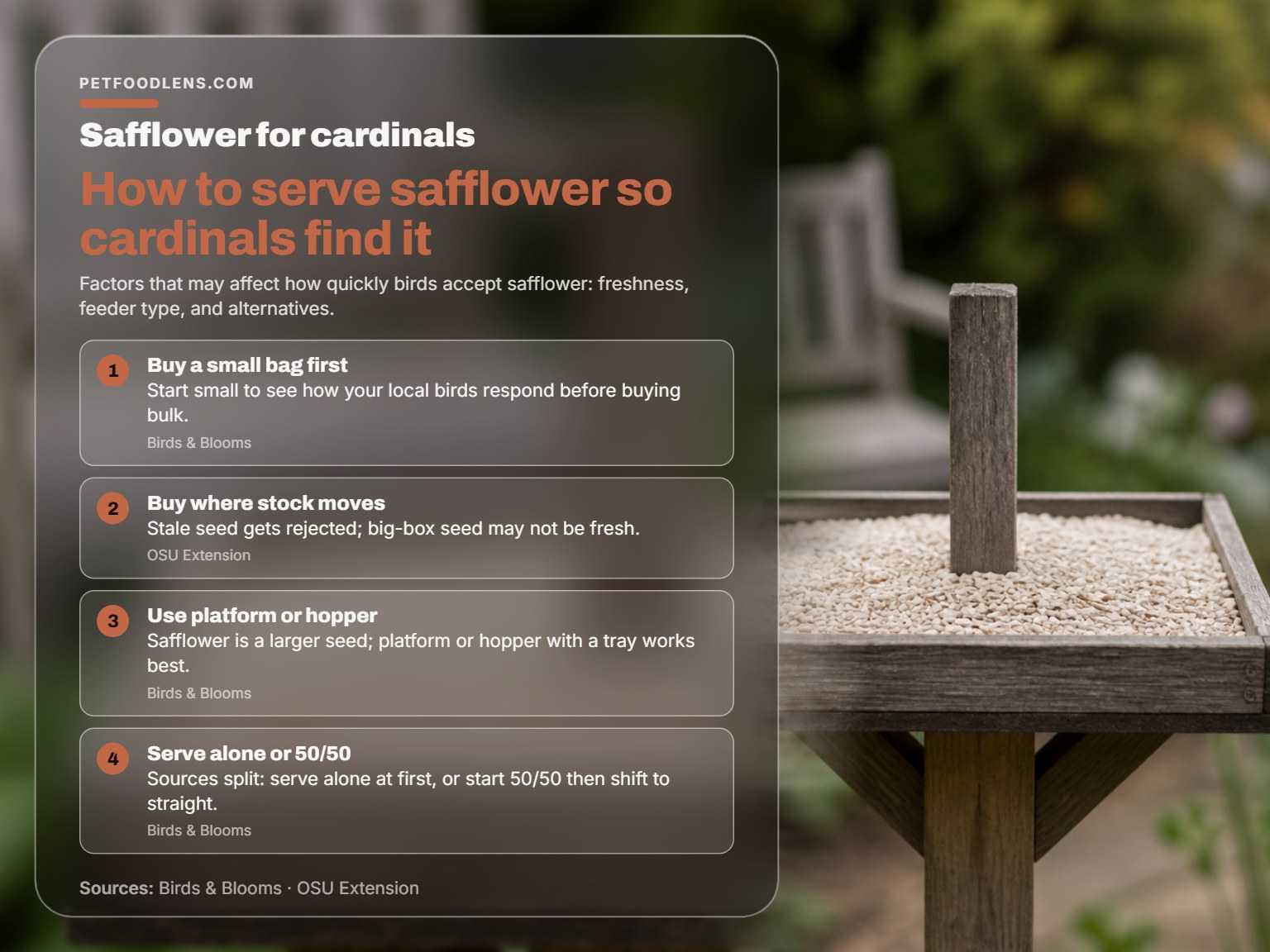
Three things decide how fast your birds switch: how fresh the seed is, what feeder it’s in, and whether an easier meal is sitting two feet away.
- Buy a small bag first. Birds & Blooms recommends starting small to see how your local birds respond. Skip this and you’re storing a bulk bag of seed nothing in your yard will touch.
- Buy where the stock moves. Stale seed gets rejected, and then the seed type takes the blame.
- Use a platform or hopper feeder with a tray. Safflower is a larger seed, and Birds & Blooms recommends both types for it. Pennington notes cardinals will also use tube feeders with reasonably large perches, while Old Potter’s Co. Puts platform and hopper ahead of tubes for cardinals and reserves tubes for finches and chickadees.
- Serve it alone, or start at 50/50. Here the sources split. Birds & Blooms says serve safflower on its own at first, with no alternatives available. Old Potter’s Co. Says begin with a 50/50 blend of safflower and your current seed, then shift to straight safflower once birds eat the mix consistently. Both agree on where you’re going.
- Scatter a handful on the ground. Mourning doves and other ground feeders won’t use a hanging feeder. Birds & Blooms and Old Potter’s Co. Both suggest scattering some seed for them, near shrubs or a low tray.
- Clean the feeder every two weeks. Mass Audubon bird feeding best practices call for disinfecting feeders every 2 weeks with one part bleach to nine parts water, then rinsing well and drying thoroughly before refilling. If sick birds appear, take the feeders down for 2 weeks, disinfect them, and clear hulls and old seed off the ground.
I’d rather see someone start with one small bag and one dedicated feeder than a bulk order and a blend. If the birds in your yard won’t touch safflower, that’s information, and it’s cheaper to learn it early.
Common mistake: Topping off a feeder that’s already full of hulls. What looks like uneaten seed is usually empty shell, and refilling on top of it buries the fresh seed where nobody will find it.
Where Safflower Fails: Region, Freshness, and the Label on the Bag
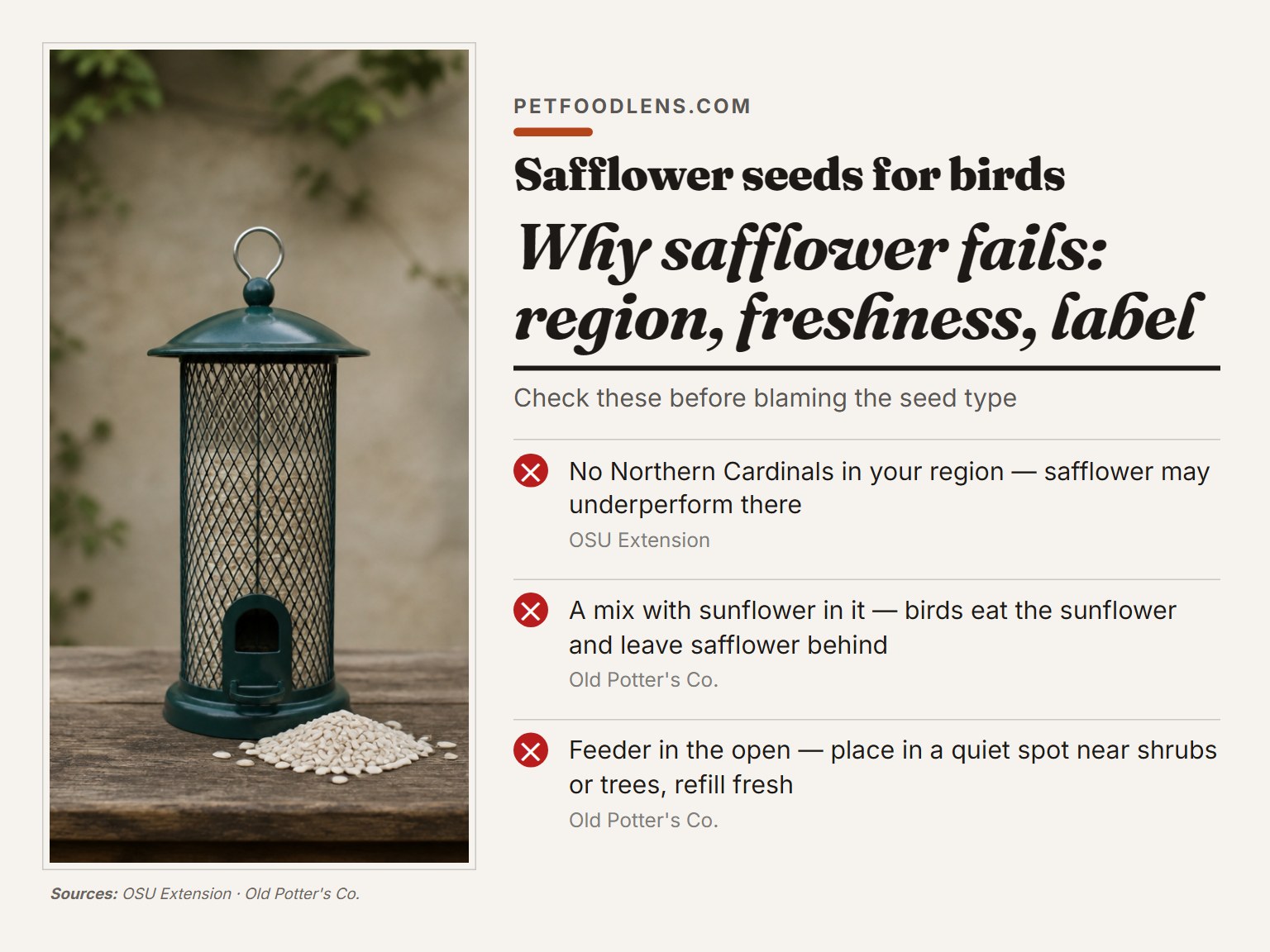
Region is the failure nobody prints on the bag. The same Oregon State response notes that Oregon doesn’t have the Northern Cardinal, so safflower may underperform there.
Skip this if: you live where Northern Cardinals don’t. Safflower’s main selling point leaves with them.
Freshness is the second failure. Stale seed from a slow-moving shelf gets rejected, and the seed type absorbs the blame. The third is mixing. Birds & Blooms field editor Connie Etter of Martinsville, Indiana, reports that when safflower is in a mix, birds tend to eat around it. Old Potter’s Co. Says the same thing in different words: most birds pick around it and eat the sunflower first.
The sources disagree on whether mixing is a problem at all. Oregon State advises avoiding mixed seed varieties entirely, because they contain filler like millet and oats that birds avoid and scatter, and because cheap mixes tend to attract house sparrows and starlings. Mass Audubon takes a softer line: mixed seed is cheaper but causes waste and rotting seed buildup under the feeder. Pennington treats mixes as acceptable as long as they include plenty of high-energy choices.
Here’s the label lesson, and it’s the same one I’d give you in a feed store aisle: read the back of the bag before you read the front. “Variety” is a marketing word. The ingredient panel tells you whether you bought seed or filler.
When a full feeder sits untouched, work through this before you blame the seed type:
- Stale stock. A flat, dusty smell, clumped seed, or a bag that’s been open since spring.
- A feeder that’s too small. Safflower is a larger seed and a tight tube port won’t pass it.
- A mix with sunflower in it. Birds eat the sunflower and leave the safflower behind.
- No cardinals in your region. The Oregon case, and the one nobody warns you about.
- A feeder in the open. Old Potter’s Co. Recommends a quiet spot near shrubs or trees, with fresh seed and regular refills.
A seed feeder supplements what birds find on their own. It doesn’t replace it, and the seed-only diet risks are worth reading before you decide one bag covers everything. If you want a second seed to run alongside safflower, pumpkin seeds for birds and the sunflower seeds for birds pros and cons breakdown cover two options with different fat profiles.
The Cornell Lab of Ornithology seed guide is the reference to keep open while you sort this out. Cornell calls black oil sunflower the best all-around seed, which is a useful thing to remember when safflower is asking you for a second chance.
Frequently Asked Questions
Do safflower seeds really keep squirrels away?
Sources range from confident to hedged. Birds & Blooms says safflower deters squirrels. Pennington attributes the same claim to “many sources.” Mass Audubon gives the most careful version: the bitter taste makes the seed unpalatable, though squirrels can develop a taste for it. Expect a filter, not a barrier.
How long does it take birds to start eating safflower?
Birds & Blooms says a week or more for picky eaters. Old Potter’s Co. Puts it at several days to a week. Pennington notes birds may need time without giving a duration. If nothing has touched a clean feeder after a week or more, suspect the seed’s freshness before you suspect the seed type.
Should I mix safflower with other seed or serve it alone?
The two positions are both defensible. Birds & Blooms recommends serving it alone at first, with no alternatives. Old Potter’s Co. Recommends starting at a 50/50 blend and shifting to straight safflower once birds eat the mix consistently. Either way, Birds & Blooms and Old Potter’s Co. Favor a dedicated feeder over a permanent blend, because birds eat around safflower in mixes, though Pennington treats mixes as acceptable if they include plenty of high-energy choices.
Will safflower bring cardinals to a new feeder?
Cardinals are the most reliable safflower eaters of any feeder bird, but they need a feeder they can use. Pennington notes they’ll visit tube feeders with reasonably large perches, plus hopper and tray feeders. Old Potter’s Co. Puts platform and hopper feeders first for cardinals. Give them cover nearby and a week to find it.
Is hulled safflower worth the extra cost?
It reaches smaller-billed birds that can’t crack whole safflower, and it leaves almost no mess. The catch is shelf life: with no shell protecting the kernel, hulled safflower stales or molds faster in humid weather, and Old Potter’s Co. Recommends replacing it every 10 to 14 days in warm months. Buy it in quantities you’ll actually use.
Can birds live on safflower alone?
No feeder seed should be the whole diet. A seed feeder supplements what birds find on their own, and a single seed type narrows the nutrition further. Mass Audubon’s guidance is blunt about the human-food side too: never put out bread or crackers, which fill birds up without feeding them.
The Bottom Line
If a clean feeder full of fresh safflower sits untouched for a week or more, change the seed before you change the seed type. Stale stock is the most common explanation and the one almost nobody tests.
The Pacific Northwest is the exception worth naming out loud. Oregon has no Northern Cardinal, and the Oregon State Extension response said so directly. Without the seed’s biggest fan in the yard, the case for safflower gets thin fast.
Here’s the position I’d defend: treat safflower as a specialty seed. Buy it when starlings or squirrels are running your feeder, buy the smallest bag on the shelf, and keep black oil sunflower as your base. That’s the arrangement that survives a bad winter and a picky flock.
Your birds will give you a verdict within a week or more. Watch the feeder, not the bag.
