
Types of Bird Seed: Which Ones Actually Get Eaten?
This post contains affiliate links. As an Amazon Associate, we earn from qualifying purchases.
The main types of bird seed are black oil sunflower, white proso millet, nyjer, safflower, peanuts, and corn. Black oil sunflower is the most preferred seed by backyard species, and the West Virginia DNR recommends a mix that is at least 75 percent black oil sunflower.
That 75 percent figure is the whole argument in one number. A bag can list eight types of bird seed and still be mostly filler, because the label rarely states proportions. Read the back first, and the seed list stops being a mystery.
What follows covers the six seeds that do real work, the fillers that don’t, and the feeder each one needs. By the end you’ll read a seed bag the way you’d read a soup can.
Key Takeaways
- Black oil sunflower is the default. The West Virginia DNR says a mix should run at least 75 percent black oil sunflower.
- White proso millet is a real seed. Red milo is the ingredient that earns the filler label.
- Nyjer needs its own feeder with small slits and perches about 5/8 inch long.
- Clean feeders twice a month, or once a week during high use, with 1 part vinegar to 20 parts water.
- An uncovered feeder gets 1 or 2 days of food, not a week’s worth, if you want to stay ahead of mold.
Why Black Oil Sunflower Tops Nearly Every Ranking
Illinois Extension calls black oil sunflower the seed that pulls in the greatest variety of overwintering birds. The West Virginia DNR puts a number on it: a mix should be at least 75 percent black oil sunflower.
Black oil sunflower carries a high meat-to-shell ratio, high fat content, and a thin shell that small bills can crack. Striped sunflower is larger with a thicker coat and takes more work to open. Cornell’s Seed Preference Test and the West Virginia DNR both rank black oil sunflower first among backyard species.
The mechanics explain the ranking. A black oil seed is small, thin-shelled, and high in fat, so a chickadee gets a lot of energy for very little work. Striped sunflower is bigger with a thicker coat, and a small bill has a harder time with it. Same plant, different types of bird seed.
Hulled sunflower, sold as sunflower hearts, removes the shell and most of the mess under the feeder. Illinois Extension notes the trade-off: a higher price tag and a greater risk of spoilage, because the kernel has no protective coat left. The sunflower seeds pros and cons come down to mess versus shelf life, and the mess side is easier to fix.
One detail that rarely makes the bag: the empty hulls carry a plant growth inhibitor. The West Virginia DNR advises sweeping them up and keeping them out of flower beds, gardens, and compost piles.
Stand under a busy sunflower feeder and you’ll hear a soft patter, hulls hitting the deck every few seconds. That’s the sound of a feeder working.
Small birds handle black oil better than almost anything else, which is why seed for small birds keeps coming back to sunflower no matter which list you check. Sunflower is also one of the few bird food types that earns a feeder slot on its own, without a blend around it.
White Proso Millet and the Filler Seed Problem
White proso millet is a top-three seed for the birds that feed on the ground, which makes the “filler” label a case of mistaken identity.
The confusion comes from variety, and the sources genuinely split on it. Oregon State University Extension’s EC 1554 warns that commercial mixes usually contain a lot of milo or millet, which most wild birds don’t eat. The West Virginia DNR, working the same question, calls white proso millet an excellent choice and one of the most preferred seeds. Cornell’s feeder table lists millet as readily eaten by chickadees, titmice, nuthatches, finches, cardinals, grosbeaks, sparrows, blackbirds, jays, pigeons, and doves.
Both positions can be right at once. White proso millet is the variety worth having. Red milo is the one that fills bags and gets left behind, and Illinois Extension is blunt about it: Illinois birds typically avoid milo and leave it in the feeder or on the ground.
The West Virginia DNR lists these as the least needed or preferred seeds:
- Canary seed — rarely necessary, and sunflower feeds mourning doves just as well.
- Cracked corn — pulls in house sparrows, brown-headed cowbirds, and starlings.
- Milo — the classic filler grain.
- Wheat, hulled oats, and rape seed — bag filler, plain and simple.
Cracked corn deserves its own line because it sits on both lists. It’s a legitimate food for larger ground feeders, and it’s also a magnet for the birds most people are trying not to encourage.
If you want the short version: buy bird seed without filler and add what you want yourself.
What Does Nyjer Seed Actually Attract?
Nyjer, also sold as thistle, is the seed that brings goldfinches and pine siskins within a few feet of the window.
The feeder matters more than the seed here. The West Virginia DNR notes that niger feeders have very small slits to discourage larger bills, and that they attract goldfinches all year. The same source suggests shortening perches to 5/8 inch to discourage house finches.
Nyjer is imported and sold at a premium, and the thin shells spoil faster than other seed. Tractor Supply’s guidance is to fill feeders with smaller quantities and refill often rather than topping off a half-empty sock.
The sources disagree on blending. Illinois Extension recommends not mixing nyjer with other birdseed at all, to avoid waste. Audubon notes that finch blends usually include nyjer alongside other fine seed fragments, aimed at the sock and mesh feeders goldfinches and Pine Siskins prefer to hang from. Both describe real products. My own preference runs toward the dedicated sock, because a goldfinch picking fragments out of a mixed bag is a bird doing unnecessary work. The nyjer seed itself is the same either way.
Safflower, Peanuts, and Corn: Where Each One Earns a Slot
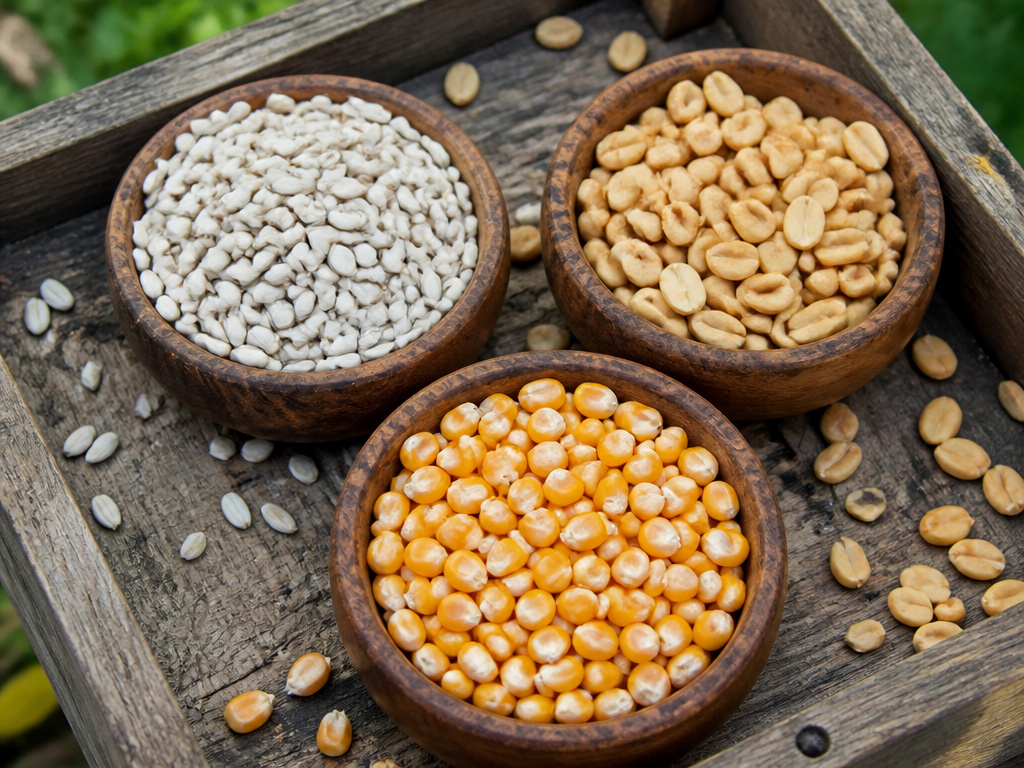
Safflower earns a slot for one reason: the birds you’d rather not host tend to ignore it.
Safflower: The Cardinal Seed Squirrels Skip
Safflower has a thick shell and delivers protein, fat, and fiber. Tractor Supply lists cardinals, finches, titmice, and grosbeaks as the regulars, while blackbirds, grackles, and squirrels stay away. The West Virginia DNR reports the same pattern with house sparrows and starlings.
That combination makes safflower seed a choice worth trying if you want to avoid blackbirds, grackles and squirrels. If your feeder is currently a starling convention, safflower is worth trying.
Peanuts: High Fat, High Risk in Wet Weather
The FAO notes that peanuts and other large seeded grains will attract woodpeckers and nuthatches.
The catch is moisture. Damp peanuts can carry aflatoxins, a type of mold that is toxic to birds, so shelled peanuts need regular changing in rainy or humid weather. Here the sources part ways on safety. Oregon State’s EC 1554 specifies roasted peanuts only, stating that raw peanuts contain toxins harmful to birds. Cornell and Audubon both recommend peanuts without that caveat. If you’re unsure, roasted is the conservative call.
Corn: Useful in Small Doses, a Problem in Bulk
Offer corn in small amounts, no more than birds will eat in one day, to avoid attracting deer, bears, raccoons and other wildlife. Offer it in amounts no larger than the birds will eat in a single day, or you’ll be feeding deer, bears, and raccoons instead.
Use a tray feeder rather than a tube for corn, since tubes trap moisture. Empty and clean feeders during rainy or humid stretches to keep aflatoxins from forming.
I’d skip corn entirely unless you’re deliberately feeding ground birds like quail or doves. It’s cheap, it works, and it also broadcasts an open invitation to raccoons. Fair warning.
Which Seed Mix Should You Buy?
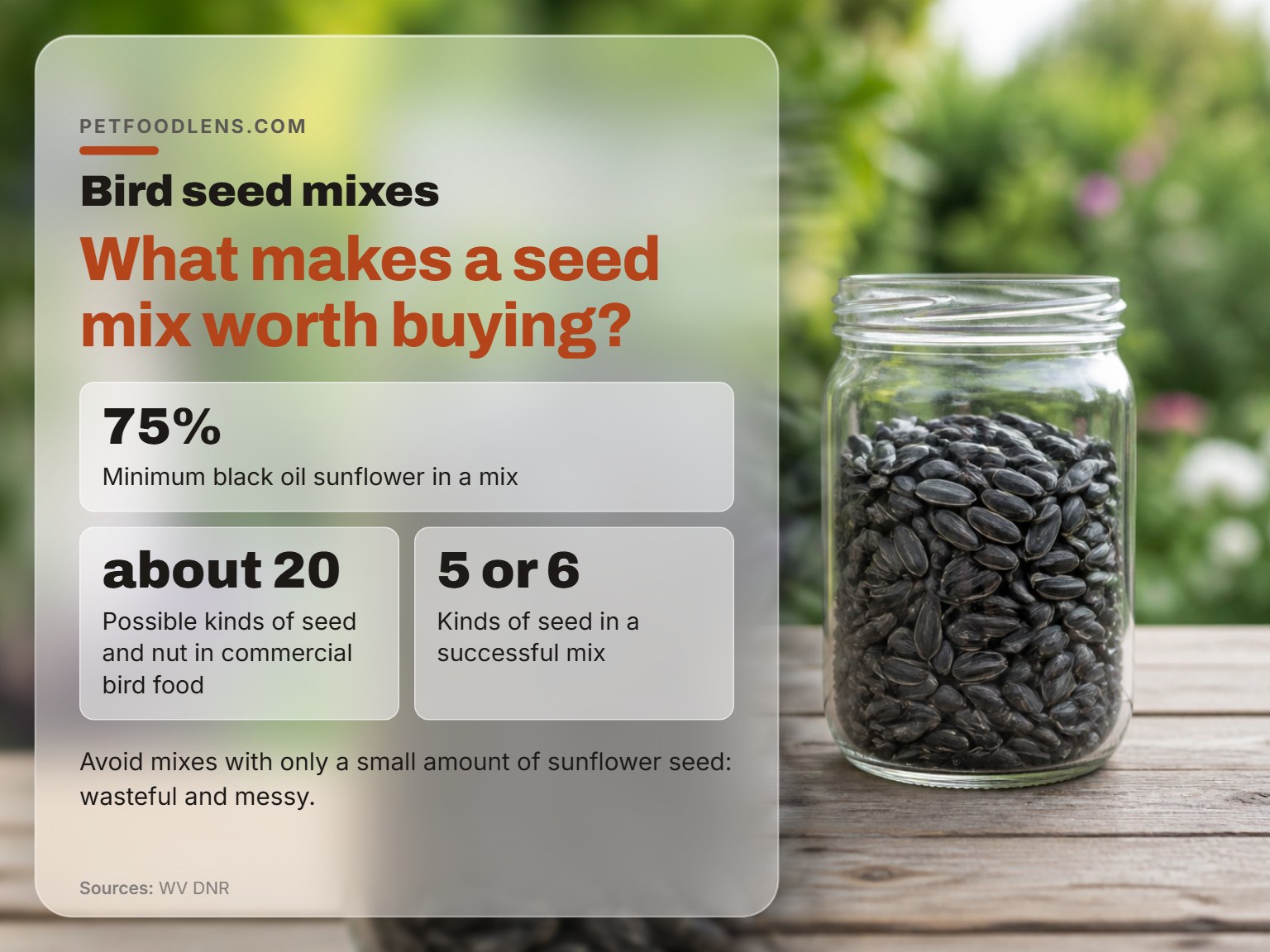
A mix is worth buying when it matches the birds you actually have, and the fastest check is the first three ingredients on the panel.
| Mix type | What’s usually in it | Who it suits |
|---|---|---|
| Black oil blend | 75 percent or more black oil sunflower | Most backyard setups |
| No-mess or hearts | Hulled sunflower, no filler grains | Patios, balconies, clean decks |
| Finch blend | Nyjer plus fine seed fragments | Goldfinches and siskins |
| Economy blend | Milo, wheat, cracked corn, millet | Ground feeders, if you accept the waste |
The West Virginia DNR notes there are about 20 possible kinds of seed and nut in commercial bird food, and that a successful mix contains 5 or 6 kinds. Cornell notes that to attract a diversity of birds you should provide a variety of food types, but you don’t need to purchase one of everything on the shelf.
Audubon’s position is that the main reason to buy a blend is to match your offerings to local birds, and that high-quality no-filler mixes do deliver on the no-mess promise. Oregon State’s advice is simpler: avoid mixes with only a small amount of sunflower seed, because they’re wasteful and messy.
Where this goes sideways: A big bag of economy blend looks like value until the birds sort through it. Soon you’ll have a carpet of milo and wheat under the feeder, and that damp layer is exactly where mold gets started.
If you’d rather not build the blend yourself, the best bird seed lists tend to converge on the same handful of straight seeds rather than the blends. The bird seed mixes worth comparing are the ones that lead with sunflower and stop there.
Matching Seed to Feeder Type
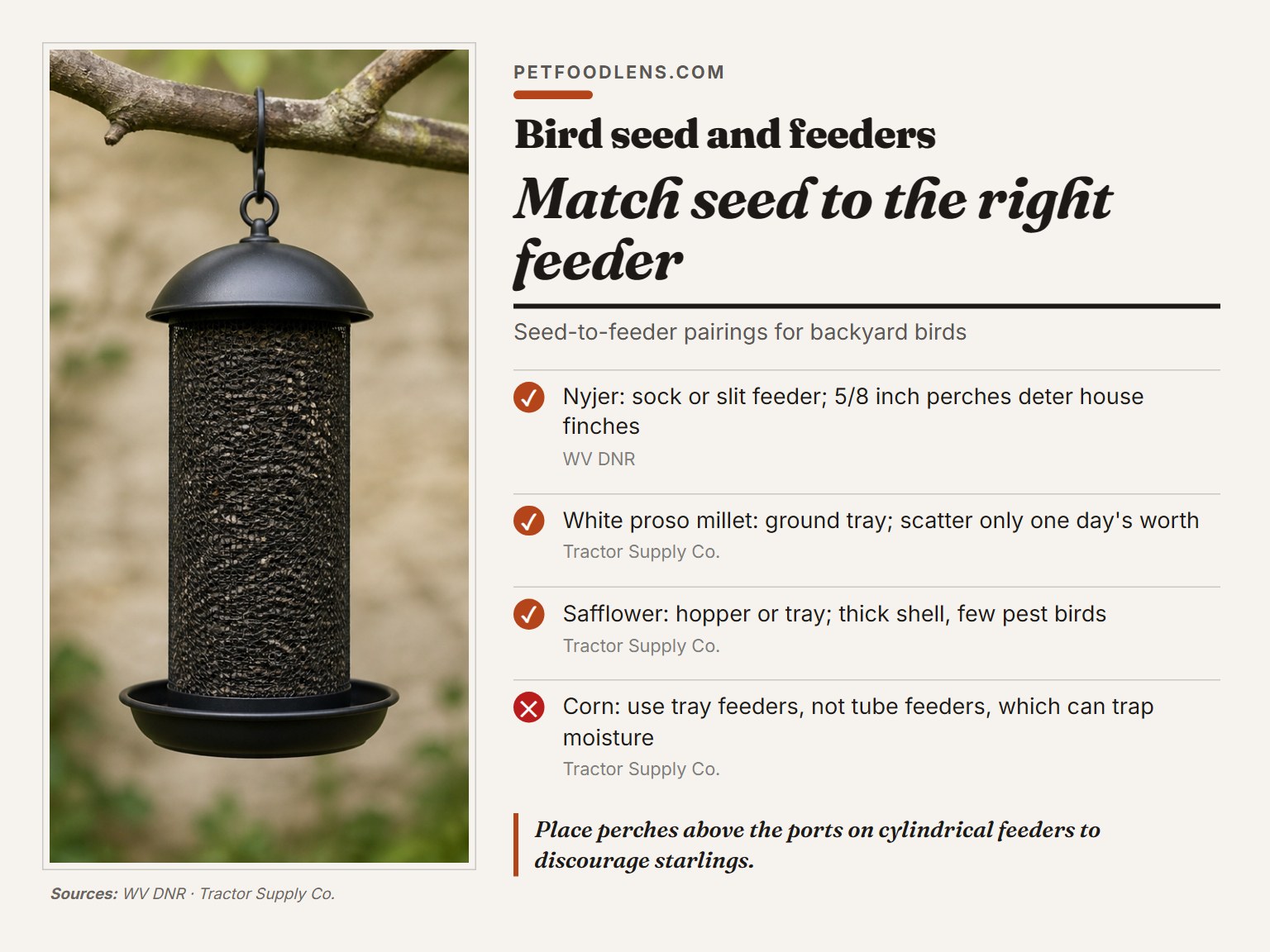
Three pairings cover most yards: sunflower in a tube or hopper, nyjer in a sock or slit feeder, and millet on a tray or the ground.
| Seed | Feeder | Note |
|---|---|---|
| Black oil sunflower | Tube or hopper, large ports | Perches above the ports cut starling use |
| Nyjer | Sock or slit feeder | Perches 5/8 inch long deter house finches |
| White proso millet | Ground tray | Scatter only what gets eaten in a day |
| Safflower | Hopper or tray | Thick shell, few pest birds |
| Corn | Tray, never a tube | Tubes trap moisture and mold |
The West Virginia DNR notes that cylindrical feeders with perches placed above the ports discourage starlings, and Audubon adds that blends heavy on sunflower are hard for European Starlings to open at all, though different feeder types do more of the work than seed choice does.
Squirrels need their own solution. Oregon State recommends a metal or PVC tube at least 5 inches in diameter around the pole, which is too wide for a squirrel to wrap its feet around.
Choosing a bird feeder is really choosing which birds you’re willing to disappoint. The bird seed for feeders question and the feeder question are the same question asked twice.
Clean Feeders, Dry Seed, and the Husks You’re Mistaking for Food
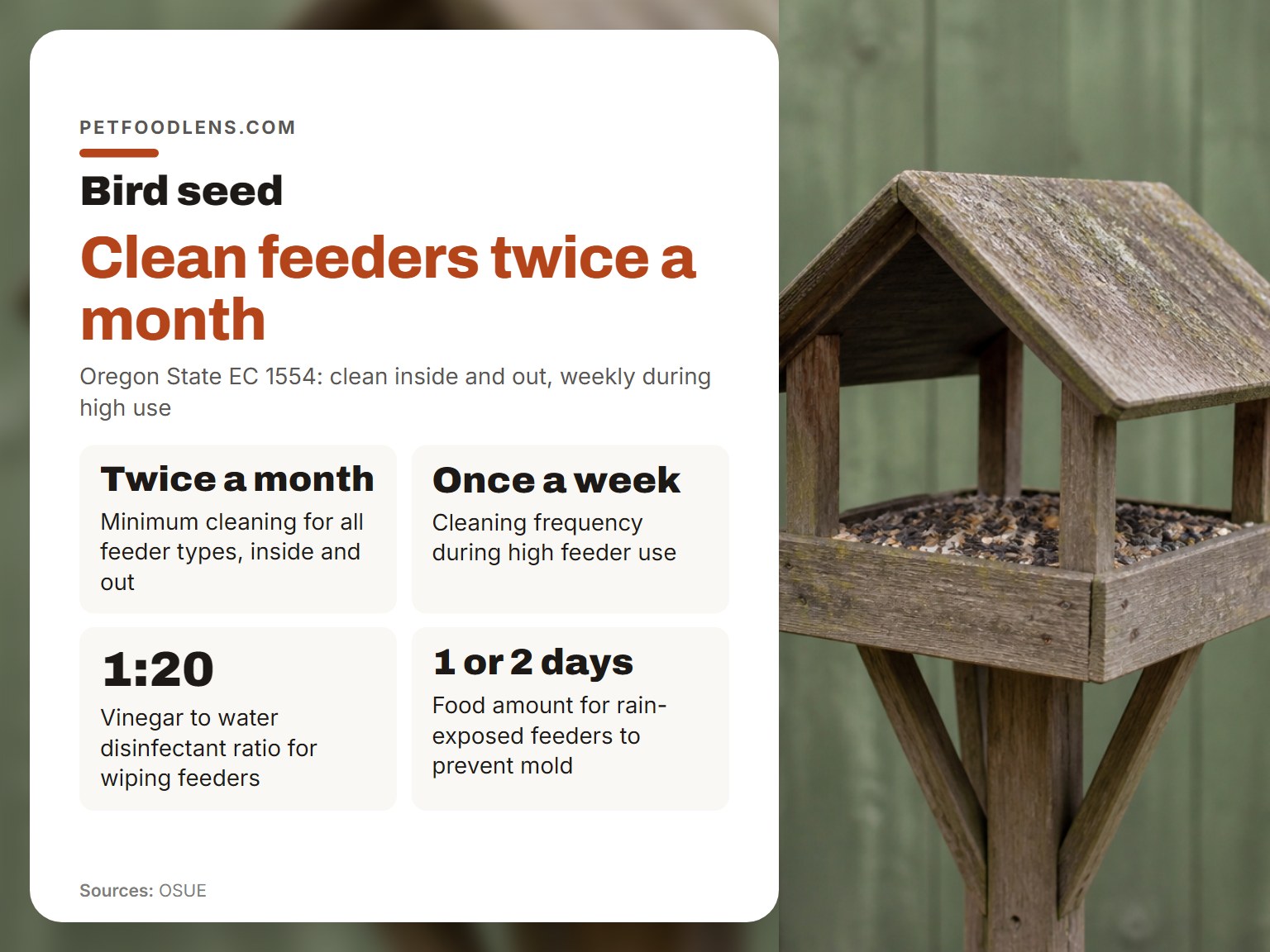
Twice a month is the floor for feeder cleaning, and once a week during high use.
Oregon State’s EC 1554 lays out the routine, and the reason behind it is disease. Clean all types of bird feeders regularly, inside and out, twice a month or once a week during high use.
Before you start: Wet seed grows mold fast, and some of that mold produces aflatoxins that are toxic to birds. Wet seed grows mold fast, and some of that mold produces aflatoxins that are toxic to birds.
- Scrape off droppings and old food first. Scrape off droppings and old food first.
- Wash with 1 part white vinegar to 20 parts water. Rinse or wipe the feeder clean with a disinfectant solution of 1 part vinegar to 20 parts water.
- Let the feeder dry completely before refilling. Refilling damp traps moisture against fresh seed, so let the feeder dry completely before refilling.
- Move feeders to a new spot occasionally, or clean up the ground underneath, so wasted seed doesn’t pile up and rot.
- Clean any catch tray daily if it’s exposed to rain. Clean any catch tray daily if it’s exposed to rain.
If you find sick or dead birds near a feeder, take it down immediately. If you find sick or dead birds near a feeder, take it down immediately.
To prevent mold, keep feeders and birdseed dry. That smell is your cue to empty the feeder rather than top it up.
Which brings up the mistake I see most: a feeder that looks full because the hulls are still there. Birds crack the shell, eat the kernel, and drop the husk, so a feeder that never seems to empty may have nothing edible left in it. Empty it into the bin and start fresh.
One more placement rule worth knowing. Illinois Extension recommends putting feeders either within 3 feet of the house or 10 feet or farther away, because that middle range is where window strikes turn fatal.
A feeder that never seems to empty is telling you something. Either the seed has gone stale, or the husks have taken over the port.
Frequently Asked Questions
Is striped sunflower seed as good as black oil?
No. Striped sunflower is larger with a longer, thicker shell, which is harder for birds to crack. Cornell and the West Virginia DNR both describe black oil as the higher-value seed, and small birds in particular struggle with the striped type.
Why do birds throw so much seed on the ground?
They’re discarding hulls, not seed. Birds crack the shell at the feeder and drop it, which is why the ground under a busy feeder fills with husks. Switching to hulled sunflower hearts cuts the debris but raises the spoilage risk, since the kernel has no protective coat.
Do birds’ seed preferences change with the season?
The sources disagree. Audubon states there’s little evidence that preferences shift by season. Oregon State’s EC 1554 notes that goldfinches and pine siskins prefer nyjer, especially from spring through fall, which implies some seasonal pattern. Cornell’s broader point is that the combination of seed and feeder is key to attracting many kinds of birds.
Should I stop feeding if I see a sick bird?
Yes, take the feeder down immediately. Oregon State’s guidance is to remove it at the first sign of sick or dead birds nearby, then clean and disinfect before hanging it again. Concentrating birds at a feeder is exactly how disease spreads through a local population.
Is nyjer the same thing as thistle seed?
In the bird feed trade, yes. The two names are used for the same small black seed. Nyjer requires a feeder with small slits to discourage larger bills.
The Bottom Line
Here’s the practical takeaway. If the first ingredient on a bag isn’t black oil sunflower, and the label doesn’t put that seed at 75 percent or more of the mix, put the bag back and buy straight seed instead.
Start smaller than you think you need to. One tube feeder of black oil sunflower and one ground tray of white proso millet will outdraw a bargain blend every time, and you’ll learn which birds are actually in your yard.
The concession worth making: none of this matters much if you don’t keep the feeder clean. A well-chosen seed in a dirty feeder is a worse setup than a mediocre seed in a clean one.
Everything above assumes you’re feeding a general backyard mix of songbirds. If you’re targeting one species, the calculus shifts, and the feeder design starts doing more work than the seed list.
