
How to Feed Tubifex Worms: The 48-Hour Purge Rule
This post contains affiliate links. As an Amazon Associate, we earn from qualifying purchases.
To feed tubifex worms, offer them 2-3 times a week as a supplement, never as the only food, and give only what the fish clear in 3-5 minutes. Live worms need a 48-hour purge in clean dechlorinated water first; frozen cubes skip that step and carry far less pathogen risk.
That 48-hour purge does less work than most keepers assume. It flushes some of what the worms picked up from river sediment. It leaves the rest behind, which is why the how to feed tubifex worms freezing step matters more than the rinsing step in most home tanks.
What follows covers the three commercial forms side by side, the purge in detail, the portion rule, and where tubifex earns a place in a rotation and where it doesn’t.
Key Takeaways
- 2-3 feeds a week is the ceiling for adult ornamental fish, not the target; larviculture protocols feed larvae 2-3 times daily.
- 3-5 minutes is the whole eating window. Siphon whatever survives it.
- Frozen tubifex keeps most of the nutrition of live worms with far less pathogen risk.
- Freeze-dried is shelf-stable and needs no refrigeration, but it’s slightly lower in nutrition than frozen.
- Strict herbivores like plecos and otocinclus should never get it at all.
How to Feed Tubifex Worms Without Fouling the Water
The tank fouls faster from tubifex than from almost any flake food in your cupboard.
Tubifex is a small red segmented worm harvested from river sediment, where it tolerates low oxygen and accumulates what the water carries. Commercial forms are sold frozen, freeze-dried, or live. Frozen product retains most of the nutritional value of the live worm while removing most of the bacterial and parasite load.
Before you start: Frozen cubes leave a protein film on hands and countertops, so thaw them in a dedicated small dish and wash up after. Never handle live tubifex and then reach into a different tank without rinsing. And if the bag has no supplier name on it, don’t buy it.
Here’s the sequence I’d run in any tank, from a 10-gallon grow-out to a 75-gallon community.
- Pick the form before you pick the portion. Frozen and freeze-dried behave differently in water, and a pinch sized for one will sink past the fish as the other.
- Thaw frozen cubes in a small cup of tank water, not under the hot tap. Hot water cooks the outside of the cube while the middle stays solid, and the whole thing sloughs off as mush.
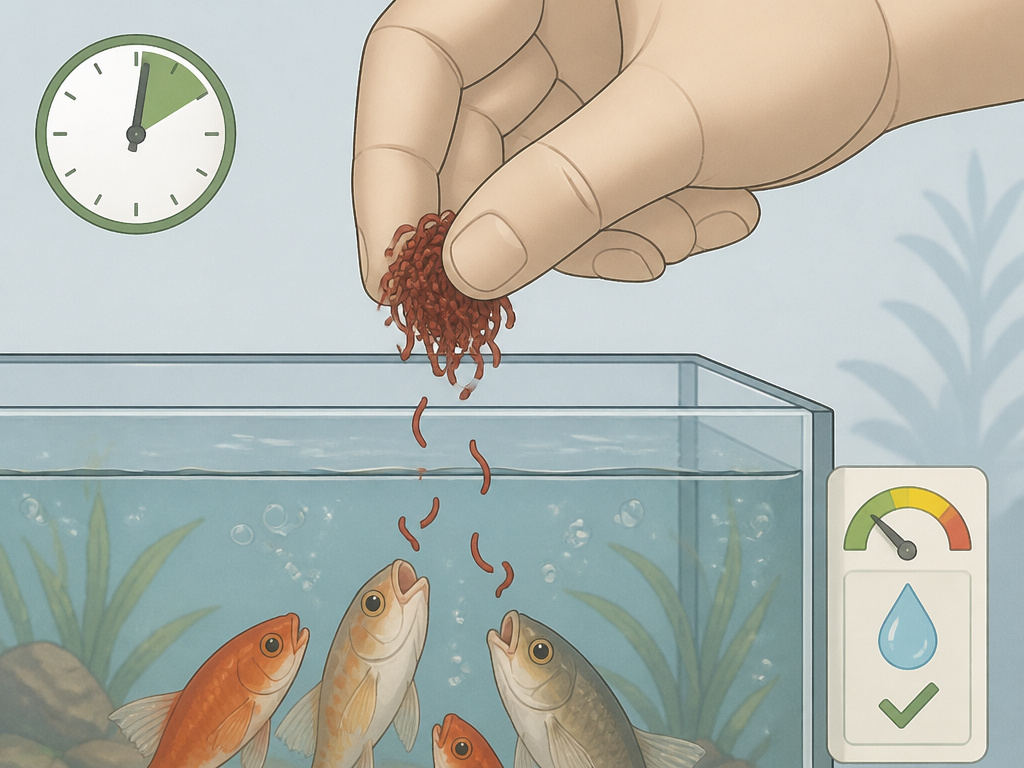
- Add a small pinch and start the clock. Only offer what the fish clear in 3-5 minutes, which is less than it looks.
- Stop adding at the 3-5 minute mark even if they’re still striking. The fish still feeding at that point are eating past full.
- Siphon or net out whatever is left. Uneaten tubifex breaks down quickly and drags water quality down with it.
Step five is the one that gets skipped, and it’s the one that costs you a water change.
Frozen, Freeze-Dried, or Live: Which One Actually Goes in the Tank?
Hikari and San Francisco Bay Brand both sell frozen tubifex described as pathogen-tested, and that line on the pack is the reason I’d start a nervous keeper on frozen.
| Form | Pathogen risk | Nutrition | Best for |
|---|---|---|---|
| Frozen cube | Low; freezing kills most bacteria and parasites | Retains most of live value | Most home tanks |
| Freeze-dried | Low; shelf-stable, no refrigeration | Slightly lower than frozen | Small tanks, occasional feeds |
| Live, known source | Reduced after a 48-hour purge, not removed | Highest, but unverified | Breeders conditioning fish |
| Live, unknown source | High; river-collected near settlements | Highest, but unverified | Nobody |
Why Frozen Wins on Safety
Freezing kills most bacteria and parasites, and the reputable brands clean the worms thoroughly before the cube is sealed, though the research brief prefers live tubifex and notes drying degrades feed value. You get most of the nutritional value of live tubifex with a fraction of the handling risk.
That’s the trade I’d take every time for a community tank.
Where Freeze-Dried Fits
Freeze-dried tubifex is shelf-stable and needs no refrigeration, which makes it the sensible option for a keeper running one small tank and feeding tubifex twice a week. It’s slightly lower in nutrition than frozen, and that’s the whole cost of the convenience.
A freeze-dried cube dropped dry into the flow floats, darkens, and sheds a rust-red cloud that drifts down the glass. Fish hit the cloud, not the cube.
Common mistake: Tipping a dry freeze-dried cube in and walking away. It floats at the surface, sheds into the filter intake, and the fish at mid-water get almost none of it. Attach it to the glass with a feeding cone, or soak it first.
If you want the soak times and the water temperatures that work, there’s a full walkthrough on how long to soak freeze-dried food that covers cubes, granules and flakes.
For the production side rather than the feeding side, the 1984 Aquaculture paper on culture and harvesting techniques is where the farming literature starts.
The 48-Hour Purge, and What It Leaves Behind
Forty-eight hours is the number quoted for purging live tubifex, and it’s the right starting point for a bag you’ve already decided to use.
Hold the worms in clean, dechlorinated water for at least 48 hours and change that water every few hours, though the research brief holds that sterilization before feeding is required to prevent pathogen transfer. They void what’s in the gut, and the water carries off loose sediment.
Then be honest about the limit. The purge flushes some contaminants and not all of them, because a worm that has spent its life in a river absorbs more than it swallows; the research brief holds that sterilization before feeding is required to prevent pathogen transfer.
A bag of live tubifex that’s still good smells like cold pond mud. One that’s turning smells sharper, closer to a drain, and no amount of purging washes that out.
Worth knowing before you start: The 2025 review of oligochaete feeds in aquaculture nutrition argues that sterilization before feeding is needed to prevent pathogen transfer, and flags cattle blood in culture media as a transmission risk. A 48-hour rinse is a lower standard than that, and it’s the standard most hobby bags are held to.
That gap matters if you’re feeding a tank of fish you can’t easily replace.
- Removes loose sediment and some surface contamination.
- Does not remove what the worm has already absorbed into tissue.
- Does not fix a bad source. A river running past a settlement stays a bad source.
- Does not replace freezing or sterilization.
If you’re keeping live tubifex for more than a day before feeding it, the handling rules in this guide to keeping live food alive apply directly. And if you’re feeding anything live, gut loading the worms before they go in the tank changes what the fish actually gets.
How Much Tubifex, and How Often?
The schedule splits depending on whether you’re feeding adult ornamental fish or fish fry, and the two camps rarely say so out loud.
| Question | Hobby guidance | Larviculture literature |
|---|---|---|
| Feeding frequency | 2-3 times per week, as a supplement | 2-3 times daily for larvae |
| Preferred form | Frozen; most keepers dropped wild live | Live preferred; drying degrades value |
| Prep before feeding | 48-hour purge, water changed often | Sterilization required |
Both positions are held by people who know what they’re doing, and they’re answering different questions. A hobby keeper is topping up a diet that’s already built on flakes or pellets. A larviculture operation is using tubifex as a first feed for fry that have no other option.
The 2025 Springer review of terrestrial and aquatic worm larviculture sits on the larviculture side of that split. It also reports that drying degrades feed value, which is why the review leans toward live.
For adult fish in a display tank, hobby guidance holds 2-3 times per week as a supplement, while the larviculture literature feeds larvae 2-3 times daily. For fry, the picture changes, and there’s a separate breakdown on feeding fry that covers the smaller-particle side of it.
The 3-5 Minute Rule Beats Any Chart
Portion comes down to the clock, not the scoop. Offer what the fish clear in 3-5 minutes, and treat anything still drifting after that as overfeeding.
Overfeeding tubifex causes rapid water quality decline, faster than most dry foods because the worms break apart as they sink.
A controlled study on Tubifex culture parameters looked at feed type, ration, temperature and density together. It’s a useful reminder that ration and temperature are linked variables, not separate dials.
Where Tubifex Earns Its Place in a Rotation
Tubifex gets sold as a conditioning food, and that’s the job it does best. Discus and angelfish breeders use it specifically to bring fish into spawn.
The hemoglobin in the worm also enhances red and orange colour in ornamental fish, which is why it shows up in so many colour-feeding schedules.
Where it fits in a normal week:
- Flakes or pellets as the base, most days.
- Frozen or freeze-dried tubifex 2-3 times a week, as the supplement.
- Bloodworms on the days tubifex isn’t on the menu, if you want variety.
- Vegetables for the grazers sharing the tank.
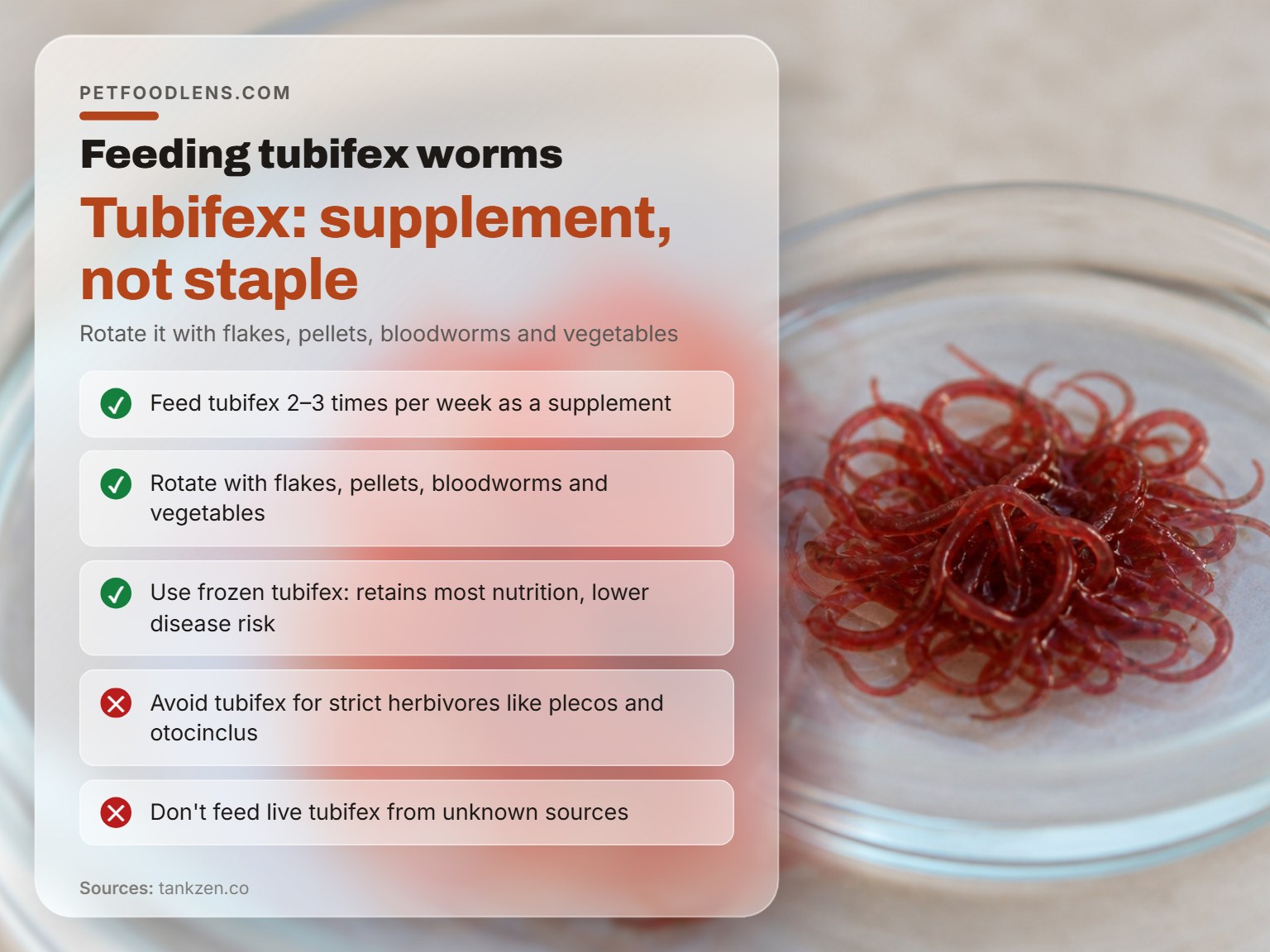
Rotating tubifex with flakes, pellets, bloodworms and vegetables is the whole point. It’s a supplement, and a supplement fed as a staple stops being one.
If you’re building that rotation out, feeding bloodworms covers portion sizes for the frozen cubes, and live blackworms are the other live option worth comparing against tubifex on handling effort.
Strict Herbivores: Skip It Entirely
Avoid tubifex for strict herbivores such as plecos and otocinclus. Their digestive systems aren’t built for high-protein animal matter, and a food they can’t process is a food that fouls the tank on the way through.
That’s not a preference thing. It’s a hard exclusion.
Easy to miss: A community tank with a pleco in it isn’t a tubifex tank. The worms that sink past the mid-water fish land on the pleco’s patch, and the pleco eats them because they’re there.
Getting Tubifex to Fry and to Bottom Feeders
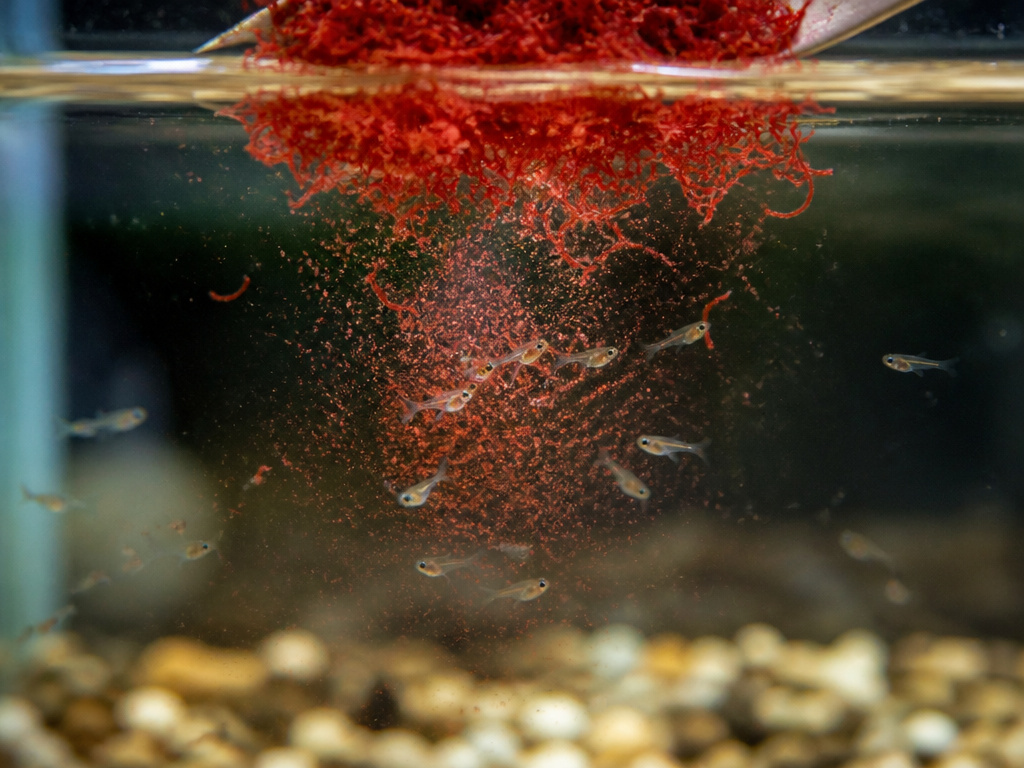
A pinch of freeze-dried tubifex hitting the surface, shedding a rust-red cloud down the front glass, and two-week-old fry already striking it before it clears the halfway mark.
Fry are where tubifex earns its reputation. Larviculture work treats it as a first feed, and the small particle size is why. The same cloud that feeds fry will mostly miss a bottom feeder, though, and that’s a delivery problem rather than a food problem.
Sinking foods solve it. So does feeding at the right end of the tank, after lights out, when the mid-water fish have stopped hunting.
If your tank runs both types, the delivery tactics in getting food to bottom feeders are worth reading before you buy another tub of anything.
The short version: Feed the water column first, then the substrate. Tubifex that reaches the gravel uneaten is wasted food and a water quality problem in the same motion.
Frequently Asked Questions
How often should I feed tubifex worms?
2-3 times per week as a supplement, alongside a base diet of flakes or pellets. It shouldn’t be the fish’s only food, and it shouldn’t be the biggest part of any single day’s feeding either.
Can I feed tubifex worms every day?
For adult ornamental fish, hobby guidance says no: daily tubifex crowds out the balanced diet you’re trying to build and raises the odds of overfeeding, though the larviculture literature feeds larvae 2-3 times daily. Fry are a different case, and larviculture protocols feed them multiple times a day.
Do I need to rinse frozen tubifex before feeding?
Thaw it in a small cup of tank water and pour off the liquid. You don’t need a long rinse, because the freezing step has already dealt with most of the bacterial and parasite load.
Is live tubifex safe?
Live tubifex from a known, reputable source and purged for at least 48 hours in clean dechlorinated water is a reduced risk, not a removed one. Most commercial live tubifex is collected from rivers near human settlements, and purging flushes only some of what the worms carry.
Can I feed tubifex to fry?
Yes, and it’s one of the standard first feeds. Feed small amounts several times a day rather than one large portion, and watch that the cloud is being cleared rather than settling.
Will tubifex cloud my water?
It will if you overfeed it. Tubifex breaks apart as it sinks, so anything the fish don’t clear in 3-5 minutes starts degrading in the water column. Portion control prevents it.
The Bottom Line
If the bag has no supplier name on it, don’t buy it. That single rule removes most of the risk people worry about with live tubifex, and it costs you nothing but a slightly longer walk to a shop that labels its stock.
Two concessions before you go. None of this applies to strict herbivores, so a pleco tank stays a pleco tank no matter how good the conditioning results are elsewhere. And the 48-hour purge is a risk reduction, not a guarantee, which is why frozen stays my default for anything but a breeding programme.
I’d rather see a keeper skip live tubifex entirely than buy it blind and hope the rinse covers it. Frozen cubes from Hikari or San Francisco Bay Brand solve the same problem with a fraction of the guesswork, and the fish don’t seem to notice the difference.
