
How to Feed Brine Shrimp to Fish: Step-by-Step
This post contains affiliate links. As an Amazon Associate, we earn from qualifying purchases.
To feed brine shrimp to fish, hatch the cysts in dechlorinated water at 10-12 ppt salinity and 27-29 C, then rinse the nauplii in dechlorinated water and feed them within hours of hatching. Knowing how to feed brine shrimp to fish means removing unhatched cysts, which left in the feed block a fry’s gut and kill it.
That 10-12 ppt figure comes from a university animal-care protocol, and it covers the hatch only. Hold the same nauplii in that water past 24 hours and they die. The salinity you hatch in and the salinity you hold in are two separate numbers, and the published sources don’t even agree on the first one.
What follows: four salinity positions side by side, the rinse step that keeps shells out of a fry’s gut, feeding density by species, and what a 24-hour enrichment soak can and cannot fix.
Key Takeaways
- Hatch at 10-12 ppt, hold at 28-32 ppt. UBC’s protocol treats those as two numbers because low-salinity hatch water kills nauplii held past 24 hours.
- Rinse in dechlorinated water before feeding. Unhatched cysts that reach a fry block its digestive tract and cause mortality.
- Feed within hours of the hatch. Yolk reserves last up to 5 days, but caloric and protein content fall the whole time.
- Match strain size to mouth size. Oversized Artemia strains cause larvae to grow poorly or starve outright.
- Density is species-specific. SRAC puts most finfish at 0.5-2 nauplii/mL; FAO runs seabass at 5.
What Salinity Do You Actually Hatch Brine Shrimp At?
Four published protocols give four different salinity numbers for the same job, and none of them is wrong.
Brine shrimp cysts hatch across a wide salinity band, but hatch rate and nauplius energy content shift with concentration. Published protocols place the hatch between 5 ppt and 35 ppt. Holding water is a separate specification: nauplii held beyond 24 hours require 28-32 ppt to survive. Rinsing before transfer removes shells and unhatched cysts.
The split runs like this. UBC’s animal-care SOP calls 10-12 ppt ideal for hatching, then adds a warning in the same paragraph: that water kills nauplii held past 24 hours, which is why the SOP switches to 28-32 ppt for holding. SRAC Publication No. 702 works from a marine hatchery angle and lists 5 ppt as the optimum. Sorgeloos and colleagues review commercial practice, with hatch salinity reported across 15-35 ppt. The FAO seabass manual notes that at lower salinities (e.g., 5 ppt) the hatching rate increases and nauplii have a higher energy content.
| Source | Hatch salinity | Stated basis |
|---|---|---|
| UBC Animal Care SOP-008 | 10-12 ppt | Called ideal for hatching |
| SRAC Publication No. 702 | 5 ppt optimum | Marine larval fish hatchery guidance (per where-sources-disagree) |
| Sorgeloos et al. 2001 | 15-35 ppt | Reported commercial hatch salinity range |
| FAO seabass manual | 5 ppt (lower salinity) | Higher hatch rate, higher nauplii energy |
Compare it on the same basis and the disagreement shrinks. All four are answering “what hatches cysts,” and they were written for different species and setups. For a home hatch feeding freshwater fry, UBC’s 10-12 ppt is the easiest to mix and the easiest to hit, though SRAC and FAO put the optimum at 5 ppt and Sorgeloos reviews 15-35 ppt.
UBC treats hatch water and holding water as different specifications, while SRAC’s 3-300 ppt tolerance describes what Artemia can survive in the wild. UBC says it out loud. SRAC’s tolerance range of 3 ppt to 300 ppt describes what Artemia can survive in the wild, which is a separate question from what keeps a dense batch alive in a beaker overnight.
Scrub the walls before anything else goes in. If this is your first batch, work through the how to hatch brine shrimp eggs routine and change one variable at a time.
The Rinse Step That Keeps Shells Out of a Fry’s Gut
Fifteen minutes after the air line comes out, the cone sorts itself. Shells float. Unhatched cysts sink. The live nauplii hang in an orange band in the middle.
That settle time is the whole separation, and rushing it is the most common way to foul a batch when you are learning how to feed brine shrimp to fish.
- Pull the air line and wait about 15 minutes. Draw earlier and floating shells come out with the shrimp.
- Open the bottom tap into a beaker and close it once the orange band clears. Running past the band drags the sunken cysts through.
- Rinse the collected nauplii in dechlorinated water. UBC requires the rinse, and the hatch water is the wrong salinity for holding anyway.
- Repeat the separation if you still see cysts. UBC’s wording is blunt: unhatched cysts block the digestive systems of baby fish and cause mortality.
Common mistake: Feeding the whole cone because the shrimp look clean. Unhatched cysts sink, so they concentrate in the last of the draw, and a fry that eats them dies with a blocked gut.
Three signs the separation went wrong:
- Shells in the beaker. They float on the surface of the collection jar, and a quick skim with a pipette removes most of them.
- A beaker that reads brown instead of orange. That’s cysts, not shrimp. Pour it back and let it settle again.
- Nauplii stuck to the cone wall. They dry there and die.
The rinse is also where you fix the salinity problem from the section above. Hatch water at 10-12 ppt goes down the drain, and the nauplii go into 28-32 ppt if they’re waiting more than a few hours.
How Long Does Hatching Take, and When Should You Feed?
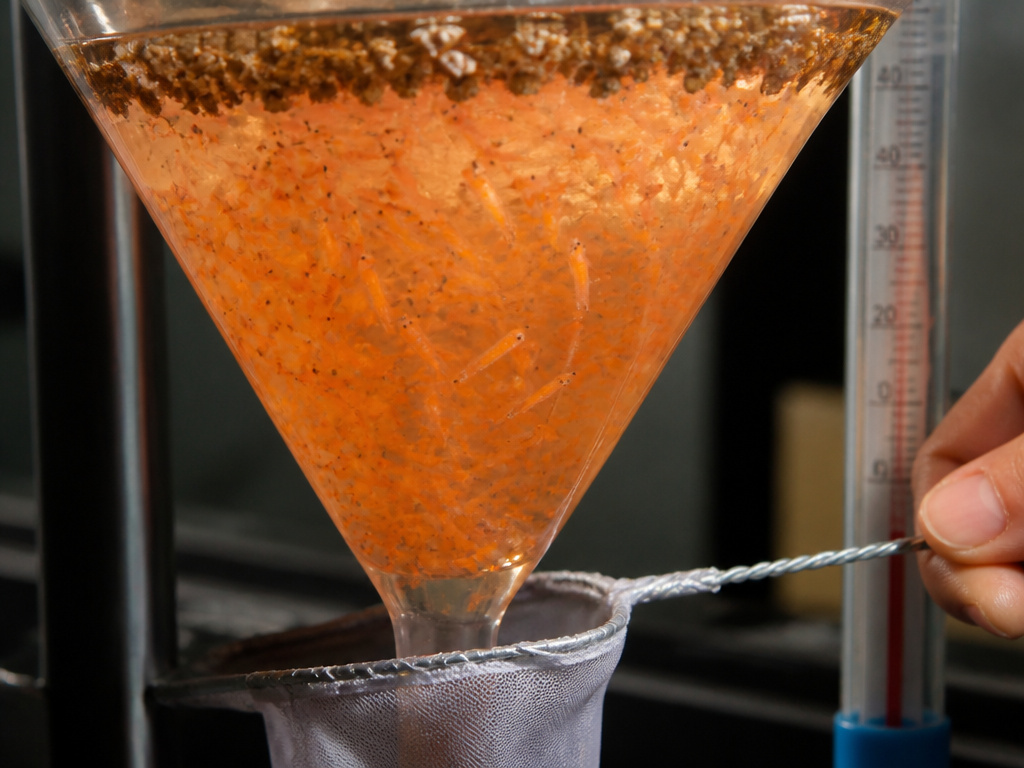
SRAC Publication No. 702 puts the shell break at 15 to 20 hours in 28 C seawater, and UBC’s protocol expects a full hatch inside 24.
| Stage | Timing | What it means for feeding |
|---|---|---|
| Shell breaks, pre-nauplius | 15-20 hours at 28 C | Nothing to feed yet |
| Instar I, free-swimming | Shortly after shell break | Orange and visible, still living on yolk |
| Molt to Instar II | About 12 hours after hatch | Starts filter feeding; enrichment works from here |
| Yolk exhausted | Up to 5 days | Calories and protein fall the whole time |
Temperature is the second disagreement when you compare a how to feed brine shrimp to fish. UBC specifies a water bath at 27-29 C or a chamber at 25-29 C. Sorgeloos gives a constant 25-28 C. SRAC says above 25 C helps and calls 28 C the optimum. All three point the same direction and none of them quote the same figure.
Feed on the orange, not on the calendar. If the cone is orange and the shells are gone, the nauplii are ready, whether that took 16 hours or 23.
The clock that matters is the one after hatching. SRAC notes the nauplius can live on yolk for up to 5 days, and that its caloric and protein content drop across that window. A day-old nauplius is a better meal than a four-day-old one, every time.
If you want them bigger than they hatch, you can culture brine shrimp for a few days and feed at 3-4 times their hatched size. That’s still small enough for newborn livebearers.
Feeding Density: How Many Nauplii per Milliliter?
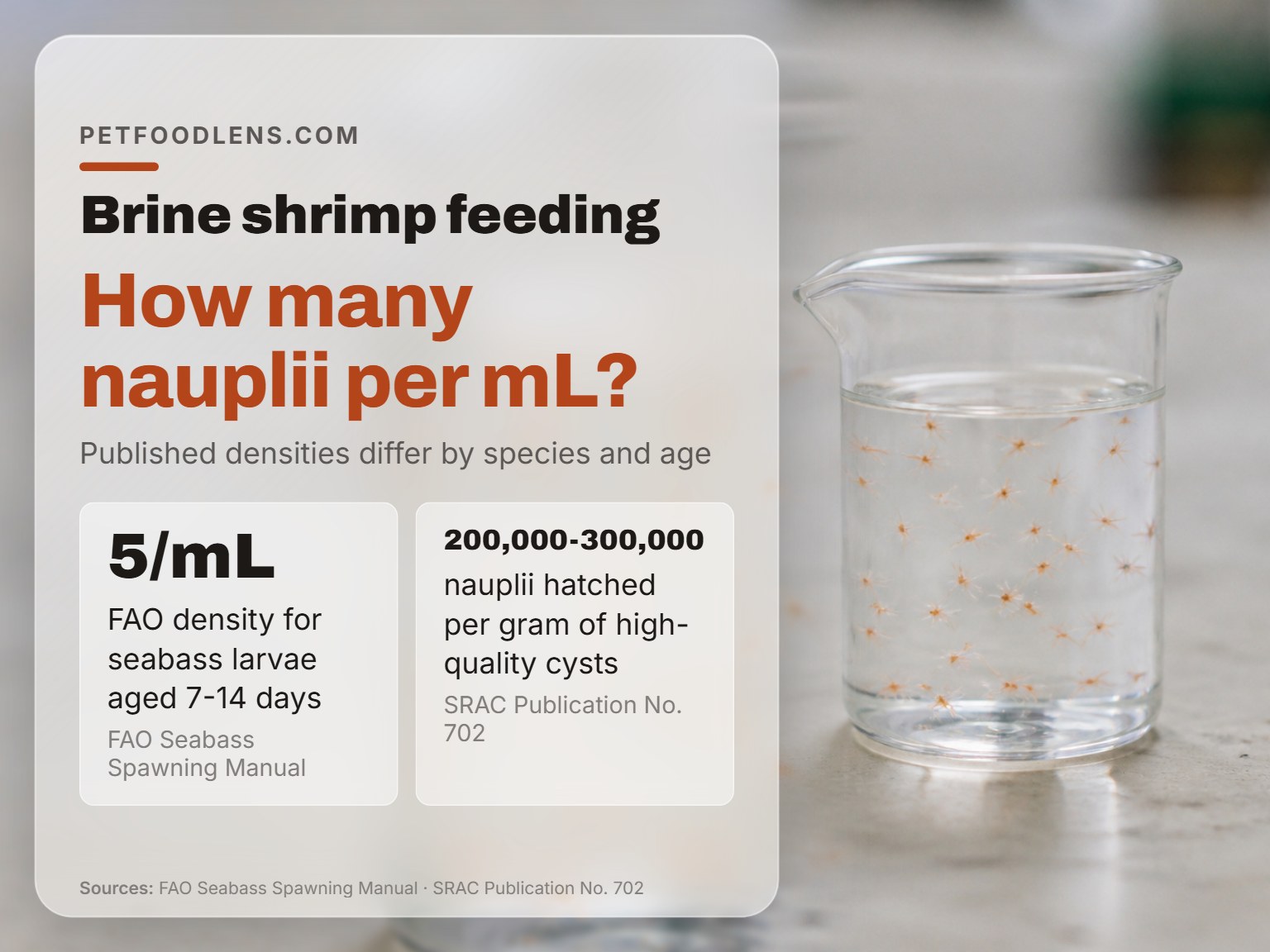
Feeding density is where the published numbers spread widest, and where home feeding goes wrong in the generous direction.
SRAC gives 0.5-2 nauplii/mL for most finfish. The FAO seabass spawning manual runs 5 nauplii/mL for seabass larvae aged 7-14 days, which it calls the best live food for that window. Both numbers are correct for the species they were written for, and neither one is a universal rule.
Where this goes sideways: Dosing by “a squirt from the pipette” instead of counting.
Run the arithmetic once and the overfeeding problem disappears. High-quality cysts yield 200,000 to 300,000 nauplii per gram, so a single gram covers a lot of tanks at SRAC’s density. The fry food guide is worth reading alongside this if you’re working across several species at once.
Two rules cover most of it. Feed to density, not to appetite, and remove what isn’t eaten within a few hours. If you’re still working out how often to present live food at all, the feed fish fry schedule is the place to start.
Enrichment: What a 24-Hour Soak Can and Cannot Fix
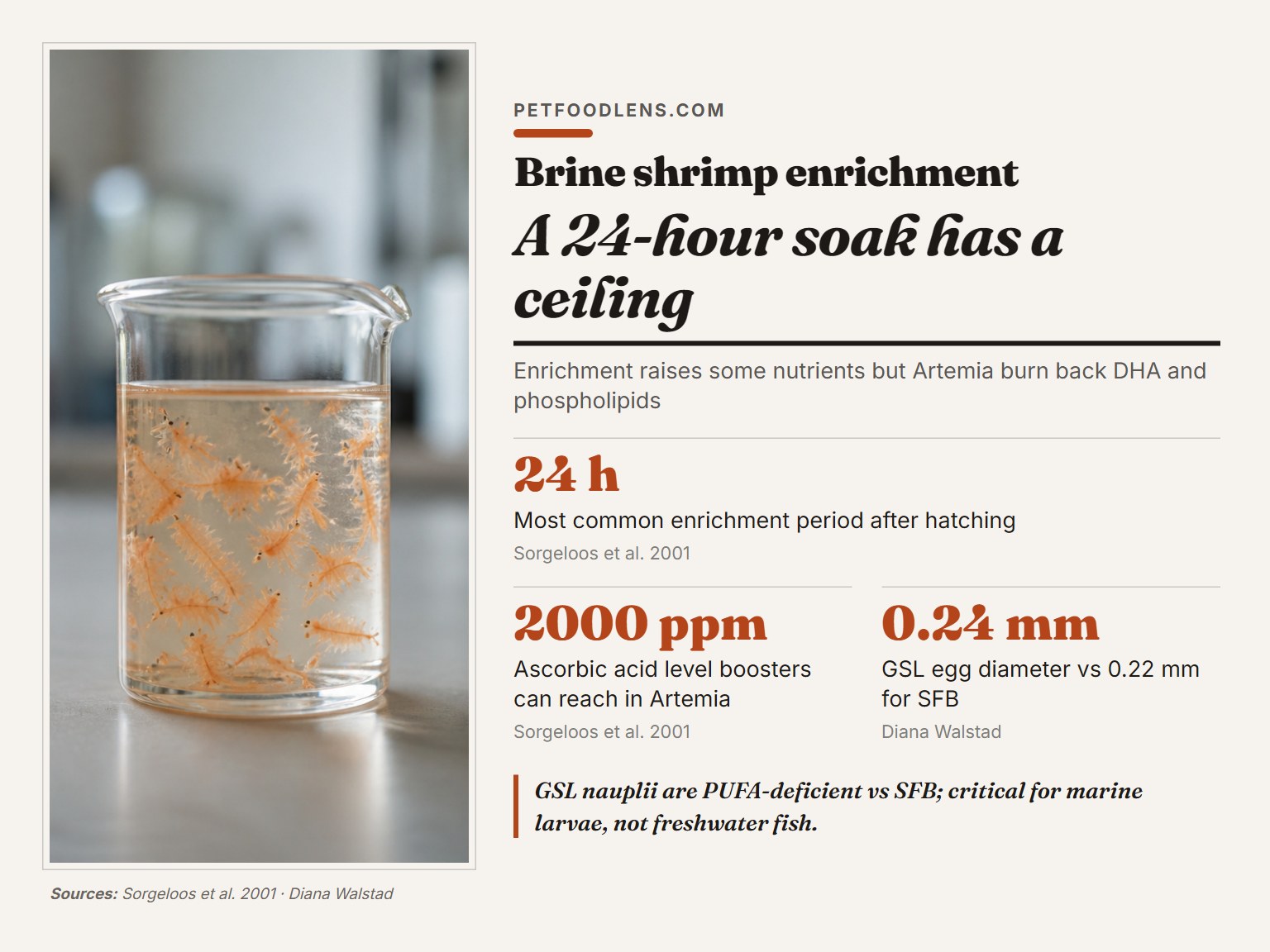
Enrichment gets sold as a repair job for cheap cysts. It buys a ceiling, and Sorgeloos puts that ceiling lower than the marketing does.
The standard technique is a 24-hour enrichment period after hatching, which is the most commonly applied method in commercial hatcheries. It works. It also has a hard limit: Artemia selectively catabolize some of the nutrients you just loaded, DHA and phospholipids among them. The shrimp burn part of the enrichment back off before your fish ever see it.
Booster formulations can push ascorbic acid in Artemia up to 2000 ppm, which is a real gain. DHA is the harder problem, and Sorgeloos notes that catabolism rates vary by strain, so strain choice partly overrides enrichment effort.
I’d rather spend on a better strain than on another bottle of emulsion. A Great Salt Lake cyst soaked for 24 hours still starts from a lower PUFA floor than a San Francisco Bay cyst, and no soak closes that whole gap.
That PUFA difference matters most for marine larvae. Walstad makes the point that GSL eggs and nauplii are deficient in vital fatty acids compared with SFB, and that the distinction is critical for marine larvae but not for freshwater fish. If you’re raising freshwater fry, the strain debate is a much smaller deal than the forums suggest.
For freshwater ornamental work, enrichment gets its own treatment in the CTSA Artemia enrichment publication. The gut loading brine shrimp routine follows the same logic: feed the feeder before you feed the feeder to something else.
Live, Frozen, or Decapsulated: Which Reaches the Fry?
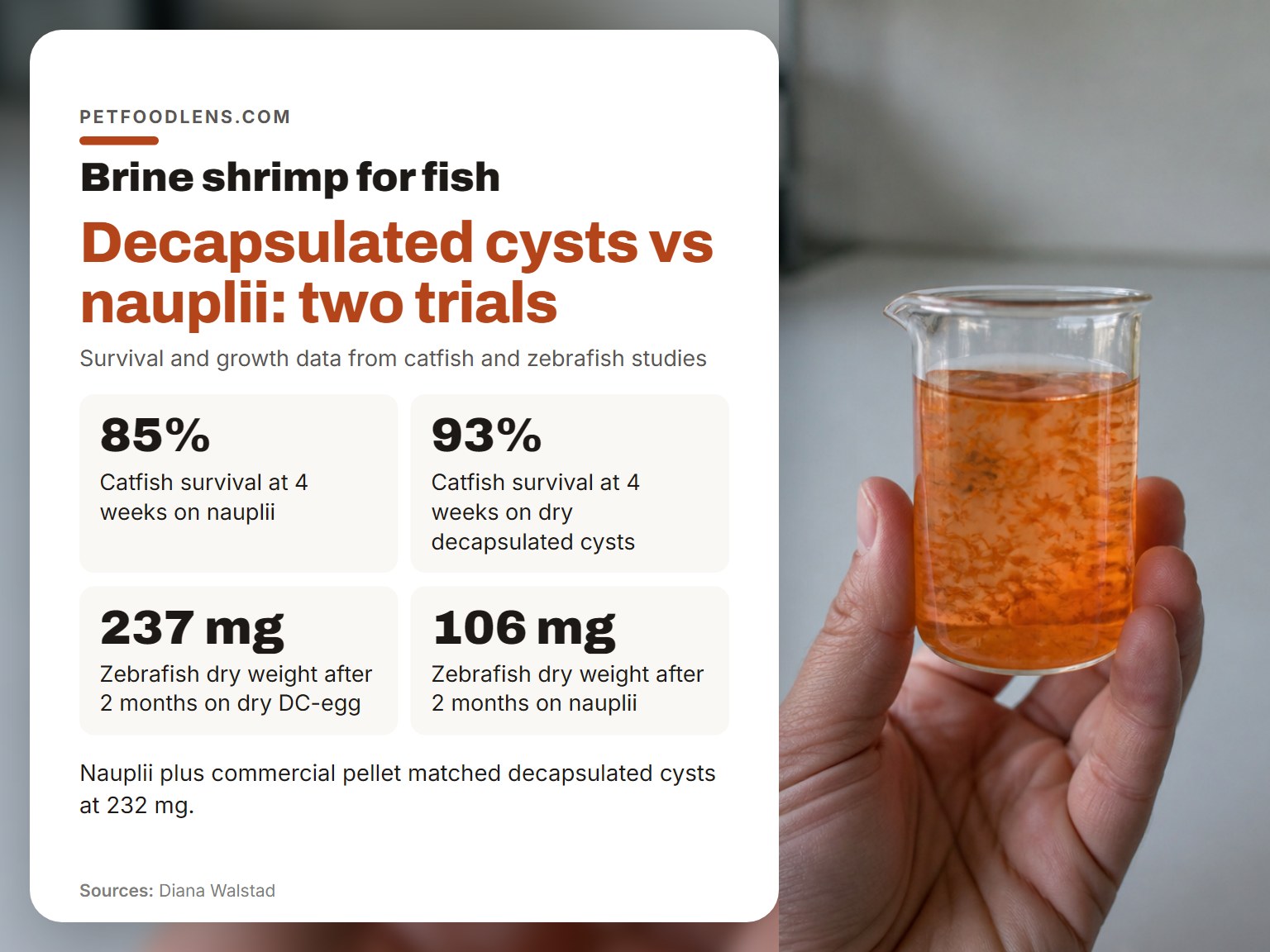
Decapsulated cysts are a different food from live nauplii, and the trial data treats them that way.
In an African catfish study Walstad cites, survival at 4 weeks was 85% on nauplii, 93% on dry decapsulated cysts, and 33% on a commercial dry food. In a zebrafish trial, fish dry weight after 2 months came out at 237 mg on dry DC-egg, 106 mg on nauplii, and 232 mg on nauplii plus a commercial pellet. Nauplii plus pellets matched decapsulated cysts almost exactly.
Read those two studies together and the practical answer falls out. Live nauplii win when you need movement to trigger a feeding response, and decapsulated cysts win when you need nutrition per unit of effort. Dry DC-eggs are more nutritious than wet ones, even freshly prepared, because the embryo is no longer metabolizing the reserves away.
The catch with decapsulated cysts is delivery. Walstad reports Black Neon Tetra fry taking a week to adapt to wet DC-eggs, with some starving because the eggs sank and the fry never fed off the bottom.
Decapsulation is also where the protocols split. FAO says to decapsulate before hatching to improve the hatch rate and eliminate diseases carried on the eggs. UBC hatches directly in the cone and separates shells afterward. Both work: FAO recommends decapsulating first to improve hatch rate and eliminate egg-borne disease, while UBC hatches directly in the cone and separates shells afterward.
Before you start: Sodium hypochlorite at these volumes burns skin and eyes on contact, and the reaction runs hot. Keep the jar under 40 C with ice, wear gloves and eye protection, and rinse until the chlorine smell is completely gone before anything goes near a fish.
FAO’s decapsulation sequence, per 100 g of cysts:
- Add 1,200 ml of seawater and aerate for 1 hour. Skipping the hydration step leaves the cyst shell too hard for the bleach to strip evenly.
- Add 1,000 ml of NaOCl or CaO, stir, then add 25 g of bleaching powder. Stir continuously through the addition.
- Watch the temperature. Above 40 C the embryos cook. Use ice to bring it down if the jar climbs.
- Rinse in a fine mesh strainer until the chlorine odour is gone. This is the step people cut short, and it’s the one that kills fish.
- Store in 300 ppt brine, or in 30 g NaCl per 100 g of cysts. Decapsulated cysts keep this way until you need them.
For the frozen side of the comparison, live vs frozen food covers what survives the freezing process. Frozen brine shrimp is a fine maintenance food and a poor first food, because nothing in the cube moves. If you’re working with a freeze-dried product instead, you’ll need to rehydrate freeze-dried food before it’s worth feeding.
Storing Nauplii: Cold, Crowded, and Briefly
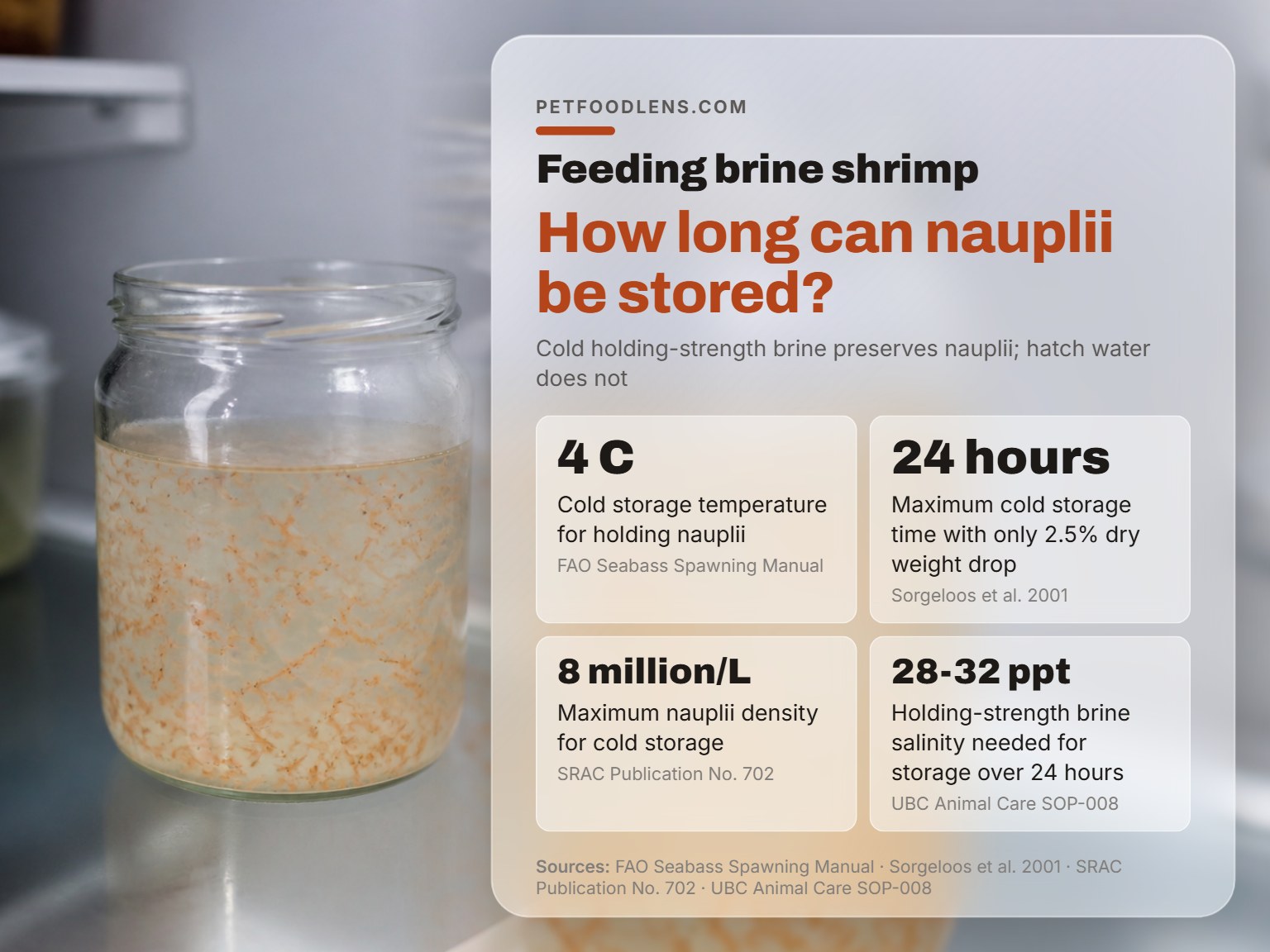
A jar of nauplii at 4 C holds for a day. The same jar on a counter loses about 30% of its dry weight in the same window.
Sorgeloos cites storage near 4 C at up to 8 million nauplii per litre for up to 24 hours, with only a 2.5% drop in individual dry weight. Cold storage also halts the molt to Instar II, which is fine if you want Instar I and wrong if you were counting on enrichment.
UBC’s protocol says to feed immediately, because the low-salinity hatch water kills nauplii held past 24 hours, while Sorgeloos cites cold storage near 4 C for up to 24 hours. Both positions are correct once you separate them: cold storage works, and it works in holding-strength brine rather than hatch water.
Aeration is the last disagreement worth knowing about. UBC wants the cone bubbling vigorously and says to raise the air pressure if eggs collect at the bottom. Walstad argues the opposite for culture, on the grounds that brine shrimp lose energy and die when they fight a cyclonic current, and recommends large bubbles at about 1-2 per second with the surface barely disturbed.
The sources disagree: UBC wants vigorous bubbling during the hatch and culture, while Walstad recommends gentle aeration with the surface barely disturbed at about 1-2 bubbles per second.
Three storage rules that cover the home case:
- Use holding-strength brine at 28-32 ppt if the nauplii are waiting more than a few hours.
- Feed or discard within 24 hours. Past that, the nutrition you paid for is gone.
For longer holds and the equipment that makes them work, keep live food alive goes deeper than a beaker in the fridge.
Frequently Asked Questions
Can I feed brine shrimp nauplii straight from the hatching cone?
No. The cone holds shells, unhatched cysts, and hatch water at the wrong salinity. Draw the orange band off the bottom, rinse it in dechlorinated water, and move it into 28-32 ppt brine if it’s waiting more than a few hours. UBC’s protocol is explicit that unhatched cysts block a fry’s digestive system and cause mortality.
How long can I keep hatched brine shrimp before feeding them?
Up to 24 hours if you cold-store them near 4 C at high density, which costs about 2.5% of individual dry weight. Beyond a day, hatch them fresh.
Do I need to decapsulate brine shrimp cysts before hatching?
Only if disease control or hatch rate is a priority. FAO recommends decapsulating first for both reasons. UBC hatches directly in the cone and separates the shells afterward, which is simpler and works fine at home.
What salinity should I use if my sources disagree?
Pick the number that matches your job. Hatching runs anywhere from 5 ppt to 35 ppt depending on the protocol. Holding nauplii past 24 hours needs 28-32 ppt, and that part isn’t in dispute.
Why won’t my fry eat the brine shrimp?
Two likely causes. The nauplii may be too large for the mouth, which SRAC warns causes poor growth or outright starvation with oversized strains. Or they may be too old and fast to catch. Freshly hatched Instar I move slowly and sit in the water column where fry can find them.
The Bottom Line
If you’re hatching at 10-12 ppt and holding the nauplii in that same water overnight, change the water. That single fix solves more failed feeds than any change to the cysts, the temperature, or the enrichment routine.
The concession worth stating plainly: if you’re raising freshwater fry, most of the strain anxiety in this hobby doesn’t apply to you. The Great Salt Lake versus San Francisco Bay PUFA gap is a marine larvae problem. A freshwater breeder can hatch GSL cysts, rinse them, and feed them with a clear conscience.
The first thing to do this week is boring. Count one feed. Pull 1 mL from your collection beaker, put it on a dark saucer, and count the nauplii. Multiply by your tank volume and you’ll know whether you’ve been feeding at 0.5 per mL or well above it.
