
10 Best Pet Food For Puppies in 2026
This post contains affiliate links. As an Amazon Associate, we earn from qualifying purchases.
The best overall puppy food is Purina Pro Plan Lamb & Rice Puppy Food. It leads with real lamb as the first ingredient and includes DHA from fish oil for brain development plus live probiotics for digestive health. For chicken-based formulas, the Blue Buffalo Life Protection Puppy Food earns top marks, while the Purina ONE Plus Healthy Puppy Food delivers strong nutrition at a better value.
New puppy owners face a wall of bag options, each promising complete nutrition. The real challenge is matching the formula to your puppy’s breed size, protein needs, and digestive tolerance, not picking the bag with the cutest puppy photo.
This guide is based on ingredient analysis, manufacturer specifications, and patterns in owner feedback across ten top-rated formulas. We break down what each recipe delivers and, just as importantly, who it’s actually meant for.
Top 10 Pet Foods For Puppies in the Market
Certain content that appears on this site comes from Amazon. This content is provided "as is" and is subject to change or removal at any time.
The Best Pet Foods For Puppies, Reviewed
Purina Pro Plan Lamb & Rice Puppy Food

What We Like
- Real lamb is first ingredient
- DHA from fish oil supports brain and vision
- Live probiotics aid digestive health
- Antioxidants support developing immune system
Trade-offs
- Only for puppies under 1 year
Real lamb as the first ingredient means this formula prioritizes animal protein over fillers, which is exactly what a growing puppy needs for lean muscle development. The addition of DHA from omega-rich fish oil targets brain and vision development during that critical first year, while live probiotics and antioxidants handle digestive and immune support. It’s a straightforward, no-nonsense recipe that covers the bases without relying on marketing fluff, making it a strong fit for owners who want to read the label and feel confident about what’s inside.
For most households, this 6-pound bag of Purina Pro Plan Lamb & Rice Puppy Food provides a practical portion size that fits neatly into a standard pantry shelf. It measures just 4.5 inches in length and 8.2 inches in width. Real lamb is the first ingredient, delivering high-quality protein to support lean muscle growth during the critical first year. The formula includes DHA from omega-rich fish oil to aid brain and vision development, while live probiotics promote digestive health and antioxidants bolster the developing immune system. Calcium and phosphorus work together to build strong bones and teeth, and Vitamin A with omega-6 fatty acids supports a healthy skin and coat. This highly digestible recipe ensures optimal nutrient absorption for puppies under one year.
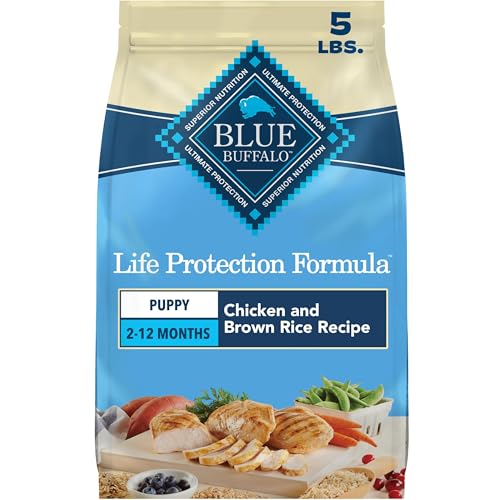
Blue Buffalo Life Protection Puppy Food
What We Like
- Real chicken is first ingredient
- DHA and ARA for brain and eye development
- LifeSource Bits support immune health
- Wholesome grains for gentle digestion
Trade-offs
- Contains grains, not suitable for grain-free diets
- Not ideal for grain-free diet preferences
The first ingredient here is real chicken, not a by-product meal or filler, which directly supports healthy muscle development in puppies from two to twelve months. That alone tells you the protein foundation is solid. Add in DHA and ARA for brain and eye development, plus choline, and you have a recipe that covers the critical early growth windows without relying on synthetic shortcuts. The LifeSource Bits, a precise blend of antioxidants, vitamins, and minerals formed at lower temperature to preserve potency, are a thoughtful touch for immune support. This is a well-rounded daily food for a puppy whose owner reads the ingredient list first and wants recognizable proteins and targeted nutrients over marketing fluff.
The five-pound bag is a practical size for small puppies, but large-breed owners will be reordering often compared to the Purina Pro Plan Large Breed Puppy Food, which comes in a thirty-four-pound bag. The formula includes wholesome grains like brown rice, barley, and oatmeal, so it’s not for anyone committed to a grain-free diet. For owners who want a chicken-first recipe with brain-building DHA, this is a straightforward, no-nonsense pick.
Purina ONE Plus Healthy Puppy Food
What We Like
- Real chicken is first ingredient
- DHA supports vision and brain development
- Four antioxidant sources for immune support
- No artificial flavors or preservatives
Trade-offs
- Contains grains, which some owners avoid
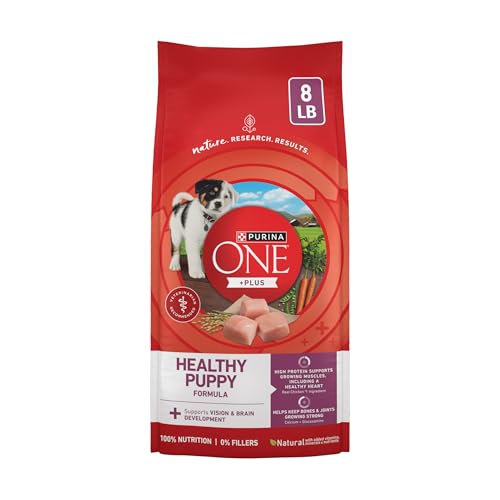
Real chicken shows up as the first ingredient, which means this puppy food puts protein front and center for building strong muscles and a healthy heart. The DHA included mimics what puppies get from their mother’s milk, supporting vision and brain development during those critical early months. Four antioxidant sources back up the immune system, and the SmartBlend includes omega-6 fatty acids for a shiny coat and healthy skin. It’s an affordable option that doesn’t cut corners on the nutrients that matter most for a growing pup.
The 8-pound bag size means you’ll need to restock more often if you have a large breed puppy, compared to larger bags like the 34-pound Purina Pro Plan Large Breed Puppy Food. That said, the ingredient list is clean, no artificial flavors or preservatives, and every ingredient has a stated purpose. For someone watching their budget but unwilling to compromise on real chicken and DHA, this delivers where it counts.
Royal Canin Small Puppy Dry Dog Food

What We Like
- Supports brain development and energy needs
- Antioxidants for immune support
- Prebiotics and proteins for digestive health
- Crunchy kibble texture
Trade-offs
- Only for puppies 2-10 months old
- Not suitable for large breed puppies over 22 lb adult weight
A 9-to-22-pound adult weight target means this formula is tailored for small breeds, with nutrients that support brain development and energy needs during their first ten months. The crunchy texture encourages chewing, and the prebiotics plus proteins aim to keep a sensitive puppy digestive tract on track. If you have a Chihuahua, Yorkie, or similar breed, this is a precision tool rather than a one-size-fits-all bag.
The trade-off is that the same precision makes it a poor fit for medium or large breed puppies. Compared to Purina Pro Plan Lamb & Rice, which covers all puppies under a year, Royal Canin narrows its window to both age and size. That focus is exactly what earns it the spot for small breeds, but it means you will need to switch formulas once your pup outgrows the 22-pound ceiling.
Purina Pro Plan Large Breed Puppy Food

What We Like
- Real chicken is first ingredient
- DHA for brain and vision development
- Glucosamine supports developing joints
Trade-offs
- 34 lb bag is heavy to handle
- Only available in large breed formula
The 34-pound bag of Purina Pro Plan Large Breed Puppy Food is built around a single priority: supporting the controlled growth rate large-breed puppies need to avoid skeletal stress. Real chicken leads the ingredient list, providing high-quality protein, while glucosamine targets developing joints and cartilage, a smart move for breeds prone to hip and elbow issues. The inclusion of DHA from fish oil for brain and vision development rounds out a formula that addresses the specific nutritional demands of large-breed puppies.
The 34-pound bag is substantial, so expect to store it somewhere accessible, and it’s formulated to support an appropriate growth rate for large breed puppies. Glucosamine supports developing joints and cartilage, which matters if you’re already concerned about your pup’s long-term mobility. For owners of large-breed puppies who want a protein-rich recipe with DHA for brain development and glucosamine for joint support, this is a straightforward choice.
Hill's Science Diet Large Breed Puppy Food

What We Like
- Balanced minerals for growing bones
- DHA and fish oil for brain development
- Antioxidant blend supports immune system
- High quality proteins fuel muscle growth
Trade-offs
- Large breed formula only
- Contains grains, not grain-free
Balanced minerals support growing bones and teeth, DHA and fish oil aid healthy brain and eye development, and an antioxidant blend helps the developing immune system. That’s a lot of targeted support packed into a single bag. The chicken and brown rice recipe is made with natural ingredients, and the 27.5-pound bag provides a substantial supply for large breed puppies during their growth period.
This is a large-breed-only product, so if your pup is a small or medium breed, you’ll need to look elsewhere, for example, the Royal Canin formula for dogs under 22 pounds. It also contains grains, which won’t suit every owner’s philosophy, though for most puppies the fiber and digestibility are a plus. Compared to the Purina Pro Plan Large Breed Puppy Food, both formulas offer DHA and calcium, but Hill’s is the #1 Veterinarian Recommended brand and is made with natural ingredients. Neither is wrong, but the Hill’s recipe provides targeted support for large breed puppies.
Product photos
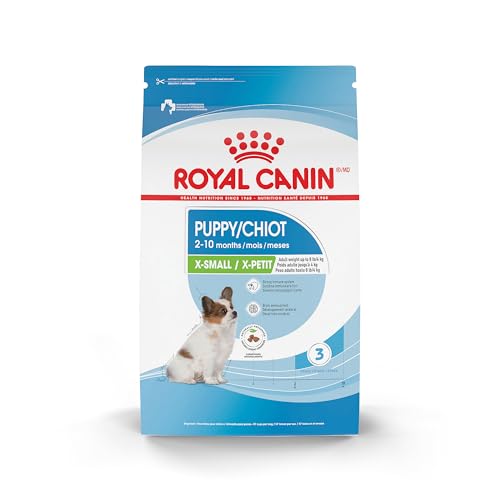
Royal Canin X-Small Puppy Dry Dog Food
What We Like
- Formulated for toy breeds under 8 lbs
- Supports brain development during growth
- Antioxidants and prebiotics for immune and digestive health
- Crunchy kibble pairs with wet food for variety
Trade-offs
- Only for puppies with adult weight under 8 lbs
- Not suitable for puppies expected to weigh over 8 lbs
A 3-pound bag of kibble designed for puppies that will top out at 8 pounds as adults. That’s the whole point: this isn’t a generic small-breed food, it’s calibrated for the extra-small end of the scale. The crunchy texture is simple to serve and pairs well with Royal Canin X-Small Puppy Thin Slices in Gravy wet food. The formula delivers antioxidants for immune support and prebiotics and proteins for digestive health. If you’ve got a Chihuahua, Yorkie, or similar toy breed under 10 months old, the nutrient profile supports brain development and energy needs during growth.
If your puppy’s expected adult weight is under 8 pounds, this formula is designed specifically for that tiny size range. The Royal Canin X-Small Puppy food supports brain development and energy needs during growth, while antioxidants and prebiotics promote immune and digestive health. For puppies that will grow larger, the Royal Canin Small Puppy recipe targets dogs 9 to 22 pounds.
Product photos
IAMS Proactive Health Large Breed Puppy Food
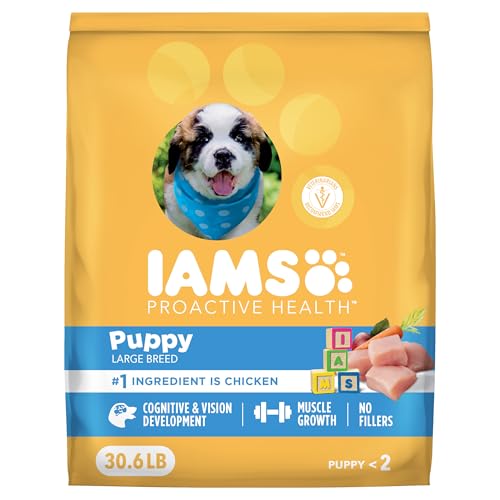
What We Like
- Real chicken as #1 ingredient
- Omega-3 DHA for cognitive development
- Optimal calcium for bone & joint health
- Vitamin E & selenium for immune support
Trade-offs
- Large breed formula only, not for small breeds
- Not suitable for small or medium breed puppies
The first ingredient is real chicken, which is a straightforward sign of protein quality for a growing large-breed puppy. With Omega-3 DHA aimed at cognitive and vision development, plus optimal calcium levels formulated to support bones and joints, this recipe targets the structural needs of bigger pups during their rapid growth phase. The immune system gets a boost from Vitamin E and selenium, rounding out a package that prioritizes foundational health over marketing fluff.
This is strictly a large-breed formula, so if your puppy is a small or medium breed, you’d need to look elsewhere, for example, the Royal Canin option for smaller pups. At 30.6 pounds, the bag is hefty, so plan for storage space or a sturdy container. For owners of large-breed puppies who want a no-nonsense ingredient list with joint support built in, this is a practical choice.
Product photos
Blue Buffalo Baby BLUE Small Breed Puppy Food

What We Like
- Real chicken is first ingredient
- DHA supports cognitive development
- Antioxidant-rich LifeSource Bits
- No by-products, corn, wheat, or soy
Trade-offs
- Not suitable for large breed puppies
Chicken is the very first ingredient here, so protein comes from a named meat source rather than mystery meal. That matters for small-breed puppies who need dense nutrition in every bite. DHA is included for cognitive development during the critical early growth window, and the antioxidant-rich LifeSource Bits offer immune support without relying on corn, wheat, or soy. This is a straightforward recipe built around whole ingredients, which is exactly what a label skeptic wants to see.
The bag size is a consideration here: at 4 pounds, you will have a smaller quantity compared to some other options like Purina Pro Plan’s 6-pound bag. For a small-breed puppy, though, the kibble size and nutrient profile are tailored to their needs, so the smaller bag is a reasonable compromise if you prioritize ingredient transparency over bulk buying.
Product photos
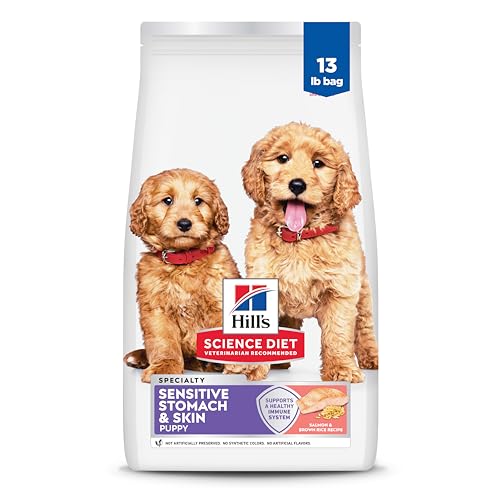
Hill's Science Diet Puppy Sensitive Stomach Dry Dog Food
What We Like
- Salmon is the #1 ingredient
- Prebiotic fiber for gentle digestion
- Omega-3 & 6 for skin and coat
- DHA supports brain development
Trade-offs
- Only one bag size available in this formula
- Not suitable for large breed puppies
A 13-pound bag of salmon-and-brown-rice kibble that puts digestive health front and center, with prebiotic fiber to keep things moving smoothly and a highly digestible formula that won’t upset a tender stomach. The #1 ingredient is salmon, so you’re not paying for corn filler, and the added DHA gives growing brains a solid start. For puppies whose tummies turn at the sight of chicken or who need extra skin support, this is the bag to grab off the shelf.
Bag size is the main factor: 13 pounds is the only option here, which means you’ll be reordering more often than with a 34-pound bag from Purina Pro Plan Large Breed. But if your pup has a sensitive stomach, the extra trips to the store are a small price for a kibble that actually stays down. It’s a targeted solution, not a one-size-fits-all, and that’s exactly what a picky puppy needs.
Product photos
How We Evaluated Pet Foods For Puppies
We started with the ingredient panel, the first five ingredients tell you what the food is really made of. We checked each formula for a named protein source (chicken, lamb, or salmon) as the first ingredient, and looked for DHA from fish oil, which supports brain and vision development in growing puppies. We also evaluated the inclusion of probiotics, prebiotics, and antioxidant blends that support a developing immune system and digestive health.
Breed-size specificity was the second major filter. A toy breed puppy has different calcium and energy needs than a large breed puppy, and feeding the wrong formula can affect bone development. We prioritized brands that formulate by size. Royal Canin, Purina Pro Plan, and Hill’s Science Diet all offer breed-specific lines, and we noted which foods include glucosamine for joint support in large-breed recipes. For more detail on size-specific nutrition, our guide to the best puppy food covers the full range of options.
Finally, we looked at what owners actually report about palatability and digestive tolerance. A nutritionally perfect formula does no good if a puppy won’t eat it or if it causes loose stools. We weighed patterns in owner feedback, particularly around picky eaters and sensitive stomachs, alongside the manufacturer’s guaranteed analysis. This is a research-led evaluation based on specs, expert round-ups, and owner-reported experience, not hands-on feeding trials.
What To Look For In Pet Foods For Puppies
Puppy food is not adult dog food with a smaller bag. The nutritional profile must support rapid growth, bone development, and a still-maturing immune system. Here are the specific factors to check before you buy.
Choose a puppy food with a named protein as the first ingredient, DHA from fish oil, and a formula matched to your puppy’s expected adult size. Avoid generic “meat meal” and check for breed-specific calcium levels.
Protein Source and DHA Content
The first ingredient should be a named animal protein, chicken, lamb, salmon, or beef, not “meat meal” or “poultry by-product.” Puppies need more protein per pound than adult dogs to support muscle and tissue growth. DHA (docosahexaenoic acid) from fish oil is the omega-3 fatty acid linked to cognitive development and retinal health.
If the bag doesn’t list DHA on the guaranteed analysis, look for fish oil or salmon oil in the ingredients. For owners exploring protein-rich options, our guide to high protein puppy food breaks down the best formulas.
Breed-Size Formulation
Small, medium, large, and toy breeds grow at different rates and have different calcium requirements. Large-breed puppies need controlled calcium and phosphorus levels to avoid skeletal abnormalities, while toy breeds need higher calorie density in a smaller kibble size. Feeding a large-breed formula to a Chihuahua, or a small-breed formula to a Great Dane, can cause developmental problems. Our guides to food for large breeds and nutrition for small breed puppies provide breed-specific recommendations.
Digestive Health and Sensitivities
Puppies have sensitive digestive systems, and switching foods too quickly or choosing a formula with common allergens (corn, wheat, soy) can cause diarrhea or vomiting. Look for prebiotic fiber (like beet pulp or chicory root) and live probiotics if your puppy has a sensitive stomach. Salmon-based formulas are often easier to digest than chicken-based ones for puppies with food sensitivities. For puppies that struggle with digestion, our guide to sensitive stomach puppy food covers the best options.
- Check that the formula is labeled “complete and balanced” for growth by AAFCO standards.
- Match the kibble size to your puppy’s mouth, tiny kibble for toy breeds, larger pieces for big breeds.
- Avoid any bag with “by-product meal” or “animal digest” in the first five ingredients.
- Start with the smallest bag size to test palatability before committing to a large bag.
A puppy’s food should change as they grow, most large-breed formulas switch to adult food around 12 to 24 months, while small breeds transition closer to 9 to 12 months.
Pet Foods For Puppies Compared
The table below compares all ten puppy foods side by side, highlighting protein source, breed suitability, and key nutritional features so you can find the right match at a glance.
| Product | Protein Source | Key Nutrients | Life Stage / Target Size | Weight |
|---|---|---|---|---|
| Purina Pro Plan Lamb & Rice Puppy Food | Real lamb first ingredient | DHA, probiotics, antioxidants | Puppies under 1 year | 6.0 pounds |
| Blue Buffalo Life Protection Puppy Food | Chicken | DHA, ARA, Choline | Puppies 2-12 months | 5.0 pounds |
| Purina ONE Plus Healthy Puppy Food | Real chicken | DHA for brain/vision | Puppies | 8.0 pounds |
| Royal Canin Small Puppy Dry Dog Food | N/A | N/A | Puppies 2-10 months, expected adult weight 9-22 lbs | 4 lb |
| Purina Pro Plan Large Breed Puppy Food | Chicken | DHA, Glucosamine, Calcium | Large Breeds | 34 lb |
| Hill's Science Diet Large Breed Puppy Food | Chicken & Brown Rice | DHA, Fish Oil, Antioxidants | Large Breed | 27.5 lb |
| Royal Canin X-Small Puppy Dry Dog Food | N/A | Antioxidants, prebiotics, proteins | Puppies 2-10 months, expected adult weight up to 8 lbs | 3.0 pounds |
| IAMS Proactive Health Large Breed Puppy Food | Real chicken #1 | Omega-3 DHA | Large Breed | 30.6 lb |
| Blue Buffalo Baby BLUE Small Breed Puppy Food | Chicken | DHA | Small Breed | 4 lb |
| Hill's Science Diet Puppy Sensitive Stomach Dry Dog Food | Salmon | Prebiotic fiber, Omega-3 & 6, DHA | Puppy | 13 lb |
Frequently Asked Questions
What is the best puppy food for a new puppy?
The Purina Pro Plan Lamb & Rice Puppy Food is the best overall choice for most puppies. It uses real lamb as the first ingredient, includes DHA from fish oil for brain development, and contains live probiotics to support digestive health. It is formulated for puppies under one year old.
When should I switch from puppy food to adult dog food?
Small and toy breeds can switch around 9 to 12 months of age. Medium breeds typically transition between 12 and 14 months, while large and giant breeds should stay on puppy food until 18 to 24 months to support proper bone and joint development.
Can I feed my puppy wet food instead of dry kibble?
Yes, wet food provides hydration and can be easier for very young puppies to eat, but it is less calorie-dense than dry food. Many owners feed a mix of both. Our guide to wet puppy food covers the best canned options for puppies.
What ingredients should I avoid in puppy food?
Avoid foods with unnamed meat meals (“meat meal” or “poultry by-product meal”), artificial colors, and excessive fillers like corn gluten meal. Also avoid formulas with generic animal fat, look for named fats like chicken fat or salmon oil instead.
How do I transition my puppy to a new food?
Gradually mix the new food with the old food over 7 to 10 days. Start with 25% new food and 75% old food, then increase the new food by 25% every few days. This gradual weaning process helps prevent digestive upset.
The Bottom Line
The Purina Pro Plan Lamb & Rice Puppy Food is the best overall choice for most puppy owners. It delivers a lamb-first protein source, DHA for brain development, and probiotics for digestive health in one formula. It works well for puppies of all breed sizes under one year old, though large-breed owners may prefer the Purina Pro Plan Large Breed Puppy Food for its added glucosamine and joint support.
If you are on a tighter budget, the Purina ONE Plus Healthy Puppy Food offers real chicken as the first ingredient and DHA for brain development at a more accessible price point. Owners of toy breeds under 8 pounds should look at the Royal Canin X-Small Puppy Dry Dog Food. Those with a sensitive-stomach puppy will want the salmon-based Hill’s Science Diet Puppy Sensitive Stomach Dry Dog Food.
The single most important factor in choosing puppy food is matching the formula to your puppy’s expected adult size. A food designed for the wrong breed size can affect bone development, growth rate, and long-term joint health more than any other variable.
