
How to Make Fish Skin Treats for Dogs: The 72-Hour Run
This post contains affiliate links. As an Amazon Associate, we earn from qualifying purchases.
To make fish skin treats for dogs, dehydrate 1 lb of scaled skins at 150 F for 72 hours, until they snap cleanly in half instead of bending. Cut each piece about twice your target size first, because skin shrinks roughly 50% as it dries. An oven works, but the chews won’t hold up as long.
Seventy-two hours is the number that makes people close the tab. What it’s chasing is moisture. The Alaska Department of Fish and Game published an account of a small salmon-frame treat operation that dried its product to less than one percent moisture, which is the line between a chew that keeps and a chew that grows something.
What follows is the dehydration schedule as published, the two places the published sources flatly contradict each other, and the storage step that decides whether you get a month or five days out of a batch.
Key Takeaways
- 150 F for 72 hours is the only published home dehydration schedule; the oven method is a separate published bake schedule.
- Cut pieces roughly double your target chew size. Skin loses about half its footprint in the dryer.
- Sources disagree on storage life: Fishful Future stores airtight in the fridge or freezer to prolong shelf life, the oven-baked version says fridge for up to five days, and Dalmatian DIY freezes all finished treats after cooling.
- No formal standard governs fish skin dog treats. Every safety step here is somebody’s judgment call, not a rule.
- Supervise the first one. Fish skin is a choking shape, and some dogs gulp instead of chewing.
What You Need Before the First Skin Hits the Tray
The how to make fish skin treats for dogs equipment list is short and none of it is specialty gear. A dehydrator that holds a steady low temperature, baking paper, a knife, and something to marinate in.
Fish skin dehydrates at 70 C, or 150 F, over a 72-hour run. Finished chews are judged firm, inflexible, and clean-breaking at the midpoint. Because the skin contracts by roughly half during drying, raw pieces are cut to approximately double the intended final chew dimensions. Trays are lined with baking paper before loading.
Any dehydrator with an adjustable thermostat will hold 150 F. A fixed-temperature unit that only does one setting is the wrong tool for this job.
- Adjustable thermostat. This is the one piece that matters. Everything else is improvising.
- Baking paper, cut to tray size. Cleanup goes from scrubbing to lifting.
- A sharp knife and a clean board, because you’re cutting skin, not sawing it.
- A glass dish or zip-top bag if you plan to marinate.
Scaling, Deboning, and the Parts People Skip
Debone completely. Dalmatian DIY is blunt about this one, and the reason is a bone in a throat.
Loose or large scales come off too. The same source flags them as a mouth and throat irritation risk, and a dried scale is a hard, sharp flake. Scale first, then decide on piece size.
The recipe lists salmon, halibut, rockfish, tilapia, cod, and pollock as fair game. Only pollock has a documented commercial trial behind it. The rest is extrapolation.
Optional marinades, one at a time, in the quantities the recipe gives:
- 1/2 cup mango puree
- 1/4 cup finely chopped parsley
- 1/4 cup anchovy paste
- 1 tbsp turmeric powder
- 1/4 cup coconut oil
- 1/4 cup Greek yogurt
Marinate in the fridge. The published recipe says as long as you like, which is unusually relaxed for a raw fish preparation, and it’s the one instruction I’d shorten if you’re leaving it past a day.
How to Make Fish Skin Treats for Dogs: The 72-Hour Run
Four steps, and three of them are waiting.
Before you start: Raw fish carries parasite risk, so freeze or cook it first if you’re following the more cautious source, and wash the board and knife with hot soapy water before they touch anything else. A dehydrator running at 150 F for three days is a heat source sitting on a counter, so clear the space around it. And cut chews shorter than your dog’s throat is wide, because a flat strip of fish skin is a shape that can lodge.
- Scale, debone, and cut. Cut pieces larger than the chew you want, since the recipe puts shrinkage at about 50%. Skip the scaling and you get hard flakes welded to the chew.
- Marinate, if you’re marinating. Coat the pieces, refrigerate, then drain. Skipping the drain leaves wet spots that stall drying.
- Roll or twist, then load the trays. Leave space between pieces. Crowded trays are the usual reason a batch is still soft at hour 72.
- Run 150 F for 72 hours. Pulling early because the outside looks dry is the mistake here. The exterior sets long before the interior does.
- Cool completely before anything touches a container. Warm chews in a sealed jar trap moisture, and moisture is what you spent three days removing.
If you’ve dehydrated dog treats before, the rhythm is familiar. The temperature is low and the run is long, closer to dehydrated liver treats than to anything quick.
How Do You Know When They’re Actually Done?
On the how to make fish skin treats for dogs question, you pull a piece at hour 60, it flexes like a leather strap, and you put it back. That’s the whole test.
The published doneness standard is firm, no longer flexible, and breaking cleanly in half. Listen for the snap rather than watching for a color change. A finished chew cracks; an underdone one tears into fibrous strings and bends back on itself.
| What you’re seeing | Likely cause | What to do |
|---|---|---|
| Still bends at hour 72 | Pieces too thick, or trays overloaded | Cut thinner, leave gaps between pieces |
| Rancid smell after a week in the jar | Stored warm, or sealed while still warm | Cool fully, then refrigerate or freeze |
| Dog coughs it back up | Piece too long, or scales left on | Shorten the strips, scale properly |
| Kitchen smells like a fish market | Normal for dehydrated fish skin | Move the unit, or ventilate the room |
Easy to miss: A chew that’s dry on the outside and still soft in the middle will pass a squeeze test and fail in storage. Break one open before you bag the batch. If the interior looks glassy instead of chalky, it goes back in.
If you’re making these partly for the chewing action, they’re a softer proposition than dental chews for dogs built for abrasion. Fish skin gives you a thin, brittle chew, not a scrubbing surface.
The Oven Shortcut, and What It Costs You
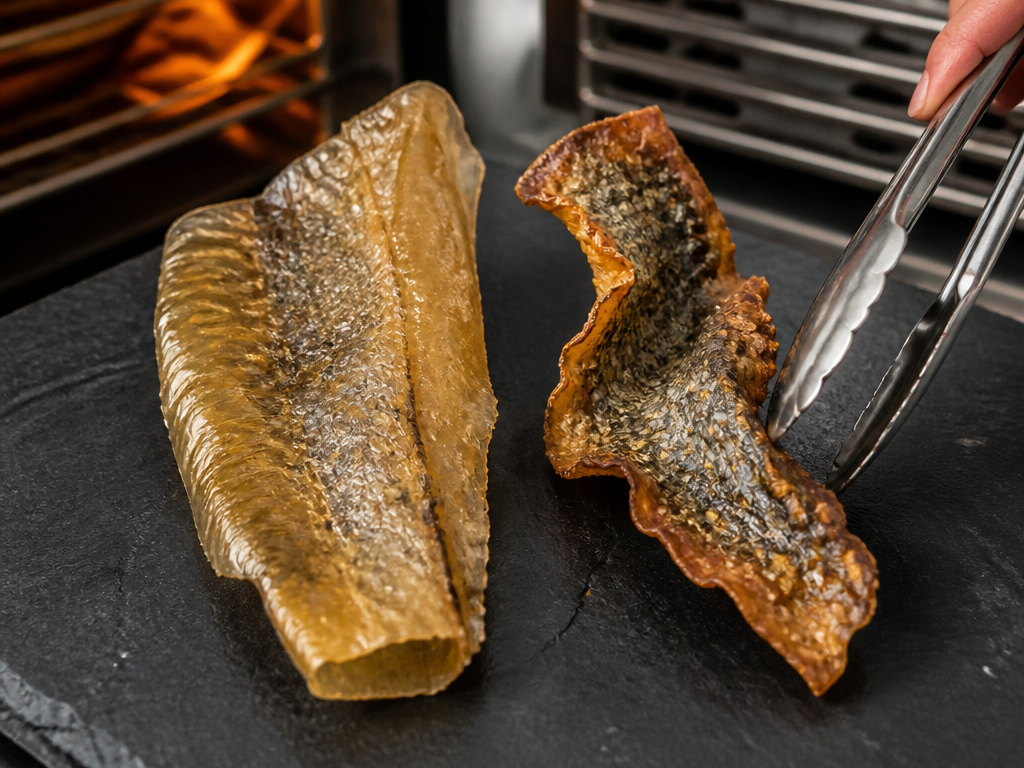
The dehydrator produces a chew. Those are two different products wearing the same name.
The dehydrator version runs 72 hours and the source behind it treats the oven as a fallback that may not hold up as long.
| Method | Time and temperature | What you get |
|---|---|---|
| Dehydrator | 150 F for 72 hours | Durable chew that takes abuse |
| Oven, low and slow | Long run, dehydrator equivalent | Fallback; may not last as long |
| Oven, hot | 400 F for 20-30 min, flip halfway | Crisp chip, fridge life up to 5 days |
If you want a chew that survives a determined dog, dehydrate. If you want a crunchy treat you’ll use up this week, the oven is fine and you get your evening back.
Pick by what you’re actually after. A dog that destroys things needs the 72-hour version. A dog that takes treats politely may not need the extra three days.
Storage Is Where Most Batches Fail
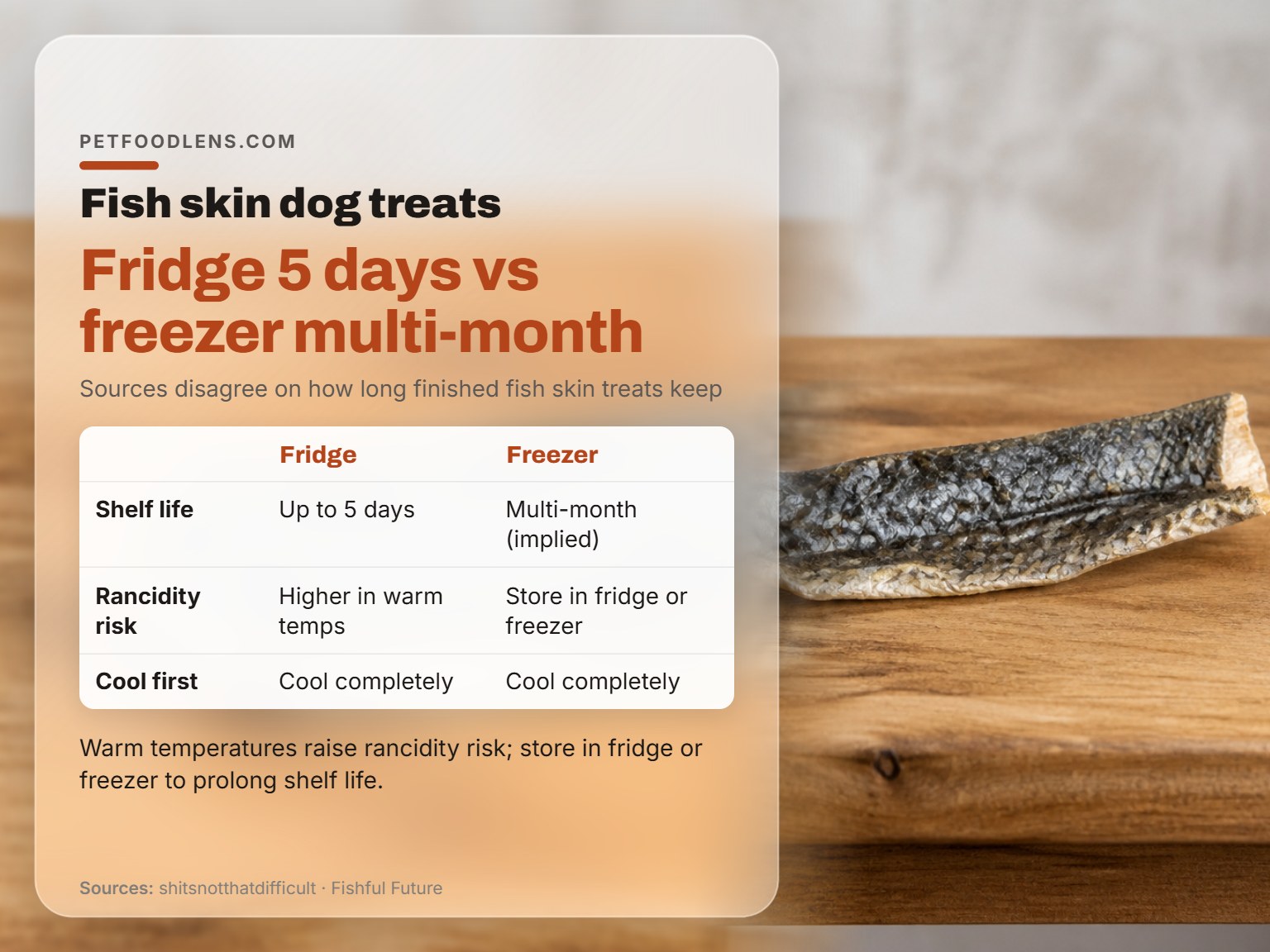
This is the step that quietly ruins the batch, and it’s the one the sources disagree about most.
The dehydrator recipe says to always store in airtight containers, and warns that fish skin turns rancid faster in warm temperatures, so fridge or freezer to prolong shelf life. Dalmatian DIY goes further and says freeze all finished salmon strips after cooling, specifically to avoid spoilage and rancid oils.
That’s a spread from five days to a target of multi-month shelf life, and nobody has published a side-by-side test to settle it.
Fridge, Freezer, or Counter
- Counter: no. Warm temperatures raise rancidity risk, and that’s the one point every source agrees on.
- Fridge: five days, if you’re going by the oven-baked guidance.
- Freezer: the safe default. Cool completely, then freeze. The oily fish versions especially.
Where this goes sideways: Bagging chews while they’re still warm from the dryer. The residual heat condenses inside the container, and you’ve just rehydrated the surface you spent 72 hours drying. Let them cool completely on the counter first.
There’s more on containers and shelf life in the guide to store homemade dog treats, which covers the same principles across other recipes.
What Commercial Fish Treat Makers Do Differently
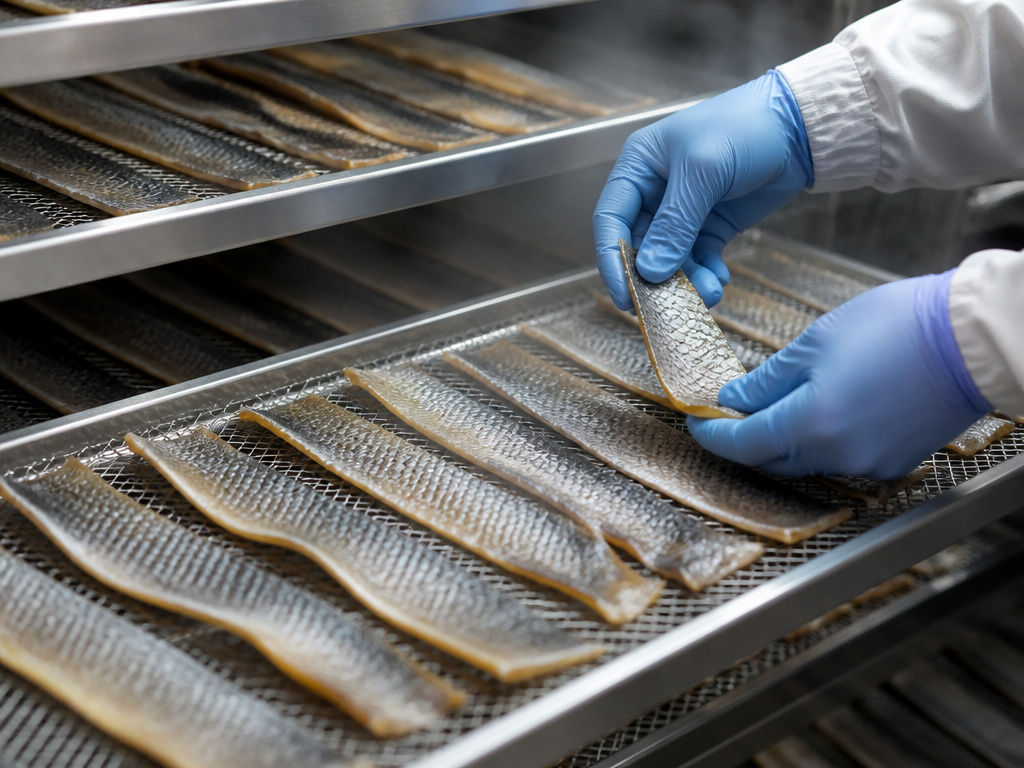
Skipper’s Pet Products, a Grimsby operation, grades fresh skins and fillet by size and hand-prepares them before drying in custom-built air-drying units at low temperatures.
The differences from a home batch are worth noting. Skipper’s says many of its treats are made with just one ingredient, fish, and that quality checks happen throughout the process rather than at the end. The company also says fish skins are naturally low in fat and easy to digest, and advises supervising your dog when feeding, especially if they gulp rather than chew.
The research route went somewhere else entirely. Alaska Sea Grant’s Sannito spent a one-day trial at the Clextral pilot plant in Tampa with 500 pounds of pollock skins, after finding that drying them was labor- and energy-intensive and a poor bet commercially. The extruder turned out a semisoft product with a consistency like licorice, high in collagen protein, and very little odor. That work, on turning pollock skins into pet treats, started from a grant in March 2015.
Why the Extruded Version Smelled Like Nothing
Odor is where these two paths split hardest, and it’s the detail that tells you the most about process.
Sannito engineered for low human-detectable odor deliberately. Mark Stopha’s account of a salmon-frame operation in pet treats from salmon waste went the other way. His dehydrated treats smelled strongly, and the smell found its way out of screw-top lids that were screwed down tight. They had to add seals.
I’ve spent most of my working life reading ingredient panels rather than running a dryer, so take this as the observation of an outsider: the odor problem is a process signature, not a recipe flaw. Same fish, two methods, opposite results.
Stopha’s operation also hit a formulation wall worth knowing about. Ground fish frames alone wouldn’t hold together when extruded, so he needed a binder, and he used spent grain from the Alaskan Brewery. When the brewery started drying that grain for fuel, he switched to another grain.
He also tried garlic powder to kill the smell. It worked immediately. It was later dropped, because garlic was noted to cause health issues in some dogs, in quantities much larger than were in the treats, and another natural herb replaced it.
That sequence is the useful part. A fix that works and a fix that’s safe aren’t automatically the same fix.
Are Fish Skin Treats Safe, and Who Decides?
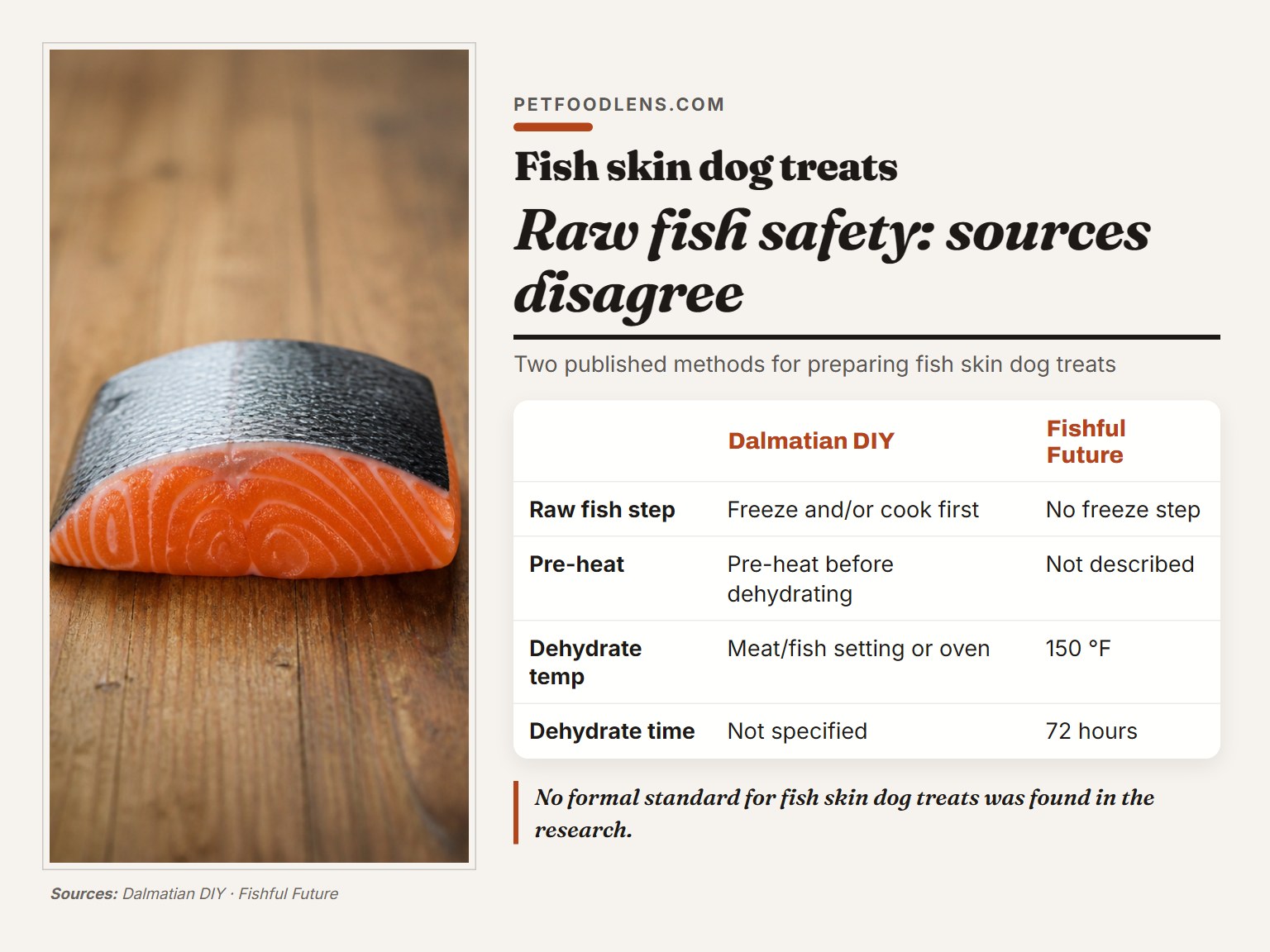
No formal standard for fish skin dog treats turned up in the research. That’s the honest starting point, and it changes how you should read every instruction above.
The sources split on raw fish handling. Dalmatian DIY says to freeze and/or cook raw salmon before it goes near your dog, and to pre-heat the pieces before dehydrating as an extra safety step. Fishful Future’s base recipe dehydrates raw skins at 150 F with no freeze step at all, and treats the bake step as optional and only for flesh, bone, or cartilage.
Both are defensible. Only one is cautious.
- Freeze first if you’re working from fresh fish you caught or bought raw.
- Pre-heat before dehydrating if you want the extra step the more cautious source describes.
- Run the optional 275 F bake for 10 minutes on any batch that includes flesh, bone, or cartilage.
- Skip the garlic. The one documented attempt to use it as an odor fix was later withdrawn over health concerns in dogs.
One more caution that has nothing to do with bacteria. Reintroducing one protein at a time is the way to learn anything, and reactions can take days to show up, though a few animals take longer. If your dog is mid-trial, don’t introduce a fish treat now. Finish the trial, then add fish as a single challenge and watch for reactions.
I’m not a veterinarian, and home-prepared dog feeding isn’t where my depth sits. What’s above is a summary of what’s published, including the parts where the publishers disagree.
If you’d rather not make them at all, there’s a wider field of fish treats for dogs already dried and graded, and a comparison of fish skin chews that covers the trade-offs. For the general technique across recipes, this guide to homemade dog treats covers the same ground, and if coat condition is what you’re chasing, these treats for skin health are worth a look.
Frequently Asked Questions
Can I make these with fish I caught myself?
Yes, with one adjustment. Dalmatian DIY recommends freezing and/or cooking raw fish before it goes to your dog as a parasite control step, and pre-heating the pieces before dehydrating. Home-caught fish is exactly the case that guidance was written for.
Do fish skin treats have to be refrigerated?
Every source puts them somewhere cold. The dehydrator recipe says airtight containers in the fridge or freezer because warm temperatures raise rancidity risk. The oven-baked version says fridge for up to five days. Freezing is the safest default, particularly for oily fish like salmon.
Is garlic powder safe for dogs?
The one documented use of garlic in fish treats was as an odor fix, and it worked. It was later dropped because garlic was noted to cause health issues in some dogs, in quantities much larger than appeared in the treats. Another natural herb replaced it. Don’t add garlic on the strength of a blog post.
What fish skins can I use?
The recipe lists salmon, halibut, rockfish, tilapia, cod, and pollock. Realistically, only pollock has a documented commercial trial behind it. Start with a species the recipe lists.
Are fish skin treats safe for dogs?
Skipper’s describes fish skins as naturally low in fat and easy to digest, and advises supervising your dog when feeding, especially if they gulp instead of chewing. The choking risk is about shape and size. Cut strips short, scale and debone properly, and watch the first one.
The Bottom Line
Here’s what doesn’t fit on a recipe card: nobody has published a validated home protocol for fish skin treats for dogs. The 72-hour schedule is one blog’s number. It’s specific, it’s plausible, and it’s untested against anything official, because the research turned up no formal standard at all.
So treat the schedule as a starting point and the doneness test as the actual rule. Firm, inflexible, snaps cleanly. If it bends, it goes back in.
Start with one pound and one tray. If your dog gulps rather than chews, skip the flat homemade strips and buy a commercial treat that’s graded by size, the way Skipper’s grades its skins, because a thin sheet of fish skin is the wrong geometry for a dog that doesn’t chew.
And if your dog is mid-elimination-trial, wait. Finish the trial, then add fish as a single challenge and watch for reactions before you decide anything.
