
Human-Grade Dog Food Pros and Cons: What the Data Shows
This post contains affiliate links. As an Amazon Associate, we earn from qualifying purchases.
Human-grade dog food pros and cons split along one line: commercial human-grade diets fall under the same pet food labeling rules and cut fecal output to a third to a half of extruded kibble, while home-made versions are where the risk sits. A 2025 review found home-prepared meals carry an inverse calcium-to-phosphorus ratio as high as 1:10.
The optimal ratio is 1:1 to 2:1, and that same review ties the skewed numbers to an inverse calcium-to-phosphorus ratio as high as 1:10. Which means the category is doing two jobs at once: one product has a formulator and a label standard behind it, and the other has a recipe card.
What follows separates the two, walks through what the feeding trials actually measured, and names the specific nutrients that go missing when a diet is built from a blog post instead of a formulation.
Key Takeaways
- Commercial human-grade and home-cooked are different risk categories. One is held to standard pet food labeling; the other should be formulated with an animal nutrition expert and evaluated regularly.
- Extruded kibble produced 2.0 to 2.9 times the fecal output of human-grade diets in a Journal of Animal Science trial.
- Home recipes ran calcium-to-phosphorus ratios as skewed as 1:10 against an optimal 1:1 to 2:1.
- The health-benefit evidence does not agree with itself. A 2025 review found no significant benefit; microbiome and metabolomic studies found measurable shifts.
- Adult dogs show deficiencies below 50% of nutrient allowances, which is the threshold the raw-diet literature keeps landing under.
Human-Grade Dog Food Pros and Cons: The Split That Matters
Two products sit under this label, and they carry different risk. One is manufactured and held to the same FDA labeling requirements as any other pet food. The other is a recipe assembled in a kitchen from a book, a website, or a breeder’s advice.
A manufactured human-grade diet is produced under the same FDA labeling requirements as any other pet food, and the manufacturer is held to the same standards as the rest of the industry. A home-prepared diet carries no such oversight. The two are frequently discussed as one category, which is where most of the confusion starts.
That distinction isn’t housekeeping.
The word itself describes ingredients and handling. Nutrient content is a separate question entirely.
| Factor | Commercial human-grade | Home-prepared |
|---|---|---|
| Labeling oversight | Same FDA rules as any pet food | None |
| Nutrient adequacy | Set by the manufacturer’s formulation | Set by whoever wrote the recipe |
| Time cost | Open the package | Sourcing, cooking, supplements |
| Documented failure mode | 2018-2023 recalls for bacteria, mycotoxins, excess vitamins | Ca:P ratios to 1:10, multiple deficiencies |
The label won’t settle it either. Working out human-grade claims means checking who formulated the diet and whether the term is defined anywhere on the package.
I read the back panel first, every time. “Human-grade” never appears in the guaranteed analysis, because it isn’t a nutrient.
The Pros Show Up Where You Can Measure Them
In a 167-dog prospective study, 62 percent of owners stuck with a customized, balanced homemade diet for 14 months.
- Coat condition improved in 70 percent.
- Bowel frequency improved in 47 percent.
- Weight-loss targets were hit in 67 percent of the dogs that had one.
- Among dogs with gastrointestinal and dermatological disorders, symptom improvement ran 95 percent for chronic enteropathy, 83 percent for dermatological cases, and 100 percent for dogs with both.
Read that last bullet carefully. Those were sick dogs on a balanced homemade diet, which is the entire qualifier.
I’d take the 167-dog result over any testimonial printed on a bag. But notice what the study tested: a customized, balanced homemade diet formulated for each dog. That’s a different product from the one most owners assemble at home.
If you want the manufactured end of this, the best human-grade dog food shortlist is a faster read than a trial paper.
Do Human-Grade Diets Really Produce Less Poop?
Yes, and the size of the effect depends entirely on what you compare it to. That’s exactly where two sources describing the same trial diverge.
The University of Illinois fecal output research reports that dogs on an extruded diet ate more to hold body weight and produced 1.5 to 2.9 times as much poop as any fresh diet. The underlying nutrient digestibility in dogs paper splits that range: 1.5 to 1.7 times versus fresh commercial diets, and 2.0 to 2.9 times versus human-grade diets.
The press summary collapses two comparisons into one number. The paper keeps them apart, and the split matters: 1.5 to 1.7 times versus fresh commercial diets, and 2.0 to 2.9 times versus human-grade diets.
You notice it at pickup: less fecal output means fewer bags on the evening walk.
The extruded control in the beagle study was Blue Buffalo Chicken & Brown Rice, so a like-for-like comparison at home starts there.
Where this goes sideways: Comparing a human-grade diet to a cheap extruded food and calling the difference a health benefit. The trial measured fecal output and digestibility. Nobody measured lifespan.
Where the Health-Benefit Evidence Actually Splits
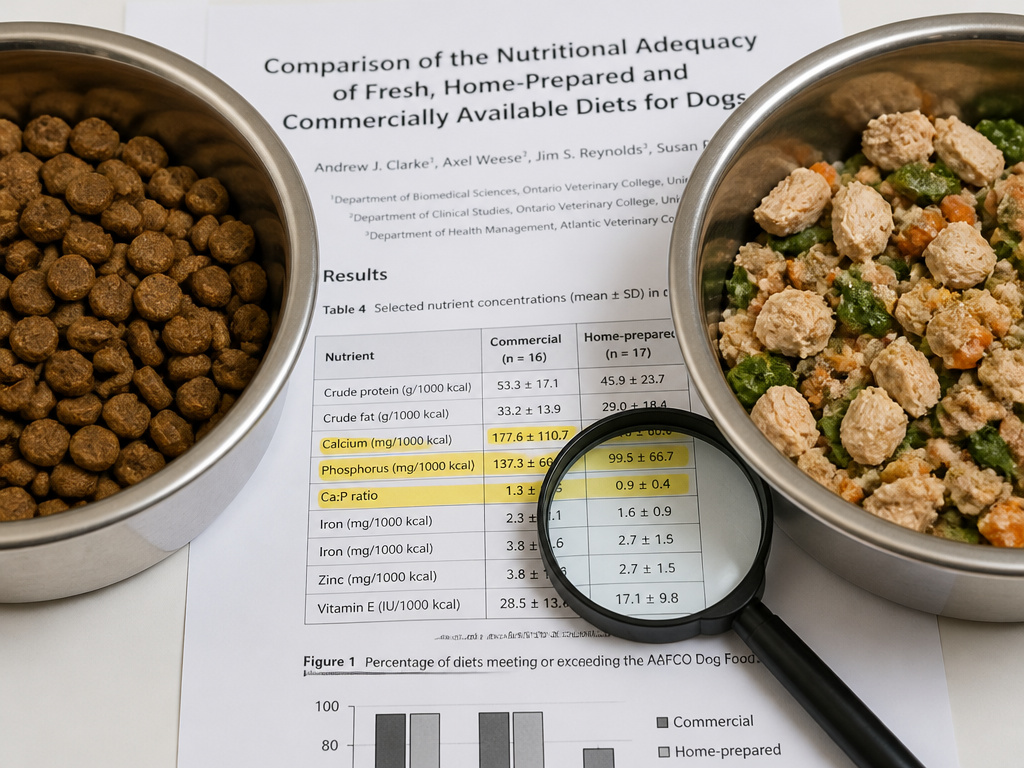
Three peer-reviewed sources looked at the same question and did not land in the same place.
The Frontiers review states plainly that home-prepared meals “do not provide any significant health benefits over commercially produced, nutritionally complete pet foods.” That’s a direct negative.
Against that, a mildly cooked human-grade dog diet study ran 20 beagles for 12 weeks on Blue Buffalo extruded versus JustFoodForDogs mildly cooked food. The human-grade diet shifted the microbiome substantially: 4 genera and 11 species up, 68 KEGG pathways up, alongside 16 genera, 25 species, and 98 pathways down. Skin, coat, and gene-expression effects were minor.
A third source, a year-long study of 22 geriatric Alaskan sled dogs, found fresh human-grade food increased BCAA metabolism, creatine, carnosine, anserine, and n-3 fatty acids, while decreasing advanced glycation end products.
What Each Study Actually Measured
None of these contradict each other once you look at the measurement. A shifted microbiome is not the same claim as a clinical health benefit, and a Bayes factor supporting the null of no adverse effects, which is what the MDPI meta-analysis reports, is not a benefit claim either.
That’s the honest state of the evidence: the Frontiers review reports no significant health benefit, while microbiome and metabolomic studies report measurable biochemical shifts and only minor clinical effects.
Aging dogs are the edge case worth flagging. Their metabolism and nutritional needs aren’t well defined, so standard adult-dog assumptions don’t transfer cleanly to a senior.
If you’re feeding a dog past middle age, that’s the finding to sit with.
The Cons Start With Mineral Math Nobody Checked
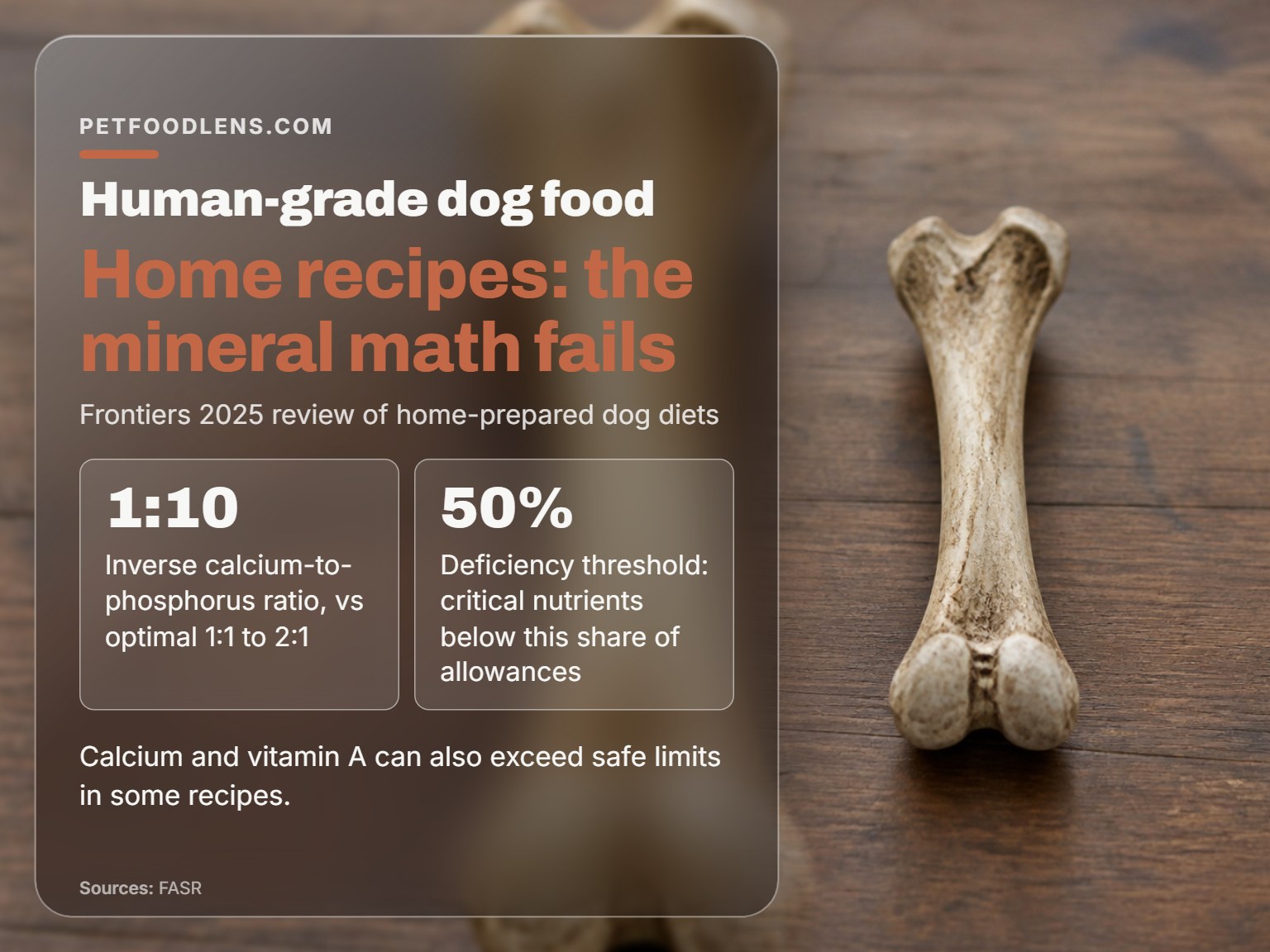
Mineral math is where home recipes fail first.
The Frontiers home-prepared dog food review found these diets are often deficient in calcium, vitamin A, and vitamin D3, and often carry an inverse calcium-to-phosphorus ratio as high as 1:10.
The Minerals That Go Missing, and the Ones That Go Too High
| Nutrient | Direction of error | What the review found |
|---|---|---|
| Calcium | Low or excessive | Deficient in many recipes; exceeds safe limits in others |
| Phosphorus | Out of ratio | Inverse Ca:P ratio as high as 1:10 |
| Vitamin A | Low or excessive | Deficient in many recipes; can exceed safe limits |
| Vitamin D3 | Low | Frequently deficient |
| Iron, zinc, copper | Low | Frequently deficient |
| Choline, riboflavin, thiamine, B12 | Low | Frequently deficient |
Raw diets add their own list: vitamin A, vitamin D, calcium, manganese, iodine, and zinc.
The review also names the line where a shortfall turns clinical. Adult dogs develop deficiencies when critical nutrients fall below 50 percent of the allowances.
The home-cooked dog food literature and the raw dog food literature overlap here, but they don’t fail identically.
Bones deserve their own line. Unground bones given to supplement calcium predispose dogs to severe constipation or gastrointestinal obstruction. Unground bones given to supplement calcium predispose dogs to severe constipation or gastrointestinal obstruction.
Then there’s handling. Raw poultry is frequently contaminated with Campylobacter and Salmonella, and raw pork often carries Yersinia and Salmonella.
Before you start: Raw poultry and pork carry Campylobacter, Salmonella, and Yersinia, so keep a separate board and knife and wash both in hot soapy water before anything else touches them. Insufficient cooking temperatures leave pathogens alive, so check the thickest piece with a thermometer rather than by eye. Cross-contamination from shared utensils is the documented route, and it reaches the humans in the house, not just the dog.
Raw poultry is frequently contaminated with Campylobacter and Salmonella, and cross-contamination from shared utensils is a documented route.
How Do You Build or Buy One Without Getting It Wrong?
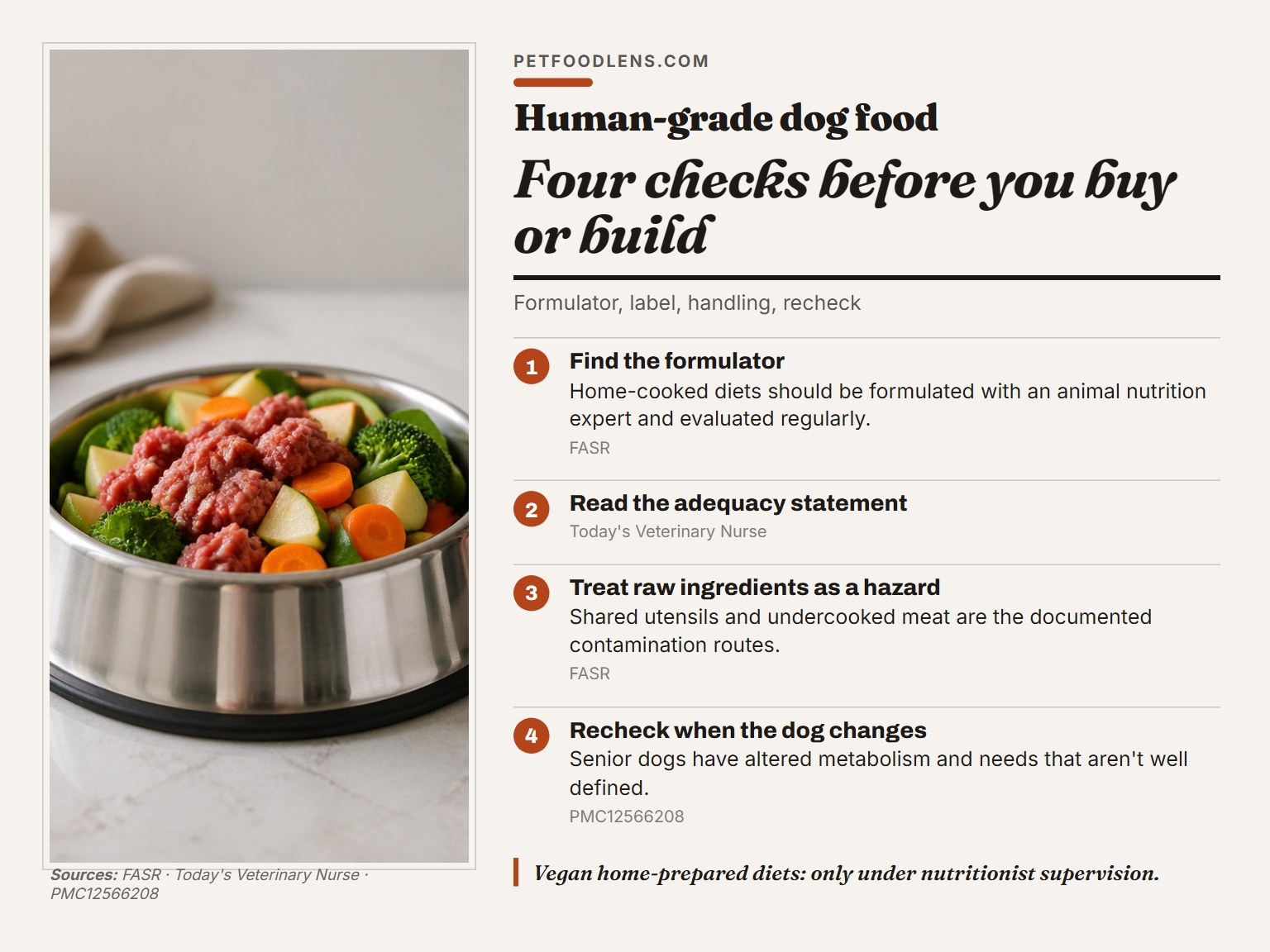
Four things decide whether a human-grade diet works: who formulated it, what the label actually guarantees, how it’s handled, and whether anyone rechecks it.
The Four Checks That Matter
- Find the formulator. The review’s position is that any home-cooked diet should be formulated in collaboration with an animal nutrition expert and evaluated regularly.
- Read the adequacy statement, not the front of the bag. FDA label requirements apply to fresh-diet manufacturers, so the same statement you’d look for on kibble should be present.
- Treat raw ingredients as a hazard. Shared utensils and undercooked meat are the documented contamination routes, and neither one announces itself.
- Recheck the recipe when the dog changes. Senior dogs have altered metabolism and needs that aren’t well defined, so a diet built for a two-year-old isn’t automatically right at twelve.
Vegan home-prepared diets are a separate case again. The review’s position is that they should only be created and administered under nutritionist supervision, full stop.
On the commercial side, the names that turn up in the trials are JustFoodForDogs and Freshpet.
One caution on those JustFoodForDogs figures. The precision-fed cecectomized rooster assay uses roosters, not dogs, so the amino acid digestibility numbers are a methodological edge case rather than a direct canine measurement.
The same paper found existing metabolizable energy prediction equations underestimate the energy content of those foods.
For the dry side, human-grade dry dog food covers the shelf-stable options, and the fresh dog food brands roundup handles the refrigerated ones.
I work from labels and published data, not lab testing. I can tell you what a bag claims and what the trials measured. I can’t tell you what’s in the bag in your hand.
Start with the label, not the slogan.
When Human-Grade Is the Wrong Answer
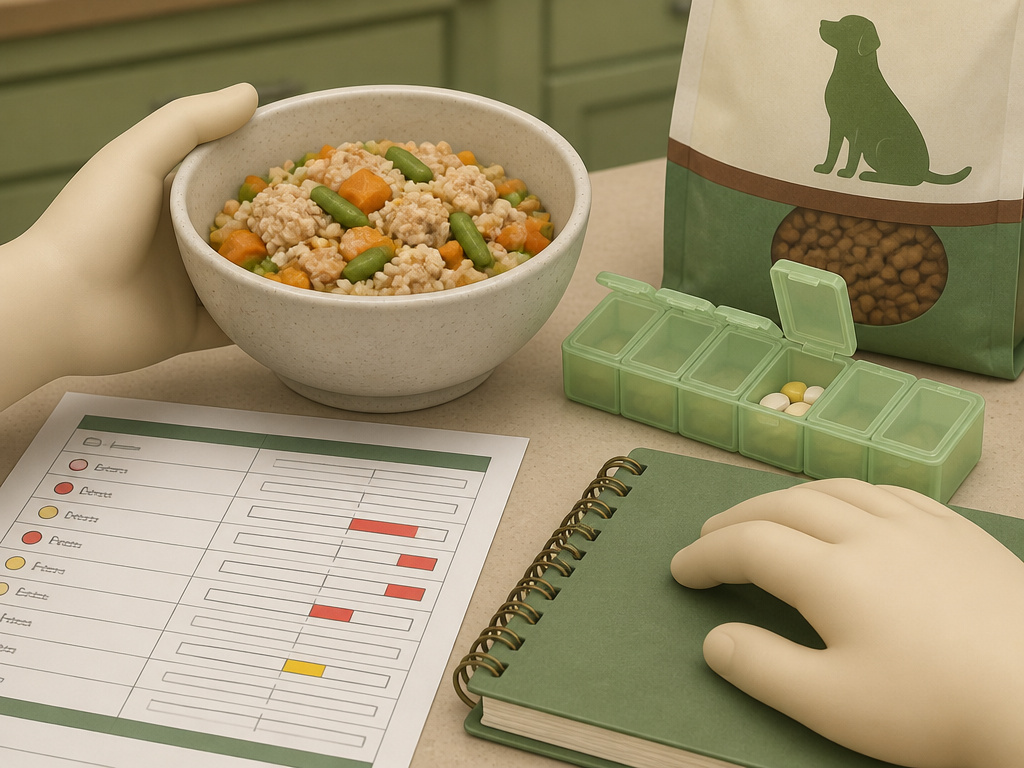
Some dogs should not be on a home-prepared diet at all.
Dogs That Should Stay on a Commercial Diet
- Dogs with a diagnosed condition. I’m not a veterinarian and can’t manage kidney disease or diabetes, and those need clinical judgment that a formulation comparison can’t supply.
- Anyone who can’t commit to the cooking. The review calls home-cooked diets more time-consuming, costly, and labor-intensive than commercial options, and that’s before supplements.
- Households with immunocompromised people or very young children, where raw meat handling adds a zoonotic route that runs both directions.
Feed an unbalanced recipe and the dog may look fine for a while. The deficiencies the review describes tend to show up in bloodwork before they show up in behavior.
Human-grade isn’t the only label competing for your attention, either. Organic dog food carries its own certification rules, which answer a completely different question.
The part nobody mentions: A recipe balanced for one dog isn’t balanced for another. The review’s guidance is regular re-evaluation, not a one-time formulation you file away and trust forever.
Frequently Asked Questions
Is human-grade dog food better than kibble?
The evidence doesn’t support a clear health advantage. A 2025 review found home-prepared meals provide no significant health benefits over commercially produced, nutritionally complete foods. What the trials do show is lower fecal output and measurable microbiome shifts, and neither of those is the same thing as a health benefit.
Is human-grade the same as home-cooked?
No, and treating them as one category is the most common mistake in this space. Commercial human-grade diets are manufactured under the same FDA labeling requirements as any other pet food. Home-prepared diets carry no such oversight, and the 2025 review treats them as a separate risk category.
What nutrients are missing from home-prepared dog food?
Calcium, vitamin A, and vitamin D3 top the list, along with iron, vitamin E, zinc, copper, choline, riboflavin, thiamine, and vitamin B12. Calcium and vitamin A can also run too high in some recipes, so the problem is imbalance in both directions rather than simple shortage.
Can I feed a human-grade diet to a senior dog?
Only with a formulation built for that dog. Aging dogs have altered metabolism and nutritional needs that aren’t well defined, so standard adult-dog assumptions don’t transfer. A year-long study of 22 geriatric sled dogs found fresh human-grade food increased BCAA metabolism, creatine, carnosine, anserine, and n-3 fatty acids and decreased advanced glycation end products.
Do human-grade diets really reduce stool volume?
Yes, and the size depends on the comparison.
The Bottom Line
Here’s the threshold I’d use: if you can’t name the person who formulated the diet, don’t feed it as the sole diet. That goes for a recipe from a website and for a bag with a handsome photo on the front.
The human-grade dog food pros and cons reduce to that one question more often than any other. Everything else is downstream of it.
This all shifts if your dog has a diagnosed condition. Then the calculus belongs to your vet, not to a label comparison, and I’d defer without argument.
One last pushback. A smaller bag of waste is a convenience. A diet that hits the calcium-to-phosphorus ratio is the actual product.
