
Pig Ears for Dogs Pros and Cons: Are They Safe?
This post contains affiliate links. As an Amazon Associate, we earn from qualifying purchases.
Pig ears for dogs pros and cons come down to three things: a long-lasting single-ingredient chew, a documented Salmonella risk, and a dog that may not suit them. The 2015-2019 U.S. Outbreak tied to pig ear treats sickened 154 people across 34 states, and 67% of the patients with data reported handling the treats.
The dog in front of you decides more of this than the treat does. A large retriever that works a chew down slowly carries a different risk profile from a small terrier that tries to swallow it whole, and the pig ears for dogs pros and cons guidance splits along that same line.
What follows is the FDA record, the places where veterinary sources contradict each other on size and age, and the label details worth checking before you hand one over.
Key Takeaways
- Salmonella is the documented risk, not the ingredient list. The FDA and CDC tied a 2015-2019 outbreak to pig ear treats.
- Once or twice a month is the only frequency figure a named veterinarian gives, and it comes from consumer media, not a regulator.
- Small breeds and puppies under six months are the two groups Dr. Julie Sanders says should skip pig ears.
- Irradiation is not a guarantee. Some individually packaged, apparently irradiated ears still tested positive.
- Check country of origin and irradiation status before buying. The FDA found both were often missing from bulk product.
What Are Pig Ears for Dogs, Exactly?
A pig ear chew is the pinna, the flap of skin and cartilage that hangs off the side of a pig’s head. Nothing gets added to it in most products, which is why the ingredient line reads like a single word.
Pig ear treats are made from the pinna, the outer flap of the ear, which consists of skin, cartilage, and a small amount of muscle. Dehydration turns the flap into a stiff, leathery chew. A 50-gram ear averages just over 200 calories, and treats should supply 10% or less of a dog’s daily caloric intake.
Turn the bag over and the panel usually confirms it. Redbarn Natural Pig Ears lists one ingredient, natural pig ear, with no artificial colors, flavors, or preservatives and no wheat, corn, soy, grains, or gluten.
That single-ingredient claim is worth exactly what it verifies. It says nothing about Salmonella, which is the risk that actually put the pig ears for dogs pros and cons question in front of the FDA.
Run the calorie arithmetic and the frequency advice starts making sense. If treats stay at 10% or less of daily calories, a 50-gram ear averaging just over 200 calories has to fit within that small share of the dog’s intake. Sanders’ answer for smaller dogs is to cut the ear into halves, thirds, or quarters.
The Salmonella Record Behind the Warnings
154 human cases across 34 states is where the multistate investigation landed. That count came from a case definition built on seven Salmonella serotypes genetically matched to isolates from pig ear treats, with isolation dates running from June 2015 through September 2019.
On July 3, 2019, the FDA and CDC announced a joint investigation and told consumers to avoid pig ear treats and retailers to stop selling them.
Three firms recalled product tied to the outbreak: Pet Supplies Plus, Lennox, and Dog Goods USA. A fourth, Hollywood Pet, recalled Salmonella-positive ears it had sourced from Dog Goods USA, though testing couldn’t confirm a link to human illnesses.
| Firm | What the record shows | Linked to illnesses |
|---|---|---|
| Pet Supplies Plus | Recalled outbreak-linked pig ear product | Yes |
| Lennox | Recalled outbreak-linked pig ear product | Yes |
| Dog Goods USA | Recalled outbreak-linked pig ear product | Yes |
| Hollywood Pet | Recalled positive ears sourced from Dog Goods USA | Testing insufficient |
| Brutus & Barnaby | Recalled all four bag sizes, nationwide distribution | Not part of the outbreak |
All of the recalled product traced back to suppliers in Argentina, Brazil, and Colombia. The importers landed on Import Alert 72-03, which allows detention without physical examination.
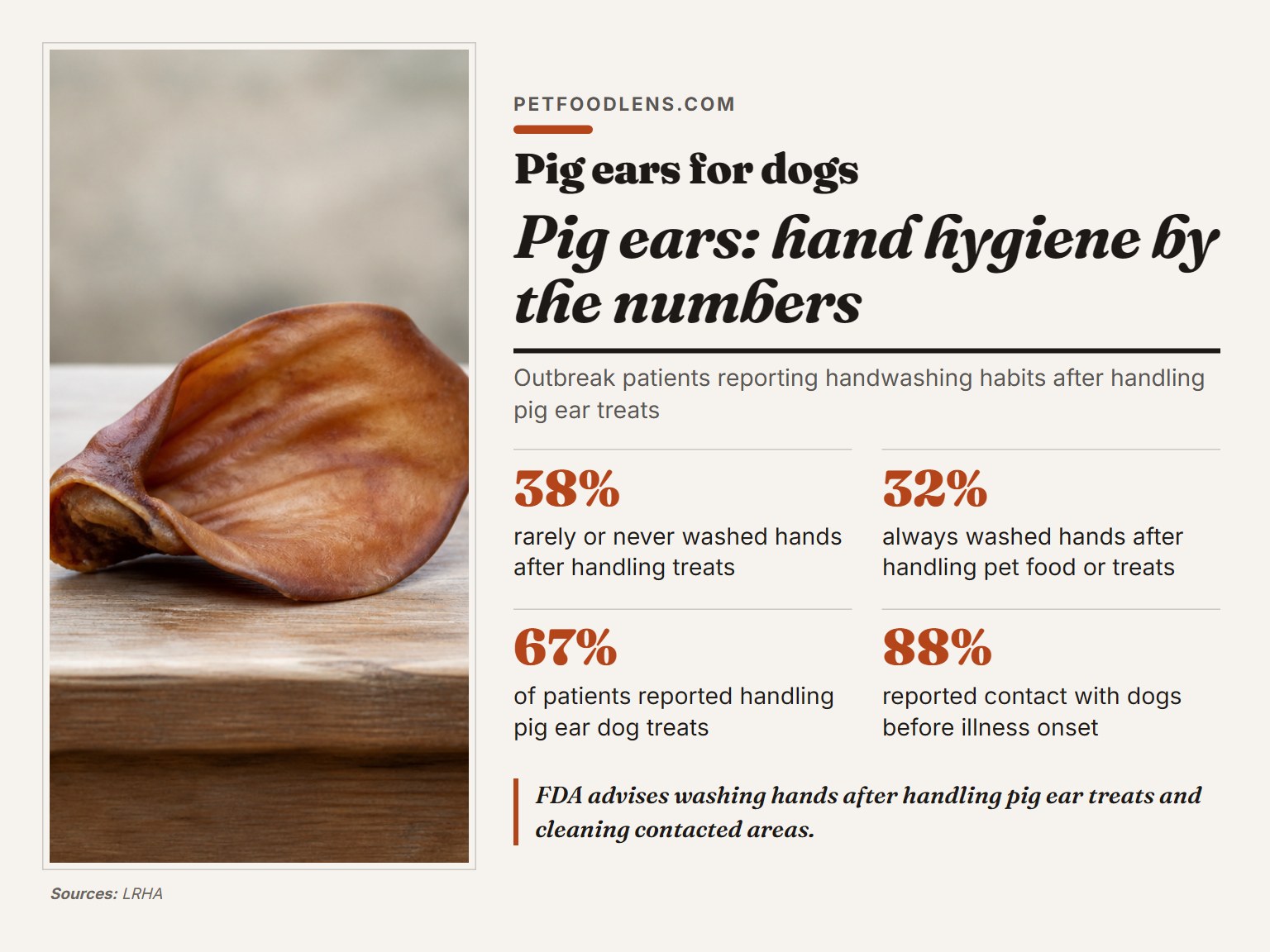
The epidemiology is what makes this a household risk rather than a kennel one. Of 122 patients with information available, 107 (88%) reported contact with a dog before they got sick, and 65 of 97 (67%) reported handling pig ear treats themselves.
The 2015-2019 pig ear treat outbreak investigation also found handwashing barely moved the needle. Fifteen of 47 patients (32%) said they always washed up after handling pet treats, and 18 (38%) said they rarely or never did.
Dogs got sick too, just less often on paper. Five of 47 patients (11%) said their dog showed signs consistent with a bacterial infection, such as diarrhea, after eating the treats.
Common mistake: Assuming the dog is the only one at risk. This was overwhelmingly a human illness event, and the exposure route ran through hands, counters, and floors rather than the chew itself.
The outbreak wasn’t the only recall. The Brutus & Barnaby pig ear recall covered all size variations of its Pig Ears for Dogs, sold in four bag sizes through Amazon, Chewy, the company’s own site, and one retail store in Clearwater, Florida.
Does Irradiation Make Pig Ears Safe?
Irradiation works. Whether a specific bag was irradiated properly is a separate question, and the FDA record shows both halves of that.
The FDA guidance on pig ear treats says properly conducted irradiation is effective at removing Salmonella from certain animal foods, including pet treats. Some ears implicated in the outbreak were individually packaged and apparently irradiated, and still tested positive.
The failure modes are boring and specific. Irradiation must be applied properly so products are effectively irradiated and not re-contaminated afterward. The FDA also notes that ears already irradiated under 21 CFR 579.22 can’t be irradiated a second time.
Importers carry a separate obligation. Under the Foreign Supplier Verification Program, an importer is accountable for verifying that a foreign supplier meets U.S. Safety standards. That puts the paperwork burden on whoever brings the ears in, not on the retailer selling them.
A Canadian pig ear Salmonella characterization study reached a conclusion that sits awkwardly beside the U.S. Timeline. Of 53 Salmonella Infantis subtypes identified around the time of the outbreak, only 6 were tied to both human infection and isolation from pig ears. The authors argued that contaminated pig ear treats act as a long-term, continuing vehicle for infection rather than a point-source event with a clean end date.
That matters because the FDA declared this outbreak over on October 30, 2019. A closed outbreak and a closed risk are different things.
How Often Can You Give a Dog a Pig Ear?
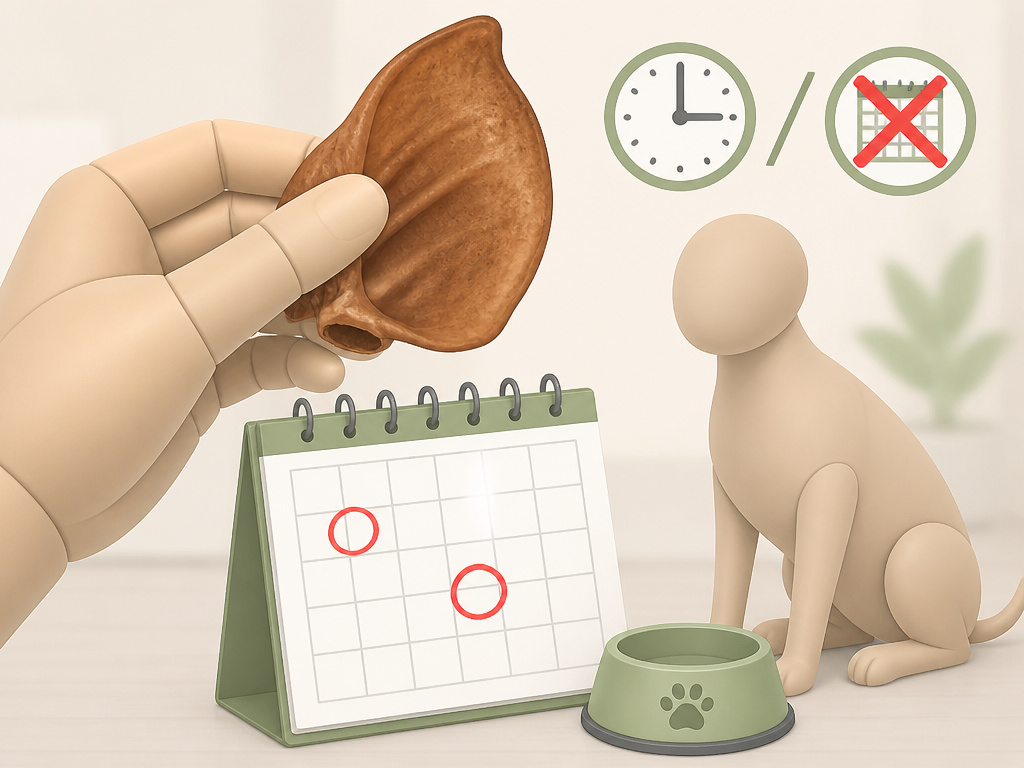
Once or twice a month is the figure, and it comes from one veterinarian quoted in consumer media rather than from a regulator or a feeding trial.
Dr. Julie Sanders, quoted by Daily Paws, calls pig ears safe for most medium and large dogs as an occasional treat at that frequency. She says flatly they are “definitely not an everyday food.”
No regulator sets a frequency. The FDA’s post-outbreak advice covers hygiene and supplier verification, and it says nothing about how often a dog should get one. Redbarn’s feeding guide gives no frequency limit either, only guidance on chewer type and supervision.
So the number is one expert’s judgment. I’d still take it over silence, because the calorie math backs it up.
There’s a second reason to keep the frequency low, and it has nothing to do with calories. Sanders lists vomiting, gas, and diarrhea as the most common problems from feeding pig ears, with pancreatitis or bloody diarrhea as rarer, more serious complications.
Which Dogs Should Skip Pig Ears Entirely?
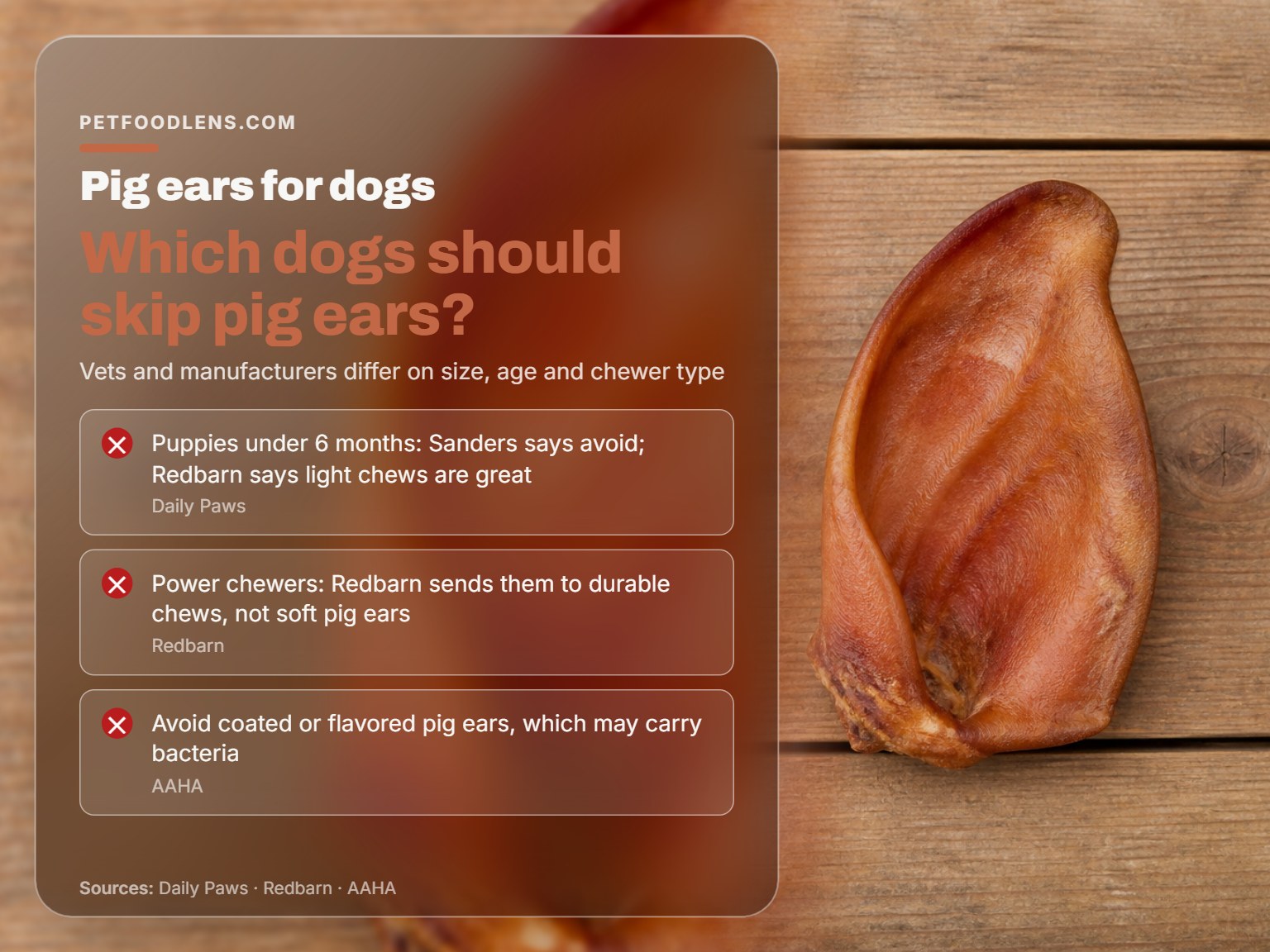
Size decides more of this than breed does, and the veterinary sources cited here don’t agree on where the line sits.
Small breeds
Sanders doesn’t recommend pig ears for small-breed dogs at all, on the grounds that smaller dogs frequently get GI upset from them and similar treats, while Dr. Lawrence says size-appropriate ears are fine. Dr. Lawrence, quoted by Adopt a Pet, takes the other side. As long as the ear looks like the right size for the dog, he says owners shouldn’t have to worry, and he’s yet to see a dog come in for an internal issue from eating one.
Puppies under six months
Sanders generally recommends steering clear of pig ears for puppies younger than six months, while Redbarn says light chews are great for dogs 6 months and younger. Redbarn says the opposite in its own feeding guide, describing light chews as great for dogs 6 months and younger because softer chews shouldn’t damage puppy teeth.
Dogs on low-fat, sensitive-GI, or novel-protein diets
Sanders lists these dogs as disqualifying for pig ears, though no manufacturer label carries that caveat. No manufacturer label carries that caveat, so it’s on you to know the diet before you buy the chew.
Power chewers
Redbarn’s own guidance sends power chewers to durable, long-lasting chews instead: bully sticks, Beef Cheeks, Collagen Sticks, or Whole Antlers. A pig ear is a soft chew by that scale.
There’s one more exclusion that neither the FDA nor the manufacturer guidance covers. The AAHA Don’t Chew On This guide advises avoiding pig ears and bully sticks that are coated or treated with flavoring, because the coating is sometimes contaminated with bacteria.
Where the Veterinary Sources Disagree
Two veterinary sources can look at the same dried pig ear and reach opposite conclusions, and the gap is wide enough to change what you’d buy.
| Question | One position | The other position |
|---|---|---|
| Small-breed dogs | Sanders: avoid entirely, GI upset is common | Lawrence: fine if the size fits the dog |
| Puppies under 6 months | Sanders: steer clear | Redbarn: soft chews suit puppies 6 months and under |
| Tooth fracture risk | AAHA groups pig ears with hard chews | Carmichael: thin texture, lower fracture risk than bone |
| Feeding frequency | Sanders: once or twice a month | Redbarn: no frequency limit given |
| Contamination source | FDA: supplier pathogen control | AAHA: inherent to the product category |
Read that table as a set of lopsided bets. Where one source says “avoid” and another says “probably fine,” the downside isn’t even. A bout of bloody diarrhea or a pancreatitis flare costs more than a missed chew.
My read: follow Sanders on size and age, because GI upset in a small dog is common and easy to trigger, though Dr. Lawrence says size-appropriate ears are fine for small dogs and Redbarn says soft chews suit puppies 6 months and under. Follow Carmichael on tooth fracture, because he’s describing the texture directly. Those two positions don’t actually collide.
Tooth Fracture Risk and the Chew You Pick Instead
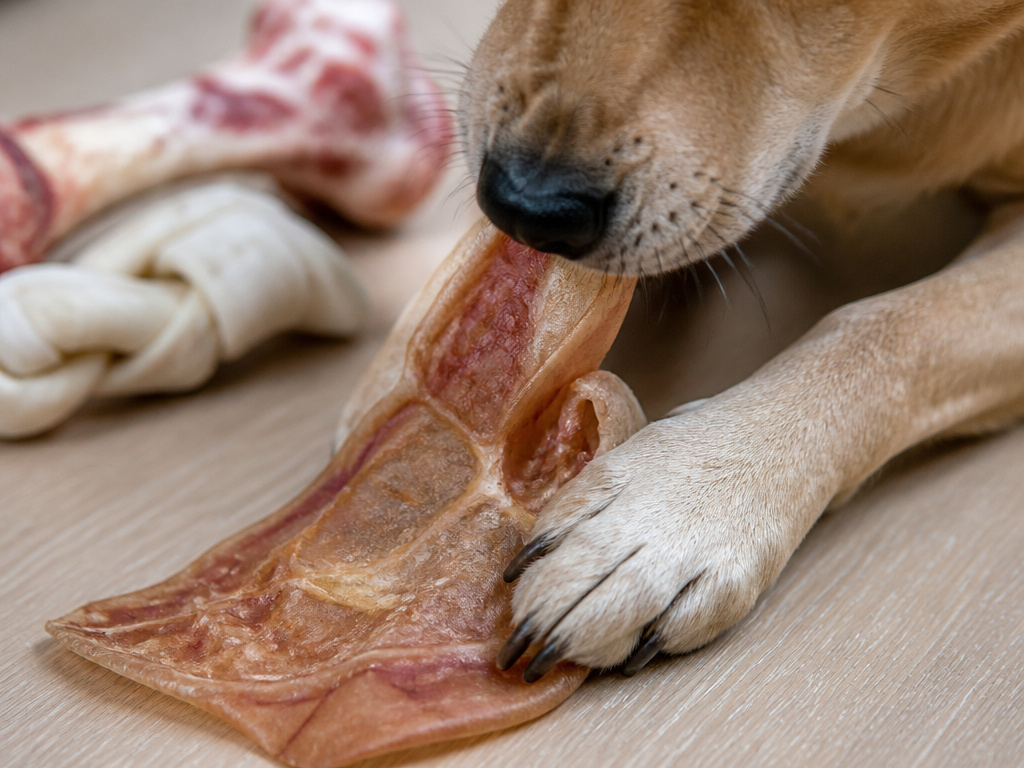
The American Animal Hospital Association groups pig ears with bones, antlers, and yak milk chews as fracture risks, though Dr. Carmichael says pig ear texture is relatively thin compared to most bones, with less risk of cracking a tooth.
Dr. Daniel Carmichael, a board-certified veterinary dentist, disagrees on the mechanism. He describes pig ear texture as relatively thin compared to most bones, which lowers the risk of cracking a tooth. He also says he sees a dog with a dental fracture from chewing on a bone several times a week, which he estimates adds up to roughly 10,000 dogs over his career.
Both statements hold up. A thin, leathery ear is a long way from a femur. The fracture cases in Carmichael’s practice are bone cases, and the AAHA grouping is a category warning rather than a per-ear measurement.
If tooth fracture is your worry, the chew you substitute matters more than the ear itself. raw bones are the classic fracture source, and rawhide chews bring a different problem: they can swell to four times their size in a dog’s stomach and become impossible to pass.
AAHA’s own safe list is unglamorous. Baby carrots, green beans, apple slices, and blueberries all make it. Grapes are the one to keep away entirely, since they’re toxic to dogs and can lead to kidney failure.
If you want to stay in the ear family, cow ears and lamb ears get sold as the softer alternatives. rabbit ears are the smallest of the three and carry their own risk profile.
How to Feed a Pig Ear Without Getting Sick
Three things happen in order: you supervise, you take the ear away, you wash your hands. Everything else is detail.
Before you start: Salmonella moves from the ear to your hands, then to counters, door handles, and children. Treat the ear like raw meat and wash up after handling it. A dog that swallows a large piece needs watching, not panic, unless it’s struggling to breathe.
The FDA’s own list is short and it covers the whole job:
- Monitor the pet while it has the treat.
- Pick the treat up when the dog is done with it.
- Keep treats away from small children.
- Clean the areas the treat or the pet contacted.
- Wash your hands after handling.
- Don’t let the pet lick you, your family, or surfaces in the home.
That list is the whole ballgame. The 38% of outbreak patients who rarely or never washed their hands after handling treats are the reason it exists.
Before you buy, work through these in order:
- Find the country of origin. If it isn’t printed, you can’t tell whether the ear came from a supplier under Import Alert 72-03.
- Check whether the packaging states the treat was irradiated. The FDA found irradiation status was often missing from bulk and commingled product.
- Confirm the ingredient line reads “pig ear” and nothing else. Redbarn Natural Pig Ears is the clean example.
- Skip anything coated or flavored. AAHA flags the coating as a separate bacterial risk.
Steps 1 and 2 are the ones that fail in practice, and the FDA said why. Bulk bins, commingled batches, and limited labeling left consumers and retailers unable to identify country of origin, irradiation status, or whether the irradiation worked at all.
Where this goes sideways: Buying from a bulk bin with no printed origin or irradiation statement. You’ve removed the only two facts that would let you check a supplier against the FDA’s import alert list, and you won’t know until the dog or the household gets sick.
If your dog does swallow a whole ear, Sanders’ guidance is to monitor rather than panic, provided breathing is normal. Pig ears are readily digestible in the stomach and unlikely to cause an obstruction, though she notes it can happen rarely.
Frequently Asked Questions
Are pig ears bad for dogs?
They’re not good or bad in the abstract. They’re a high-calorie, single-ingredient chew with a documented Salmonella history attached to the category. The FDA tied a 2015-2019 outbreak to pig ear treats, with 154 human cases across 34 states. For a healthy medium or large dog, occasional feeding is what the veterinary sources describe as reasonable.
How often can a dog have a pig ear?
Once or twice a month, per Dr. Julie Sanders. She calls pig ears “definitely not an everyday food” and puts treats at 10% or less of a dog’s daily caloric intake. A 50-gram ear runs just over 200 calories, so the frequency limit is doing real work.
Can puppies have pig ears?
Sanders generally recommends steering clear of pig ears for puppies younger than six months. Redbarn’s feeding guide says light chews are great for dogs 6 months and younger because softer chews shouldn’t damage puppy teeth. If you want one answer, follow the veterinarian.
Are pig ears safer than rawhide?
They fail in different ways. Rawhide can swell to four times its size in a dog’s stomach and become impossible to pass. Pig ears carry the bacterial contamination record and a calorie load. Neither belongs in the bowl of a dog that swallows chews whole.
What happens if my dog swallows a pig ear whole?
If the dog is breathing normally, Sanders says no emergency action is needed, but recommends monitoring closely. Pig ears are readily digestible in the stomach and unlikely to cause an obstruction, though rarely it can happen. Watch for vomiting, gas, or diarrhea.
The Bottom Line
Pig ears sit in an awkward spot: a genuinely simple chew with a documented pathogen history and no regulatory frequency limit. The pros are real. So are the cons, and the cons are the ones that send people to a doctor.
Dr. Julie Sanders advises skipping pig ears for small breeds, puppies under six months, and dogs on low-fat, sensitive-GI, or hydrolyzed-protein diets, while Dr. Lawrence says size-appropriate ears are fine for small dogs and Redbarn says soft chews suit puppies 6 months and under. That’s Sanders’ line, and it’s the conservative one.
For everyone else, the useful threshold sits on the packaging, not the calendar. Turn the bag over. If you can’t find a country of origin and an irradiation statement, put it back. Those are the two facts the FDA said shoppers and retailers were missing during the outbreak, and nothing since has made them easier to find.
I’d rather hand a dog a baby carrot than a pig ear from an unlabeled bulk bin. AAHA lists carrots, green beans, apple slices, and blueberries as safe chews, and none of them come with a recall notice.
