
Cow Ears for Dogs Pros and Cons: Are They Worth It?
This post contains affiliate links. As an Amazon Associate, we earn from qualifying purchases.
Cow ears for dogs pros and cons: the pros are a single-ingredient cartilage chew that is low in fat and naturally high in chondroitin; the cons are calories, a choking window at the end of the chew, and a hard no for a dog with a beef allergy.
Single-ingredient is the claim doing the most work on the front of the bag, and it’s also the easiest one to check in the aisle. A plain cow ear is cartilage under a thin skin. That structure drives everything else: how long the chew lasts, how it breaks down in the gut, and why the cow ears for dogs pros and cons calorie count sits lower than the size suggests.
What follows is the anatomy, the calorie math, the four places where the published sources contradict each other, and the short list of dogs that should never get one.
Key Takeaways
- One ingredient, or it isn’t a plain cow ear. A single-ingredient ear carries no rawhide, no binders, no preservatives, and no grain.
- 59.6 kcal per ear on The Country Butcher‘s spec sheet, at 0.7 oz and 85.2 kcal/oz.
- Take the last chunk away. Once it’s small enough to swallow whole, that’s the choke point.
- Small dogs get a portion, not a whole ear. One vet says so directly, and one manufacturer disagrees.
- A beef allergy rules it out completely. Beef protein makes up a large percentage of the ear.
What Are Cow Ears Actually Made Of?
Cartilage under a thin skin. That’s the whole structure, and it explains the digestibility, the chew time, and the smell in one go.
Cow ears are a by-product of beef processing. The ear is cleaned of hair, disinfected, then dried by baking or dehydration, with irradiation sometimes used to reduce bacterial load. The finished chew is mostly cartilage, which is naturally high in chondroitin, a compound studied for joint health. Color ranges from white to brown depending on whether irradiation was used.
The off-white color is a processing artifact. Ears are disinfected and then baked and dried in an oven, which leaves them pale. Pig ears come out a deeper brown because they’re smoked for flavor. That color difference tells you how each one was handled before it reached the shelf.
Chondroitin is the reason some owners reach for these over other chews. Because the ear is mostly cartilage, it carries the compound naturally, and the glucosamine and chondroitin research is worth reading before you treat that as a joint supplement. It’s a chew with a nutritional side effect. It isn’t a dose.
Processing varies more than the front of the bag suggests. Cow ears come from different sources with very different welfare standards, and they’re processed in very different ways. Two ears that look identical on the shelf can be different products.
The 50% Size Gap Between Cow Ears and Pig Ears
At least 50 percent bigger, and sometimes double the size. That’s the gap between a cow ear and a pig ear, and it’s the first thing to get straight because size drives everything a shopper cares about.
The bigger ear doesn’t buy you proportionally more chewing time. Jo Hardy, a vet writing for Kip & Twiggy’s, puts a cow ear at 20 minutes to a couple of hours for an average dog. Lynnette Walczak, writing for The Fun Times Guide, says her dogs can demolish one in less than an hour. Neither figure supports the “long lasting” line on a product page.
| Trait | Cow Ear | Pig Ear |
|---|---|---|
| Size | At least 50% bigger, sometimes double | Smaller overall |
| Fat and calories | Lower fat, fewer calories | Higher fat, higher calories |
| Smell and grease | Less greasy, barely noticeable smell | Smellier and greasier |
| Color | Off-white, disinfected then baked | Deeper brown, smoked |
Why the Bigger Ear Isn’t the Longer Chew
An ear softens as the dog works it. Once it goes soft, it tears into pieces fairly easily, which is why Walczak doesn’t let her dogs swallow the large chunks they pull off. A dense ear lasts longer than a thin one of the same length. That’s the variable to shop on, and no bag prints it.
The smell question has a split answer too. Hardy describes cow ears as less greasy and less smelly than pig ears, with barely a noticeable smell unless you hold one close to your nose, while Specialty Rawhide calls its ears odorless, BullyStick.com calls them grease-free, and one Amazon reviewer reported greasy, smelly ears. Specialty Rawhide goes further and calls its ears odorless. Rendered cartilage does have a smell. Treat “odorless” as a claim, not a spec.
If your dog burns through an ear quickly, bully sticks will hold attention longer. One reviewer on BullyStick.com’s own product page put cow ears at roughly half to two-thirds the life of a bully stick.
Are Cow Ears Safe for Dogs? The Choking Window That Matters
The last chunk is where the risk lives.
Hardy’s position is that cow ears are highly digestible, meaning what reaches the stomach should break down successfully, but the last piece should still come away before the dog swallows it whole. Walczak takes the more cautious line and doesn’t let her dogs eat any really large pieces at all. Both are describing the same moment: the point where a soft, worked ear becomes small enough to gulp.
An ear that’s been worked for twenty minutes feels like wet leather and tears with a soft rip instead of a snap. That texture change is your signal.
Before you start: A softened cow ear tears into pieces a dog can swallow in one go, and a chunk that size can lodge. Stay within arm’s reach for the entire session. Check the ear every few minutes and bin it once it’s small enough to sit behind the dog’s molars.
The routine that works, in order:
- Pick a size that matches the dog, not the bag. A chew meant for a medium or large dog should be bigger than the dog’s mouth. Skip this and you’ve handed a large dog a swallow-sized object.
- Sit down with the dog. Every source in this category says supervise. Leave the room and the whole risk profile changes.
- Watch for the tear. Once the ear starts coming apart in strips, the session is nearly over.
- Take the last chunk yourself. Hardy’s instruction is explicit. Waiting for the dog to finish it is the mistake.
- Bin it, don’t save it. A dried-out remnant goes hard and brittle, and brittle pieces are the ones that splinter.
Stop the session immediately if the ear starts breaking into small pieces, if the dog tries to swallow a piece without chewing, or if the ear develops hard, sharp edges. BullyStick.com’s guidance is to throw the chew away at that point rather than let the dog keep working it.
Common mistake: Giving a large dog a small chew because it’s the last one in the bag. A small chew on a big dog is a choking hazard, and it’s the one size error that shows up in every manufacturer’s warning list.
How Many Calories Are in a Cow Ear?
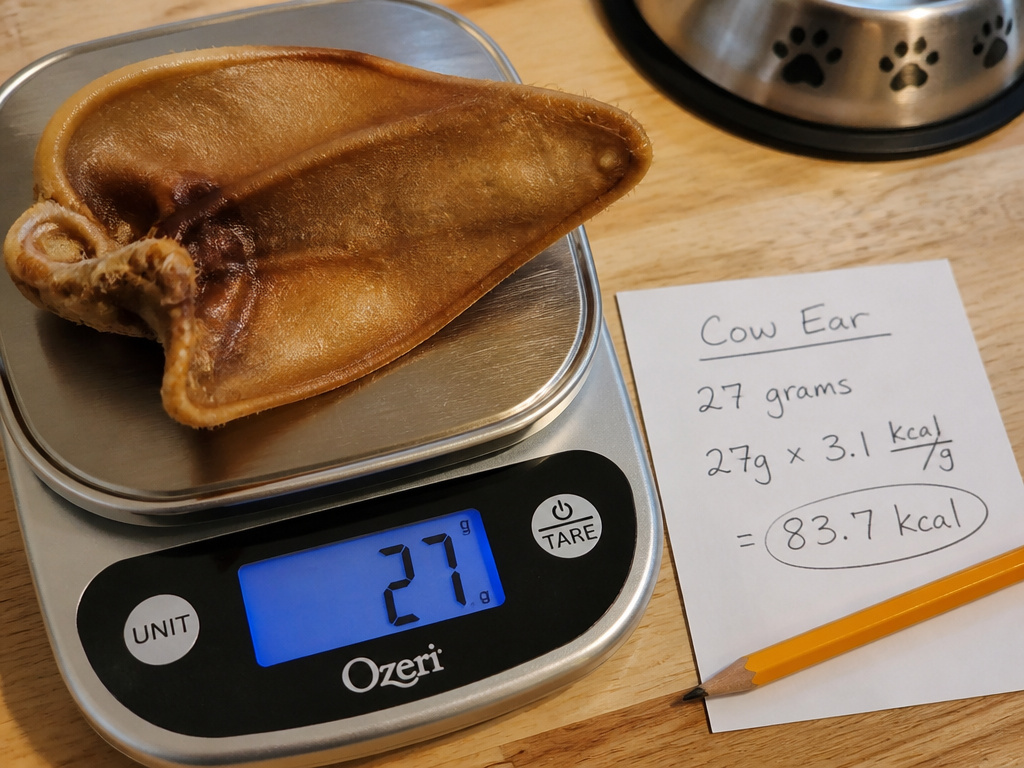
That same sheet lists crude fat at a 3 percent minimum, crude fiber at 3 percent maximum, moisture at 10 percent maximum, and salt at 0.26 percent.
So the “low fat” label holds up on the numbers for some sources, though others describe cow ears as higher in fat and calories; either way it doesn’t mean calorie-free. Hardy’s framing is the accurate one: low in fat, still carrying calories, so a dog shouldn’t over-indulge. Walczak calls it a low-calorie treat on the strength of the protein-to-fat ratio.
Doing the Calorie Math for Your Dog
Take the ear out of the daily ration rather than adding it on top. A 59.6 kcal ear is a real contribution to the day, and two ears is double that.
The math is simple. Weigh the ear if the bag doesn’t state it, note the calories per ounce, and subtract the equivalent from the evening meal. That’s the whole method, and it’s the same arithmetic you’d use for any treat.
I spend a lot of time on guaranteed analyses, and this category shows why the front panel can’t be trusted.
Cow Ears for Dogs Pros and Cons: Where the Sources Disagree
One manufacturer’s guaranteed minimum sits above a vet’s stated ceiling. That’s worth pausing on.
| Question | One position | The other position |
|---|---|---|
| Protein content | The Country Butcher: crude protein min 92% | Jo Hardy (vet): 66–90% across products |
| Fat content | The Country Butcher: crude fat min 3% | Jo Hardy (vet): 1–3% |
| Small dogs | The Country Butcher: suitable for any size dog | Jo Hardy (vet): a whole ear is too big, give a portion |
| Chew duration | Jo Hardy: 20 minutes to a couple of hours | Lynnette Walczak: under an hour sometimes |
| Smell and grease | Jo Hardy: less greasy and smelly than pig ears | Specialty Rawhide and BullyStick.com: odorless, grease-free |
A guaranteed analysis is a floor, not a measurement. “Crude protein, minimum 92 percent” means no batch fell below that line. It doesn’t mean the average ear hits it, and it doesn’t reconcile with a vet’s published 66 to 90 percent range across the category. Read the label, not the packaging.
Easy to miss: The fat numbers conflict in the same direction as the protein numbers. A manufacturer’s minimum of 3 percent sits at the top of the vet’s 1 to 3 percent range. When two sources disagree this cleanly, the honest answer is a range, not a single figure.
The size question matters more than the nutrition debate. The Country Butcher states its ears suit any size dog and any chewing type, while Jo Hardy (vet) says a whole ear is too big for a small dog and Brutus & Barnaby recommends a smaller portion for small dogs. Hardy states plainly that a whole cow ear isn’t a suitable size for a small dog and only a portion should be given. Brutus & Barnaby lands in the middle, recommending a smaller portion or shorter sessions for small dogs while medium and large dogs take a whole ear.
Which Dogs Should Not Get Cow Ears?
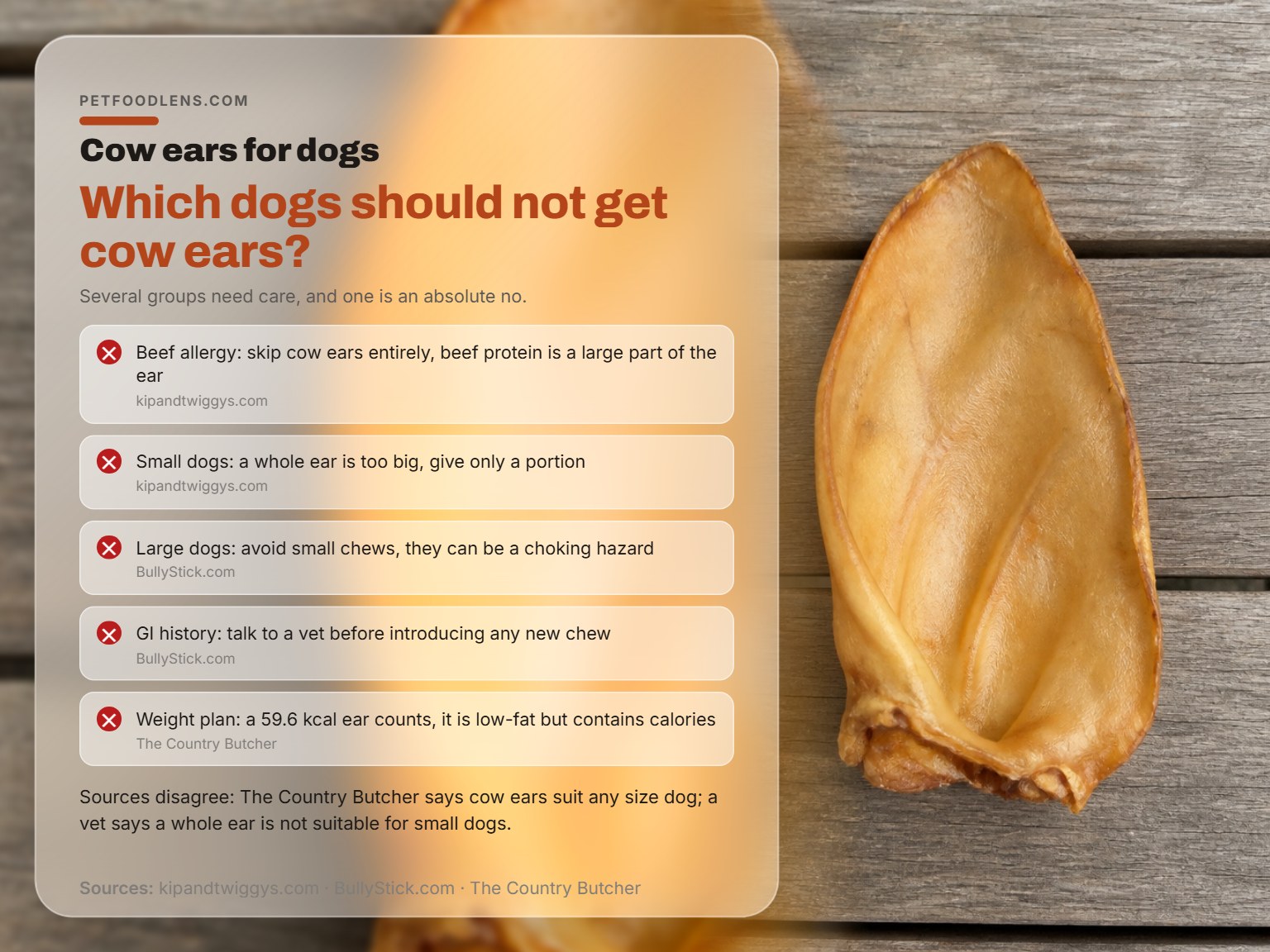
Four categories, and the first one is absolute.
Dogs With a Beef Allergy
Skip cow ears entirely. Beef protein makes up a large percentage of the ear, so this isn’t a “reduce the amount” situation. It’s a no.
Small Dogs and Portion Size
A whole ear is a big object for a small mouth. Cut it down, or buy a smaller chew. Hardy’s alternative for small dogs is lamb ears, which carry the same cartilage benefits at a manageable size, though The Country Butcher states cow ears suit any size dog. For medium dogs, pig ears work, though they’re fattier and greasier.
Beyond those two, three more groups need care:
- Large dogs offered small chews. BullyStick.com flags this as a choking hazard, and it’s the mirror image of the small-dog problem.
- Dogs with a history of gastrointestinal issues. BullyStick.com advises a vet conversation before introducing any new chew.
- Dogs on a weight plan. A 59.6 kcal ear counts. It’s low fat, not free.
Puppies fall into a grey area. Brutus & Barnaby’s guidance is that puppies can have cow ears once they’re old enough for harder chews and can chew safely under supervision, with an appropriate size and the small end pieces removed.
How to Choose a Cow Ear Before You Buy
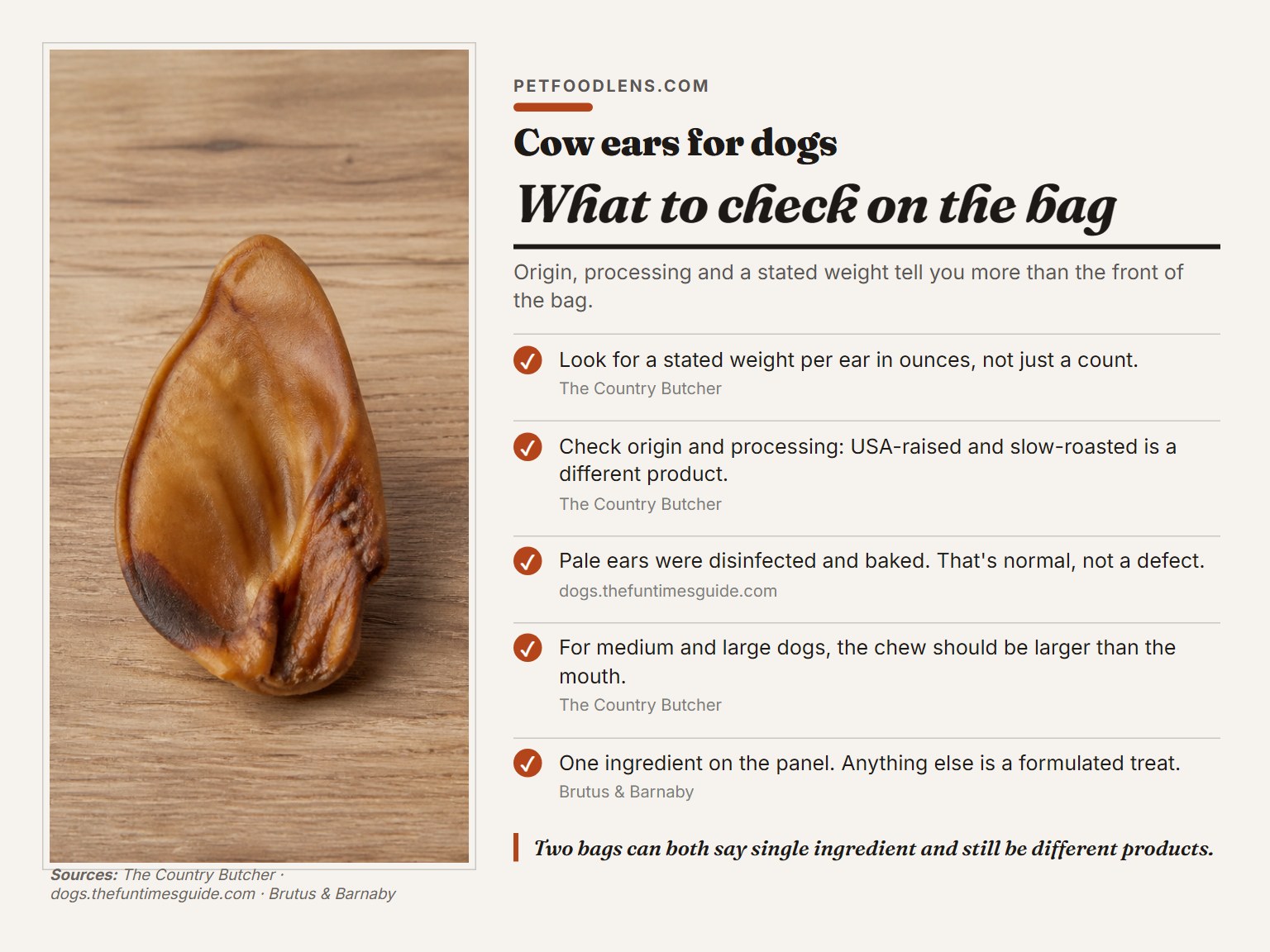
Two bags can both say single ingredient and still be different products.
Turn the bag over. What you’re looking for is origin, processing, and a stated weight, because those three tell you more than any word on the front.
Brands Worth Comparing
The Country Butcher sells single-ingredient ears from USA-raised beef, slowly roasted, at 0.7 oz and roughly 5.5 by 3.5 by 0.5 inches. Redbarn sells a 4.2 oz product and states that every ear passes 2,500-plus monthly quality checks at SQF-certified facilities, which is a processing claim you can at least look up. Brutus & Barnaby’s ears are single-ingredient with no rawhide, preservatives, fillers, or grains.
BullyStick.com sources 100 percent beef from grass-fed South American herds and describes its ears as grease-free and suited to light chewers and small dogs. Specialty Rawhide’s ears average 5.5 inches. On pack sizes, Pawstruck sells in 10, 25, 50, 100, and 250 counts, and Cadet sells a 12-piece package.
The checklist that actually separates them:
- Stated weight per ear. A number in ounces tells you what you’re paying attention to. A count alone doesn’t.
- Origin and processing. USA-raised and slow-roasted is a different product from an unspecified source.
- Color. Pale ears were disinfected and baked. That’s normal, not a defect.
- Size against your dog’s mouth. The chew should be larger than the mouth for medium and large dogs.
- One ingredient on the panel. Anything else is a formulated treat wearing a chew’s clothing.
If your dog destroys ears quickly, antlers last far longer and contribute no calories because they aren’t ingested. Yak cheese chews sit in the middle. Rabbit ears are the small-dog option when even a portion of a cow ear is too much.
Frequently Asked Questions
Are cow ears safe for puppies?
Brutus & Barnaby’s guidance is that puppies can have them once they’re old enough for a harder chew and can chew safely under supervision. Choose an appropriate size and remove the small end pieces. A whole ear is too large for a small puppy, so cut it down.
How long does a cow ear last?
Jo Hardy puts it at 20 minutes to a couple of hours for an average dog. Lynnette Walczak says her dogs can finish one in under an hour. Treat the low end as the realistic figure for a determined chewer.
Can cow ears make my dog sick?
Diarrhoea is rare and shows up most in dogs that haven’t had them before or that eat too many too often. It typically clears within a day or two. If your dog has a history of gastrointestinal issues, talk to your vet before introducing any chew.
Are cow ears better than rawhide?
Rawhide doesn’t dissolve in the stomach. It swells instead, which is why swallowed pieces have to pass. Cow ears are cartilage in a thin skin with no splintering, and every manufacturer in this category markets them as the more digestible option, though Hardy still advises removing the last bit to prevent choking.
How often can I give my dog a cow ear?
No published source gives a fixed frequency. Hardy’s guidance is that over-indulgence is what causes trouble, and a 59.6 kcal ear counts against the day’s food. There is no fixed published frequency; Hardy’s guidance is that over-indulgence is what causes trouble, so work any ear into the ration rather than adding it on top.
Before You Go
One threshold decides this for you. If your dog finishes a cow ear at the fast end of the range, cow ears may be the wrong category for that dog. Size up, or move to antlers or yak cheese, because a fast chewer turns a soft ear into swallowable pieces well before you’ve had time to react.
The second thing I’d say plainly: the sources don’t agree on how much protein or fat is in these chews, and nobody has published an assay to settle it. Anyone quoting a single confident number is quoting a minimum off a bag.
Where cow ears earn their place is the middle of the market. A lean, single-ingredient chew with natural chondroitin, at a calorie cost you can actually calculate, suits a medium dog that works a chew steadily. It suits a small dog in a cut portion. It doesn’t suit a dog with a beef allergy, and it doesn’t suit a dog left alone with it.
I’m not a clinician, so if your dog has gut problems or a diagnosed condition, that’s a vet conversation rather than a label-reading one. Everything above is about reading what’s on the panel and matching it to the dog in front of you.
