
Antlers for Dogs Pros and Cons: The Hard-Chew Trade-Off
This post contains affiliate links. As an Amazon Associate, we earn from qualifying purchases.
Antlers for dogs pros and cons split on hardness. In a University of Pennsylvania study, 24 maxillary carnassial teeth fractured at a mean load of 1,281 N, and antler hardness often outlasts the force a tooth applies. The pros are durability and long chew time; the cons are fractured teeth, splinters, and blockages.
That 1,281 N figure is a mean, and the antlers for dogs pros and cons spread around it matters more than the mean does. Bite-force measurements run from 13 N in a small dog to 3,417 N at the molars in the largest, so the same antler a spaniel gnaws for a month can take a slab off a rottweiler’s carnassial in one sitting.
What follows walks both sides of the ledger: the durability and nutrition arguments owners make, the fracture and obstruction data veterinarians cite, and the species differences that make “antler” a useless single category. I’ll also show you where the veterinary positions genuinely conflict, because they do.
Key Takeaways
- Fracture load sits at 1,281 N in the Penn cadaver study, and a large dog’s molars can exceed 3,417 N.
- Antlers rank among the most likely implicated products for carnassial fractures, alongside bones.
- No regulation governs chew hardness. No limits exist for the textural properties or hardness of chews, food, or toys for dogs.
- The thumbnail test is a screen, not a measurement. No source calibrates it to the 1,281 N threshold.
- Veterinarians disagree outright. Cornell and Dalblair say avoid antlers entirely; the AKC allows supervised use; Whole Dog Journal defends cut moose splits.
What the Fracture Numbers Actually Show
Twenty-four teeth. That is the entire sample behind the most-quoted figure in this argument, and it pays to know exactly what was measured before a number decides anything for you.
Twenty-four maxillary fourth premolar teeth were mounted at 60 degrees to the ground and loaded by axial compression until failure. Mean maximum load at fracture was 1,281 N, plus or minus 403 N, at a mean impact angle of 59.7 degrees. Complicated crown fracture was the most common outcome (n=12), followed by uncomplicated crown fracture (n=6).
The method matters as much as the result. Teeth were loaded at an angle, not straight down, because dogs do not chew straight down. The study found no statistically significant correlation between dog age, weight, or impact angle and the load at fracture. Size did not protect the tooth.
Here is the comparison that reframes the whole debate:
| Measure | Value | Source |
|---|---|---|
| Mean load at carnassial fracture | 1,281 N (+/- 403 N) | Penn / Reiter study |
| Mean impact angle at fracture | 59.7 degrees (+/- 5.2) | Penn / Reiter study |
| Bite force across 22 dogs | 13 to 1,394 N, median 163 N | Lindner 1995 |
| Highest molar bite force recorded | 3,417 N | Cited in Veterinary Practice News |
| Dog premolar and molar enamel | 0.1 mm to 1 mm | Crossley 1995 |
| Human enamel, for comparison | Up to 2.5 mm | Ten Cate’s Oral Histology |
Read the top row against the bottom two. A dog’s chewing enamel runs 0.1 mm to 1 mm thick on the premolars and molars, while human enamel reaches 2.5 mm. The antler does not have to be harder than steel. It only has to be harder than the tooth, and the tooth is the thinner material.
That is the mechanism behind every fracture story you’ll read here. A chew that does not deform under load passes the entire force into enamel that is a fraction of a millimetre thick in places. Something gives, and it is not the antler.
The Pros Antler Chews Genuinely Have
The pros are real. I’ll give them that much.
- Durability that survives a serious chewer. A dog will not work through an antler in one sitting the way it works through a softer, edible chew, per Whole Dog Journal. Dogster notes antlers can last several months.
- No animal is killed to produce one. Deer, elk, and moose shed antlers seasonally, from November to May, so the raw material is collected rather than harvested.
- Less splintering than bone. The AKC notes antlers do not appear to splinter as easily as bones or other toys.
- Mineral content. Calcium, phosphorus, potassium, magnesium, zinc, iron, and type I collagen, with relatively little marrow.
- Chewing enrichment.
The collagen claim deserves a specific caveat. A 2023 paper in BioTechnologia reported an optimal collagen yield of 22.04% from red deer antler, but that figure came from a specified laboratory extraction process. It describes a materials process. Nobody is recommending you feed your dog an extraction protocol.
Durability is the argument that actually sells antlers, and it is also the argument that creates the risk. A chew that lasts several months is a chew that stays in the mouth for months. Compare that to rawhide, which most dogs finish in a session, or to raw bones, which carry their own fracture record.
The Cons: Fractured Teeth, Splinters, and Blocked Intestines
A dog works an antler down over weeks. Then one afternoon there is a yelp, a dropped chew, and a tooth sitting at an angle it should not be.
Fractured teeth
Antlers have become one of the most common offenders in causing carnassial tooth fractures, according to Lewis, a board-certified veterinary dentist writing in Veterinary Practice News. The hardness outlasts the forces the carnassial teeth apply, and the tooth wears or breaks instead.
Dalblair Vets describes the outcome in clinical detail: two fractured upper carnassial teeth from antler chewing, both showing typical slab fractures with pulp exposure. Treatment is a root canal or a difficult surgical extraction. Dalblair also puts jaw-closing force on a snap bite at up to a tonne, which explains why the tooth loses.
Splinters and blockages
Where this goes sideways: Handing an antler to a dog with an existing cracked tooth or a history of dental disease. Dogster flags those dogs as higher risk, and a chew a healthy mouth survives will finish a compromised tooth in one session.
Splintering is a separate problem from fracture, and the Texas A&M veterinary chew toy guide treats it as the more dangerous one. Real bones, antlers, and hooves can injure a dog when pieces splinter off and cause obstruction or puncture wounds.
The AKC adds the detail that makes this concrete. Antler pieces that break off can lodge in the mouth, throat, or intestines and cause blockages that need emergency surgery. Vomiting is usually the first sign of an obstruction, and surgery is usually what follows.
The signs owners miss
Dogs hide mouth pain well.
One owner report described an 11-year-old dog fed antlers and bones for life, found to have multiple broken and fractured teeth with resorption, requiring several extractions.
I read labels for a living. Dental fractures are a clinical question, and the clinical answers here come from people with veterinary dentistry credentials after their names, not from me.
Deer, Elk, Moose, and Water Buffalo Horn Are Not the Same Chew
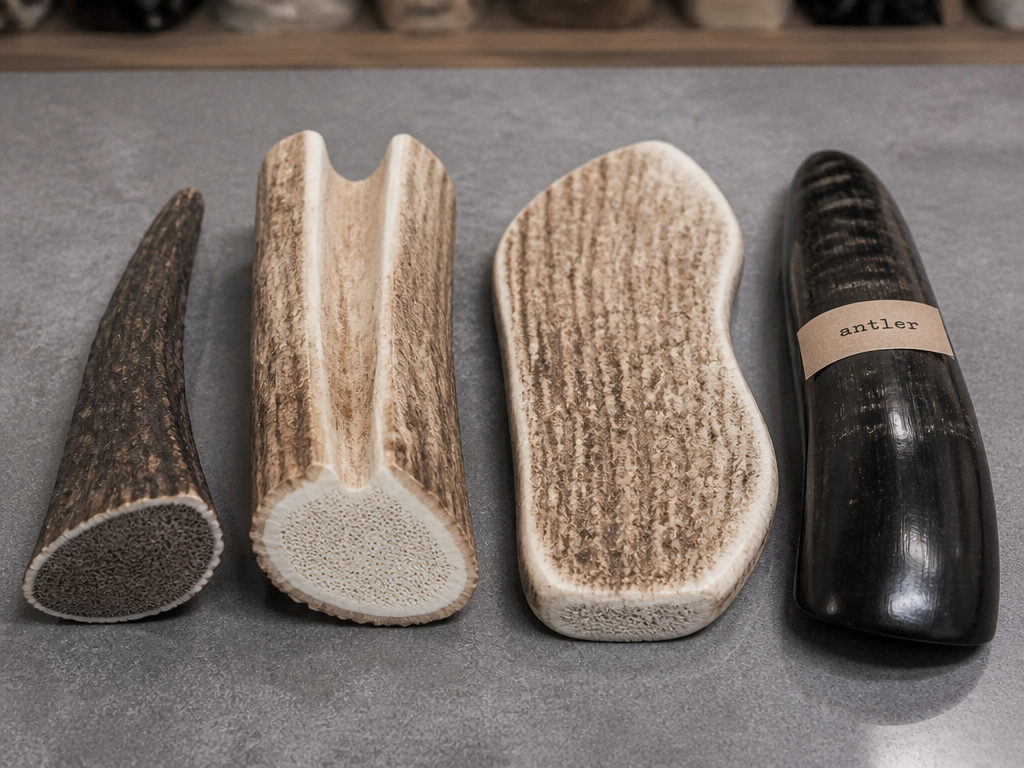
Four materials. One shelf label.
| Type | Hardness | What the sources say |
|---|---|---|
| Deer antler | Harder texture than other antlers | AKC notes deer runs harder; no species-specific fracture data published |
| Elk antler | Density varies by antler section | Often sold split, which exposes softer inner bone |
| Moose antler | Softer than other antlers | Sold in slices and shapes; Whole Dog Journal defends cut splits |
| Water buffalo horn | A different material entirely | Marketed as “antler”; it is horn, not antler |
The AKC expert advice on antlers is the clearest source on this split. Deer antlers carry a harder texture than other varieties. Elk antlers vary in density depending on which part of the antler was cut. Moose antlers are softer and are sold in slices and shapes.
Then there is water buffalo horn, which some sellers label as antler. It is a different material with different properties, and a buyer reading a shelf tag would never know.
Whole Dog Journal makes the strongest case for one specific format: moose antler splits cut to 8 to 12 inches long and 1.5 to 2 inches in diameter, split lengthwise with the points removed. That publication reports these do not break or splinter. The AKC’s general warning about antlers breaking or splintering cuts against extending that claim to every antler on the shelf.
Antlers for Dogs Pros and Cons: Where the Experts Split
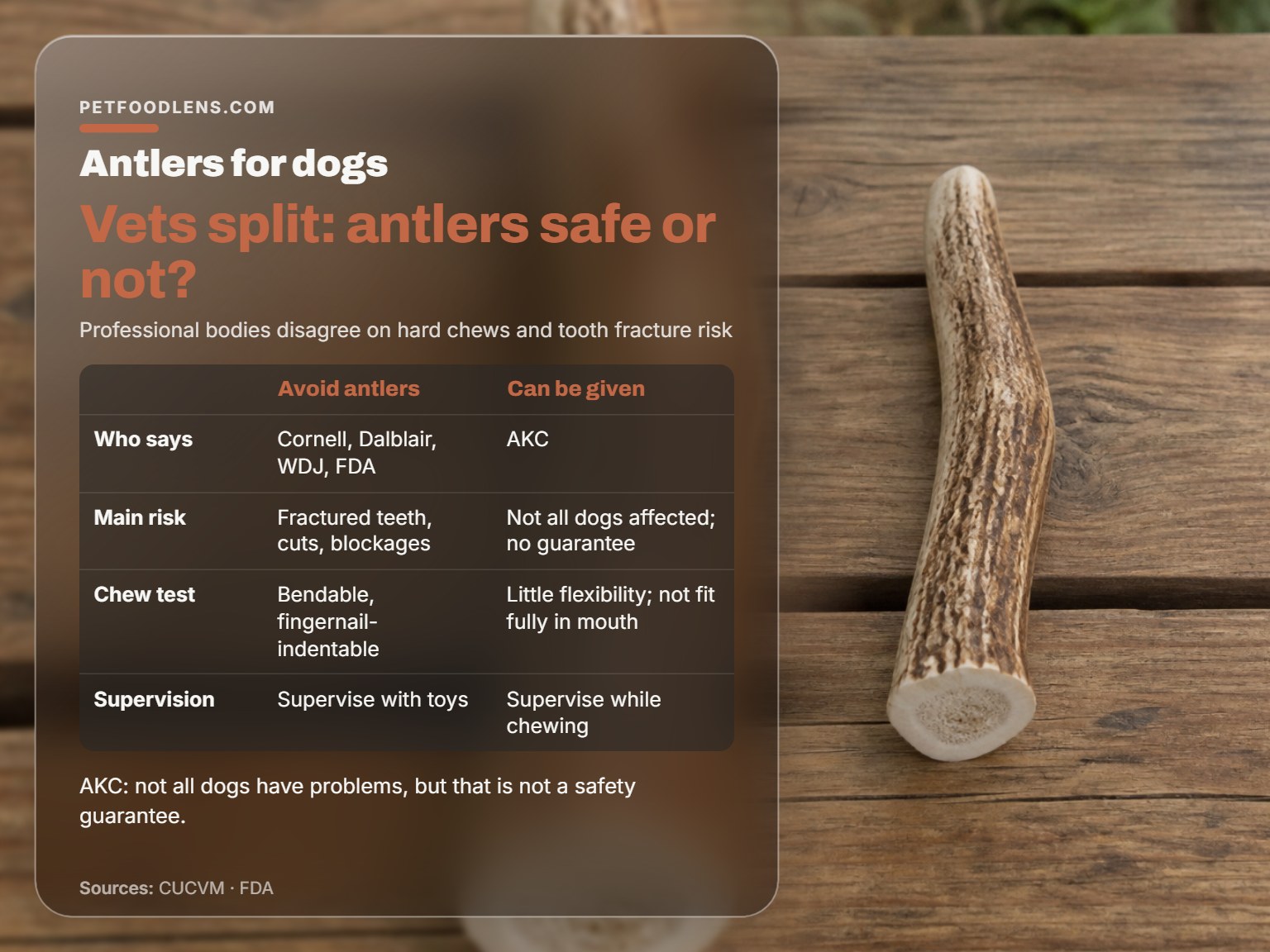
The disagreement here is not a matter of emphasis. It is a genuine conflict between professional bodies, and pretending otherwise would be dishonest.
| Position | Who holds it |
|---|---|
| Avoid bones, antlers, and hooves of any kind, plus any hard or abrasive object | Cornell University College of Veterinary Medicine (Collins) |
| Antlers, bull horns, and very hard nylon bones are not safe, and all result in fractured teeth | Dalblair Vets |
| No veterinary dental specialist would sign off on antlers | Whole Dog Journal |
| Items with a degree of “give” beat antlers, bones, hooves, yak milk chews, and nylon bones | Lewis, VMD, DAVDC |
| Antlers can be given if supervised and sized correctly; not all dogs have problems | AKC |
| Warns against bones and antler-type chews for cuts in the mouth and fractured teeth | FDA, relayed by the Cornell veterinarian FDA bone treat warning |
They do not agree, and I cannot reconcile these positions for you. What I can do is point at the one line that gets misread.
The AKC’s concession is that not all dogs will have problems, and some owners give antlers for years without problems. That is a statement about observed outcomes. It is not a safety guarantee, and the AKC says so directly in the same paragraph.
Cornell advises that suitable chew items should be bendable and able to be indented with a fingernail, while the AKC advises choosing chew toys with little flexibility. An antler fails that test by definition.
Does the Thumbnail Test Actually Work?
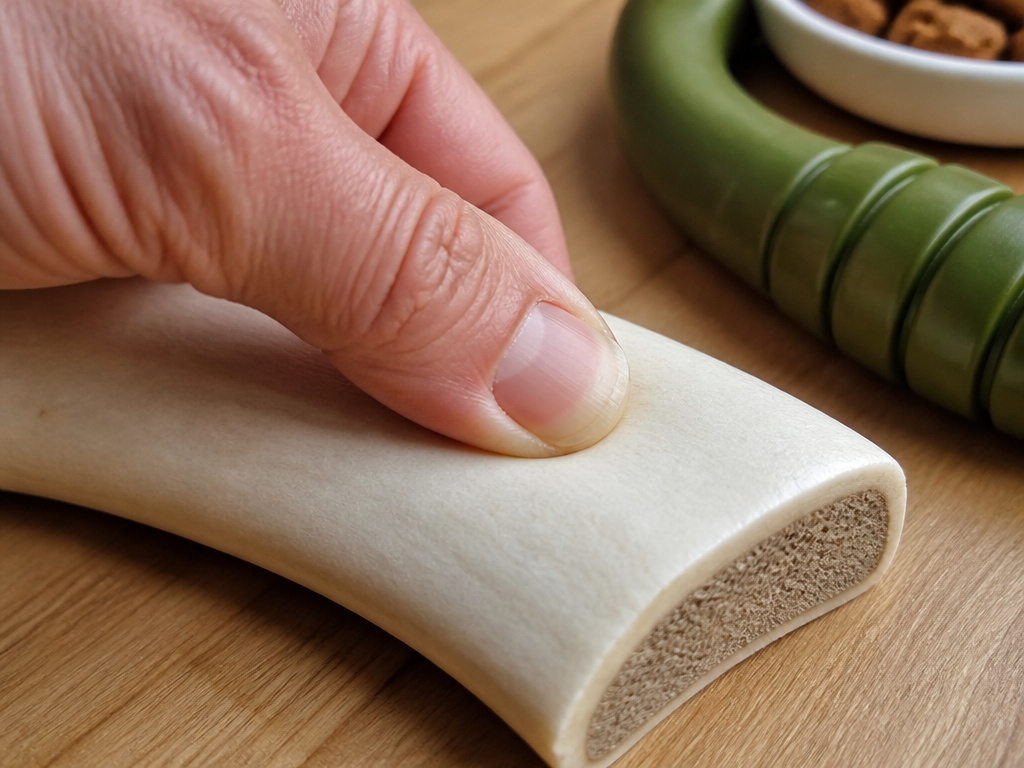
Norman Johnston, a specialist in veterinary dentistry, gave the test its clearest wording. His advice is not to give a dog anything to chew that you cannot dent with a thumbnail, or that would not bend or break in the mouth on contact with teeth.
Cornell’s guidance lines up with it: bendable, and able to be indented with a fingernail. Dr. Lori Teller at Texas A&M applies the same test to nylon toys, advising owners to indent them with a thumbnail and skip the extremely hard options.
Norman Johnston and Cornell advise that if you cannot dent it with a thumbnail, or it will not bend or break against teeth, it does not go in the dog’s mouth, while the AKC advises choosing chew toys with little flexibility. That single rule covers antlers, nylon bones, hooves, and every other “durable” chew in the same sentence.
Now the honest limit. No source ties the thumbnail test to the 1,281 N fracture figure. Nobody has published a calibrated force value for “dents under a thumbnail.” The test is a screen that sorts soft from hard, and it will not tell you whether a specific antler is safe for a specific dog.
It is a screen. Use it as one.
If You Give an Antler Anyway, Five Rules
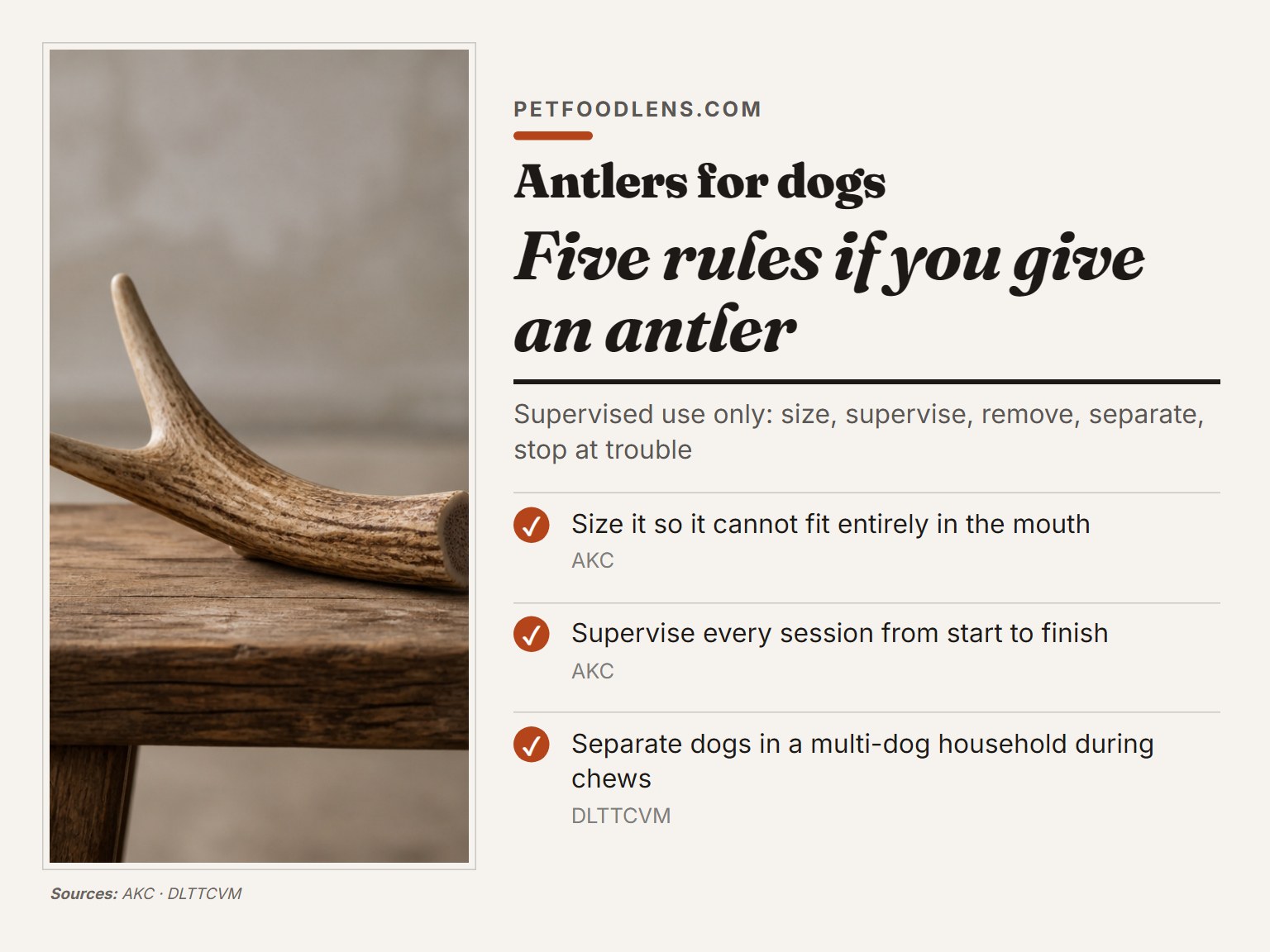
So what does supervised use actually look like in practice? It looks like five rules, and skipping any one of them is how the dental appointment happens.
Before you start: An antler piece that splinters can lodge in the mouth, throat, or intestine, and the AKC notes blockages of this kind can require emergency surgery. Unsupervised chewing is the highest-risk version, because you may not see the piece go down. Keep the chew too large to fit fully in the mouth, and take it away once it wears down.
- Size it so it cannot fit entirely in the mouth. A chew small enough to swallow whole is a choking and obstruction risk, and the AKC advises picking toys that don’t fit all the way into the dog’s mouth.
- Supervise every session from start to finish. A dog left alone can swallow a piece without you knowing until symptoms appear, which is how a dental problem turns into an emergency surgery.
- Remove it once it wears down. The guidance is to replace an antler when it gets small enough to swallow, and a worn antler reaches that size faster than most owners expect.
- Separate dogs in a multi-dog household. Teller advises separating dogs during chews in multi-dog households to eliminate competition or the urge to gulp a treat.
- Stop at the first sign of trouble. Excessive drooling after chewing an antler points at a problem that needs a veterinary look.
Supervision is the floor. It is not a fix for hardness.
Which Chews Do Veterinarians Reach For Instead?
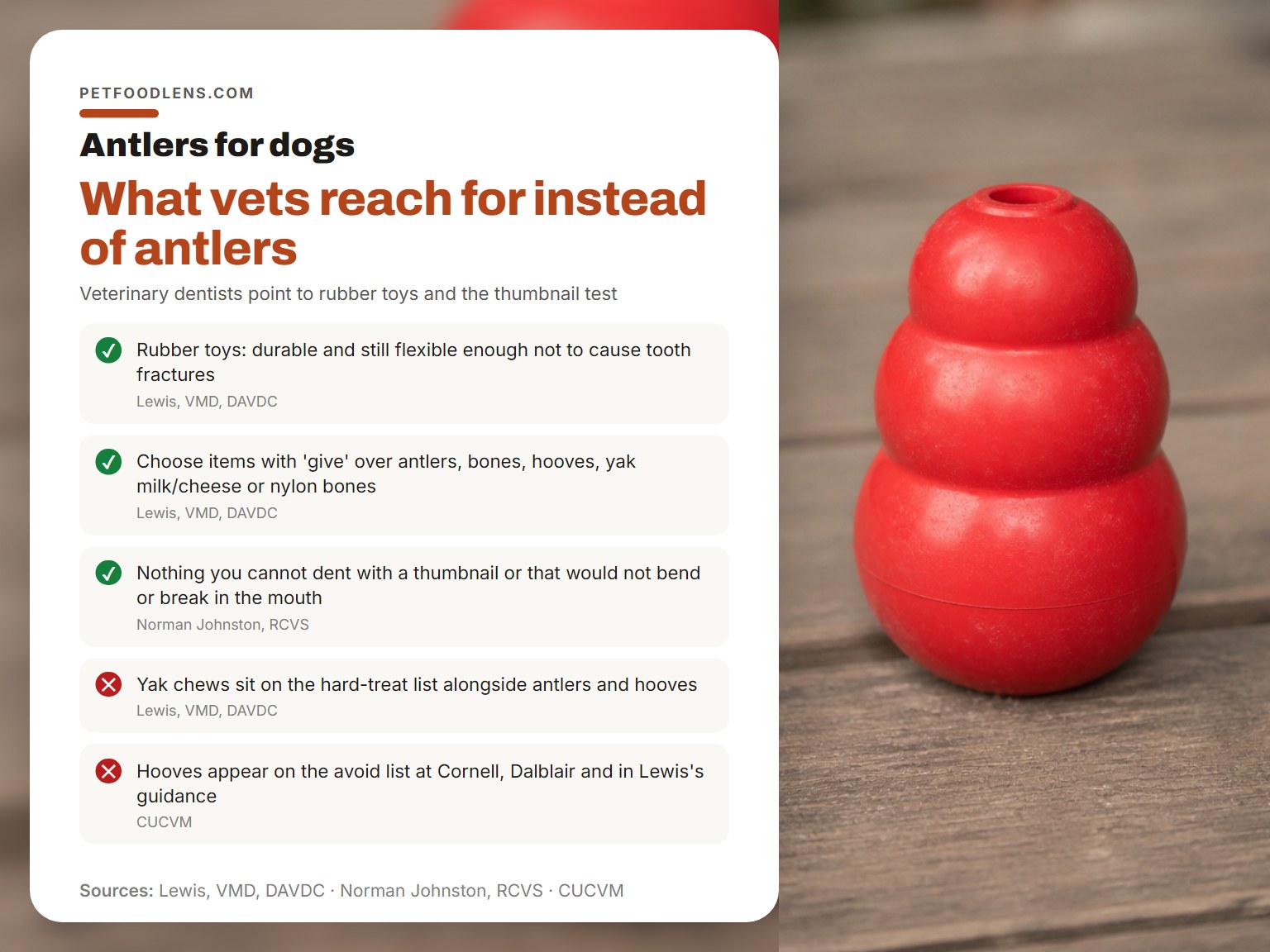
Rubber first. Lewis notes that rubber toys can be durable and still flexible enough not to cause tooth fractures.
That points at rubber toys rather than bone: rubber toys can be durable and still flexible enough not to cause tooth fractures.
The rest of the chew aisle carries its own trade-offs, and the hardness question follows you down it:
- Bully sticks are softer than antler but digest differently, and they get swallowed in pieces as they soften.
- Yak chews sit on Lewis’s hard-treat list alongside antlers and hooves, so the same test applies before you buy.
- No-hide chews trade the rawhide process for a different material, which changes the obstruction risk rather than removing it.
- Collagen chews soften as they are worked, which is the property antler lacks entirely.
- Pig ears are a dental non-issue for most dogs, though
- Hooves appear on the avoid list at Cornell, Dalblair, and in Lewis’s guidance, so they are not an upgrade.
- Chew treats in general should clear the thumbnail test before they clear the shopping cart.
I’d start with rubber and work outward from there. It is the one category where durability and flexibility coexist, and it is the category the veterinary dentists keep pointing at.
Frequently Asked Questions
Are antlers bad for every dog?
No, and the AKC says so directly: not all dogs will have problems, and some owners use antlers for years without problems. That is not the same as safe. The risk concentrates in power chewers and dogs with existing dental disease, and the study found no statistically significant correlation between dog weight and the load at fracture.
Which antler type is softest?
Moose antler is softer than deer or elk, according to the AKC, and it is often sold in slices and shapes. Elk density varies depending on which section of the antler was cut. Deer antler carries a harder texture than the other varieties.
How long should a dog chew on an antler?
Supervise every session and remove the antler once it wears down to a size the dog could swallow. The practical marker is condition, not minutes: pull the antler once it wears down to a size the dog could swallow.
What are the first signs of a broken tooth?
Watch for eating less, chewing on one side, pawing at the face, rubbing the muzzle on furniture, or dropping food. Dalblair’s point is worth repeating: a dog not showing pain is not the same as a dog without pain.
Do antlers clean a dog’s teeth?
The claim does not hold up. Dalblair states that assertions about bones and similar chews “naturally clean teeth” have no foundation in fact and exist to sell product. The AKC notes that chewing does reduce plaque and tartar, but places antlers among the common causes of broken teeth, which is a poor trade.
Is a split antler safer than a whole one?
Split antlers are cut lengthwise, which exposes the softer inner bone, and Whole Dog Journal reports that properly cut moose splits of 8 to 12 inches do not break or splinter. The AKC’s general warning about antlers splintering still applies to antlers generally, so the split format reduces one risk without eliminating the hardness problem.
The Bottom Line
Here is the trigger I would give you. If your dog is a power chewer, has a cracked tooth, or has had an extraction before, skip antlers entirely and do not spend time weighing the species question. The study found no statistically significant correlation between dog weight and the load at fracture, so a big dog is not safer for being big.
If your dog is a light, careful chewer and you still want to try it, buy one antler, size it too large to swallow, and watch the whole session. Then run your thumbnail into it. If it does not dent, you have your answer and you did not need a study to get it.
One concession worth stating plainly: this is a dental question, and I read ingredient panels for a living. Cornell, Dalblair, and the board-certified dentists are the ones with the clinical standing here, and their positions range from caution to outright refusal. Where they disagree, I have shown you who says what so you can weigh it yourself.
The one thing they all agree on is the thumbnail. Read the label, not the packaging, and then put your thumb in the chew.
