
How to Choose a Cat Bowl for Whisker Fatigue: 4 Checks
This post contains affiliate links. As an Amazon Associate, we earn from qualifying purchases.
To choose a cat bowl for whisker fatigue, check two measurements first: depth and diameter. A bowl that clears the whiskers is shallow and wide, and the 2020 trial that tested this enrolled 40 cats but found no measurable change in how much they ate.
The two measurements are easy to take with a ruler. What is harder is the evidence underneath them: one peer-reviewed trial found no change in eating behaviour, a veterinary editorial calls whisker fatigue very real, and a review site calls the research inconclusive. That split turns this into a buying decision rather than a medical one, which is why how to choose a cat bowl for whisker fatigue comes down to your own judgment.
What follows is four checks in order, the two bowls the research actually used, and the one place where a wide bowl makes more mess than the deep bowl it replaced.
Key Takeaways
- Measure depth and diameter before anything else. The two dishes in the 2020 trial were 3.5 cm and 1 cm deep, and all 38 owners’ normal bowls were narrower and deeper than both.
- Owner reports and measured behaviour disagree. 24 of 38 owners said their cat preferred the whisker-friendly dish, while 18 of 38 cats ate the same amount from either bowl.
- Grade 304 or 18/8 stainless is the default material, unless your cat has chin acne, in which case ceramic is the better pick.
- Skip plastic entirely. It scratches, it holds a film, and both veterinary and review sources link it to chin acne.
- A wide bowl spills more, not less. The trial recorded an average of 14.3 kibble dropped from the whisker-friendly dish against 1 kibble from the normal dish.
Does Whisker Fatigue Actually Change How a Cat Eats?
Forty indoor cats were enrolled in the 2020 trial and 38 finished it. The protocol was simple enough that any owner could repeat it at home with a phone and a kitchen scale.
The 2020 trial fasted each cat for 12 hours, filmed a normal feeding for up to 5 minutes, then switched the cat to a whisker-friendly dish for a 7-day transition. Filming repeated, and the following day both dishes were offered side by side. Measured eating time, intake, and dropped kibble showed no significant difference between dishes.
The full write-up is in Evaluation of whisker stress in cats, and the protocol is worth reading before you spend anything on a bowl.
Owners reported something the cameras did not. Twenty-four of 38 said their cat preferred the whisker-friendly dish, 9 said the normal bowl, and 5 saw no preference. The authors put the estimated probability of preferring the new dish at 0.74, then warned that cats were never pre-tested for a left-or-right side bias.
That caveat matters more than it looks. A cat that always approaches from the left picks whichever bowl sits on the left, and the trial offered the two dishes in no specified position.
Intake barely moved either. Only 12 of 38 cats ate more from the new dish, and 18 of 38 cleaned the plate regardless of which bowl it came in.
So where does that leave the case for whisker fatigue in cats? Three sources read the same evidence three ways. Preventive Vet states plainly that whisker fatigue is very real and can change the bowl you feed from. The Spruce Pets calls the research inconclusive but still reviews a whole category of bowl built around it. The trial itself concluded that food dish-associated whisker stress did not affect the eating habits of the study cats.
Dr. Sikule, quoted by The Spruce Pets, lands in the middle. Whisker fatigue is not a disease or a symptom of one, but some cats may experience sensory overload from whiskers touching the sides of a bowl.
I am not a clinician and I will not pretend this settles a medical question. What it settles is the how to choose a cat bowl for whisker fatigue shopping question: a shallow wide bowl is a cheap thing to try, not a treatment you can buy.
The Two Measurements That Decide Whether Whiskers Clear
Picture a cat eating from a deep cereal bowl. The sides rise past the eyes, the whiskers fold back against the rim, and the kibble collects in a ring the tongue cannot reach.
Width and depth describe that problem completely, and neither number appears on most bowls you pick up in a shop.
The 2020 trial used two commercial dishes. The ThinkPet Shallow Wide Cat Dish measures 14 cm by 15 cm by 3.5 cm. The Jackson Galaxy Eclipse Stainless Steel Bowl measures 10 cm by 19 cm by 1 cm.
| Bowl | Footprint | Depth | Why it was chosen |
|---|---|---|---|
| ThinkPet Shallow Wide Cat Dish | 14 x 15 cm | 3.5 cm | Ceramic option, shallow and wide |
| Jackson Galaxy Eclipse Stainless Steel Bowl | 10 x 19 cm | 1 cm | Stainless option, near-flat profile |
| Owners’ normal bowls (all 38) | Not recorded | Not recorded | Narrower and deeper than both study dishes |
Every one of the 38 owners’ normal bowls was narrower and deeper than both study dishes. That is worth knowing before you decide your current bowl is fine: the trial never tested a bowl that was already shallow.
There is a how to choose a cat bowl for whisker fatigue catch, and it is a large one. Owners were given the new dish matched to the material of their existing bowl, ceramic for ceramic and stainless for stainless. Shape and material were never separated, so the trial cannot tell you whether cats responded to the width or to the surface.
The Spruce Pets gives the practical version of the rule anyway: pick a bowl shallow and wide enough that whiskers do not touch the sides and food does not fall off the edges. That is a description you can check with a ruler, which is more than most packaging offers.
A shortlist of shallow cat food dishes is faster than measuring every box in the aisle.
Which Bowl Material Holds Up Best?
Preventive Vet names grade 304 or 18/8 stainless steel as the best material for most cats, and that is the line I would start from.
The grade is the part worth reading. Preventive Vet recommends looking for 304 or 18/8 stainless steel.
| Material | Best for | Watch out for |
|---|---|---|
| Stainless steel (304 or 18/8) | Most cats, wet or dry food | Noisy on tile; reflections can spook a nervous cat |
| Ceramic | Cats with chin acne; heavy bowls that stay put | Scratches and chips hold bacteria |
| Plastic | Nothing I would recommend | Holds a film; linked to cat acne |
Stainless Steel: The Default, With Two Annoyances
Stainless is what Preventive Vet recommends in most cases, and the reasons are boring in the right way. It resists scratching, it does not hold a film, and it survives the dishwasher.
Two complaints come up. Stainless bowls are noisy when a cat pushes and tips them, and some cats get spooked by their own reflection in the metal. Both are real. Neither is a dealbreaker.
Ceramic: The Better Pick for a Cat With Chin Acne
Preventive Vet makes one clear exception to the stainless rule. If your cat has chin acne, reconsider metal and go ceramic instead. The reaction is uncommon but possible.
Small win, but a real one.
Plastic: The One to Skip
The Spruce Pets strongly recommends avoiding plastic bowls because they can lead to cat acne, and that matches what I see.
Scratches matter more than the material name on the box. Preventive Vet notes that scratches and imperfections create hiding places for bacteria and biofilms, which can lead to digestive upset, chin acne, or periodontal disease when the damage sits on the rim.
One hygiene note that gets skipped constantly: if a bowl is made from a material that may contain lead or other unwanted substances, running it through the dishwasher can contaminate your own dishes and utensils. Preventive Vet is explicit about that.
If you want the material question answered without the marketing, best material for cat dishes is the comparison I would read first, and it lands on the same two: food-grade stainless or glazed ceramic.
The 4 Checks for Choosing a Cat Bowl for Whisker Fatigue
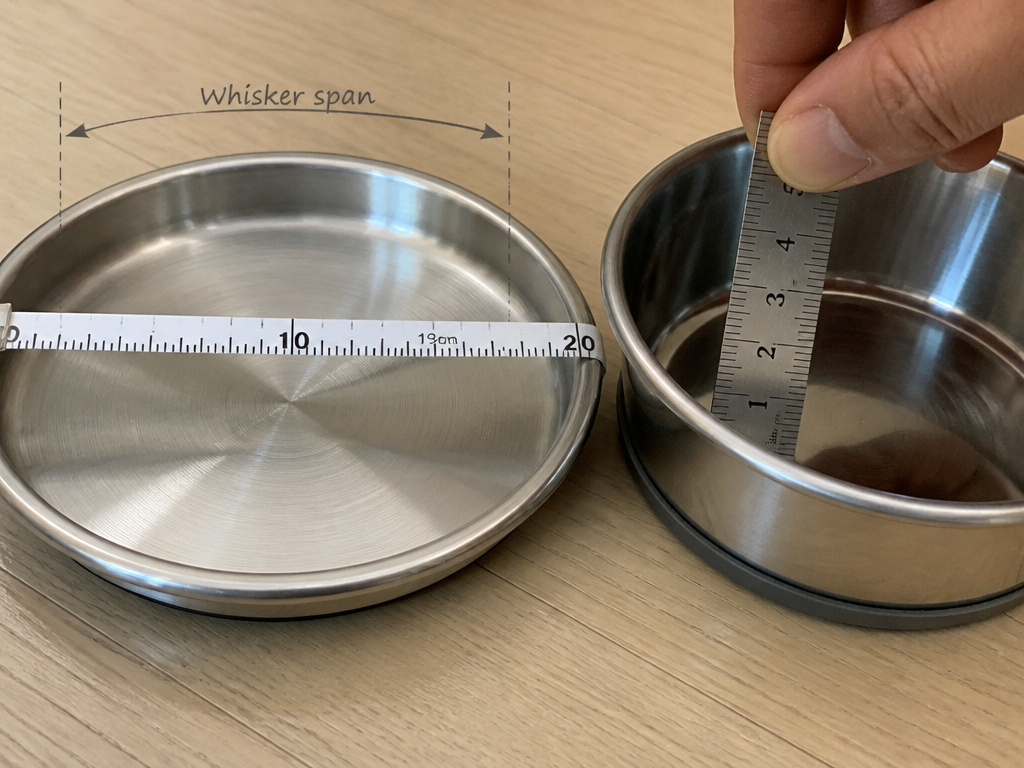
Four checks, in this order: depth, diameter, material, and where the bowl sits.
Before you start: Scratched bowls harbor bacteria and biofilm, so inspect the inside surface before you inspect the shape. Never run a bowl of unknown material through the dishwasher with your own plates. If you hand-wash, keep a dedicated sponge for pet bowls so you are not moving gunk between the sink and your dinner plates.
- Measure the depth. The two dishes in the trial were 3.5 cm and 1 cm deep, and both cleared the whiskers. A deep bowl forces the whiskers to fold against the rim on every bite, which is the exact contact the whole category exists to avoid.
- Measure the widest point at the rim. The study dishes were 14 to 19 cm across at their widest. A bowl narrower than your cat’s whisker span puts the sides back in contact, and you have bought a shallow bowl for nothing.
- Check the material and the grade. Look for 304 or 18/8 stainless, or glazed ceramic. Skip plastic.
- Check where it sits.
There are more types of cat bowls than those four checks suggest, including puzzle feeders and elevated stands, but none of them change the two measurements.
The Water Bowl Next to the Food Bowl Is a Habit
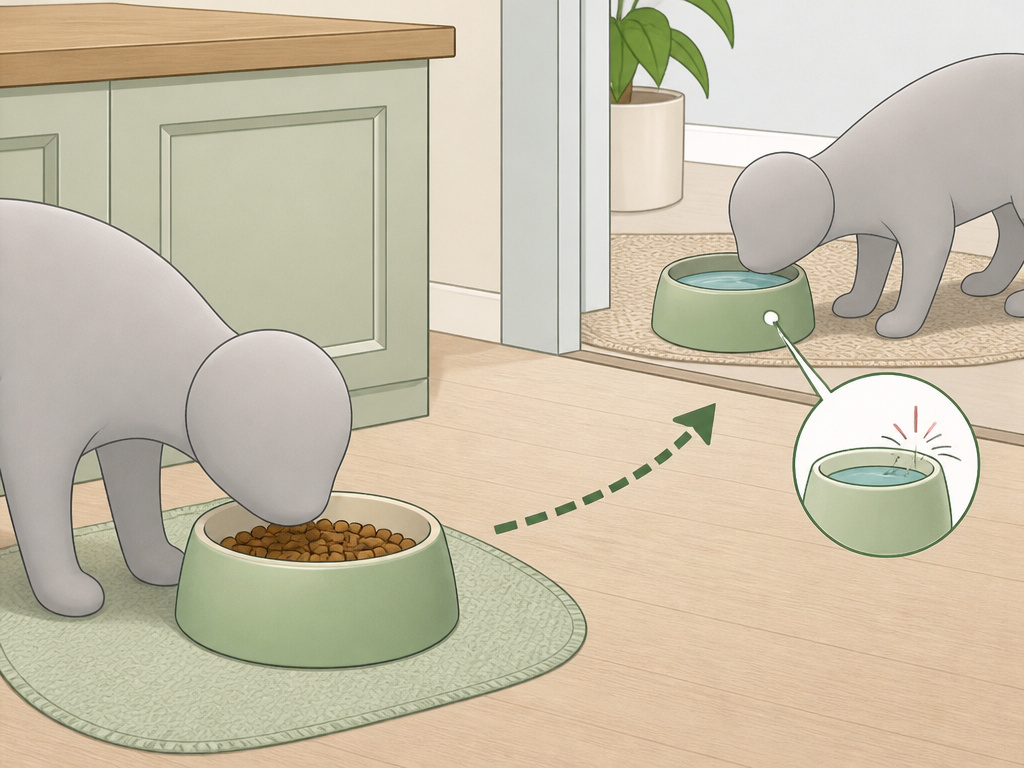
I moved a cat’s water bowl away from the food dish and changed nothing else. Drinking picked up.
No new fountain, no new food, no vet visit. The usual explanation is that cats in the wild avoid drinking near a kill, and I do not have a study to hand you on that. What I have is a change that costs nothing to try.
The setup I see most often is the water bowl parked directly beside the food dish. Moving it a few metres away, even into a different room, is free and sometimes works.
Preventive Vet recommends water fountains over bowls for water, on the reasonable grounds that running water gets some cats drinking. The Spruce Pets picks the Petlibro Capsule Water Fountain for water, and Preventive Vet names a PEGGY11 stainless steel set as a straightforward watering bowl.
Water: Bowl or Fountain?
Both sources land on the same side. Preventive Vet recommends fountains outright, and The Spruce Pets treats a shallow-dish fountain as its water pick while still listing a stainless bowl set as workable.
It does not replace a vet visit for a cat that has stopped drinking.
I would spend money on a fountain before I spent it on a whisker-shaped bowl. Water intake is the thing I actually worry about in a cat eating dry food, and bowl shape is a comfort question by comparison.
A raised stand solves a different problem than whisker clearance, so elevated cat bowls are worth considering for a senior cat with a stiff neck rather than a fussy one.
Whisker contact seems to bother some cats, and
Why a Wide Bowl Drops More Kibble Than a Deep One
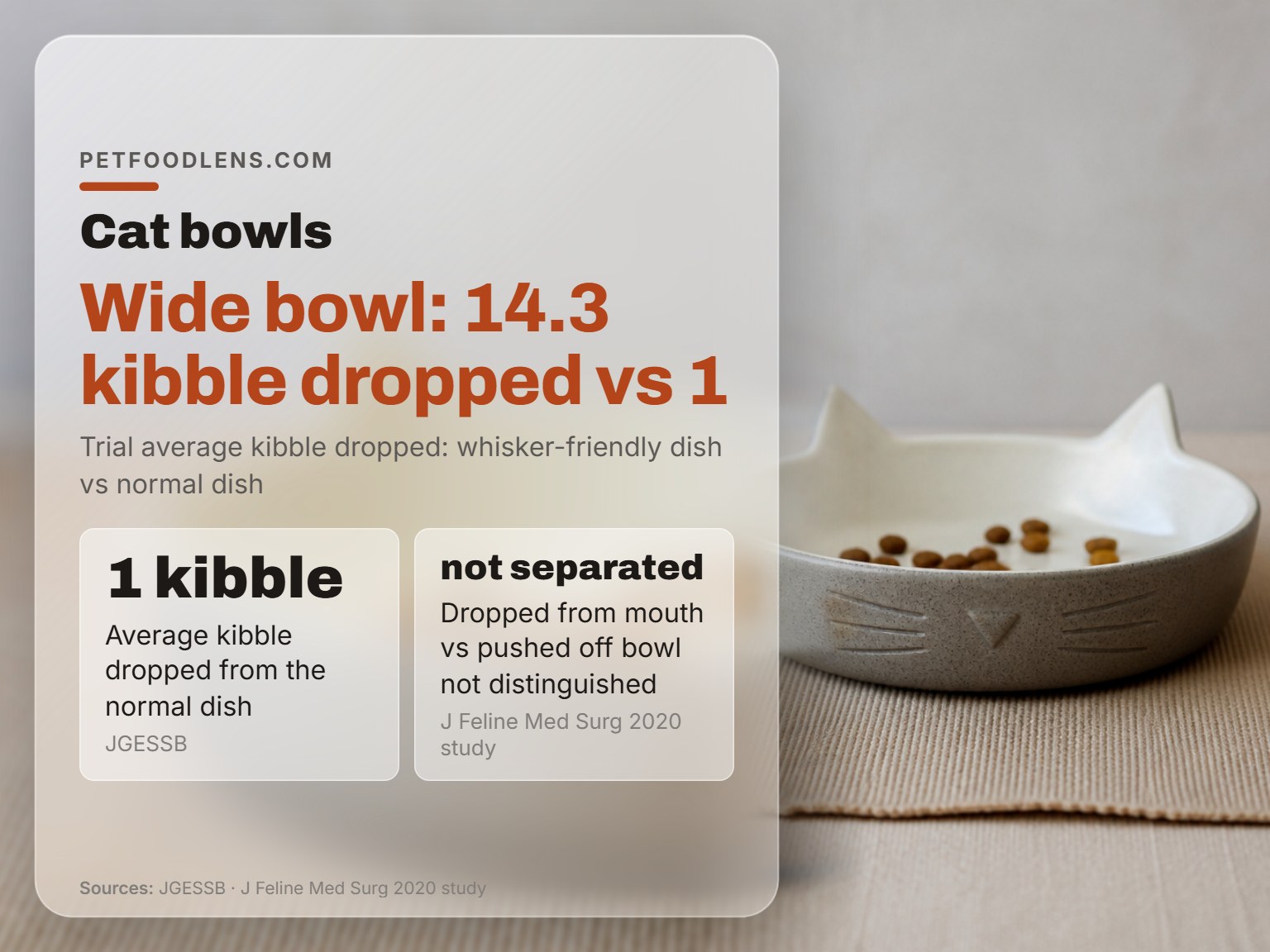
The trial recorded an average of 14.3 kibble dropped from the whisker-friendly dish and 1 kibble from the normal dish. That runs straight against the reason most people buy one.
The mechanism is simple. A shallow rim sits lower, so a cat pushing food toward the edge with the side of its tongue clears the lip far more easily.
The study authors flagged a limitation that matters here: they did not separate food dropped from the mouth from food pushed off the bowl. A shallow dish makes pushing easier, so the number may be measuring the bowl’s edge rather than the cat’s aim.
Preventive Vet reaches the same practical conclusion from another direction, noting that whisker-fatigue bowls have very low sides and that cats push food around, so things get messy.
A later peer-reviewed feed bowl design eating behavior study examined the same variable and did not reach the same answer, so treat neither result as the final word.
Most whisker-friendly dishes are shallow enough that a determined cat can push a kibble over the rim, so plan for it:
- Put a mat under the bowl. A mat catches what goes over the edge and saves the floor.
- Feed smaller amounts more often. Less food in the bowl means less food to push around, and it fits a measured-meal routine.
- Keep the bowl off carpet.
Buy the mat.
What to Do If Your Cat Already Avoids the Bowl
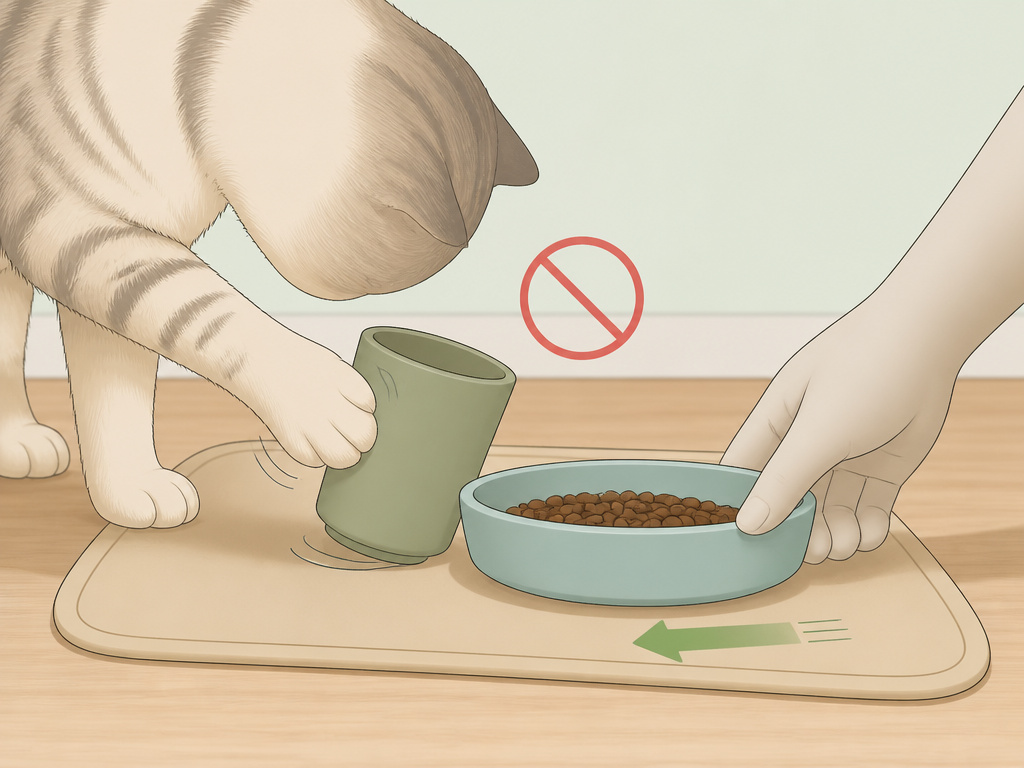
A cat that leaves food in the bowl is giving you information. The question is whether that information is about the bowl or about the cat.
The Spruce Pets lists three signs worth writing down:
- Agitation at feeding time. Pacing, chirping, or batting the bowl before any food is touched.
- Pawing at the bowl.
- Avoiding the bowl entirely.
Dr. Sikule’s advice, via The Spruce Pets, is to try a whisker-friendly bowl if you notice your cat avoiding some bowls, and to consult a vet about any change in eating or drinking to rule out an underlying health issue. That order matters.
She also makes an observation I find more useful than the bowl marketing: feral cats squat and eat from flat surfaces, so a pet cat may simply prefer a flat surface to a deep bowl.
Skip this if: your cat is losing weight or has stopped eating entirely. Weight loss is a vet problem, not a shopping problem.
The Raised Bowl Option
One product worth naming is the Necoichi raised cat food bowl. It measures 6.1 by 5.7 inches across and 5.3 inches tall, with a 15-degree tilt aimed at reducing whisker fatigue and neck strain in larger or senior cats. It is porcelain, FDA-approved, dishwasher-safe, and microwaveable.
The Spruce Pets did not test it and says so, citing more than 7,700 five-star Amazon ratings instead. That is a popularity signal, not a test result, and I would treat it as one.
Preventive Vet names the Felli Pet Oblik as a bowl option for cats with whisker fatigue, and it is an elevated design as well.
If you want a starting shortlist rather than a single pick, whisker-friendly bowls is where I would begin, and the Necoichi is the one I would check first for a senior cat.
Frequently Asked Questions
Does whisker fatigue actually exist?
The evidence is genuinely split, and you should know that before you spend anything. The 2020 trial concluded that food dish-associated whisker stress did not affect the eating habits of the study cats. Preventive Vet calls whisker fatigue very real, and The Spruce Pets calls the research inconclusive while noting that some cats may get sensory overload from whiskers touching a bowl.
How deep should a whisker-friendly cat bowl be?
The two dishes used in the 2020 trial were 3.5 cm and 1 cm deep. Both were shallower and wider than every owner’s normal bowl in the study. Use those as your reference points rather than a single number, and measure the bowl you already own before buying a replacement.
Is stainless steel or ceramic better for a cat bowl?
Preventive Vet recommends grade 304 or 18/8 stainless steel for most cats. It makes one exception: if your cat has chin acne, a ceramic bowl is preferable because a metal bowl may cause a reaction. Both sources agree that plastic is the material to avoid.
Do wide bowls really stop a cat dropping food?
The 2020 trial found the opposite. Cats dropped an average of 14.3 kibble from the whisker-friendly dish against 1 kibble from their normal dish. The authors noted they could not separate food dropped from the mouth from food pushed off the bowl, which is a real limitation on that number.
Should I move my cat’s water bowl away from the food?
It costs nothing to try. The common setup is water parked right beside the food dish, and moving it a few metres away, even to another room, sometimes changes drinking behaviour. Preventive Vet also recommends water fountains over bowls for cats.
When should I see a vet instead of changing bowls?
Any change in eating or drinking habits is worth a vet visit, per Dr. Sikule via The Spruce Pets. A cat that avoids a full bowl, loses weight, or stops eating entirely needs a clinical answer. Bowl shape is a comfort question and cannot rule out an underlying health issue.
The Bottom Line
Here is the cheapest version of this decision. Put a ruler against your current bowl. If the rim rises past your cat’s whiskers when the head is down, and the bowl is narrower than the whisker span, buy one shallow dish and one non-toxic mat and change nothing else.
If drinking is your actual worry, skip the bowl purchase for now and move the water bowl to another room first. That is the change I have seen work fastest, and it costs nothing.
None of this fixes a medical problem. A cat that stops eating needs a vet, and no bowl shape substitutes for that.
Read the label on the bowl the way you read the label on the food. The front of the packaging is a mood. The measurements and the material grade are the evidence.
