
Whisker Fatigue in Cats Explained: What the Evidence Shows
This post contains affiliate links. As an Amazon Associate, we earn from qualifying purchases.
Whisker fatigue in cats, explained plainly, is the theory that a bowl’s sides overstimulate the whisker follicles and put a cat off its food. The only controlled trial on the question found no evidence it changed how much cats ate, how long they ate, or how much they dropped.
That trial is worth reading closely. It’s the only controlled one on the books, and its own authors are the people behind the whisker fatigue in cats explained caveat that the term whisker stress appears solely in commentary, perspective, and opinion literature. Which means the thing you’re worried about has a paper trail made almost entirely of opinion pieces.
What follows walks through what the study measured, where the veterinary sources split on whether the condition exists at all, and how to size a dish when nobody will give you a straight answer.
Key Takeaways
- The only controlled trial found no effect on eating time, amount eaten, or food dropped.
- 24 of 38 owners (63%) said their cat preferred the wide dish, but the authors call that figure unreliable.
- Rule out dental disease, kidney disease, and GI illness first. No bowl fixes any of them.
- Never trim a cat’s whiskers. Regrowth to functional length runs 6 weeks to 3 months (PetMD) or 2 to 3 months for a shed whisker to be replaced (Zoetis).
- A wide, shallow dish costs little to try and does no harm if the cat ignores it, though the 2020 trial found no measured benefit while Zoetis and PetMD suggest shallower dishes may help sensitive cats.
Whisker Fatigue in Cats Explained: What the Term Actually Means
The term whisker stress shows up solely in commentary, perspective, and personal-opinion literature. That line comes from the 2020 study’s own literature review, not from a skeptic’s blog.
Whiskers are tapered keratin rods seated in a follicle-sinus complex, a heavily innervated and vascularized structure. Contact between a whisker and an object fires mechanoreceptors in that follicle. For a given object distance, a tapered whisker deflects about 50 percent less than an untapered one, which sharpens distance discrimination.
The physical shaft has no nerve endings. Zoetis Petcare puts the sensitivity in the follicle, which is packed with receptors and attached to a small muscle the cat uses to move the whisker, a detail worth pairing with any whisker fatigue in cats explained.
How many receptors? PetMD cites 100 to 200 neurons per follicle. That’s a lot of signal coming off a structure that spends mealtimes pressed against ceramic.
Where the Term Came From
Cats.com traces the mainstream version of this idea to a New York Times article in 2017.
The underlying biology is documented in a tapered whisker function analysis, which is a genuine peer-reviewed mechanics paper. What it measures is deflection, not wear.
What the Anatomy Does and Doesn’t Support
Contact firing is documented. Wear from repeated contact has never been measured.
That gap is the whole argument. A cat’s whiskers sit roughly as wide as its body, which is how it judges whether a gap will fit. Pressing them flat against a bowl wall at mealtimes is a different kind of load than brushing past a doorway.
What Did the 2020 Whisker Stress Study Actually Find?
Forty cats enrolled. Thirty-eight finished, and the two dropouts were cats whose owners couldn’t film them eating.
The design was a crossover. Owners fasted each cat for 12 hours, filmed one meal on the cat’s normal dish for up to 5 minutes, then switched to a whisker-friendly dish for a 7-day transition and repeated the filming.
Results came back flat. Time spent eating, P = 0.8. Amount of food dropped, P = 0.9. Amount eaten, P = 0.7.
Then the odd bit. The estimated probability of a cat preferring the whisker-friendly dish was 0.74, though the authors flag owner preference reports as unreliable.
The study ran at Washington State University under IACUC approval ASAF # 05073-001. Cats were 1 to 12 years old, median 7.5. Fifteen were spayed females, 23 castrated males. Nineteen ate from ceramic, 19 from stainless steel.
The full write-up is open access as the whisker stress in cats study, and it’s published in the Journal of Feline Medicine and Surgery. The peer-reviewed feline whisker paper is where the P values live if you want to check my reading of them.
Where the Veterinary Sources Disagree
Zoetis Petcare calls the follicle overstimulable and says pressure on whiskers should be avoided. Cats.com says there’s no evidence whiskers can fatigue at all. Both are published, and neither is being coy about it.
| Source | Position on whether it exists |
|---|---|
| 2020 J Feline Med Surg trial | Term appears only in opinion literature; no measured effect on eating |
| Zoetis Petcare | Follicle can be overstimulated; avoid pressure on whiskers |
| PetMD (Wooten, reviewed by Hart) | Not a disease; existence still debated in the veterinary community |
| Cats.com | No evidence whiskers fatigue; most vets doubt the syndrome |
PetMD carries both positions on its own site, on different pages. One calls overstimulation a real issue driven by chronic recurrent pressure. The other says the existence is still debated and that it isn’t a disease.
Read those side by side and you get a spectrum of confidence rather than a flat contradiction.
I don’t treat this as a diagnosis. I treat it as a cheap experiment. If a cat eats cleanly from a wide dish and picks at a narrow one, the bowl may be worth changing whether or not the syndrome ever gets a name.
There’s a longer walkthrough on how to choose a cat bowl if you want the sizing logic without the philosophy.
Does a Whisker-Friendly Bowl Change Anything?
A wider, shallower dish is cheap to try and does no harm. What it won’t do is change a cat’s intake, at least not in a way the trial could measure.
The Drop-Food Result Nobody Quotes
Cats dropped 14.3 +/- 26.6 kibbles from the whisker-friendly dish versus 1 +/- 2.2 from their normal dish. The difference wasn’t significant at P = 0.9, but the direction runs against the marketing.
That’s the number I’d want on a bowl’s packaging. It won’t be there.
What Limits the Result
Three things blunt it. Eighteen of 38 cats ate their entire ration regardless of bowl, so intake couldn’t tell the dishes apart. The 12-hour fast may have overridden any negative whisker sensation, as the authors themselves note. And the 5-minute window may under-capture eating, since cats take several small meals a day.
The owners weren’t blinded either. There was no left/right control, and a new dish is a novelty.
When I test a change like this, I change one variable. I learned that the hard way years ago, when I switched a cat’s brand and its food format in the same week and then spent a month unable to tell which change caused the problem. Same rule here: new dish, same food, same portion.
If you want a shortlist, these shallow cat dishes cover the shapes that keep whiskers clear of the rim.
Where this goes sideways: Swapping the bowl and the food in the same week. If the cat improves you’ve learned nothing, and if it worsens you’ve got two suspects and no way to separate them.
The Bowl Dimensions That Actually Matter
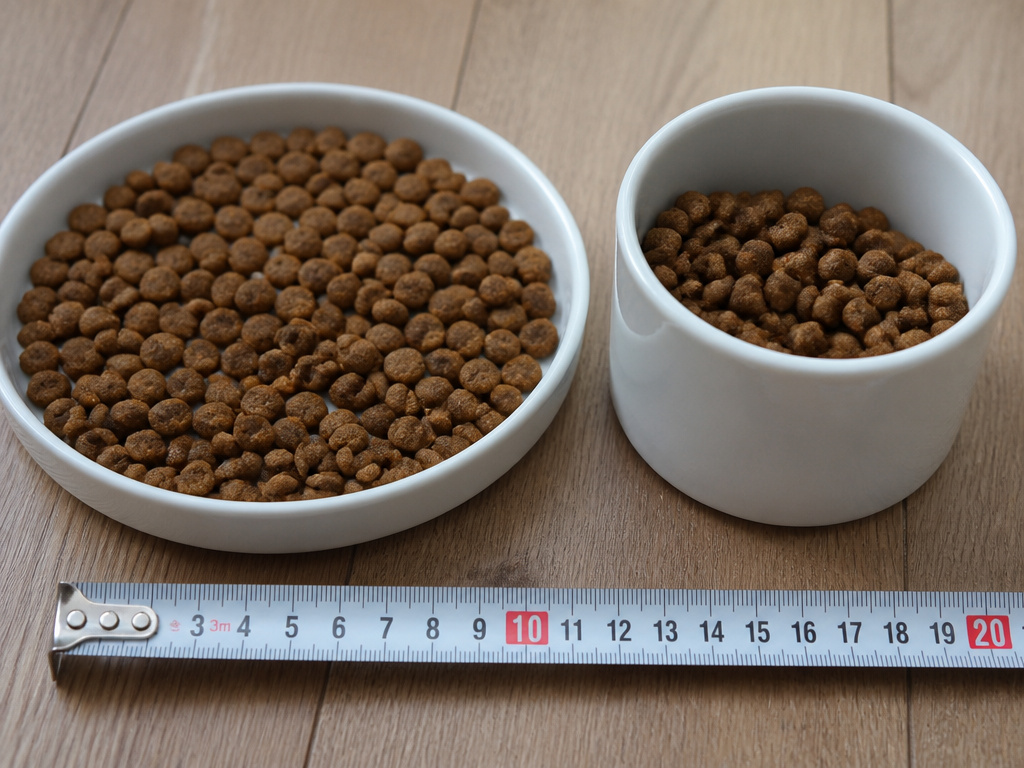
The two dishes in the trial measured 14 by 15 by 3.5 centimeters and 10 by 19 by 1 centimeter. Every one of the 38 cats’ normal dishes was narrower and deeper than both.
| Dish | Dimensions | Role in the trial |
|---|---|---|
| ThinkPet Shallow Wide Cat Dish | 14 x 15 x 3.5 cm | Given to cats that normally ate from ceramic |
| Jackson Galaxy Eclipse Stainless Steel Bowl | 10 x 19 x 1 cm | Given to cats that normally ate from stainless |
| Owners’ own dishes (all 38) | Narrower, deeper | The whisker-contact setup |
Depth is the number that matters most. A shallower dish leaves kibble more spread out. In a deep bowl the kibble piles against the far wall, and the cat ends up chasing it with its tongue while its whiskers drag the sides.
For a starting point, the ThinkPet Shallow Wide Cat Dish is the exact 14 x 15 x 3.5 cm dish the trial used. The Jackson Galaxy Eclipse Stainless Steel Bowl is the 1 cm option if your cat already eats from stainless and you’d rather not change material.
Material was split evenly in the study: 19 ceramic, 19 stainless. Heavy ceramic bowls don’t slide when a cat pushes off them. Stainless is the other common material. The types of cat bowls break down further by height and material if you’re starting from nothing.
Here’s how I’d run the test:
- Clear the vet first. Dental disease, oral tumors, kidney disease, and inflammatory bowel disease all produce the same messy eating. A bowl won’t touch any of them.
- Measure the current dish in centimeters, width and depth. All 38 normal dishes in the trial were narrower and deeper than both test dishes.
- Buy one wide, shallow dish. One. Changing several at once tells you nothing.
- Hold the food and the portion identical for the whole trial, or you’ve confounded the result before you start.
- Run the trial and write down what you see. Kibble on the floor, time at the bowl, how much is left in the dish.
When It Isn’t Whisker Fatigue at All
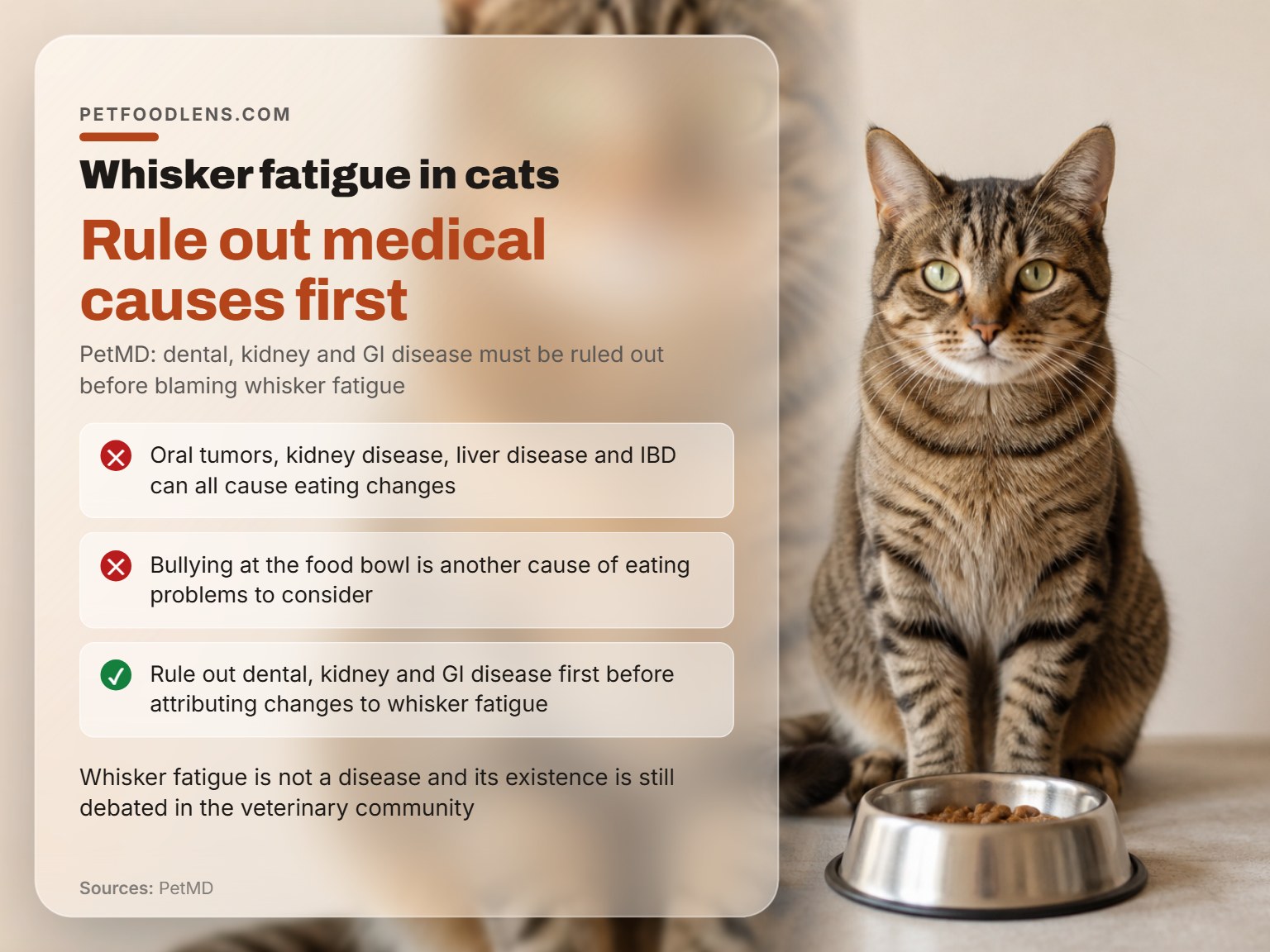
Many cats that quit a bowl have a medical problem. The bowl is a bystander.
PetMD lists the differentials, and they’re worth reading in full before you buy anything:
- Dental disease, which is common, painful, and looks exactly like fussy eating.
- Oral tumors.
- Kidney disease and liver disease.
- Inflammatory bowel disease.
- Another cat guarding the bowl. Bullying at the food bowl produces identical behavior, and no dish fixes it.
I’m not a clinician. When a cat stops eating, my first move is a vet visit.
Common mistake: Assuming a bowl change will fix a cat that’s losing weight. Weight loss plus a new dish is a vet appointment wearing a product problem’s clothes.
Once the vet clears the teeth and the kidneys, then look at cat food dishes and bowl height. Not before.
Should You Trim a Cat’s Whiskers?
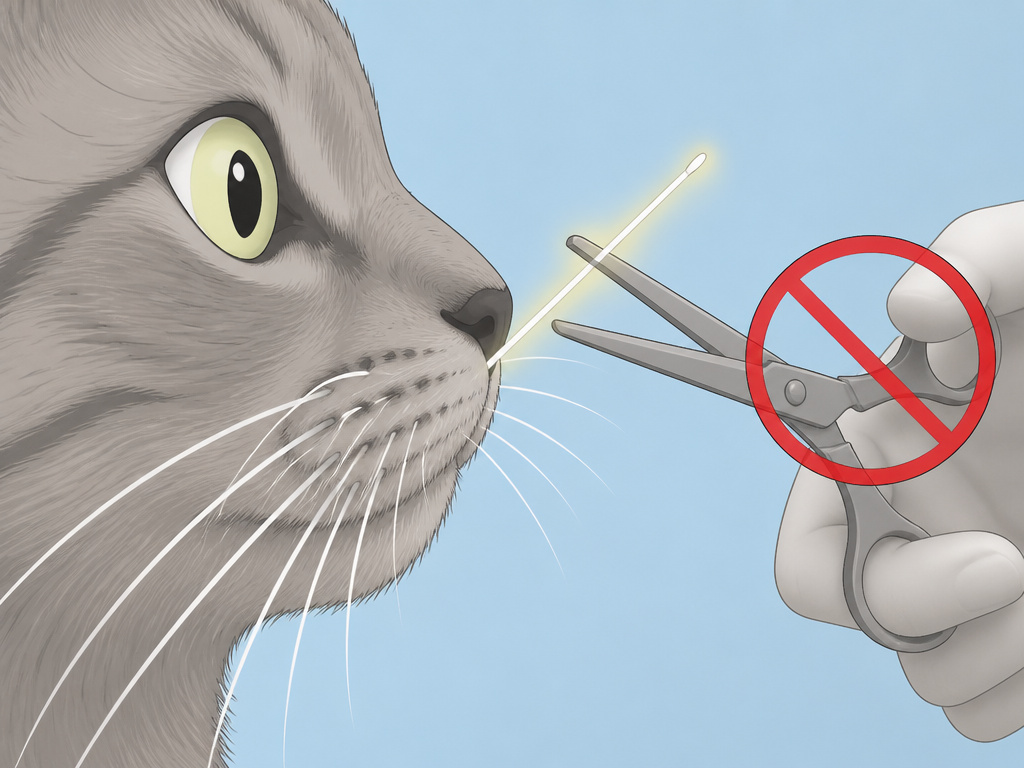
Mostly no. Dr. Neil Marrinan, DVM, of Old Lyme Veterinary Hospital in Connecticut, doesn’t hedge: “Trimming whiskers mutes their expression, dims their perceptions, and in general, discombobulates cats and annoys them.” Zoetis allows one exception: a veterinarian may direct trimming for a medical issue.
Zoetis allows one exception. A veterinarian may direct trimming for a medical issue. That’s the only reason either source recognizes.
Regrowth timelines differ slightly by source. PetMD says 6 weeks to 3 months for a facial whisker to reach functional length. Zoetis says 2 to 3 months for a new whisker to replace a shed one. Either way you’re looking at weeks.
Normal shedding runs 1 to 2 whiskers at a time. If you’re finding more than that, PetMD flags infection, mange, vasculitis, and chemotherapy as causes, and that’s a vet question.
Whiskers sit roughly as wide as a cat’s body, which is how it judges a gap. Cut them and you’ve taken away its close-range measuring stick for 6 weeks to 3 months.
Frequently Asked Questions
Is whisker fatigue a real medical condition?
Cats.com and the 2020 trial say no recognized condition exists, while Zoetis Petcare and PetMD (Why Do Cats Have Whiskers) call whisker fatigue a real issue caused by chronic pressure. Cats.com states plainly that it isn’t a recognized medical condition and has no specific diagnosis or treatment. PetMD notes the existence is still debated. The 2020 trial found no measured effect on eating.
Do wide bowls actually help cats?
Some cats appear to prefer them. 24 of 38 owners (63%) reported a preference for the whisker-friendly dish, but the authors flag that as unreliable because owners weren’t blinded and there was no left/right control. Measured intake, eating time, and food dropping showed no significant difference.
Can whiskers actually get tired?
There’s no evidence of fatigue in the shaft. The shaft has no nerve endings; the follicle is the sensitive part. Whether repeated follicle firing wears the system down has never been measured in a controlled setting.
What if my cat pulls food out of the bowl onto the floor?
Rule out dental disease first. PetMD lists dental disease, oral tumors, kidney disease, liver disease, and inflammatory bowel disease as causes of abnormal eating, plus bullying at the food bowl. If a vet clears all of that, a shallower dish is a reasonable next step.
How long does a cat’s whisker take to grow back?
PetMD puts it at 6 weeks to 3 months for functional length. Zoetis says 2 to 3 months for a new whisker to replace a shed one. Normal shedding runs 1 to 2 whiskers at a time, never more.
The Bottom Line
If your cat eats cleanly from whatever dish is in front of it, leave the dish alone. No study gives you a reason to change it, and the marketing around whisker-friendly bowls is running well ahead of the evidence.
The trigger for action is narrower than that. A cat that paws kibble onto the floor, eats in short bursts and walks away, or leaves a ring of crumbs around a deep bowl, and has been cleared by a vet for dental and kidney problems, is a cat worth testing on a wide shallow dish.
Here’s where I part company with the bowl aisle. I’d rather see you spend that money on a dental check than on a third dish. Dental disease is a common reason a cat quits its bowl, and nobody puts a picture of a molar on the packaging.
Whisker fatigue in cats, explained properly, is a theory with one null trial behind it and a lot of confident marketing in front of it. Try the dish. Just don’t expect it to be the fix.
