
How to Feed a Cat That Eats Too Fast: Step-by-Step
This post contains affiliate links. As an Amazon Associate, we earn from qualifying purchases.
To feed a cat that eats too fast, spread the portion across a 9- by 13-inch baking pan instead of a bowl, or use a maze-style slow feeder. Both force smaller bites with pauses between them. If the cat still gulps, weigh portions on a digital gram scale and split the daily allowance into several small meals.
The pan works because it breaks the gulp into a walk. One bite, a step, another bite. That pause gives the stomach time to stretch and send the fullness signal before the cat outruns it. This is how to feed a cat that eats too fast.
What follows is the order I’d try these fixes in, the places where the veterinary sources disagree with each other, and the signs that mean you should stop adjusting bowls and call your vet.
Key Takeaways
- Spread food on a 9- by 13-inch pan before you buy anything. It’s the cheapest fix, and PetMD gives it a specific published dimension.
- Weigh the portion in grams, not cups. The AAFP consensus statement flags cup measurement as demonstrably inaccurate.
- Puzzle feeders need a ramp-up: full fill, large holes, rolling with almost no effort at first.
- Automatic feeders split the sources. PetMD discourages units without portion control; AAFP calls them a helpful adjunct.
- Regurgitation is not vomiting. Undigested food with no abdominal heaving points at eating speed, not stomach upset.
Why Fast Eating Causes Regurgitation, Not Vomiting
The mess on the floor is usually undigested food. Vomit looks and smells different, and the difference decides what you do about it.
Dry kibble absorbs water in the stomach and swells. When a cat eats quickly, the swollen mass exceeds stomach capacity and triggers the regurgitation reflex, sending undigested food back up the esophagus. This differs from vomiting, which expels partially digested stomach contents after repeated abdominal contractions and visible signs of nausea.
| Feature | Regurgitation | Vomiting |
|---|---|---|
| What comes up | Undigested food, often tube-shaped | Partially digested, sour-smelling |
| Warning signs | None; it just appears | Lip licking, drooling, retching |
| Body movement | Passive, no heaving | Repeated abdominal contractions |
| Typical trigger | Eating too fast | Stomach upset or illness |
If you can’t hear or see the cat chewing, they are likely eating too fast.
If the pattern looks more like the right-hand column, work through vomiting after eating before you touch the feeding setup. Different problem, different fix.
There’s a second cost beyond the cleanup. The stomach needs time to stretch and signal the brain that it’s full, and appetite hormones need time to act. A cat that eats fast can eat more than needed before the body registers fullness.
Dr. Laura Greene, a veterinary internal medicine specialist at Merck Animal Health, told Rover that fast eating more often traces to a medical or behavioral factor than to plain enthusiasm. PetMD frames it as a mechanical cycle: kibble swells, stomach overfills, reflex fires. Both can be true at once, and which one you’re looking at changes what you should try first.
The 9- by 13-Inch Baking Pan: Start Here
Nine by thirteen inches is the dimension PetMD gives for the baking-pan method. PetMD, written by Sandra C. Mitchell, DVM, DABVP, calls the pan spread the first and often simplest option.
Swap the bowl for a rimmed pan, scatter the portion across it, and leave real gaps between pieces. The cat has to take a bite, walk to the next one, and take another.
Before you start: Rover notes that cats can choke when eating too quickly, so change the setup on a day you’re home. Use a pan with a raised lip so kibble doesn’t skate onto the floor, and set it on a towel so the pan doesn’t slide when the cat pushes at it.
- Swap the bowl for a 9- by 13-inch rimmed pan. A flat sheet with no lip lets kibble slide off the edge, and you’ll be sweeping instead of feeding.
- Scatter the portion in a single layer with visible gaps. Piling it defeats the point, because the cat needs distance between bites.
- Add a second layer of obstacles if the cat still inhales it. PetMD specifies tennis balls at this stage.
- Watch the next few meals. If nothing has changed, move to a maze bowl rather than adding more obstacles.
Portion size stays exactly the same on a pan. Only the eating time changes, which is the entire mechanism.
Here’s where the two best sources part company. PetMD puts the pan first. The 2024 AAFP consensus statement on feline feeding programs doesn’t mention the pan at all and treats puzzle feeders and foraging as the primary program. Neither is wrong. The pan is faster to try and costs nothing; the puzzle program has the peer-reviewed weight behind it.
Slow Feeder Bowls, Maze Feeders, and Lick Mats Compared
Maze bowls and lick mats slow a cat in two different ways, and only one of them works on dry kibble.
A maze bowl has ridges, grooves, or channels molded into it. The cat has to nose the kibble out of the channels instead of scooping it. The University of Illinois slow feeder resource describes the design as built-in ridges or patterns that force the pet to work around obstacles, with the portion size unchanged.
PetMD names two maze-style options specifically: the Trixie activity strategy game tunnel feeder cat toy and the Northmate Catch interactive feeder. Both make the cat solve a small problem to reach the food, and both add exercise and mental work on top of the meal.
| Method | Best for | Main limitation |
|---|---|---|
| Baking pan, 9×13 | Dry kibble, first attempt | Cat can still bolt if food is piled |
| Bowl obstacles (balls) | Cats that reject a new bowl | Fails in large-hopper auto feeders |
| Maze slow feeder | Dry kibble, daily use | Some cats walk away from it |
| Puzzle feeder | Wet or dry, mental work | Needs a full-fill ramp-up |
| Lick mat | Wet food, anxious cats | No use for dry kibble |
The slow feeders shortlist covers the shapes that actually hold kibble in the channels instead of letting it pool at the rim.
Maze bowls vs. Lick mats
The two get lumped together because both are sold as slow feeders. They solve different problems.
Maze bowls work on dry food. Lick mats work on wet. A silicone or TPR rubber lick mat holds spreadable food on a textured surface, so the cat has to lick rather than bite, and that naturally stretches the meal out. Rover notes they’re popular with anxious cats because licking is thought to be self-soothing. PetMD doesn’t mention lick mats at all.
Pick the maze bowl if your cat eats dry kibble and inhales it. Pick the lick mat if your cat eats pate or shredded wet food and bolts it. Neither one fixes a cat that’s gorging for a reason outside the bowl.
The best slow feeder cat bowls comparison goes deeper on the maze designs if you want the full list.
Common mistake: Filling a maze bowl to the rim. The channels are the mechanism, and burying them under a pile of kibble turns an expensive bowl back into a regular bowl.
The slow feeder pros and cons piece covers the cats that simply refuse them, which is a real outcome and not a training failure.
Puzzle Feeders: Start Full, Then Make It Harder
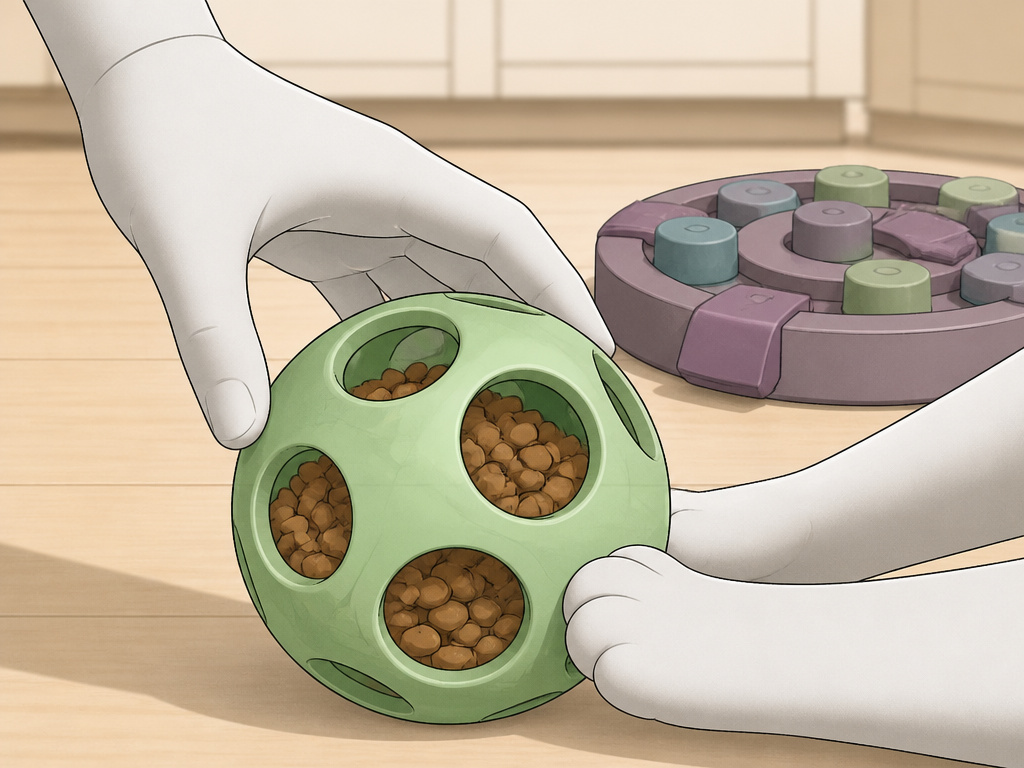
For a cat that eats too fast, the first puzzle feeder you set down should be almost too easy.
The AAFP companion paper on food puzzles for cats is specific about the starting configuration. Fill the puzzle as full as possible, use several large holes, and make sure it rolls with very little manipulation. At first, the effort required should equal that of a food bowl.
I’ve watched people hand a cat a tight, multi-channel puzzle on day one and conclude the cat hates puzzles. What the cat hates is being bad at something. Start at bowl difficulty and let it win for a week.
The same paper’s case series is where the numbers live. One older cat lost 6.4% of body weight in 3.5 months after food puzzles were implemented. A younger cat lost 11% of body weight over 12 months. A separate 16-year-old cat lost 32% of body weight over 18 months after starting with stationary puzzles and eventually moving to all types.
Those are case reports, not a controlled trial, and they describe weight loss, which was the point. Read them as evidence that puzzles can carry a feeding program, not as a promise about your cat.
The full food puzzles for cats study is worth reading if you want the case-by-case detail. The puzzle feeders list covers the rolling and stationary styles those cases used.
Puzzle feeding works best when it replaces a meal rather than sitting next to one. The how often to feed a cat breakdown covers how to split the daily allowance across the day.
Automatic Feeders: Where Two Veterinary Sources Disagree
Should you buy an automatic feeder for a cat that eats too fast? The two best sources on this topic give opposite answers, and it’s worth seeing both before you spend anything.
| Question | PetMD (Mitchell, DVM) | AAFP 2024 consensus |
|---|---|---|
| Automatic feeders | Not recommended without portion control | Can be helpful, but no foraging |
| First-line fix | 9×13 baking pan spread | Puzzle feeders and foraging |
| Multi-cat feeding | Not addressed | Separate, visually separated stations |
| Portion measurement | Not addressed | Digital gram scale, not a cup |
| Aged or ill cats | Not addressed | Monitor weight and body condition |
On automatic feeders specifically, PetMD’s objection is weight control and appetite monitoring. PetMD’s objection to units without portion control is weight control and appetite monitoring. The AAFP statement agrees feeders don’t provide foraging or predation, but treats them as a helpful adjunct to a feeding program.
PetMD discourages automatic feeders without portion control, while AAFP calls automatic feeders a helpful adjunct; a feeder with portion control is one option that addresses PetMD’s concern. PetMD names the PetSafe Eatwell 5-meal automatic pet feeder as an example of a unit that can be set to open on a schedule and feed small meals frequently, which often helps prevent regurgitation. Some automatic cat feeders have an ice pack below the bowl to keep canned food fresh all day long.
One trap PetMD flags: tennis-ball obstacles will not work well in self-replenishing feeders with large-capacity hoppers. Tennis-ball obstacles will not work well in self-replenishing feeders with large-capacity hoppers.
The feline feeding programs review is the document to read if you want the AAFP’s full position rather than my summary of it.
Weigh the Portion on a Gram Scale, Not a Cup
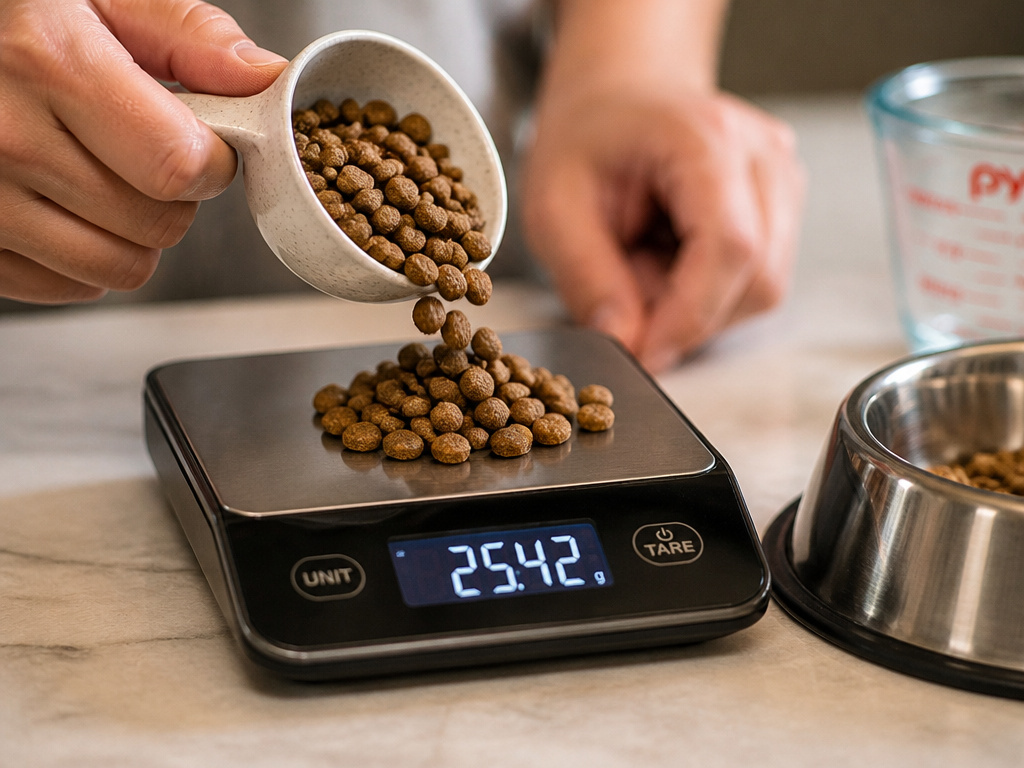
The measuring cup is the weakest link in most how to feed a cat that eats too fast routines.
The 2024 AAFP consensus statement says to measure portions with a digital gram kitchen scale rather than a measuring cup. The reason is cited directly: owners are demonstrably inaccurate with cup measurement. The statement points to German et al. 2011 in the Journal of Animal Physiology and Animal Nutrition, a study on imprecision when using measuring cups to weigh out extruded dry kibble.
Why the measuring cup fails
Kibble isn’t a uniform substance. Piece size, shape, and how tightly the food settles in the cup all change the weight, so one cup of one food and one cup of another can be very different amounts of calories. A gram scale removes the variable entirely.
No tolerance band is published in these sources, so I won’t invent one. The instruction is simply to weigh.
The how to measure cat food portions walkthrough covers the scale setup and how to convert the bag’s chart into grams.
Weigh the food, not the scoop. A gram scale is the only number in this routine that stays the same from bag to bag.
Turn the bag over. The feeding chart on the back gives you a range, and a range is a starting point. Use it as an opening bid, then adjust against body condition rather than treating the top of the range as a target.
Rover’s practical screen is worth keeping: if the meal is gone in about two minutes or less, or you can’t hear or see the cat chewing, the cat is likely eating too fast. PetMD doesn’t publish a time cutoff, so treat the two-minute mark as a rough flag rather than a diagnosis.
When Slow Feeding Won’t Fix It
The cat eats, walks away, and twenty minutes later the food is back on the rug. You’ve tried the pan, the maze bowl, and the puzzle. Nothing changed.
That’s the point where the bowl stops being the answer. The AAFP statement is direct about one scenario: a cat may gorge specifically to escape a stressful encounter, including one with a toddler, and then vomit. Slow-feeding hardware doesn’t touch the root cause.
- Frequent regurgitation, or any weight loss. PetMD says either one warrants a vet visit.
- Aged, debilitated, or chronically ill cats. AAFP says puzzle feeders and elevated foraging need monitoring, with weight and body condition checked regularly.
- Elevated feeding spaces. AAFP permits them only when the cat’s physical status allows it.
- A cat that only bolts when another cat is nearby. That points at competition, not at bowl design.
Multi-cat homes need separate stations
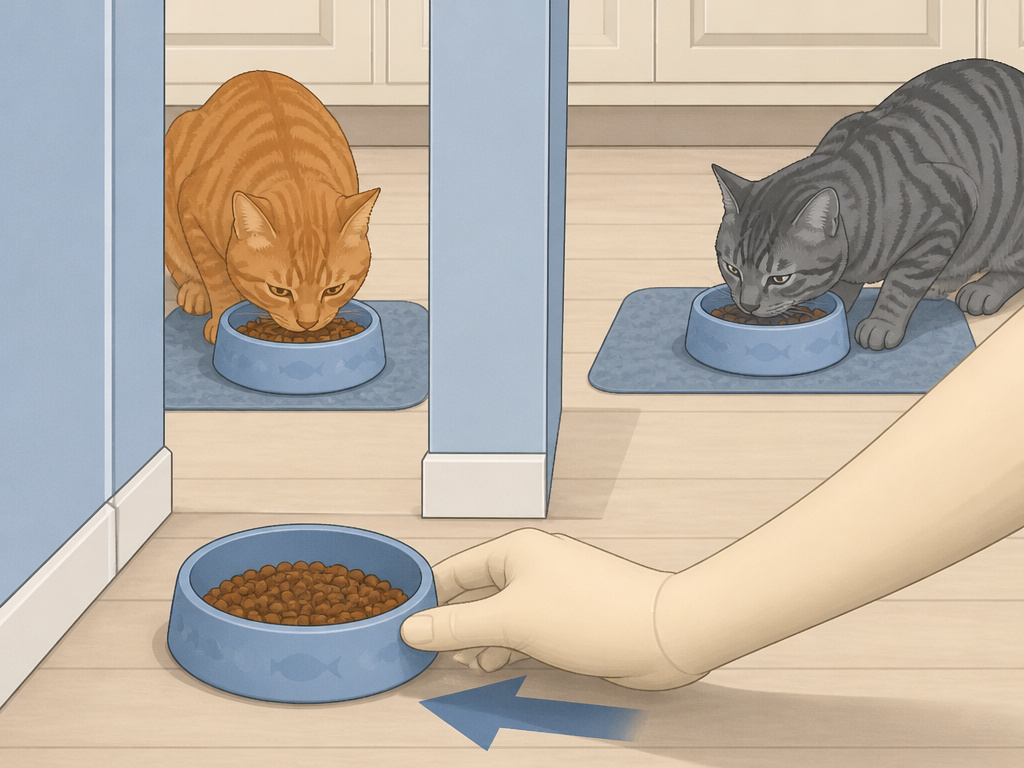
I’ve walked into multi-cat homes where the “fast eater” turned out to be the cat that finished first and then ate the other cat’s dinner. The speed was real. The cause was the shared bowl. Now I ask about the household setup before I ask about the food.
The AAFP position is that cats eating together does not mean they benefit from it, and separate, visually separated feeding stations are required. Rover’s Dr. Delgado is slightly softer: separate bowls at least a few feet apart, or separate rooms if the cats are hyper-sensitive to territory and food resources.
AAFP requires separate, visually separated feeding stations, while Rover’s Dr. Delgado recommends separate bowls at least a few feet apart, or separate rooms only if the cats are hyper-sensitive to territory and food resources.
For cats on different diets, Dr. Greene and colleagues at Merck Animal Health often recommend the Sure Petcare Microchip Pet Feeder Connect, which opens only to the programmed pet. AAFP’s statement doesn’t endorse microchip feeders and still calls for separate stations.
If the meowing around mealtimes is the bigger problem, the how to stop a cat from begging for food guide covers the behavior side.
Where this goes sideways: Adding a puzzle feeder for an arthritic older cat without checking its weight and body condition regularly. AAFP requires monitoring in aged cats, and appetite loss in an older cat compounds quickly.
One last thing worth saying plainly. A cat that eats too fast doesn’t always need a vet visit, and Rover is clear on that. But frequent regurgitation, weight loss, or any other change alongside the fast eating is the line where you stop adjusting bowls and book the appointment. PetMD says the same thing in fewer words.
Frequently Asked Questions
Is it normal for a cat to eat fast?
Cat that cleans the bowl in seconds is common, but common and normal aren’t the same thing. Dr. Laura Greene at Merck Animal Health says fast eating more often traces to a medical or behavioral factor than to simple enthusiasm. If the cat holds weight and keeps the food down, it may be harmless. If food comes back up, it isn’t.
How fast is too fast for a cat?
Rover’s screen is about two minutes or less for a full meal, or a cat you never hear chewing. PetMD doesn’t publish a time cutoff, so treat the two-minute mark as a rough flag rather than a rule. What happens after the meal is the more reliable signal.
Do slow feeder bowls actually work?
PetMD says spreading food on a pan can often slow the process enough to resolve the problem, while AAFP notes slow-feeding hardware does not address the root cause when a cat gorges to escape stress. The University of Illinois I-PETS program describes the mechanism plainly: ridges and patterns force the pet to work around obstacles, which stretches the meal out without shrinking the portion. The catch is fit. Some cats simply walk away from a maze bowl.
Should I switch my cat to wet food?
PetMD suggests it if the cat always regurgitates dry food, since canned food may be better in the long run. Rover suggests asking your vet about a high-moisture or high-protein diet for the same reason. Neither source says wet food alone fixes fast eating, so pair the switch with a slower feeding method.
Can a cat choke from eating too fast?
Rover notes that cats can choke when eating too quickly, which is one more reason to change the setup on a day you’re home rather than the morning you leave for work.
When should I see a vet?
PetMD says frequent regurgitation or any additional sign such as weight loss warrants a visit. Rover is a bit looser: fast eating alone doesn’t always mean a checkup, but unwanted behaviors, digestive upset, or weight loss alongside it do. Both land in the same place once weight loss is on the table.
Before You Go
Start with the pan tonight. It costs nothing, it’s reversible, and it’s the one fix with a published dimension behind it. If three meals on a 9- by 13-inch pan change nothing, you’ve learned something useful: the speed isn’t the problem, and you should be looking at competition, stress, or a medical cause instead of a bowl.
One caveat on everything above. I read labels and veterinary consensus for a living. I don’t examine your cat. If there’s weight loss, frequent regurgitation, or a cat that’s suddenly ravenous after years of normal eating, the bowl advice is the wrong tool for the job.
The AAFP statement and PetMD disagree on automatic feeders, on whether the pan or the puzzle comes first, and on how far apart multi-cat bowls need to sit. They agree on exactly one thing, and it’s the one that matters most here: a cat losing weight or bringing up food repeatedly needs a veterinarian, not a better bowl.
