
How to Choose a Cat Food Topper: Start With the Label
This post contains affiliate links. As an Amazon Associate, we earn from qualifying purchases.
To choose a cat food topper, read the adequacy statement first, then fit the topper inside the 10% of daily calories that VCA Animal Hospitals sets aside for extras. Anything that isn’t complete and balanced stays a small addition to the bowl.
The adequacy statement is a legal sentence, not a marketing line. It comes out of AAFCO model regulations and tells you whether the product is formulated to meet nutrient profiles for a named life stage, or whether it’s stamped “intermittent or supplemental feeding only.” That one phrase sets how much nutritional room the topper has before it starts crowding out the base diet.
What follows: how to read that statement, how to do the calorie math on the back of the can, and where the published sources genuinely disagree about whether you should pull base food out of the bowl.
Key Takeaways
- Cap toppers and treats at 10% of daily calories. The other 90% comes from a complete and balanced food, per VCA Animal Hospitals.
- A topper is not a supplement, a therapy, or a hydration treatment. Petful is blunt about this, and it matters when a label implies a urinary benefit.
- Check the label role before the flavor. “Intermittent or supplemental feeding only” means small share of the diet, full stop.
- If your cat cleans the bowl at every meal, a topper is usually unnecessary. VCA says there’s usually no reason to add one, while Wellness presents toppers as a general mealtime enhancement.
- Never scale a dog’s weight-based serving down to a cat. Use cat-specific directions only.
How to Choose a Cat Food Topper: Start With the Adequacy Statement
Grab a can and find the small print under the guaranteed analysis. That block is where the product tells you what it actually is.
A nutritional adequacy statement identifies the life stage a product is formulated for and whether the food is complete and balanced or labeled for intermittent or supplemental feeding only. The statement is the legal determinant of a product’s role in the diet, and format alone does not establish it: wet, dry, broth, and treat products can carry either designation.
Petful makes the same point in plainer language. Decide whether you’re using a complete cat food in a smaller portion or a supplemental extra, because that distinction determines how much nutritional room the topper has. A wet food that happens to be complete and balanced can legally carry part of the diet. A broth that’s labeled supplemental cannot.
| Label statement | What it means | Room in the bowl |
|---|---|---|
| Formulated to meet the AAFCO Cat Food Nutrient Profiles for a named life stage | Complete and balanced for that life stage | Can carry the base diet in a measured portion |
| “Intermittent or supplemental feeding only” | Not a complete diet | Small share of daily calories |
| No adequacy statement printed anywhere | Role unverified | Treat it as an extra, not a meal |
| Broth or milk with cat-specific directions | Usually supplemental | Count every spoonful |
The trap here is assuming format equals role. A chunky stew in a pouch can be complete. A shelf-stable broth in a carton can be supplemental. Plenty of cat food toppers on the shelf sit on both sides of that line, and the front of the package won’t tell you which.
Turn the can around. The answer is in the fine print, every time.
How Much Topper Fits Inside the 10% Calorie Ceiling?
VCA Animal Hospitals spells out the arithmetic: a dog that needs 1,000 calories a day should get no more than 100 calories from toppers and treats, with 900 coming from complete food. Feeding past that 10% can unbalance the diet and lead to obesity.
The same ceiling applies to cats, and the how to choose a cat food topper math is the same. Here’s how to actually run it.
- Find the calorie figure on the base food. It’s printed as kcal per cup or per can, and skipping it leaves you without a denominator for every other number.
- Add up every extra, including the ones you don’t call treats. VCA puts toppers and treats in the same 10% bucket, so a squeeze of paste and a dental chew compete for the same room.
- Divide the allowance across meals. A 100-calorie daily allowance over two meals is 50 per bowl, and spending it all at breakfast leaves the evening meal with nothing.
- Rerun the total when the food changes. A new formula with different calorie density shifts the math, and last month’s portion quietly stops fitting.
I treat the 10% number as a budget line, not a target. A cat that’s eating well doesn’t need the full allowance spent on extras, and I’d rather see that room go unused than filled with something that adds calories and nothing else.
Where the Sources Diverge on Portion Size
The sources don’t agree on how to measure the topper, and pretending otherwise would be dishonest. VCA frames everything as a percentage of daily calories. Cats.com works from the same 10% figure but notes that a small, low-calorie topper may not require reducing the main portion at all. Wellness Pet Food states that non-complete toppers should be under 10% of daily calories, full stop. Petful says to count every extra inside the daily calorie plan.
| Source | How it limits the topper | What that means at the bowl |
|---|---|---|
| VCA Animal Hospitals | 10% calorie ceiling with a worked example | Cap extras at 100 kcal per 1,000 kcal fed |
| Cats.com | About 10% of intake; small low-calorie toppers may need no base-food cut | A teaspoon of broth may not require an offset |
| Wellness Pet Food | Non-complete toppers under 10% of daily calories | Treat it as a hard limit for anything not complete |
| Petful | Count every extra inside the daily calorie plan | No free extras outside the total |
On the offset question specifically, the positions split. Cats.com advises considering a slight reduction of the main food for high-calorie toppers, while noting that small low-calorie ones may not need it. VCA frames toppers inside the 10% ceiling without an explicit offset instruction. Petful wants every extra counted within the daily plan.
My read: if the topper is a splash of broth, the offset is noise. If it’s a quarter cup of calorie-dense wet food, pull an equivalent amount of base food or you’ve just added a meal. That’s arithmetic, not a manufacturer position.
Which Topper Format Fits Your Cat’s Actual Problem?
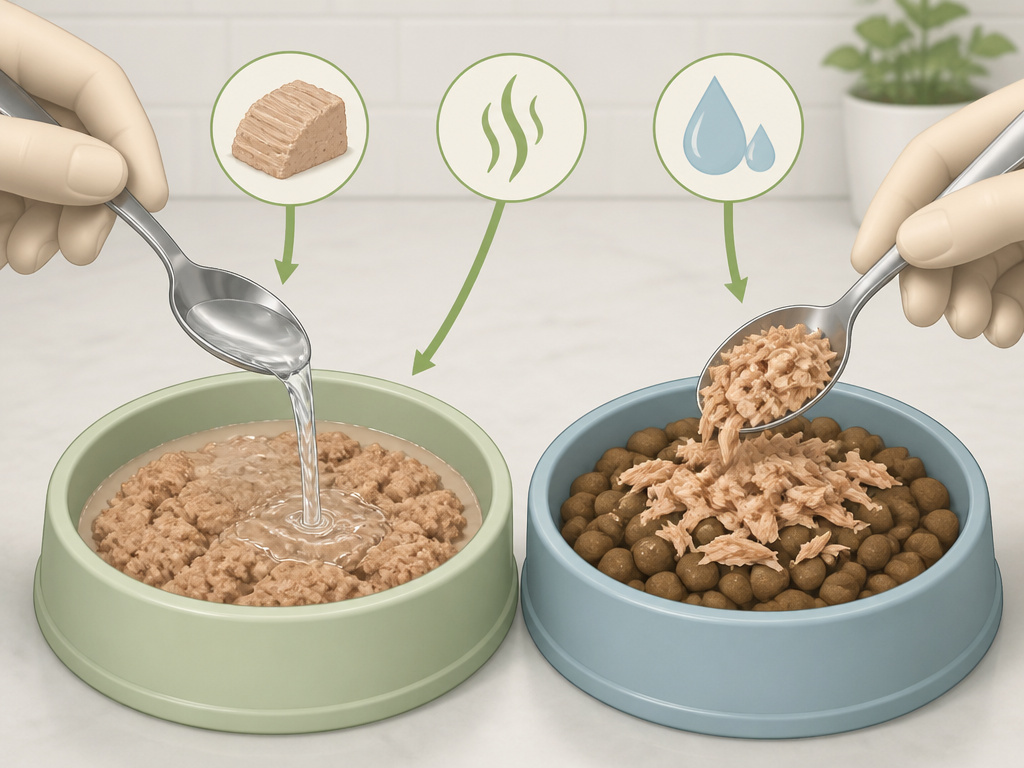
A cat that walks away from a pate and a cat that walks away from dry kibble are telling you two different things.
NC State’s nutrition service notes that animals respond to smell, taste, and texture, and lists meal toppers as a solid way to improve flavor without swapping the food itself. Petful’s version of the rule is to pick a specific goal first: texture, aroma, or moisture. A topper chosen without a goal is just an unmeasured extra.
Before you start: Fresh toppers spoil faster than owners expect, so feed them promptly and refrigerate opened wet product according to the package. Frozen toppers need proper thawing before serving, not a warm-water shortcut that leaves the center cold. And keep any topper containing raw or fresh meat away from surfaces you use for your own food.
- Gravy or broth: adds aroma and moisture in one move. Check sodium and species directions before you pour, because broth is often a supplemental product.
- Minced or shredded wet food: changes mouthfeel. A spoonful of minced or shredded wet food does this without turning the bowl into a different meal.
- Freeze-dried sprinkles: adds crunch and scent with almost no volume. A few pieces is the intended use for freeze-dried sprinkles.
- Pate thinned with warm water: the cheapest texture change going, if the cat already accepts pate.
Moisture content is where the format labels get slippery. A pate spreads like soft butter off the spoon. A “stew” or “chunks in gravy” can mean thickener is doing work the meat should be doing. You can see it in the bowl: gel holding cubes in suspension rather than meat sitting in its own liquid.
Mixing In vs. Serving Alongside
Cats.com points out that toppers don’t have to go on top. They can be mixed through the food or served alongside it. Mixing works better for a cat that licks gravy off and leaves the kibble, because the flavor is on every piece. Serving alongside works better for a cat that gets suspicious when the familiar texture changes. Try the smaller intervention first.
For cats where the goal is water intake, there’s a real disagreement to flag. Cats.com treats bone broth as a favorite topper for added hydration, while Petful argues a topper is not automatically hydration therapy. Petful pushes back, arguing that a topper is not automatically hydration therapy and that “improved urinary health” is a medical conclusion a bowl cannot establish. Both are worth holding at once. You can use toppers for hydration as a practical way to get more water into a cat without claiming a clinical outcome.
How to Choose a Cat Food Topper When the Front of the Bag Is Selling Something Else
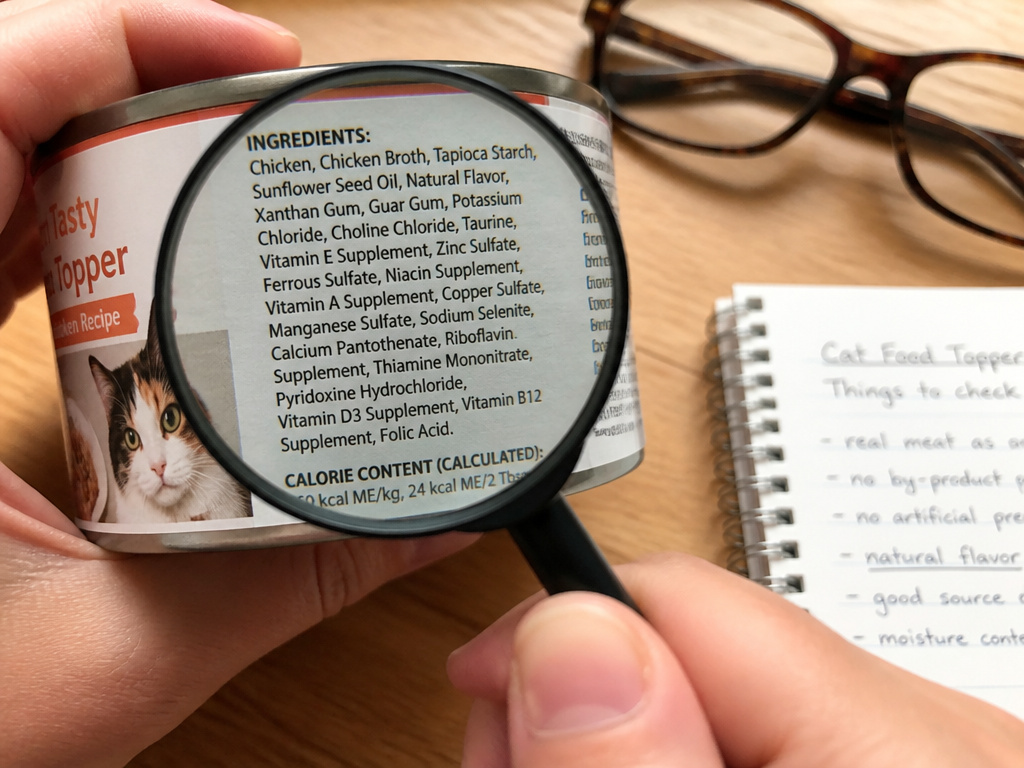
Petful says it plainly: a grain-free topper is not automatically better for a cat without a specific dietary need. That’s the whole game on the front panel, and it’s the first thing I’d strike from your decision criteria.
The category I’m most skeptical of is over-the-counter “limited ingredient” products. I’ve seen multiple distinct animal proteins on the labels of some, and nothing on the bag suggests cross-contact controls in the plant. For a genuine elimination trial, a veterinary hydrolyzed or novel-protein diet with one protein and one carbohydrate is the tool. Anything less is a hopeful guess in good packaging.
Read the ingredient list in order of weight and look for where the cross-contaminants hide. On “fish-free” or “chicken-free” foods, I find fish digest, poultry fat, or “natural flavor” when I read the fine print. Digest and fat are the usual hiding places, so scan for those before you trust the protein name on the front. If you want the full method, reading ingredient lists properly is worth the time per can.
Where this goes sideways: Buying a topper because the ingredient list is short. A brief list can belong to a supplemental product with no vitamin and mineral premix, while a complete food legitimately needs those additions. Short doesn’t mean better; it means you still have to check the adequacy statement.
If Your Cat Cleans the Bowl, You Probably Don’t Need a Topper
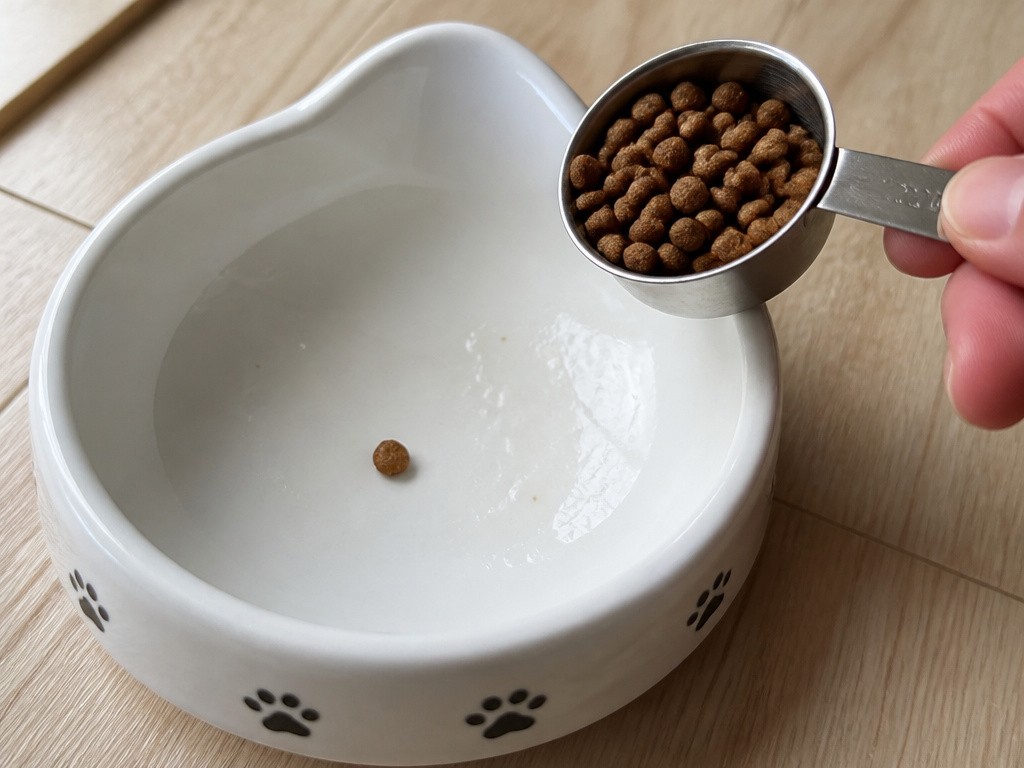
VCA Animal Hospitals states it directly: if a pet eats all the food offered at each meal, there is usually no reason to add a topper, though Wellness presents toppers as a general mealtime enhancement. That single line would eliminate a large share of the topper purchases I see.
People ask me whether table scraps will make a food more appealing. I recommend against it, because scraps dilute the balance of a complete diet and add calories fast. A small amount of the same food, warmed or measured out as a topper, does the job without changing the nutritional math.
The sources split on human food more broadly. NC State’s nutrition service says not to provide any human food before discussing it with a veterinarian. Wellness Pet Food takes a wider view, describing a topper as anything from fresh or frozen meats to vegetables, fruits, or shelf-stable commercial products. Both can be true: a plain cooked meat can function as a topper, and a cat with a health condition shouldn’t be getting kitchen improvisation without a vet in the loop.
Fresh toppers carry a timing problem. Wellness notes they need to be fed quickly to avoid spoilage, and the tell is smell before appearance. A fresh topper that’s turning goes faintly sour at the edge of the bowl before it looks any different.
If you’re going to add anything at all, start with a complete food you already trust in a measured portion. The best cat food for your cat is the one that carries the 90%, and the topper is a rounding error on top of it.
Common mistake: Leaving a topper out between meals because the cat grazes. Supplemental products are labeled for a reason, and a bowl that sits out all afternoon is a bacterial growth experiment, not a feeding strategy.
What Changes for a Picky Cat, a Senior Cat, or a Cat on a Therapeutic Diet?
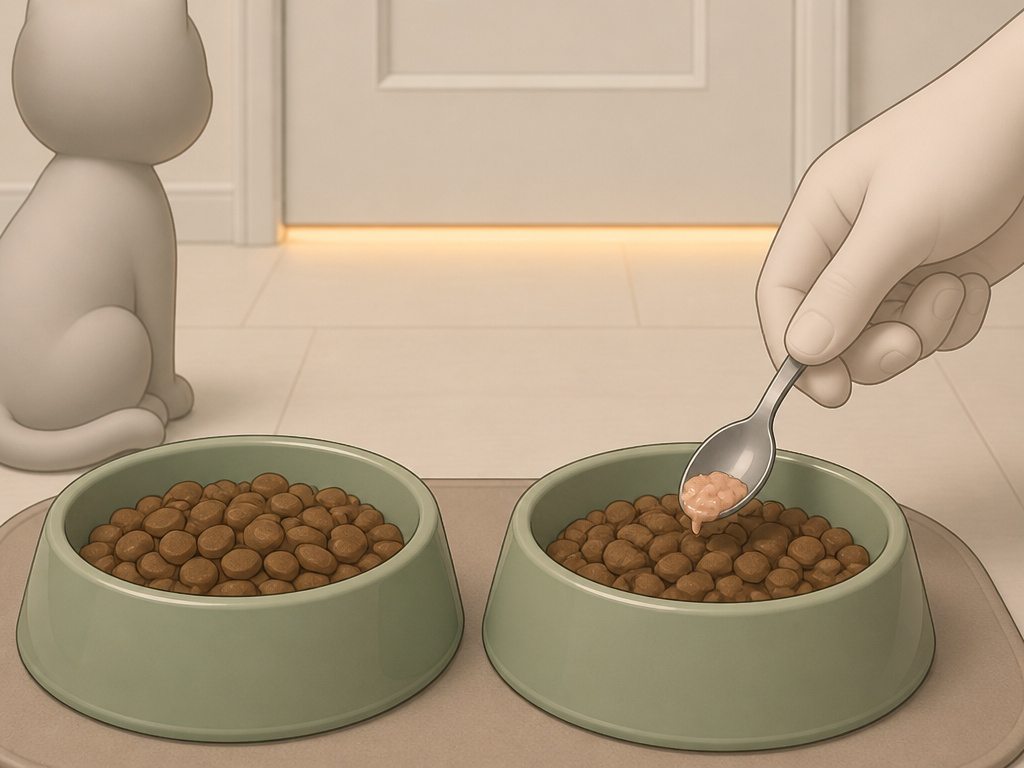
Three situations change the calculation, and none of them is solved by a bigger spoonful.
Petful flags the escalation trap directly: coaxing a selective cat with richer and richer extras can teach the cat to refuse the base diet while it waits for something better. The staged approach is tiny taste beside the food, then at the edge, then partially mixed, then the smallest amount that keeps the cat eating. Don’t advance on a calendar, and don’t withhold food to force a texture change.
NC State’s veterinary nutrition advice for picky cats covers the environment side too, which most topper advice skips. Feeding pets separately in a multi-cat house reduces competition, and a cat on a special diet should be fed in a quiet room where nobody else can interrupt. If you’ve been layering toppers on while two cats share a bowl, the topper wasn’t the problem. There are dedicated toppers for picky cats if you’ve already ruled the environment out.
Cats on a Therapeutic Diet
Wellness Pet Food raises the point that matters most here: if a cat is on a therapeutic diet, check that the topper’s ingredients or nutrients won’t affect the condition. For kidney or heart disease, the sodium level of the topper is the number to know.
This is where I hand off. I read labels for a living, and I’m not a clinician. Prescription and therapeutic diets for kidney disease or urinary crystals belong to your veterinarian, and a topper decision inside one of those plans belongs to them too. For older cats generally, there are toppers for senior cats built around palatability, but the diet plan comes first.
Frequently Asked Questions
Is a cat food topper the same thing as a supplement?
No. Petful is explicit that a topper is not automatically a vitamin supplement, an appetite treatment, or a hydration therapy. It’s a small amount of food added to the meal to change texture, aroma, or moisture. Products marketed as supplements have their own dosing and their own label rules.
How much topper is too much?
Anything that pushes toppers and treats past 10% of daily calories is too much, per VCA Animal Hospitals. On a 1,000-calorie day that’s a 100-calorie allowance covering both toppers and treats together. VCA’s worked example puts 900 of those calories on complete food.
Do I need to reduce my cat’s regular food when I add a topper?
It depends on the topper’s calorie density, and the sources don’t fully agree. Cats.com suggests considering a slight reduction for high-calorie toppers while noting small low-calorie ones may need no offset. Petful says to count every extra within the daily plan. For a calorie-dense topper, pull an equivalent amount of base food.
Can I use dog food toppers on my cat?
No. Petful warns specifically against applying dog weight-based directions to cats. Use cat-specific package instructions or feline serving guidance confirmed by the manufacturer. A product sold mainly for dogs may not carry cat directions at all, which is a boundary worth respecting.
My cat eats fine. Should I add a topper anyway?
VCA’s guidance is that if a pet eats all the food offered at each meal, there’s usually no reason to add a topper, while Wellness presents toppers as a general mealtime enhancement. Wellness presents toppers as a general mealtime enhancement, so there’s room for preference here. If the cat is maintaining weight and cleaning the bowl, you’re not solving a problem.
The Bottom Line
Here’s the trigger that should decide it for you: if your cat leaves food in the bowl at more than one meal a day for several days running, and the vet has ruled out a medical cause, a topper is worth trying. If the bowl is empty every time, close the cabinet.
One concession on everything above. This whole approach assumes a cat eating a complete and balanced base diet. If your cat is on a therapeutic or prescription food, the 10% math still applies but the ingredient choices don’t belong to me or to a label. Kidney and heart diets turn on sodium and nutrient levels that a topper can quietly wreck, and that call is your veterinarian’s.
Fair warning on the picky-cat ladder: it works slowly or it doesn’t work. Owners who escalate from broth to minced food to shredded fillets in a week usually end up with a cat that now refuses plain kibble and a cupboard full of half-used cartons. Pick the smallest topper that gets the cat eating, hold it there, and stop climbing.
