
Cat Water Fountain Pros and Cons: What They Won’t Fix
This post contains affiliate links. As an Amazon Associate, we earn from qualifying purchases.
A cat water fountain helps some cats drink more, but it does not replace the water a cat gets from wet food. The pros are convenience and moving water; the cons are weekly cleaning, a filter interval that sources dispute, and a pump that burns out if it runs dry.
The gap is in the bowl, not the fountain. A cat eating dry kibble takes in little water with its food, while a canned-fed cat gets a large share of its water with the meal. No pump closes that distance.
What follows: the evidence on intake, the maintenance bill nobody quotes up front, a materials comparison, and the one interval where three published sources flatly disagree.
Key Takeaways
- A fountain raises intake for some cats, not all; crossover studies have not shown a consistent urine-dilution benefit.
- Cleaning intervals vary. Zoetis Petcare ties cleaning to every refill, which lands around once a week; Catit recommends weekly cleaning of the stainless top, and Whisker gives no fixed interval.
- Never let the pump run dry. Whisker notes an empty fountain that keeps running can burn out, while Zoetis recommends a fountain with an auto shut-off pump.
- Wet food moves the needle further than any fountain; treat the fountain as a supplement, not a fix.
Cat Water Fountain Pros and Cons: What the Evidence Actually Supports
The cat water fountain pros and cons case is thinner than the packaging suggests, and the peer-reviewed work doesn’t all point the same way.
Two crossover studies have tested whether cats drink more from moving water. One found higher intake from a fountain but no significant change in urine concentration. The other found no intake difference between still, circulating, and free-falling bowls.
A circulating fountain pushes water over an activated-carbon filter and back through the basin, aerating the stream and keeping it cooler than a still bowl. The filter traps saliva, food particles, chlorine, and pesticides. The pump supplies the flow. Neither part adds water to the cat’s total daily intake.
That last sentence gets buried in most write-ups. Zoetis Petcare notes that cats often prefer moving water. Whisker points out that electric fountains keep water cooler, which slows bacterial growth. Dr. Dwight Alleyne, quoted in Consumer Reports’ trial of five fountains with three dogs and two cats, says flowing water is often cleaner with a low risk of bacterial growth. All three are describing appeal and cleanliness, not a corrected water deficit.
Individual taste decides the rest. A later crossover trial found cats with significant bowl preferences pointing in opposite directions: one cat favored circulating water, another free-falling, another still. There’s no universal rule here.
If your cat walks past the fountain, the machine may not be the problem. Practical routes to get a cat to drink more exist, and several of them don’t involve electricity at all.
The Cons Show Up in Month Two, Not Week One
The maintenance is the whole story.
A fountain is a wet appliance with a pump, a cord, and a filter, and all three run on a schedule whether you’re paying attention or not. Week one is fine. By week three, every surface that touches water has a film on it.
Run a thumb along the inside of the basin after a fortnight and it comes away slick. The smell arrives before the slime is visible, somewhere between a wet dishcloth and a drained vase.
The real cons, in order of how often they bite:
- Cleaning is essential, and Zoetis ties it to every refill, which works out to roughly once a week for a single cat; Catit recommends weekly cleaning of the stainless top, and Whisker gives no fixed interval.
- Pump burnout when the water level drops and the motor keeps running dry, which Whisker flags directly.
- Filter replacement, which Zoetis says to budget for every month or so.
- Cord damage, especially the section that stays submerged, which Zoetis says to inspect at each cleaning.
- Plastic basins that scratch and then hold bacteria in the scratches.
- Noise, if the fountain sits anywhere near where you sleep.
Many fountains I’ve seen in homes were overdue for a clean. That isn’t a knock on the owners. It’s what happens when a maintenance item has no reminder attached to it.
Where this goes sideways: Topping up the water without pulling the pump. The basin looks full and the flow looks fine while the impeller packs in hair and grit, and the motor stalls a few weeks later.
How Often Do You Actually Have to Clean a Cat Fountain?
The published sources give different intervals, and none of them are wrong.
| Source | Cleaning interval | Filter interval |
|---|---|---|
| Zoetis Petcare | Every refill, about weekly | Every month or so |
| Catit (Stainless Steel Fountain manual) | Weekly on the stainless top, to limit lime | Every 3 weeks, or when saturated |
| Glacier Point Pet Fountains | Not fixed; judge by flow | Replace or recharge when flow drops |
| Whisker | Daily water-level check | Not specified |
The filter is the part people stretch, and the gap between Catit’s 3 weeks, Zoetis’s monthly budget, and Glacier Point’s flow-based guidance is where most of the arguing happens. Catit’s manual puts the pad at every 3 weeks or when visibly saturated. Zoetis says budget for monthly. Glacier Point’s manual refuses to name an interval at all, and instead says a significant reduction in flow means the charcoal is clogged and needs changing or recharging.
Flow is the honest gauge. When the charcoal loads up, the stream thins from a ribbon to a trickle and the pump note rises as the motor works against the restriction. That sound change is your reminder.
The 5% Vinegar Method
Glacier Point’s manual gives the cleaning step most people skip: soak the pump and filter parts in a 5% vinegar solution for 3 minutes to disinfect them. It also warns against boiling water, because the fittings loosen and the pump and filters leak afterward.
Before you start: Unplug the fountain before you touch the pump. Check the submerged length of cord at every cleaning for nicked insulation, since that’s the section sitting in water. Keep the pump and filters out of boiling water; the fittings loosen and the unit leaks after that.
- Unplug the unit and lift the pump out. Skipping the unplug is how people end up handling a live pump with wet hands.
- Disassemble and rinse the basin, reservoir, and spout. Skip this and the film you can’t see keeps feeding the filter.
- Soak the pump and filter parts in 5% vinegar for 3 minutes. Longer doesn’t help; the manual’s number is 3 minutes.
- Scrub the corners, grooves, and rubber fittings. These are the spots that hold slime when a rinse-only clean happens.
- Reassemble, refill, and watch the flow for the first minute. A weak stream means a clogged filter or an impeller still carrying hair.
Which Fountain Material Holds Up Best?
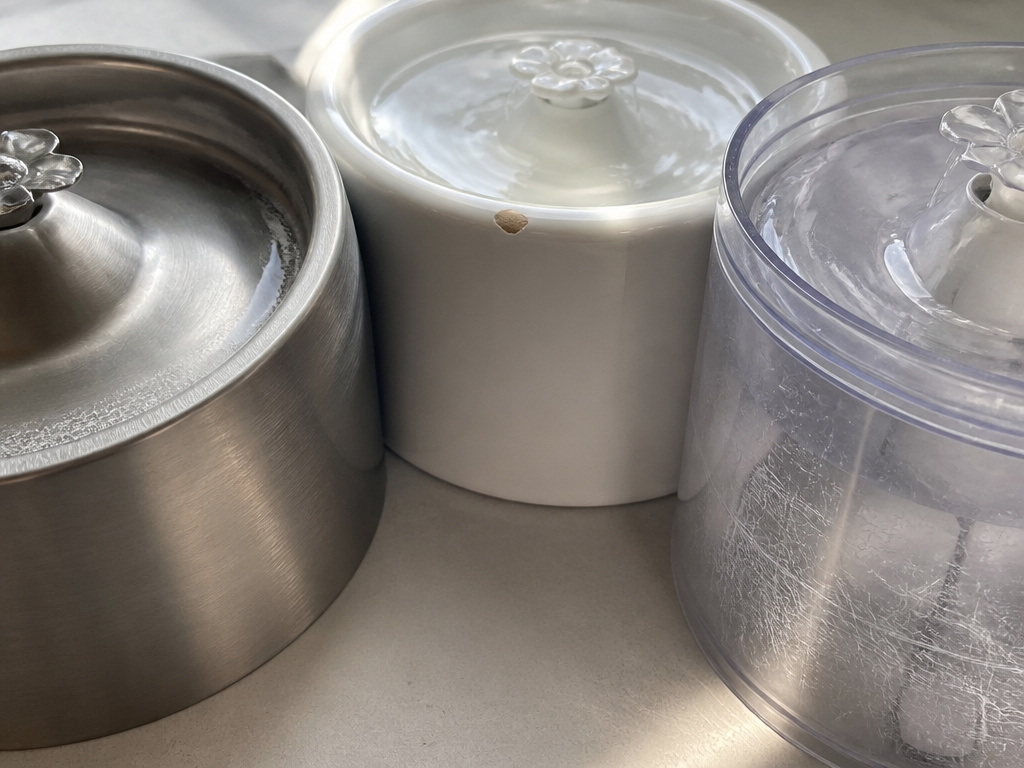
Stainless steel and ceramic both beat plastic, and the reason is mechanical rather than aesthetic.
| Material | What it does well | Failure mode |
|---|---|---|
| Stainless steel | Doesn’t scratch, wipes clean | Lime crust on the top; needs weekly attention |
| Ceramic | Heavy, stable, easy to clean | Chips at the rim |
| Plastic | Light and inexpensive | Scratches hold bacteria; some cats react to it |
| Wood or stone | Looks good in a room | Porous, holds odors when maintenance slips |
Zoetis says stainless and ceramic are generally better than plastic because plastic scratches and scratches hold bacteria. Whisker adds that plastics harbor more bacteria when water sits too long, and that wood and stone can be porous and hold onto odors. Glacier Point’s manual goes further, stating that non-plastic fountains don’t scratch, so they don’t harbor mold or bacteria and don’t cause chin acne.
Why Plastic Scratches Matter
A scratch is a place a rinse can’t reach. Bacteria settle into the groove, the film rebuilds from the inside out, and no amount of rinsing gets it back to smooth. That’s the mechanism, and it’s why a scratched plastic basin never really comes clean again.
The Catit Stainless Steel Drinking Fountain has a stainless top and a listed pump and filter part number. Glacier Point Pet Fountains builds the Basic and Perfect models around a non-plastic basin and an in-line C290 charcoal filter.
The same logic carries over to what you feed from. Bowl materials behave the same way: a scratched surface is a surface that stays dirty.
Where Should the Fountain Go?
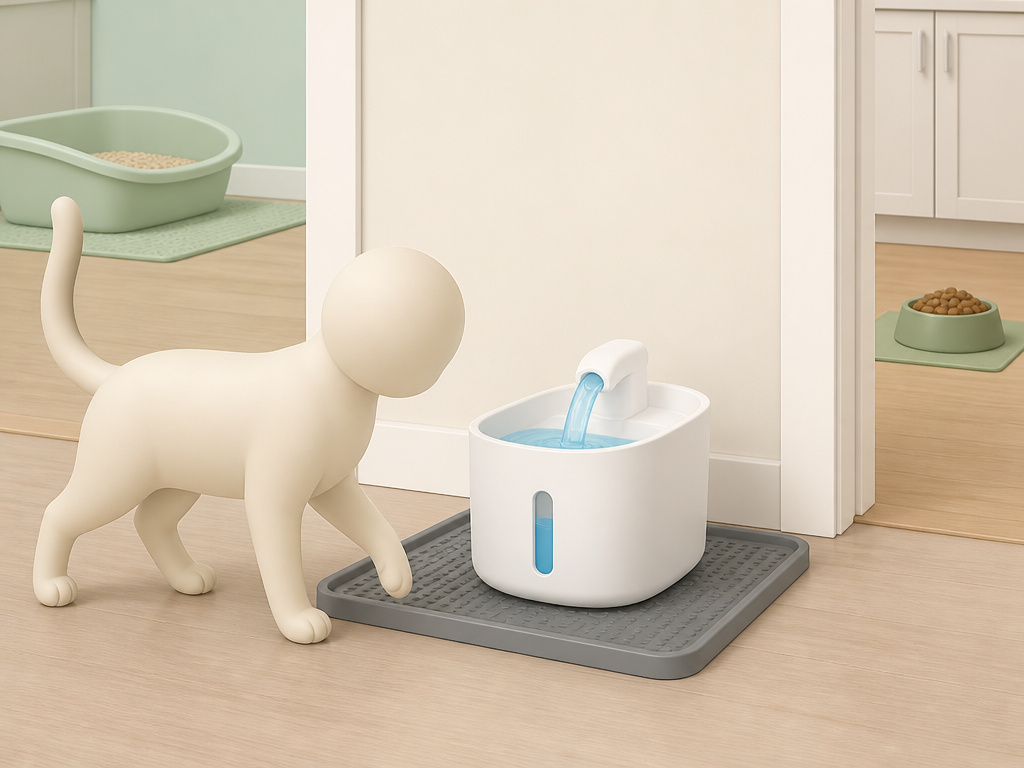
A fountain beside the food bowl, in a busy hallway, close to the litter box. That setup is common, and it works against you.
Glacier Point’s manual is blunt about it: the fountain should not be near the food bowl, ideally should be in another room, and definitely should not be near the litter box; Whisker only asks that the fountain sit somewhere easily accessible. The reason given is contamination, since dropped food carries bacteria into the water. Whisker’s guidance is looser and only asks that the fountain sit somewhere easily accessible, which encourages use.
Both can be true. Accessibility gets the cat to the water; separation keeps the water cleaner.
- Another room from the food bowl, not beside it.
- Nowhere near the litter box.
- Somewhere the cat already walks, not a corner it never visits.
- Indoors only, per Catit’s manual.
- On a rubber mat with raised edges, which Zoetis recommends for spill containment.
The 3-Day Switch-Over
Glacier Point’s transition method is the most specific guidance in any of these manuals, while Zoetis advises trying different fountain styles if the cat doesn’t respond to the first. Place the new fountain within a few feet of the old water source, sit with the cat while it inspects the fountain, and after 3 days remove the old supply entirely. For a nervous cat, fill the fountain but leave it unplugged for a day or so, refreshing the water as needed, then plug it in while you’re present.
If you already run automatic feeders in the kitchen, don’t park the fountain beside them just because the power strip is there. Convenience for you and separation for the cat pull in opposite directions here.
The Parts You’ll Be Replacing, and What the Warranty Covers
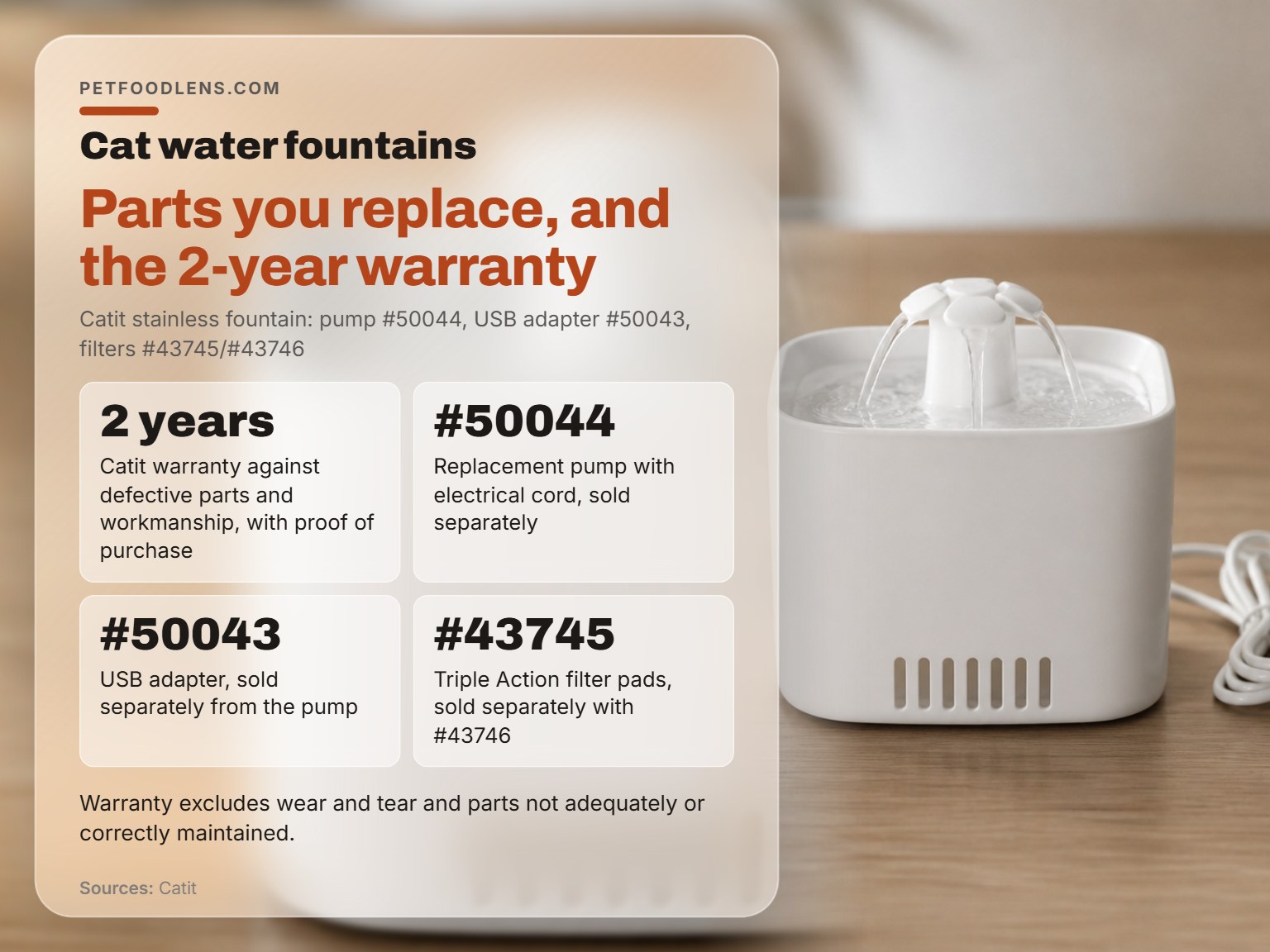
Catit sells the pump as Art. #50044 and the USB adapter separately as Art. #50043.
That detail matters more than it sounds. A pump with a published part number is a pump you can replace. A sealed housing with no part number turns a working fountain into landfill the day the impeller seizes.
The consumables, by part number:
- Pump with electrical cord: Catit Art. #50044
- USB adapter: Catit Art. #50043
- Triple Action filter pads: Catit Art. #43745 and #43746, sold separately
- Charcoal filter: Glacier Point C290
What the Warranty Doesn’t Cover
Catit’s stainless fountain carries a 2-year guarantee against defective parts and workmanship, valid only with proof of purchase. It excludes wear and tear and any part that hasn’t been adequately or correctly maintained.
Read that second clause twice. Skip the vinegar soak for a year, seize the pump, and the warranty conversation ends there.
Zoetis recommends choosing a fountain with an auto shut-off pump that stops when the water level drops too low, while Whisker advises monitoring the water level daily to avoid burnout. Whisker’s position is that fountains should provide water around the clock with the level checked daily. Zoetis’s position is that if you have any concerns, unplug the fountain when you’re not home and leave another water source out.
Both are defensible. The deciding factor is whether your pump has auto shut-off.
Do Fountains Beat a Bowl for a Cat That Won’t Drink?
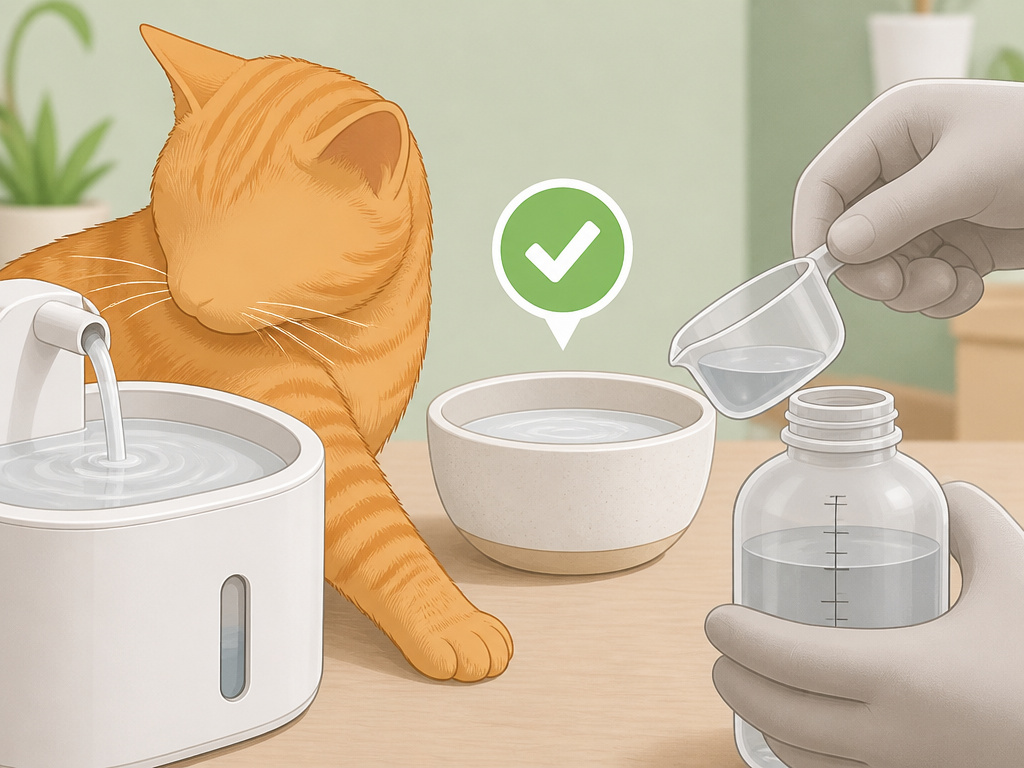
Ever watched a cat ignore a fountain for a week and go straight back to the bowl?
That’s the normal outcome, not a malfunction. The crossover evidence doesn’t support fountains as a reliable intake booster, and a bowl is easier to clean and cheaper to replace. Plain ceramic or stainless water bowls, washed daily, beat a neglected fountain every time.
If you want a real number instead of an impression, Glacier Point’s manual gives you the method. Note the inches drained from the refill bottle: with a 16 oz bottle, 1 inch equals 3 oz, and with a 32 oz bottle, 1 inch equals 5 oz. That converts a vague sense of “she drinks a lot” into ounces per day.
Then compare that number against what the food delivers. A cat on dry kibble gets little water from its food, and canned food carries far more water per bite than kibble does. That’s where the wet cat food comparison does more work than any fountain spec sheet.
If your cat eats dry food and you’re leaning on a fountain to protect the urinary tract, you’re solving the problem at the wrong end of the bowl.
One honest limit: I read labels and formulations, not bloodwork. If your cat has a history of crystals, blockages, or kidney disease, the fountain question is secondary to whatever your vet has already prescribed.
Frequently Asked Questions
Are cat water fountains safe?
Yes, when the fountain is well made and uses proper waterproof materials, per Zoetis Petcare. The parts that need checking are the pump and the cord, especially the submerged section, which should be inspected at every cleaning for exposed wiring.
How often should I change the fountain filter?
Catit’s manual says every 3 weeks or when visibly saturated. Zoetis Petcare says to budget for replacement every month or so. Glacier Point’s manual skips the calendar entirely and says a significant reduction in flow means the charcoal is clogged and needs changing or recharging.
Can I leave a cat fountain running while I’m at work?
Whisker’s guidance is that fountains provide water around the clock and the level should be checked daily, because an empty fountain that keeps running can burn out. Zoetis suggests unplugging the fountain when you’re not home if you have concerns, and leaving another water source out. A pump with auto shut-off resolves most of the tension between those two positions.
Do cats really prefer running water?
Some do, and some don’t. Zoetis notes cats often prefer moving water, and Dr. Dwight Alleyne told Consumer Reports that flowing water can be more appealing than standing water. A crossover trial found individual cats with strong bowl preferences pointing in different directions, so there’s no universal rule.
Why does my fountain’s flow keep slowing down?
Thinning stream usually means the charcoal filter is loaded, which Glacier Point’s manual describes as the filter doing its job and needing replacement or recharging. If a fresh filter doesn’t restore the flow, pull the pump and check the impeller for hair wrapped around the shaft.
The Bottom Line
A fountain is a supplement, not a treatment. If your cat eats dry food and you’re worried about urinary health, the food is the first thing to change and the fountain is the second.
Here’s the trigger I’d use: if the flow drops noticeably between cleanings, the filter is loaded and the pump is working harder than it should. Change the filter that day, not at the end of the month.
This week, unplug the unit, pull the pump, and run a thumb along the cord where it sits underwater. Then soak the pump and filter parts in 5% vinegar for 3 minutes and put it back together. That’s the whole job, and it takes less time than reading the manual.
None of this makes fountains a bad purchase. For a cat that already likes moving water, a clean fountain with a fresh filter is a reasonable way to keep water available all day. It just isn’t the lever that decides whether a cat is hydrated, and the cat water fountain pros and cons only make sense once you’ve stopped expecting it to be.
