
Fresh Dog Food Pros and Cons: What the Data Shows
This post contains affiliate links. As an Amazon Associate, we earn from qualifying purchases.
The fresh dog food pros and cons balance out this way: controlled feeding trials show fresh diets are more digestible than extruded kibble, with lower fecal output, but fresh food needs refrigeration, spoils faster, and only some brands meet AAFCO complete-and-balanced standards.
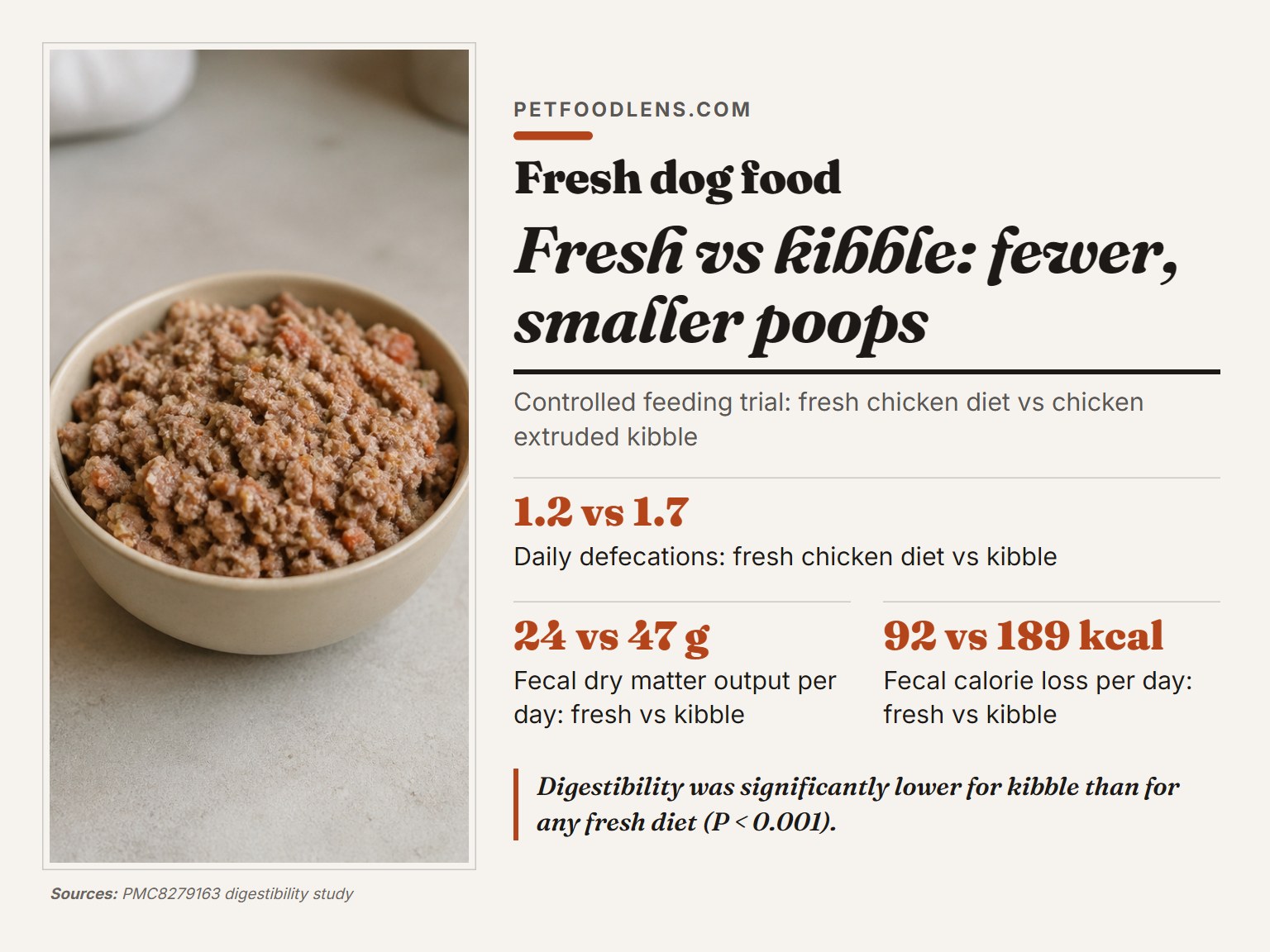
The digestibility gap is measured, and it shows up in the yard. A controlled trial comparing a fresh chicken diet with chicken extruded kibble logged 1.2 versus 1.7 daily defecations and 24 versus 47 grams of fecal dry matter per day. That gap is real. Whether your dog benefits from it depends on the formula in the pack, not the photo on the website.
What follows walks through the trial data, the fresh dog food pros and cons, the four places where marketing and peer-reviewed work pull in opposite directions, the cold-chain costs, and the specific dogs that should stay on kibble.
Key Takeaways
- Fresh diets measured more digestible than kibble in a controlled trial, with 1.2 versus 1.7 daily defecations and lower fecal calorie loss.
- AAFCO completeness is the line that matters. Some fresh brands need supplementation to hit it.
- Refrigeration is a hard constraint, not a footnote. Power loss, travel, and warm-weather delivery all threaten the food.
- Very young, very old, pregnant, and immunocompromised dogs should not be switched without veterinary input.
- Long-term health advantage is still unproven. The human-grade comparison rests on 6 studies with high risk of bias.
The Feeding Trial That Put Numbers on Fresh Food
A controlled feeding trial ran five diets through 10-day periods and weighed what came out the other end.
That is the strongest published evidence anyone has for the fresh dog food pros and cons. It is also narrower than the marketing around it suggests.
The peer-reviewed fresh dog food trial measured apparent total-tract digestibility, which means it tracked what went in against what came out. Dry matter, protein, fat, nitrogen-free extract, and calories all came out significantly lower for kibble than for any of the fresh diets (P < 0.001).
Why Fecal Output Is a Proxy for Digestibility
Whatever the gut does not absorb leaves the body as waste. Feed two diets at matched dry matter and matched calories, and the one producing less fecal dry matter per day is the one the animal pulled more nutrition from. That is the entire logic of the measurement.
The calorie figure is the one worth sitting with. On kibble, 189 kcal per day left the body in the stool. On fresh, 92 did. That energy was paid for and never used (which is the part that stings).
The trial also exposed a measurement problem almost nobody mentions. The modified Atwater equation underestimated metabolizable energy for kibble, while the NRC 2006 approach was most accurate for it. For high-fat fresh diets, standard Atwater came closest. For the high-protein pork diet, NRC 2006 won again.
Which equation a manufacturer picks changes the calorie number on the label. Show me the numbers, and then show me which equation produced them.
Where Fresh Food Marketing and the Research Disagree
Four claims get repeated on fresh food websites, and the published research pushes back on each one in some form.
| Claim | The marketing position | What the sources say |
|---|---|---|
| Human-grade ingredients | Safer and more nutritious | 6 studies, high risk of bias; not necessarily healthier |
| Additives and preservatives | Harmful, best avoided | No substantiated harm within AAFCO limits |
| High digestibility | Pure benefit | Can run too high; fiber deficit causes constipation or diarrhea |
| Feeding less per pound | Justified by digestibility | Changes calorie math, not individual energy needs |
A 2026 systematic review in Animals screened 4,888 studies and included 121. Its pooled risk difference for additives came out at 0.0006 across 60 studies, and 0.0003 for preservatives across 39. Bayes factors supported the null in both cases.
Translation: within AAFCO limits, the review found no substantiated harm from additives or preservatives.
Additives and Preservatives: Two Opposite Positions
The fresh category sells partly on the idea that preservatives are the problem. The meta-analysis doesn’t support that framing inside legal limits, and the human-grade dog food argument inherits the same weakness.
The human-grade versus feed-grade comparison rested on 6 studies with high risk of bias. Clinician’s Brief states plainly that human-grade foods follow a different set of minimum manufacturing guidelines but are not necessarily healthier or more nutritious.
That’s the honest version. Human-grade describes a supply chain and a set of handling rules. It doesn’t describe nutritional superiority.
The processing effect on digestibility scored a standardized mean difference of 1.971 across 102 comparisons (p=0.005). Nutrient content scored 1.405 across 137 comparisons (p<0.001). Both point the same direction: processing and formula change what a dog actually absorbs.
Clinician’s Brief adds a wrinkle the trial data can’t show. In the author’s clinical experience, digestibility can run too high for some animals, and a fiber deficit then produces constipation or diarrhea. Same metric, opposite verdict.
Cold Chain: The Cost That Never Shows Up on the Label
Your freezer decides whether fresh feeding works.
Clinician’s Brief lays out the practical load. Owners may need a second fridge or freezer, smaller and more frequent shipments, and someone home at delivery during summer and in warm climates. Refrigeration disruption from a power cut, travel, or an evacuation creates both a food-safety risk and spoiled food. Coolers stop being practical on long trips, hiking, camping, or a disaster evacuation.
Fair warning: that list is where most people discover the real cost, and it isn’t on the website.
PetMD gives the storage rule. Freeze at 0°F or lower, then thaw and use within three months. Frozen subscription services like The Farmer’s Dog and We Feed Raw ship pre-portioned packs that claim a serious share of freezer real estate.
Kibble has a storage problem too, just a slower one. I once emptied a pantry bin and found a yellowish, tacky film on the walls and a sharp crayon-and-paint smell. Months of fresh kibble had been poured over that residue, so every new bag met old oxidized fat on day one.
Before you start: Raw and gently cooked meat both carry bacterial risk, so wash hands, bowls, and counters with hot soapy water after every meal. Thaw in the refrigerator, never on the counter. A pack that has sat out warm and smells sour goes in the bin, not the bowl.
Ordering refrigerated dog food means planning around delivery windows, not just shelf space. Four rules cover most of it:
- Clear freezer space before the first delivery. A box that arrives with nowhere to go sits warm while you rearrange shelves, and the spoilage clock starts the moment it lands.
- Portion into daily bags while the food is still cold. Scooping from a thawed tub twice a day means more handling, more air exposure, and a faster decline.
- Label every portion with the freeze date. PetMD’s three-month window is easy to blow past when every pack looks identical.
- Keep a shelf-stable backup. JustFoodForDogs JustFresh is the shelf-stable option PetMD names, and it covers a power cut or a missed delivery.
Does Fresh Dog Food Have to Be Complete and Balanced?
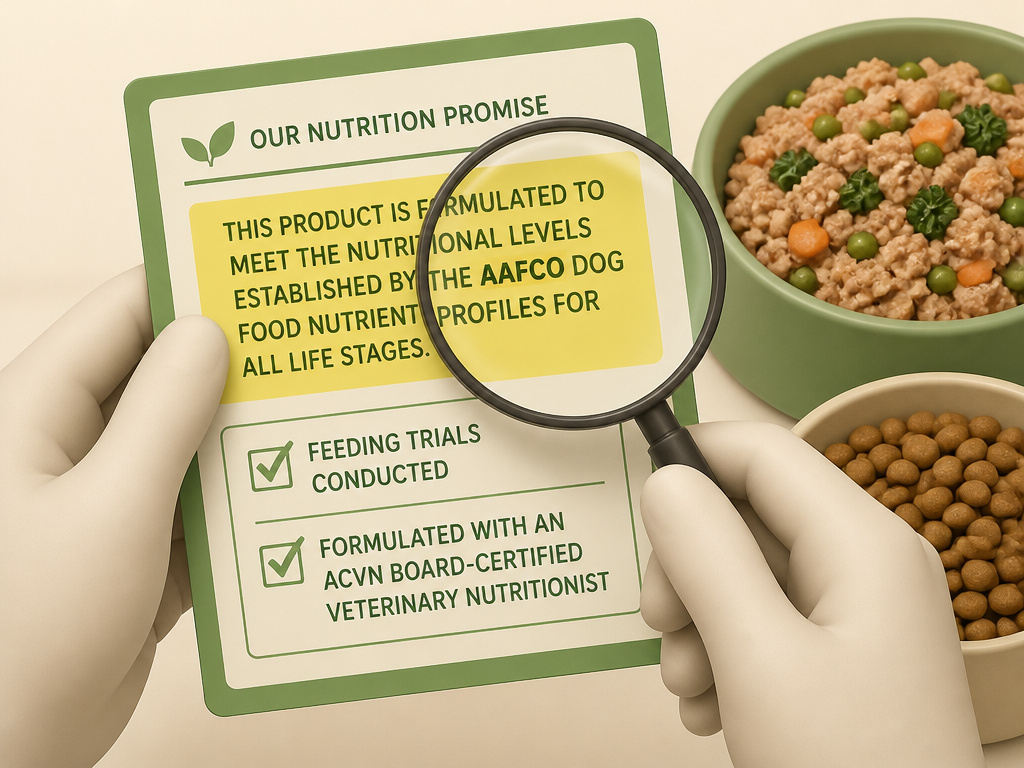
The first ingredient on a fresh food label tells you almost nothing about whether the diet is complete.
In my first year reading panels, I assumed the ingredient listed first made up most of the food. Fresh chicken is mostly water, and that water cooks off, so the ranking shifts once you convert the list to dry matter. I now weigh meat against meal before I trust a panel.
That correction matters more for fresh food than for kibble, because fresh formulas lean hard on muscle meat.
PetMD is direct about the gap: not all fresh dog foods provide complete and balanced nutrition, and some brands may need supplementation. The fix is an AAFCO nutritional adequacy statement, which means the diet meets the Association of American Feed Control Officials profile for a named life stage.
PetMD also sets a bar for the companies. The best ones employ a veterinary nutritionist with a PhD in animal nutrition or American College of Veterinary Nutrition board certification, and they run feeding trials. JustFoodForDogs meets AAFCO standards.
Reading the AAFCO Statement in Ten Seconds
- Find the life stage. “Adult maintenance,” “growth,” and “all life stages” each carry different nutrient minimums.
- Look for the words “feeding trials” rather than “formulated to meet.” The first means dogs were fed the diet; the second means it was calculated on paper.
- Check for a named nutritionist on the company’s site, with a PhD or ACVN board certification.
- Skip brands with no statement at all. A fresh food without an adequacy claim is a recipe, not a diet.
If you want a shortlist that clears this bar, the fresh dog food brands worth comparing are the ones that publish the statement on the product page rather than in a footnote.
Which Dogs Should Stay on Kibble?
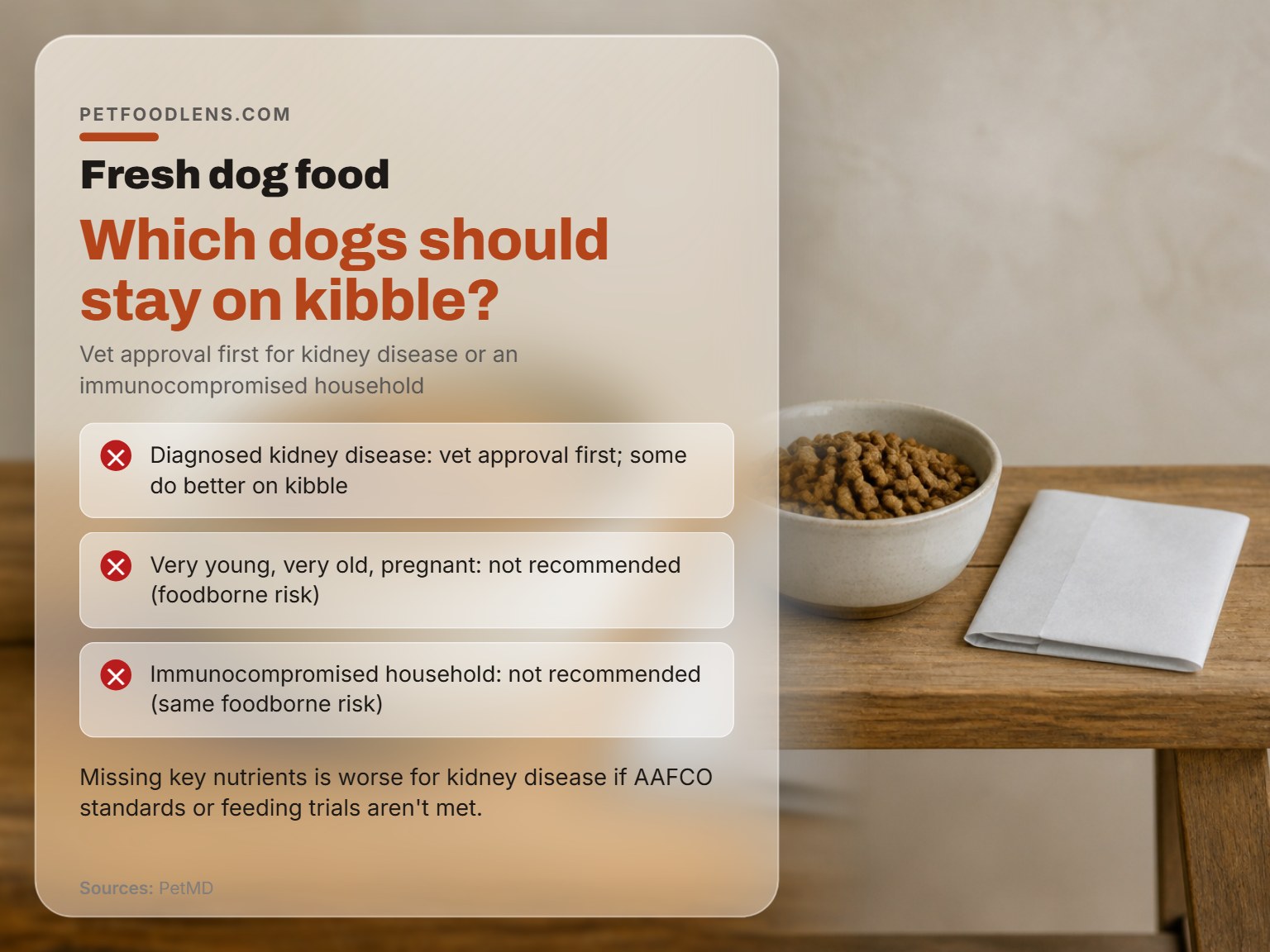
Two groups should not be switched without a veterinarian in the room: dogs with diagnosed organ disease, and dogs living with an immunocompromised person.
| Dog profile | Fresh food fit | Reason |
|---|---|---|
| Healthy adult, ideal weight | Reasonable | Complete-and-balanced options exist; digestibility measured higher |
| Diagnosed kidney disease | Veterinary approval first | PetMD notes some kidney patients do better on commercial kibble |
| Very young, very old, pregnant | Not recommended | Lower-temperature cooking and foodborne risk |
| Immunocompromised household | Not recommended | Same foodborne risk profile |
| Stable diet, chronic GI sensitivity | Case by case | Higher digestibility can overshoot, and a fiber deficit follows |
PetMD flags fresh food as unsuitable for very young, very old, pregnant, or immunocompromised dogs, citing lower-temperature cooking and foodborne risk. The same source notes that the risk of missing key nutrients is worse for dogs with conditions like kidney disease when AAFCO standards or feeding trials aren’t met.
I’m not a veterinarian. My comparisons come from labels and published data, and a blood panel beats both when an organ is involved.
Where this goes sideways: Switching a dog with kidney disease to a fresh diet because the ingredient panel looks cleaner. A therapeutic kidney formula from Hill’s or Royal Canin is built for the condition, and a general fresh recipe isn’t. The problem shows up in bloodwork, not on the scale.
Watch for these after any switch:
- Vomiting or loose stool that doesn’t settle once the transition is done.
- Weight loss you didn’t plan for.
- A dog that stops finishing meals on a food they used to clear.
Companies sometimes use high digestibility to justify a lower calorie recommendation per pound of body weight. Clinician’s Brief counters that higher digestibility changes the calorie calculation per gram of macronutrient but does not change the animal’s individual energy needs. Anyone shopping for fresh food for weight loss should hold that distinction firmly.
If the reason for switching is itchy skin, a fresh dog food for allergies comparison beats a general fresh diet, because the protein source matters more than the format.
Fresh, Raw, Home-Cooked, and Freeze-Dried Compared
Four formats get filed under the word fresh: gently cooked, raw, home-cooked, and freeze-dried.
PetMD lists the processing routes as gently cooked, high-pressure processed, air-dried, dehydrated, or freeze-dried. Those are different products with different risk profiles, and the front of the pack rarely makes the distinction obvious.
A thawed pack slumps into a wet, loose mash that smells faintly of cooked chicken and liver. That moisture is the point. PetMD notes fresh food typically holds substantially more water than dry food, which contributes to daily fluid intake, though canned food offers the same benefit.
Fresh vs Raw: The Distinction That Matters
FDA’s contamination data applies to raw product, and the agency says explicitly that raw and cooked fresh should not be conflated. Cornell’s guidance is that raw food should reach an internal temperature of 165°F before feeding.
That 165°F figure is the dividing line. A gently cooked fresh diet has been through heat. A raw patty has not, and some raw brands, Mae among them, are marketed as feedable straight from the freezer.
If a fresh diet doesn’t carry an AAFCO adequacy statement for your dog’s life stage, treat it as a topper and not a complete meal. Half a diet plus good intentions is still half a diet.
A fresh vs raw dog food comparison comes down to heat treatment first and ingredient quality second. Home-cooked dog food sits in a third category, where the recipe is yours and the nutrient math is also yours. Freeze-dried dog food solves the freezer problem and leaves the hydration problem in place.
Frequently Asked Questions
Is fresh dog food better than kibble?
“Better” needs a definition before it means anything. On digestibility, fresh diets measured higher in a controlled trial, with fewer daily defecations and less fecal calorie loss. On long-term health outcomes, PetMD describes the evidence as limited. On convenience and storage, kibble wins comfortably.
Do I need a second freezer for fresh dog food?
Not always, but plan for it. Clinician’s Brief notes owners may need a second fridge or freezer, or smaller and more frequent shipments. If your freezer is already full, a shelf-stable option like JustFoodForDogs JustFresh sidesteps the problem entirely.
Can I feed fresh dog food to a puppy?
PetMD flags fresh food as unsuitable for very young dogs because of lower-temperature cooking and foodborne risk. If you want to feed fresh to a puppy, involve a veterinary nutritionist and choose a diet carrying an AAFCO growth statement.
Is fresh dog food the same as raw dog food?
No. Fresh usually means gently cooked or high-pressure processed. Raw means uncooked. FDA states that its contamination data applies to raw product and shouldn’t be applied to cooked fresh food, and Cornell advises raw food reach 165°F internally before feeding.
How long does fresh dog food keep in the freezer?
PetMD’s guidance is to freeze at 0°F or lower and use within three months. Label each portion with the date, because identical packs become impossible to tell apart once they’re stacked.
The Bottom Line
Here’s the version I’d give a friend standing in my kitchen. For a healthy adult dog with a normal appetite, a complete-and-balanced fresh diet is a reasonable upgrade on digestibility grounds, and you pay for it in freezer space and planning.
One threshold decides most of this. If your dog has a diagnosed condition, or lives with someone immunocompromised, stop and call your vet before you order anything. The digestibility data doesn’t cover those dogs, and no amount of label reading substitutes for a diagnosis.
The first thing to do this week costs nothing. Pull up the brand’s site and find the AAFCO nutritional adequacy statement. If it isn’t there, you have your answer.
I’d rather see an owner run a complete kibble as the base and use fresh as a topper than switch the whole bowl and hope the formula holds up. That’s a less exciting answer than the one on the website. It’s also the one that survives a blood panel.
