
Small Breed Puppy Food Guide: Meals, Labels, and Switching
This post contains affiliate links. As an Amazon Associate, we earn from qualifying purchases.
Small breed puppy food starts with three numbers: an adult weight under 20 lb (9 kg), a body condition score of 4 out of 9, and an AAFCO growth statement that holds until skeletal maturity. Small breeds need more calories per pound than large ones, so the food is calorie-dense and the portions are tiny.
The skeletal maturity line is where the sources stop agreeing. VCA puts it at 6 to 9 months for toy breeds, Merck at 8 to 12 months for small and medium breeds, and a board-certified veterinary nutritionist writing in Clinician’s Brief puts small and medium breeds at about a year. The disagreement is about where to draw the line on the same growth curve.
What follows: the meal schedule, the label checks, and the measuring habits that hold up whichever date you pick. Plus the one number most owners never weigh.
Key Takeaways
- Weigh the kibble, don’t scoop it. VCA calls cups imprecise even when the same person feeds every time, and recommends a digital kitchen scale.
- Count meals by age, not by habit. VCA wants at least three small meals under 4 months; Merck and the AKC both land on two meals a day by 6 to 12 months, while VCA gives no puppy-age cutoff for dropping to two.
- Keep a growth or all-life-stages statement on the bag until skeletal maturity, which the four sources place anywhere from 6 months to a year for small breeds.
- Treats are the fastest way to unbalance a toy puppy’s diet. VCA says skip them during growth; Merck caps all treats at under 10% of daily calories.
- Watch body condition weekly. The target for a growing puppy is 4 out of 9, while the adult target is 4 to 5 on the 9-point scale.
What Actually Counts as a Small Breed Puppy?
The line sits at 20 lb (9 kg) of adult weight. VCA treats any dog that reaches 20 lb or less as toy or small, and the small breed puppy food guide uses the same 20-pound ceiling for small-breed dogs.
Small and toy breed puppies reach adult body weight faster than large breeds, with many small-breed dogs reaching adulthood by 9 months of age. Calorie needs per pound remain higher than in large breeds throughout growth, so portion size stays small while calorie density runs high. Body condition, not the calendar, sets the pace.
Small breeds also finish growing early. A large breed is still adding height well past a year, while a small-breed puppy is largely done. That compressed timeline is why the small breed puppy food guide feeding schedule below moves faster than the one you’d use for a Labrador.
Per pound of body weight, the small dog needs more calories. That’s VCA’s kcal/lb point, and it explains the whole design of a small-breed formula: more calories crammed into a smaller volume of food.
Kibble size is the other half of it. The AKC notes that smaller pieces are easier for a small puppy to grab and chew, and less of a choking hazard. If you’re comparing bags side by side, the small kibble dog food comparison is worth reading as its own category rather than a footnote.
Breed matters at the edges. If you’re feeding a Chihuahua, the Chihuahua puppy food question is really about kibble size and meal frequency, not a different nutrient profile.
How Many Meals a Day Does a Small Breed Puppy Need?
Meal counts for a young small-breed puppy vary by source: VCA asks for at least three small meals under 4 months, Merck sets three a day from weaning to 6 months (more for small breeds), the AKC recommends four to six, and Today’s Veterinary Nurse lands at three to four until 3 months.
Before you start: Toy-breed puppies can slide into hypoglycemia after a missed meal, so a skipped breakfast matters more than it looks. An unbalanced treat can swing calcium and phosphorus in a puppy this small. And extra calcium, phosphorus or vitamin D on top of a complete growth diet is rarely necessary and may be contraindicated.
Here’s the honest picture. VCA asks for at least three small meals for puppies under 4 months. Merck sets three meals a day from weaning to 6 months and adds that small-breed puppies may need more than three. The AKC goes higher, recommending four to six feedings a day for small and toy breeds specifically to prevent hypoglycemia. Today’s Veterinary Nurse lands at three to four feedings until 3 months of age.
| Age band | Meals per day | Source |
|---|---|---|
| Small and toy breeds, early weeks | 4 to 6 | AKC |
| 6 to 12 weeks | 4 | AKC |
| Under 3 months, toy and teacup | 3 to 4 | Today’s Veterinary Nurse |
| Under 4 months | At least 3 | VCA Animal Hospitals |
| Weaning to 6 months | 3, more for small breeds | Merck Veterinary Manual |
| 6 to 12 months | 2 | Merck and AKC |
The pattern inside that table is the useful part. Everyone agrees the count starts high and falls. Nobody agrees on the exact number at any given week, which means the right answer for your puppy is the count that keeps it eating steadily without a crash.
The AKC puppy feeding fundamentals timeline is the one I hand to new owners, because it puts ages next to meal counts instead of leaving them abstract.
The Hypoglycemia Window in Toy Breeds
Low blood sugar is the reason the meal count runs so high in toy breeds. The AKC explains it plainly: small-breed puppies have high metabolic rates and low sugar and body fat reserves, which makes hypoglycemia a real risk rather than a theoretical one.
Watch for weakness, lethargy, muscle tremors and seizures. A puppy heading that direction goes quiet and wobbly before anything dramatic happens, and the AKC’s guidance is to call your veterinarian immediately if you suspect it.
Easy to miss: A puppy that picks at breakfast and cleans up at dinner isn’t necessarily fussy. If the pattern repeats across several days, the portion is probably too large or the puppy is ready to drop a feeding.
Once the bowl is down, it comes up. The AKC says don’t leave food down more than 15 minutes, while the AKC Owner’s Manual (Puppy Nutrition) says 10 to 20 minutes. Pick a window and hold it, because a bowl that stays down all afternoon turns into a puppy that grazes instead of eating meals.
Reading the Label: What a Small Breed Puppy Food Guide Should Check First
Early in my first year of label work I cleared a food without reading its nutritional adequacy statement. It took a second pass to notice the can was built for supplemental feeding, not as a complete diet. That statement is now the first thing I look for on any bag or can, before the ingredient panel, before the guaranteed analysis, before anything.
The statement is the AAFCO nutritional adequacy statement, and it’s the only line on a pet food label with a legal definition behind it. VCA’s position is simple: if the label says the food is appropriate for puppies or for all life stages, the food is safe.
That single line does more work than the front of the bag. A bag can say “puppy” in three different fonts and still be a supplemental product. The VCA nutritional considerations for toy and small dogs lays out exactly which statements qualify.
The Two Routes to an AAFCO Statement
A food earns that statement one of two ways: it passed an AAFCO feeding trial, or it was formulated to meet the AAFCO nutrient profile for growth. VCA notes that a food using statement 2 or 3 hasn’t been through a feeding trial but is formulated to AAFCO levels, and calls it safe as well. The Tufts review in Clinician’s Brief treats formulation and feeding trial as two valid routes to the same conclusion.
Merck adds a detail that matters for this size class. Small and medium-breed puppies can be fed a growth or all-life-stage diet that doesn’t meet the criteria for large-breed growth. The large-breed statement reads “including growth of large size dogs (32 kg or more as an adult),” and your small-breed puppy doesn’t need it.
For a first bag, choose a small-breed puppy food with small kibble sized for a mouth that’s still small and a formula in the small-breed growth range. Other small-breed puppy foods with similarly small kibble are also widely used. A third option is any small-breed puppy food sold in a bag size that won’t go stale before a toy puppy finishes it.
If you want the shortlist rather than the reasoning, the small breed puppy food comparisons cover the same ground product by product. For owners who’d rather feed dry, the dry puppy food options are where kibble size and calorie density get weighed against each other.
When Do You Switch From Puppy Food to Adult Food?
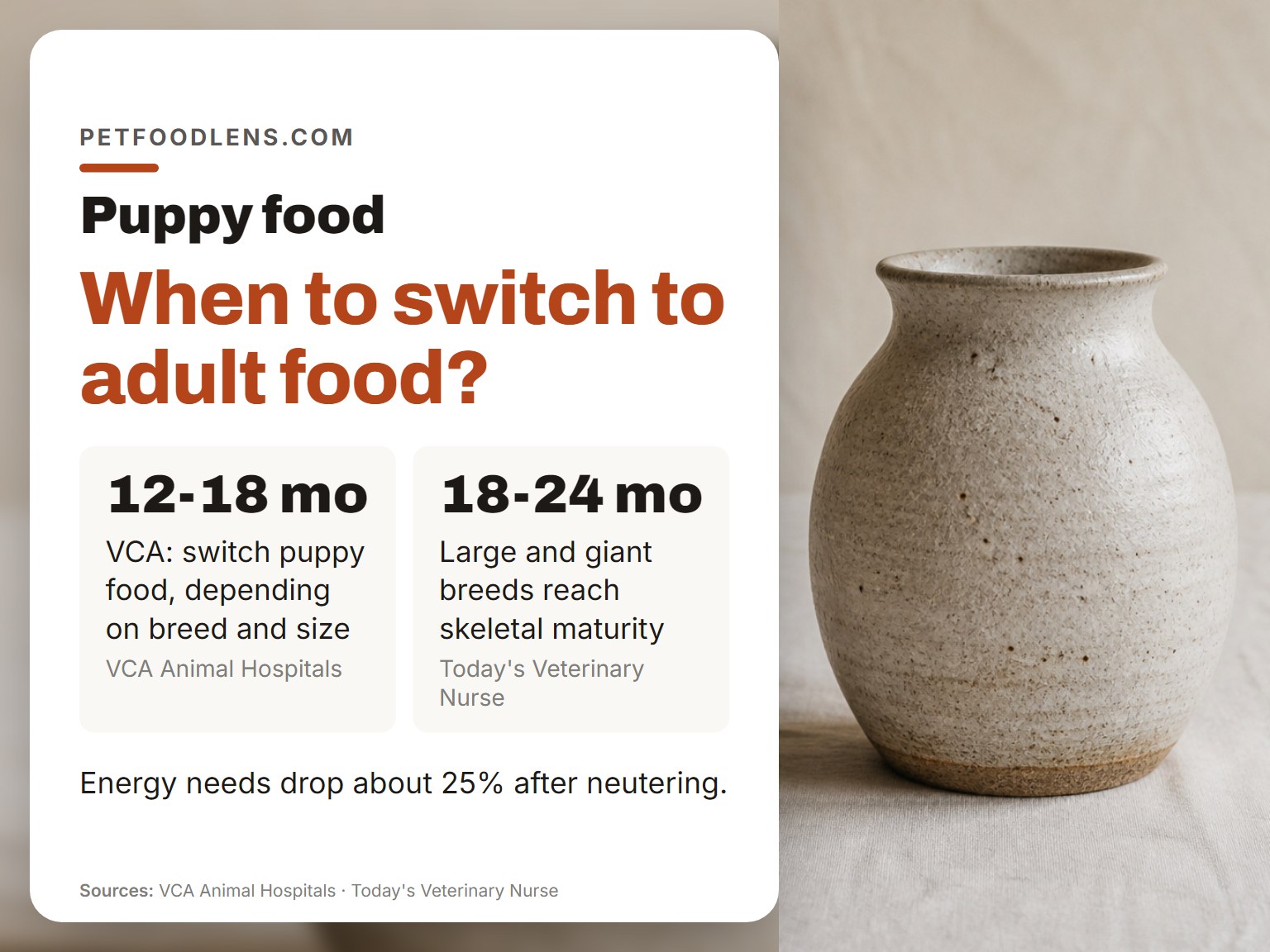
Six months or twelve? The four sources split, and the split is wider than most owners expect.
| Source | Switch age for small breeds | Basis given |
|---|---|---|
| VCA Animal Hospitals | 6 to 9 months (toy), 8 to 10 months (small) | Skeleton fully grown |
| Merck Veterinary Manual | 8 to 12 months | Skeletal maturity in small and medium breeds |
| AKC | 7 to 9 months | Small breeds reach adulthood by 9 months |
| Clinician’s Brief (Tufts) | About 1 year | Skeletal maturity in small and medium breeds |
Read that table as a range, not a contradiction. Every source is aiming at the same event, which is the point where the skeleton stops growing. They differ on when that event lands.
Merck offers a trigger that doesn’t depend on a calendar at all: switch to a less nutrient-dense diet once the dog reaches about 90% of its expected adult weight. That’s a more useful marker than a birthday, because it’s measured on your dog.
Pick the switch date from your puppy’s growth chart, not from the bag. A puppy at 90% of expected adult weight is further along than a puppy that merely turned 8 months old.
The Merck Veterinary Manual feeding practices reference is where that 90% figure comes from, and it’s worth reading alongside VCA’s version rather than instead of it.
How to Make the Switch Without Loose Stools
Today’s Veterinary Nurse gives the cleanest protocol I’ve found, and it’s four days long.
- Start on a day when nothing else changes. The same reference says not to begin a diet transition on the first day in a new home. Move house and switch food in the same week, and the puppy refuses dinner and you blame the formula.
- Add a quarter of the new food each day, over four days. Remove the old food in the same increments. Skip the step and the result is loose stools and a puppy that goes off its food entirely.
- Weigh the blend, don’t eyeball it. A quarter-by-volume estimate drifts badly when the two kibbles are different sizes, and the four-day ramp stops being a ramp.
The AKC’s version is looser, calling for a gradual switch over a few days, and both land in the same place. Slow beats fast.
Once the switch is done, the small breed dog food question changes shape. You’re no longer buying for growth, so the calorie density that was an asset becomes something to watch.
Why Calorie-Dense Food Cuts Both Ways
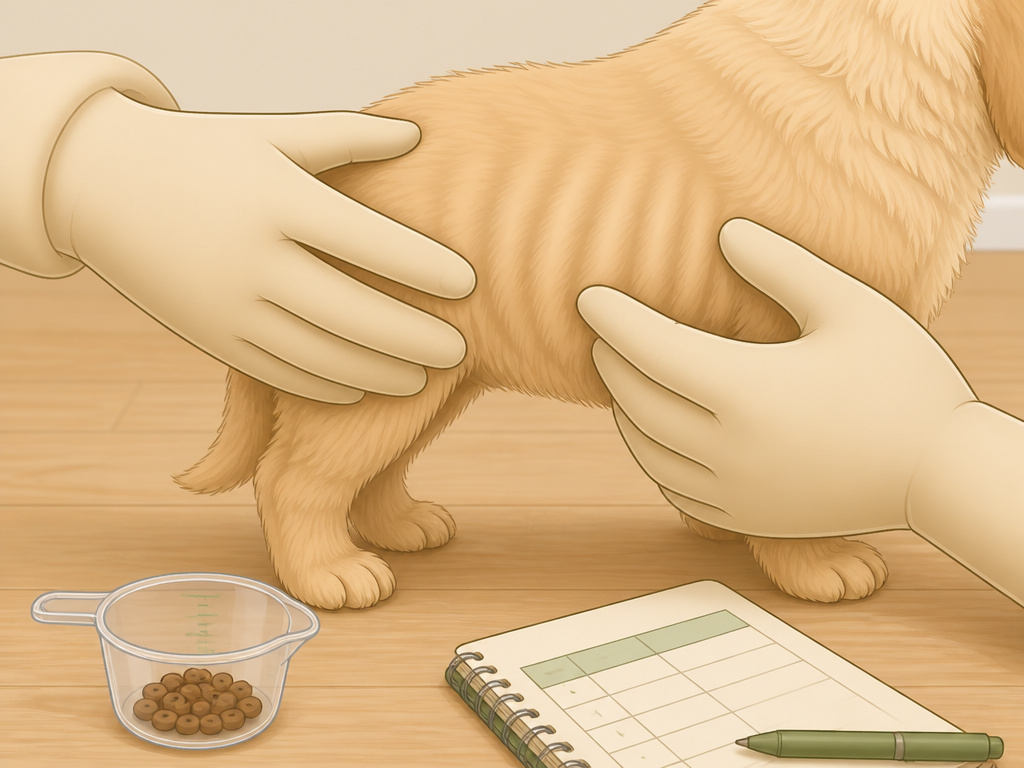
Every guide repeats that small breeds need calorie-dense food. That same density is why these puppies get round.
VCA makes the mechanism explicit. Diets for toy and small dogs may run higher in fat than other diets, fat carries more calories than the same weight of protein or carbohydrate, and the result is more calories per cup. More calories per cup means excessive weight gain becomes a live concern rather than a distant one.
The AKC Owner’s Manual adds the behavioral half. Small-breed dogs tend to be more pampered and less active than larger breeds, so an owner feeding a high-calorie small-breed formula has to be careful not to overfeed.
Merck frames the growth-stage risk. Overfeeding during growth increases growth rate, which is incompatible with proper skeletal development and contributes to obesity later in life. Merck’s stated preference is a slow growth rate over a fast one.
What most people get wrong: Reading a clean bowl as a hungry puppy. A small-breed puppy on a dense food can meet its whole day’s calories in a portion that looks like a garnish, and the evidence shows up at the next weekly weigh-in.
That’s why body condition beats the scale number on its own. VCA’s target is 4 to 5 on the 9-point scale for adults, and 4 out of 9 for puppies specifically, to keep them from tipping overweight.
Run your fingers along the ribs of a puppy at 4 out of 9 and you feel them under a thin layer, not under a cushion. Stand above the dog and there’s a waist behind the rib cage. Lose that waist and you’ve already overshot.
Weigh weekly and write it down. The AKC recommends recording progress against breed-appropriate weight charts and adjusting intake to hit an average growth rate, and the AKC puppy nutrition ebook has the chart logic laid out page by page. VCA adds that any growth chart should be built on the puppy’s sex and expected adult weight, since both change the curve.
If you’re feeding a toy breed specifically, the toy breed puppy food comparison is where the density question gets sharpest, because the margin for error shrinks with the dog.
Measuring Portions: Why the Cup Lies
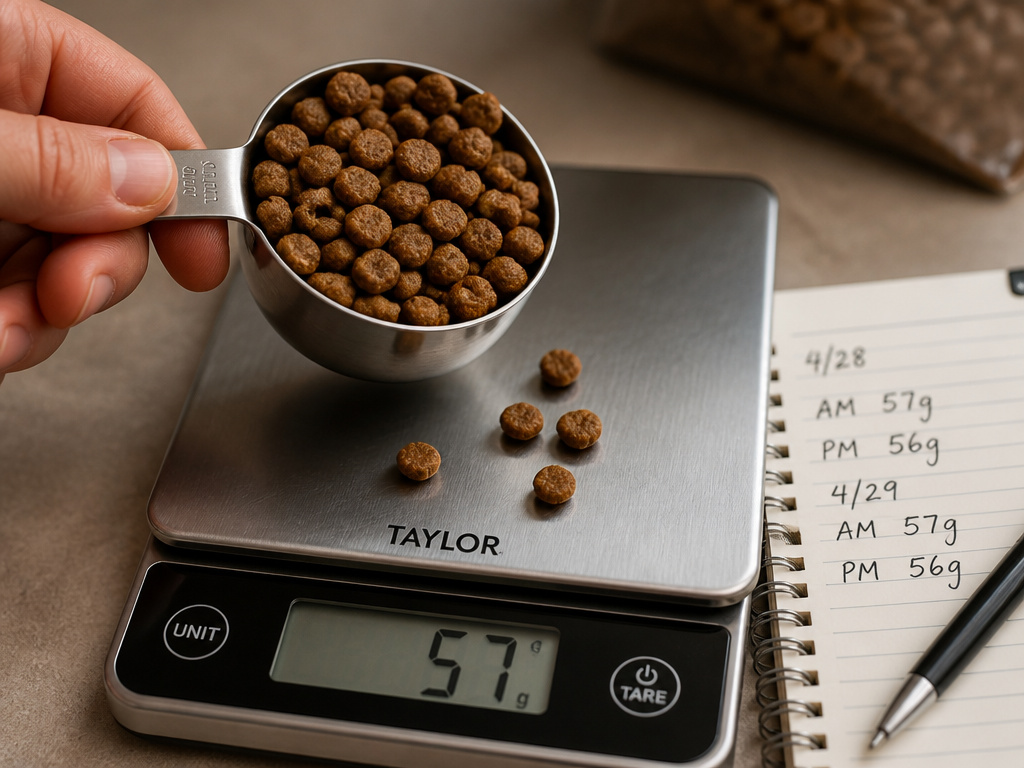
A cup is not a unit of weight, and small-breed portions are where that difference bites hardest.
VCA is direct about it: measure the amount you feed, ideally on a digital kitchen scale, because cups aren’t precise even when the same person feeds every time. Merck’s framing is that any daily feeding recommendation is an estimate or a starting point, modified by weight, condition, skin and coat, performance and attitude.
Tap a measuring cup once and the kibble settles. Tap it three times and you’ve added a mouthful without changing the reading. On a small puppy, a mouthful is a meaningful share of the day.
I weigh the first scoop of every new bag and write the number on the lid. Three weeks later, when the puppy looks a little round, I know whether the portion changed or the puppy did.
I built a cost-per-calorie spreadsheet early in my career with a formula error that made one food look far cheaper than it was. I caught it only because the number didn’t match a hand calculation on one row. Now I verify at least one row by hand before I trust any total.
The same discipline applies to portion math. If a bag’s feeding table gives you a range, weigh the low end first and adjust upward from the weekly numbers rather than starting high.
Merck’s adult recommendation is two premeasured meals at regular times each day, and the word doing the work there is premeasured. The dog food portion guide by breed size is a reasonable starting reference, and the scale is what turns a reference into a plan.
Treats, Water, and the Extras That Unbalance a Diet
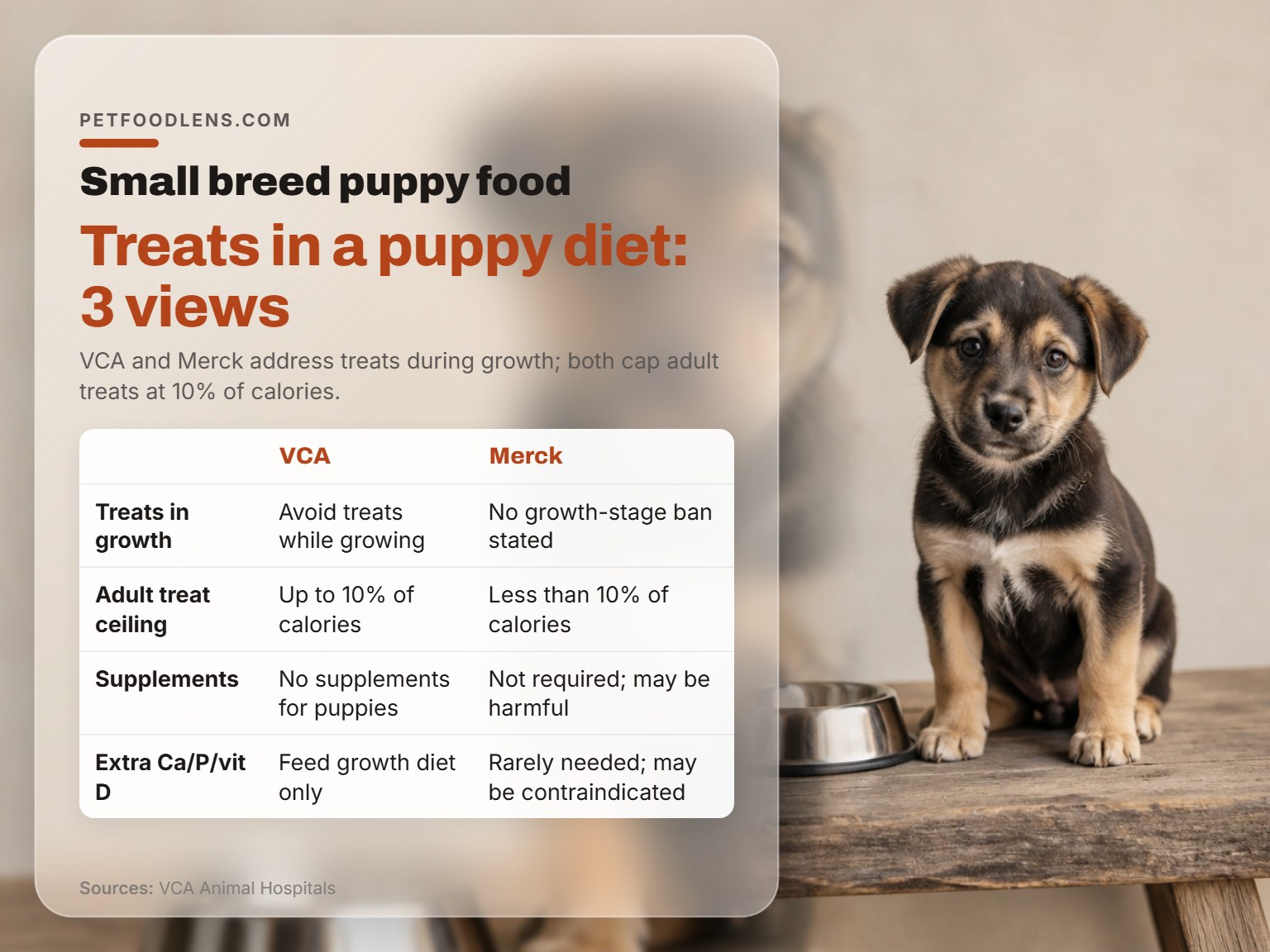
Treats are where a tight calorie budget comes apart, and the sources don’t fully agree on how to handle them during growth.
VCA’s position is the strictest. To avoid unbalancing a puppy’s diet, avoid treats and other foods while the puppy is growing. Once the dog is an adult, up to 10% of calories can come from treats or foods that aren’t complete and balanced.
Merck sets the 10% ceiling without a growth-stage prohibition, framing it as a way to prevent nutrient deficiencies across the board. The AKC Owner’s Manual takes a third position: treat-based training is fine as long as you reduce the mealtime amount to compensate and keep each treat as small as possible.
Three positions, one practical rule. If you train with food, the treats come out of the daily total, not on top of it. And in a toy breed, the stakes are higher than the calorie count suggests.
VCA notes that in toy breeds even a small inappropriate portion of treats or unbalanced food can quickly produce a deficiency or excess of calcium and phosphorus. That’s the part that gets skipped in most treat advice. It isn’t only about weight.
Supplements belong in the same conversation. Merck states that nutritional supplements aren’t required and may be harmful in some cases, and that supplementing calcium, phosphorus or vitamin D beyond what a complete and balanced growth diet already provides is rarely necessary and may be contraindicated.
Water is the one thing that should never be restricted. VCA calls for constant access while avoiding excessive drinking, and the AKC Owner’s Manual adds a detail most owners skip: wash the water bowl daily to keep bacteria from building up.
If you’re going to use treats, the small puppy treats list is worth reading with the 10% ceiling in mind rather than as a shopping list.
Frequently Asked Questions
How much should I feed a small breed puppy?
Start with the low end of the range on the bag and treat it as an estimate, which is exactly how Merck describes any daily feeding recommendation. Weigh the portion on a digital kitchen scale rather than scooping it, then adjust based on weekly weight and body condition. VCA’s target for a growing puppy is 4 out of 9 on the body condition scale.
Can I give my small breed puppy treats while training?
The sources split. VCA advises avoiding treats entirely while the puppy is growing. Merck caps total daily treats at under 10% of caloric intake. The AKC Owner’s Manual allows treat-based training if you reduce the mealtime portion to compensate and keep treats as small as possible. Whichever you follow, the calories come out of the daily total.
When can a small breed puppy switch to adult food?
Somewhere between 6 months and a year, depending on which source you follow. VCA says 6 to 9 months for toy breeds and 8 to 10 months for small breeds, Merck says 8 to 12 months, the AKC says 7 to 9 months, and Tufts puts small and medium breeds at about a year. Merck’s alternative trigger is roughly 90% of expected adult weight.
Do small breed puppies need supplements?
Merck states that nutritional supplements aren’t required and may be harmful in some cases. Extra calcium, phosphorus or vitamin D on top of a complete and balanced growth diet is rarely necessary and may be contraindicated. If a veterinarian has diagnosed a specific deficiency, that’s a clinical decision rather than a feeding one.
How do I know if my puppy is at a healthy weight?
Use body condition scoring rather than the scale alone. VCA’s target is 4 to 5 on the 9-point scale for adults and 4 out of 9 for puppies. Weigh weekly, record the number, and compare it against a growth chart built on your puppy’s sex and expected adult weight.
Why does my small breed puppy need more calories than a big dog?
Per pound of body weight, small and toy dogs need more energy than large dogs, which VCA states directly. Small-breed puppies also have high metabolic rates and low sugar and body fat reserves, which is why the AKC flags hypoglycemia as a specific risk for this size class.
The Bottom Line
If you change one habit this week, make it the scale. Put the scoop away, weigh the next meal, and write the number where you’ll see it. That single change fixes portion drift before it turns into a body condition problem.
Your switch-to-adult-food trigger is roughly 90% of expected adult weight. Not a birthday, not the number on the bag. Merck’s marker is measured on your dog, and it survives the fact that four credible sources can’t agree on whether that day lands at 6 months or 12.
One concession, and it matters. This all assumes a healthy puppy with no diagnosed condition. If your puppy has had a hypoglycemic episode, is on a prescription diet, or is losing weight between weekly checks, the schedule above is a starting point and your veterinarian sets the real one. I read labels for a living and I still don’t diagnose.
