
Hummingbird Feeder Pros and Cons: What Actually Matters
This post contains affiliate links. As an Amazon Associate, we earn from qualifying purchases.
The hummingbird feeder pros and cons come down to cleaning and placement. A feeder gives you close-up birds and supplements natural nectar, but sugar water spoils fast. Cornell Lab says refill every three days at 80 F; the National Wildlife Federation says daily or every other day in hot weather.
The spoilage clock runs at different speeds in different yards. A 2013 field study in Oklahoma found feeder solution clouded after 97 growing degree days in full sun and 178 in full shade.
What follows is the split, honestly: what a feeder gives you, what it costs you in labor, and the three design choices that decide which side of the ledger you land on.
Key Takeaways
- Clean every three days at 80 F per Cornell Lab. Its threshold tightens to two days or less above 90 F, while the National Wildlife Federation and Melanie Furr say daily or every other day in hot weather.
- Shade delays cloudiness. Cloudiness arrives at 178 growing degree days in shade versus 97 in full sun.
- Sources split on soap. The National Wildlife Federation says avoid soap and use hot water and weak vinegar; Perky-Pet’s manual and Cole’s recommend mild or hot soapy water.
- Two small feeders beat one large one. A dominant bird can only defend a single feeder.
- Inside 3 feet of glass beats 3 to 25 feet. The middle distance is the strike zone.
The Real Hummingbird Feeder Pros and Cons
A feeder supplements native plants and insects. It does not replace them. That framing comes straight from the National Wildlife Federation feeder guide, and it settles most of the argument before you hang anything.
Sugar water ferments as growing degree days accumulate. A 2013 Oklahoma field study measured clarity loss and found the solution clouded after 97 growing degree days in full sun and 178 in full shade. Sucrose concentration had no significant effect on clarity. Neither the yeast nor the bacterium found in the solution is thought toxic to hummingbirds.
The pros are real. You get close-up views of birds that normally stay in the canopy, and a well-placed feeder pulls hummingbirds into a yard that already has flowers. If your yard is bare, start with plants and use a feeder to attract hummingbirds to the spots you can actually see from a window.
The cons are labor. Sugar water is a growth medium. Warm it up and it becomes a better one. Everything else here follows from that single fact.
Mix the nectar at one part white sugar to four parts water, the ratio Cole’s, Vox, and Maryland DNR give. Honey ferments faster than sugar water and should never go in a feeder.
The Cleaning Interval Four Sources Cannot Agree On
Four credible sources give four different summer cleaning numbers. That gap is the first thing to understand about feeder hygiene, because it tells you the interval is a judgment call, not a settled rule.
| Source | Summer interval | Trigger |
|---|---|---|
| National Wildlife Federation | Daily or every other day | Hot weather |
| Cornell Lab of Ornithology | Every 3 days | 80 F |
| Cornell Lab of Ornithology | 2 days or less | Above 90 F |
| Becker et al. 2013 | Every 4 to 6 days | Summer |
| Melanie Furr (via Vox) | Daily or every other day | Hot weather |
Read the table by temperature, not by source. Cornell’s numbers are the only ones tied to a thermometer, and they tighten as the mercury climbs.
Why the Numbers Diverge
The Bulletin of the Oklahoma Ornithological Society study is the outlier at four to six days. A clear feeder is not automatically a safe one.
Spring and fall split even wider. Becker puts the interval at 10 to 18 days. Furr puts it at two to three days. The National Wildlife Federation lands near three days.
Cleaning intervals vary by source, from daily or every other day in hot weather to every four to six days in summer. The cost of an extra scrub is small; the cost of a spoiled feeder is a sick bird.
The part nobody mentions: Cloudiness is a visible cue, not a full safety test. A feeder can look clear and still be growing the yeast and bacteria that rehabbers report in sick birds.
Saucer vs Bottle: Which Design Survives Your Schedule
Which feeder design actually gets cleaned on schedule? That question matters more than capacity or color, because the feeder you skip is the one that harms birds.
| Design | Cleaning effort | Drip risk | Best for |
|---|---|---|---|
| Saucer | Bowl lifts out, few parts | Low; no inverted reservoir | Hot climates, daily cleaners |
| Bottle | Narrow neck, more parts | Higher in direct sun | Cooler climates, larger yards |
| Window-mount | Small, frequent refills | Low | Close viewing |
Why Saucers Win on Cleaning
The bowl lifts out of a saucer in one motion. There is no narrow neck to scrub and no inverted reservoir dripping onto your wrist while you work.
The Southeastern Avian Research feeder review lands on the same conclusion: fewest parts, base separates in two, ports molded into the lid.
Where Bottles Still Make Sense
Bottle feeders hold more and hang from a single hook, which suits a yard with one good viewing spot. They also drip more in direct sun, and a dripping bottle draws wasps.
If you want a bottle that does not soak the ground, look at leak proof hummingbird feeders and read the port design before the capacity.
For most yards, a saucer wins. The Aspects HummZinger Excel (item 143) is a saucer design with a removable bowl, built-in ant moat, and a lifetime guarantee, priced $34.96.
If you want a second feeder for a different corner, the Aspects HummZinger Ultra (model 367) holds 12 ounces across four ports and hangs out of sight of the first.
Bottle fans have options too. The Perky-Pet Diamond Wine Top Fill holds 24 ounces and fills from the top, so you are not flipping a full reservoir over the sink.
The full types of hummingbird feeders breakdown covers the third category, window-mount units, in more detail.
The Placement Rules That Decide Whether Birds Crash
A feeder hung 3 to 25 feet from glass sits in the strike zone. The National Wildlife Federation puts the risk band there because birds build up speed in that gap and do not see the window until it is too late.
Inside 3 feet, the geometry flips. Birds slow down, notice the glass, and pull up. Cornell Lab notes that hummingbirds come readily to window hummingbird feeders and will use suction-cup mounts on the glass itself.
Cornell also recommends the coolest part of the yard with some wind protection. Shade does double duty: it slows fermentation and it keeps the feeder from baking in afternoon sun.
Common mistake: Hanging the feeder where you can see it best. The best viewing spot is often right against the glass, which is fine, or four feet out, which is the worst possible distance.
Which Feeder Features Are Worth Paying For
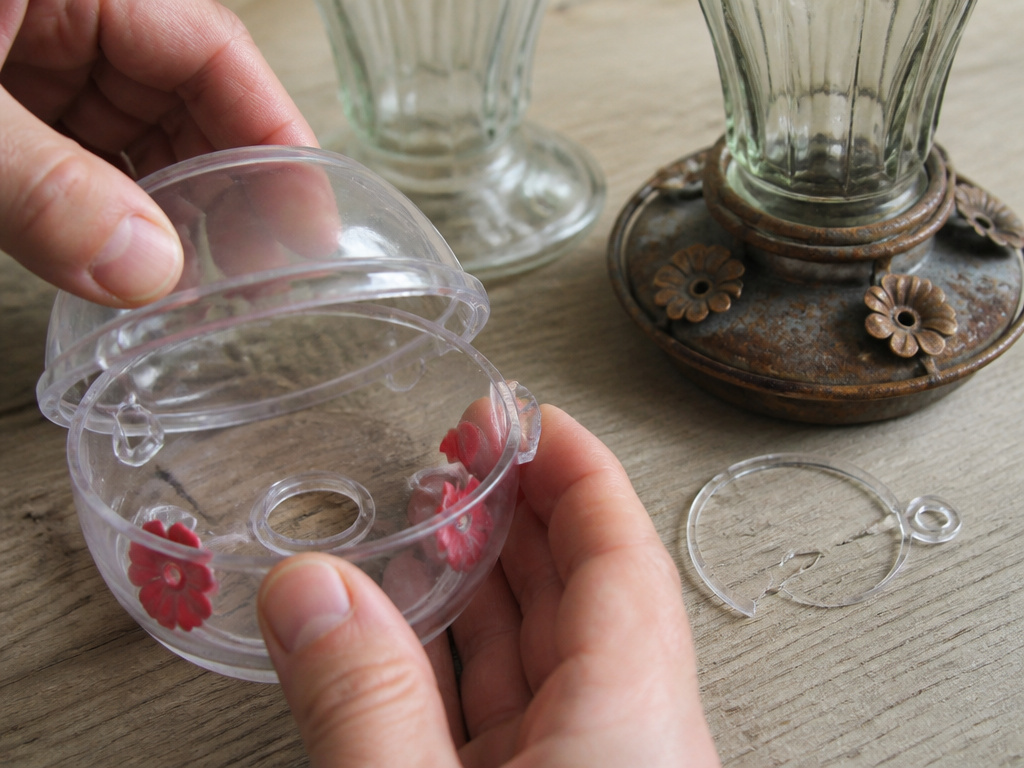
The Southeastern Avian Research review advises avoiding all metal-base feeders, because metal bases rust from the inside first and the rust leaches iron into the nectar.
Here is what to look for instead:
- Fewest parts. Every extra seam is a place mold hides.
- Red port flowers molded into the base lid, not glued on.
- A base that separates in two so you can reach the interior.
- Oval or round ports, never slits. Hummingbirds have been documented catching bills in slits.
- Metal hangers. Plastic hangers break under a full reservoir.
A built-in ant moat helps, but only if you keep it filled. Cole’s Hummer High Rise molds one into the bowl and asks for two-thirds water.
Bees and wasps are a separate problem. Moving the feeder a few feet confuses them for a while, per Cornell. A design with tight port seals does more, and bee proof hummingbird feeders list that feature first.
If bees are already established, start with the drip. The keep bees away from feeders approach removes the puddle first, not the feeder.
Owners report the Perky-Pet 203CPBN hanging loop is thin and eventually breaks under the weight of nectar. The same reports say the plastic ports crack and leak, and Perky-Pet does not sell replacement parts.
The 203CPBN is an 8-ounce glass feeder with four ports and built-in bee guards. Just know the loop is the weak point.
When a Feeder Does More Harm Than Good
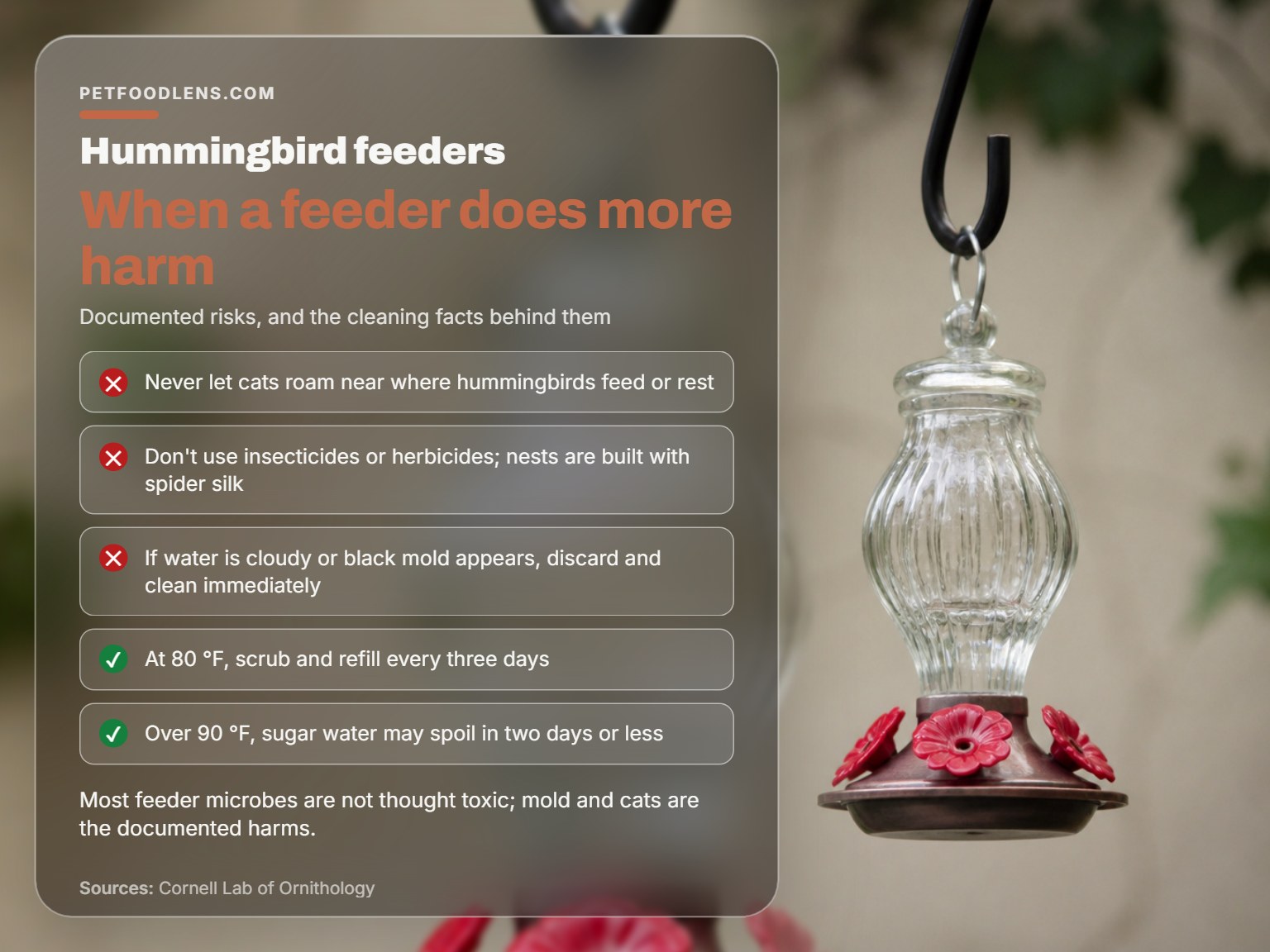
Two studies say most feeder microbes are not dangerous to hummingbirds. A rehabber says individual infections are fairly common. Both are true, and holding them together is the honest position.
The Vox feeder hygiene explainer lays out the split. A 2019 study found most feeder microbes are benign. Melanie Furr, a licensed rehabber in Georgia, reports candida-type fungal infections that swell a bird’s tongue and put it at risk of starvation.
The yeast and bacterium found in the Oklahoma study, Saccharomycetales and Methylobacterium extorquens, are not thought toxic. That finding covers two organisms, not a feeder left out too long.
The bigger harms are documented and boring:
- Cats. Cornell says never let cats roam near where hummingbirds feed or rest.
- Pesticides and herbicides. Skip them entirely; hummingbirds build nests with spider silk.
- Mold. Discard the solution and clean at the first sign of cloudy water or black mold.
Before you start: A feeder brings birds to a fixed point, and a fixed point is easy for a cat to watch. Hang it high, away from furniture a cat can launch from, and keep the ground below clear of brush. Skip yard chemicals for the season, because spider silk is nest material.
The hummingbird feeders roundup covers models with tighter port seals and fewer mold traps, if you want to reduce the cleaning burden without giving up the hobby.
How to Clean a Feeder Without Ruining It
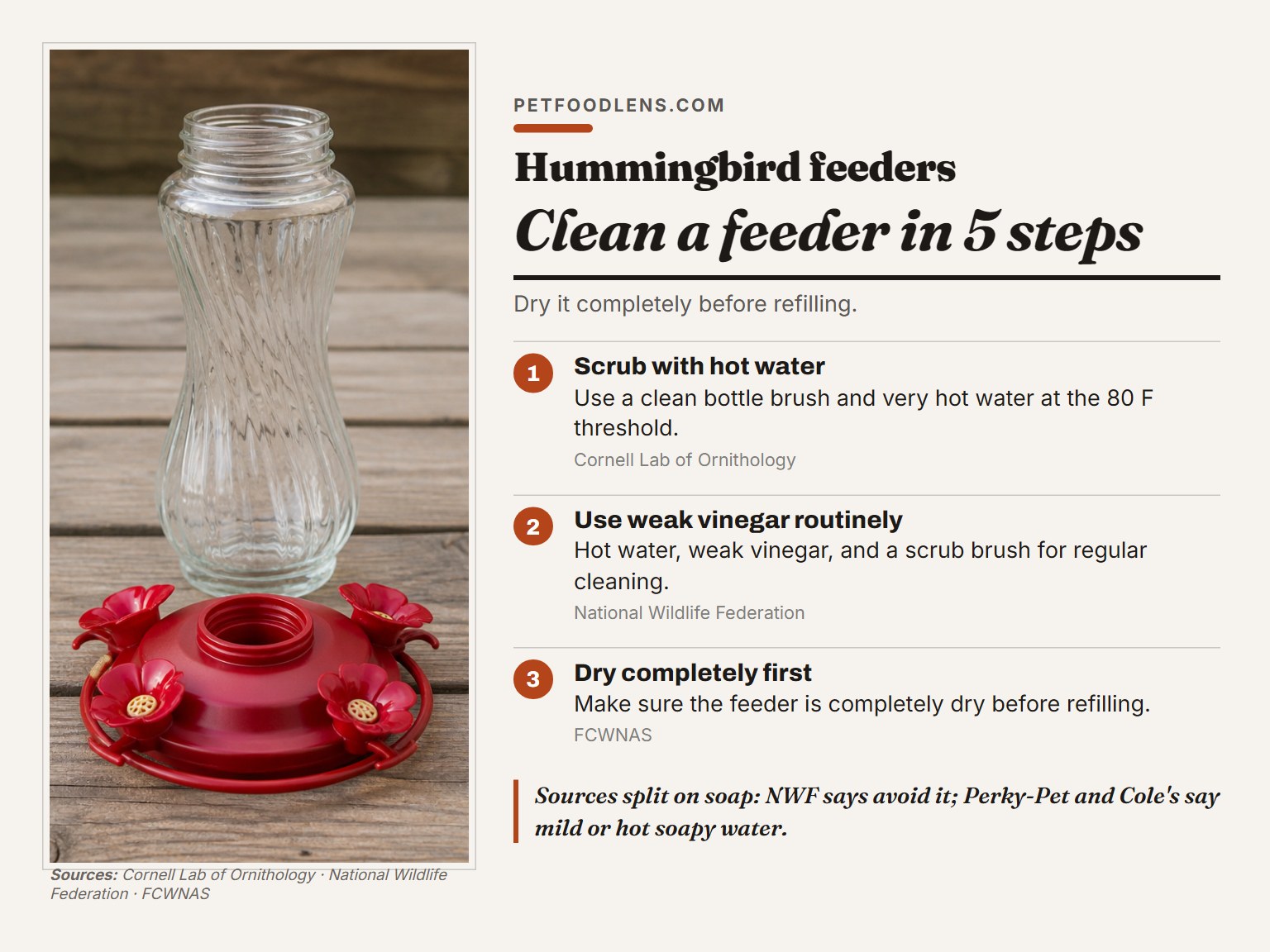
Five steps, and the fourth one is the one people skip.
- Empty and disassemble. Dump the old nectar down the sink. Leaving it in the garden just feeds ants.
- Scrub with hot water and a bottle brush. Cornell asks for a clean bottle brush and very hot water at the 80 F threshold.
- Use weak vinegar for routine cleaning. The National Wildlife Federation recommends hot water, weak vinegar, and a scrub brush.
- Dry completely before refilling. Chad Witko of the National Audubon Society says a wet feeder grows bacteria faster.
- Refill with cooled nectar. Let the sugar solution reach room temperature first.
The Soap Question
Soap is where the sources split. The National Wildlife Federation says avoid soap because it leaves a harmful residue. Perky-Pet’s 203CPBN page says mild soap and water. Cole’s says hot soapy water or the top rack of a dishwasher.
The National Wildlife Federation says avoid soap because it leaves a harmful residue, while Perky-Pet and Cole’s recommend mild or hot soapy water.
The Cornell Lab Attracting Hummingbirds PDF ties the interval to 80 F and 90 F, and it adds a monthly vinegar soak.
For a deep clean, soak the feeder in a 1:2 ratio of vinegar and warm water for a few hours. Cornell asks for one hour in weak vinegar at least once a month, and immediately if you spot black mold.
A spoiled feeder shows it before you smell it. If you see cloudy water or black mold, Cornell says discard the solution and clean the feeder immediately.
Cornell says boiling the sugar water isn’t necessary if your drinking water is safe, as long as you change the solution every few days. Maryland DNR says boiling the water kills potential fungi and bacteria.
Nectar keeps in the fridge, but the sources disagree on how long. The National Wildlife Federation says up to a week. Cornell and Vox both say up to two weeks. Label the jar with the date you made it.
Skip this if: You cannot commit to a regular cleaning schedule in summer. A neglected feeder draws birds to a contaminated food source.
Frequently Asked Questions
How often should you clean a hummingbird feeder in summer?
Cornell Lab says every three days at 80 F and every two days or less above 90 F. The National Wildlife Federation says daily or every other day in hot weather. The Becker et al. 2013 study says every four to six days. Go with the shortest interval that fits your climate.
Is red food coloring safe for hummingbirds?
No. Cornell Lab calls red food coloring completely unnecessary and possibly harmful. FeederWatch says not to add it. The National Wildlife Federation notes that red coloring on the feeder itself helps attract birds, which is a different thing from dye in the nectar.
Do hummingbird feeders attract bees and wasps?
Yes, especially bottle feeders that drip. Cornell suggests moving the feeder a few feet to confuse returning insects. A built-in ant moat and tight port seals do more over time.
Can you leave a hummingbird feeder out in the rain?
What is the right sugar-to-water ratio?
One part white sugar to four parts water, the ratio Cole’s, Vox, and Maryland DNR give. Never use honey.
Do hummingbird feeders actually help hummingbirds?
They supplement native plants and insects, which is how the National Wildlife Federation frames them. A clean feeder adds a food source. A dirty one adds a disease vector.
The Bottom Line
Here is the practical takeaway. If your yard loses afternoon shade, buy a saucer, hang it inside 3 feet of glass, and plan on cleaning daily or every other day in hot weather.
The hummingbird feeder pros and cons do not balance evenly. The pros are visual and immediate. The cons are a scrub brush and a timer, all season.
Start with one feeder, not three. Watch how long the nectar actually lasts in your yard before you buy a second. The birds will tell you whether the first one was worth it.
