
How to Use a Feeding Ring: Sizing and Setup
This post contains affiliate links. As an Amazon Associate, we earn from qualifying purchases.
How to use a feeding ring starts with matching the ring to the animal and the feed. A horse hay ring needs a bale that fills it, a squirrel-deterrent ring needs 14 inches of clearance, and a pet slow-feeder ring needs to match your cat’s eating speed. The ring controls access. It doesn’t control how much goes in the bowl.
Every ring feeder is a compromise between access and restriction. Give the animal too much room and the feed ends up on the ground. Give it too little and the animal can’t eat enough to hold weight. The specs on the box tell you which side of that line the ring sits on, if you read them.
What follows covers the three ring feeders you’re most likely to meet: a horse hay ring, a squirrel-deterrent bird feeder, and a pet slow-feeder ring. Each one has setup numbers that matter more than the marketing copy.
Key Takeaways
- Match the ring to the feed, not the photo on the box. A hay ring sized for a round bale won’t help a square bale, and a squirrel ring hung too close to a rail won’t trip.
- The Martinson trial measured 19% hay waste for its Ring feeder, against 57% with no feeder at all.
- The study concluded that more restrictive feeders resulted in less hay waste, but it also grouped the Ring with three others as statistically indistinguishable.
- A squirrel-deterrent ring needs 14 inches of clearance so the squirrel puts full body weight on the perch.
- Skip the ring if the animal is small enough to lean across it. The trigger never fires.
What Counts as a Feeding Ring, Exactly?
A feeding ring is a physical barrier that limits how far an animal can reach into a feed source. Ring diameter, bar spacing, and height set the trade-off between access and restriction, and those three dimensions determine how much feed is pulled free versus wasted.
“Feeding ring” is a category name, not a product. It covers three different things, and the setup rules don’t transfer between them.
- A round-bale ring feeder for livestock. A metal or poly cage that drops over a hay bale. The animal reaches through the bars, and the cage holds the bale together so it doesn’t scatter.
- A squirrel-deterrent bird feeder with a weight-triggered perch ring. The ring is a sensor. A squirrel’s weight trips a motor that spins the perch; a bird’s weight doesn’t.
- A pet slow-feeder or puzzle ring. A ring-shaped obstacle inside a bowl or on a mat. The cat or dog has to work around it, which stretches the meal out.
Three products, one name. That’s the first thing to sort out before you buy anything.
The category name is doing too much work. If a product page says “feeding ring” and nothing else, you don’t yet know what you’re looking at.
How to Use a Feeding Ring on a Round Bale
Twenty-five horses, nine feeders, and one no-feeder control. That’s the setup behind the most-cited trial on round-bale ring feeders, run by Martinson and colleagues and published in the Journal of Animal Science in 2011. The full study PDF is hosted by the University of Nebraska.
The trial used 50 orchardgrass round bales, baled in June 2010. Horses were fed 20 consecutive days per feeder in 4-day rotation cycles. The study is worth reading in full because the numbers don’t line up the way a summary would suggest.
| Feeder | Mean hay waste | Intake (% body weight) | Payback period |
|---|---|---|---|
| R & C Livestock Ring | 19% | 2.1% | 2 months |
| Tombstone Saver | 13% | Not reported | Not reported |
| Waste Less (JSI Innovations) | 5% | 2.3% | 8 months |
| No feeder (control) | 57% | Reduced | Not applicable |
The no-feeder control is the number to keep in mind. Fifty-seven percent mean hay waste, reduced intake, and horse weight loss. That’s the failure mode a ring is supposed to prevent.
The Ring feeder itself measured 19% mean waste, 2.1% body weight intake, and zero herd weight change. Payback was 2 months at the hay price the study assumed. For most horse setups, the R & C Livestock Ring is the one with the most direct evidence behind it, because the trial measured that exact unit.
The disagreement inside the study
The Ring’s 19% was statistically grouped with the Tombstone, Cone, and Tombstone Saver. No significant difference among circular feeders.
But the same paper concludes that more restrictive feeders resulted in less hay waste, and the Tombstone Saver measured 13% against the Ring’s 19%.
Both statements are in the paper. A reader who quotes only one is quoting half the result. The study both grouped the Ring with three other circular feeders as statistically indistinguishable and concluded that more restrictive feeders resulted in less hay waste, with the Tombstone Saver at 13% versus the Ring’s 19%.
The prior-literature gap
The study also cites earlier work that found ring feeders cut waste to 2% on bermudagrass and 9% on alfalfa, against 38% and 31% with no feeder.
Those numbers are much better than the 19% this trial measured. Different forage, different ring design. Don’t merge them into one “ring feeders waste X%” claim.
What the trial did and didn’t test
Pure orchardgrass, 50 bales, one growing season. No alfalfa, no bermudagrass, no mixed grass. The study says so directly: results may not transfer to other forages.
If your hay is alfalfa, treat the 19% as a starting point, not a promise. I don’t work with horses, so I’ll stick to what the trial actually measured.
Worth knowing before you start: The 19% figure is a mean across 25 horses, with 20 consecutive days per feeder in 4-day rotation cycles. Your herd’s waste will land somewhere around it, not exactly on it. Weigh your hay in and weigh what’s left on the ground if you want your own number.
The burrowing problem
Horses fed inside the Hayhut, Tombstone, Ring, and Tombstone Saver all created distinct burrowing holes. That’s a wear issue for dirt paddocks. The ring doesn’t stop a horse from pawing a hollow into the ground under the bale.
On dirt, the ring legs sink and the cage tilts off level. You’ll see it in the gap under one side.
Payback math
Payback is the number that matters. Sticker price tells you less.
The Ring ($300) paid back in 2 months at $100/ton hay. The Waste Less (JSI Innovations, $1,450) paid back in 8 months despite costing more up front. A cheap ring that wastes 19% can cost more over time than an expensive one that wastes 5%. If you want the lowest measured waste, the Waste Less (JSI Innovations) is the one to look at.
Payback matters more.
Why Does the 14-Inch Hang Rule Matter for Squirrel-Deterrent Rings?
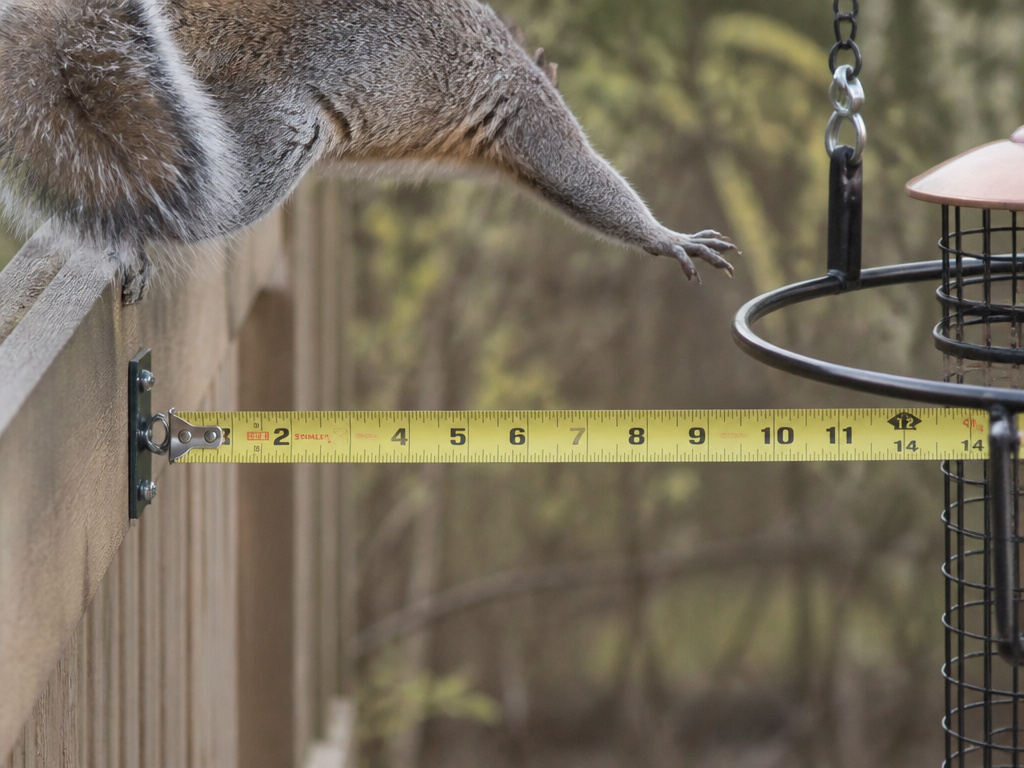
The Yankee Flipper manual is unusually specific for a bird feeder: hang it at least 14 inches from a deck rail, pole, or tree. The reason is leverage. A squirrel has to put its full body weight on the perch ring to trip the motor, and 14 inches is the distance at which leaning across stops working.
A squirrel that can brace a hind foot on the rail and reach the perch with one paw only loads part of its weight on the ring. The trigger never fires.
The 14-inch minimum is a floor. It doesn’t guarantee the trigger fires.
| Symptom | Likely cause | Fix |
|---|---|---|
| Squirrel empties the feeder | Ring hung too close to a rail | Move it to 14 inches minimum |
| Feeder never spins | Squirrel too light to trigger | Red squirrels and chipmunks may not activate |
| Motor runs, squirrel stays | Partial weight on ring | Increase distance; check for lean-across |
| Perch ring iced up | Freezing rain or icicles | Turn the knob OFF |
The manual also names the light-species failure directly. Red squirrels and chipmunks may not be heavy enough to activate the perch ring. No amount of setup fixes that.
Skip this if: freezing rain is in the forecast or icicles form on the perch ring. The manual’s instruction is to turn the knob OFF, not to wait and see. Ice on the ring is the condition the warning is written for.
The base-removal click
To remove the Yankee Flipper base, twist counterclockwise about 1/2 inch until you hear an audible click. Three locking tabs align to the hash mark on the port.
The click is the stop.
The charging window
The manual covers charging the Yankee Flipper, but check the manual for the specific charging time.
I’ll admit the bird feeder is outside my wheelhouse. The manual is specific enough to stand on its own.
How Do Ring Feeders Fit Into Pet Feeding?
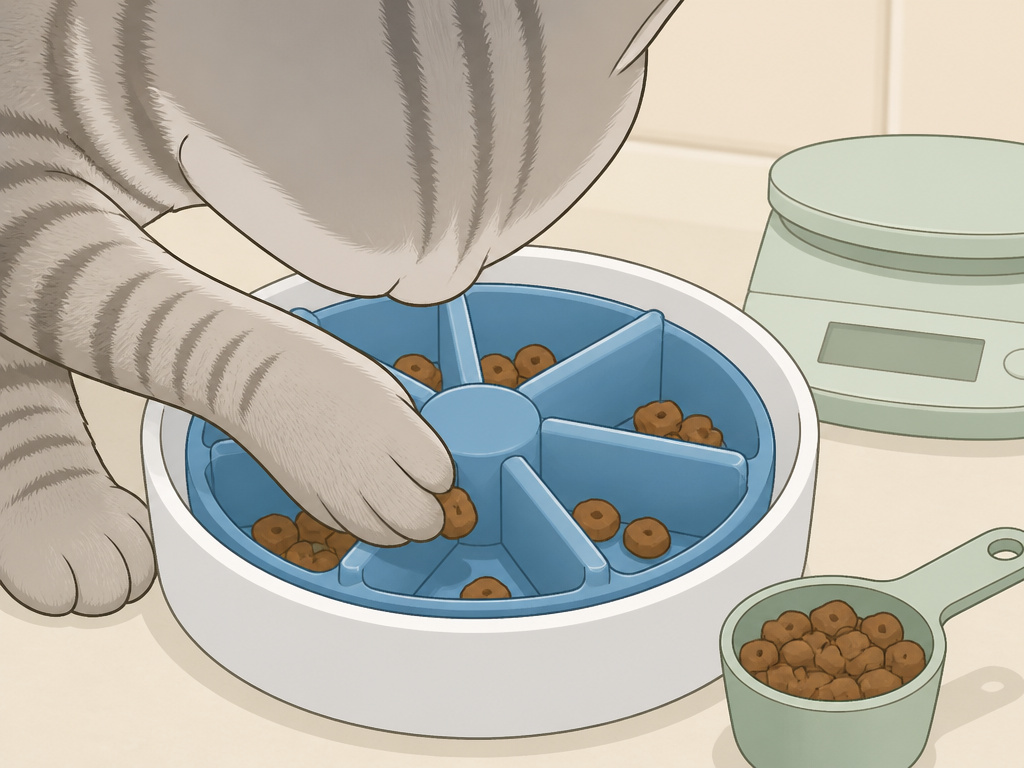
A cat that inhales a bowl of kibble and then brings it back up is the classic case for a slow-feeder ring. The ring forces the cat to work around obstacles, which stretches the meal out and gives the gut time to register fullness.
The cone’s ridges slow the cat down, and the ring is the pet version.
If your dog eats too fast, a puzzle feeder does more work than a plain ring because the food is hidden, not just obstructed. The best dog feeders for fast eaters are maze-style slow feeders, not ring-style.
A dog feeding station with a raised bowl and a mat is the setup that keeps a ring feeder from sliding across the floor. A ground feeder is the opposite approach, open access with no restriction, and it’s the wrong choice for a cat that bolts its food.
Here’s the sequence that works for most cats:
- Start with the ring empty and let the cat investigate it for a day.
- Add a small portion of the normal meal and watch the first attempt.
- If the cat gives up, the ring is too hard. Try a shallower one.
- Increase the difficulty only after the cat finishes cleanly.
A kitchen scale is the cheapest tool I recommend for portions. Grams repeat; scoops don’t.
The ring controls access during the meal. It doesn’t set the calorie target. Set a daily target from body condition score, divide it into measured meals, and adjust by monthly weigh-ins. A slow-feeder ring buys you time during the meal. It doesn’t change how much goes in the bowl.
Where Ring Feeders Fail
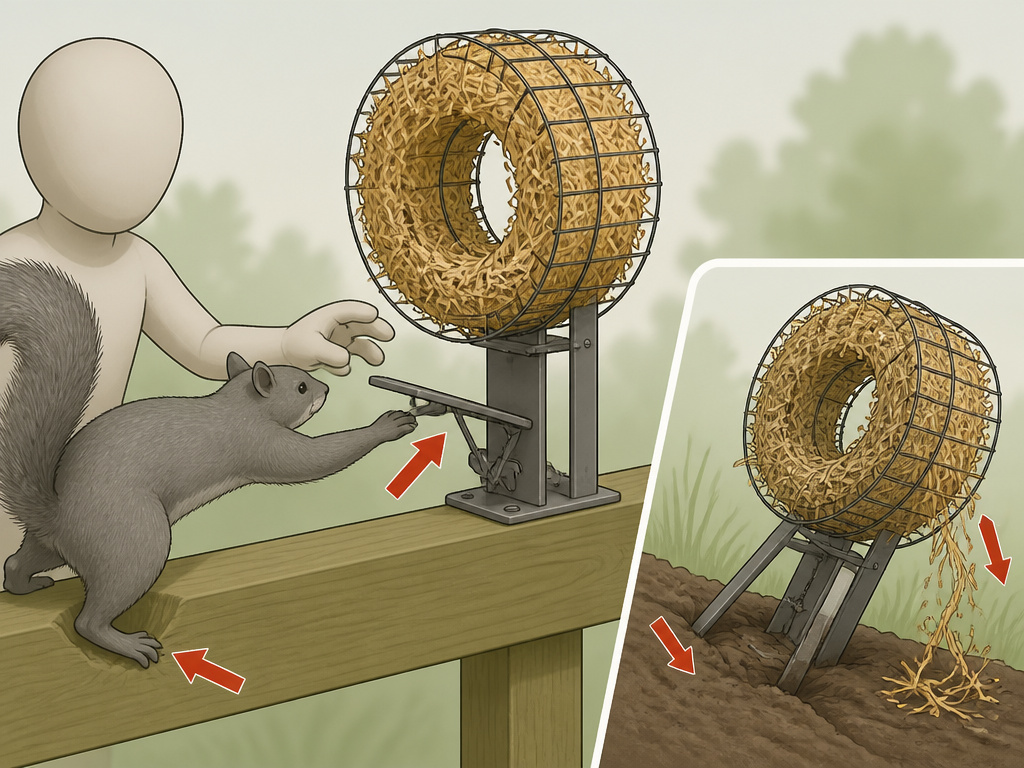
Most ring-feeder failures are setup failures. The product is fine; the placement isn’t.
- Ring too close to a rail. A squirrel leans across and only loads part of its weight. The trigger never fires.
- Ring on a slope. The bale rolls, the cage lifts on one side, and hay pulls loose.
- Ring on soft ground. The legs sink and the cage tilts. Burrowing holes make it worse.
- Ring sized for the wrong species. Red squirrels and chipmunks may not trip a perch ring at all.
The pattern is the same across all three categories. The ring has to match the animal’s reach and the feed’s shape. Get either wrong and the ring becomes decoration.
Common mistake: Hanging a squirrel-deterrent feeder at 14 inches and calling it done. The manual’s number is a minimum, not a guarantee. A squirrel that can brace a hind foot on the rail and reach the perch with one paw will beat it. Watch the feeder for a week before you trust it.
I’ve watched cat owners chase a slow-feeder problem for a month before measuring the portion. Measure the portion first.
Frequently Asked Questions
What is a feeding ring used for?
Feeding ring limits how far an animal can reach into a feed source. For horses, a round-bale ring holds the bale together and cuts hay waste. For birds, a perch ring is a weight sensor that trips a squirrel deterrent. For pets, a slow-feeder ring stretches out a meal.
How much hay does a ring feeder waste?
The Martinson et al. 2011 trial measured 19% mean hay waste for its Ring feeder. The no-feeder control measured 57%. The same study grouped the Ring with three other circular feeders as statistically indistinguishable, and its Tombstone Saver measured 13%.
How far should a squirrel-deterrent feeder hang from a rail?
At least 14 inches, per the Yankee Flipper manual. The distance is a floor, not a guarantee. A squirrel that can lean across and load only part of its weight on the perch ring will avoid triggering it.
Can a feeding ring work for cats and dogs?
Yes, as a slow feeder. A ring-shaped obstacle inside a bowl forces the animal to work around it, which stretches the meal out. It works best as part of a measured feeding plan, not as a replacement for one.
Do ring feeders work with alfalfa?
The Martinson trial used pure orchardgrass only and says directly that results may not transfer to alfalfa or bermudagrass. Prior literature cited in the study found different waste numbers on those forages, so treat the 19% as a starting point.
What’s the payback period on a ring feeder?
The Ring paid back in 2 months at the hay price the study assumed. The Waste Less feeder paid back in 8 months. Payback depends on hay cost and herd size, so run the math for your own operation.
The Bottom Line
The honest answer to how to use a feeding ring is that the ring is only half the job. The other half is measuring what goes in and what’s left on the ground. The number that should decide your purchase is payback period, not sticker price. The Ring paid back in 2 months at $100/ton hay. The Waste Less paid back in 8 months despite a higher up-front cost. If you feed one horse, the math may never work. If you feed a herd through winter, it usually does.
None of this covers alfalfa. The trial used pure orchardgrass, and the study says so directly. If your hay is alfalfa, treat the 19% as a starting point and weigh your own waste.
I’d rather see a cheap ring and a kitchen scale than an expensive ring and no measurements. The ring restricts access. The scale tells you whether it worked.
