
How to Feed a Lovebird: Pellets, Produce, and Portions
This post contains affiliate links. As an Amazon Associate, we earn from qualifying purchases.
How to feed a lovebird: build the diet around a complete pellet at 75% to 80% of intake, add 20% to 25% fresh vegetables and a little fruit, and treat seed as a supplement rather than the base. VCA Animal Hospitals sets pellets at 75%-80% of the diet, with the rest split between vegetables and limited fruit.
Those percentages only work if the bird actually eats them. VCA notes that a lovebird often selectively eats only 1 or 2 of its favorite seed types from a mix, which quietly defeats the variety printed on the bag. A diet that looks balanced on paper can still be a two-seed diet in practice.
What follows walks the pellet base, the produce share, the seed question, and the conversion schedules, with the points where the veterinary sources disagree called out plainly.
Key Takeaways
- Pellets at 75%-80% of the diet is the VCA target, with produce taking the remaining 20%-25%.
- Seed as the only food can lead to ill health and a potentially shortened lifespan, per VCA.
- Grit is contested: VCA and Merck say lovebirds don’t need it; Ark Veterinary Sheffield says it aids digestion.
- Convert slowly — VCA’s two schedules run 6 days or 10 days, and mature birds can take weeks or months.
- Avocado and onion are toxic and should never be offered, per VCA and MSPCA-Angell.
What Should a Lovebird’s Daily Diet Actually Look Like?
VCA Animal Hospitals places pellets at approximately 75% to 80% of a lovebird’s diet, with the remaining 20% to 25% consisting of vegetables and a limited amount of fruit. Merck Veterinary Manual notes that strictly seed-based diets are suboptimal because seeds are deficient in vitamin A, protein, calcium, and other nutrients.
VCA also states, in a separate section of the same handout, that fruits, vegetables, and greens should account for 20%-40% of the daily diet. That is a real internal inconsistency in the same document, and it is worth knowing before you build a feeding chart around it.
MSPCA-Angell puts the daily volume at 1 1/2 to 2 ounces (45-60 grams) of feed for a single bird. That number is the total, not the pellet portion alone.
Here is how the four main sources line up on the base diet.
| Source | Base Diet | Produce Share |
|---|---|---|
| VCA Animal Hospitals | Pellets at 75%-80% | 20%-25% veg + limited fruit |
| Merck Veterinary Manual | Pellets plus fresh veg daily | Small amounts daily |
| MSPCA-Angell | Small parrot mix + supplements, or formulated diet + produce | Greens and vegetables as supplements |
| Ark Veterinary Sheffield | Complete pellet diet | Leafy greens; treats under 10% |
The disagreement in that table is not noise. It reflects a real split in the veterinary literature about whether a seed-based diet can serve as the base for a lovebird at all. More on that below.
The Pellet Base: Why 75% to 80% and Not “Some Pellets”
Merck sets the vitamin A ceiling for a formulated pellet at 5,000 to 8,000 IU per kilogram of feed, and says higher amounts should be avoided. That number matters because it is the same vitamin the seed diet is short on, and the same vitamin that becomes toxic when a pellet-fed bird gets an extra supplement on top.
Merck’s professional reference is blunt about why: strictly seed diets are deficient in vitamin A, lysine, methionine, calcium, and other nutrients, regardless of supplementation. A bird eating mostly seed has to eat more to chase the missing nutrients, and still comes up short. That is the mechanism behind VCA’s warning that a seed-only diet can shorten a lovebird’s lifespan.
For a plain pellet base, choose a complete formulated pellet diet, which Ark Veterinary Sheffield describes as the best way to ensure a lovebird has the best balance of nutrients. That is the category VCA and Merck are describing when they say “complete pellet diet.”
Pellets left sitting in a damp dish can go soft and stale, so remove uneaten fresh food before it spoils. If your bird leaves them, they are not going to eat them later.
Vegetables, Fruit, and the 20% to 25% Share
Picture two bags of pellets on a shelf when you compare a how to feed a lovebird approach. One lists “sunflower seed, millet, safflower” first and “vegetables” somewhere near the bottom. The other lists a single formulated pellet and nothing else. Flip the bag over and read the order before you trust the photo on the front.
VCA is specific about which vegetables are worth the space. Pale vegetables with a high water composition, like iceberg or head lettuce and celery, offer little nutritional value. MSPCA-Angell notes that greens and vegetables can be offered as supplements to the diet.
Fruit should be offered only in limited amounts as part of the produce share. Keep the fruit portion small. VCA says “a limited amount of fruit,” not a fruit bowl.
Ark Veterinary Sheffield caps treats at no more than 10% of the total diet. That is a tighter ceiling than VCA’s 20%-25% produce share, and it applies specifically to the orange, apple, corn, and grated carrot treats the practice lists.
A full list of safe fruits and vegetables is worth keeping on the fridge, because the “is this safe?” question comes up every time you open the produce drawer.
If a lovebird eats only one or two seed types out of a mix of 4 to 10 different seeds and nuts, the mix is not providing variety. It is providing the same two seeds every day with nine decorative ones.
VCA says fresh produce should come out of the cage after a couple of hours, especially in warm climates. Merck says the same thing in softer language: fresh food should not be left too long because it can go bad.
Where this goes sideways: Leaving fresh produce in the cage all day. VCA advises no more than a couple of hours, and warm kitchens push that timeline faster because spoilage follows room temperature.
Is Seed Ever Okay for a Lovebird?
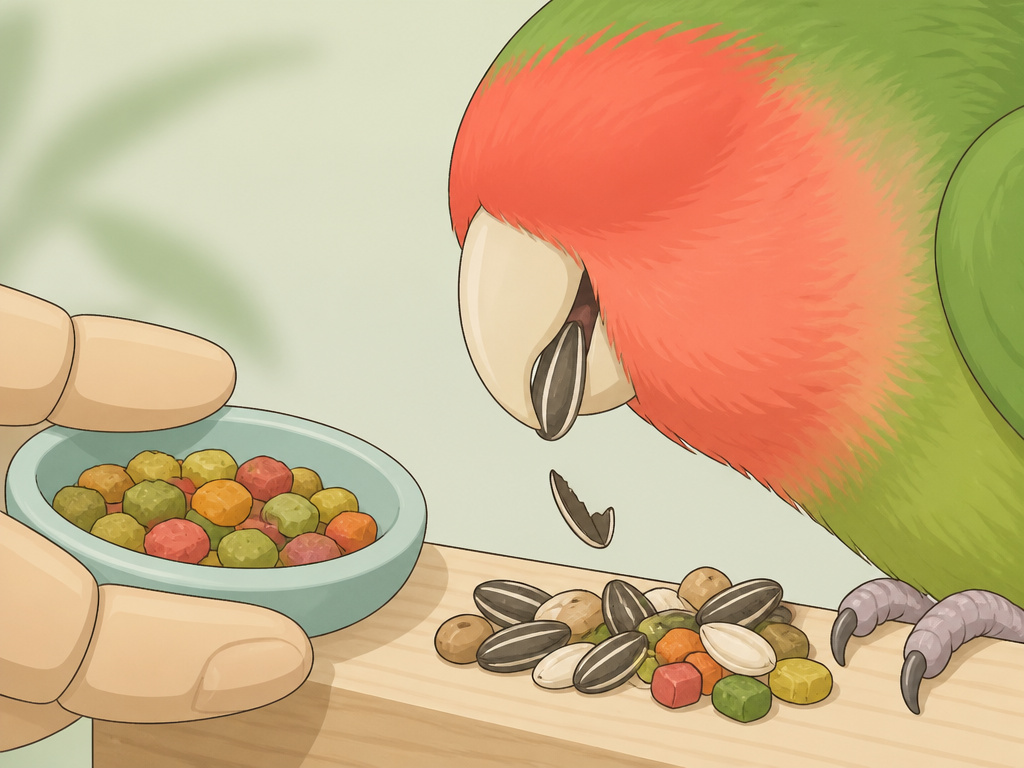
Two veterinary sources read the same seed and reach different conclusions, and the split is worth understanding before you pick a side.
MSPCA-Angell states that a diet of a small parrot mix along with a variety of supplements and vitamins is “generally regarded as suitable.” That is the softest position in the source set. Merck’s owner-facing page says seeds shouldn’t make up most of a bird’s diet because they are high in fat and not very nutritious. Merck’s professional reference goes further: strictly seed diets, regardless of supplementation, are suboptimal for psittacines. VCA lands in the same place, saying a seed-only diet could ultimately lead to ill health and a potentially shortened lifespan.
The mechanism behind the split is selective eating. VCA notes that a lovebird often eats only 1 or 2 of its favorite seed types from a mix, even when the bag lists 4 to 10 different seeds and nuts. So the “variety” on the label is not the variety in the bird.
A lovebird hulls a seed with a quick crack you can hear across the room, then drops the empty shell. That is also why powdered supplements on hulled seeds are of little value, per VCA: the bird removes the hull before it ever reaches the kernel.
If your bird is a committed picky eater and refuses everything but seed, the conversion plan below is the practical next step, not a different seed mix.
How to Feed a Lovebird Through a Seed-to-Pellet Conversion
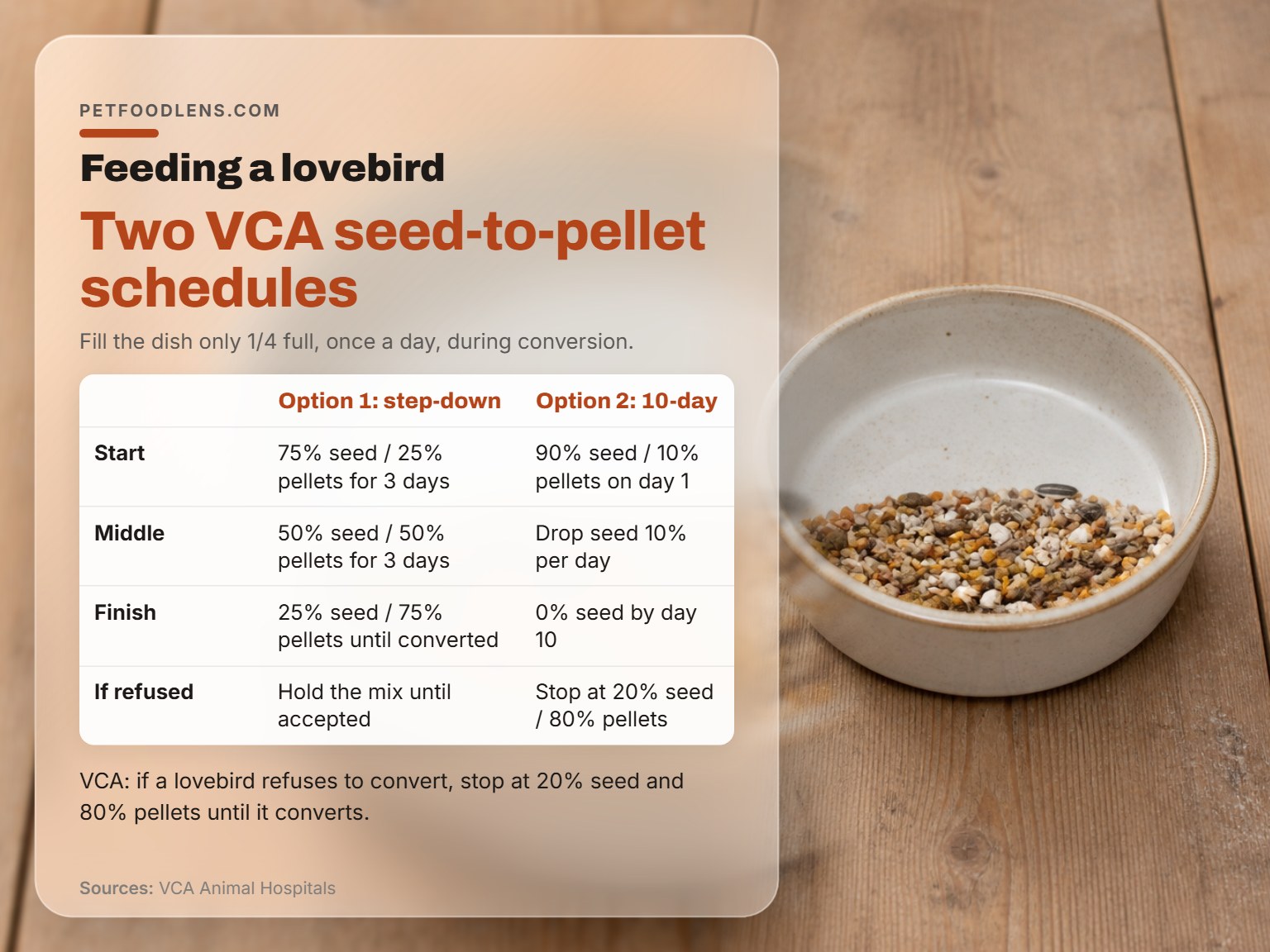
Conversion is the step that breaks the plan. VCA says mature birds may be difficult to convert, and the process can take days, weeks, or months.
Before you start: Avocado and onion are toxic to lovebirds and should never be offered. Non-stick cookware near the cage can release lethal fumes when heated, and zinc-coated cage materials are toxic. Move the cage out of the kitchen before you cook, and check that every dish, perch, and toy is zinc-free.
VCA’s conversion protocol starts with one rule: fill the food dish only 1/4 full, once a day. A full dish gives the bird the option to ignore the pellets and wait for a refill.
VCA Option 1: The 6-Day Step-Down
The first schedule is a three-stage ratio change. Offer 75% seed and 25% pellets for 3 days, then a 50/50 mix for 3 days, then 25% seed and 75% pellets until the bird is fully converted.
VCA Option 2: The 10-Day Gradual Shift
Offer 90% seed and 10% pellets on day one, then 80% seed and 20% pellets on day 2, and so on, until 0% seed on day 10.
When the Bird Refuses to Convert
VCA’s fallback is specific: if the bird refuses to convert, stop at 20% seed and 80% pellets until it converts. Do not push past that ratio on a bird that is not eating.
| Stage | Option 1 (step-down) | Option 2 (10-day) |
|---|---|---|
| Start | 75% seed / 25% pellets for 3 days | 90% seed / 10% pellets on day 1 |
| Middle | 50% seed / 50% pellets for 3 days | Drop seed 10% per day |
| Finish | 25% seed / 75% pellets until converted | 0% seed by day 10 |
| If refused | Hold the mix until accepted | Stop at 20% seed / 80% pellets |
The steps in order:
- Weigh or scoop the current seed ration so you know what a normal day looks like. Skipping this makes every later ratio guesswork.
- Fill the dish only 1/4 full, once a day, per VCA. A full dish slows conversion because the bird can wait you out.
- Pick one schedule and hold it. Pick one schedule and hold it, following VCA’s conversion steps until the bird is fully converted.
- Withdraw seed only once pellets and produce are confirmed eaten. VCA is explicit about this, and pulling seed early is how birds lose weight fast.
- Watch the cage floor. Watch the cage floor for hulls and crumbs as a sign of whether the bird is actually eating.
Common mistake: Filling the food dish to the top during conversion. VCA’s protocol calls for a dish only 1/4 full, once a day, so the bird has to try the pellets instead of ignoring them.
If your bird is stuck at the 20/80 mark, the detailed switching to pellets walkthrough covers the refusal cases in more depth.
Water, Dishes, and the Daily Cleaning Routine
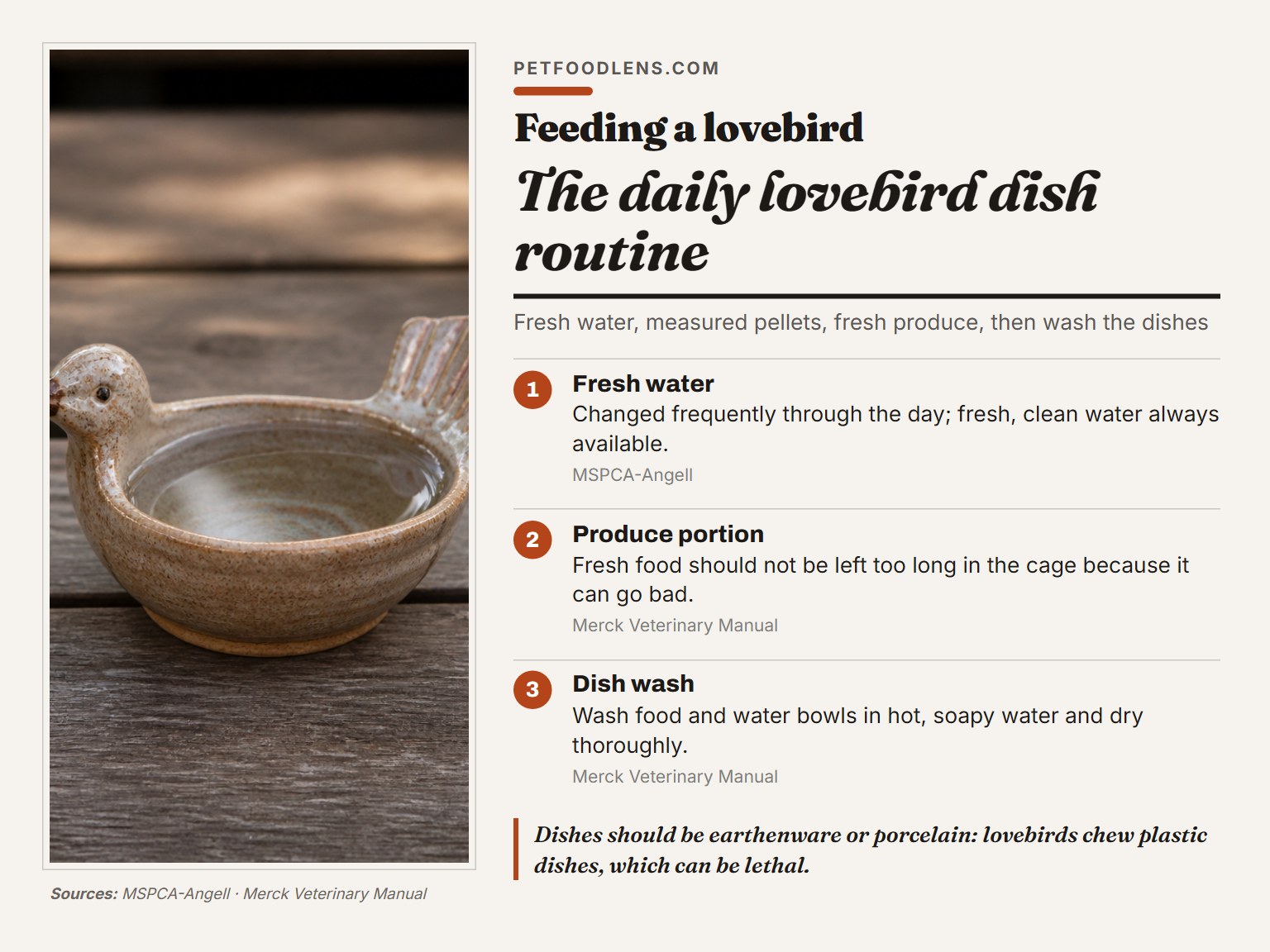
MSPCA-Angell is blunt about the dish itself: earthenware or porcelain, not plastic. Lovebirds chew plastic dishes, and the source calls that potentially lethal. The MSPCA-Angell lovebird care guide covers the full husbandry setup beyond feeding.
Water change frequency is one of the places where the sources do not fully agree. Ark Veterinary Sheffield says water should be changed daily. Merck says the same. MSPCA-Angell says lovebirds drink a lot of water, so dishes should be changed frequently through the day. Ark Veterinary Sheffield and Merck say water should be changed daily, while MSPCA-Angell says lovebirds drink a lot of water, so dishes should be changed frequently through the day.
Merck adds a cleaning step that is easy to skip: wash food and water bowls in hot, soapy water and dry them thoroughly, every day.
The daily routine, in order:
- Fresh water in a clean dish, changed at least once a day and more often if soiled.
- Pellet portion measured to the day’s target, not topped off from yesterday’s leftovers.
- Produce portion added fresh and removed after a couple of hours, per VCA.
- Dish wash in hot soapy water, dried thoroughly, per Merck.
- Cage floor check for hulls and crumbs, which tells you whether the bird is actually eating.
The feeding schedule question comes up a lot with lovebirds because they eat small amounts throughout the day. The pellet-and-produce base can stay in the cage; the fresh produce cannot.
Where the Veterinary Sources Disagree on Grit and Seed
Two veterinary practices can read the same seed and reach opposite conclusions about grit.
VCA is direct: lovebirds do not need gravel or grit because they remove the outer hull of the seed before ingesting the kernel. The handout goes further, warning that some birds over-consume grit and develop gastrointestinal tract obstructions that are potentially life-threatening. Merck’s professional reference agrees that grit is not needed by psittacines that remove seed hulls before ingestion.
Ark Veterinary Sheffield takes the other position: grit will provide additional minerals and aid with digestion of food. MSPCA-Angell sits in the middle, recommending a cuttlebone, or gravel and oyster shell in a separate dish, to provide calcium.
The disagreement is real, and it is not resolved by the sources in front of me. What is clear is that the calcium need is not in dispute. MSPCA-Angell’s cuttlebone recommendation and VCA’s note that egg-laying hens require calcium supplementation point at the same gap from different angles. If you want a calcium source without the grit risk, MSPCA-Angell recommends offering a cuttlebone.
The seed suitability split runs the same way. MSPCA-Angell calls a small parrot mix with supplements “generally regarded as suitable.” Merck and VCA both treat seed-dominant diets as suboptimal. MSPCA-Angell regards a small parrot mix with supplements as suitable, while Merck and VCA treat seed-dominant diets as suboptimal; Ark Veterinary Sheffield advises a vitamin and mineral balancer if a seed diet is fed. It is still not the 75%-80% pellet base VCA recommends.
The UF/IFAS pet bird nutrition publication makes a related point that applies here: improper nutrition includes overnutrition, and providing too much food too often is a common cause of problems.
Foods That Should Never Reach the Cage
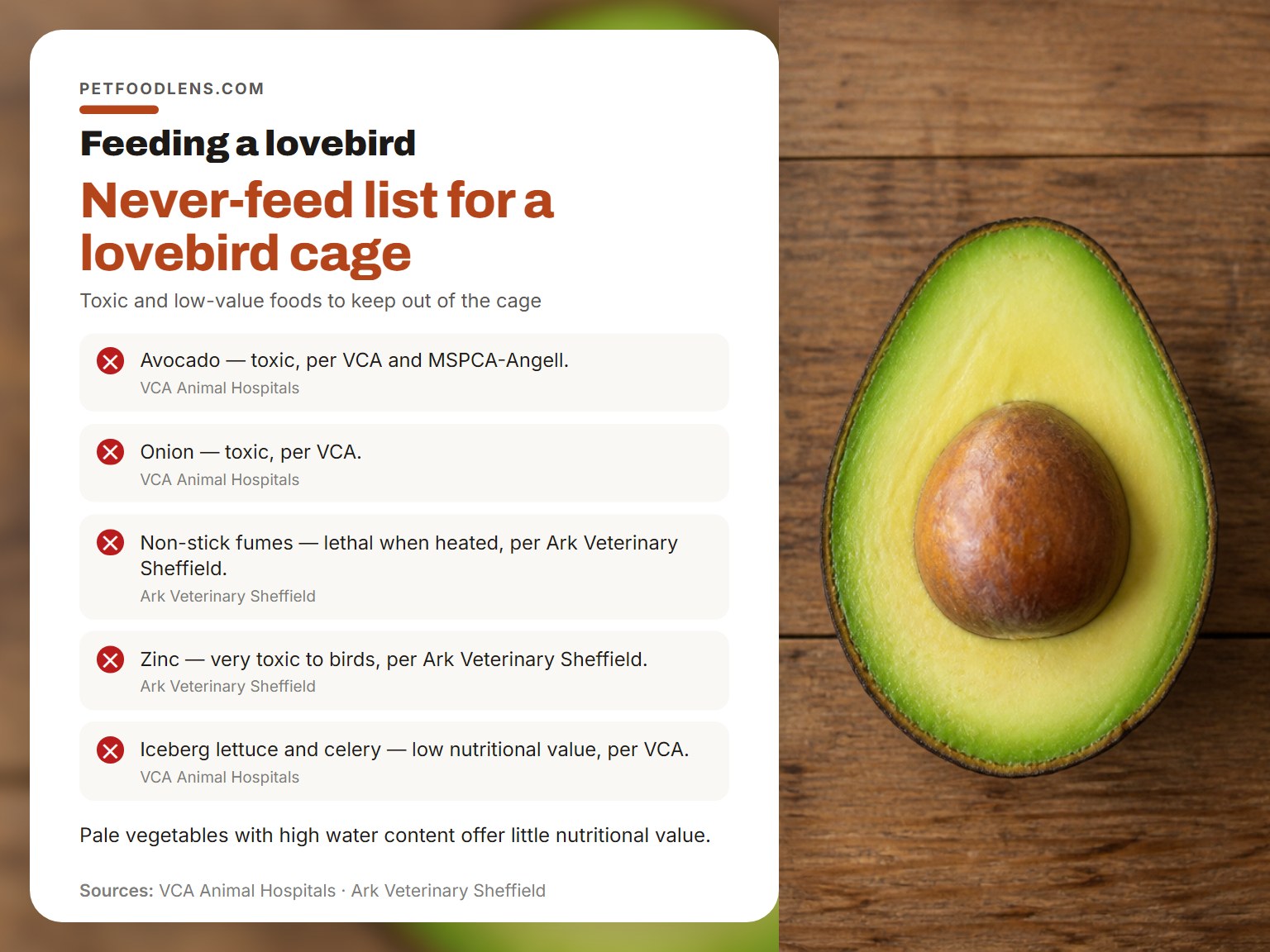
Avocado and onion are toxic and should never be offered, and non-stick cooking utensils can release lethal fumes when heated.
VCA and MSPCA-Angell both list avocado as toxic. VCA adds onion to the same list. Ark Veterinary Sheffield flags non-stick cooking utensils as a source of lethal fumes when heated, and zinc-coated cage materials as toxic to birds.
Pale vegetables are a lower-tier problem, not a toxic one. VCA says iceberg lettuce and celery offer little nutritional value, so they take up produce space without contributing much. Skip them and use the darker greens instead.
The full never-feed list:
- Avocado — toxic, per VCA and MSPCA-Angell.
- Onion — toxic, per VCA.
- Non-stick fumes — lethal when heated, per Ark Veterinary Sheffield.
- Zinc-coated cage parts — toxic, per Ark Veterinary Sheffield.
- Iceberg lettuce and celery — low nutritional value, per VCA.
What most people get wrong: Treating the front of a pellet bag as a quality signal. VCA and Merck both point at the formulation and the vitamin levels. Read the guaranteed analysis before the front of the bag.
Frequently Asked Questions
How much should I feed a lovebird each day?
MSPCA-Angell puts a single bird’s daily intake at 1 1/2 to 2 ounces (45-60 grams) of feed. That total includes the pellet base and the produce share, not pellets alone. VCA’s split is 75%-80% pellets and 20%-25% vegetables with limited fruit.
Can a lovebird live on seed alone?
VCA says a seed-only diet could ultimately lead to ill health and a potentially shortened lifespan. Merck’s professional reference calls strictly seed diets suboptimal because seeds are deficient in vitamin A, protein, calcium, and other nutrients. MSPCA-Angell is softer, calling a small parrot mix with supplements “generally regarded as suitable,” but that is the outlier position in this source set.
Do lovebirds need grit?
VCA and Merck both say no. Lovebirds hull seeds before swallowing, so the gizzard never sees the shell, and grit is not needed for mechanical digestion. VCA warns that over-consumption can cause life-threatening GI obstructions. Ark Veterinary Sheffield disagrees and recommends grit for minerals and digestion. The sources do not resolve this one.
How long does pellet conversion take?
VCA’s two schedules run 6 days and 10 days on paper, but the same handout says mature birds may take days, weeks, or months to convert. If the bird refuses, VCA’s fallback is to hold at 20% seed and 80% pellets until it accepts the new ratio.
Should I add vitamins to a pellet-based diet?
VCA says birds on 75%-80% pellets need no supplements. Merck warns that excess vitamin A from over-supplementing pellet-fed birds can be as harmful as deficiency, causing toxicosis and reduced absorption of other fat-soluble vitamins. Ark Veterinary Sheffield advises a vitamin and mineral balancer specifically if a seed diet is fed, which is a different situation from a pellet base.
The Bottom Line
If your lovebird has been on seed for years and is still refusing pellets past the 20/80 mark, book an avian vet visit before you push the ratio further. VCA’s own language is that conversion can take months, and a bird that is not eating is losing weight faster than the schedule is gaining ground.
The one number to hold onto is 75%-80%. That is the VCA pellet target, and it is the anchor every other decision hangs from: how much produce to add, whether a supplement is needed, and whether a seed mix is a base or a treat.
Start this week with one change: weigh or scoop the current seed ration so you know what a normal day looks like. Every conversion schedule here assumes you know that number, and most owners don’t.
