
How to Feed a Breeding Bird: Step-by-Step
This post contains affiliate links. As an Amazon Associate, we earn from qualifying purchases.
How to feed a breeding bird: keep formula at 102-106°F (39-41°C), measured with a thermometer. Mix roughly 90% water for a day-old chick and 70-75% liquid after day two, then feed 6-10 times daily in week one, tapering as feathers come in. Skip the overnight feeds.
The thermometer is the part of how to feed a breeding bird that gets skipped. A microwaved bowl can have hot and cold spots, and the chick gets the hot spot first.
What follows covers the temperature, the dilution, the frequency, and the two places where the published sources disagree: overnight feeding and grit. Plus the crop check that overrides every schedule.
Key Takeaways
- Measure formula temperature with a thermometer, not a wrist test. VCA puts the target at 102-106°F (39-41°C); too hot burns the crop, too cold gets refused.
- Thin the formula by age. Day-old chicks take roughly 90% water; after day two, 70-75% liquid.
- Feed 6-10 times daily in week one, then taper to 5-6, 3-5, and 2-3 as the chick matures.
- Stop feeding if the chick won’t bob its head. VCA warns that aspiration into the trachea can kill a chick.
- Grit is a state-code recommendation, not a federal one. The NSW Code says provide it, especially to breeders; 9 CFR 3.155 is silent.
What Temperature Should Hand-Feeding Formula Be?
VCA Animal Hospitals puts the target at 102-106°F (39-41°C), measured with a thermometer through the whole mixture, not just the top. A bowl that feels warm on the wrist can still have a hot pocket in the middle after a microwave run.
Formula temperature for hand-feeding sits between 102°F and 106°F (39-41°C), verified with a thermometer throughout the mixture. Formula above that range can burn the crop; formula below it gets refused and slows digestion. Stir thoroughly after microwave heating to eliminate hot and cold spots before drawing the syringe.
The two failure modes are not symmetric. Too-cold formula gets refused, and a refused feed is annoying but recoverable. Too-hot formula burns the crop, and a crop burn is a vet visit.
Before you start: Formula above 106°F (41°C) burns the crop, and formula below 102°F (39°C) gets refused and slows digestion. Measure with a thermometer through the mixture, not at the surface. Never feed a chick that won’t bob its head; VCA warns that aspiration into the trachea can kill it.
The wrist test is the wrong test when you consider how to feed a breeding bird. Skin tolerance runs hotter than crop tissue. Use a digital thermometer, stir, and check again.
How Often Do You Feed a Breeding Bird’s Chicks?
Six to ten feeds a day in the first week, per VCA. That works out to one feed every two to three hours, and it’s the number that catches first-time breeders off guard.
| Age / Stage | Feeds per Day | Interval | Source |
|---|---|---|---|
| Under 1 week | 6-10 | Every 2-3 hours | VCA |
| Eyes still closed | 5-6 | Every 3-4 hours | VCA |
| Eyes open | 3-5 | About every 5 hours | VCA |
| Feathers growing in | 2-3 | Every 6-12 hours | VCA |
| Zebra finch, first 5 days | Not stated | Every 2 hours, 06:00-23:00 | CSH Protocol |
| Zebra finch, after day 5 | Not stated | Every 3 hours | CSH Protocol |
The VCA Taper vs. The CSH Fixed Interval
The VCA schedule is a taper, not a fixed rule. The number drops as the chick’s eyes open and feathers come in. A chick still on six feeds a day at three weeks is being fed on the wrong schedule, not a generous one.
The CSH zebra finch protocol runs on a fixed clock instead: every two hours from 06:00 to 23:00 for the first five days, then every three hours until the bird feeds itself. The two schedules describe different species under different conditions, and both are worth knowing before you pick one.
If you want the broader picture on intervals across pet species, the bird feeding frequency breakdown covers the maintenance side.
That’s the part no schedule covers.
Formula Consistency: Why the Water Ratio Changes With Age
A day-old chick gets formula that is about 90% water, because the yolk sac is still supplying most of the nutrition. By day two, the ratio drops to 70-75% liquid as the chick starts relying on the formula itself.
| Age | Water / Liquid Ratio | Why | Source |
|---|---|---|---|
| Day-old | About 90% water | Yolk sac still feeding the chick | VCA |
| Older than 1-2 days | About 70-75% liquid | Chick is now formula-dependent | VCA |
Mixing one batch for a whole clutch saves time. It also feeds at least one chick the wrong dilution. A day-old and a five-day-old in the same nest need different ratios, and that difference is measured in water, not in scoops.
VCA also recommends choosing one formula and sticking with it until weaning. Switching brands mid-rearing stresses digestion, and a stressed chick eats less. CSH names ZuPreem as an example formula for zebra finches, which gives you a starting point if you haven’t picked one.
I check the nutritional adequacy statement on every bag I pick up, bird food included. It takes seconds and tells me whether the food is complete and balanced or meant only for supplemental feeding. That is the same check I run on cat food, and it matters just as much here.
When the Sources Disagree on Overnight Feeding
VCA says feeding between 10:00 p.m. And 6:00 a.m. Is not necessary because the chick should be sleeping. The same VCA handout also says some birds benefit from feeding during the night in the first week. The zebra finch protocol stops hand-feeding at 23:00 and picks up again at 06:00, which leaves a seven-hour gap.
| Position | Source | What It Says |
|---|---|---|
| No overnight feeds | VCA Animal Hospitals | Feeding 10:00 p.m.-6:00 a.m. Is not necessary; chick should be sleeping |
| Some night feeding helps | VCA Animal Hospitals | Some birds benefit from night feeding in week one |
| Fixed overnight gap | CSH zebra finch protocol | Hand-feeding stops at 23:00, resumes at 06:00 |
VCA says feeding between 10:00 p.m. And 6:00 a.m. Is not necessary, while the same handout notes some birds benefit from night feeding in week one, and the CSH protocol stops at 23:00. If your chick is losing weight overnight, the night feed is the first thing to add back. If it’s gaining, the gap is fine.
Common mistake: Feeding a chick on the clock when its crop is still full from the last feed. VCA says the best time to feed is when the crop is empty. A full crop plus another scheduled feed is how sour crop starts.
The Tool Question: Syringe, Spoon, or Feeding Tube
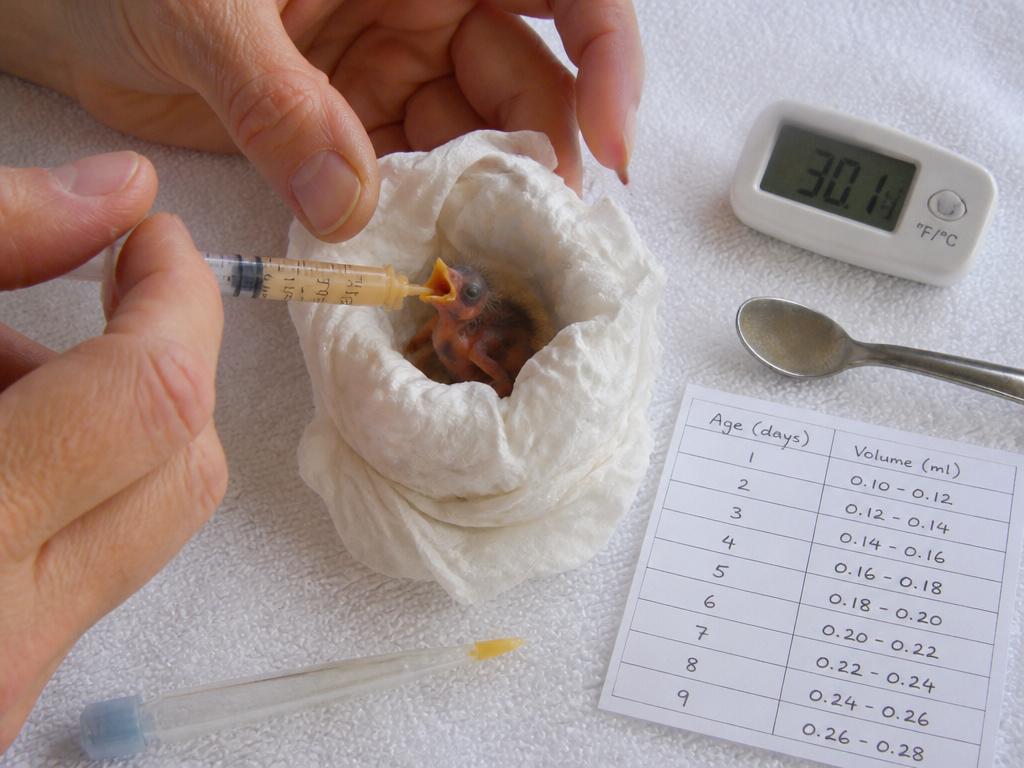
VCA calls syringes the preferred tool, with a spoon with the sides bent up and inward as an alternative, while the CSH zebra finch protocol delivers food by syringe until the crop appears full.
Feeding tubes are the one tool VCA explicitly warns against. The reasons are specific: crop damage, and tube slippage that requires surgical removal. Some breeders use them for speed. The speed is not worth the surgery.
Why Feeding Tubes Get Warned Against
A tube delivers formula fast and bypasses the chick’s natural feeding response, which is exactly the mechanism that keeps food out of the trachea. VCA’s warning is about the tool itself, not about user error. Crop damage and slippage are both listed as risks, and the slippage case ends in surgery.
- Syringe (preferred): accurate volume, easy to chart, VCA’s first choice.
- Spoon with bent sides: acceptable alternative, less precise on volume.
- Feeding tube: not recommended by VCA; crop damage and slippage risk.
Chart every feed. Volume in, crop status, droppings. A chick that takes less at one feed than the last is telling you something, and the chart is the only place that pattern shows up.
If you’re going to spend money on one piece of equipment, spend it on syringes and a digital thermometer. Everything else in this article is a schedule you can adjust with your eyes.
The Crop Is Your Dashboard
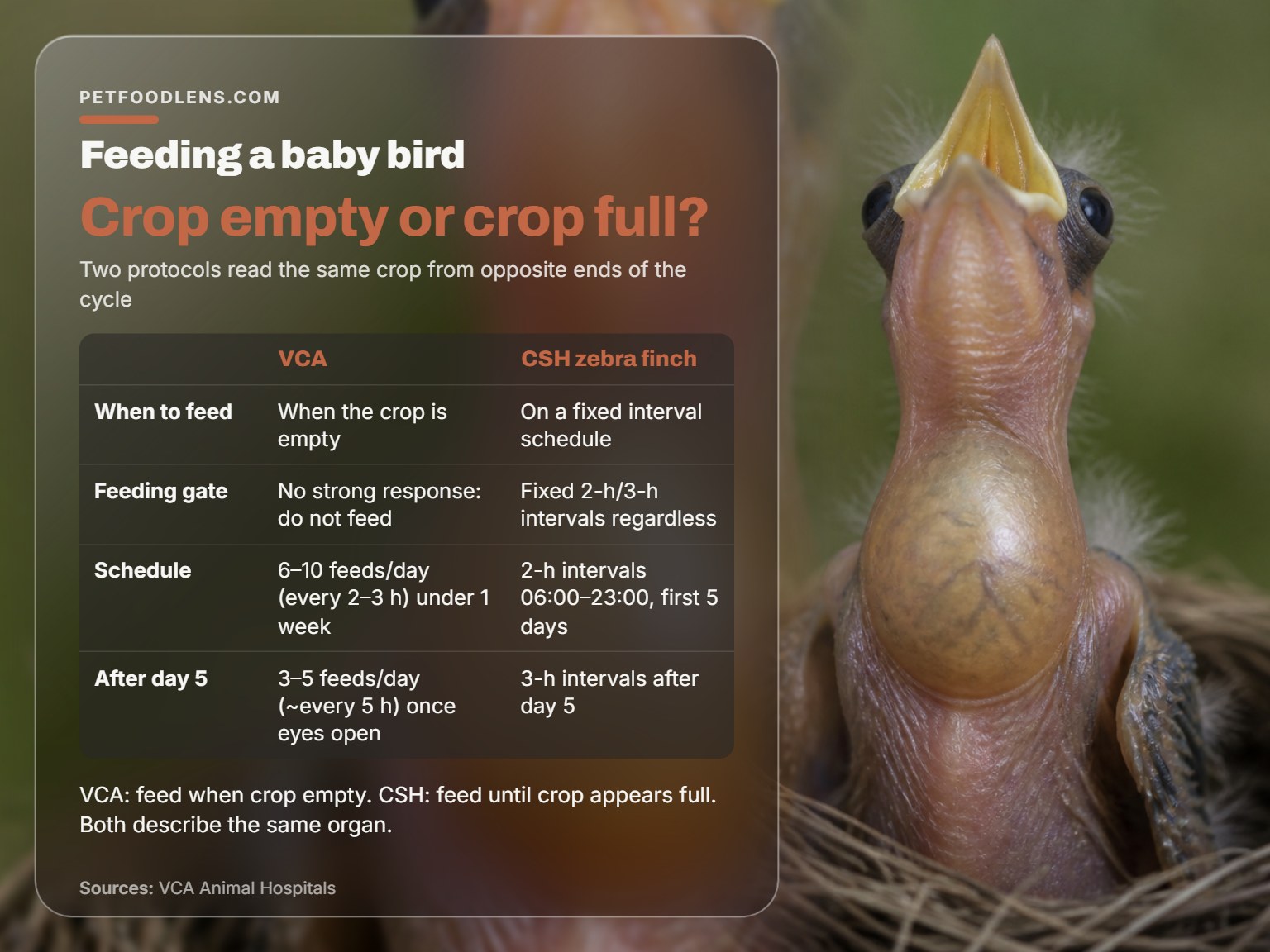
The crop is the sac at the base of the neck, visible through the skin, and it’s the only real-time readout you get on a chick. VCA says to feed when the crop is empty. CSH says to feed until the crop appears full. Both are describing the same organ from opposite ends of the cycle.
VCA is explicit: if the chick does not show a strong feeding response, do not feed, while the CSH zebra finch protocol feeds on a fixed 2-h/3-h interval schedule regardless. The risk is aspiration into the trachea and lungs, and aspiration can kill a chick.
A healthy chick bobs its head rapidly when you touch the corners of its mouth. That bobbing closes the trachea and lets food go down fast. A chick that won’t bob is a chick that needs a vet, not a bigger syringe. The weak bird feeding guide covers the next steps when a chick goes flat.
Where this goes sideways: Pushing a feed on an unresponsive chick to stay on the clock. VCA warns that aspiration into the trachea can lead to death. The schedule is a guideline; the feeding response is the gate.
Hygiene and the Brooder
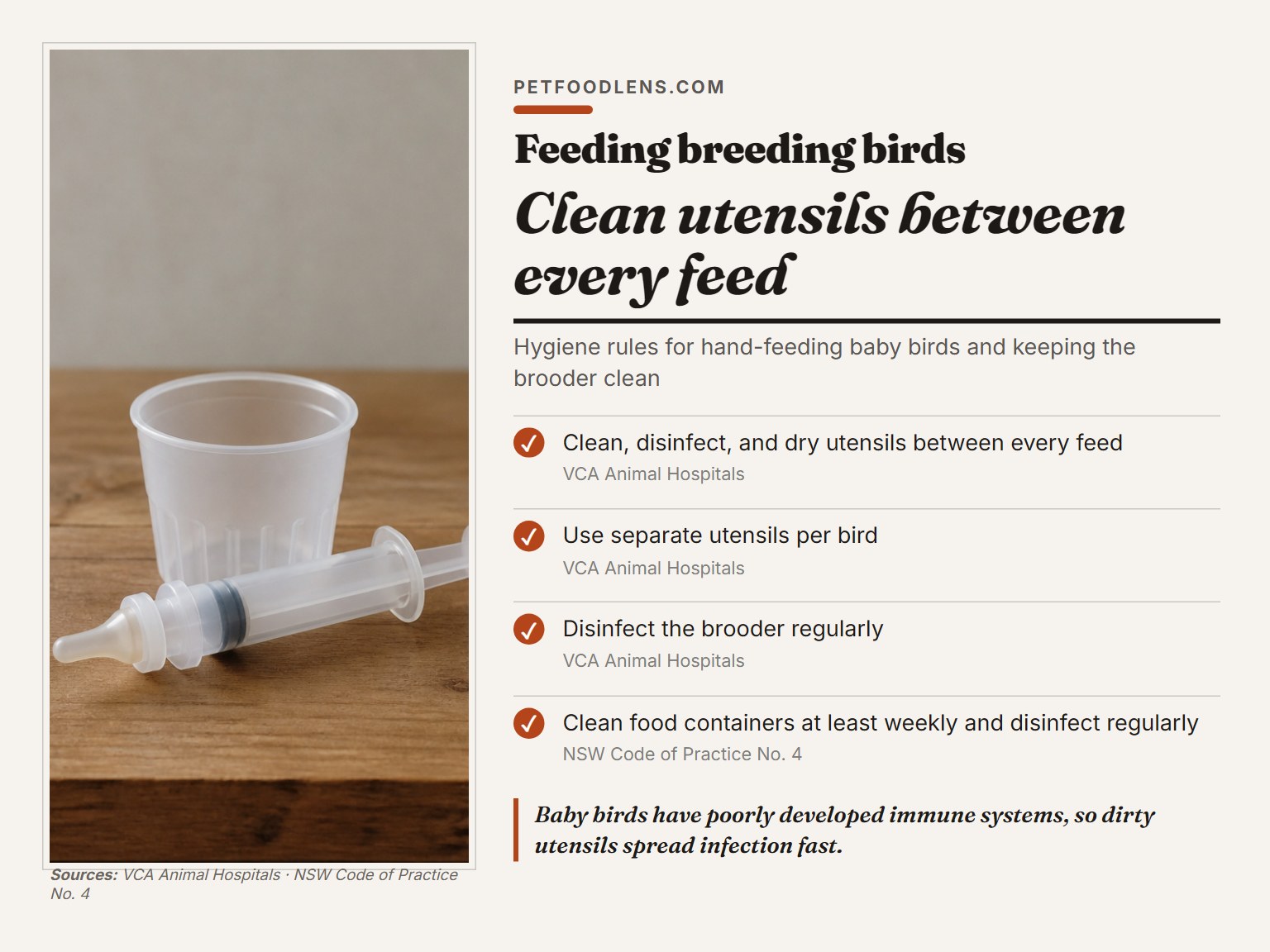
Picture a plastic feeding cup that sat in warm formula for an hour between feeds. Baby birds have poorly developed immune systems, and that cup is now a culture dish. VCA says all feeding utensils must be cleaned, disinfected, and dried thoroughly between feedings, and separate utensils per bird are recommended.
- Clean, disinfect, and dry utensils between every feed. Not once a day. Between feeds.
- Use separate utensils per bird. Cross-contamination between chicks is the fastest way to spread an infection through a clutch.
- Disinfect the brooder regularly. VCA ties this directly to the chick’s undeveloped immune system.
- Disinfect the coop, feeders, and waterers at least weekly. The UC Davis avian feeding guide gives the mix: one tablespoon of bleach per gallon of water, then rinse thoroughly.
Weaning: The Two-Sided Failure Window
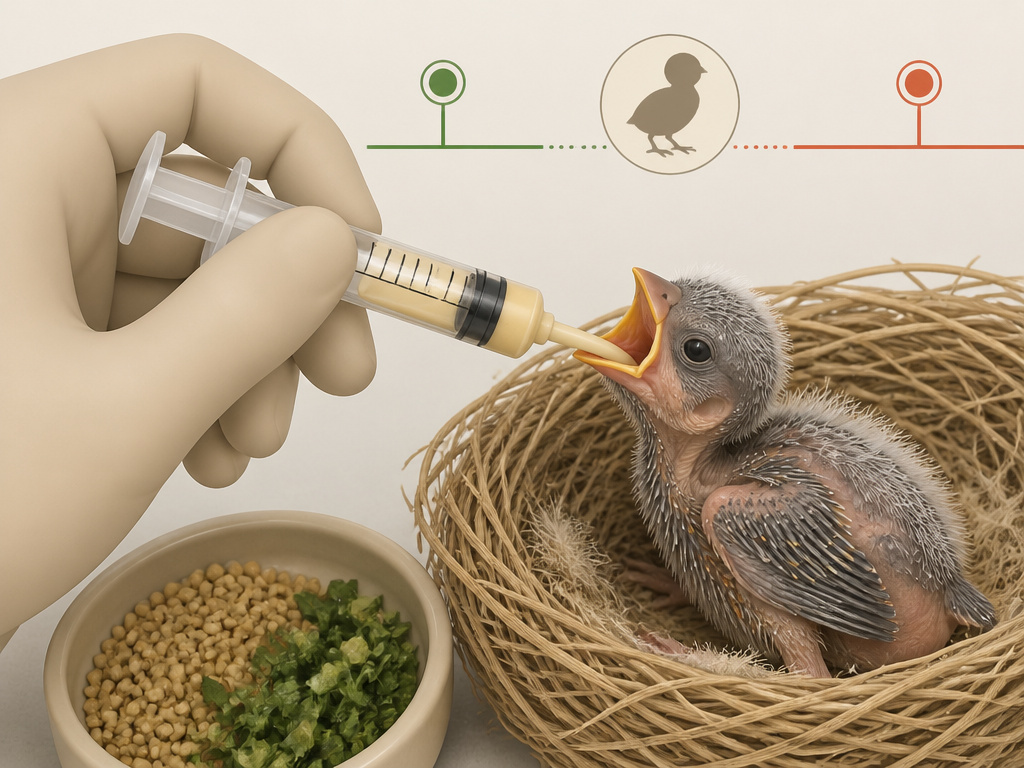
Two failure modes sit on either side of the weaning window. Wean too early and the chick can suffer poor nutrition or death. Leave it too long and it interferes with the next clutch.
The 30-50 Day Window
The peer-reviewed finch breeding guidelines put self-feeding at 30-35 days post-hatch for zebra finches. Chicks left with the parents beyond about 50 days post-hatch start interfering with subsequent clutches. That’s the window: roughly 30 to 50 days, with the goal of self-feeding somewhere in the first half of it.
VCA’s weaning sequence is a taper, not a cut:
- Withhold the mid-day feeding first. The chick is most motivated to explore food in the middle of the day.
- Then withhold the morning feeding. By this point the chick should be eating pellets or fresh food on its own.
- Then withhold the evening feeding. This is the last one to go.
Offer pellets and fresh vegetables throughout the taper. Some chicks learn faster by watching older birds eat, which is one more reason to keep a mixed-age group if the species tolerates it.
A chick that weans early and loses weight is harder to bring back than a chick that weans late. When in doubt, hold the schedule and keep feeding.
Grit, Calcium, and the Breeding-Bird Diet
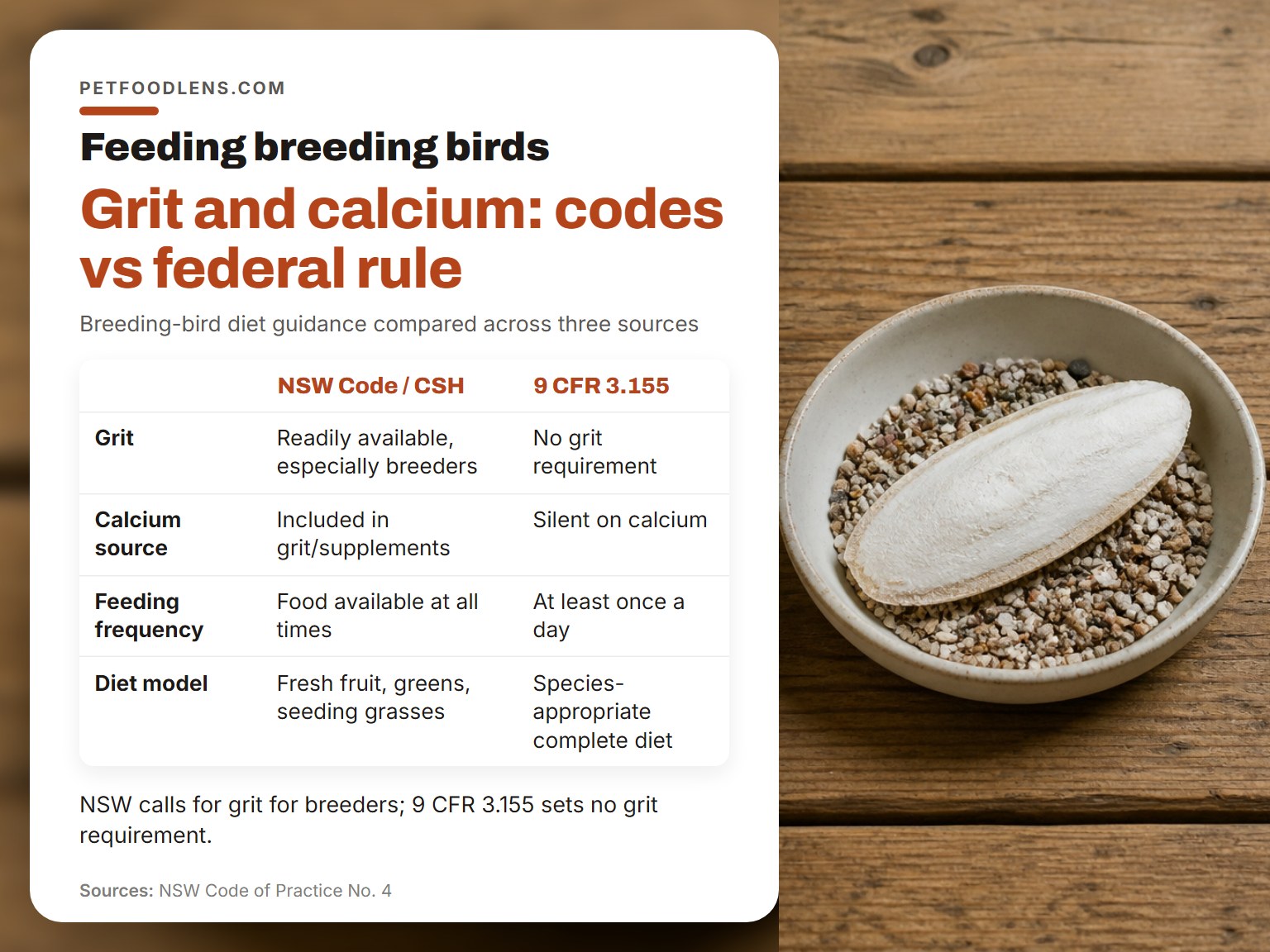
The NSW Code of Practice bird keeping says grit and other supplements should be readily available, especially to breeding birds. The zebra finch protocol specifies grit ad libitum. The federal rule in 9 CFR 3.155 says nothing about grit at all.
| Position | Source | What It Requires |
|---|---|---|
| Grit readily available, especially for breeders | NSW Code of Practice No. 4 | Grit and supplements on offer |
| Grit ad libitum | CSH zebra finch protocol | Free access in the cage |
| No grit requirement | 9 CFR 3.155 | Silent on grit |
The NSW Code and CSH protocol call for grit, especially for breeders, while 9 CFR 3.155 imposes no grit requirement.
Calcium is the other breeding-specific gap. UC Davis says laying hens should get a calcium source such as oyster shell. The NSW code folds this into the same grit-and-supplements recommendation. A hen that lays without a calcium source is drawing from her own skeleton, and that’s how egg binding starts.
The base diet is where the sources split again. The UF IFAS pet bird nutrition guide frames a single balanced, complete diet as the backbone of proper nutrition, with six nutrient categories: water, proteins, carbohydrates, lipids, minerals, and vitamins. NSW instead describes a fresh-food model: fruit, greens, and seeding grasses supplied daily, plus grit.
| Diet Model | Source | Core Idea |
|---|---|---|
| Balanced complete diet | UF/IFAS VM067 | One formulated diet covers all six nutrient categories |
| Fresh-food model | NSW Code of Practice No. 4 | Daily fruit, greens, seeding grasses, plus grit |
UF/IFAS frames a single balanced, complete diet as the backbone, while NSW describes a fresh-food model of daily fruit, greens, seeding grasses, and grit. UF/IFAS also warns that overnutrition is as harmful as undernutrition, which is easy to miss when you’re trying to support a hen through a clutch.
Read past the front of the bag on this one. The guaranteed analysis on the back is where the real numbers live. The balanced bird diet breakdown walks through how to read those proportions, and the egg food for breeding birds guide covers the protein boost many breeders add during a clutch.
If your base is a seed-based diet, the supplement question gets more urgent, because seed alone rarely covers the full nutrient list.
What the Regulations Actually Require
The 9 CFR 3.155 feeding regulation sets the federal floor. The diet must be appropriate for the species, size, age, and condition of the bird, and it must be wholesome, palatable, and free of contamination. Birds must be fed at least once a day. Group-housed birds need multiple food receptacles so all birds get enough.
9 CFR 3.155 requires feeding at least once a day, while VCA says neonates need 6-10 feeds per day.
The NSW code adds the breeding-specific layer: unweaned birds should only be traded to people competent in hand-rearing, and birds with overgrown beaks should not be used for breeding unless the cause is curable. UC Davis also lists flock raiser at 20% protein for adult chickens and turkeys, and layer feed at 16% for laying hens, which gives you a benchmark for what “complete” looks like on a bag.
Frequently Asked Questions
How do I know if formula is the right temperature without a thermometer?
You don’t, reliably. VCA specifies 102-106°F (39-41°C) measured with a thermometer throughout the mixture. A wrist test reads skin tolerance, not crop tolerance, and a microwaved bowl can have hot spots that the wrist never feels.
Can I feed a chick if its crop is still full from the last feed?
No. VCA says the best time to feed is when the crop is empty. A full crop plus another feed is how sour crop and crop stasis start.
What do I do if the chick won’t take the syringe?
Stop. VCA is explicit that a chick without a strong feeding response should not be fed, because of aspiration risk into the trachea and lungs. A chick that won’t bob its head needs a vet, not a bigger feed.
Do breeding birds need grit?
It depends on which standard you follow. The NSW Code of Practice says grit should be readily available, especially to breeding birds, and the zebra finch protocol specifies it ad libitum. The federal rule in 9 CFR 3.155 does not mention grit.
When should I start weaning?
For zebra finches, the CSH protocol puts self-feeding at about 30-35 days post-hatch. Start withholding the mid-day feed first, then the morning, then the evening, per VCA.
Is night feeding necessary?
VCA says feeding between 10:00 p.m. And 6:00 a.m. Is not necessary because the chick should be sleeping. The same handout also notes that some birds benefit from night feeding in the first week. The CSH protocol stops at 23:00. Watch the chick’s weight and crop emptying; add a night feed back if weight drops.
The Bottom Line
The one number to write on the brooder lid is 102-106°F. Everything else here is a schedule you can adjust. That range is not adjustable, because a crop burn is a vet visit and a refused feed is just a lost hour.
If you’re breeding for the first time, do this before the eggs hatch: buy a digital thermometer, buy syringes, and pick one formula and stick with it. The chicks will tell you the rest.
One concession worth stating plainly: I’m a label-reader by trade, not a bird vet. The husbandry numbers here come from VCA, the CSH protocol, NSW, UC Davis, and 9 CFR 3.155, and where those sources disagree I’ve shown the disagreement rather than picking a winner. If a chick is losing weight, gaping, or refusing feeds, the schedule here is not the answer. A vet is.
