
How to Attract Cardinals to a Feeder: Seed, Water, Cover
This post contains affiliate links. As an Amazon Associate, we earn from qualifying purchases.
To attract cardinals to a feeder, offer black oil sunflower seed in a hopper or platform feeder near shrub cover, plus a water source. Cardinals generally won’t use a tube feeder, per Bonter, though Chicago Botanic Garden points to a hopper-style feeder with sunflower seeds, and a new feeder can sit empty for a week or longer before the first bird finds it.
The how to attract cardinals to a feeder point deserves a sentence of explanation, because a tube packed with sunflower seed looks like a cardinal feeder. David Bonter, who heads Cornell’s Project FeederWatch, told National Wildlife that cardinals find the narrow cylindrical perches hard to stand on. A cardinal is a broad, heavy-bodied bird that feeds on branches and on the ground. A perch built for a goldfinch won’t hold one.
What follows is the how to attract cardinals to a feeder seed order the agencies actually agree on, the feeder shapes that work, the placement argument the state agencies haven’t settled, and the cleaning interval that matters more than any of it.
Key Takeaways
- Black oil sunflower ranks first with Audubon, Maryland DNR, Minnesota DNR, and Chicago Botanic Garden. Striped sunflower and sunflower chips come next in Audubon’s order.
- Skip the tube feeder. Bonter says cardinals can’t stand on the narrow cylindrical perches, so a tube full of sunflower is decoration; Chicago Botanic Garden instead points to a hopper-style feeder with sunflower seeds.
- Clean every two weeks per Maryland DNR, and sooner if seed gets wet or a sick bird appears at the perch; Chicago Botanic Garden and Audubon instead advise cleaning occasionally or regularly without a fixed interval.
- Place feeders near conifer cover but at least ten feet from where a cat or hawk can hide, per Minnesota DNR; NWF instead advises placing food near shrubs or other cover with no distance attached.
- Fill through middle to late spring. Chicago Botanic Garden notes that early spring is the hardest stretch of the year for birds to find food.
Which Seed Actually Brings Cardinals In?
Eli Haislip manages The Wood Thrush Shop in Nashville, and he told the Audubon cardinal attraction guide that cardinals are one of the easiest birds to pull in and not remotely picky. His first choice is black oil sunflower, and the state agencies line up behind him.
Black oil sunflower carries a thin husk and high oil content. Small-billed birds open the seed with less work than striped sunflower requires, and the Illinois DNR rates black oil as preferred over striped for that reason. That same state guidance calls black oil the lowest-waste option and recommends drainage holes in tray-feeder bottoms to keep damp seed from molding.
I ran a test feeder on plain black oil sunflower two winters back, with a bag of multi-species mix hanging ten feet away. Inside about two weeks the black oil feeder had cardinals, chickadees, titmice, and a blue jay. The mix feeder had a longer ingredient list on the bag and fewer birds on the perches.
That result tracks with what the panels say. Flip the bag over. If sunflower isn’t near the top of the list, the rest of the bag is filler aimed at the owner rather than the bird. Maryland DNR is blunt about it: common seed mixes pull in European Starlings, House Sparrows, and pigeons, and many contain substantial red milo that only a few species eat.
Sorting out best bird seed to attract cardinals comes down to two questions. Does the bird eat it, and does the bag waste half its weight on something that ends up on the ground?
The female is tawny brown with red in the wings and crest, which is why a pair at a feeder often reads as two different species.
| Seed | Cardinal response | What to know |
|---|---|---|
| Black oil sunflower | Top pick across sources | Thin husk, least waste |
| Striped sunflower | Second in Audubon’s order | Harder shell, more waste |
| Sunflower chips | Third in Audubon’s order | Less mess, higher cost |
| Safflower | Eaten readily | Maryland DNR: starlings avoid it; Audubon does not endorse the deterrent claim |
| Peanuts | Minnesota DNR: cardinals come to peanut feeders | Strong winter food |
| Suet | Audubon: eaten gladly | Maryland DNR says fall and winter |
Black Oil, Striped, or Chips?
Black oil wins on shell thickness. Striped sunflower is a bigger seed with a heavier coat, and Audubon’s ranking puts it second rather than first. Chips, which are shelled sunflower hearts, cut the mess under the feeder because nothing has to be cracked open.
Chicago Botanic Garden makes the trade-off plainly: shelled sunflowers mean less debris, but they cost more. If your feeder sits over a patio, that’s a real argument for chips. If it hangs over grass, black oil is the better buy.
Maryland DNR lists safflower seed as foraged by cardinals, doves, purple finches, and titmice, and notes that feeder hogs like grackles and starlings tend to leave it alone. Audubon lists safflower as a cardinal favorite too but does not endorse the starling-deterrent claim.
Only Maryland DNR makes the deterrent claim, though. Audubon doesn’t back it up, and nothing else in this source set tests it. Treat safflower as a seed cardinals will eat, with a possible side benefit that Maryland DNR reports and Audubon does not endorse.
A Feeder Full of Seed Can Still Be the Wrong Feeder
Bonter’s tube-feeder verdict is the single most useful line in the whole source set: cardinals are large birds with wide feet, and a tube feeder’s perches are short metal pins sized for small finches, while Chicago Botanic Garden instead names a hopper-style feeder with sunflower seeds. The bird lands, can’t balance, and leaves.
Hoppers and platforms solve that. Chicago Botanic Garden names a hopper-style feeder filled with sunflower seed as a cardinal magnet. National Wildlife’s guidance is a sturdy platform or hopper placed near shrubs. Illinois DNR goes further and suggests mounting a tray feeder near the ground to include cardinals at all.
| Feeder type | Cardinal fit | Why |
|---|---|---|
| Hopper | Strong | Chicago Botanic Garden names it directly |
| Platform | Strong | NWF: sturdy platform near cover |
| Ground tray | Good | Illinois DNR: mount near ground to include cardinals |
| Tube | Poor | Bonter: perches too narrow to stand on |
The best bird feeders for cardinals share one trait that has nothing to do with brand: a landing surface wide enough for a heavy bird. A hopper feeder covers most yards. A tube feeder is beautifully built and still the wrong tool for this species.
Squirrels will find it before the cardinals do. A baffle handles most of that, and squirrel proofing a feeder is worth doing before the first bag goes in rather than after.
Hopper vs Platform vs Tray
Pick a hopper if you want one feeder and a clean answer. It holds a good amount of seed, keeps seed dry, and gives a cardinal a real ledge to land on.
Pick a platform if you want the widest species list. It feeds cardinals, jays, doves, and anything else that lands, and it dumps seed on the ground in wind.
Pick a ground tray only if you have a spot away from cover where cats can’t sit. Illinois DNR recommends it, and it works, but it’s the most exposed of the three.
Ten Feet From Cover, and the Window Exception
Minnesota DNR puts a number on feeder placement that most guides skip: put the feeder near the shelter of pines, spruce, or juniper, but keep it at least ten feet from the nearest cover where a raptor or cat could hide; NWF instead advises placing food near shrubs or other cover with no distance attached. Close enough to rest in, far enough that nothing can ambush from the shrub line.
If your only option is inside that ten-foot zone, the same guidance says to ring the feeder with 2 by 4 inch welded wire fencing at least thirty inches high and six to eight feet across.
National Wildlife’s version is looser. It says to place food on a sturdy platform or hopper near shrubs or other cover, with no distance attached. Both agencies want cover nearby. Only Minnesota DNR puts a number on the gap.
Bird feeder placement is where the agencies stop agreeing, so it’s worth knowing which one you’re following.
Minnesota DNR has a counterintuitive fix for window strikes: move the feeder to within one or two feet of the glass, while Audubon instead advises making windows visible to birds. The reasoning is that birds never build up enough speed in that short a run to hurt themselves.
Audubon’s advice runs the other direction: it says to make the windows visible to birds in the first place, and to clean feeders and birdbaths regularly, while Minnesota DNR instead advises moving feeders to within one or two feet of the window. Both are in the Maryland DNR wild bird feeding guide tradition of practical, low-cost fixes, and neither is wrong.
I’d try the window treatment first and the feeder move second, because moving a feeder resets whatever routine the birds have built.
How to Attract Cardinals to a Feeder in the First Month
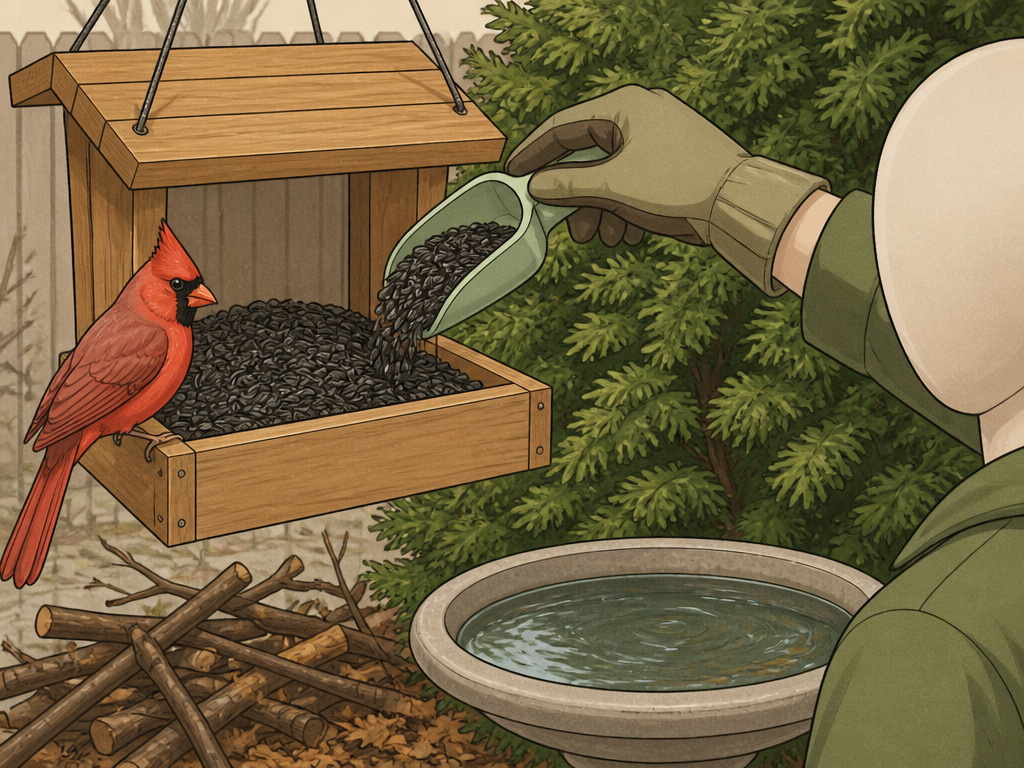
Picture a feeder that’s been hanging since October with nothing on it but a squirrel. That’s the normal starting state, and it isn’t a failure.
Chicago Botanic Garden is direct about the timeline: it can take up to a week or longer for certain birds to find a new food source. Cardinals work a daily route, and your feeder has to become part of it.
Here’s the sequence that gets there fastest:
- Hang black oil sunflower in a hopper or platform feeder near shrub or conifer cover, at least ten feet from predator hiding spots per Minnesota DNR (NWF advises near cover with no distance).
- Add water. Audubon recommends a fountain or birdbath, and a heated birdbath if winters regularly drop below freezing where you live.
- Build a brush pile from downed limbs, pruned branches, and used Christmas trees, per Audubon.
- Leave the seedheads standing. Audubon suggests skipping the fall cut on coneflowers, goldenrods, and other perennials that feed birds through winter.
- Keep the feeder full through middle to late spring, since early spring is the leanest stretch of the year for birds.
If nothing shows up, attract birds to a new feeder is mostly about patience and cover rather than seed volume. Adding a second feeder doesn’t speed anything up.
Planting helps in the long run. National Wildlife names serviceberry, flowering dogwood, arrowwood viburnum, eastern red cedar, white pine, and elm as native plants that supply cardinal food, and notes the birds prefer thickets and evergreens for nesting and roosting.
Going away for a week is fine. The Chicago Botanic Garden bird feeding guide says to fill the feeders full before you leave and restock when you get back.
Where the Experts Actually Disagree
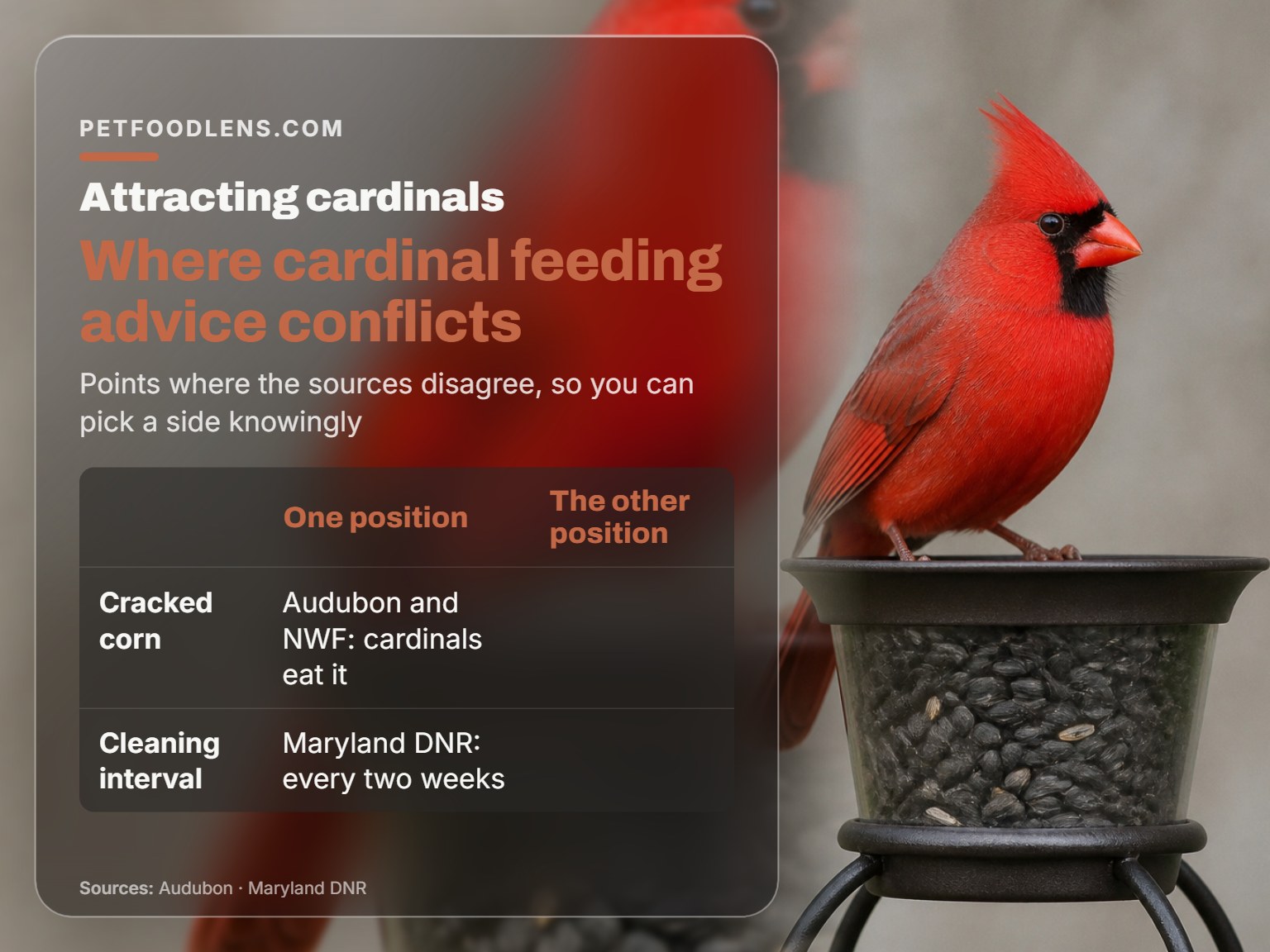
The sources here contradict each other on at least five points, and none of the positions is obviously wrong. Here’s the map, so you can pick a side knowingly.
| Question | One position | The other position |
|---|---|---|
| Cover distance | Minnesota DNR: at least ten feet from predator cover | NWF: near shrubs and other cover, no distance given |
| Cracked corn | Audubon and NWF: cardinals eat it | Minnesota DNR: not recommended, pulls sparrows and starlings (sources disagree) |
| Seed mixes | Chicago Botanic Garden: individual foods, not mixes | Minnesota DNR: cardinal mixes are 80 to 90 percent of state winter seed (sources disagree) |
| Cleaning interval | Maryland DNR: every two weeks | Chicago Botanic Garden: occasionally, when it needs it (sources disagree) |
| Suet timing | Maryland DNR: fall and winter only, raw suet goes rancid | Audubon: lists suet with no seasonal limit (sources disagree) |
My read on the cracked corn row is to skip it. Audubon and NWF say a cardinal will eat cracked corn, and Minnesota DNR says it pulls in house sparrows and starlings by the flock; the sources disagree, and only one of them is the outcome you want.
On mixes, the two positions describe different products. Chicago Botanic Garden is warning about generic grocery-store blends, while Minnesota DNR is describing a sunflower, safflower, and peanut mix with a defined composition; the sources disagree, so read the panel and pick a side knowingly.
Does Cleaning Really Matter That Much?
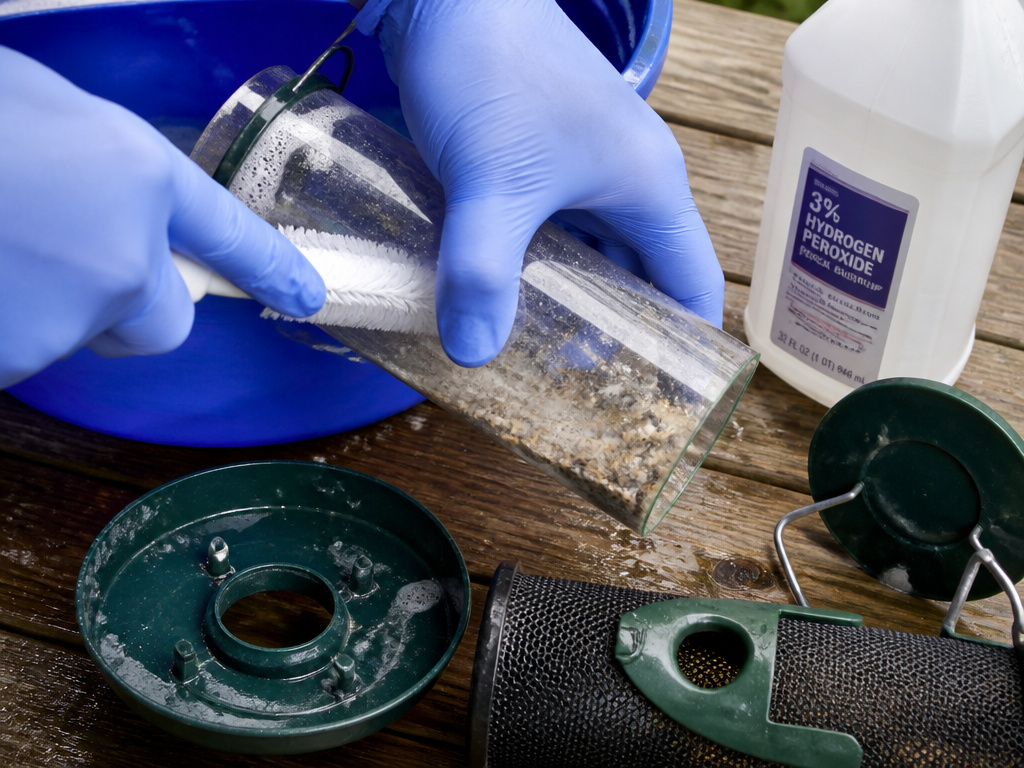
Cleaning is the part that decides whether a feeder helps or hurts. Chicago Botanic Garden states it without hedging: moldy seeds can sicken birds as well as the humans who handle them.
Maryland DNR gives an interval. Clean feeders once every two weeks, and more often if seed gets wet or sick birds show up at the perch. Chicago Botanic Garden says to wash with soap and water, dry the feeder, and rehang it.
Seed that’s gone over smells sour and damp, like a wet basement, before you see anything growing on it. If you catch that smell when you open the lid, the whole load goes in the bin.
I learned the refill habit the hard way with nyjer. Left in a tube through humid weather, it clumps and cakes, and goldfinches would land, pick at it, and leave. Tossing the leftover seed and rinsing the tube with a diluted bleach solution between refills changed the traffic within a week.
A dirty feeder is worse than no feeder at all. If you won’t commit to emptying and scrubbing it on a schedule, don’t hang it.
The part nobody mentions: Topping the feeder up without emptying it first. Wet seed compacts at the bottom, molds inside a week or two, and every bird that visits afterward is eating off a contaminated tray.
What Does a Cardinal Eat in January?
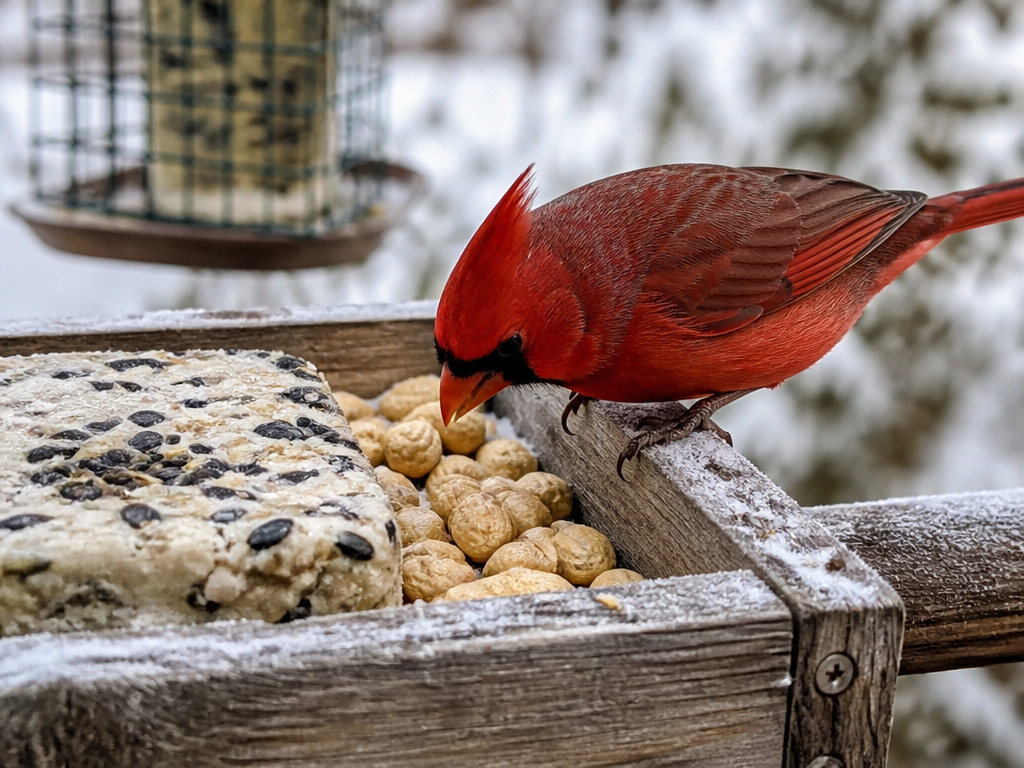
Suet is the winter lever, and it comes with two hard rules. Maryland DNR says commercial suet cakes or fresh suet mixed with sunflower and other seed make a favored treat for cardinals, woodpeckers, nuthatches, and chickadees, and that most commercial varieties don’t melt in the sun.
Rule one: Maryland DNR says raw suet goes rancid in the sun, so offer it only on cold winter days, while Audubon lists suet with no seasonal restriction. Rule two: if black bears live in your area, only put suet out while they’re hibernating.
Peanuts are the other winter food worth adding. Minnesota DNR notes that even northern cardinals will come to a peanut feeder, alongside chickadees, nuthatches, woodpeckers, and blue jays.
Bird food for cardinals in cold weather is as much about fat as seed, which is why suet and peanuts earn a slot next to the sunflower.
The numbers change in winter too. Bonter told National Wildlife that a single feeder can draw 20, 30, or 40 cardinals at once the cold sets in and territorial behavior eases. During nesting season, the same article notes you’ll probably only attract one pair.
If blue jays are showing up as well, feeders for cardinals and blue jays need a wider perch and a heavier baffle than a cardinal-only setup.
Skip this if: you live in bear country and it isn’t denning season. Suet and bears are a bad combination, and Maryland DNR’s guidance is to wait for hibernation.
Minnesota DNR also suggests running several feeder clusters of three to four feeders each, plus a ground feeding site, with each cluster offering larger seeds, smaller seeds, and suet. When snow starts accumulating, tray and fly-through feeders can move to a deck railing where you can still reach them.
Frequently Asked Questions
Will cardinals use a tube feeder?
Rarely. David Bonter of Cornell’s Project FeederWatch says cardinals find the narrow cylindrical perches difficult to stand on, which is why a hopper or platform feeder works better, while Chicago Botanic Garden instead names a hopper-style feeder with sunflower seeds. A tube feeder will still pull chickadees and finches.
What is the single best seed for cardinals?
Black oil sunflower. Audubon, Maryland DNR, Minnesota DNR, and Chicago Botanic Garden all point to it, and Illinois DNR rates it over striped sunflower because the thinner husk means less waste.
How long does it take cardinals to find a new feeder?
Up to a week or longer, according to Chicago Botanic Garden. Cardinals run a daily route, and a new feeder has to get folded into it. Leaving it stocked and undisturbed is the fastest path.
Do cardinals eat suet?
Yes. Maryland DNR lists suet as a favored treat for cardinals, woodpeckers, nuthatches, and chickadees. Maryland DNR advises commercial no-melt cakes in mild weather and raw suet only on cold winter days, while Audubon lists suet with no seasonal restriction.
How often should I clean a cardinal feeder?
Maryland DNR recommends once every two weeks, and more often if the seed gets wet or you see a sick bird. Chicago Botanic Garden advises washing with soap and water, drying, and rehanging.
Why do I only see one pair of cardinals?
Cardinals are aggressive and territorial. National Wildlife notes you’ll probably only attract one pair during nesting season unless your property is large. Winter is different, when groups gather at feeders.
Before You Go
If you take one thing from all of this, take the cleaning interval. Maryland DNR recommends emptying and scrubbing the feeder every two weeks, and the moment you smell damp or see clumping, do it that day instead; Chicago Botanic Garden and Audubon instead advise cleaning occasionally or regularly without a fixed interval. Everything else here is optimization. That’s the floor.
The concession is worth stating plainly: if you’re not going to clean it, don’t hang it. A feeder that goes three weeks between refills with wet seed caked at the bottom does more harm than an empty hook on the porch.
Start with one hopper feeder, one bag of black oil sunflower, and a birdbath. Give it two weeks before you decide it isn’t working. If a cardinal hasn’t found it by then, add the brush pile and check your distance from cover before you change anything about the seed.
