
Dental Treats for Cats Pros and Cons: Do They Work?
This post contains affiliate links. As an Amazon Associate, we earn from qualifying purchases.
The dental treats for cats pros and cons reduce to one measurable gain and one hard limit: VOHC-accepted products cut tartar by at least 20 percent in scored trials, the effective dose can reach 16 pieces a day, and whether any of them prevents periodontal disease is still contested.
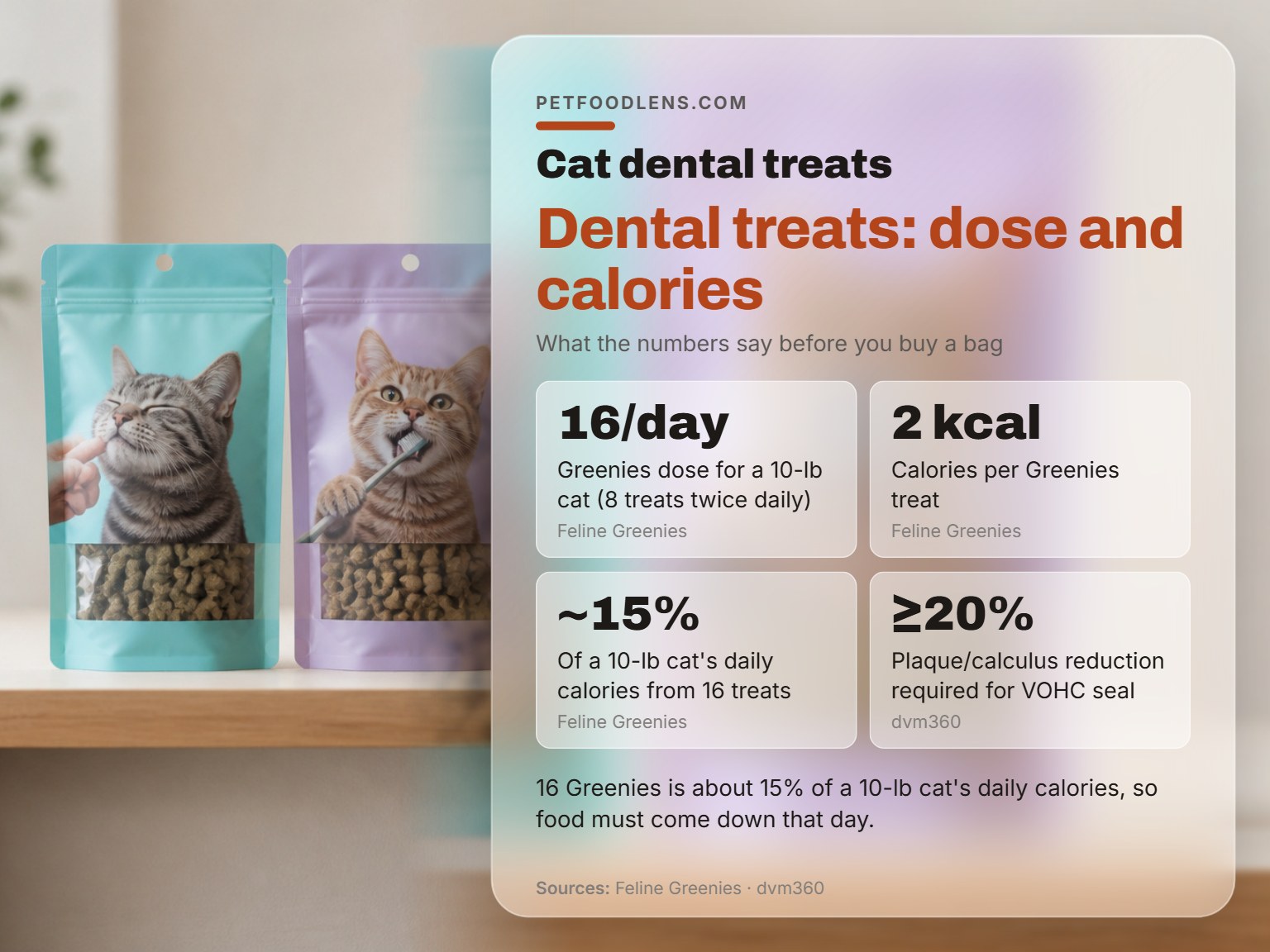
Sixteen pieces is the number printed nowhere on the front of the bag. It comes from the manufacturer’s own efficacy guidance for a ten-pound cat, and it’s the most useful figure in this entire category because it shows exactly how far the marketing sits from the dosing.
What follows walks the mechanism first, then the dose math, then the honest cons: hardness, calories, gulpers, and the real scope of that seal on the package.
Key Takeaways
- VOHC acceptance means at least a 20 percent reduction in plaque or calculus, not protection from periodontal disease.
- The tested dose varies wildly: Greenies guidance is 16 pieces a day for a ten-pound cat, while Virbac Intellident recommends 3.
- If a fingernail won’t dent it, it’s too hard to chew safely, per veterinary dental guidance.
- Cats that swallow chews whole get almost no abrasive benefit from them.
- Treats reach the back teeth that grind food, not the incisors or canines.
What a Dental Treat Physically Does Inside a Cat’s Mouth
A dental treat works by abrasion, and abrasion happens only where treat and tooth actually touch. That sounds obvious until you look at how a cat chews.
Feline chewing is a shearing motion rather than a crushing one. Ten cats across six breeds were recorded for a dentition study, and each bolus was chewed three to seven times before swallowing. Chew geometry built around a crushing motion therefore contacts the tooth surface differently than cat anatomy allows.
That geometry matters because a cat shears and swallows fast, which is the dental treats for cats pros and cons question in miniature. A hard treat that survives two seconds in the mouth does almost no work. The feline dentition study modeled chews at 18 mm for the occlusion region alone, and at 45 mm by 18 mm once oral size was folded in.
Contact is the whole mechanism.
WSAVA’s 2019 proceedings put the limit bluntly: treats only clean the teeth that grind food, which leaves the incisors and canines untouched. Clinicians Brief makes the same split from the other direction, noting that passive methods like treats serve the distal back teeth while active brushing serves the mesial front ones.
There’s a second, chemical route. Sodium hexametaphosphate, usually listed as SHMP, binds the calcium in saliva so plaque minerals into calculus more slowly. That effect works even on teeth a chew never touches. It also doesn’t remove plaque, and plaque is what drives the disease.
How Many Dental Treats Does a Cat Actually Need Per Day?
Have you ever counted out 16 treats for a ten-pound cat? The number isn’t on the front of the bag, and that gap is where most dental treat purchases go sideways.
The published figures don’t agree, and the disagreement is large enough to matter.
| Product | Daily dose, 10-lb cat | VOHC accepted | Calorie note |
|---|---|---|---|
| Feline Greenies Dental Treats | 8 treats, twice daily | Yes, tartar reduction | 2 kcal each, about 15% of daily needs |
| Virbac Intellident | 3 treats | No | Not stated |
| Trial dental bite (Virbac study) | 3 bites | Not stated | Under 8 kcal per day |
The three-bite figure comes from a randomized, blinded trial: 50 domestic short-hair cats aged 3 to 10 years, 25 per group, scored on Day 28 after a Day 0 scaling and polish. The 16-piece figure comes from the manufacturer’s own efficacy guidance.
Both numbers are honest, and when you compare a dental treats for cats pros and cons, they’re just describing different products at different doses, and the label doesn’t foreground either one.
A household with two cats on different foods had to separate feeding spots before the portions made sense, and dental treats make that worse, because one cat eating both shares splits the dose between them. Ask about the feeding setup before you quote any number.
The Real Pros: Where Dental Treats Earn Their Place
Chewing beats nothing, and that is a lower bar than the packaging suggests.
The strongest argument for treats isn’t efficacy. It’s compliance. Clinicians Brief estimates only about 1 percent of clients brush their pets’ teeth daily, and dvm360 puts the share of owners who brush enough to have a positive effect at under 5 percent. Compliance also drops to roughly 50 percent after six months even among motivated owners.
That’s the gap treats fill, and the two sources frame it differently. Clinicians Brief argues passive home care may actually outperform active care because it gets done regularly. The Virbac paper calls tooth brushing the gold standard and then concedes that daily brushing is a real challenge in cats. Both are describing the same reality from opposite ends.
If you want the full comparison laid out, dental treats versus brushing for cats covers the trade-off in more depth.
- Passive care actually happens. A treat gets given on days the toothbrush stays in the drawer.
- Back teeth get the contact. Passive methods reach distal teeth better than brushing does.
- The measured effect is real but modest. In the Virbac trial, calculus fell 24 percent against control over 28 days.
- Anti-calculus chemistry works without contact. Polyphosphates reduce tartar on teeth the chew never reaches.
- A low-calorie option exists. The three-bite protocol came in under 8 kcal a day.
A dental treat is a maintenance tool. It slows tartar on the teeth it touches, and it does nothing for the ones it misses.
The Cons: Hardness, Calories, and Claims That Outrun the Data
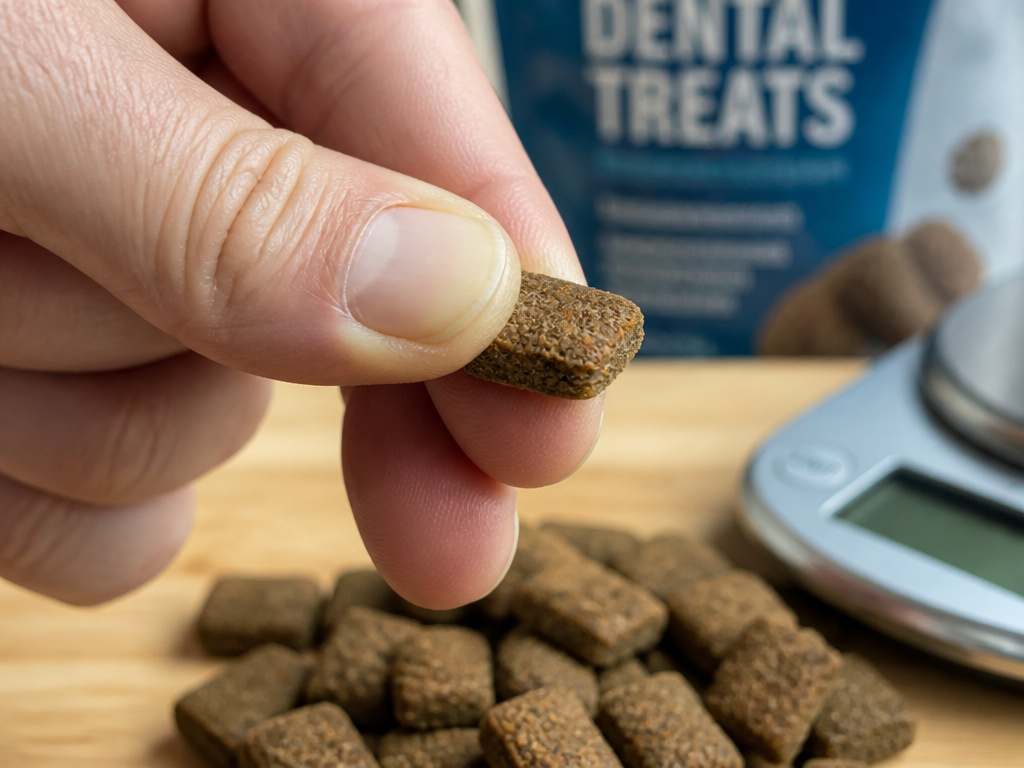
The word “dental” on a treat bag isn’t a regulated claim.
“Dental” describes a category. It doesn’t describe a result.
I read the fronts of dental treat bags once, looking for the verb. All of them said “helps clean teeth” or “freshens breath.” Not one said “treats periodontal disease.” That single word is the difference between a marketing claim and a tested outcome.
| What you see on the bag | What it actually means | Where it breaks down |
|---|---|---|
| “Dental” or “helps clean teeth” | Unregulated category wording | No threshold, no independent review |
| VOHC seal | At least 20% plaque or calculus reduction | Says nothing about hardness or calories |
| “Crunchy texture” | Abrasion while the cat chews | Fails on cats that swallow whole |
| “Low calorie” | Fewer kcal per piece | Dose still governs the total |
The Fingernail Test
Clinicians Brief is direct about this one: chew treats claiming dental disease control are often hard in texture and may result in tooth fracture. The test is simple. If a fingernail indentation can’t be made in the product, it’s too hard to chew safely.
WSAVA’s proceedings say the same thing from the other side, warning that very hard treats can cause tooth fractures. Neither source names brands, and that’s the point. Hardness is a property of the individual product, not the category.
Here’s where the sources genuinely split. Feline Greenies are described as having a crunchy texture and are recommended for cats a year and older. Purina DentaLife is VOHC-accepted to remove tartar, but its large round shape may be difficult for cats missing a few teeth to eat. A seal and a safe mouth fit are two separate questions.
The Calorie Math Nobody Runs
Each Greenies treat is about 2 calories. Sixteen of them add up to roughly 15 percent of what a ten-pound cat needs in a day, which means the food has to come down.
WSAVA takes a softer line, noting treats are a source of calories but not the main source. That’s true in a household that feeds four treats. It stops being true at sixteen.
Easy to miss: Plaque can recolonize a cleaned tooth surface within 24 hours, and periodontal pockets return to pretreatment depths within six weeks of a professional cleaning. A dental treat is maintenance between cleanings, not a substitute for one.
Why the VOHC Seal Is Useful but Narrower Than You Think
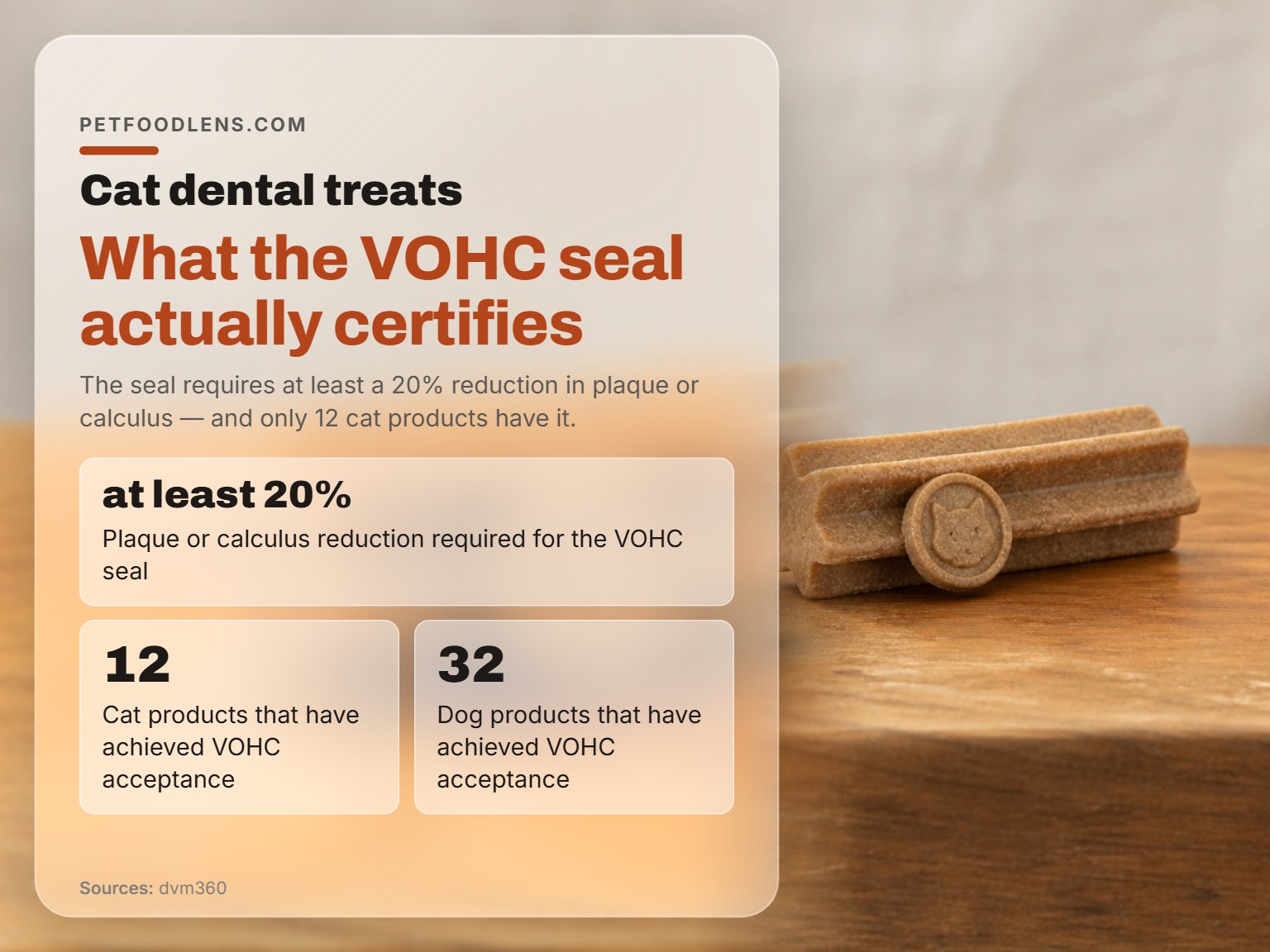
The Veterinary Oral Health Council awards its seal only to products that decrease plaque or calculus by at least 20 percent, and only 32 dog and 12 cat products have achieved acceptance.
What the Seal Certifies
The seal has real meaning. Veterinarian Christopher Snyder describes it as evidence that a treat has been scientifically shown to reduce plaque, tartar, or both. That’s a reviewed claim, and it’s more than most of the aisle can offer.
What It Does Not Certify
The seal’s scope stops well short of what shoppers assume. The AHVMA chew items considerations document notes that VOHC acceptance says nothing about hardness, digestibility, or nutritional value, yet owners and retailers treat it as a general safety endorsement.
Dvm360 adds the other half: using a VOHC-accepted product should not imply the pet will not develop periodontal disease. Control takes a multimodal approach covering diet, chews, home care, and professional care.
If you want the shortlist of products that actually cleared the threshold, VOHC-approved dental treats is the place to start rather than the shelf.
Do Dental Treats Prevent Periodontal Disease?
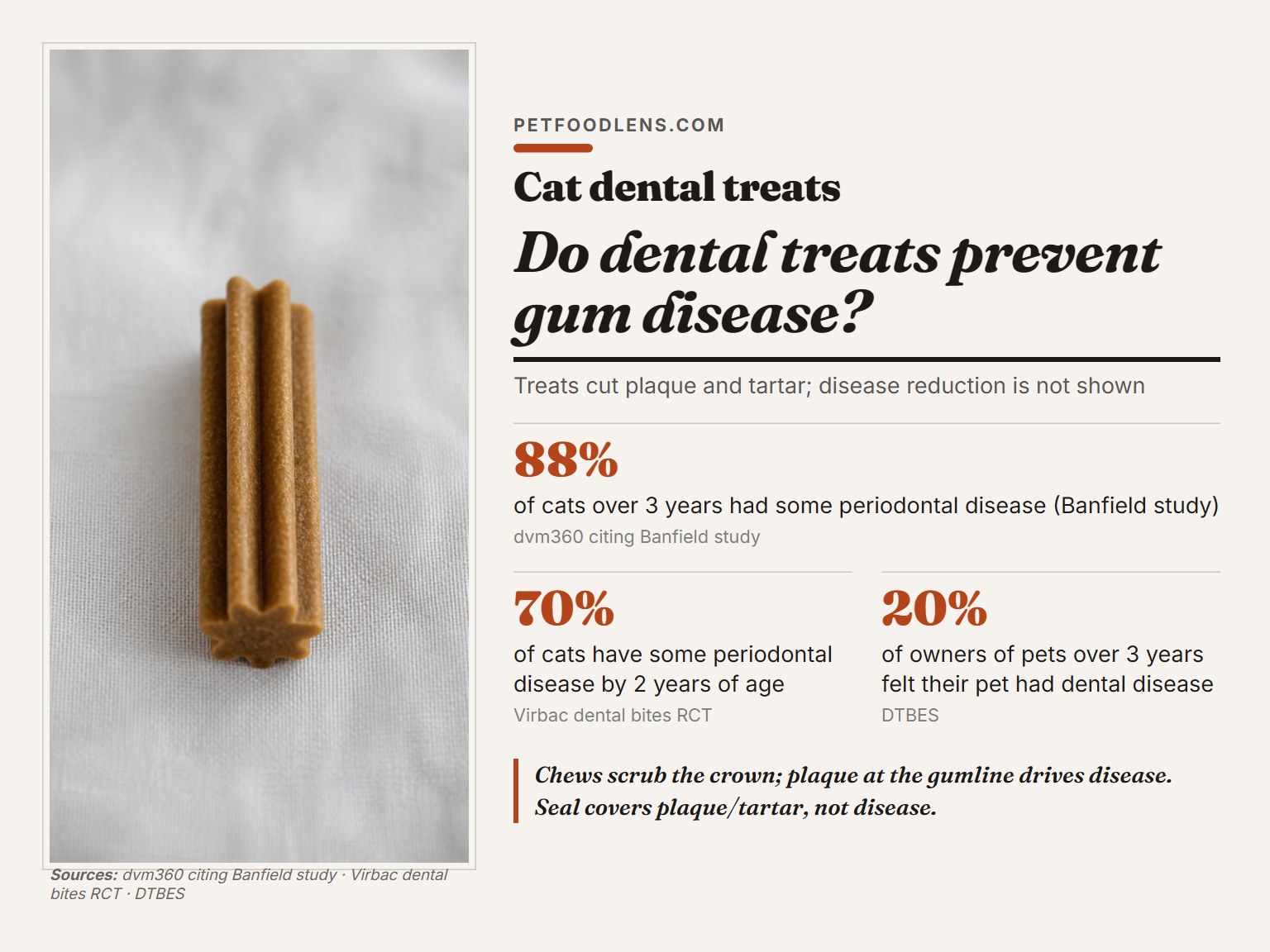
88 percent of cats older than three years had some form of periodontal disease in a Banfield study cited by dvm360. Virbac’s own introduction puts the figure at 70 percent by two years of age. Both numbers are large, and they’re measuring different populations.
The prevention question splits three ways, and the aisle blends all three into one promise:
- Deposit reduction. Measured in trials. Virbac found calculus down 24 percent and plaque down 10 percent overall, though plaque reduction was significant only on the left side.
- Disease reduction. Clinicians Brief states plainly that chew products have not been associated with a reduction in periodontal disease.
- Seal acceptance. VOHC reviews plaque and calculus data. It does not adjudicate disease outcomes.
Those are three different claims, and only the first one has numbers behind it.
There’s a mechanical reason the disease claim stays shaky. Clinicians Brief notes that supragingival plaque and calculus have negligible effects on periodontal disease development, while plaque at the gingival margin and below it drives the inflammation. A chew scrubs the crown of the tooth. The disease lives at the gumline.
The owner-perception gap makes all of this harder. In a Trone Brand Energy survey of more than 1,000 owners, only 20 percent of caregivers with pets older than three years felt their pets had any dental disease. Compare that to the 88 percent figure and the scale of the blind spot is obvious.
For cats already carrying a diagnosis, cat dental disease needs a different plan than the treat aisle offers. And if you’re choosing between formats, cat food for dental health covers what a diet can and can’t do.
Which Cats Should Not Get Dental Treats
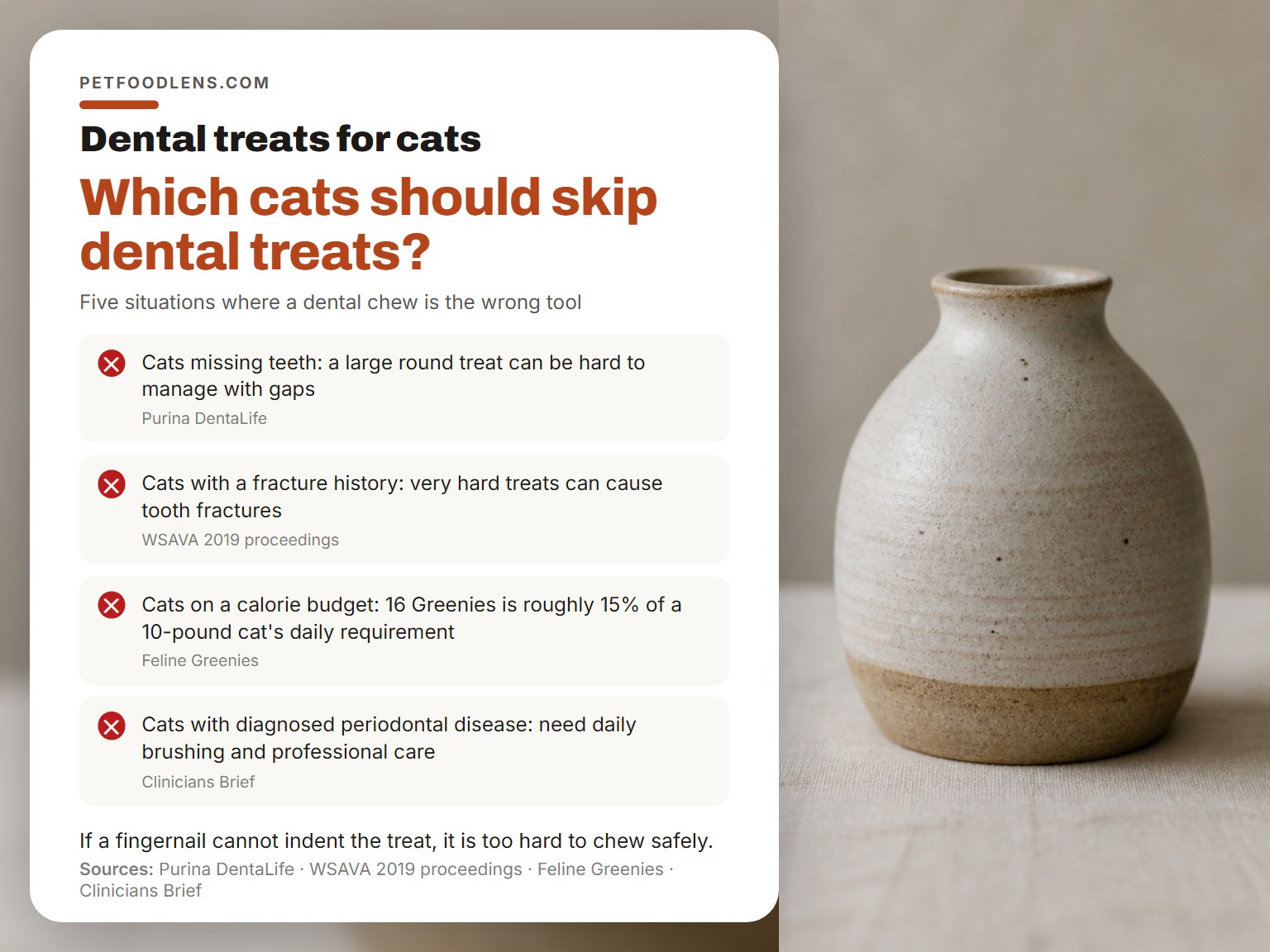
Some cats should skip them entirely.
- Gulpers. Cats that swallow chews whole barely keep them in the mouth long enough to abrade anything, which defeats the mechanism.
- Cats missing teeth. A large round treat can be genuinely hard for a cat with gaps to manage.
- Cats with a fracture history. Very hard treats can cause tooth fractures, and a previous fracture is a warning.
- Cats on a calorie budget. Sixteen Greenies is roughly 15 percent of a ten-pound cat’s daily requirement.
- Cats with diagnosed periodontal disease. Those cats need daily brushing and professional care, not a treat.
Skip this if: Your cat is a gulper. The chew goes down whole, the abrasion never happens, and you’ve bought a calorie with a dental logo on it.
Texture is the variable worth testing first. crunchy versus soft cat treats breaks down which format suits which mouth, because a soft treat and a hard one fail in opposite directions.
How to Compare Two Dental Treat Bags in the Aisle
Two bags, same shelf, both say “dental” in a friendly font. One carries the VOHC seal and one carries a picture of a fish.
Before you start: Three hazards come with this category. Hard chews can fracture teeth, so test with a thumbnail before buying. Whole chews are a choking and obstruction risk, so watch the first one go down. And the effective dose carries real calories, so subtract from the food rather than adding on top.
That’s an ingredient to note, not a reason to buy on its own.
- Find the VOHC seal. No seal means no reviewed evidence of a 20 percent reduction. Skip this and you’re buying on font choice.
- Read the daily dose, then do the math. Greenies needs 16 pieces for a ten-pound cat. Feed 4 and you’re at a quarter of the tested dose.
- Press a thumbnail into the treat. If it won’t dent, it’s hard enough to fracture a tooth. This one test eliminates more products than any front-of-bag claim.
- Check the calorie line. Sixteen Greenies runs about 15 percent of a ten-pound cat’s daily calories, so the food has to come down that day.
- Watch the cat eat it. A cat that swallows whole gets no abrasive benefit, and the purchase was wasted regardless of what the seal says.
If you’d rather start from a filtered list than read labels in the aisle, cat dental treats and teeth cleaning treats both sort by what’s actually been tested.
Frequently Asked Questions
Are dental treats for cats actually effective?
They reduce tartar, and that effect is measured. VOHC acceptance requires at least a 20 percent reduction in plaque or calculus, and the Virbac trial found calculus down 24 percent over 28 days. Whether that translates into less periodontal disease is a separate question the trials haven’t answered.
How many dental treats should I give my cat each day?
It depends entirely on the product, and the range is wide. Feline Greenies guidance is 8 treats twice daily for a ten-pound cat. Virbac Intellident recommends 3. The Virbac trial protocol used 3 bites a day for 28 days. Feeding below the tested dose puts you outside the studied range.
Is it safe to give a cat dental treats every day?
For many cats, yes, with two checks, though sources disagree on hardness risk, with Clinicians Brief and WSAVA warning that very hard treats can fracture teeth while Greenies are presented as suitable for cats a year and older. Press a fingernail into the treat, because if it won’t dent it’s hard enough to fracture a tooth. Then count the calories, since 16 Greenies is roughly 15 percent of a ten-pound cat’s daily requirement.
Do dental treats replace brushing?
No. Brushing remains the gold standard for home dental care in the Virbac paper, though Clinicians Brief argues passive care may outperform active care because it gets done regularly. Clinicians Brief calls daily brushing optimal and suggests three times a week as the minimum for a cat with good oral health. Treats are the fallback for cats that won’t tolerate a brush.
What does the VOHC seal mean on a cat treat bag?
It means the product was reviewed and shown to reduce plaque, tartar, or both by at least 20 percent. It says nothing about hardness, digestibility, or nutritional value, and it doesn’t mean the cat won’t develop periodontal disease.
Can dental treats make my cat gain weight?
They can contribute. Each Greenies treat is about 2 calories, but the effective dose of 16 pieces adds up to roughly 15 percent of a ten-pound cat’s daily calorie requirement. Reduce the food if you feed the full dose.
The Bottom Line
If your cat already carries a periodontal diagnosis, the treat aisle is the wrong aisle. Treats are a maintenance tool for cats with healthy mouths, and the sources that study them say so without much hedging.
The first step costs nothing and takes ten seconds. Take whatever dental treat is already in the cupboard and press a thumbnail into it. If it won’t dent, it’s hard enough to fracture a tooth, and that single test rules out more products than any label claim on the shelf.
But if your cat tolerates a brush, brush. The treat is the backup plan, not the plan.
