
Bone Broth for Dogs Pros and Cons: Is It Worth It?
This post contains affiliate links. As an Amazon Associate, we earn from qualifying purchases.
The bone broth for dogs pros and cons break down this way: a strained, dog-safe broth adds water, glycine, glucosamine, and minerals to a dog’s bowl, while cooked bones left in the pot are a documented hazard. Bone material accounts for 30% to 80% of esophageal foreign bodies in dogs and cats.
Straining is the whole distinction. Bones simmered at low heat for an extended period give up collagen, minerals, and amino acids into the liquid, and the bones themselves go in the bin. The bone broth for dogs pros and cons question turns on this: the hazards in the veterinary literature attach to the bone. The liquid is a separate object with a separate risk profile.
What follows covers the nutrient case, the bone case, the raw-versus-cooked argument nobody has actually settled, and the label traps that decide whether the carton in your fridge is worth buying twice.
Key Takeaways
- Bone material causes 30% to 80% of esophageal foreign bodies in dogs and cats, so strain the pot and check the sieve by hand.
- A strained broth carries glycine, glucosamine, chondroitin, collagen, and minerals, though no source quantifies how much of each reaches the bowl.
- Shelf-stable broth carries a seven-day consume-within window, which the AKC calls far too short for a small dog to finish.
- Bone broth won’t fix a joint problem by itself; the AKC points owners back to their vet for the rest of the plan.
- Onion, garlic, and salt are the additives to check for on any commercial broth before it goes in the bowl.
What Bone Broth Actually Puts in the Bowl
A stock pot yields four things the sources name outright, and one thing they don’t.
Bone broth is a stock produced by simmering animal bones at low heat over an extended period. Collagen and connective tissue break down into gelatin, glycine, and arginine, while glucosamine, hyaluronic acid, and chondroitin remain in the liquid along with magnesium, calcium, sulfur, silicon, and phosphorus. No source in the veterinary literature quantifies how much of each reaches the bowl.
The AKC’s breakdown is the most complete list in the material I pulled. It separates the amino acids from the joint compounds and the minerals, and it credits each with a different job.
- Glycine and arginine, the two amino acids the AKC ties to liver function and inflammation.
- Glucosamine, hyaluronic acid, and chondroitin, the joint compounds, which the AKC says support repair and stability.
- Minerals: magnesium, calcium, sulfur, silicon, and phosphorus.
- Collagen, which the AKC links to skin and coat condition as natural production drops with age.
- And water, which is the least fashionable item on that list and the one that matters most for a dog who won’t drink from a bowl.
Here is what the numbers actually say. No source here puts a milligram figure on any nutrient in a bowl of broth, and the AKC piece lists them without quantities. That doesn’t make the list wrong. It makes it a list of what is present, and a dose is a different thing.
Compare that with a fish oil product, which prints EPA and DHA per capsule on the label. Broth has no equivalent panel.
The same gap turns up in collagen chews: the compound is present, the amount per serving is the part worth hunting for.
So when you compare a bone broth for dogs pros and cons, treat broth as food, not as a supplement with a label dose.
Cooked Bones Are the Hazard, and the Broth Is Not
A cooked bone that has come out of a stock pot crumbles between your fingers and splits into splinters.
That physical change is the whole argument. Bone material accounts for 30% to 80% of esophageal foreign bodies in dogs and cats, according to a review in JAVMA 243(11) and a 2025 evidence review indexed as PMC11816250. The range is wide, but the direction holds. The direction holds anyway.
Dr. Jerry Klein, Chief Veterinarian at the American Kennel Club, makes the practical version of the point. Cooked bones are dangerous, they lodge in the throat, and owners should confirm that no small bones escaped notice before anything reaches the bowl.
Before you start: Strain the finished liquid through a fine sieve and run your fingers through the mesh before it goes in the bowl, because a fragment that slips past the sieve ends up in the dog. Check every commercial broth for onion, garlic, or salt, which the AKC flags as common additives. And get the pot into the fridge once it stops steaming, since a warm pot left on the stove keeps the middle of the batch in the range where bacteria multiply fastest.
The broth is the route to the same nutrients without handing over the bone. That is the AKC’s framing exactly, and it is the reason the two ideas get talked about as one.
Raw Bones vs Cooked Bones: Where the Sources Actually Land
Raw-bone advocates argue that raw bones cause fewer problems than cooked ones.
The JAVMA review states that the frequency of obstruction or perforation with raw versus cooked bones has not been evaluated. PMC11816250 repeats the point: research on raw versus cooked bone obstruction has, to the authors’ knowledge, not been conducted.
That leaves the advocate claim unverified rather than refuted. The distinction matters, and most write-ups blur it.
If you want the fuller version of that argument, the raw bones pros and cons breakdown covers the mechanical case on both sides.
I’d still strain the pot. A broth that has been through a sieve has no bone in it at all, which takes the question off the table.
Can Bone Broth Replace a Meal or Repair a Joint?
No on both counts, and the sources are unusually direct about the second one.
The AKC states that bone broth won’t cure joint problems without other treatments and that owners should contact their vet for additional solutions. The glucosamine, chondroitin, and hyaluronic acid are real. The dose isn’t a therapeutic one.
A joint supplement carries a stated amount of glucosamine per chew. A ladle of stock doesn’t.
What Bone Broth Will Not Do
Three things it gets credit for and shouldn’t:
- Replace a complete and balanced diet. The AKC frames broth as something added to a complete diet, and a bowl of stock plus kibble is still a bowl of kibble plus stock.
- Substitute for joint treatment. The vet conversation still happens.
- Fix a gut on its own. Broth is described as an excellent meal for a dog who needs a break from solid food during stomach upset or diarrhea. That is a comfort measure while the dog recovers, and it says nothing about the cause.
Where broth earns its place is narrower and more useful. A senior dog losing interest in food may eat a bowl that has been moistened with it. A dog with diarrhea heading toward dehydration gets water in a form he will actually take. A dog sensitive to common allergens may tolerate it, since the AKC notes it is low in allergens.
Probiotics are the other thing owners ask about in that situation, and that’s a vet question rather than a broth question.
Broth’s joint reputation borrows from the glucosamine supplements literature, which is a different conversation with its own evidence base and its own dosing.
So the honest version: broth is a delivery vehicle for water and flavor, with some nutrients riding along.
The Seven-Day Window That Sinks Homemade Batches
Seven days is the number the AKC mentions for shelf-stable broth, and it flags the problem in the same sentence.
The AKC notes that most shelf-stable broths need to be consumed within seven days, a window it calls far too short a period for a small dog to get through. Note that the piece gives no citation for the seven-day figure. Treat it as a rule of thumb from an institutional source rather than a measured shelf life.
The AKC’s own conclusion is to buy a dog food specifically formulated with fresh bone broth, which it calls the safest, simplest, and most economical solution, while the raw-feeding community instead cites wild carnivore ancestry, lack of processing, and low-carbohydrate content as reasons for raw feeding.
The Small-Dog Problem
A small dog getting a splash a day will not finish a batch inside a week, and the arithmetic gets worse the smaller the dog.
I won’t freeze a batch in one big container. Thawing the whole thing to get one serving means reheating it twice, and the second reheat is where a good batch turns.
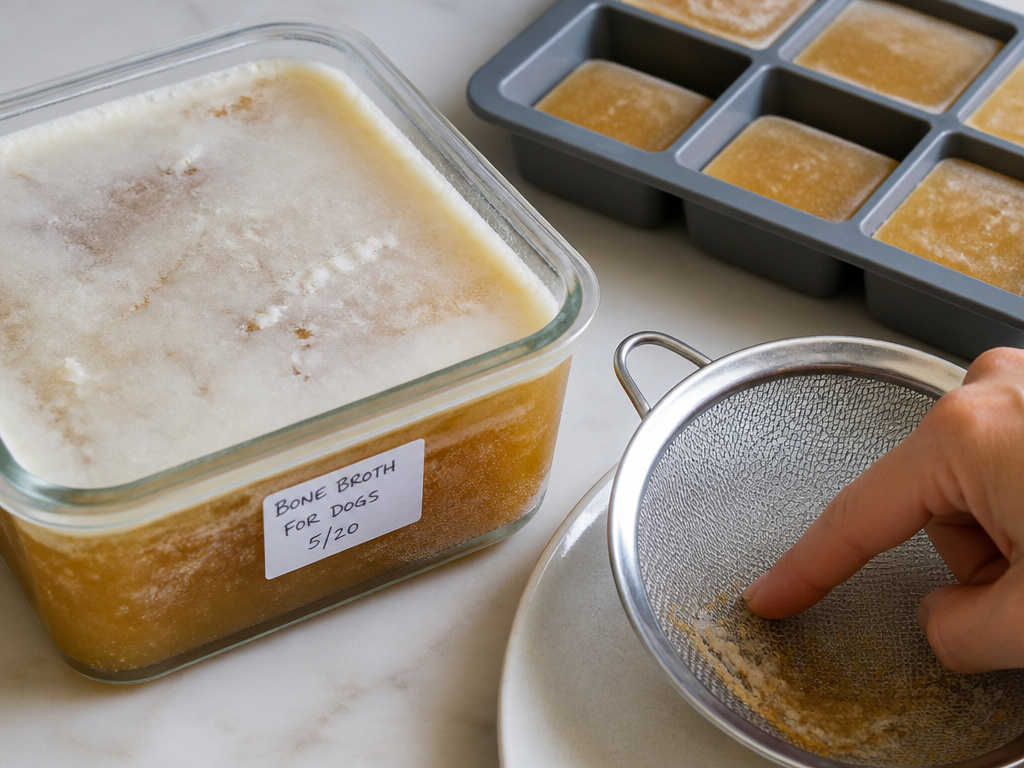
- Strain through a fine sieve, then run a finger through the mesh. A fragment that gets past the sieve ends up in the bowl.
- Cool the pot uncovered until it stops steaming, then refrigerate. A lid traps heat and the center of the batch stays warm for hours.
- Write the date on the container. An opaque jar hides the one number that matters.
- Freeze what the dog won’t finish inside the window. Ice cube trays work, and a single cube drops into a bowl without thawing the whole batch.
A batch that has set in the fridge turns to a firm jelly with a white fat cap on top. That gel is the collagen, and it melts back to liquid the moment it hits heat.
For portion sizes, the how much bone broth to give guide is the place to start, since the answer depends on the dog’s size and what else is in the bowl.
Reading a Broth Label Past the Front of the Package
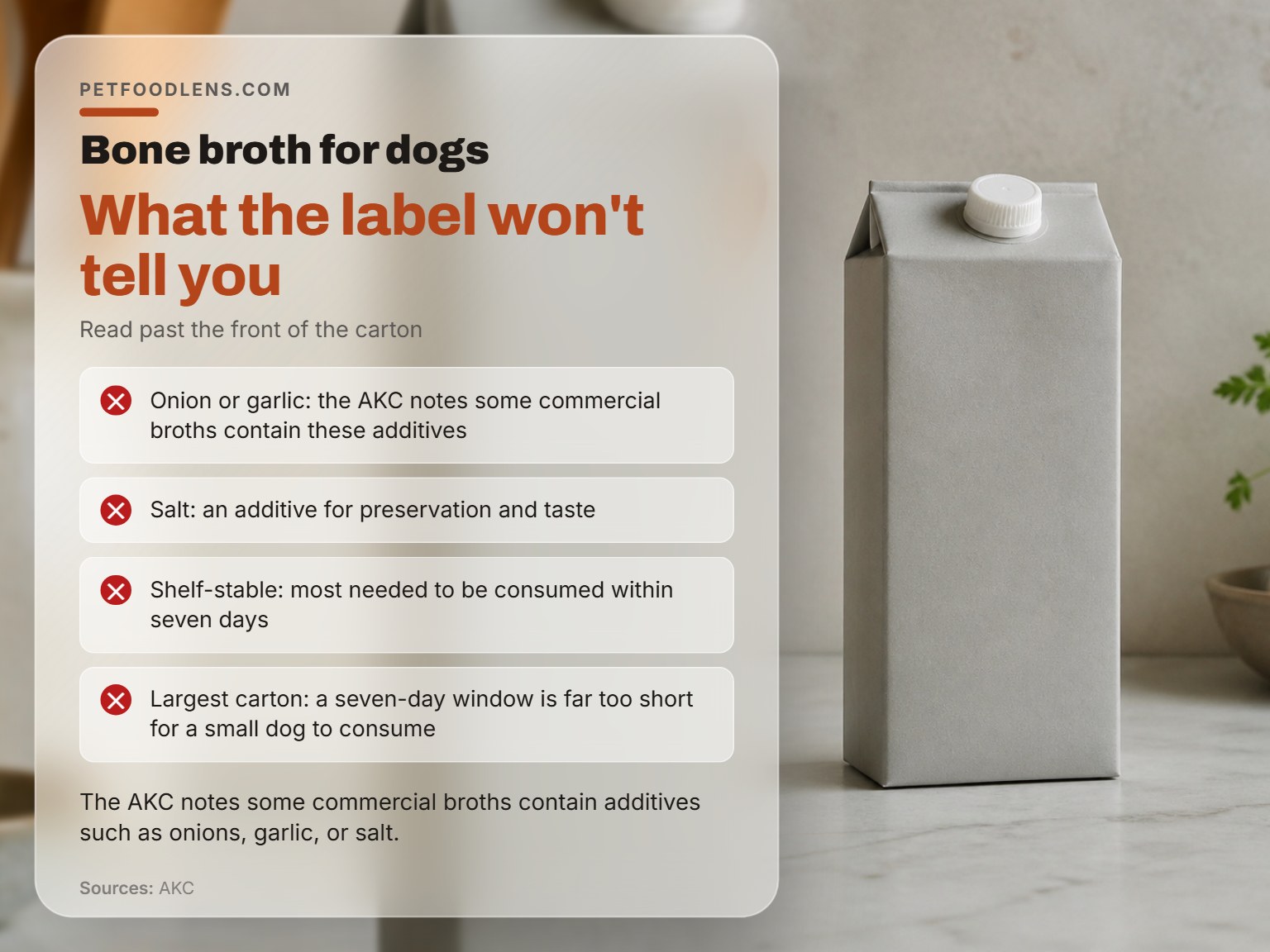
The carton says bone broth in large letters and “supports joint health” in small ones.
I’ve read the fronts of a lot of supplement packaging over the years, and the verb does all the work. “Supports” is a claim about nothing in particular. “Dissolves” is a claim you can test.
| Label term | What it tells you | What to do |
|---|---|---|
| “Bone broth” listed first | Ingredients are ordered by weight, and broth is mostly water | Read the guaranteed analysis instead |
| Onion or garlic powder | The AKC flags both as common additives | Leave it on the shelf |
| Salt | Added for taste, not for the dog | Choose an unsalted version |
| “Shelf-stable” | The AKC’s seven-day window applies once opened | Buy a size the dog finishes |
The AKC’s warning list is short and specific: onions, garlic, and salt. Those three turn up in commercial broths for preservation and taste, and the AKC flags all three.
Where this goes sideways: Buying the largest carton on the shelf. The seven-day window starts when you open it, and a dog that gets a splash a day won’t finish it. You end up pouring the last third down the sink.
Three things the label won’t tell you:
- How much glycine is in a serving.
- Whether the bones went in raw or cooked.
- What “bones” actually means beyond the word itself.
If you’re already making batches, the home-cooked dog food comparison is worth reading before you decide how much of the diet broth should carry.
Does the Raw-Feeding Debate Change Anything About Broth?
The professional bodies and the raw-feeding community have been arguing about the same question for years, and broth sits at the edge of it.
AAHA, AVMA, and CVMA have adopted statements discouraging raw or undercooked animal protein. PMC8174467, which followed 28 raw-fed dogs against 27 kibble-fed dogs for more than a year, found a slight improvement in composite clinical health score in the raw group at P=0.03, lower serum ALP and globulin at P<0.001, and a higher lymphocyte count at P<0.05.
Then comes the part that gets skipped. JAVMA 243(11) describes a paucity of good data from high-quality studies and notes that no reports have been published on the long-term risks and benefits of raw meat-based diets. PMC6849757 concedes that formal evidence exists for an altered microbiome and improved stool quality, and calls the other claimed benefits a mixture of anecdote and opinion.
| Question | One position | The other position |
|---|---|---|
| Do raw bones obstruct less than cooked bones? | Raw-bone advocates say yes | JAVMA: never evaluated |
| Should raw animal protein be fed at all? | AAHA, AVMA, CVMA discourage it | PMC8174467: slight score gain, P=0.03 |
| How strong is the evidence overall? | JAVMA: paucity of good data | PMC6849757: some formal evidence exists |
The hygiene side doesn’t resolve cleanly either. PMC6849757 notes that raw pet food commonly exceeds hygiene thresholds for Enterobacteriaceae counts, can encode resistance to extended-spectrum cephalosporins, and that Brucella suis was found in EU and UK raw pet meat imported from Argentina.
None of that lands on a strained, cooked broth directly. But if broth is a stepping stone toward a raw diet, that’s the argument you’re walking into.
My read: the professional-body position deserves weight precisely because the evidence base is thin. A group looking at weak data and still saying “don’t” is telling you something about the downside.
If protein level is the thing you’re actually chasing, the high-protein dog food breakdown covers what the number on the front does and doesn’t mean.
Frequently Asked Questions
Is bone broth good for dogs every day?
As a topper on a complete and balanced diet, yes, and the AKC treats it as a safe way to get nutrients to a dog. The catch is the batch, not the frequency. A seven-day window means daily serving only works if the batch is small enough to finish inside it.
Can bone broth make a dog sick?
Cooked bones are the documented hazard, and the JAVMA review ties bone material to 30% to 80% of esophageal foreign bodies in dogs and cats. Commercial broths add a second risk through onion, garlic, and salt, which the AKC flags as common additives. Strain the liquid and read the label.
Is store-bought bone broth safe for dogs?
It can be, and the label decides. Choose a broth with no onion, garlic, or salt, and check the container size against the seven-day window the AKC describes. The AKC’s own preference is a dog food formulated with fresh bone broth rather than a carton of stock, while the raw-feeding community instead cites wild carnivore ancestry, lack of processing, and low-carbohydrate content as reasons for raw feeding.
Does bone broth help dogs with arthritis?
The AKC says bone broth won’t cure joint problems without other treatments and tells owners to contact their vet for additional solutions. Glucosamine, chondroitin, and hyaluronic acid are present in the liquid. The amount per bowl isn’t established anywhere in the sources.
Can I pour bone broth over kibble?
Yes. The AKC frames broth as something added to a complete and balanced diet, which is exactly what a topper is. Watch the total volume if the dog is a fussy eater who will hold out for the wet stuff.
Are the bones in bone broth dangerous?
The bones come out before serving, and the broth is the reason you don’t have to hand over a bone at all. The AKC makes that contrast directly: bone broth is a safe way to get nutrients to a dog, unlike giving cooked bones.
The Bottom Line
The trigger I’d use is simple. If the batch is past seven days old, or if you can’t account for every bone that went into the pot, dump it and start over. A fresh batch is cheaper than an emergency visit, and seven days is the number the AKC attaches to shelf-stable broth.
One concession before you go. I know commercial cat food far better than I know dog food, so where this article leans on the veterinary literature, that’s why. The label-reading habit transfers cleanly. The species-specific dosing doesn’t, and I’d rather say so than pretend otherwise.
What the front of the package promises and what the back of the package proves are two different documents. Broth is an example of the gap, and once you’ve seen it here you’ll see it on the next bag you pick up.
