
10 Best Wifi Bird Feeders in 2026
This post contains affiliate links. As an Amazon Associate, we earn from qualifying purchases.
The Kiwibit Solar Smart Bird Feeder combines 4K HDR video with AI that identifies over 10,000 bird species. It is powered by dual solar panels and a large battery, so it keeps running without frequent charging. For those who want free lifetime AI identification, the NETVUE Birdfy Smart Bird Feeder offers reliable solar power and a 36-month battery life. The Birdfy Smart Bird Feeder Fir Wood delivers a natural look with slow-motion capture and no subscription needed.
Choosing a WiFi bird feeder means balancing video quality, battery life, AI identification costs, and physical durability. Some feeders excel at camera resolution while others prioritize squirrel-proof construction or compact size for small spaces. The subscription model for bird identification varies widely, from completely free to premium-only.
This guide is based on manufacturer specifications, expert round-ups, and patterns in owner feedback across ten models. We break down the key differences in video quality, power options, AI features, and build materials so you can match a feeder to your specific setup and budget.
Top 10 WiFi Bird Feeders in the Market
Certain content that appears on this site comes from Amazon. This content is provided "as is" and is subject to change or removal at any time.
The Best WiFi Bird Feeders, Reviewed
Kiwibit Solar Smart Bird Feeder

What We Like
- 4K HDR video and 8MP photos
- AI identifies 10,000+ bird species
- Dual solar panels with 5200mAh battery
- Detachable hopper for easy cleaning
Trade-offs
- 2.4GHz Wi-Fi only, no 5GHz support
- At 2.5 lb, heavier than some competitors
- Premium subscription needed for full cloud history
A 4K HDR camera with a 132° ultra-wide lens captures every visitor in crisp detail, while the built-in AI identifies over 10,000 bird species without a subscription. The dual solar panels paired with a 5200mAh rechargeable battery keep it running through cloudy stretches, so you don’t have to scramble for an outlet. This is the set-it-and-forget-it option for anyone who wants sharp video and smart ID features right out of the box, without nickel-and-diming you for basics like live view or replay.
The trade-off is that it only works on 2.4GHz Wi-Fi, which can be a bottleneck if your home network is crowded or you’re streaming to multiple devices at once. Compared to the NETVUE Birdfy, which also offers free bird ID and a similar form factor, the Kiwibit’s 4K resolution and larger battery give it a clear edge in image quality and uptime. Not ideal for buyers who need dual-band Wi-Fi or prefer a lighter feeder that’s easier to hang from a thin branch.
Product photos
NETVUE Birdfy Smart Bird Feeder
What We Like
- Free unlimited AI bird ID
- 2K camera with color night vision
- Solar-powered, 36-month battery life
- Weather- and UV-resistant build
Trade-offs
- Heavier than Birdbuddy Nook (3.0 vs 1.9 lb)
- Advanced AI features require subscription
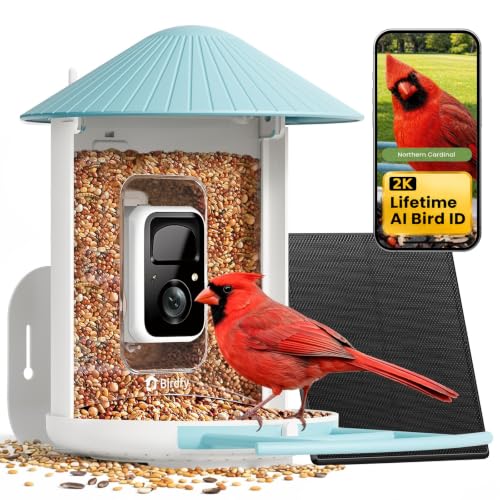
A 5200mAh battery that runs up to 36 months per charge, backed by a solar panel, means you can mount this feeder and practically forget about power for years. The 2K camera captures clear video day or night, and the free, unlimited AI bird ID recognizes roughly 11,000 species, so you’re getting a solid birdwatching tool without a recurring fee for the core feature. It’s built from weather- and UV-resistant materials to handle sun, rain, snow, and wind, making it a set-and-forget option for backyard birders who want consistent performance through the seasons.
At 3.0 pounds, this feeder is noticeably heavier than the Birdbuddy Nook at 1.9 pounds. You’ll want a sturdy post or bracket rather than a thin branch. That heft comes from the large battery and durable housing, which also explains the long run time. If you’re fine with a slightly bulkier feeder for the sake of extended battery life and free bird ID, this is a straightforward pick. The advanced AI features, like deeper species insights, do require a subscription, but the basic identification works without paying, so you’re not locked into a plan just to know what’s at the feeder.
Product photos
Birdfy Smart Bird Feeder Fir Wood
What We Like
- FSC-certified fir wood construction
- 60FPS high-frame-rate slow-motion capture
- 1080P close-up bird view
- Free lifetime AI bird ID included
Trade-offs
- 2.4GHz Wi-Fi only, no 5GHz support
- Side-mounted camera limits viewing angle
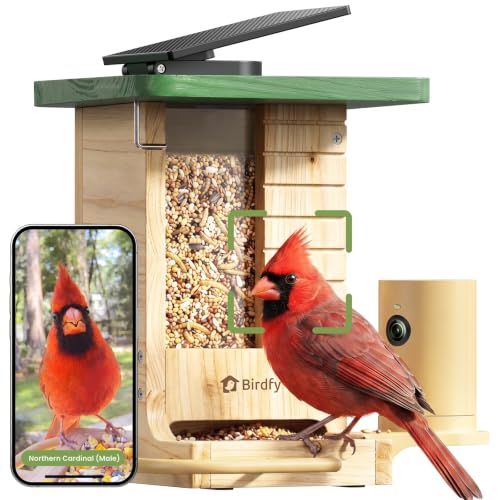
The FSC-certified fir wood construction gives this feeder a natural, warm look that blends into a backyard without screaming ‘gadget.’ It’s a deliberate choice for someone who wants the tech without the plastic. The 60FPS slow-motion capture is the standout feature here. It lets you see wing flaps and takeoffs in detail that standard frame-rate cameras miss. For birders who care about motion clarity, that’s a real advantage over many competitors that cap at lower frame rates. The 1080P video and full-color night vision keep the view sharp from dawn to dusk, and the free lifetime AI bird ID means you’re not locked into a subscription just to know what’s at the feeder.
The 2.4GHz-only Wi-Fi can be a bottleneck if your router is far away or your network is crowded. Also, the side-mounted camera means you’re seeing birds from the side rather than head-on, which some folks might find less engaging than a front-facing setup. If you prioritize a natural wood aesthetic and slow-motion video over network speed or camera angle, this is a strong pick. Not ideal for those with a congested 2.4GHz band or who prefer a front-facing bird view.
Product photos
Birdbuddy Nook Smart Bird Feeder
What We Like
- Compact footprint for tight spaces
- 2K HDR video with close-up focus
- AI identifies 11,000 bird species
- IP67 weatherproof construction
Trade-offs
- Small seed capacity limits refill frequency
- Small seed capacity requires frequent refills
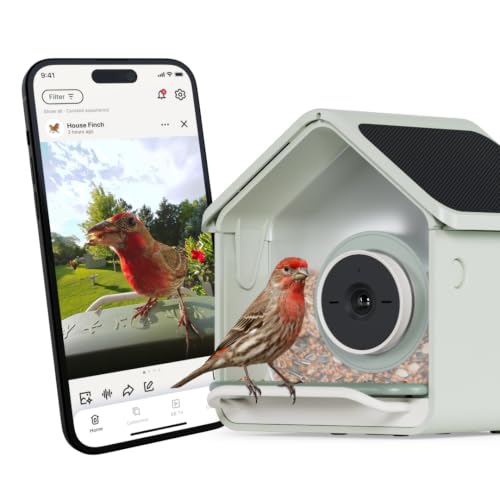
At just 1.9 pounds and 8 inches tall, the Birdbuddy Nook fits where larger feeders won’t, balcony rails, narrow patio tables, or a crowded garden shelf. Its 2K HDR camera and 135-degree wide-angle lens capture feather detail and color that make identifying visitors a genuine pleasure, and the AI can recognize up to 11,000 species by sight and sound. For anyone with limited outdoor space who still wants crisp live birdwatching, this is a purpose-built solution that doesn’t compromise on image quality.
The Nook holds up to 3.8 cups of birdseed, so you’ll refill it more often if a busy flock visits. Its compact size fits easily on a balcony or small patio, and the IP67 weatherproof build keeps it safe outdoors. You can add the optional solar panel accessory for extra charging flexibility.
Product photos
Birdfy Metal Smart Bird Feeder
What We Like
- Chew-resistant metal deters squirrels
- Free unlimited AI bird identification
- Solar panel with 9000mAh battery
- Dual-band Wi-Fi (2.4/5GHz)
Trade-offs
- At 7.3 pounds, heavier than most competitors
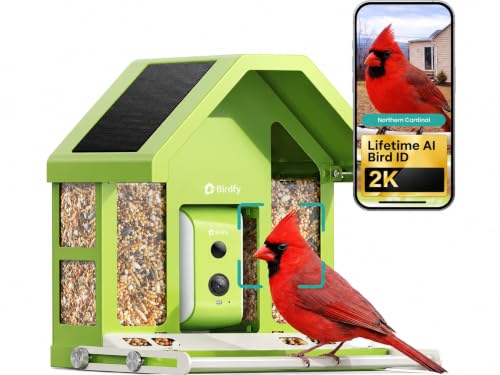
A 9000mAh battery paired with a solar panel means this feeder keeps running through cloudy days and overnight without constant recharging, so you don’t have to haul it inside every time the sun dips. The chew-resistant metal construction does exactly what it says: it keeps squirrels from gnawing their way in, and it holds up to rain, snow, and sun without rusting or cracking. Free unlimited AI bird identification means you get species names and facts without ever pulling out a credit card, which is rare in this category. This is the feeder for someone who wants a tough, low-maintenance setup that won’t be outsmarted by backyard critters or drained batteries.
At 7.3 pounds, this feeder is noticeably heavier than the Kiwibit Solar Smart Bird Feeder at 2.5 pounds. Mounting it on a thin shepherd’s hook or a flimsy pole might feel unstable. You’ll want a sturdy stand or a post that can handle the load. For a durable, squirrel-proof, solar-powered camera feeder with free bird ID, this is the one to beat.
Product photos
Birdbuddy Pro Smart Bird Feeder
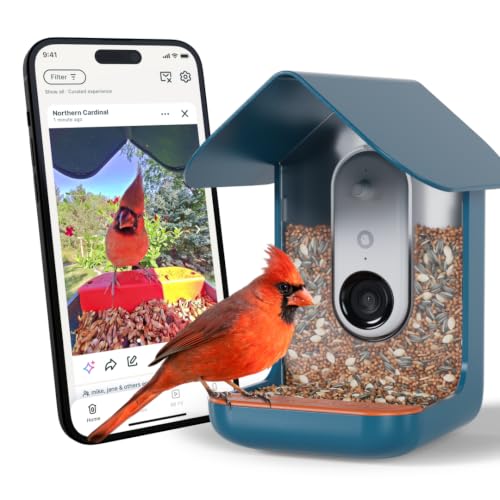
What We Like
- 2K video with HDR for vibrant colors
- 5MP photos from larger sensor
- AI identifies bird species and illness
- Privacy-focused on-device processing
Trade-offs
- Premium subscription required for AI features
- No solar panel or built-in battery
- Only 2.4 GHz Wi-Fi support
A 1/2.7-inch sensor with HDR captures 2K video and 5MP photos that hold detail even in tricky low-light conditions. You can actually make out the subtle feather patterns on a chickadee at dusk rather than a blurry silhouette. That larger sensor and HDR processing give this feeder a genuine edge in image quality over most competitors. It makes this the pick for anyone who cares more about crisp, colorful bird portraits than just getting a notification that something landed on the perch. The AI bird identification and illness detection require a premium subscription, and all image processing happens on the device, which keeps your data private.
The catch is that the Birdbuddy Pro relies on a 2.4 GHz Wi-Fi connection and has no solar panel to top it off between visits. That means you will need to charge the camera every so often, whereas the Kiwibit Solar Smart Bird Feeder includes a built-in solar panel for continuous power. If you have a shaded mounting spot or just want a set-it-and-forget-it setup, the solar route might be more practical. But if you want high-quality camera features in a compact feeder that hangs from a branch or mounts on a pole, this is a strong option.
FreeKoala 4K Bird Feeder Camera
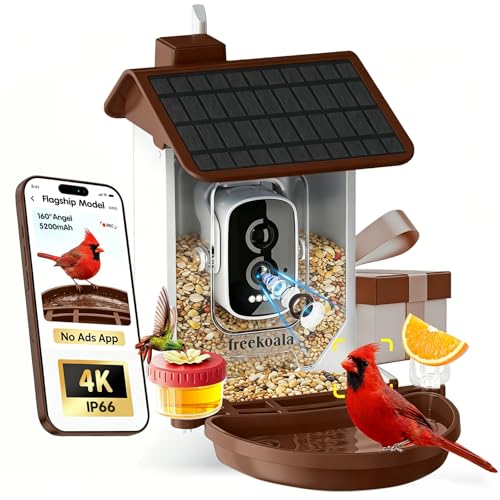
What We Like
- 160° wide-angle 4K UHD video
- Solar powered with 5200mAh battery
- AI filters out wind and branches
- Built-in bird bath and hummingbird port
Trade-offs
- No 5GHz Wi-Fi support
- Premium AI Bird ID requires subscription after trial
- MicroSD card not included for local storage
A 160-degree wide-angle lens captures the full feeder tray in true 4K clarity, so you see every feather detail even at the edges. Local recording is completely free with no monthly fees, and the live stream can be shared with up to 20 family members, grandparents can watch cardinals from their living room. Night vision keeps the show going after dark, preserving bright colors and tiny details. It’s designed to be surprisingly easy to use, making it a thoughtful gift for parents or retirees who want to enjoy backyard birds without technical hassles.
The premium AI bird identification, which covers over 11,000 species, requires a subscription after the 30-day free trial, while basic alerts stay free forever. The feeder only works on 2.4GHz Wi-Fi, so if your router is far or crowded, you might need to boost the signal. On the plus side, the 3-in-1 design includes a built-in bird bath and a hummingbird port, so you get more than just a feeder in one unit.
HEAPETS Solar Bird Feeder Camera
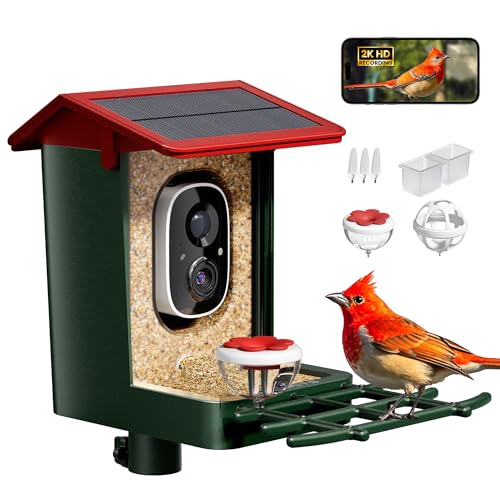
What We Like
- Solar-powered reduces frequent charging
- 2K HD live streaming to phone
- AI identifies 10,000+ bird species
- Weatherproof for year-round use
Trade-offs
- Bird ID requires subscription after free trial
- Heavier than some competitors at 3.5 lbs
- No built-in battery capacity stated
A built-in solar panel means this feeder keeps running without constant battery swaps, so you can leave it out all year without worrying about power. The 2K HD video streams live to your phone, and the AI can identify a vast number of bird species during a one-month free trial. Setup takes minutes on a tree, pole, or wall, and the weatherproof build handles rain, snow, and heat, making it a practical pick for reliable birdwatching.
The AI bird identification comes with a one-month free trial, after which you pay a monthly or yearly subscription, while the NETVUE Birdfy includes lifetime free bird ID. Weighing 3.5 pounds, it’s heavier than many competitors, so mount it on a sturdy pole or wall. If you value solar-powered operation over free ID and can handle the weight, this feeder gives you live 2K video and motion alerts without frequent charging.
Product photos
Kiwibit Solar Powered Smart Bird Feeder 2 Mini
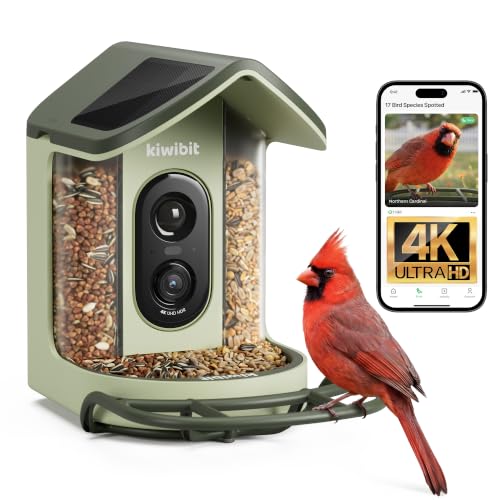
What We Like
- 4K UHD video with HDR imaging
- Integrated solar roof for power
- IP65 weather-resistant housing
- Removable camera and 1L seed container
Trade-offs
- AI bird ID requires paid subscription after 30 days
- 2.4GHz WiFi only, no 5GHz support
- Micro SD card up to 512GB not included
A 4K UHD camera with HDR-enhanced imaging and a 132-degree wide-angle lens means you get crisp, detailed views of visiting birds even in tricky light. The built-in solar roof helps keep the battery topped off outdoors, and the IP65 weather-resistant housing lets it sit through rain without worry. This is a smart feeder that fits neatly on a wall, pole, or fence, and the removable camera module plus 1L seed container make refilling and cleaning straightforward. It’s a good match for someone who wants a compact, solar-assisted setup that doesn’t dominate the yard.
The AI bird identification feature, which tells you what species you’re watching, requires a Kiwibit Premium subscription after a 30-day free trial. That’s a recurring cost not everyone wants, especially when some competitors like the NETVUE Birdfy offer lifetime free bird ID. Also, the feeder only connects to 2.4GHz WiFi, so if your home network runs primarily on 5GHz, you may need to adjust settings or add a compatible router. For a compact, solar-ready design with strong video quality, this is a reasonable option, but the subscription for AI ID is worth factoring in.
Product photos
Nafnti Smart Bird Feeder with Camera
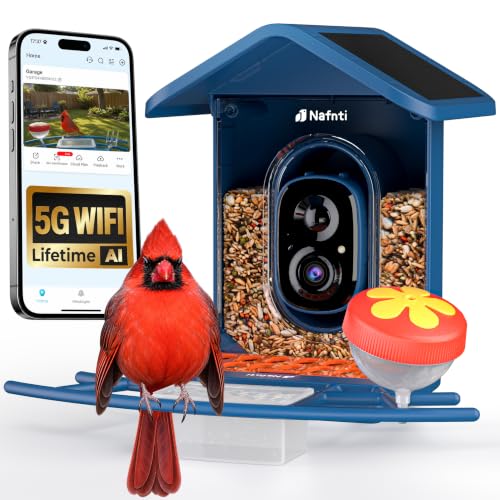
What We Like
- No subscription AI bird ID
- 5GHz WiFi for stable connection
- Metal mesh seed tray deters squirrels
- Solar powered with 5200mAh battery
Trade-offs
- 4.0 pounds is heavier than some competitors
The Nafnti Smart Bird Feeder skips the subscription trap entirely, using onboard AI to identify over 10,000 bird species without a monthly fee. That means every visitor gets logged and labeled in the app, with 2K live video and color night vision letting you watch from dawn to dusk. The 5GHz WiFi keeps the stream snappy even if your router is across the house, and the 160-degree wide-angle lens catches more of the feeder than most rivals. It suits anyone who wants smart bird ID without recurring costs and prefers a solar-assisted battery that can run for days between top-ups.
The plastic body feels less premium than the metal Birdfy Metal feeder, though the IP65 rating keeps weather out. At 4.0 pounds it’s heavier than the 3.0-pound NETVUE Birdfy, so mounting on a thin pole might need a sturdier base. The metal mesh seed tray does stop squirrels from gnawing through, which is a real plus if you’ve dealt with raiders before. For the price of no subscription and a camera that works on both WiFi bands, it’s a practical pick for budget-conscious birders who want ID features without a recurring bill.
Product photos
How We Evaluated WiFi Bird Feeders
We reviewed ten WiFi bird feeders by examining their camera specifications, power systems, AI identification capabilities, and physical construction. Manufacturer data sheets provided the technical baseline for video resolution, battery capacity, and Wi-Fi compatibility. Expert round-ups from birdwatching publications and technology reviewers helped us understand which features matter most in real-world use. Patterns in owner feedback revealed common strengths and recurring issues across each model.
The four criteria that mattered most were video quality (resolution, frame rate, and night vision), power autonomy (solar charging and battery capacity), AI bird identification (free versus subscription, species database size), and build quality (weather resistance, material durability, and ease of cleaning). For this category, a feeder that requires frequent battery changes or a paid subscription for basic bird ID loses much of its convenience advantage.
A research-led evaluation has limits: we did not install each feeder outdoors for months of observation. Our conclusions draw from what the specifications say and what consistent owner reports describe. We encourage readers to check the latest firmware updates and subscription terms, as these change more often than hardware.
When comparing models, consider the pros and cons of each design approach. A metal squirrel-proof body adds weight but may outlast plastic in harsh weather, while a compact feeder saves space but requires more frequent seed refills.
What To Look For In WiFi Bird Feeders
Choosing a smart feeder involves more than picking the one with the highest resolution. You need to match the camera quality, power source, AI subscription model, and physical design to your specific yard setup and birdwatching habits.
Look for a feeder with at least 2K video resolution, solar charging or a long battery life, and free AI bird identification if you want to avoid monthly fees. Also look for weatherproof construction rated IP65 or higher. Weight matters for mounting options.
Video Quality and Camera Features
Resolution determines how clearly you can identify birds from the recorded footage. Entry-level feeders offer 1080P video, while premium models reach 4K UHD. Higher resolution also means larger video files, which affects cloud storage needs and local microSD card capacity.
Night vision capability, infrared or color night vision, lets you see nocturnal visitors or early-morning activity. Frame rate matters for action shots: 60FPS capture allows smooth slow-motion playback of birds in flight or feeding behavior. Some feeders offer HDR (High Dynamic Range) imaging, which balances bright sunlight and shadow for more accurate feather colors.
The WiFi bird feeder cameras on the market range from wide-angle 160-degree views to close-up portrait-style shots. A wider lens captures more of the feeder area but may show less feather detail at a distance.
Power Source and Battery Life
Solar-powered feeders reduce the need for frequent battery changes, but the effectiveness depends on panel size, battery capacity, and your yard’s sun exposure. Models with dual solar panels and large batteries (around 5200mAh) can run for weeks without direct sunlight. Some feeders have no built-in battery and require constant USB power, which limits placement to near an outlet. Battery life estimates from manufacturers assume ideal conditions; real-world performance varies with temperature, Wi-Fi signal strength, and video upload frequency.
The solar-powered feeders with the largest panels and batteries tend to be heavier, so check weight limits if you plan to hang the feeder from a branch or hook.
AI Bird Identification and Subscription Costs
AI bird identification is the main smart feature that separates these feeders from simple trail cameras. Some manufacturers offer free unlimited bird ID for life, while others require a monthly or yearly subscription after a trial period. The size of the species database varies from 10,000 to over 11,000 species.
Free AI services may have fewer species or slower identification times. A few models process identification on-device for privacy, while most use cloud-based services. If you want to avoid ongoing costs, look for subscription-free feeders that include AI identification in the purchase price.
Build Quality and Weather Resistance
Outdoor electronics need protection from rain, snow, UV radiation, and temperature swings. Weather resistance ratings like IP65 or IP67 indicate dust and water protection levels. Materials range from plastic and acrylic to FSC-certified fir wood and metal. Wood offers a natural look but may weather over time. Metal construction resists squirrels and chewing but adds significant weight. Easy cleaning is essential, a detachable hopper or removable seed tray makes regular maintenance much simpler.
- Check the Wi-Fi band: most smart feeders support only 2.4GHz, not 5GHz.
- Verify the mounting method: pole mount, hanging hook, or wall bracket.
- Confirm whether a microSD card is included or must be purchased separately.
- Look at the seed capacity: smaller feeders need more frequent refills.
- Review the app’s notification settings and sharing features if you plan to share clips.
A feeder that is difficult to clean will eventually develop mold, which can harm birds and reduce visits.
WiFi Bird Feeders Compared
The table below compares the ten WiFi bird feeders across video resolution, power source, AI bird identification model, weight, and key distinguishing features.
| Product | Camera Resolution | Power Source | Bird ID | Weight |
|---|---|---|---|---|
| Kiwibit Solar Smart Bird Feeder | 4K HDR | Dual solar + 5200mAh battery | AI Bird ID | 2.5 pounds |
| NETVUE Birdfy Smart Bird Feeder | 2K | Solar panel + 5200mAh battery | Free, unlimited, ~11,000 species | 3.0 pounds |
| Birdfy Smart Bird Feeder Fir Wood | 1080P | Solar Powered | Lifetime Bird ID Free | 2.1 pounds |
| Birdbuddy Nook Smart Bird Feeder | 2K HDR | Solar Panel | Up to 11,000 species | 1.9 pounds |
| Birdfy Metal Smart Bird Feeder | 2K | 9000mAh with solar panel | Free unlimited AI identification | 7.3 pounds |
| Birdbuddy Pro Smart Bird Feeder | 2K | N/A | AI Bird ID | 3.1 pounds |
| FreeKoala 4K Bird Feeder Camera | 4K UHD | 3W, 5200mAh battery | 11,000+ species (premium) | 2.3 pounds |
| HEAPETS Solar Bird Feeder Camera | 2K HD | Built-in panel | AI, 10,000+ species | 3.5 pounds |
| Kiwibit Solar Powered Smart Bird Feeder 2 Mini | 4K UHD | Built-in | AI Bird Species Identification | 2.5 pounds |
| Nafnti Smart Bird Feeder with Camera | 2K HD | 5200mAh battery + 3W solar | 10,000+ species | 4.0 pounds |
Frequently Asked Questions
Do WiFi bird feeders need a subscription for AI bird identification?
Some models include free lifetime AI bird identification, such as the NETVUE Birdfy and the Birdfy Fir Wood. Others, like the Kiwibit and FreeKoala, offer a free trial period before requiring a paid subscription for full AI features. Check the specific model’s terms before purchasing.
What video resolution should I look for in a bird feeder camera?
Most smart feeders offer 1080P or 2K video, with premium models reaching 4K UHD. Higher resolution captures more feather detail for species identification but creates larger files. For casual birdwatching, 2K provides a good balance of clarity and storage efficiency.
Can WiFi bird feeders work without an internet connection?
These feeders require a 2.4GHz Wi-Fi connection to stream video and use AI identification features. Without internet, the camera may still record to a microSD card in some models, but live viewing and cloud storage will not function. Most models do not support 5GHz networks.
How often do I need to clean a smart bird feeder?
Cleaning frequency depends on seed type and weather conditions, but every two to four weeks is typical. A detachable hopper or removable seed tray makes the job much easier. Regular cleaning prevents mold growth that can spread disease among visiting birds.
Are solar-powered bird feeders worth the extra cost?
Solar-powered feeders reduce the hassle of battery changes and can run for weeks on a full charge in sunny conditions. The smart bird feeders with the largest solar panels and batteries cost more upfront but save on replacement batteries over time. They work best in locations with direct sunlight for several hours per day.
The Bottom Line
The Kiwibit Solar Smart Bird Feeder is the best overall choice for bird lovers who want the highest video resolution, longest battery life, and free AI identification for over 10,000 species. Its dual solar panels and 5200mAh battery keep it running through cloudy stretches, and the detachable hopper makes cleaning straightforward. If you prioritize free lifetime AI identification without a subscription, the NETVUE Birdfy Smart Bird Feeder offers reliable solar power and a 36-month battery life.
For those with limited space, the Birdbuddy Nook provides excellent 2K HDR video in a compact, weatherproof design. Squirrel-prone yards call for the Birdfy Metal Smart Bird Feeder, which combines chew-resistant construction with dual-band Wi-Fi and free AI identification. Budget-conscious buyers who want no subscription fees should consider the Nafnti Smart Bird Feeder with Camera, which includes free AI bird ID and 5GHz Wi-Fi support.
The single most important factor is matching the subscription model to your budget. A feeder with free AI identification saves you money over time, while a model requiring a paid subscription may offer higher video quality or a larger species database. Choose the one that fits how you plan to use it.
