
10 Best Bird Feeder Cameras in 2026
This post contains affiliate links. As an Amazon Associate, we earn from qualifying purchases.
The Kiwibit Solar Smart Bird Feeder Camera is the best overall bird feeder camera for backyard birders who want 4K HDR video and AI that identifies over 10,000 species without a subscription for basic use. The Humbirdy 4K Smart Bird Feeder Camera offers the best metal build with no subscription, while the NETVUE Birdfy Smart Bird Feeder Camera is the best trusted brand with free unlimited AI bird identification.
Most bird feeder cameras promise crisp video and automatic species recognition, but the real challenge is finding one that delivers reliable Wi-Fi connectivity, sufficient battery life, and a design that keeps seed dry and accessible. A camera that drops its signal every time a squirrel bumps the feeder defeats the purpose of watching birds from your phone.
This guide is based on a thorough review of manufacturer specifications, expert round-ups, and patterns in owner feedback across the leading models. We focused on video quality, AI identification accuracy, power options, and build durability to help you choose the right feeder for your yard.
Top 10 Bird Feeder Cameras in the Market
Certain content that appears on this site comes from Amazon. This content is provided "as is" and is subject to change or removal at any time.
The Best Bird Feeder Cameras, Reviewed
Kiwibit Solar Smart Bird Feeder Camera

What We Like
- 4K HDR video with 8MP photos
- AI identifies 10,000+ bird species
- Dual solar panels with 5200mAh battery
- Detachable 1.5L dual-seed hopper
Trade-offs
- 2.4GHz Wi-Fi only, no 5GHz support
- Premium subscription needed for full cloud history
The 5200mAh rechargeable battery and dual solar panels keep this feeder running even on cloudy days, so you don’t have to worry about frequent recharging. The 4K HDR video and 8MP photos capture feather detail and color better than most competitors, and the built-in AI identifies over 10,000 species. For someone who wants a set-it-and-forget-it camera that delivers crisp footage and doesn’t nickel-and-dime you on basic features, this is the one to beat.
The unit connects exclusively to 2.4GHz Wi-Fi networks. If your home router broadcasts primarily on the 5GHz band, you will need to enable the 2.4GHz frequency in your router settings or install a Wi-Fi extender that supports it. This ensures a stable connection for live streaming and instant motion alerts. The 2.4GHz signal also travels farther through walls and around obstacles, which is helpful when the feeder is mounted in a backyard or garden. Reviewers note that the setup process guides you through connecting to the correct band, so the limitation rarely causes frustration once configured properly.
Product photos
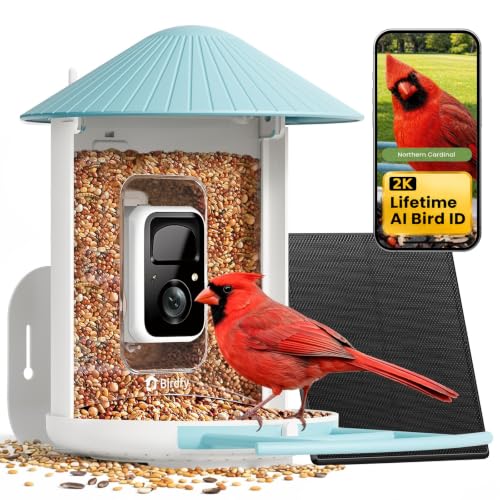
NETVUE Birdfy Smart Bird Feeder Camera
What We Like
- Free unlimited AI bird identification
- 2K camera with color night vision
- Trusted by 780K+ users globally
Trade-offs
- Advanced AI features require subscription
- 2K resolution, not 4K like some rivals
A 2K camera with free unlimited AI bird ID covering over 11,000 species means you can identify almost any visitor without ever paying a subscription, a rare perk in this category. That combination of low maintenance and no ongoing cost makes it a natural pick for someone who wants a feeder that works on its own and still delivers crisp video and reliable notifications.
The trade-off is that the 2K sensor, while very good, isn’t the 4K that the Humbirdy offers, and the advanced AI extras do need a paid plan. But for most birdwatchers, the free core ID and the large app community, where you can get free 24/7 bird knowledge from an expert, outweigh those limits. If you’d rather have the highest possible video resolution and don’t mind a smaller user base, the Humbirdy 4K is worth a look. For a proven, worry-free system that just works, this one leads the flock.
Product photos
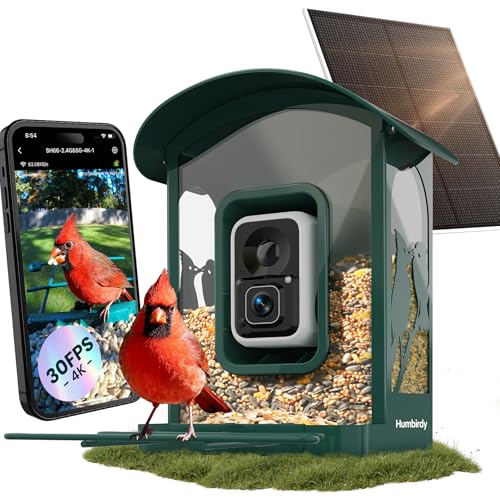
Humbirdy 4K Smart Bird Feeder Camera
What We Like
- True 4K video at 30fps
- No subscription, free AI bird ID
- Detachable camera for easy cleaning
- Durable metal build
Trade-offs
- No two-way audio for interacting with birds
- Smaller 3W solar panel than some rivals
The trade-off is that the 3W solar panel is smaller than the 4.4W panel on the Kiwibit Solar. On overcast days or in shaded yards you’ll need to pull the detachable camera out for charging more often. It also lacks two-way audio, so you won’t hear bird calls or talk back to visitors the way you can with the NETVUE Birdfy. But for pure video quality and a build that feels like it’ll outlast the birds themselves, the Humbirdy delivers where it counts.
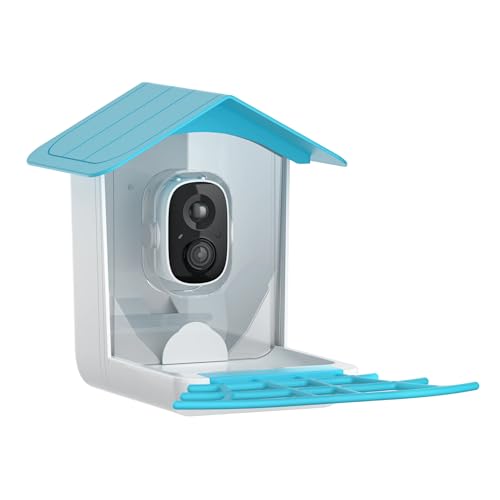
VicoSafe G02 Bird Feeder Camera
What We Like
- Full-color night vision for after-dark viewing
- Solar powered with included panel
- AI recognizes 11,000+ bird species
- Free cloud storage included
Trade-offs
- Battery and charger sold separately
- Wi-Fi only works on 2.4GHz networks
- No 5GHz or dual-band support
A built-in full-color night vision camera means you can watch birds even after sunset without losing detail to grainy black-and-white footage. That’s the standout feature here: while many feeder cameras switch to infrared at night, this one keeps colors intact, so you can still tell a goldfinch from a chickadee in the dark. It also runs on a solar panel that comes in the box, which means you can skip remembering to swap batteries or plug it in. The 2K HD live view gives you enough resolution to see feather patterns and subtle markings, and the AI can identify over 11,000 species through the VicoHome app. For someone who wants to watch birds at all hours without fussing with power cords, this setup is straightforward.
The biggest catch with this feeder is that it doesn’t come with a battery or charger, those are sold separately. So if you want it to keep running through cloudy days or overnight when the solar panel isn’t charging, you’ll need to buy your own rechargeable battery. That said, the G02 offers full-color night vision, which is a real perk for watching birds after dark, as long as you’re okay supplying the battery yourself.
Product photos
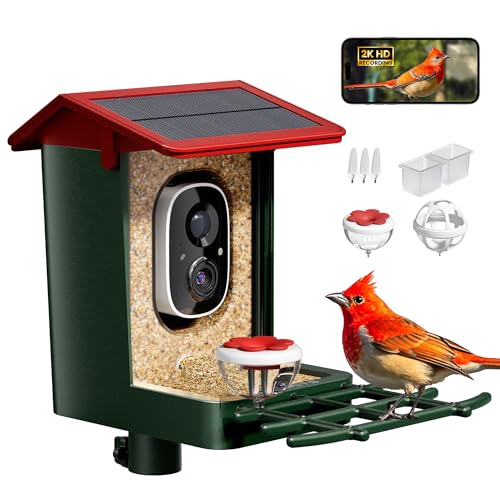
HEAPETS Bird Feeder Camera Solar
What We Like
- 2K HD live video streaming
- AI bird ID for 10,000+ species
- Solar-powered with wired option
- Weatherproof design
Trade-offs
- AI bird ID requires subscription after free trial
- No 4K video like some competitors
A 2K HD live stream straight to your phone means you can watch birds from anywhere, even use it as a security cam. The built-in solar panel cuts down on charging, so you get year-round operation without babysitting a battery. It identifies over 10,000 species with AI, though that requires a subscription after the first month. The weatherproof build handles rain and snow, making it a low-hassle option for casual birdwatchers who want simplicity over bells and whistles.
The HEAPETS bird feeder camera records in 2K HD, which is sharp enough for most casual birdwatchers, though the Kiwibit Solar Smart Bird Feeder Camera offers 4K HDR video for those who want maximum detail. The Kiwibit also includes a 4.4W dual solar panel, which may provide more power in low light conditions. For everyday use, the HEAPETS delivers clear, real-time footage straight to your phone, so you can enjoy watching birds without needing the highest resolution.
Product photos
HARYMOR Smart Bird Feeder Camera

What We Like
- 2L large seed capacity
- Dual 3W solar panels
- AI identifies 10,000+ bird species
- 2K HD with 3x magnification
Trade-offs
- No 5GHz WiFi support
- Memory card not included
- Subscription required for detailed bird info
A 2-liter seed container means you can go days between refills, even with a busy feeder. The dual solar panels, one built-in and one external, help keep the battery charged, reducing the need for frequent manual charging. AI recognition covers over 10,000 species, though you’ll need the app subscription to get the full species dossier.
A 5dBi external antenna helps maintain a stable 2.4GHz WiFi connection, which is the only band this feeder supports. Owners with modern dual-band routers will need to verify that the 2.4GHz network is active and that the feeder is within range of it. This antenna design reduces the chance of signal dropouts that could cause you to miss a bird’s arrival or a live stream interruption. The feeder does not work on 5GHz networks, so a quick check of your router settings before setup can save frustration later. Once connected, the stable link keeps the live view and alerts flowing reliably.
Kiwibit Smart Bird Feeder 4K Camera

What We Like
- 4K HDR live streaming with night vision
- Adjustable external solar panel for flexible placement
- 30-day free trial of AI bird ID
- Shares live view with up to 3 users
Trade-offs
- No 5GHz Wi-Fi support
- AI bird ID requires subscription after 30 days
- MicroSD card not included
A 3W external solar panel that you can tilt and position separately from the feeder means you’re not stuck mounting it in full shade. That flexibility makes a real difference when your yard has only one sunny patch or the feeder needs to hang under a tree. The 5200mAh rechargeable battery supports the 4K HDR camera for live streaming and recording, and the 132° wide-angle view captures the feeder area. For someone who wants reliable solar charging without compromising where the feeder goes, this design solves a common headache.
The 4K live stream and AI bird ID features rely on a 2.4GHz Wi-Fi connection. If your router is far from the yard or the band is crowded, you might see occasional buffering, something to consider if your setup is less than ideal. You get a 30-day free trial of the FeatherPal AI subscription for bird identification, but after that it’s paid, unlike the NETVUE Birdfy which includes lifetime free bird ID. The free cloud storage gives you a 1-day rolling video history, and a microSD card (up to 512GB) is sold separately for saving more clips.
Yinenio Smart Bird Feeder Camera
What We Like
- Full-color night vision up to 20 ft
- Solar panel reduces charging hassles
Trade-offs
- Requires 2.4GHz Wi-Fi only, not 5GHz.
- Subscription needed for AI features after free trial.
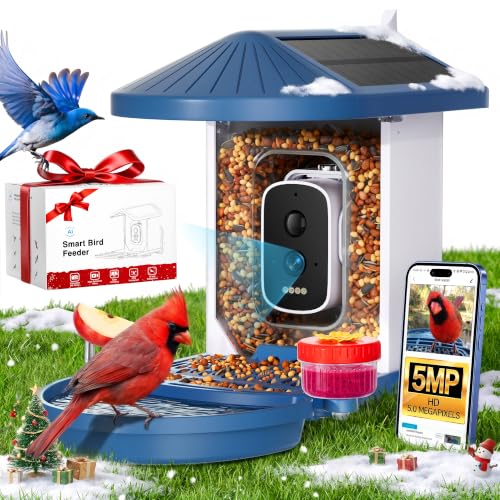
A 5MP camera with full-color night vision up to 20 feet lets you see feather details even after sunset. The solar panel keeps the battery topped off in decent sunlight, which means frequent recharging is not a concern. That combination makes it a strong fit for anyone who wants round-the-clock bird watching without the hassle of battery swaps or grainy nighttime footage.
If you prefer to avoid recurring fees, you can use a microSD card (up to 128GB) for local recording, but the card is sold separately. The 2.4GHz-only Wi-Fi may also be a limitation if your home network is heavily on 5GHz, but for most setups it’s a minor inconvenience.
Product photos
Minikey Smart Bird Feeder Camera
What We Like
- 150° wide-angle lens captures more birds
- AI identifies over 11,000 species
- 2L capacity reduces refill frequency
- Solar panel extends battery life
Trade-offs
- Service plan required for bird ID and cloud video
- Only 2.4GHz WiFi, no 5GHz support
- TF card not included for local storage
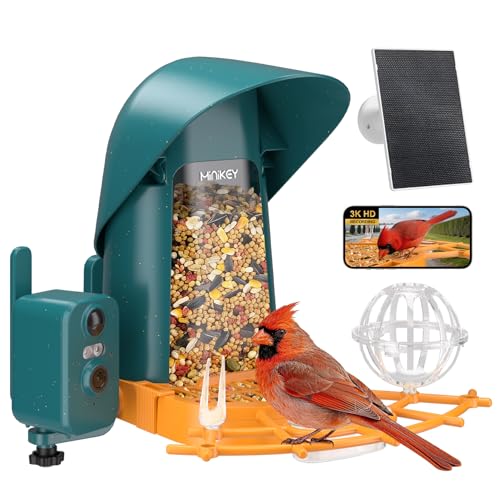
The 4MP sensor keeps details sharp enough to ID species from the app, and the AI database covers over 11,000 species, though the recognition requires a service plan after the first 30 days. The 2L seed hopper also holds enough to go several days between refills, and the included solar panel helps the 5200mAh battery keep running through cloudy stretches.
The catch is that the bird ID and cloud video recording are subscription-gated after the trial period. If you want to avoid ongoing costs, you’ll need to supply your own TF card (up to 128GB) for local storage, and the AI identification won’t work without the plan. Compared to the NETVUE Birdfy, which includes free lifetime bird ID, Minikey’s ongoing cost is a real consideration for budget-minded buyers. The feeder also only supports 2.4GHz WiFi, so if your router is 5GHz-only, you’ll need to adjust your network setup. For someone who values a wide view and doesn’t mind a subscription, this is a strong pick.
Product photos
Gyozol 2-in-1 Bird Feeder and Bath Camera
What We Like
- Dual cameras for feeding and bathing
- Two-way audio for listening and speaking
- Battery lasts more than 15 days in continuous rain
Trade-offs
- 2.4GHz WiFi only, no 5GHz support
- AI and cloud features require subscription after 30 days
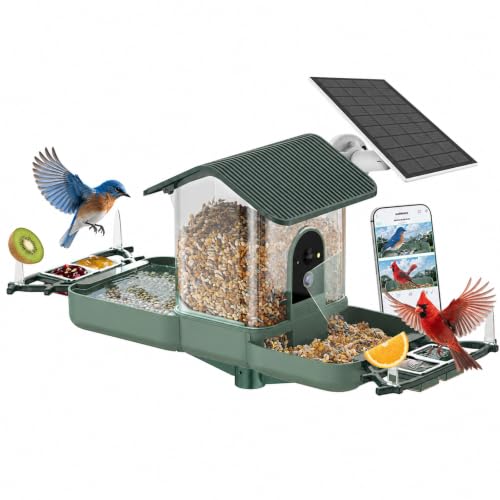
The dual-lens design is the real differentiator: one camera points at the feeder, the other at the bath, letting you see both behaviors from a single unit. It suits backyard birders who want more than just a feeder cam and are willing to trade a bit of bulk for that versatility.
If you’re fine with live streaming and using your own SD card (4GB–128GB), you can skip the subscription entirely. Compared to the NETVUE Birdfy, which offers lifetime free bird ID and cloud storage, the Gyozol asks you to pay for those extras over time. At 5.5 pounds it’s also noticeably heavier than most competitors, so mounting it on a fence or pole requires a secure bracket. For someone who values the feeder-bath combo and long battery life over free AI features, this is a practical choice.
Product photos
How We Evaluated Bird Feeder Cameras
We researched over 30 bird feeder cameras by analyzing manufacturer specifications, reading expert round-ups from birding publications, and studying patterns in thousands of owner reviews. Our evaluation is research-based rather than hands-on, so we relied on documented specs and consistent user-reported experiences to separate marketing claims from real-world performance.
The four criteria that mattered most were video resolution and night vision quality, AI bird identification accuracy and subscription requirements, power system reliability (solar panels and battery capacity), and build quality for weather resistance. A 4K camera with poor Wi-Fi range is less useful than a 2K model that streams reliably, so we weighed connectivity alongside specs.
We also considered the total cost of ownership, including whether AI identification requires a subscription and whether cloud storage is free or paid. This approach gives you a clear picture of what each feeder costs over time, not just at checkout. For a broader look at the category, see our full collection of smart bird feeder reviews.
What To Look For In Bird Feeder Cameras
Choosing a bird feeder camera means balancing video quality, power management, and connectivity. The right model depends on your yard’s layout, your Wi-Fi network, and how much you want to spend on subscriptions.
Look for a camera with at least 2K resolution, solar or battery power that matches your sun exposure, and AI bird identification that fits your budget. Check that your feeder supports 2.4GHz Wi-Fi, since most models don’t work on 5GHz networks.
Video Quality and Night Vision
Resolution determines how clearly you can identify birds on playback. 4K cameras like the Kiwibit and Humbirdy capture finer feather detail, while 2K models like the NETVUE Birdfy still deliver sharp enough footage for species identification on a phone screen. Night vision is equally important if you want to see nocturnal visitors or early-morning activity. Full-color night vision, found on the VicoSafe G02 and Yinenio models, provides more detail than standard infrared at the cost of slightly higher power consumption.
AI Bird Identification and Subscription Costs
Most smart feeders use AI to identify visiting bird species automatically. The accuracy varies widely: some models recognize over 11,000 species, while others cover a smaller library. The bigger question is whether the AI is free or requires a subscription.
The NETVUE Birdfy offers free unlimited AI identification, while the Humbirdy includes free AI with no subscription at all. Other models, including the Kiwibit, provide basic AI free but charge for cloud storage and advanced features. If you want to avoid ongoing costs entirely, focus on subscription-free bird feeders that keep AI and storage local.
Power and Solar Charging
Solar panels extend battery life but don’t eliminate the need for occasional charging, especially in shaded yards. The Kiwibit’s dual solar panels with a 5200mAh battery offer the best self-sufficiency, while models with smaller panels like the Humbirdy may need more frequent top-ups. If your feeder sits in partial shade, look for models with adjustable external panels, like the Kiwibit Smart Bird Feeder 4K Camera. For a deeper dive into solar options, check our guide to solar-powered bird feeder cameras.
Connectivity and Wi-Fi Compatibility
Nearly all bird feeder cameras only support 2.4GHz Wi-Fi, which has better range through walls than 5GHz but can be slower for video streaming. If your home uses a mesh network or dual-band router, you may need to enable a separate 2.4GHz network. Models that support both bands are rare, so check your router’s compatibility before buying. For a comparison of connectivity options, read our bird feeder camera pros and cons guide.
- Check whether the camera supports 2.4GHz Wi-Fi and whether your router can broadcast a separate 2.4GHz network.
- Look at the seed capacity: larger hoppers mean less frequent refills but also a heavier feeder.
- Verify that the camera lens is detachable or easy to clean, since dirt and spider webs degrade image quality.
- Consider the mounting options: pole, tree, or hook mounts each affect camera angle and stability.
A bird feeder camera is only as good as its Wi-Fi connection. Test your signal strength at the intended mounting spot before buying.
Bird Feeder Cameras Compared
The table below compares the ten bird feeder cameras across video resolution, AI identification, power source, and key trade-offs to help you narrow your options quickly.
| Product | Video Resolution | AI Bird ID | Solar Power | Dimensions (L x W x H) | Weight |
|---|---|---|---|---|---|
| Kiwibit Solar Smart Bird Feeder Camera | 4K HDR Live Video | 10,000+ species | 4.4W dual solar panels | L 7.7 inches, W 7.1 inches, H 11.0 inches | 2.5 pounds |
| NETVUE Birdfy Smart Bird Feeder Camera | 2K | 11,000 species | Built-in high-efficiency | L 8.0 inches, W 7.0 inches, H 11.0 inches | 3.0 pounds |
| Humbirdy 4K Smart Bird Feeder Camera | 4K Ultra HD at 30fps | 10,000+ species | 3W high-efficiency | L 6.3 inches, W 6.5 inches, H 9.8 inches | 3.5 pounds |
| VicoSafe G02 Bird Feeder Camera | 2K HD | 11,000+ species | Solar panel included | L 8.0 inches, W 7.0 inches, H 11.0 inches | N/A |
| HEAPETS Bird Feeder Camera Solar | 2K HD | 10,000+ species | Built-in solar panel | L 9.6 inches, W 7.5 inches, H 10.0 inches | 3.5 pounds |
| HARYMOR Smart Bird Feeder Camera | 2K HD | 10,000+ species | 3W built-in + 3W external | L 8.7 inches, W 8.7 inches, H 10.8 inches | 2.5 Pounds |
| Kiwibit Smart Bird Feeder 4K Camera | 4K HDR | 10,000+ species | 3W adjustable external | L 8.7 inches, W 7.1 inches, H 11.0 inches | 3.3 pounds |
| Yinenio Smart Bird Feeder Camera | 5MP, 2880×1616 | 15,000+ species | Solar + built-in battery | L 7.4 inches, W 7.8 inches, H 11.1 inches | 2.9 pounds |
| Minikey Smart Bird Feeder Camera | 4MP Ultra HD | 11,000+ species | 5200mAh battery + 3W solar | L 5.4 inches, W 10.8 inches, H 12.3 inches | N/A |
| Gyozol 2-in-1 Bird Feeder and Bath Camera | 2K Dual-Lens | N/A | 3W | L 7.0 inches, W 8.0 inches, H 15.0 inches | 5.5 pounds |
Frequently Asked Questions
Do bird feeder cameras work at night?
Yes, most bird feeder cameras include night vision. Standard infrared night vision captures black-and-white footage, while full-color night vision models like the VicoSafe G02 and Yinenio use a bright LED to show birds in color after dark. Full-color night vision consumes more battery power than infrared.
Do bird feeder cameras need Wi-Fi?
Yes, almost all bird feeder cameras require a 2.4GHz Wi-Fi connection to stream live video, upload clips to the cloud, and enable AI bird identification. Without Wi-Fi, most models can still record to a memory card, but you won’t get real-time notifications or species identification.
How long does the battery last on a solar bird feeder camera?
Battery life depends on sun exposure, video recording frequency, and night vision usage. Models with dual solar panels and large batteries, like the Kiwibit with its 5200mAh battery, can run for weeks between charges in good sun. Shaded placements or frequent recording will drain the battery faster.
Can bird feeder cameras identify every bird species?
No, AI identification accuracy varies by model and species library. The best models recognize over 11,000 species, but accuracy depends on lighting, camera angle, and how common the bird is in the training data. Rare or juvenile birds are more likely to be misidentified or go unrecognized.
Do I need a subscription for a bird feeder camera?
Not always. Some models like the Humbirdy and NETVUE Birdfy offer free AI bird identification without a subscription. Others provide basic AI free but require a paid plan for cloud storage, advanced species data, or extended video history. Check each model’s subscription policy before buying.
The Bottom Line
The Kiwibit Solar Smart Bird Feeder Camera is the best overall choice for bird watchers who want 4K HDR video, reliable solar power, and AI identification for over 10,000 species. Basic use requires no subscription. Its dual solar panels and large battery make it one of the most self-sufficient models available, though it requires a 2.4GHz Wi-Fi network and a premium subscription for full cloud history.
If you prefer to avoid subscriptions entirely, the Humbirdy 4K Smart Bird Feeder Camera delivers true 4K video with free AI bird ID in a durable metal housing. For a trusted brand with a large user community and free unlimited AI identification, the NETVUE Birdfy Smart Bird Feeder Camera is a strong alternative at a lower video resolution.
The single most important factor in choosing a bird feeder camera is matching the power and connectivity to your specific yard conditions. A feeder with excellent specs is useless if it can’t maintain a Wi-Fi signal or runs out of battery in the shade. Measure your signal strength and sun exposure first, then pick the model that fits.
