
Millet Treats for Birds Pros and Cons: What Labels Hide
This post contains affiliate links. As an Amazon Associate, we earn from qualifying purchases.
Millet treats for birds have one clear pro and one clear con: spray millet is highly palatable and works as a training reward, but it carries no vitamin A and very little calcium, so it can’t anchor a diet. Kaytee lists crude protein at 7.5% minimum; Vitakraft Sun Seed lists 8%.
Those two protein floors sit half a point apart, and neither one settles the millet treats for birds pros and cons question, or tells you whether the spray in your hand is fresh, dusty, or carrying something the label never mentions.
What follows is the label-first read: the guaranteed analyses side by side, the frequency numbers the manufacturers and the guide sites don’t agree on, and the two failure modes worth knowing before you clip one to the cage.
Key Takeaways
- Millet is a treat, not a base. Kaytee and Vitakraft both say so in writing, and VCA Canada puts pellets at roughly 75%-80% of a cockatiel’s diet.
- The guaranteed analyses don’t match. Kaytee lists 7.5% minimum protein and 3.0% minimum fat; Vitakraft lists 8% and 2%.
- Portion by length, not by spray. Planète Pets recommends a 3-5 cm piece two or three times a week, not a spray left hanging.
- Cut it slowly or not at all. An owner account on Omlet describes a budgie losing close to 20% of its body weight in days after a fast reduction.
- Hang it, don’t floor it. Both manufacturers warn against letting millet rest on the cage bottom where it soils.
What Is Spray Millet, and What Is Actually on the Stem?
Spray millet is the whole seed head of a millet grass, sold on its stalk instead of loose in a bag.
Spray millet is the intact seed head of a millet grass, harvested and dried on the stalk. The bird shells each seed before swallowing the kernel. Because the husk stays attached to the stalk, the edible portion is smaller by weight than the bulk of the spray suggests.
The naming gets messy fast. FAO’s chapter on small-seed processing lists white millet seed (proso millet) as a component of standard budgerigar mix, while Omlet notes foxtail millet, Setaria italica, is also sold as parakeet food. Omlet notes that white and red millet are the same species, Panicum miliaceum, and that the red version simply carries a tougher husk. Both get sold as parakeet food.
Why does that matter at the till? Because you’re paying for stalk and husk, and the bird discards both.
The guaranteed analysis on the bag describes the seed. What lands on your cage floor is mostly husk and dust.
Where Millet Earns Its Place: Training, Weaning, and Enrichment
Watch a budgie work a spray clipped to the bars and you’ll see the whole argument for it in about ten seconds. The bird clings, husks, drops half of it, and comes back for more, which is the millet treats for birds pros and cons in miniature.
Kaytee markets spray millet as useful for encouraging weaning and getting birds to eat, and calls it ideal for bonding and playtime. Vitakraft describes millet as a treat to be fed in addition to a complete daily diet, and notes it is lower in fat than many other bird seeds. Neither claim is exotic. Both are reasonable.
The practical uses stack up like this:
- Training reward. A bird that takes millet from your fingers learns hands are safe. Planète Pets treats it mainly as a taming reward for budgies.
- Weaning aid. Kaytee positions it for fledglings and juveniles, which is the one place the “treat only” rule gets suspended.
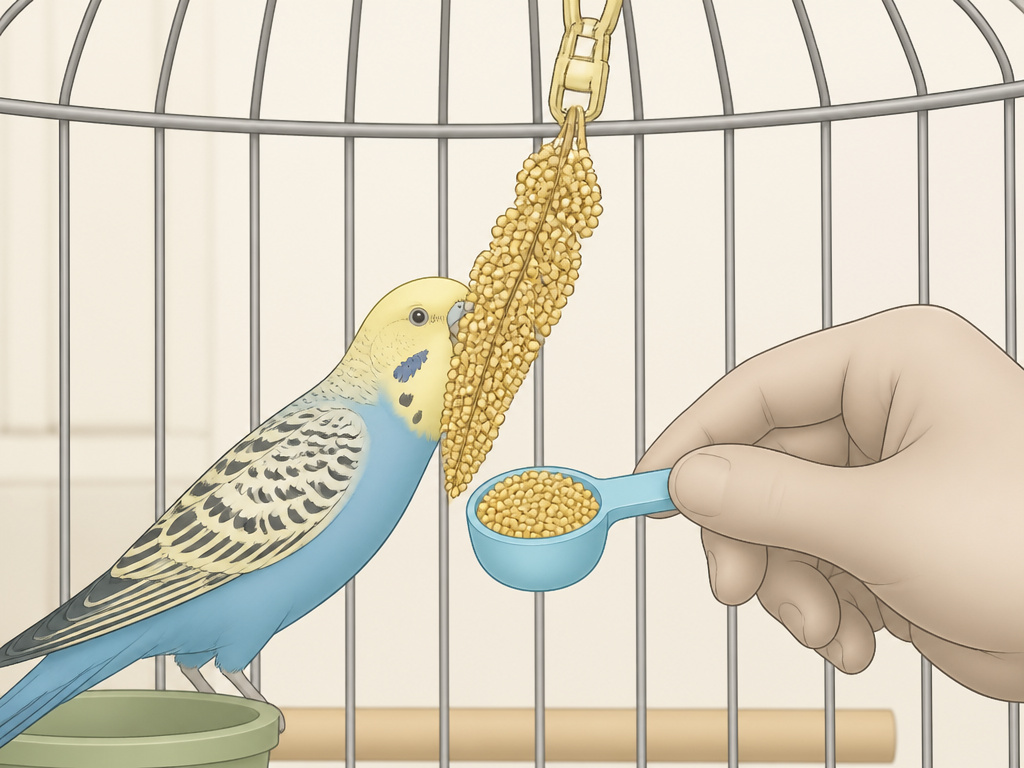
- Enrichment. Omlet suggests fastening the woody end to the cage bars or hanging it from the roof so the bird has to work for it.
- Getting a reluctant bird eating. A bird that has stopped eating is a vet problem, but millet is what many owners reach for while they wait for the appointment.
One caution on the “birds love it most” line. A UBC Expedition feeder study found millet and hemp equally preferred (p>0.05), and sunflower equally preferred to millet (p>0.05). Peanuts were the least preferred seed (p<0.05). Millet is well liked. It isn’t magic.
The Cons: No Vitamin A, Very Little Calcium, and a Bird That Quits Its Pellets
Planète Pets puts the problem in one line: millet contains no vitamin A and very little calcium.
That single sentence explains most of the trouble when you compare a millet treats for birds pros and cons. VCA Canada lists vitamin A deficiency, insufficient dietary calcium, and egg-binding as the nutrition problems cockatiels are vulnerable to. Millet contributes to none of the three.
VCA is blunt about the category: seeds are deficient in many nutrients, should be only a very small part of a balanced diet, and should never be the entire diet. FAO reaches the same place from the feed side, noting that traditional grain mixes may lead to unbalanced protein intake, a shortage of essential amino acids, or a lack of vitamins and trace minerals.
Here’s where the two big spray millet brands actually land, side by side:
| Nutrient | Kaytee Spray Millet | Vitakraft Sun Seed Golden Spray Millet |
|---|---|---|
| Crude protein | 7.5% min | 8% min |
| Crude fat | 3.0% min | 2% min |
| Crude fiber | 12.0% max | 20% max |
| Moisture | 12.0% max | 12% max |
Read that table carefully. The protein floors differ by less than a point. The fat floors differ by a full point. The fiber ceilings differ by several points, which is the biggest gap on the panel.
None of those figures are wrong. They’re different products, and a guaranteed minimum is a floor, not a measurement. Compare it on the same basis or the comparison means nothing.
What most people get wrong: Treating a guaranteed minimum as if it were the actual content. A “3.0% min” fat line means the lab result came in at 3.0% or higher. It says nothing about the ceiling.
The other thing the panel doesn’t show is what millet displaces. If your bird fills up on spray and leaves the pellet bowl untouched, the millet isn’t the problem. The empty bowl is.
How Much Millet, and How Often? Where the Sources Disagree
Kaytee says replace the spray weekly or more frequently if desired. Planète Pets says a few centimetres two or three times a week, and specifically not a spray left in the cage all the time.
Those are not the same instruction. One treats a hanging spray as a standing item. The other treats it as an event.
Kaytee treats a hanging spray as a standing item replaced weekly or more often, while Planète Pets treats it as an event of a few centimetres two or three times a week; I’ll take Planète Pets’ side on this one, and here’s the reasoning rather than the rule. A spray that hangs in the cage for a week is available every hour the bird is awake. A 3-5 cm piece given twice a week is a fraction of that intake, and it keeps the pellet bowl doing its job.
The practical sequence:
- Set the base first. VCA puts pelleted food at roughly 75%-80% of a cockatiel’s diet. Fix that number before you touch the treat budget.
- Measure by length, not by spray. A 3-5 cm piece is the Planète Pets figure. A whole spray is not a portion.
- Two or three times a week. Not daily, and not permanently clipped.
- Watch what’s left in the bowl. If the seed sits and the millet vanishes, cut the frequency.
- Remove the stripped stem. Planète Pets says pull it once the bird has cleaned it.
Step 2 is the one people skip. Skipping it turns a treat into a second diet, and the bird stops bothering with the first one.
I’ve made the counting mistake myself, in my own line of work.
Skip this if: Your bird is weaning, or ill and refusing food. Kaytee positions millet for fledglings and juveniles, and the treat-only rule is deliberately suspended in those states. A sick bird that eats millet is better than a sick bird that eats nothing.
Does Millet Make Birds Fat? Both Sides of the Fat Argument
Omlet calls millet high in fat and says it should be treated with caution. Vitakraft prints the opposite on its own product page, describing millet as lower in fat than many other bird seeds.
Planète Pets splits the difference, arguing millet isn’t especially fatty and that the real problem is the missing vitamin A and calcium.
Three sources, three positions, and the numbers don’t settle it. Kaytee’s fat floor is 3.0% minimum. Vitakraft’s is 2% minimum. Neither is a maximum, so you can’t line them up and declare a winner.
For scale, USDA FoodData Central entry 169702 puts raw millet at 378 kcal and 73 g of carbohydrate per 100 g. FAO puts typical caged bird food at around 12% fat overall. Millet is an energy-dense grain sitting inside a category that is already energy-dense.
The UBC feeder study is the interesting wrinkle. It found no significant correlation between consumption and energy (r=0.11), protein (r=0.078), lipid (r=0.26) or carbohydrate (r=-0.22). Birds in that trial didn’t pick seeds by the numbers.
If you take one rule from this: millet is a portion problem, not a poison. Control the length of the piece and the number of days per week, and the fat argument stops mattering.
Where the fat question does matter is an overweight or inactive bird. Planète Pets says cut the frequency further and talk to an avian vet. Omlet suggests hanging the spray high so the bird burns energy getting to it. Both are reasonable, and neither replaces the vet.
Placement, Storage, and the Dust Nobody Warns You About
Both manufacturers give the same placement instruction, and both bury it under the marketing copy.
Kaytee says to hang the spray by a clip or set it in a holder near a perch, and to keep it off the cage bottom where it may become contaminated. Vitakraft says hang it near a perch or place it in an elevated dish, and not to lay it on the floor where it may be soiled. Omlet adds that fastening the woody end to the bars makes the bird work harder.
Handle a dry spray and you’ll notice the dust first. A fine pale powder comes off the stalk and settles on the bars, the tray, and your sleeve. That dust is the part of millet nobody puts on a product page.
The part nobody mentions: Millet dust is an inhalant allergen, not just a mess. Immunoblot testing found specific IgE against a 60-kd protein in the birdseed millet.
That case is about the owner, not the bird.
Storage is the easy part. Kaytee says store it cool and dry. A spray that has gone soft or smells musty is a spray to bin.
Reading the Bag: Pesticides, Dyes, and Honey
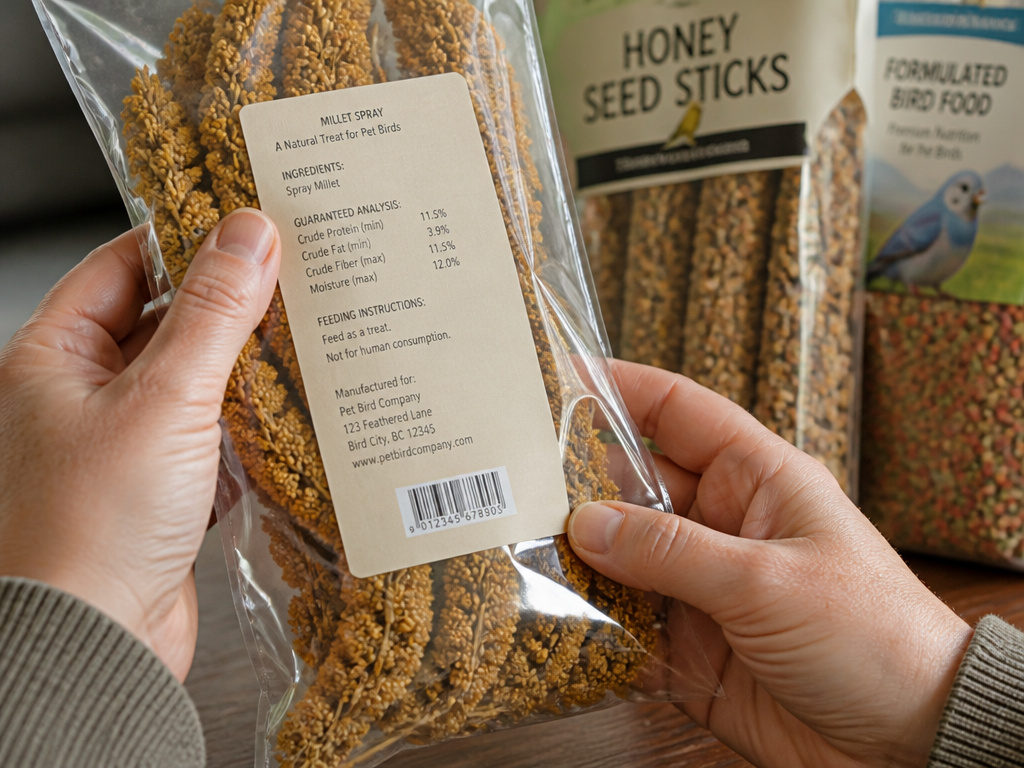
Turn the bag over. The front of a millet package tells you very little, and the back is where the actual decisions live.
Omlet raises a point worth repeating: make sure the sprays are free from pesticides and other chemicals, and treat a suspiciously cheap product as a possible sign of mass production with spray-on chemical use. That’s an inference, not a lab result, but it’s a reasonable filter.
FAO’s small seed production guide notes that some exotic-bird mixes run to 20 or 25 different ingredients, and that the most complex mixes are found in the treats. Complexity in a treat is not a virtue.
Then there’s the honey question. VCA describes honey sticks plainly: seeds stuck together on a stick with sugar and honey, and similarly nutrient-deficient. That’s the packaged treat category in one sentence.
For a base diet, a formulated pellet does the work millet can’t. Harrison’s Bird Foods makes a pelleted line, and that’s the category to compare against rather than another seed product. For a packaged treat that isn’t a seed stick, Lafeber’s foraging and nut-based products are the ones I’d look at before a honey-bound stick.
If honey, syrup, or a dye is doing the structural work, put it back.
Frequently Asked Questions
Is millet bad for birds?
No, but it isn’t a diet either. Kaytee and Vitakraft both state that millet is a treat to be fed alongside a complete daily diet, and VCA Canada describes seeds as nutritionally incomplete. The problem starts when millet replaces the base rather than sitting on top of it.
How often should I give my bird millet?
Planète Pets recommends a 3-5 cm piece two or three times a week. Kaytee’s packaging says replace the spray weekly or more often, which is a different instruction entirely. The lower frequency keeps the treat from crowding out pellets.
Can a bird live on millet alone?
No. Millet contains no vitamin A and very little calcium, and VCA Canada notes that cockatiels are vulnerable to vitamin A deficiency and insufficient dietary calcium. FAO adds that grain mixes alone may lead to unbalanced protein intake and a shortage of essential amino acids.
Is millet fattening for budgies?
The sources disagree. Omlet warns about its fat content, while Vitakraft describes millet as lower in fat than many other bird seeds, and Planète Pets argues the fat level isn’t the real issue. The guaranteed fat floors differ too: 3.0% minimum for Kaytee, 2% minimum for Vitakraft.
Should I give millet to a sick or weaning bird?
Yes, within reason. Kaytee positions spray millet as useful for encouraging weaning and getting birds to eat, and that’s the situation where the treat-only rule gets set aside. Any bird that has stopped eating still needs a vet.
Is millet dust harmful to people?
For most people, no. For an atopic bird keeper, it’s a documented inhalant allergen. The 2008 case report describes asthma triggered by cage cleaning, with specific IgE against a 60-kd protein in birdseed millet.
The Bottom Line
Here’s the threshold I’d actually use: if the millet in your bird’s week would fill more than a couple of short pieces, you’ve moved past a treat and into a second diet. Cut back to a 3-5 cm piece two or three times a week and watch the pellet bowl for a fortnight.
And if you’re reducing millet because the bird is hooked on it, go slower than feels necessary. Omlet advises cutting over the first few days and then removing it, while a reader account on the same page describes a budgie that dropped close to 20% of its body weight in days after a fast reduction, with the vet saying the change should have run over a month or two. Budgies will starve themselves over a diet change made too quickly.
This all assumes a bird that’s healthy and eating. If yours is losing weight, sitting fluffed, or refusing food, the millet question is not the question. That’s a vet visit, and no bag panel will answer it.
Millet is a tool. It’s just a tool with a label that oversells it, and the label is the part you’re supposed to read.
