
What Is AAFCO and Why It Matters: Who Sets the Rules
This post contains affiliate links. As an Amazon Associate, we earn from qualifying purchases.
AAFCO, the Association of American Feed Control Officials, is a non-profit that writes model standards for pet food and animal feed. It holds no regulatory authority of its own. State feed officials vote on those models and carry them home, and most states have adopted the Model Pet Food Regulations in some form.
That gap between writing a standard and enforcing one is where nearly every consumer misunderstanding about this organization starts. A model regulation has no force until a state legislature or an agriculture department adopts it, and adoption is uneven on purpose. Political, financial and cultural differences between governing bodies explain why the scope of feed and pet food programs varies from one jurisdiction to the next, which is what is AAFCO and why it matters.
What follows walks through who actually votes, what “AAFCO-approved” does and does not mean, how a model becomes state law, and where the organization’s own published numbers disagree with its own laboratory data.
Key Takeaways
- There is no such thing as AAFCO-approved pet food. The association’s own FAQ states it does not approve, certify or endorse any product.
- AAFCO has no regulatory authority whatsoever. Enforcement sits with state feed officials and the FDA, not the association.
- Most states adopted the Model Pet Food Regulations in some form, and that phrase is doing real work.
- The analytical variation values in the Official Publication trace to a 1986 revision, according to the 2022 study.
- Five analytes failed to match the published tolerance in a 2022 peer-reviewed audit of AAFCO’s own proficiency testing data.
Who Actually Sits at the AAFCO Table
The Association of American Feed Control Officials was founded in September 1906, and membership is restricted to one kind of person: an employee of a state, dominion or other North American government agency who enforces animal feed regulations, including those for pet food.
Membership in the Association of American Feed Control Officials is limited to government employees who enforce animal feed regulations in North America. The Food and Drug Administration, the Canadian Food Inspection Agency, Costa Rica and Puerto Rico all hold seats at the table. Each member gets one vote on any particular issue.
The FDA is a voting member and shows up to meetings, seminars and training sessions. It also does more than observe. The FDA brings expertise and judgment on the safe and effective use of ingredients that AAFCO defines, which matters later when we get to the what is AAFCO and why it matters of how ingredient definitions get approved.
Here is the actual roster:
- State departments of agriculture, which is where most day-to-day enforcement happens.
- The U.S. Food and Drug Administration, holding a voting seat.
- The Canadian Food Inspection Agency.
- Costa Rica and Puerto Rico, both listed as members.
One Member, One Vote, and What That Means
The Procedures Manual, current revision dated 2025-09-24, spells out the rule: each state, province, dominion, territory, republic, commonwealth and federal agency that regulates animal feed and pays annual dues designates one voting representative.
One jurisdiction, one vote. California and Rhode Island count the same.
Anyone can register for and attend an AAFCO midyear or annual meeting. Interested parties from wider organizations can apply to serve as non-voting committee advisors. The AAFCO’s role in pet food explainer notes that the association promotes including consumer advocates as advisors, and industry representatives still far outnumber them.
Why ‘AAFCO-Approved’ Is a Phrase You Should Not Trust
The AAFCO pet food FAQ says it in one sentence: the association does not approve, certify or otherwise endorse pet foods, and there is no AAFCO-approved pet food.
The reason is partly practical. The number of pet food products on the market precludes AAFCO from maintaining a list of products that meet its standards. There is no registry to check, no database to search, no certificate number to look up.
So what does AAFCO actually do? Four things, none of them approval:
- It writes model bills, model regulations and ingredient definitions.
- It runs a laboratory proficiency testing program.
- It publishes the Official Publication, which state laws reference.
- It provides a venue for feed regulators to compare notes and push toward uniformity.
And four things it does not do:
- Approve, certify or endorse any pet food.
- Maintain a list of products meeting its standards.
- Provide veterinary medical advice or recommendations of any type.
- Enforce feed law anywhere.
What most people get wrong: Reading “AAFCO approved” on a bag as a certification. No product holds that status.
Now, here is where two AAFCO statements sit next to each other and look like they disagree. The FAQ says there is no such thing as AAFCO-approved food. The role page says most state feed laws reference the AAFCO Official Publication as part of nutritional adequacy labeling, and then adds that AAFCO itself has no regulatory authority whatsoever.
Both are correct, and the distinction is the whole what is AAFCO and why it matters point. State law points at the AAFCO standard. AAFCO does not enforce that law. The reference is to a science-based nutritional standard, not to a stamp of approval issued by the association.
How a Model Regulation Becomes Law in Your State

A model regulation does nothing until a legislature or an agriculture department adopts it. AAFCO members meet, establish and refine the models, then share them with their own legislative and rulemaking bodies for incorporation into law and rules.
The AAFCO Model Bill, which most states have adopted as law, includes adulteration definitions the FDA enforces. There is a second wrinkle there. The FDA definition of adulteration applies to food for humans and animals, while the AAFCO version applies strictly to animal feed. Two overlapping definitions, not one.
Here is how the work splits:
| Actor | Role in the standard | Enforcement power |
|---|---|---|
| AAFCO | Writes model bills, regulations, ingredient definitions | None |
| State feed officials | Adopt models, inspect plants, license products | Within their own state |
| FDA | Voting member; reviews ingredient safety before votes | Federal, over human and animal food |
| AAFCO PTP | Runs proficiency testing for feed laboratories | None; it scores labs |
And here is the tension I mentioned. Two statements from the same organization pull in different directions. On one side, AAFCO says the majority of states have adopted the Model Pet Food Regulations in some form, and that political, financial and cultural differences account for varying regulatory scope. On the other, it says it would be infeasible for a company to distribute pet food in multiple states without meeting those standards.
Both positions are held by AAFCO, on the same page, and both are true at once. The floor is high enough that you cannot practically sell across state lines without clearing it. The ceiling is uneven, so a formulation that clears one state’s program may not clear another’s.
Where AAFCO’s Own Numbers Disagree With Its Own Labs
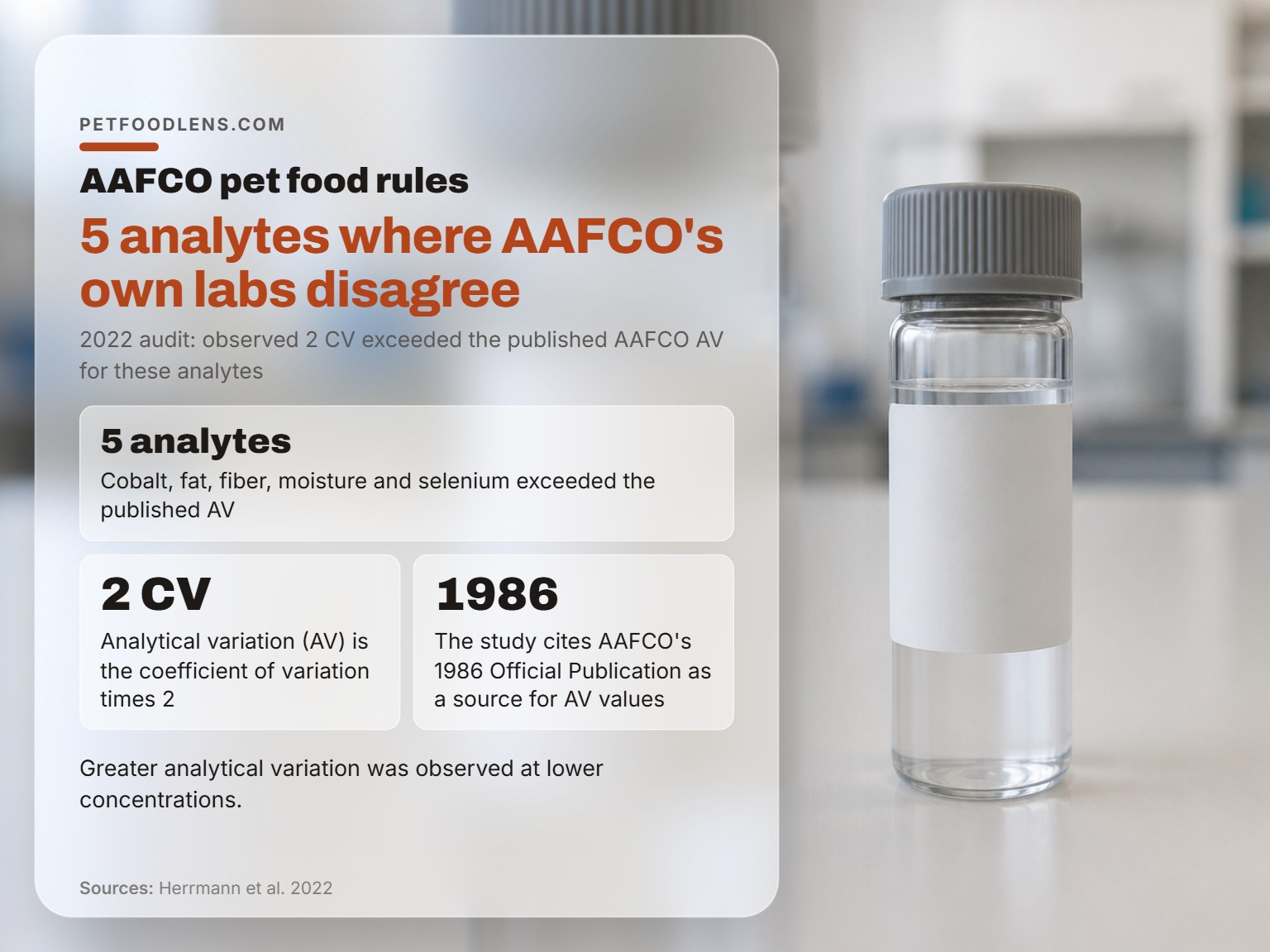
Five analytes came back with more variation than the published tolerance allowed: cobalt, fat, fiber, moisture and selenium.
That finding comes from a 2022 peer-reviewed paper in the Journal of Regulatory Science. The authors assessed the accuracy of the analytical variation values published in AAFCO’s Official Publication using AAFCO’s own proficiency testing data from 2014 to 2020.
The definition first, because the jargon gets thick. Analytical variation, or AV, is the coefficient of variation times 2. It is a tolerance band: the normal spread you should expect between two competent laboratories running the same sample. AAFCO built those bands from its own proficiency testing results.
The audit found that for cobalt, fat, fiber, moisture and selenium, the observed 2 CV was higher than the current AAFCO AV. In plain terms, real labs spread wider than the published tolerance permits. The majority of data points showed acceptable reproducibility for the other methods tested.
| Analyte | What the 2022 audit found | What it means for a label |
|---|---|---|
| Cobalt | Observed 2 CV exceeded the published AV | The AVs are too tight relative to observed lab reproducibility |
| Fat | Same | Two labs can disagree and both be right |
| Fiber | Same | Fiber is one of the analytes where real lab spread exceeded the published tolerance |
| Moisture | Same | Moisture is one of the analytes where real lab spread exceeded the published tolerance |
| Selenium | Same | Selenium is one of the analytes where real lab spread exceeded the published tolerance |
The peer-reviewed AAFCO testing evaluation goes further than the five analytes. It notes that the study cites AAFCO’s 1986 Official Publication as a source for the AV values.
Read that again. The tolerance band applied to feed testing today traces to a 1986 revision cited as a source for the AV values.
Why Lower Concentrations Drift More
Greater analytical variation was observed at lower concentrations. That is the single most useful line in the paper for anyone reading a guaranteed analysis.
A guarantee printed near the detection limit is the least reliable number on the panel. The closer a value sits to zero, the wider the spread between two labs running the same sample, and the less a passing or failing result tells you about the food itself.
The authors built regression models from the 95% tolerance interval of expanded uncertainty and 2 CV, then validated them against 2019-2020 proficiency testing data. The validation data fell inside the model bounds. Their conclusion is measured: the AAFCO AV and its issues need to be better understood to improve accuracy and traceability of laboratory measurement and regulatory decisions.
Now for the second disagreement. AAFCO’s AAFCO proficiency testing program page notes that the program is accredited to ISO/IEC 17043:2010 by ANAB and provides performance scores for each analyte and method reported. That is a real, functioning quality system. The Herrmann paper does not dispute that the program works. It disputes whether the tolerance values derived from that program’s data match what the program’s data actually shows.
Two credible positions, held by two credible parties, pointing at the same numbers.
Does AAFCO Accreditation Mean the Lab Got It Right?
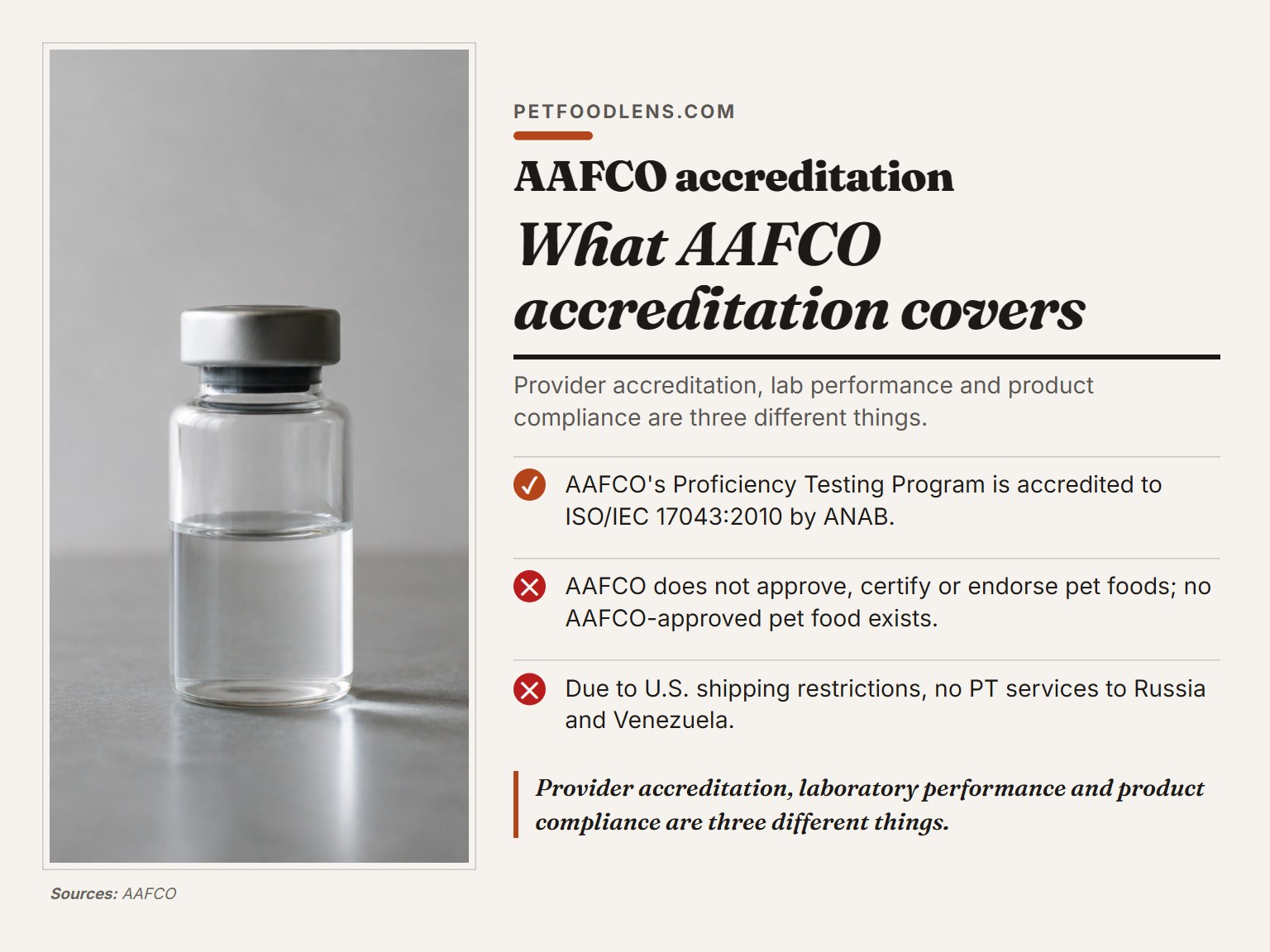
Accreditation answers a narrower question than most people assume.
AAFCO’s Proficiency Testing Program is accredited to ISO/IEC 17043:2010 by ANAB. That standard covers proficiency testing providers, meaning the organization running the comparison has been checked against an international benchmark for how such programs are run. It does not certify any individual laboratory, and it does not certify any product.
Here is what the program actually does. Rounds are distributed to customers on a predetermined schedule, and each laboratory tests the samples for analytes of interest. Results come back using specified AAFCO method codes and units, which allows statistical analysis of how a given method performed. Laboratories then receive performance scores for each analyte and method reported.
I tell people to stop asking whether a brand is certified and start asking what the certification covers. A lab accreditation and a product approval are two different documents, and only one of them says anything about the bag in your hand.
There are limits to the program’s reach, too. Due to shipping restrictions in the United States, AAFCO can no longer provide proficiency testing services to Russia and Venezuela. A laboratory in either country is outside this system entirely.
Provider accreditation, laboratory performance, and product compliance are three different things, and marketing copy tends to collapse them into one.
What the Nutritional Adequacy Statement Actually Tells You
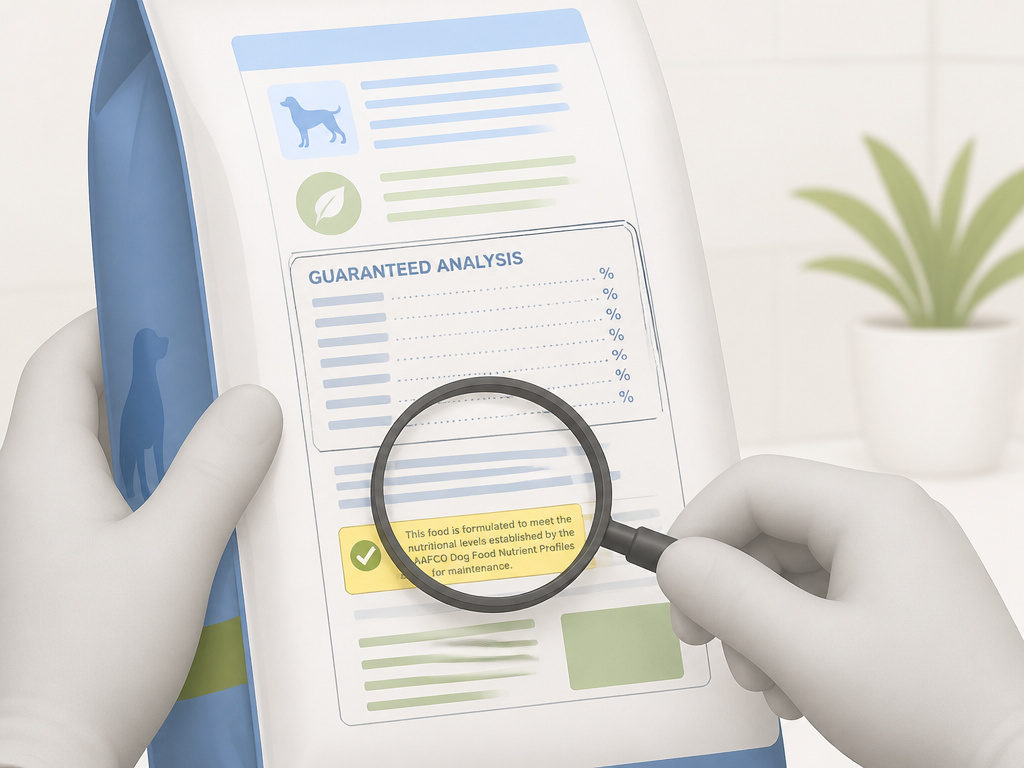
Flip the bag over and look below the guaranteed analysis. There is a single line of small type, usually running the width of the panel, that states whether the food conforms to an AAFCO Dog or Cat Food Nutrient Profile or to an AAFCO Dog or Cat Food Feeding Protocol.
That line is the closest thing to an official finding on the entire package. Most state feed laws reference the AAFCO Official Publication as part of nutritional adequacy labeling, and the consumer is directed to that statement to see whether a product conforms.
Nutrient Profile vs Feeding Protocol
A nutrient profile is a target set of nutrient levels that a formula is built to hit on paper. A feeding protocol is a test where animals are actually fed the food and observed. Both appear on labels. They are not the same claim.
This is the part most people skip past, and it is the part that tells you how the company verified the food.
Four steps, in order:
- Find the adequacy statement on the back panel, below the guaranteed analysis.
- Note whether it cites a nutrient profile or a feeding protocol, since the second involves actual feeding. 3. 4.
The Ingredient Gate That Stops Most Submissions
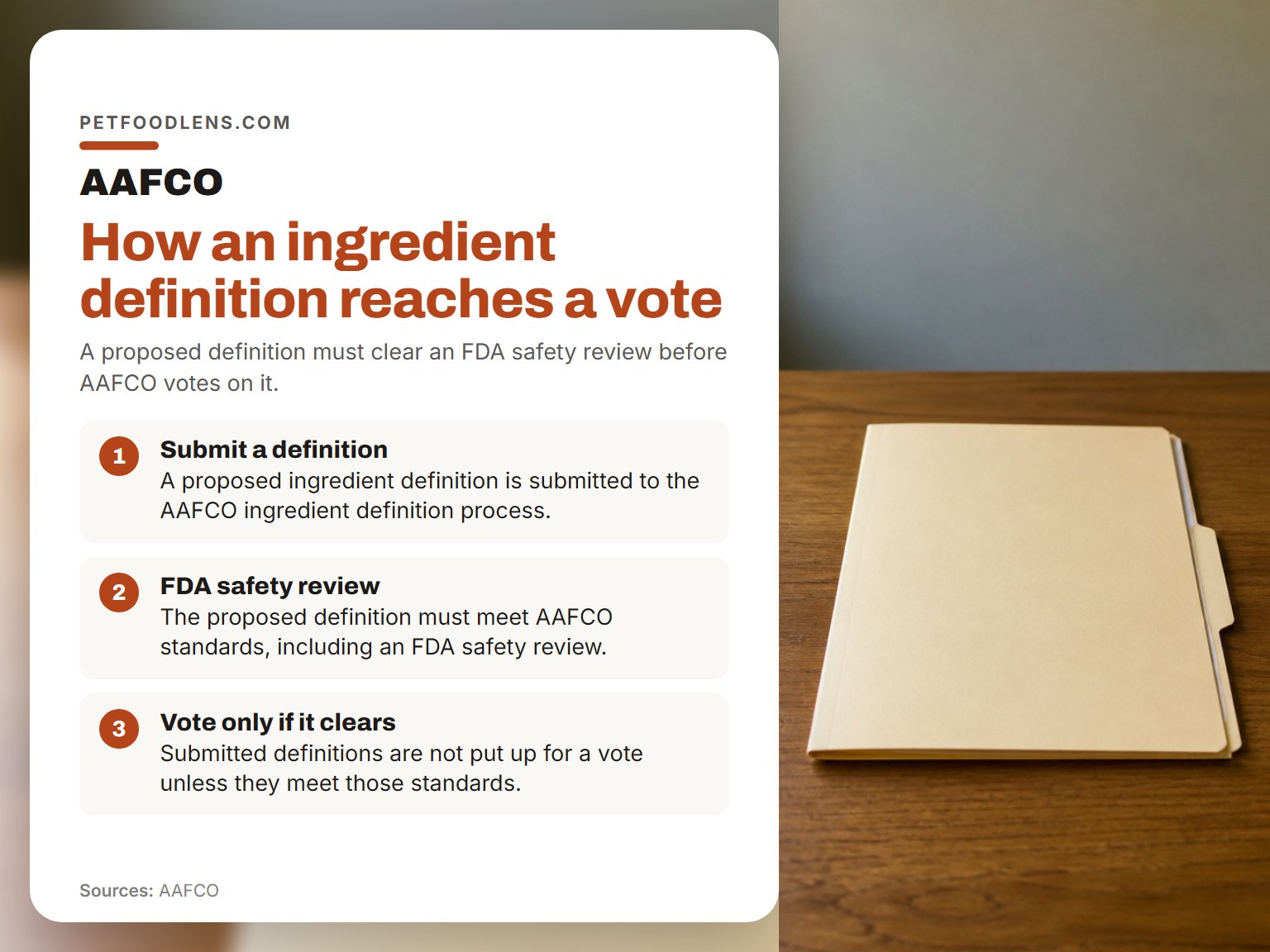
The Ingredient Definitions Committee does not vote on a proposed definition until it clears an FDA safety review.
That gate is explicit. Submitted ingredient definitions are not put up for a vote unless the proposed definition meets the standards of the AAFCO ingredient definition process, including an FDA safety review. A submission that fails that review does not get voted down in public. It never reaches the agenda.
The part nobody mentions: A definition that fails the FDA safety review never reaches a vote at all. It does not get rejected publicly; it simply does not appear.
The raw material rules are separate and narrower than most people assume. Raw materials that may have come from diseased or disabled animals are prohibited from use as raw animal feed or raw pet food. Cooking, high-temperature treatment or rendering can kill potential microbial agents and make such materials safe for animal consumption, which is why rendered products are treated differently from raw ones.
On top of that, to avoid mad cow disease, certain specified risk material is prohibited from use in any animal feed, rendered or not. That prohibition does not have a rendering exemption.
Frequently Asked Questions
Is there really no such thing as AAFCO-approved pet food?
Correct. AAFCO states plainly that it does not approve, certify or otherwise endorse pet foods. The association also cannot maintain a list of compliant products, because the number of products on the market makes it impractical. Any package implying AAFCO approval is using the name loosely.
Does AAFCO enforce pet food law?
No. AAFCO itself has no regulatory authority whatsoever. Individual members have authority within their own jurisdictions, and the FDA holds a voting seat and enforces federal rules. The association writes models; other bodies adopt and enforce them.
What is the AAFCO Official Publication?
It is the document containing the association’s models, ingredient definitions, label standards and laboratory standards. Most state feed laws reference it as part of nutritional adequacy labeling. It is also where the analytical variation values live, which the 2022 study cites the 1986 Official Publication as a source for.
Where do I find the AAFCO nutritional adequacy statement?
On the back of the package, below the guaranteed analysis, usually as a single line of small type. It states whether the food conforms to an AAFCO Dog or Cat Food Nutrient Profile or an AAFCO Dog or Cat Food Feeding Protocol. That statement is the consumer-facing output of the whole system.
What is analytical variation in feed testing?
It is the coefficient of variation times 2, a tolerance band representing the normal spread between laboratories running the same sample. AAFCO derived its published values from proficiency testing results. A 2022 audit found that for cobalt, fat, fiber, moisture and selenium, real lab spread exceeded the published band.
Can AAFCO tell me whether a food is safe for my cat?
No. AAFCO and its members are not practicing veterinarians, and the association does not provide veterinary medical advice or recommendations of any type. If you believe your pet has a health issue tied to a food, the association points consumers toward filing a complaint rather than toward a diagnosis.
The Bottom Line
Here is the practical version of what AAFCO is and why it matters: it is a standards body with no enforcement power, whose models most states adopted in some form, and whose name gets borrowed constantly by marketing departments that have no standing to borrow it.
The uncomfortable part is the numbers. The tolerance bands in the Official Publication trace to a 1986 revision cited as a source for the AV values, and a peer-reviewed audit of AAFCO’s own proficiency testing data found five analytes where real laboratory spread exceeded the published tolerance. That does not make the system worthless. It makes the label a starting point rather than a verdict.
One concession, and it is a real one. Everything above assumes a healthy adult cat eating a maintenance diet. If your cat has kidney disease, diabetes or a diagnosed food allergy, none of this replaces an exam, and I am not a veterinarian. General label guidance can give you false confidence in exactly those cases, so take the questions to your vet instead of the bag.
Your first step this week: pick up whatever you are feeding now and find the nutritional adequacy statement. If you cannot locate it in ten seconds, that tells you something about how the front of the bag was designed.
