
How to Set up a Bird Feeding Station: Step-by-Step
This post contains affiliate links. As an Amazon Associate, we earn from qualifying purchases.
To set up a bird feeding station, drive the pole at least 30 cm into soft ground, fit the pole section with the longest recess at the top, fill every dispenser before attaching it, and mount the feeder so the lowest tray clears 6 feet.
The 30 cm stake depth and the 6-foot tray height come from different sources. Thompson & Morgan’s G1357 manual sets the stake. University extension bulletins set the height. Following one without the other leaves the pole loose in wet soil, or the feeder low enough for a squirrel to launch onto it.
What follows walks through how to set up a bird feeding station in the order the manuals specify, then the placement decisions they leave out: baffle size, distance from cover, seed choice, and the cleaning routine that keeps a feeder from spreading disease.
Key Takeaways
- Drive the pole 30 cm into soft ground before attaching anything to it; a pole sunk shallow into a spring lawn will lean by the second rain.
- Fill every dispenser before you hang it on the pole. The Oypla 4101 manual specifies this, and refilling after assembly means pulling the top section back off.
- Oil-type sunflower seed is the base to build around; it flows well in tray feeders and pulls cardinals, chickadees, titmice, blue jays, and finches.
- Fit an 18-inch inverted cone below the feeder if squirrels are already on the property, and keep the pole 20 feet from any launch point.
- Clean with hot soapy water and a veterinary disinfectant on a regular schedule; moldy seed and droppings are the documented disease route.
Where the Pole Goes: 30 cm Down, 6 Feet Up
The G1357 manual gives one hard number for installation: push the pole at least 30 cm into soft ground. That figure appears in no top-ranking guide I have read on how to set up a bird feeding station, and it is the single most useful line in the manual. A pole sunk shallow into a spring lawn will lean by the second rain.
A bird feeding station is a vertical load on a narrow point of soil. The pole must be inserted at least 30 cm into soft ground so the surrounding soil can grip the shaft below the frost line. A pole set shallower than that relies on surface tension alone and tips once the soil saturates.
Height is where the sources split. UNL Extension EC1783 puts pole feeders at 6 feet or higher. The Missouri Department of Conservation’s build plan uses a 6-foot post. UW Extension G3176 gives 5 to 6 feet. Six feet satisfies UNL and MDC, while UW Extension G3176 gives 5 to 6 feet, so 6 feet is a safe working minimum.
Why the 30 cm Depth Matters
Soil holds a pole through friction along the buried length. A 30 cm bury gives you more surface contact than a 10 cm bury, which is why the G1357 number exists in the first place. If your soil is sandy or waterlogged, drive the pole deeper than the manual says, or switch to a socket-style ground anchor. The Oypla 4101 manual only says “secure in the ground” and gives no figure, so treat 30 cm as the floor and go deeper if the pole wobbles when you push it.
Assembly Order: What the Manuals Actually Tell You
The G1357 ships as 4 metal poles, 2 top sections with hooks, 2 seed dispensers, 1 nut dispenser, 1 fat-ball dispenser, 2 trays, and 1 set of hooks. That is a lot of parts to stack on one pole, and the order you stack them in when you compare a how to set up a bird feeding station decides whether the top section seats properly. If you want a station that ships with everything sorted, choose a model with a complete parts list.
The Parts List for a G1357 Station
- Join the pole sections first, longest recess at the top. The G1357 manual states this explicitly. The recess is the internal sleeve that the next section slides into; getting it wrong means the top section wobbles.
- Fill every dispenser before attaching it to the pole. The Oypla 4101 manual specifies this. Filling after assembly means pulling the whole top section back off, which is when people bend the hooks.
- Slide the hangers on and align the wingnuts on the same corner. Oypla 4101 is specific about this. The hangers fit together snug, and the wingnuts must line up vertically. If they do not, the hanger will not seat and the feeder hangs crooked.
- Drive the pole into the ground last. Attach everything while the pole is lying flat on the lawn. Standing the pole up with dispensers already loaded is how the fat-ball cage ends up in the grass.
That is the order. If you are still choosing the pole itself, the feeder pole comparison covers the difference between a socket base and a straight stake.
Before you start: A loaded G1357 station weighs enough to injure a child if it tips. Never let children or pets swing from or play with the pole; the Oypla 4101 manual carries the same warning for the same reason. Drive the stake before you load the dispensers, not after.
How Do You Keep Squirrels and Raccoons Off a Pole Feeder?
The two OEM manuals are silent on predators. The extension bulletins are not. UNL Extension EC1783 gives a baffle spec that actually works against raccoons: 8 inches in diameter or larger, mounted just below the feeder and at least 4 feet off the ground. The Missouri Department of Conservation feeder plans go bigger for squirrels: an inverted sheet-metal cone at least 18 inches in diameter, on a 6-foot post, at least 20 feet from any point a squirrel can jump from.
Those numbers are not interchangeable. A squirrel can clear a jump from a deck rail. A raccoon can climb a pole but cannot pass an 8-inch baffle if the baffle is mounted correctly. If you want a squirrel-resistant feeder instead of a baffle, choose a model that closes under a squirrel’s weight and reopens after they leave.
| Pest | Baffle spec | Distance rule |
|---|---|---|
| Squirrels | 18-inch inverted cone below feeder | 20 ft from jump points (MDC) |
| Raccoons | 8-inch baffle, 4 ft off ground | Keep trees trimmed so they cannot drop on the roof |
| Both | Move feeder away from deck rails | 10-15 ft from any squirrel-feeding station |
The UNL bulletin and the MDC plan disagree on distance. MDC says 20 feet from jump points. The Nebraska Extension bird feeding publication says trim trees and keep feeders off the deck, with no specific distance. MDC’s 20-foot figure is stricter, while UNL gives no specific distance, so follow MDC if you have mature trees near the pole.
Where this goes sideways: A baffle mounted too low does nothing. Squirrels launch from the ground as easily as from a branch, and the whole point of the 4-foot minimum is to force them to climb the pole itself. Mount the baffle below the feeder but above the launch zone.
If squirrels are already on the property, squirrel-proofing a feeder setup is a separate problem from choosing the feeder. UNL’s simplest fix is the one most people skip: stop feeding for a week. Removing seed for about a week breaks the raccoon cycle.
Seed Choice: What Actually Flows and What Attracts Which Birds
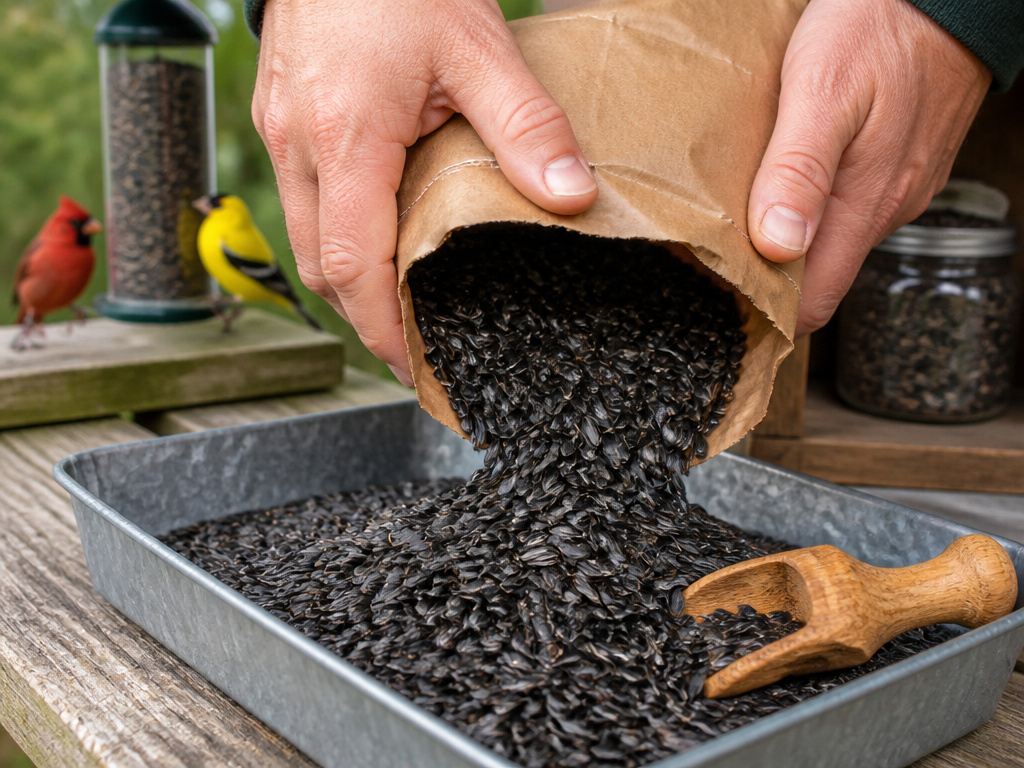
In 2006, researchers estimated 55 million adult Americans fed wild birds and other wildlife, and Americans spent an estimated 3.3 billion dollars on wild bird food that year, according to the Wisconsin 4-H bird feeding guide. Most of that money went into commercial mixes that the same bulletin calls relatively unattractive to most birds. Wheat, millet, peanut hearts, hulled oats, and rice fill out cheap bags, and the birds pick around them.
UW Extension G3176 is blunt about this: the food you provide matters more than feeder design. Oil-type sunflower seed is the base to build around. MDC’s build plan says the same thing in different words: small oil-type sunflower flows well in a tray feeder and pulls cardinals, chickadees, titmice, blue jays, and finches.
Which Seed Attracts Which Bird
- Oil-type sunflower: cardinals, chickadees, titmice, blue jays, finches (MDC, UW G3176).
- Thistle (niger): goldfinches and house finches, per the UW G3176 species table.
- Safflower: cardinals and chickadees, and squirrels tend to leave it alone.
- Fine-cracked corn: juncos and tree sparrows, useful on a ground tray.
- Hulled sunflower: goldfinches, grackles, and starlings, but it spoils faster than black oil.
Buying seed is one decision. Keeping it dry is another. The seed storage question matters more than most people think, because damp seed molds in the bag before it ever reaches the feeder.
| Seed | Best for | Skip if |
|---|---|---|
| Oil-type sunflower | Year-round base | Never skip |
| Thistle (niger) | Goldfinches | Feeder has large ports |
| Safflower | Cardinals, squirrel-heavy yards | You want finches |
| Fine-cracked corn | Ground-feeding species | Raccoons are present |
If you want the full breakdown by species, the bird seed comparison covers it. The short version: one bag of oil-type sunflower outperforms any “wild bird mix” on the shelf. I would skip the mixes entirely.
Common mistake: Buying a bag that lists wheat or millet as the first ingredient. UW Extension G3176 lists both as unattractive to most birds. The bag is cheaper because the filler is cheaper, and you will refill it twice as often.
The Cleaning Routine That Prevents Disease
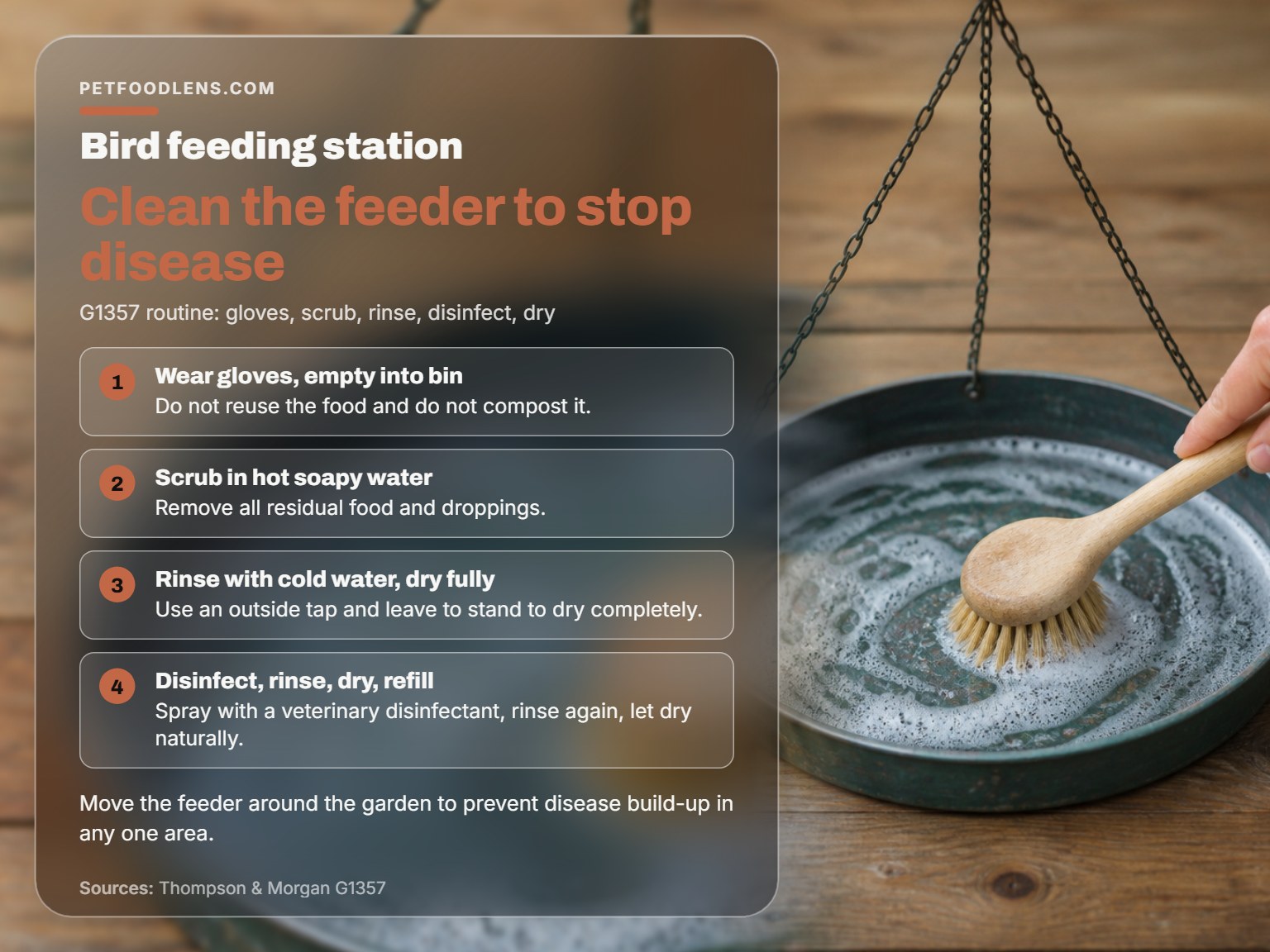
A feeder that never gets cleaned is a disease vector. UW Extension G3176 is direct about it: feeders contaminated with bird droppings and moldy seed can facilitate disease transmission. The G1357 manual spells out the routine.
- Wear rubber gloves and empty the feeder into a bin. Do not reuse the food and do not compost it. The G1357 manual is explicit on both points.
- Scrub with a brush in hot soapy water. Get every bit of residual food and droppings off, including the tray floor. MDC’s build plan notes that flour dust and moisture form a hard paste on the tray that blocks seed flow and clogs the drain holes unless you scrape it off.
- Rinse with cold water from an outside tap and leave it to dry completely. A damp feeder refilled with seed can mold.
- Spray with a veterinary disinfectant, rinse again, and let it dry naturally before refilling. The G1357 manual calls for the disinfectant step specifically to kill remaining infections.
Move the feeder around the garden between cleanings. The G1357 manual says this directly: relocating the feeder prevents a build-up of disease in any one area. The cleaning routine is worth reading in full if you have had a disease outbreak in your yard.
Worth knowing before you start: A feeder cleaned once a season is not cleaned. The G1357 manual calls for cleaning on a regular basis, and warm weather compresses that interval. In summer, clean more often than in cooler weather.
Where Sources Disagree: Height, Cover, and Window Distance
Three university and agency sources give three different answers on the same variables. None of them is wrong. They are solving for different threats.
| Variable | UW Extension G3176 | UNL Extension EC1783 | MDC build plan |
|---|---|---|---|
| Feeder height | 5-6 ft | 6 ft or higher | 6 ft post |
| Distance from cover | Within 5 ft | 6 ft clearance from cat cover | Near bushes for retreat |
| Window distance | Within 3 ft | No guidance | No guidance |
Height is the easiest to settle. Six feet satisfies UNL and MDC, while UW Extension G3176 gives 5 to 6 feet, so 6 feet is a safe working minimum.
Cover distance is where the sources genuinely conflict. UW G3176 wants cover within 5 feet so birds have a retreat from cats. UNL EC1783 wants 6 feet of clearance from any cover that could conceal a cat. Those are opposite recommendations for the same threat, and the resolution is to read your own yard. If you have a neighbor’s cat that hunts the border, follow UNL. If you have open lawn and no cat pressure, I would follow UW.
Window distance only appears in one source. UW G3176 recommends feeders within 3 feet of glass to reduce high-force strikes. The logic is that a bird leaving a feeder close to a window cannot build enough speed to injure itself. The OEM manuals give no window guidance at all, so a reader following only the G1357 or Oypla 4101 instructions gets no window advice. The feeder placement guide covers this in more depth.
Should You Feed Birds Through Winter?
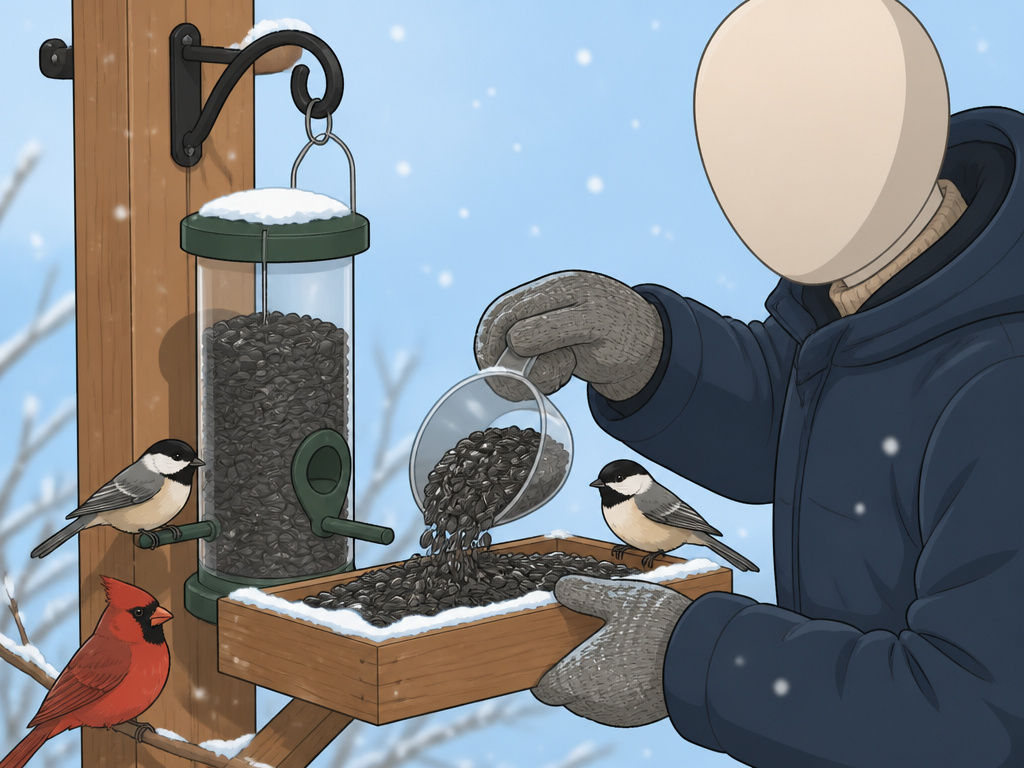
The two agency sources frame winter feeding differently. MDC’s build plan treats winter as a season you can opt into: begin in late fall or with the first snowfall, continue through winter, and taper off by March or April. UW Extension G3176 treats winter as a commitment you make before you set the pole up at all, because feeding can be harmful if it is not continued through the winter.
Both are correct about the mechanism. Birds that key on a feeder in late fall will key on it through winter, and a feeder that goes empty mid-winter strands them. The difference is one of framing. MDC’s plan works if you want a seasonal station. UW’s guidance is the one to follow if you are setting up a permanent pole.
If you set the pole up in fall, plan to keep it stocked through winter. A feeder that runs dry mid-winter does more harm than a feeder that never went up.
If your setup is a balcony or a window mount, the balcony feeder approach covers the small-space version of the same commitment. For a full winter plan, the winter feeding guide walks through seed selection and refill intervals.
Frequently Asked Questions
How deep should the pole go into the ground?
At least 30 cm, per the Thompson & Morgan G1357 manual. Deeper is better in sandy or waterlogged soil. The Oypla 4101 manual only says “secure in the ground” and gives no figure.
What is the right height for a pole feeder?
Six feet is the working minimum. UNL Extension EC1783 and the Missouri Department of Conservation both use 6 feet, while UW Extension G3176 gives 5 to 6 feet.
Do I need a baffle if I do not have squirrels?
If raccoons are on the property, yes. UNL EC1783 specifies an 8-inch baffle mounted at least 4 feet off the ground to stop raccoons from reaching a pole feeder. Squirrel baffles are larger, at 18 inches in diameter, per MDC.
What seed should I put in a new feeder?
Oil-type sunflower seed. It flows well in a tray feeder and attracts cardinals, chickadees, titmice, blue jays, and finches, according to both MDC and UW Extension G3176. Avoid mixes with wheat, millet, peanut hearts, hulled oats, or rice as the leading ingredients.
How often should I clean the feeder?
On a regular basis, per the G1357 manual, and more often in warm weather. The full routine is hot soapy water, a cold rinse, a veterinary disinfectant spray, and a complete dry before refilling.
Can I move the feeder after birds start using it?
Yes, and the G1357 manual recommends it. Relocating the feeder periodically prevents a build-up of disease in any one area. Expect a few days of reduced traffic while the birds find the new spot.
The Bottom Line
Set the pole before you set the seed. A 30 cm stake in soft ground, a 6-foot tray height, and an 18-inch baffle if squirrels are already in the yard will get you through the first season without a re-do.
The single line from the G1357 manual worth taping to the shed wall: fill every dispenser before attaching it. It sounds trivial until you are standing on a step stool with a loaded fat-ball cage in one hand.
If you are setting the station up in fall, commit to feeding through winter before you drive the stake. A feeder that runs dry in January does more harm than one that never went up.
