
How to Hand-Feed a Baby Bird: Step-by-Step
This post contains affiliate links. As an Amazon Associate, we earn from qualifying purchases.
To hand-feed a baby bird, mix commercial formula fresh for each feed, warm it to 102-106°F (39-41°C) measured with a thermometer, and deliver it only while the chick is actively bobbing its head. Feed 6-10 times a day in the first week, stopping when the crop is rounded or the bird refuses.
The temperature range is where the sources split. VCA Animal Hospitals gives 102–106°F (39–41°C) and Unusual Pet Vets gives 39–41°C, while Kaytee’s guide targets 102–110°F and warns against feeding above 110°F. That 4-degree gap is not rounding. Formula above the crop’s tolerance burns tissue, and formula below 100°F can stall digestion, which is why knowing how to hand-feed a baby bird safely matters. VCA Animal Hospitals and Unusual Pet Vets use the lower range of 102–106°F (39–41°C), while Kaytee allows up to 110°F, so the sources do not agree on a single ceiling.
What follows walks the mixing chart by age, the feeding-response rule that prevents aspiration, brooder temperatures that shift every few days, and the crop-emptying signs that mean call a vet, all part of how to hand-feed a baby bird. By the end you’ll know what to do at 6 a.m. On day three, when the schedule says feed and the chick says no.
Key Takeaways
- 102-106°F (39-41°C) is the safe formula range; measure with a thermometer, because wrist-testing is inaccurate.
- Never feed a chick that isn’t head-bobbing. The airway is only closed during the response, so a quiet bird risks aspiration.
- Mix by weight, not by eye. Kaytee’s chart runs 8% formula at hatch up to 25-30% by day 5.
- Weigh every morning before the first feed on a gram scale in 1-gram increments.
- No feeds between 10 p.m. And 6 a.m. The chick should be sleeping.
What Temperature Should Hand-Feeding Formula Be?
Three sources give different ceilings, and the spread is 4°F. VCA Animal Hospitals and Unusual Pet Vets both land on 102-106°F (39-41°C), while Kaytee’s guide allows 102-110°F and warns against feeding above 110°F.
Hand-feeding formula is warmed to a measured 102-106°F (39-41°C) before delivery. A digital thermometer reads the mixed formula itself, not the water used during preparation. Formula above the ceiling burns the crop lining within a single feed; formula below 100°F slows digestion and is frequently refused by the chick.
| Source | Feed Temperature | What It Says |
|---|---|---|
| VCA Animal Hospitals | 102-106°F (39-41°C) | Measure with a thermometer before feeding |
| Unusual Pet Vets | 39-41°C | Wrist-gauging is inaccurate; use a thermometer |
| Kaytee | 102-110°F | Do not feed above 110°F; below 100°F affects digestion |
A thermometer is the whole game here. Unusual Pet Vets is blunt about wrist-testing: it’s inaccurate and should be avoided. A wrist cannot reliably gauge formula temperature, and formula that is too hot can burn the crop.
Where this goes sideways: Reheating formula in a microwave. Kaytee caps it at 5 seconds per half cup on high with vigorous stirring, VCA permits it only if mixed thoroughly, and Unusual Pet Vets advises against it entirely because hotspots cause crop burns.
A crop burn is a risk when formula is too hot. I test formula with a thermometer, not a wrist, because wrist-testing is inaccurate.
Mixing Ratios by Age: The Concentration Chart
Concentration changes with age, and the chart is where the numbers live. Kaytee’s hand-feeding formula guide mixes by weight, so you weigh formula and water on a gram scale rather than eyeballing scoops. The hand-feeding formula you choose matters less than how you mix it.
Before you start: Formula above 110°F burns the crop lining, formula below 100°F stalls digestion, and feeding a chick that isn’t head-bobbing can push formula into the trachea. Warm to 102-106°F, measure with a thermometer, and wait for the bob.
| Age | Formula : Water (by weight) | Consistency |
|---|---|---|
| Hatch to 2 days | 8% : 92% | Thin; separation is normal |
| 2-5 days | 16-20% : 80-84% | Slightly thicker |
| Day 5 to weaning | 25-30% : 70-75% | Thickest mix |
Here is the math: 25 grams of formula to 75 grams of water is the day-5 mix. Adding more than 75% water (2 parts) causes the formula to separate and dilutes the nutrients, which Kaytee flags especially for babies older than 5 days. VCA’s numbers line up: a day-old chick takes formula at roughly 90% water, and chicks older than 1-2 days drop to 70-75% liquid.
If you’re still choosing between products, the best baby bird food comparison covers the commercial options by life stage. Kaytee publishes a mixing chart by weight that is easy to follow.
Formula transitions are where refusals happen. Kaytee recommends a minimum of 24-48 hours to switch, mixing both products and increasing the new one in proportion. I ask about feeding history before I recommend any change in how to hand-feed a baby bird, because a refusal is easier to prevent than to fix.
How Much and How Often to Feed a Baby Bird
VCA’s frequency table runs from 6-10 feeds a day at hatch down to 2-3 by the time feathers fill in. The intervals stretch as the chick grows and its crop holds more.
- Under 1 week: 6-10 feeds a day, every 2-3 hours.
- Eyes still closed: 5-6 feeds a day, every 3-4 hours.
- Eyes open: 3-5 feeds a day, about every 5 hours.
- Feathers growing in: 2-3 feeds a day, every 6-12 hours.
No feeds are needed between 10 p.m. And 6 a.m., because that’s when the chick should be sleeping. VetZone adds that some night feeding in the first week may help, so the overnight rule is a default, not a hard wall.
Meal volume is the other split. Kaytee puts each meal at 10-12% of body weight, with up to 15% allowed but likely to cause regurgitation. Unusual Pet Vets says 6-10% per feed. Start at the low end of both ranges and watch the crop.
The feeding frequency by age table is the one to tape inside the brooder cabinet.
Common mistake: Feeding by the clock instead of the crop. The schedule is a guide; a crop that’s still half full is the actual signal to wait.
I weigh the chick before the first feed, not after, because a full crop adds grams that aren’t growth.
Feeding Mechanics: The Response, the Crop, and When to Stop
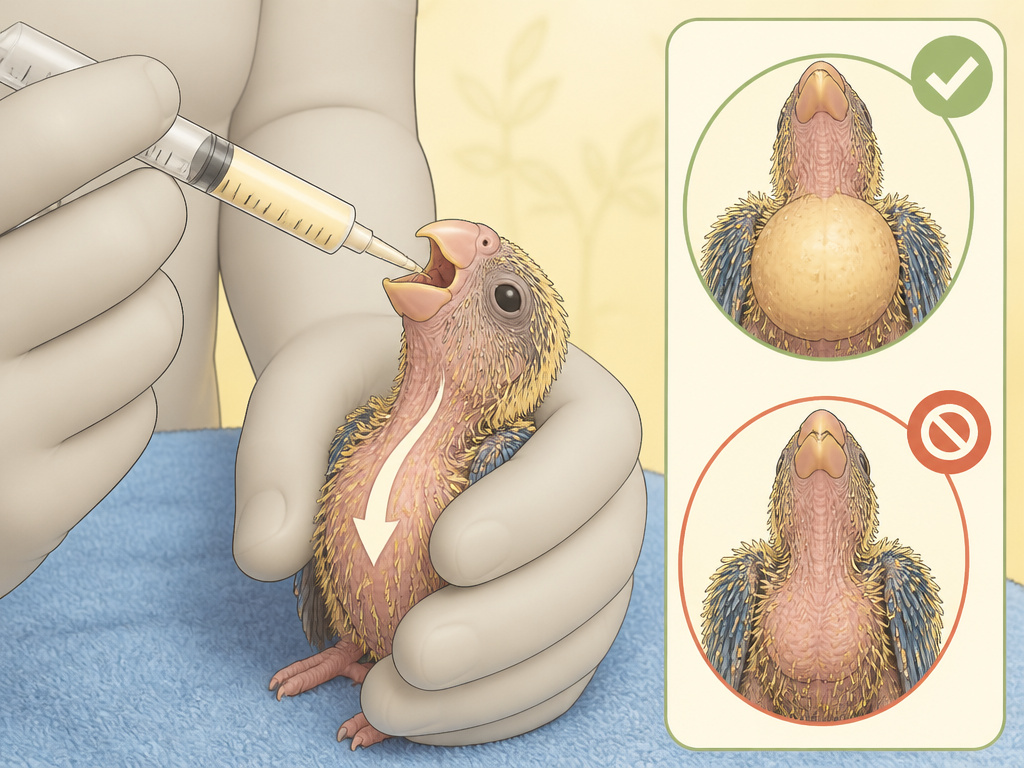
A chick that wants food bobs its head before the syringe is anywhere near the beak. That bob is the green light. During it, the trachea closes and formula can go in quickly and safely. Without it, the airway is open and aspiration is a real risk.
Unusual Pet Vets is direct: don’t feed a chick that isn’t showing a feeding response, because the food can be inhaled. VetZone goes further and names the outcome: aspiration into the trachea and lungs, which can kill the bird.
Stop at a nicely rounded crop or when the chick refuses more, whichever comes first. Kaytee warns that overfeeding causes regurgitation. If a chick regurgitates, stop, clean the food off, and don’t handle it.
Syringes are the preferred tool because they let you record exact volumes. A bent spoon works for some people, but you lose the measurement. Feeding tubes are the one place the sources openly fight.
Skip this if: You were about to use a feeding tube to save time. VCA warns tubes damage the crop or slip off the syringe and need surgical removal, and Unusual Pet Vets says crop needles shouldn’t be used at all. Kaytee lists a tube as acceptable, but the vets don’t.
If the chick isn’t bobbing, put the syringe down. A quiet bird is a closed airway, and a closed airway is how formula reaches the lungs.
Brooder Temperature, Humidity, and Footing
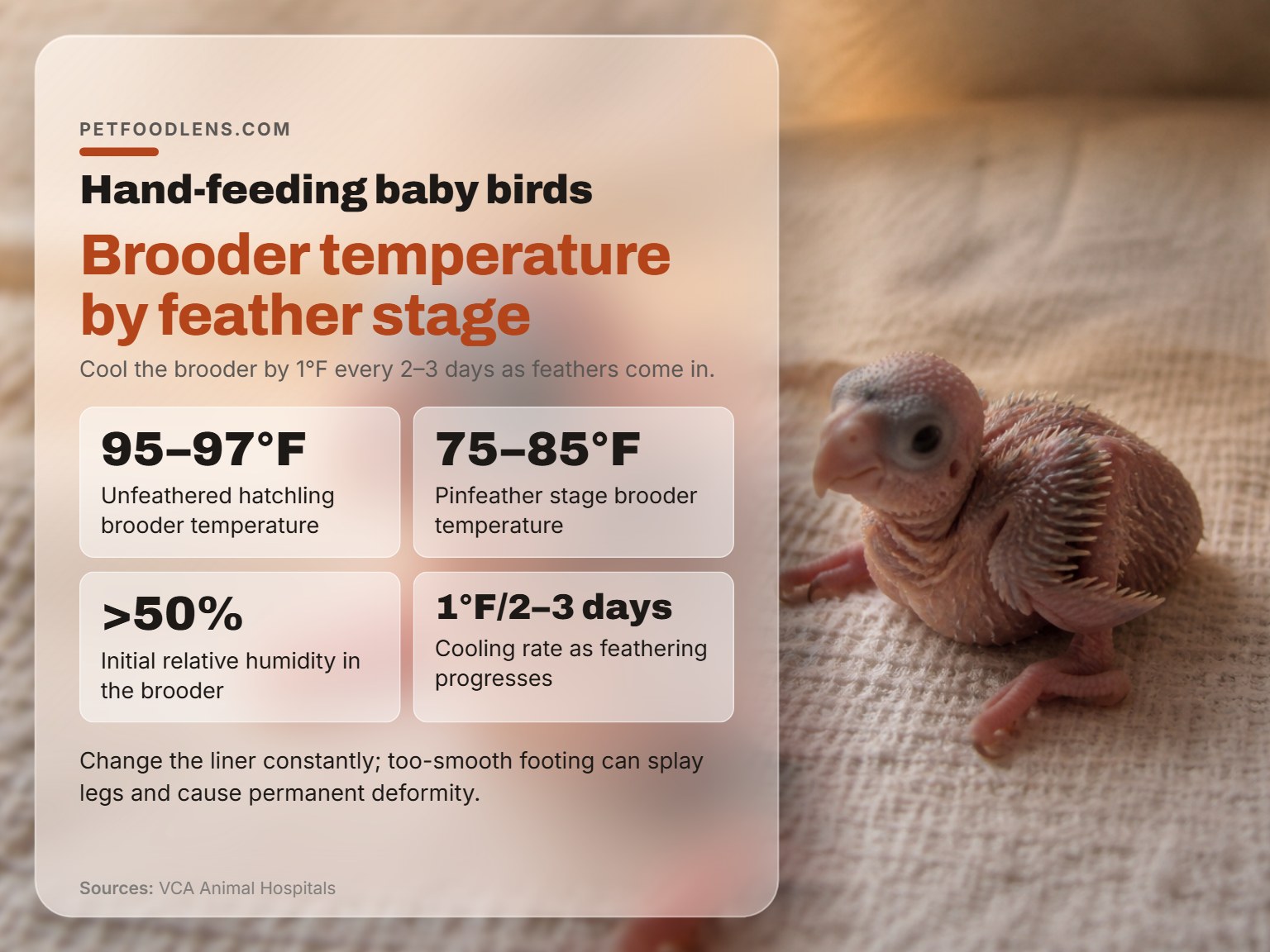
A brooder that feels warm to your hand can still be too cool for an unfeathered chick. VCA’s hand-feeding guide puts the unfeathered brooder at 95-97°F (35-36°C) and the pinfeather stage at 75-85°F (24-30°C). Relative humidity starts above 50%.
Setting the Brooder Temperature
The target drops as feathers come in. VCA’s rule is to cool the brooder by 1°F every 2-3 days.
Choosing the Right Footing
Footing matters more than most guides admit. VetZone’s hand-feeding guidelines warn that a bottom liner that’s too smooth lets the legs splay, which can cause permanent deformity. Change the liner constantly and check that nothing can catch a wing or leg.
I’d rather see a brooder checked with a thermometer twice a day than a chick kept “warm enough” by feel. The target moves every few days, and your hand doesn’t recalibrate.
Crop Emptying and Slow-Down
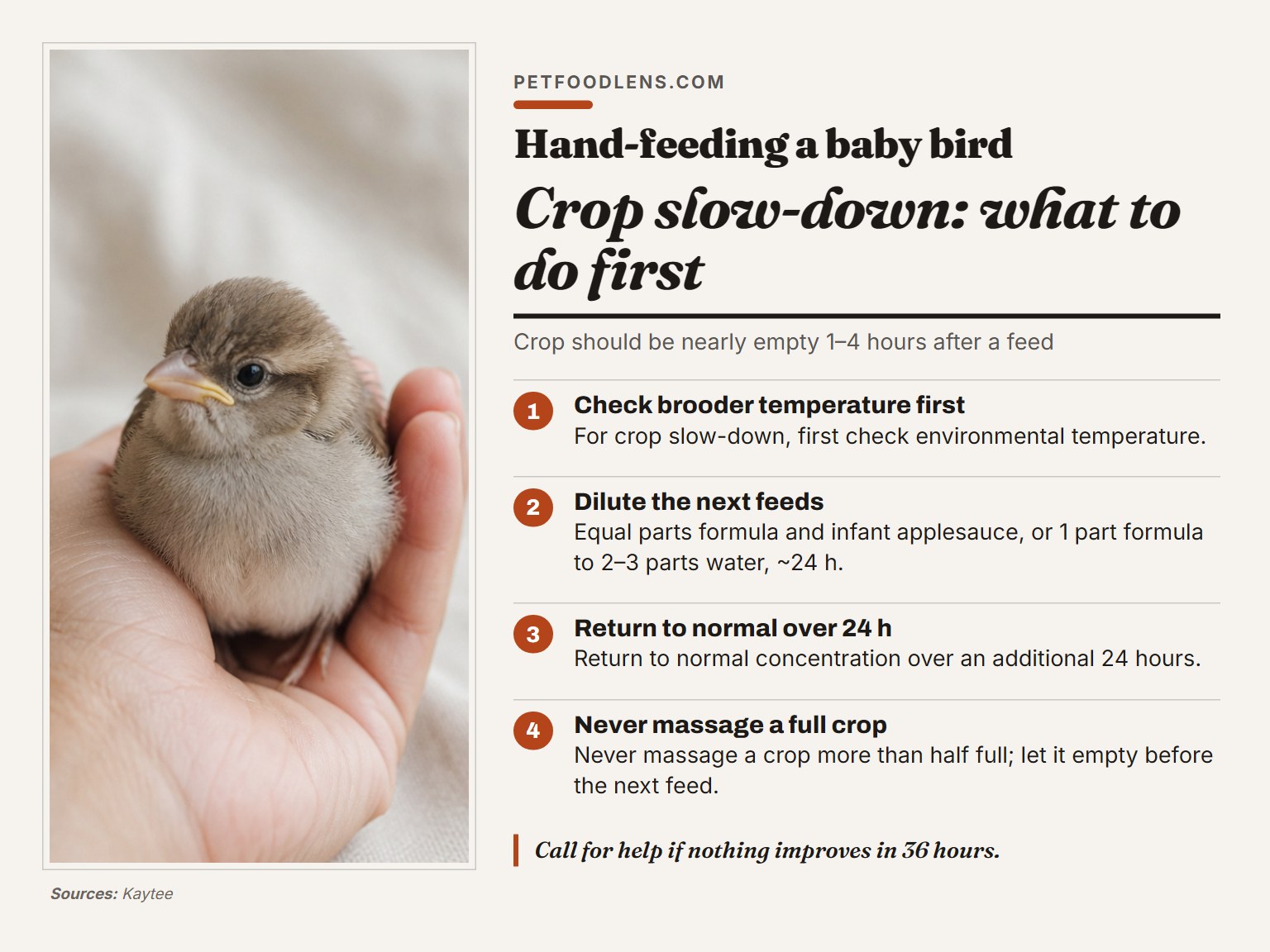
One to four hours after a feed, the crop should be steadily draining and nearly empty, depending on species and amount fed. Unusual Pet Vets says the crop should steadily drain and be nearly empty 1-4 hours after a feed, depending on species and amount fed.
If emptying time suddenly increases, evaluate it immediately. Kaytee’s slow-down protocol runs in this order:
- Check the brooder temperature first. A cold chick slows its crop, and this is a frequent cause.
- Dilute the next feeds. Mix equal parts formula and infant applesauce, or one part formula to two or three parts water, for about 24 hours.
- Return to normal concentration over another 24 hours.
- Never massage a crop that’s more than half full. Let it empty before the next feed.
- Call for help if nothing improves in 36 hours.
If the crop still has food in it when you see them, evaluate emptying rate right away.
The part nobody mentions: Check the brooder before you change the formula.
Weighing and Weaning
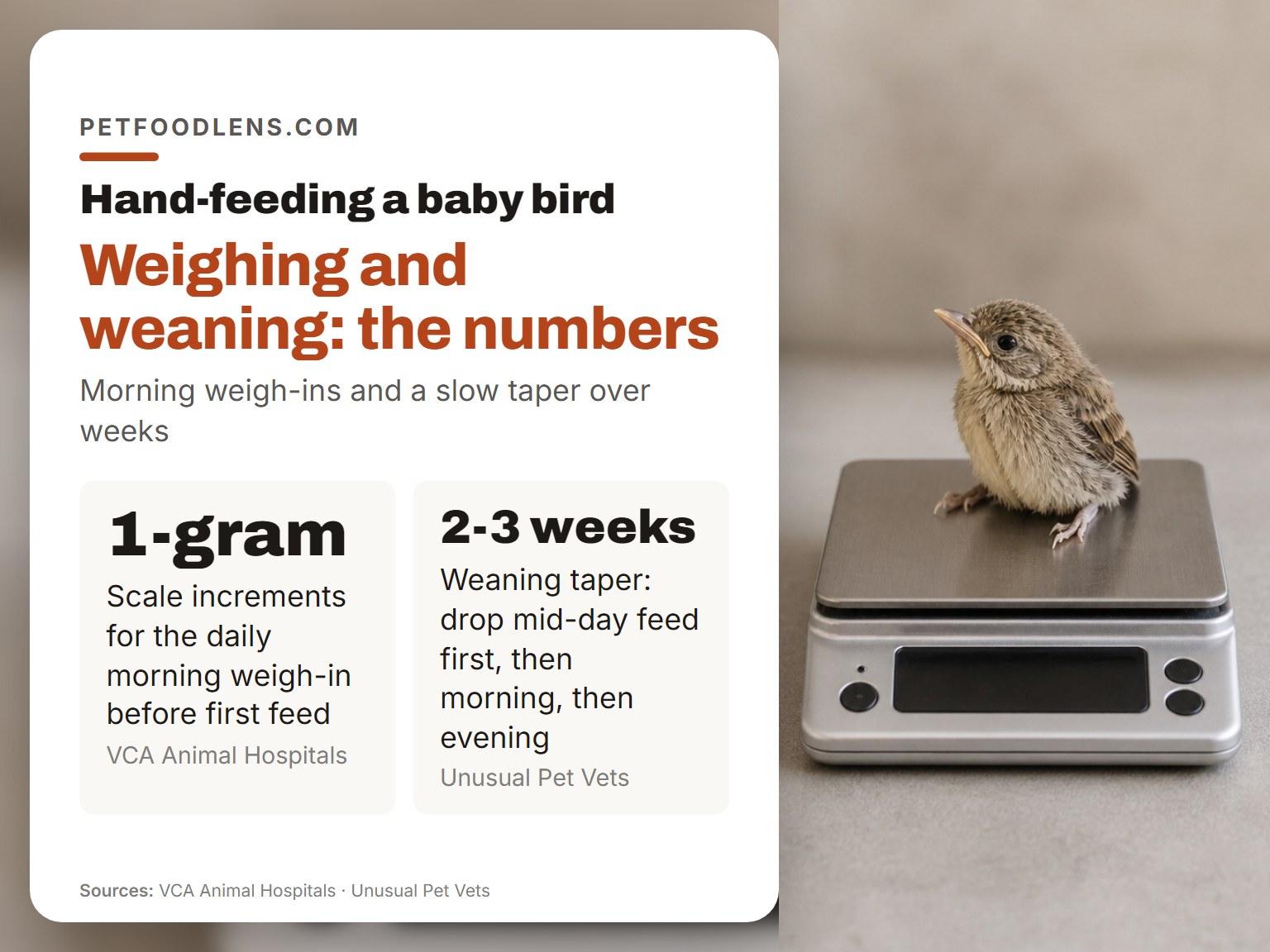
Weigh the chick every morning before the first feed, because monitoring weight gain and loss is the best way to spot a problem early. Use a gram scale in 1-gram increments, at the same time daily, before the first feed. Kaytee calls weight monitoring the best way to spot a problem early.
The Morning Weigh-In
If the number stalls, check your mixing ratio before you change products.
The Weaning Taper
Weaning is a taper that runs over weeks. Unusual Pet Vets reduces formula feeds over 2-3 weeks, removing the mid-day feed first, then the morning, then the evening. Some birds take much longer, and that’s normal.
Weight loss during weaning is where the sources split again. Kaytee allows up to 10% body weight loss during weaning. Unusual Pet Vets calls 5% loss in the week after weaning acceptable. Kaytee allows up to 10% body weight loss during weaning, while Unusual Pet Vets calls 5% loss in the week after weaning acceptable.
Wean by dropping the mid-day feed first. It’s the easiest one to lose, and it’s the one the chick misses least.
Hygiene and When to Call a Vet
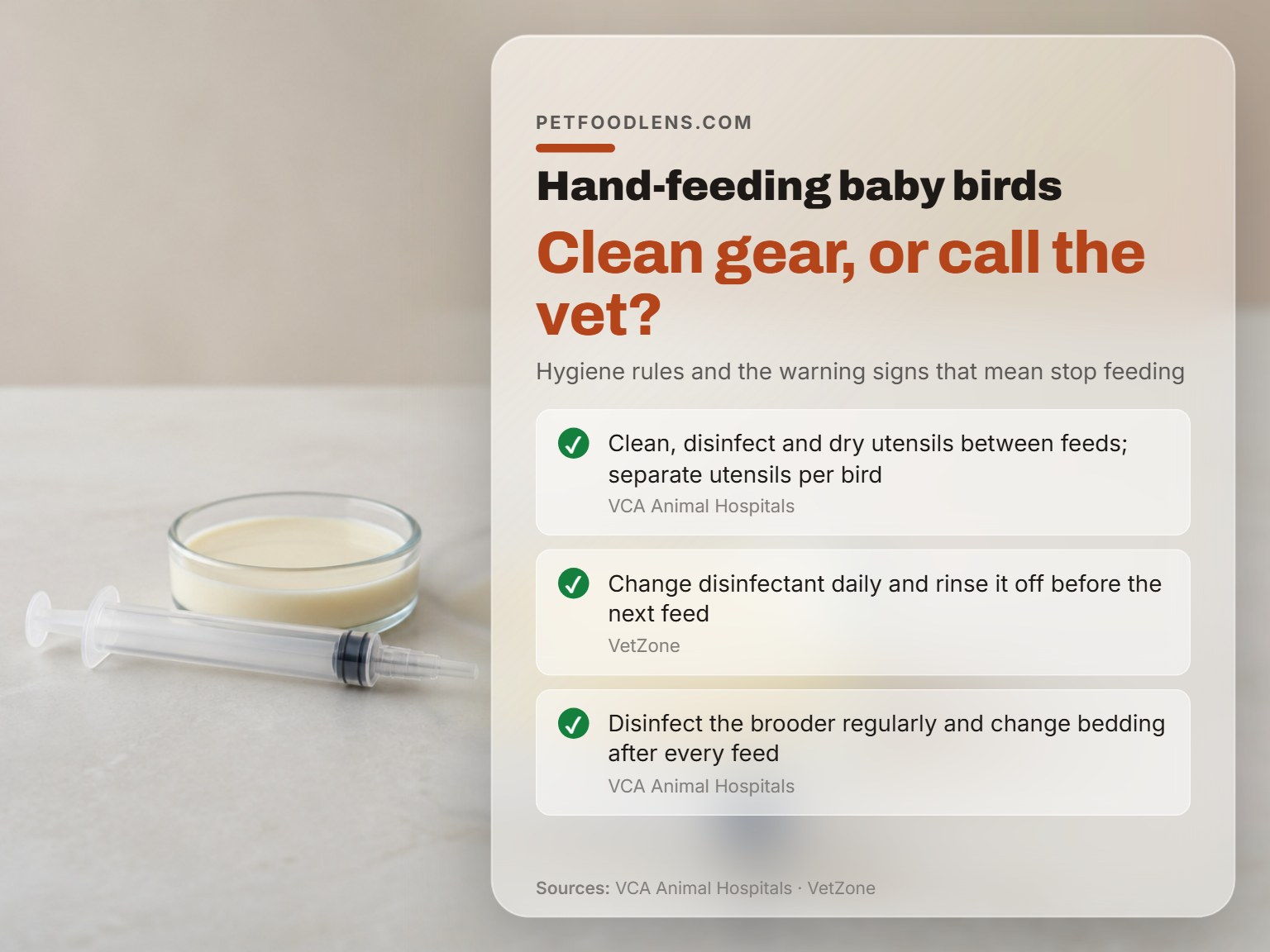
Clean equipment is not optional with chicks, because their immune systems are barely developed. VCA says all utensils must be cleaned, disinfected, and dried between feeds, with separate utensils per bird. VetZone adds that the disinfectant should be changed daily and rinsed off before the next feed.
The brooder gets disinfected regularly too, and bedding changes after every feed. Kaytee’s guide is specific: clean spilled food off the chick and change bedding each time.
Some signs mean stop and call an avian vet. Unusual Pet Vets lists the triggers:
- Vomiting or regurgitation
- Diarrhea
- Delayed crop emptying or a persistently enlarged crop
- Poor or absent feeding response
- Weight loss or failure to gain
- Abnormal leg, wing, or posture development
If the chick won’t bob at all, read up on feeding a weak bird before you attempt another feed. A chick that’s genuinely ill needs a vet, not a different syringe.
One more rule that isn’t about husbandry: wildlife should only be hand-reared by experienced, licensed wildlife carers. A found songbird is a call to a rehabber, not a project.
Frequently Asked Questions
Can you hand-feed a baby bird without a thermometer?
No. Unusual Pet Vets says wrist-gauging is inaccurate and should be avoided. A digital thermometer reads the mixed formula, and the safe range is 102-106°F (39-41°C). A wrist cannot reliably gauge formula temperature, and formula that is too hot can cause crop burns.
How do you know when to stop feeding?
Stop when the crop is nicely rounded or the chick refuses more food, whichever comes first. Kaytee warns that overfeeding causes regurgitation. If the chick regurgitates, stop, clean it off, and don’t handle it.
Can you feed a baby bird with a syringe?
Yes. Syringes are the preferred tool because they let you record exact volumes. A bent spoon works for some people, but you lose the measurement. Avoid feeding tubes, which VCA and Unusual Pet Vets both warn against.
What if the crop isn’t emptying?
Check the brooder temperature first, because a cold chick slows its crop. Then dilute the next feeds for about 24 hours, and return to normal concentration over another 24 hours. If nothing improves in 36 hours, call an avian vet.
How often should you feed a newly hatched bird?
Six to ten times a day, every 2-3 hours, in the first week. No feeds are needed between 10 p.m. And 6 a.m. The frequency drops as the chick grows and its crop holds more.
The Bottom Line
The single habit that prevents most hand-feeding disasters is the morning weigh-in. If a chick is losing weight, stop adjusting formula and call an avian vet.
Everything else here assumes a chick that’s gaining. A chick that isn’t gaining is a different problem, and no mixing ratio fixes it.
The temperature rule is the one to get right on day one. Warm to 102-106°F, measure it, and don’t feed a chick that isn’t bobbing. The rest is repetition and a scale.
