
How to Feed Dried Mealworms to Birds: Step-by-Step
This post contains affiliate links. As an Amazon Associate, we earn from qualifying purchases.
To feed dried mealworms to birds, offer them in a hanging feeder or a rimmed dish, put out about 100 a day once birds find them (NABS puts a nesting pair at a hundred or so worms morning and evening, near 200 a day), and clear anything uneaten by dusk. Dried worms are a supplemental food, not a complete diet, and they only help where birds already visit your yard.
Those two figures, the daily count and the dusk deadline, are where most of the practical argument sits. The North American Bluebird Society puts a nesting pair’s intake near double what Birds & Blooms reports for an established feeder, and that gap changes how much you buy and how often you refill. It also shapes how to feed dried mealworms to birds.
What follows walks the label math first, then the feeder choice, the daily routine, the soak question, and the storage rules. By the end you’ll know which of the four published positions on ground feeding you can actually live with.
Key Takeaways
- 1.5 inches (about 38 mm) is the entry-hole size the North American Bluebird Society says excludes larger birds from a mealworm hopper.
- A hundred worms morning and evening is NABS’s figure for a pair with a box of nestlings, while Birds & Blooms puts an established feeder at about 100 a day.
- Clear leftovers by dusk if you scatter on the ground: RSPB allows ground scattering but flags hedgehog risk from worms left overnight, while NABS calls ground scattering the least advised method and Birds & Blooms prefers a platform feeder or rimmed dish.
- Soak dried worms 10 to 15 minutes in warm water for nestlings; RSPB says keep soaked worms out of the feeder during spring and summer, while Aspen Song gives the same soak time with no feeder restriction and Kaytee promotes feeder use with no rehydration guidance.
- Mealworms won’t pull in bluebirds that aren’t already nearby, according to NABS, and the local birds usually eat the offering first; Birds & Blooms instead frames mealworms as a way to entice new species and offers tips to improve the odds.
What the Guaranteed Analysis on a Bag of Dried Mealworms Actually Tells You
Aspen Song Premium Dried Mealworms prints a guaranteed analysis of protein (min) 12.3%, fat (min) 15.7%, and fiber (max) 17.5%. The front of that same bag calls the contents “a perfect source of protein.”
Dried mealworms are the larval stage of the darkling beetle, Tenebrio molitor, harvested and dried rather than kept alive. Freeze-drying and oven-drying strip the moisture that makes live larvae perishable, which extends shelf life and removes the water a bird would otherwise get from the worm. Both manufacturers describe their drying process as preserving nutritional value.
Read past the front of the bag. A 12.3% minimum protein figure is a floor, not an average, and it sits a long way from the word “perfect.” RSPB calls dried mealworms “an excellent source of protein” without printing a number. Kaytee does the same.
That’s the whole problem with comparing these products from the front panel. One manufacturer publishes a figure you can check. The other two publish an adjective. No source in this set gives a protein figure for live mealworms, so the dried-versus-live comparison stays qualitative no matter how carefully you read it.
The NYSBS mealworm fact sheet is the most technical document in this set, and it carries a revision date of 10/20/06. It’s still the document other guides quote for feeder dimensions and daily quantities. Treat it as the reference, and treat its age as a caveat rather than a disqualifier.
Dried larvae rattle in the bag like coarse gravel and smell faintly of dry grain and dust. That’s the moisture that’s missing, and it explains why the storage rules for dried worms look nothing like the rules for a live culture.
My own background is reading guaranteed analyses on pet food, not counting bluebirds, so I lean on the society guidance for the bird-side specifics. The label math, though, is the same math.
Do Dried Mealworms Work as Well as Live Ones?
The two manufacturers say yes. Birds & Blooms says dried worms may not catch a bird’s eye the way a wriggling larva does, and suggests soaking them or running live worms briefly to train birds onto the feeder.
| Factor | Dried mealworms | Live mealworms |
|---|---|---|
| Moisture | Removed during drying, per RSPB | Present |
| Bird appeal | Birds & Blooms: may not catch a bird’s eye | Birds & Blooms: most appealing |
| Storage | Aspen Song: no refrigeration needed | NABS: refrigerate to slow growth |
| Nestling use | RSPB: soak first, keep out of feeder | Ready as offered |
Kaytee states plainly that dried mealworms “have the nutritional value of live mealworms.” RSPB says they carry “all the goodness of live mealworms” minus the moisture. Birds & Blooms lands somewhere else, reporting that dried worms may not be as effective at catching birds’ attention.
The practical difference is largely convenience. Kaytee says dried mealworms have the nutritional value of live ones and RSPB says all the goodness minus the moisture, while Birds & Blooms says dried worms may not be as effective at catching birds’ eyes. Dried worms survive a freezer, a cupboard, and a fortnight of neglect; live ones need a shallow container with airflow and a vegetable scrap about once a week.
If you’re feeding through the cold months and don’t want a live colony on the counter, Aspen Song Premium Dried Mealworms is the bag I’d point at first, because it’s the only product here that publishes a guaranteed analysis you can actually check. For the fuller comparison, live vs dried mealworms covers the trade-offs in more depth.
Why the Ground-Scattering Advice Depends on Who You Ask
Two of the four sources here allow scattering dried mealworms on the ground, while NABS calls ground scattering the least advised method because other birds take the offering first, and Birds & Blooms prefers a platform feeder or rimmed dish to keep worms contained.
| Source | What they recommend | Stated reason |
|---|---|---|
| North American Bluebird Society | Hopper with 1.5-inch holes; avoid ground | Other birds take the offering first |
| RSPB | Hanging feeder or ground; clear by dusk | Convenience, plus hedgehog risk |
| Aspen Song | Hand, dish, or ground scatter | Encourages natural foraging |
| Birds & Blooms | Platform feeder or rimmed dish | Keeps worms contained |
The disagreement isn’t about bird safety. It’s about who gets the worms. NABS points out that if bluebirds aren’t already in the yard, other birds will find the offering and clear it before a bluebird ever shows up. Birds & Blooms makes the containment argument: a rimmed dish stops worms crawling off and keeps them out of damp soil.
RSPB allows either method but attaches a deadline: it asks that worms all be eaten or cleared away by dusk the same day, especially if scattered, to prevent hedgehogs consuming leftovers, while NABS calls ground scattering least advised and Birds & Blooms prefers contained feeding.
I’d take the containment argument over the convenience argument every time. A rimmed dish on a pole keeps the worms where you can see them, keeps them out of wet grass, and turns the dusk cleanup into a ten-second job instead of a rake job.
Where this goes sideways: Scattering on lawn instead of a hard surface. Worms sink into damp grass, birds miss them, and the leftovers you can’t see are exactly the ones RSPB is warning about.
The 1.5-Inch Entry Hole That Sets the Bird List
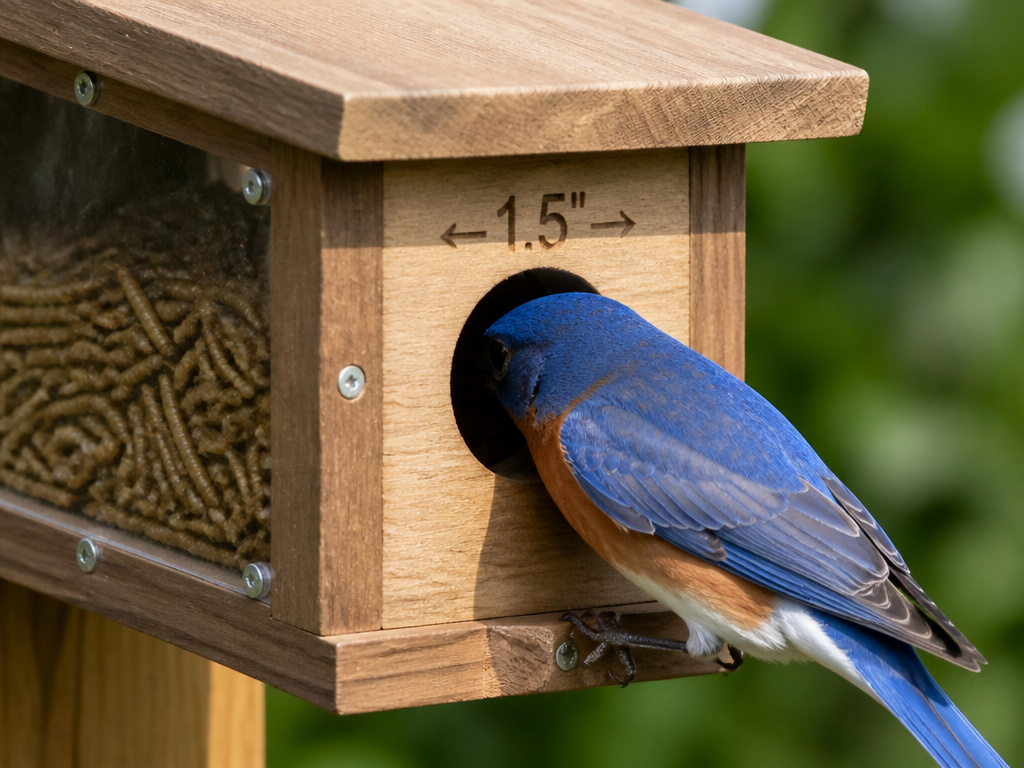
One and a half inches is the number that decides which birds get fed. NABS specifies an entry hole of 1.5 inches (about 38 mm) at each end of a mealworm hopper, which it says will effectively exclude larger birds.
That single dimension does more work than any marketing claim on a feeder box. Get it right and the small birds you wanted get a clear run at the food.
Hopper, Platform, or Rimmed Dish?
- Hopper with 1.5-inch holes: NABS’s specification. Excludes larger birds and keeps worms dry, but holds less than an open platform.
- Platform feeder: Easy landing for bluebirds and wrens, though rain soaks dried worms fast and they clump.
- Rimmed dish: The cheapest option and Birds & Blooms’ pick for containment. Works on a pole, a railing, or a windowsill bracket.
- Hanging mealworm feeder: RSPB’s first suggestion, and the tidiest choice for a small yard with cats around.
If you want the shortlist rather than the theory, mealworm feeders for bluebirds covers specific models and mounting options.
Where to Hang It
Birds & Blooms places feeders near vegetation and away from windows. Vegetation gives birds a staging point to check the feeder before committing, and glass is the single biggest killer of backyard birds.
Height matters less than cover. A feeder near vegetation and away from windows, as Birds & Blooms advises, gives birds a staging point to check the feeder before committing.
The Feeding Routine, Step by Step
Six steps, in this order.
Before you start: Leftover mealworms left out overnight draw hedgehogs in the UK, and RSPB asks that they be eaten or cleared by dusk. Kaytee tells you to discard old food before every refill and clean feeders regularly to minimize mold and bacteria. Kaytee says to discard old food before refilling and clean feeders regularly to minimize mold and bacteria.
- Confirm birds already use the yard. If you’ve never seen a bluebird nearby, NABS says the worms won’t change that, and the local birds will eat the offering instead.
- Set the feeder up before you buy food. A hopper with 1.5-inch holes, a platform, or a rimmed dish. Skip this and you’ll be scattering on the ground by default, which is the method NABS advises against.
- Offer a small amount at the same time each day. NABS suggests once or twice daily unless the weather is poor. Irregular timing means birds never learn the schedule.
- Keep the offering dry. Damp worms clump, and Kaytee says to discard old food before refilling and clean feeders regularly to minimize mold and bacteria.
- Clear or refrigerate leftovers by dusk. RSPB asks that worms be eaten or cleared away by dusk the same day to prevent hedgehogs consuming leftovers, while Aspen Song states no refrigeration is necessary for its dried product; clearing also doubles as a mold control measure.
- Wash the feeder regularly. Kaytee’s instruction to discard old food before refilling and clean feeders regularly is the minimum. Here’s how to clean a bird feeder without leaving soap residue behind.
How Many Worms Per Day, and Why the Numbers Don’t Match
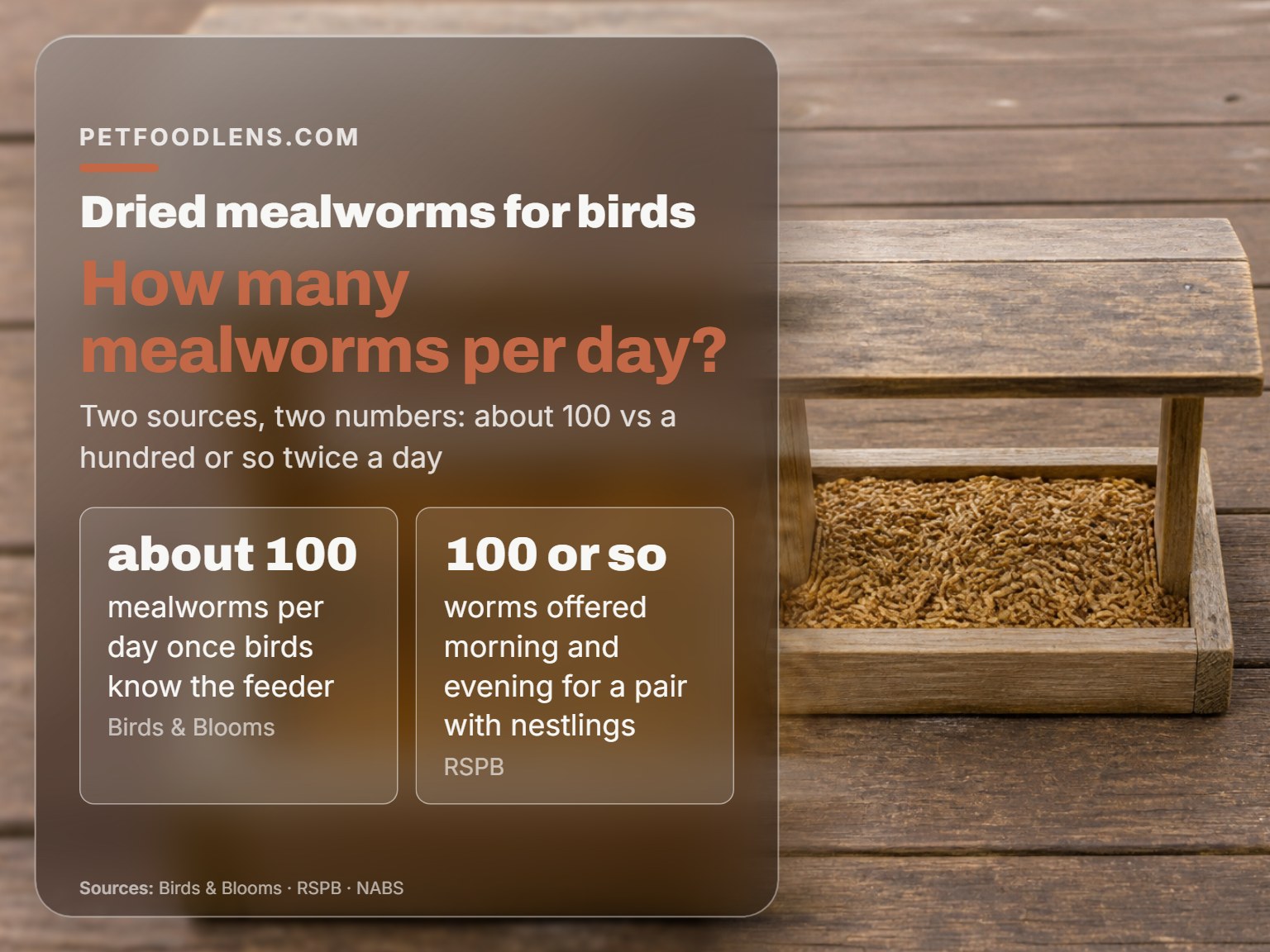
NABS puts a hundred or so worms offered morning and evening as adequate for a pair with a box of nestlings. That works out near 200 a day. Birds & Blooms reports about 100 mealworms per day once birds know where to find them.
The gap is roughly double, and both figures are defensible when you compare a how to feed dried mealworms to birds. NABS is describing a breeding pair feeding young, while Birds & Blooms is describing an established feeder once birds know where to find them. Start near Birds & Blooms’ about 100 a day and watch what’s left at dusk, because the only number that matters is the one your birds actually clear.
If you’re feeding through spring and fall as well, feeding birds during migration covers seasonal feeding considerations.
Soaking Dried Mealworms: Right for Nestlings, Wrong in the Feeder
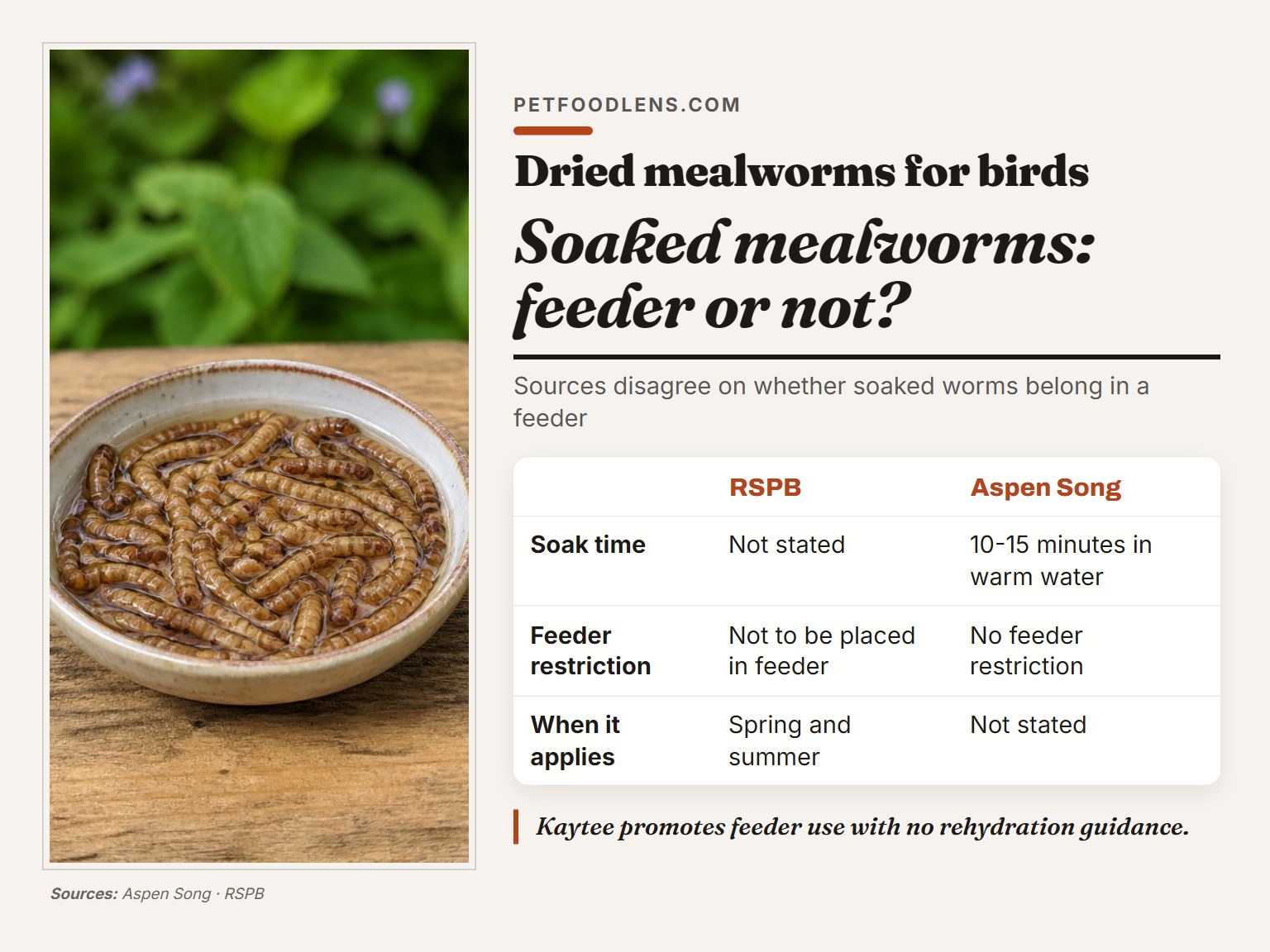
Warm water turns a brittle dried worm into something a nestling can actually swallow, which is the how to feed dried mealworms to birds question in brief. RSPB says dried mealworms can be soaked in water during spring and summer to make them easier for nestlings to eat, and adds a restriction the manufacturers don’t: soaked worms should not be placed in a feeder.
Aspen Song recommends soaking in warm water for 10 to 15 minutes with no feeder restriction. Kaytee promotes feeder use with no rehydration guidance at all. Birds & Blooms suggests soaking dried worms in lukewarm water before putting them out to make them more appealing.
Soak for nestlings, serve dry for adults, and note that RSPB says keep soaked worms out of the feeder during spring and summer, while Aspen Song gives a 10-15 minute soak with no feeder restriction and Kaytee promotes feeder use with no rehydration guidance. Dry worms keep well; wet ones are what Kaytee’s mold warning is written for.
The Nestling Soak and the Feeder Restriction
RSPB’s restriction is one position during breeding season: it says soaked worms should not be placed in a feeder, while Aspen Song gives a 10-15 minute soak with no feeder restriction and Kaytee promotes feeder use with no rehydration guidance. Soaked worms in a hopper sit in a warm, enclosed space and go off quickly, so a rimmed dish with small amounts swapped out rather than topped up is the cautious choice.
Birds & Blooms recommends soaking dried worms in lukewarm water before putting them out to make them more appealing to birds that are ignoring them.
Storage, Mold, and the Frass Rule
Most dried mealworm failures happen in the bag, not at the feeder. Aspen Song states no refrigeration is necessary for its freeze-dried product, and describes a long shelf life as one of the format’s advantages.
The refrigeration line you’ll see quoted everywhere comes from the NABS fact sheet, and it describes a live colony. Mealworm metabolism can be slowed by keeping them in the refrigerator for a few weeks up to several months, with the vegetable matter removed first. That guidance applies to living larvae, not a sealed bag of dried ones.
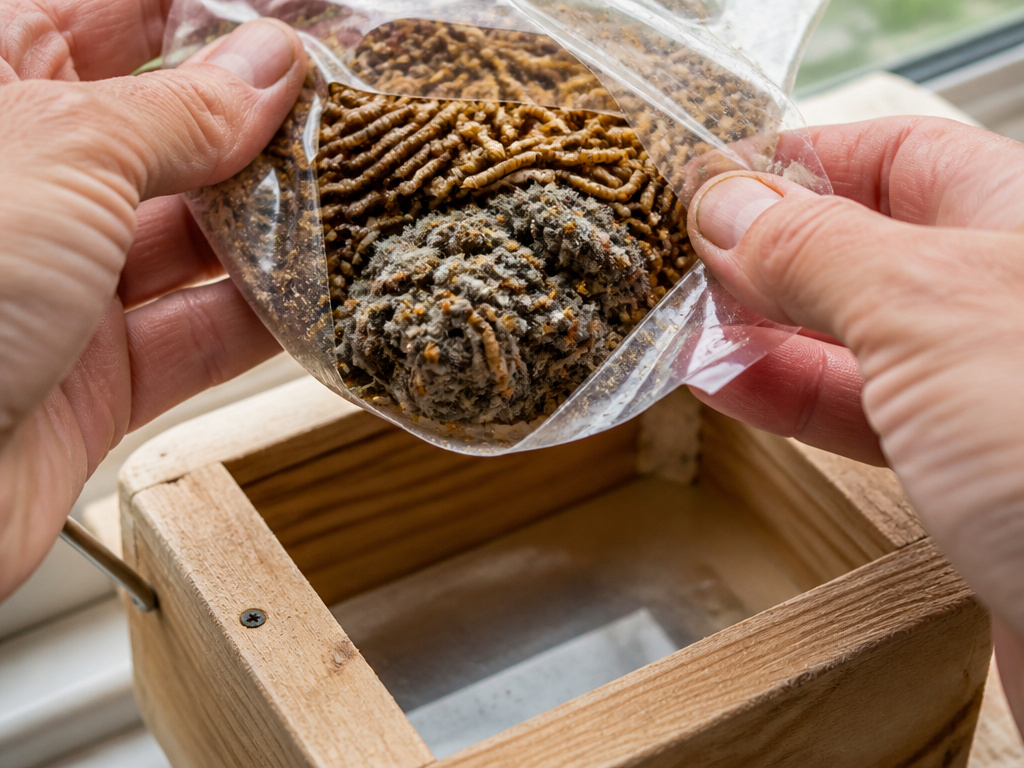
A live culture going off smells of ammonia before you see anything wrong. NABS says to sift the grain, wash the container, and add new grain once frass builds up and that faint ammonia odor appears. Good bird treat storage is mostly about keeping moisture out and checking the bag before you refill.
What most people get wrong: Topping up a feeder without emptying it. Old worms sit under new ones, absorb humidity, and the mold starts at the bottom where you never look. Empty, check, then refill.
Kaytee’s instruction is the one to tape to the feeder: discard old food before refilling and clean feeders regularly to minimise mold and bacteria. If you’re already seeing clumping or a grey bloom on the worms, moldy bird food walks through what to throw out and what to keep.
What Mealworms Won’t Do for Your Yard
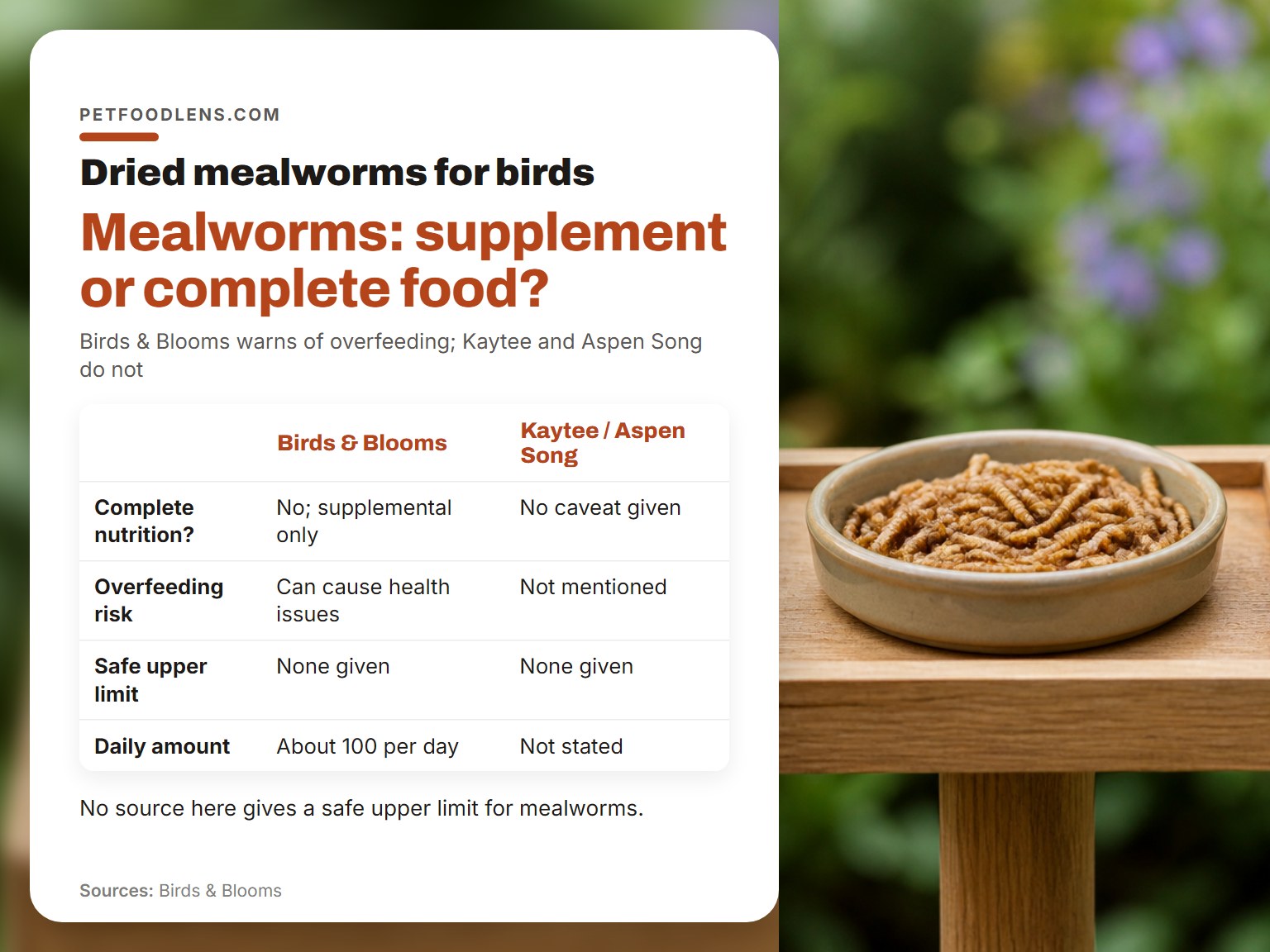
The bag copy promises a lot. Birds & Blooms says mealworms are a supplemental food that don’t replace a balanced diet and that overfeeding can cause health issues, while Kaytee and Aspen Song describe them as an excellent or high-energy food without that caveat; NABS adds that they won’t manufacture bluebirds where there aren’t any.
NABS is direct about the last point. If you’ve never or rarely seen a bluebird in your yard, chances are they won’t show up just because you’ve put out mealworms, and other birds will consume the offering first. Birds & Blooms frames mealworms as a way to entice new species and offers tips to improve the odds. That’s a genuine disagreement between a specialist society and a consumer magazine, and I’d weight the society’s warning more heavily.
On nutrition, Birds & Blooms states that mealworms don’t provide complete nutrition, should be used as a supplemental food source on a limited basis, and that overfeeding can cause health issues for adults and young. Kaytee and Aspen Song both describe mealworms as an excellent or high-energy food without that caveat.
The Supplemental-Food Rule
Birds & Blooms treats dried mealworms as a supplemental food source on a limited basis, a small regular portion alongside the food the animal actually needs, while Kaytee and Aspen Song describe them as an excellent or high-energy food without that caveat. No source here gives a safe upper limit for mealworms, so the practical ceiling is what the birds clear in a day.
That’s also why insect-based bird food is worth reading alongside this, since a mixed offering covers more of the diet than mealworms alone. And if you’re feeding year-round, feeding birds in winter covers the higher-fat foods that carry birds through cold snaps.
Frequently Asked Questions
Should dried mealworms be soaked before feeding?
Soaking is optional for adult birds and recommended for nestlings. RSPB suggests soaking dried worms in water during spring and summer to make them easier for nestlings to eat, and Aspen Song gives a soak time of 10 to 15 minutes in warm water. Birds & Blooms suggests lukewarm water as a way to make dried worms more appealing to birds ignoring them.
How many dried mealworms should I put out each day?
NABS describes a hundred or so worms offered morning and evening as adequate for a pair with a box of nestlings, which is close to 200 a day. Birds & Blooms reports about 100 mealworms per day once birds know where to find them. Start near Birds & Blooms’ about 100 a day and adjust to what actually gets eaten.
Will dried mealworms attract bluebirds to my yard?
Not on their own, according to NABS. The society warns that if you’ve never or rarely seen a bluebird, they probably won’t appear just because mealworms are out, and other birds will take the offering first. Birds & Blooms takes a more optimistic line and offers tips for enticing new species.
Do I need to refrigerate dried mealworms?
Aspen Song states no refrigeration is necessary for its dried product. The refrigeration advice in the NABS fact sheet describes slowing the metabolism of live larvae for a few weeks up to several months, which is a different situation entirely. Keep dried worms sealed, dry, and out of direct sun.
What should I do with mealworms the birds don’t eat?
Clear them by dusk, especially if they were scattered on the ground. RSPB asks that mealworms be eaten or cleared away the same day to prevent hedgehogs consuming leftovers. In a feeder, discard old food before refilling rather than topping it up.
The Bottom Line
Here’s the trigger I’d use: if you can’t name a bird that already visits your yard, don’t buy the bag yet. NABS is clear that mealworms don’t conjure bluebirds out of a neighbourhood that doesn’t have them, and the birds that do show up will clear your offering before a bluebird ever finds it.
The ground-scattering argument doesn’t have a clean winner. RSPB and Aspen Song both allow it, while NABS and Birds & Blooms both push you toward a container. If you’re in hedgehog country, RSPB’s dusk rule settles it for you regardless of which camp you’re in.
Start with a rimmed dish, about a hundred worms, and a check at dusk. That combination follows Birds & Blooms on containment and quantity, but NABS puts a nesting pair at a hundred or so worms morning and evening (near 200 a day), and RSPB and Aspen Song both allow ground scattering, so no single routine satisfies every source.
