
How to Place a Bird Feeder: The 18-Inch Rule
This post contains affiliate links. As an Amazon Associate, we earn from qualifying purchases.
To place a bird feeder, hang it with at least 18 inches of clearance on all sides, high enough that a squirrel has to climb onto it rather than reach across from something else, and far enough from branches, fences, and rails that nothing can jump to it. Clearance decides whether a squirrel-proof feeder works.
That 18-inch figure shows up in two manufacturer manuals for the same reason. The perch on a weight-triggered feeder only closes the ports when a squirrel’s full weight lands on it, so a squirrel that keeps one paw on a fence rail never trips the mechanism. This is why how to place a bird feeder matters as much as the feeder’s design.
Four numbers do most of the placement work: side clearance, pole height, distance from the nearest launch point, and baffle height. The sources below don’t agree on all four. Where they disagree, I’ve said so and named who holds which position.
Key Takeaways
- 18 inches of clearance on all sides is the one number both Brome and Perky-Pet publish, and it’s the number that decides whether a weight-triggered feeder functions.
- Pole height and launch-point distance are genuinely contested: Perky-Pet says 5 ft and 10 ft, King County says 4 ft and 8 ft, UNL Extension says 6 ft and 8 ft.
- Empty the feeder before dark if rats are a concern, as King County advises, and store bulk seed in metal, since rats chew through plastic.
- “Squirrel-proof” doesn’t mean pest-proof. Brome states plainly that its feeders aren’t built to stop raccoons, which drop and roll them.
- Hang 3 feet or closer, or 30 feet or further, from windows. The middle distance is the collision zone.
Why 18 Inches of Clearance Does Most of the Work
A Brome Squirrel Buster and a Perky-Pet Smart Camera Squirrel-Resistant Feeder ask for the same thing: at least 18 inches of clearance on all sides. Brome writes it as 18 inches or 47 cm. Perky-Pet writes it as 18 inches so squirrels can’t reach the ports without activating the perch.
A weight-activated feeder closes its seed ports when a squirrel’s full body weight settles on the perch. A squirrel that reaches over from a fence rail or branch keeps most of its weight on that foothold, so the perch never triggers and the ports stay open. Clearance removes the foothold.
The mechanism explains why the number matters more than the feeder’s price tag when you compare a how to place a bird feeder against a cheaper model. A squirrel has to put its whole body on the perch to trigger the close. Give it a foothold within reach and it leans across, keeps its weight on the fence, and eats with the ports wide open.
Here’s what counts as a foothold:
- A fence rail within jumping range of the ports
- A deck rail, house eave, or roof line above or beside the feeder
- A shepherd’s hook where the feeder hangs closer than 18 inches to the pole itself
- A branch, gutter, or downspout
I’d rather see a plain weight-triggered feeder hung correctly than a camera feeder bolted to a deck rail without enough clearance. The camera tells you which squirrel is winning.
If you’re already fighting this, the deeper fixes live in squirrel-proof a feeder, but placement is the first thing to check.
How High Should a Feeder Hang, and How Far From a Tree?
Three sources give three different answers, and each one is answering a slightly different question.
| Source | Pole or hanging height | Distance from nearest launch point |
|---|---|---|
| Perky-Pet | 5 ft free-standing pole | 10 ft from nearest tree; 6 ft from trunk or limbs if hung in a tree |
| King County Public Health | 4 ft off the ground | 8 ft out from branches, fences, or other jump-off objects |
| UNL Extension EC1783 | 6 ft or higher | 8 ft from branch, rail, or fence; pole 7 to 8 ft from launch points |
None of these is a typo. Perky-Pet is writing about squirrels and climbing predators, King County is writing about rats, and the extension publication on bird feeding is writing about jump distance from a standing start.
The practical read: pick the source that matches your problem, then stop second-guessing. If rats are the issue, King County’s 4 feet and 8 feet is the relevant pair. If squirrels are cleaning you out, the higher and wider numbers are the ones that matter.
What all three agree on is the shape of the answer. Height alone does nothing; height plus distance from anything a pest can stand on is the whole how to place a bird feeder trick.
That’s why a bird feeder pole placed in open lawn outperforms a bracket screwed to a fence post, even at the same feeder height.
Near Cover or Out in the Open? Where the Sources Genuinely Split
Brome tells you to hang close to a bush. Perky-Pet tells you to hang away from bushes. UNL Extension says keep feeders 6 feet from concealing plants. All are describing the same backyard.
Here is each position, in the source’s own terms:
- Brome Bird Care: place feeders close to cover, such as a tree, bush, or brush pile, so birds have somewhere to hide when a predator appears.
- Perky-Pet: hang the feeder away from trees, bushes, fences, or buildings, because squirrels and predators use them to climb or jump onto the feeder.
- UNL Extension EC1783: keep feeders 6 feet from concealing plants to prevent cat ambush.
Pick your predator first, then your placement. A hawk problem wants cover close by. A cat problem wants 6 feet of open ground around the feeder. A squirrel problem wants distance. One yard can have all three, and then you compromise.
The compromise most yards land on is this: keep the feeder 6 feet or more from dense low cover that hides a cat, but leave a mature tree or brush pile nearby so small birds have a retreat. That satisfies UNL’s ambush clearance and most of Brome’s cover argument at the same time.
It won’t satisfy Perky-Pet’s “away from trees” line. Nothing does, if you also want cover. That’s a real trade-off, not a rule you can optimize your way out of.
The Overnight Rule That Keeps Rats Out of Your Seed
King County Public Health says to leave no seed in feeders overnight because rats are most active then, while Brome suggests bringing feeders in at night to deter raccoons, opossums, deer, and bears. King County’s public health guidance is the most direct on this, and it’s the line that changes the most behavior.
The county’s position is that rats are most active overnight, so no bird seed should be left in feeders after dark. It also recommends filling with only the amount birds will finish in a day, and notes that rats are good climbers that frequently access feeders hanging in trees.
That last point is worth sitting with. Hanging a feeder in a tree does not put it out of reach. It puts it on a climbing route.
The King County bird feeders and rats document also covers storage: bulk seed goes in a metal container, because rats chew through plastic easily. And if there’s an active infestation, the seed has to come out entirely before trapping or poisoning will work.
Brome’s guidance overlaps but frames the night problem differently. Brome points at raccoons, opossums, deer, and bears, and suggests bringing feeders in at night if you find one on the ground in the morning. Same action, different animal.
Before you start: the cleaning mix is 1 part household bleach to 10 parts water, and it stays in the bucket. Wear gloves, keep the bucket where no pet can drink from it, and soak the feeder for 10 minutes rather than scrubbing it dry.
Seed that ends up on the ground
Filler seed is the quiet rat feeder. King County flags blends heavy in millet, milo, or sorghum, since birds scatter those and they land on the lawn. UNL Extension makes the same point about finch mixes containing millet and canary grass seed.
Buy seed the birds actually eat and there’s less on the ground. That’s the whole strategy.
Cleaning matters here too. King County names salmonellosis as the most common bird feeder disease, and recommends the 1:10 bleach soak for 10 minutes on a regular schedule. If you want the full routine, clean your bird feeder covers the timing.
Windows: The 3-Foot-or-30-Foot Rule
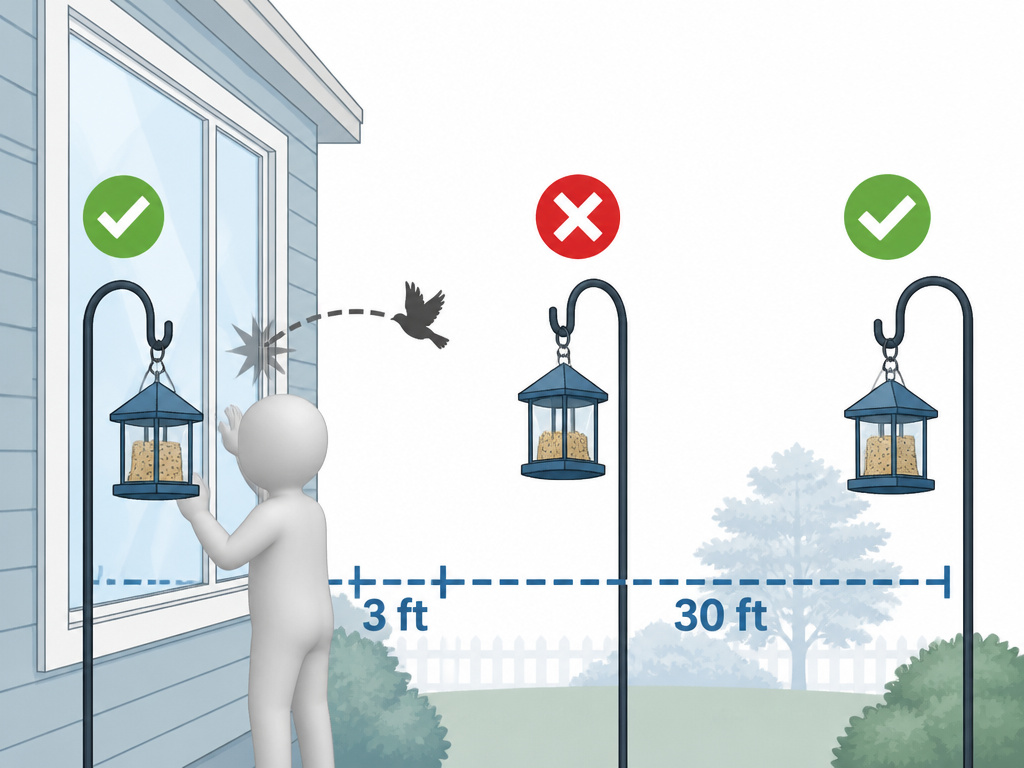
Three feet or thirty. Brome’s window guidance has a hole in the middle, and the hole is the part most people pick.
Brome’s placement page says to hang feeders 3 feet and closer, or 30 feet and further, from windows to avoid collisions. That’s a bimodal rule, and it cuts against the common instinct to hang a feeder right outside the glass for a close view.
The logic holds up. A bird leaving a feeder in the middle distance from a window has room to build speed and no room to turn. At 3 feet, it never gets going. At 30 feet, it has space to see the glass and adjust.
Where this goes sideways: hanging a feeder in the middle distance from a window because that’s where the bracket already is. That’s the band where birds commit to a flight path and can’t correct in time.
If you’re working from a balcony or a window mount, the geometry changes. Balcony bird feeding has its own set of constraints, and window-mounted feeders sit inside the 3-foot zone by default.
What “Squirrel-Proof” Covers, and What It Doesn’t
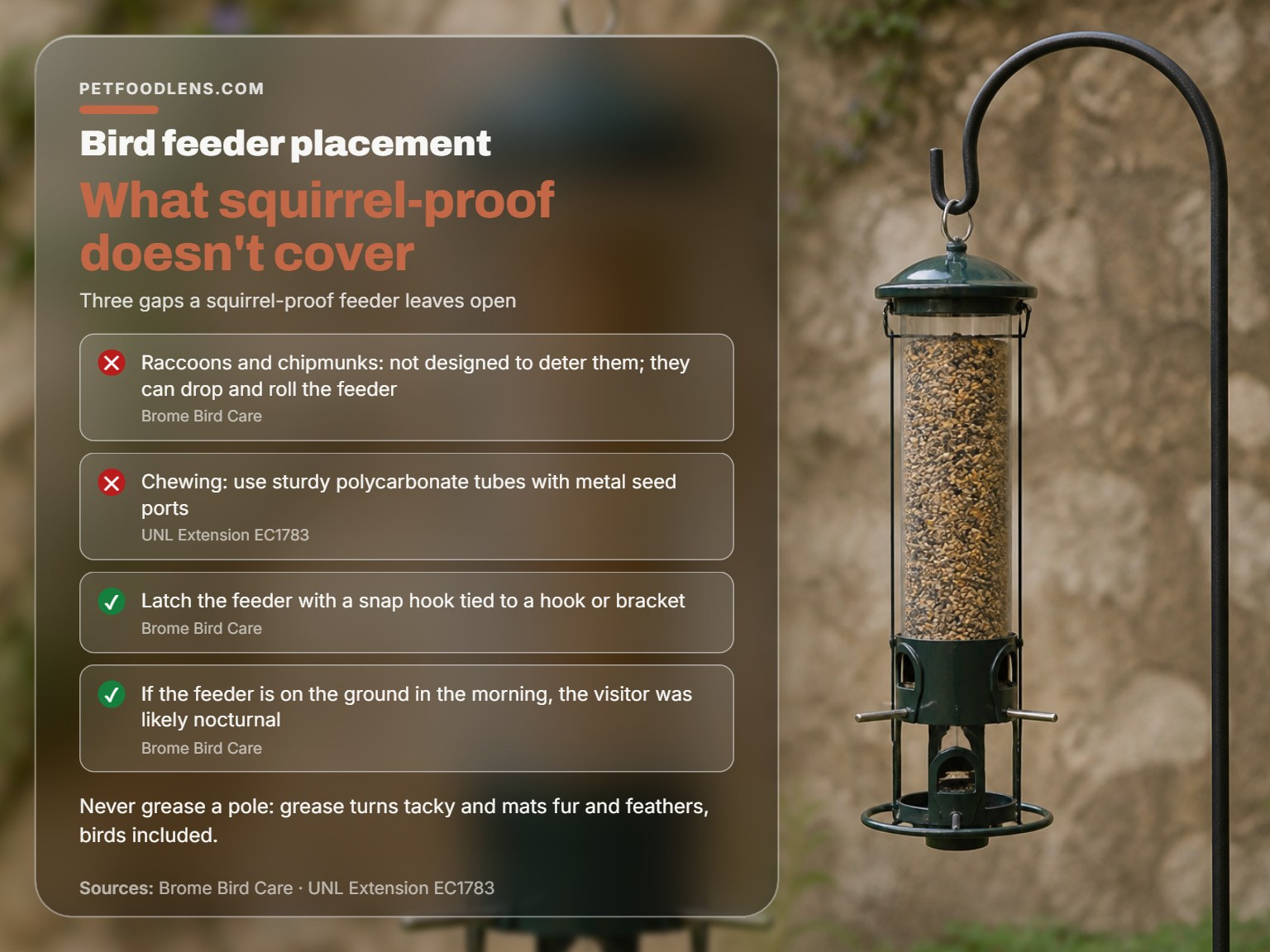
Brome’s own placement page says the quiet part out loud: Squirrel Buster feeders are squirrel-proof but not built to stop raccoons, chipmunks, or similar critters that can drop and roll the feeder.
That’s a manufacturer stating a limit on its own product, which is rare enough to take seriously. Squirrels lack the dexterity and strength to manipulate a feeder and drop it. Raccoons don’t.
Brome’s fix is mechanical and cheap: latch the feeder with a snap hook tied to a hook or bracket. That doesn’t stop a raccoon from visiting, but it stops the feeder from ending up on the lawn.
If you find the feeder on the ground in the morning, the visitor was almost certainly nocturnal. Squirrels don’t do that.
Never grease a pole to stop squirrels. UNL Extension is blunt about why: the grease turns tacky with time, and it mats the fur and feathers of whatever touches it, birds included. The squirrel gets a sticky pole and the bird gets a ruined coat.
What a squirrel-proof feeder does not cover
Three things, based on the sources:
- Raccoons and chipmunks, which defeat the mechanism by moving the feeder rather than climbing it.
- Partial-weight leaning, where a squirrel reaches from a foothold and never loads the perch.
- Chewing, which is why UNL recommends sturdy polycarbonate tubes with metal seed ports.
Baffles and Mounting: The Order That Saves a Second Trip
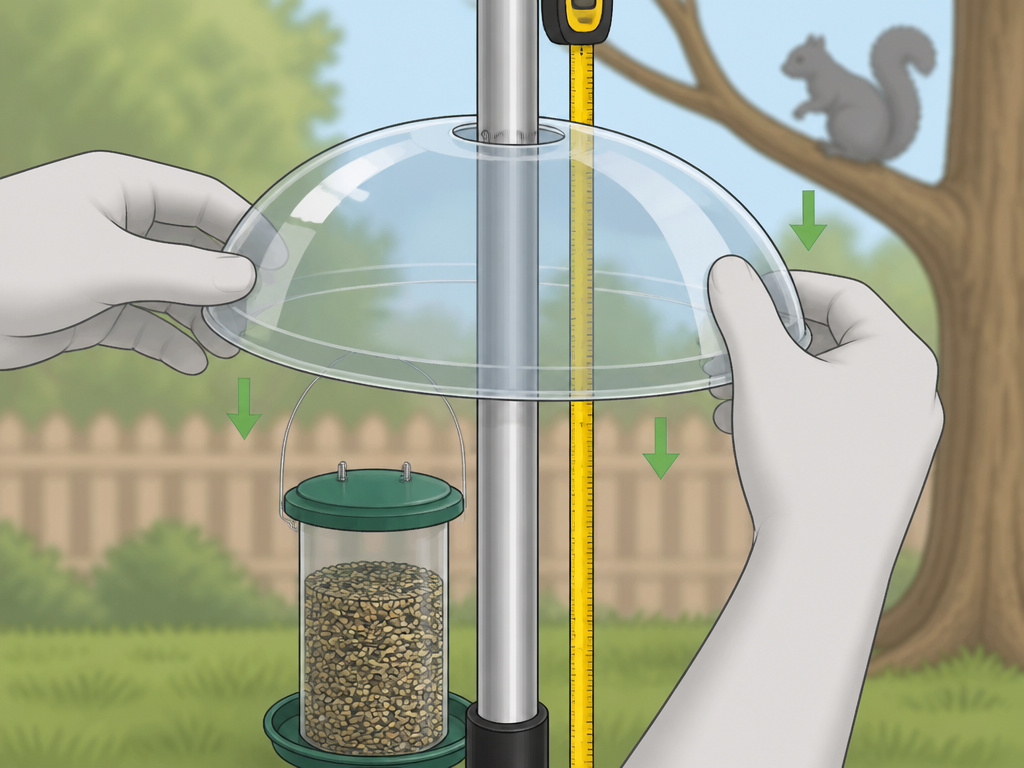
You’ve got the pole in the ground, the feeder filled, and the baffle still in the box.
Do it in this order instead:
- Set the pole or hook first, at the height your chosen source specifies. Mount the feeder before the pole is set and you’ll be re-hanging it twice.
- Slide the baffle onto the pole before anything hangs from it, at least 4 feet off the ground per UNL. Skip this and you’ll be disassembling a full feeder later.
- Measure the 18 inches of side clearance with your arm, not your eye. Eyeballing it is how a feeder ends up too close to a downspout.
- Fill the feeder last, so spilled seed doesn’t land where you’re still working.
| Mounting type | Where the baffle goes | Why |
|---|---|---|
| Pole or shepherd’s hook | On the pole, below the feeder | Stops squirrels climbing the pole |
| Tree branch or trunk | Sloped cone above the feeder | Blocks the drop from above |
| Platform feeder | Above and below | Both approach routes stay open |
| Any mounting | At least 4 ft off the ground | Keeps it out of a standing jump |
Cone baffle vs pole baffle
These solve different problems and you may need both. UNL says a sloped cone-shaped baffle above the feeder is necessary when hanging in a tree. On a pole or shepherd’s hook, a baffle mounted on the pole below the feeder is what stops the climb.
A squirrel baffle on a pole does nothing about a squirrel dropping from a branch overhead. That’s the case for the cone.
One exception worth knowing: UNL notes that squirrels tend to leave nyjer and safflower alone, and feeders filled with those seeds may not need baffles at all. If you’re feeding finches, that changes the budget.
Once the pole and baffle are sorted, the rest of the layout is a bird feeding station question rather than a placement one.
Do Hummingbird Feeders Need Different Placement?
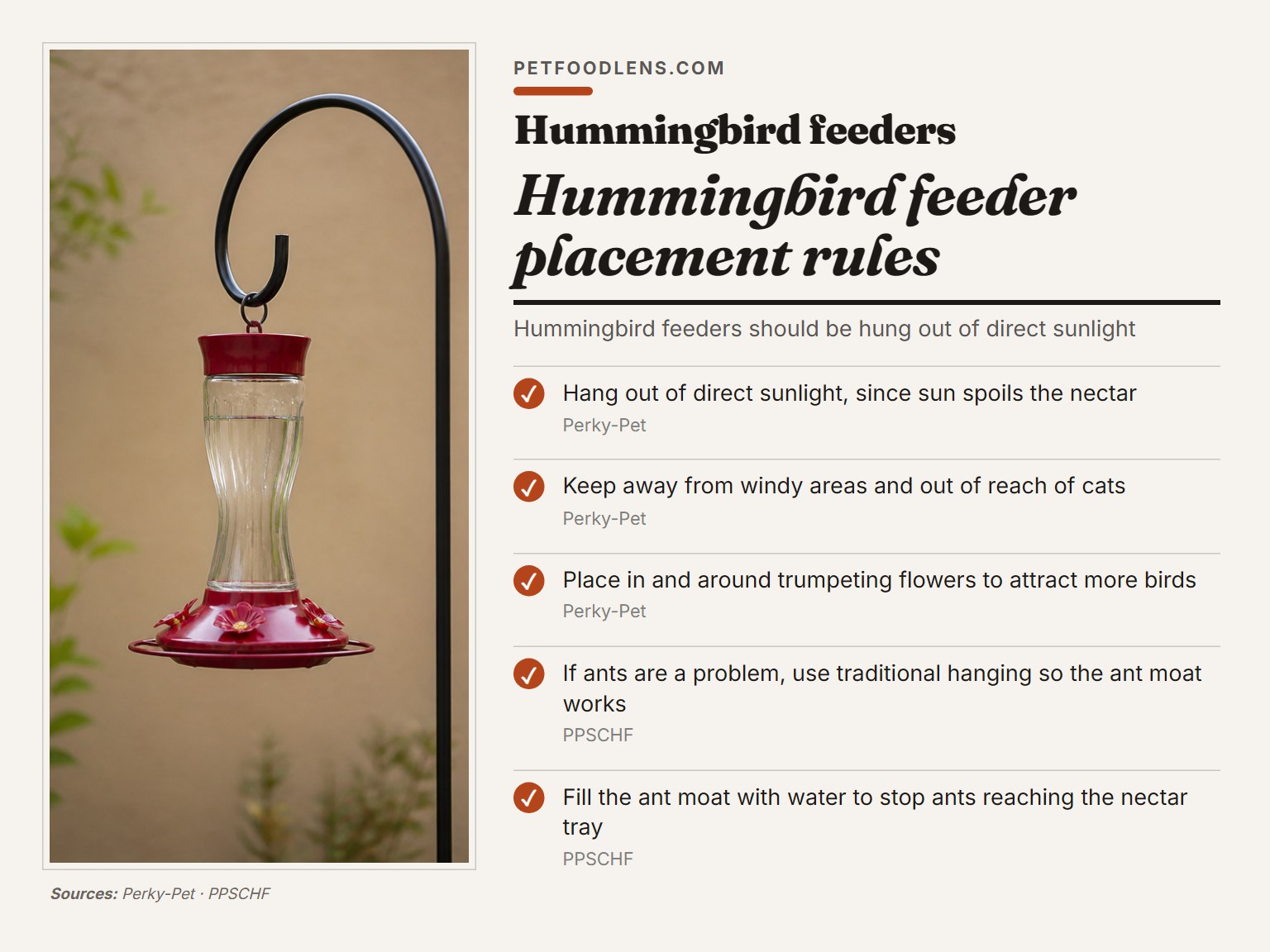
Nectar spoils in sunlight, so a hummingbird feeder’s placement problem starts with the sun rather than the squirrel.
Perky-Pet’s guidance for hummingbird feeders is a separate list from the seed feeders:
- Hang out of direct sunlight, since sun spoils the nectar
- Keep it away from windy areas
- Keep it out of reach of cats
- Place it in and around trumpeting flowers to pull more birds in
Traditional hanging is preferred over mounting if ants are a problem, because hanging is what allows the included ant moat to be used.
Ants and the moat
Fill the moat with water. That’s the whole mechanism: ants travel down the hanger, hit the water, and stop. Skip the water and you’ve built them a bridge with a decorative ring on it.
If ants are already a problem, keep ants out covers the rest of the options.
How Long Before Birds Find a New Feeder?
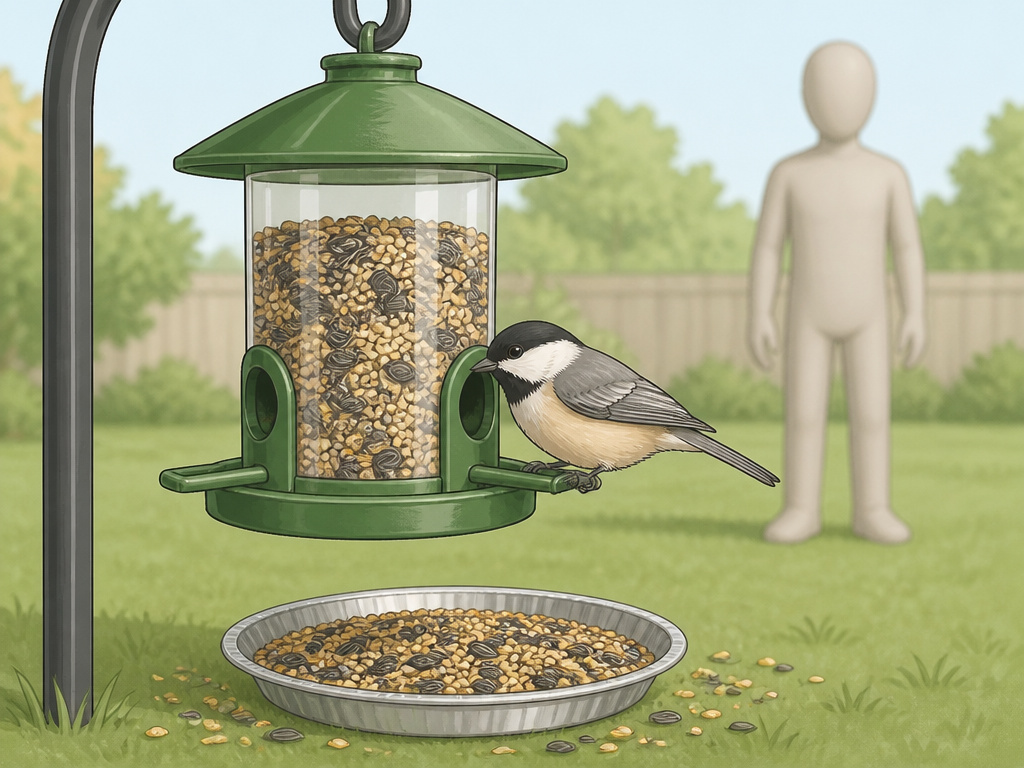
Week one: nothing. Week two: a single chickadee lands, looks, and leaves.
Perky-Pet notes that if this is the first feeder in the yard, you may wait several weeks for birds to discover it. That’s normal, and it’s the point where most people move the feeder and restart the clock.
Perky-Pet’s shortcut is a shiny pie pan with some seed in it placed underneath the feeder, which helps birds spot the food from the air. Water helps too.
Leave the feeder where it is. Moving it every few days is the fastest way to make sure nothing ever finds it. More on that in attract birds to a feeder.
Frequently Asked Questions
How far should a bird feeder be from the house?
Brome’s window guidance is 3 feet and closer, or 30 feet and further, to reduce collisions. For the feeder’s own protection, Perky-Pet recommends keeping it away from buildings that predators can climb or jump from. Those two rules point in different directions, so most people end up hanging from a pole in open lawn at least 3 feet from the glass.
Will a bird feeder attract rats?
King County Public Health states plainly that if you feed birds, expect increased rat numbers around your home. Bird seed spills, and rats climb. The county’s countermeasures are filling only a day’s worth of seed, leaving nothing in the feeder overnight, and storing bulk seed in metal.
Do I really need a baffle?
It depends on the mounting and the seed. UNL Extension says feeders filled with nyjer or safflower may not need squirrel baffles, since squirrels tend to leave those alone. On a pole, a baffle below the feeder is what stops the climb. In a tree, a sloped cone above the feeder is the necessary piece.
How high off the ground should a feeder hang?
The sources differ. King County says 4 feet off the ground. Perky-Pet says a free-standing pole should be 5 feet high. UNL Extension says pole-mounted feeders should be at least 6 feet high, with the baffle at least 4 feet off the ground. Match the number to the pest you’re managing.
Should I bring my feeder in at night?
King County recommends leaving no seed in feeders overnight because that’s when rats are most active. Brome suggests bringing feeders in at night if you’re losing them to raccoons, opossums, deer, or bears. If either animal is present, taking it in solves both problems at once.
The Bottom Line
If you can’t get 18 inches of clear space on all sides, don’t buy a weight-triggered feeder. It won’t work, and you’ll spend a season blaming the feeder instead of the nearby fence rail.
That’s the trigger. Measure the clearance before you shop, not after.
One concession worth stating: everything above assumes a yard with room to move a pole around. If you’re on a balcony, in a rental, or working with a single fixed hook, most of this collapses into “hang it as far from a rail as the space allows and accept the compromise.” Window feeder setups are a different article because they’re a different problem.
And if a feeder keeps ending up on the ground overnight, stop adjusting the height. Something with hands is moving it, and no amount of pole math fixes that.
