
Window Feeder Pros and Cons: What the Data Says
This post contains affiliate links. As an Amazon Associate, we earn from qualifying purchases.
The window feeder pros and cons come down to one trade-off: close-up views and easy refills against a documented collision risk. A peer-reviewed residential study found feeder presence raised bird-window collisions 1.57 to 2.20 times, while Cornell Lab and earlier Klem work report the opposite. Glass treatment and feeder distance decide which result you get.
That multiplier came out of 284 paired month-long trials at 55 windows on 43 houses in and around Edmonton, with feeders sitting 1 m or 5 m in front of the glass. The same authors call feeder presence a weak predictor in their own mixed model, so the window feeder pros and cons honest reading sits between the two camps. Which camp you land in depends on things you control.
Here is the practical takeaway: this piece walks the collision evidence, the distance argument nobody has settled, three named feeders with their real specs, the mounting steps that keep a cup on cold glass, and the cleaning routine that stops a feeder becoming a disease vector.
Key Takeaways
- Feeder presence raised collisions 1.57 to 2.20 times in the only residential manipulative study, and the authors still call that result weak.
- Klem et al. 2004 found within 1 m reduced collisions while 2 to 10 m increased them, though Kummer & Bayne 2015 found feeder presence raised collisions and the Ornithology Center and Klem 2025 say no distance is safe.
- Untreated glass is the real problem. Klem 2025 states no feeder distance is safe on reflective or transparent panes.
- Sticker spacing of 2 by 2 inches on center is the working retrofit spec, per Sheppard 2019.
- Clean regularly and keep feeders out of the kitchen. Pathogens transfer to food surfaces, and a vacuum cleaner aerosolizes them.
What the Collision Research Actually Shows
The strongest dataset on this question is the peer-reviewed feeder collision paper published by Kummer and Bayne in 2015. Homeowners logged 51 collisions in months with no feeder and 94 in months with one, across the full run of trials.
Paired month-long trials at 55 windows on 43 Edmonton houses produced 51 collisions during feeder-absent months and 94 during feeder-present months, a 1.57 to 2.20-fold rise depending on feeder model. The authors label feeder presence a weak predictor, because the mixed-model result fell short of P = 0.05 and delta AIC above 2.
Read that caveat twice. A near-doubling in raw counts that fails the significance test is exactly the kind of finding that gets quoted as a headline and never as a footnote.
Machtans et al. 2013 estimated that 90% of window collision mortality in Canada happens at residential windows, which is why a house-level result carries more weight here than anything measured at a forest edge. The study also found the highest collision counts during fall migration and the lowest in winter. Twenty-six of the 55 windows recorded no collisions at all, so a handful of bad panes can carry most of a total.
The mechanism behind Klem et al. 2004’s low-collision result is worth understanding: a bird leaving a feeder mounted within 1 m of glass cannot build enough flight speed to hurt itself before it hits, while at 5 m it has room to accelerate. Kummer & Bayne 2015, however, found feeder presence raised collision risk, and Klem 2025 says no distance is safe on reflective glass.
Is There a Safe Distance Between Feeder and Glass?
No source has published a distance that satisfies all the others. Klem et al. 2004 found collisions rose when feeders sat 2 to 10 m from a window and fell within 1 m, though Kummer & Bayne 2015 found feeder presence raised collision risk and the Ornithology Center and Klem 2025 say no distance is safe. The Ornithology Center states flatly that there is no safe distance to place an attractant away from the window surface. Klem 2025 goes further and says reflective or transparent glass makes distance irrelevant, so retrofitting is required regardless of where the feeder hangs.
| Source | Position on feeder near glass | Basis |
|---|---|---|
| Kummer & Bayne 2015 | Feeder presence raised collisions 1.57 to 2.20x | 284 trials, 55 residential windows |
| Klem et al. 2004 | 2 to 10 m raises collisions; within 1 m lowers them | Forest-edge panes, not houses |
| Ornithology Center | No safe distance exists | Commentary on published guidance |
| Klem 2025 (via BirdNet) | No distance is safe on reflective glass | Retrofitting required regardless |
The retrofit spec is more settled than the distance argument. Sheppard 2019 puts 2 by 2 inches on center as the ideal sticker spacing, with 2 by 4 inches on center also workable. The proper wild bird feeder use guidance adds a sequencing rule: treat every window facing the feeder first, then monitor the rest and treat any pane that takes a strike.
Easy to miss: A feeder hung 5 m out on a pole in front of the same window sits squarely in the worst band Klem measured. The risk rises without a single change to the feeder itself.
The geometry shifts completely for a pole setup, which is why bird feeder placement in a yard starts with sight lines and cover rather than raw distance.
The Window Feeder Pros and Cons That Survive a Second Look
Cornell Lab’s All About Birds makes the practical case cleanly: window mounts suit small birds such as finches, chickadees, titmice, nuthatches, and sparrows, and they put those birds at eye level instead of forty feet away, though Kummer & Bayne 2015 found feeder presence raised collision risk. The US Fish and Wildlife Service counted 57 million people feeding birds in 2018, so a design flaw in this category reaches a very large number of windows.
What actually holds up:
- Views you cannot get any other way. A tray feeder at the glass puts a chickadee close to your coffee.
- Quick refills. The Nature’s Way WIN-3 tray lifts out, and the whole unit detaches from the window without pulling the suction cups.
- Small birds get a turn. Window feeders suit small birds such as finches, chickadees, titmice, nuthatches, and sparrows.
- Setup is quick and one-person, assuming the glass is clean and the cups are warm.
Most window bird feeders share the same tray-and-suction architecture, so the real differences come down to cup count, tray drainage, and whether the tray comes out for cleaning. Balcony setups change the geometry again, since balcony bird feeders hang on railings rather than glass and sit outside the 1 m rule entirely.
Renters who cannot drill or treat a pane ask constantly how to feed birds in an apartment at all. The answer is usually a window mount plus a treated pane, and skipping the second half is where the plan falls apart.
The Cons That Don’t Make the Box
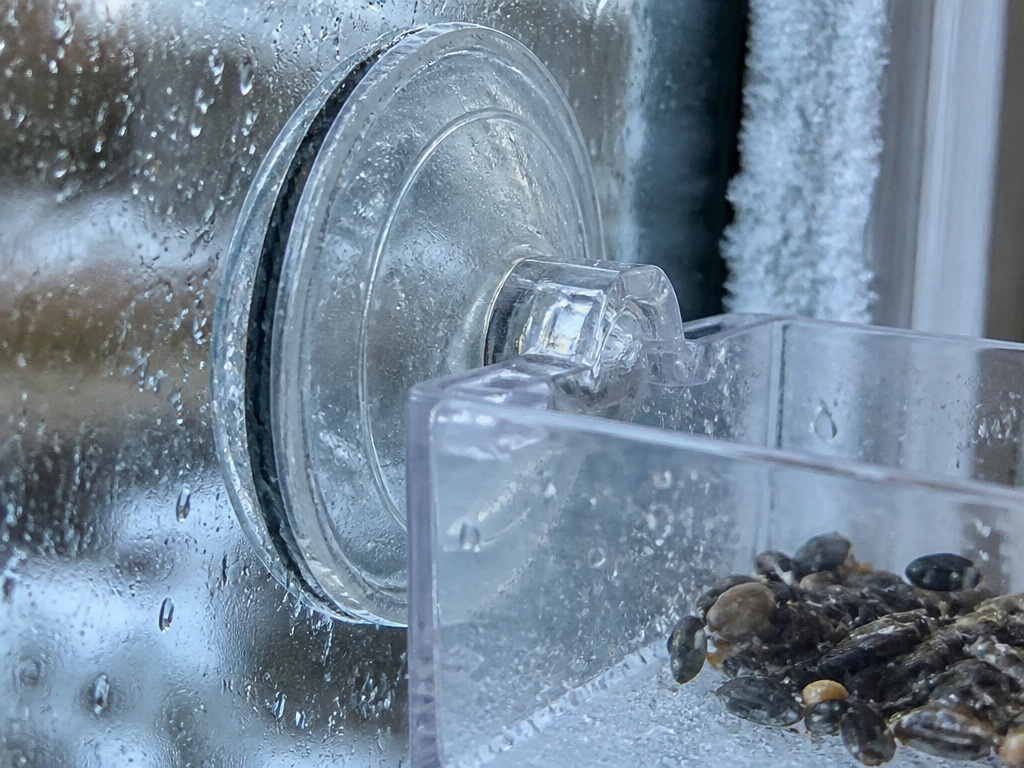
The suction cup is the weak point, and every manufacturer knows it. Droll Yankees lists three strong suction cups on the Observer, and reviewers on that same product page report the feeder dropping off the window despite an alcohol-cleaned pane and replacement cups.
The rest of the list:
- Cold, dirty, or textured glass defeats the seal, and the failure often happens when the temperature drops.
- A wet tray can grow biofilm. Seed that stays damp spoils, and spoiled seed is how feeders spread disease.
- The feeder concentrates birds at the one surface most likely to kill them. That is the entire argument in the first section.
- Squirrels are not deterred. Droll Yankees lists the Observer as Squirrel-Resistant: No.
- Cleaning is mandatory, not optional, and a unit you cannot detach without pulling the cups is harder to clean.
I won’t hang a feeder on a pane I haven’t treated first. The feeder decides where the bird lands. The glass decides whether it gets up again.
App features do not touch any of this. The smart bird feeders category adds a camera and a Wi-Fi radio, and neither one changes the collision math or the cleaning schedule by a single day.
Which Window Feeder Actually Stays on the Glass?
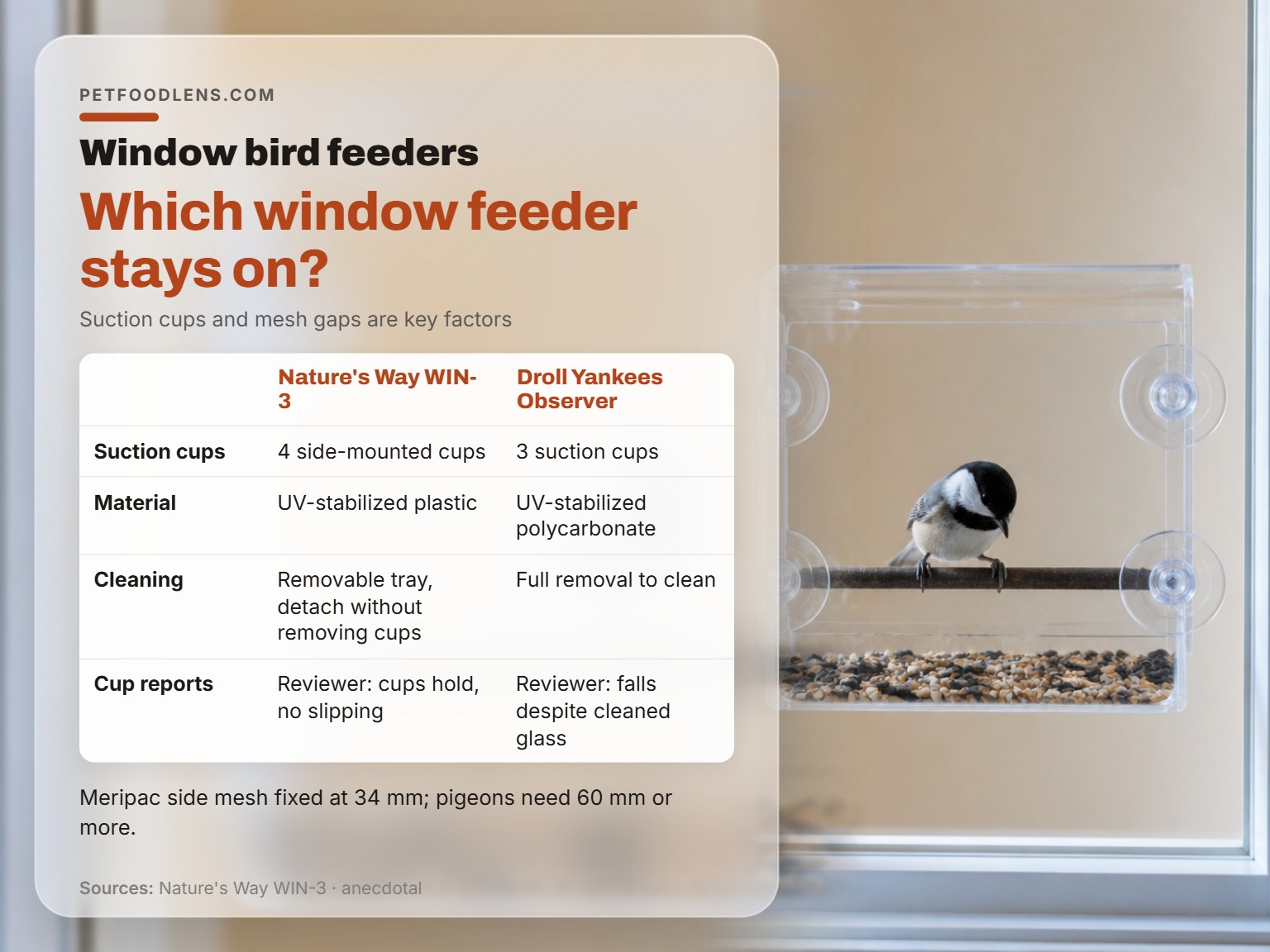
Cup count and tray design separate the three models worth comparing, and the spec sheets disagree with the marketing on at least one point.
| Model | Capacity | Mount | Notes |
|---|---|---|---|
| Nature’s Way WIN-3 | 2 cups, 0.75 lb | 4 side suction cups | UV-stabilized plastic, 6.75 x 9.25 x 5 in, removable tray |
| Droll Yankees Observer | 0.5 lb, 2 cups | 3 suction cups | UV-stabilized polycarbonate, Prop 65 BPA warning, not squirrel resistant |
| Meripac Pigeon Proof | 0.33 kg seed | Window mount | Front mesh 28 to 58 mm, side mesh fixed at 34 mm |
The Nature’s Way WIN-3 is the one I would hand a first-time buyer. Four cups spread the load, the tray lifts out, and the whole feeder comes off the glass without disturbing the seals. A reviewer on the product page reports the cups holding with no slipping, which matches the four-point design.
The Droll Yankees Observer is the better-looking unit and the more annoying one to own. It holds 2 cups of seed, fruit, suet, or mealworms, which is genuinely useful, and it carries a Prop 65 warning for Bisphenol A. Reviewers describe it falling repeatedly, cups that are too rigid to seat in their slots, and a fill routine that requires full removal. Show me the numbers, and the numbers say three cups doing the work of four.
The Meripac is the odd one out and the most interesting. The front mesh gap adjusts from 28 mm to 58 mm, the side mesh is fixed at 34 mm, and pigeons, seagulls, magpies, and jackdaws need 60 mm or more. So the side panels do the excluding and the front setting decides which small and mid-size birds get through. The box says pigeon proof. The spec says 34 mm against a 60 mm requirement. Read that again. Meripac also builds in a green warning strip to cut the odds of a bird flying into the roof, plus a retention system that catches the feeder if you fumble it while filling.
The All About Birds feeder selection guide groups window mounts with trays and hoppers, and the grouping is fair: all three share the same cleaning burden. Anyone weighing a window mount against a pole or tube should choose a bird feeder on cleaning access first and species second. Hummingbird units are a separate purchase entirely, and window hummingbird feeders need the same treated glass behind them or you have built a very small trap.
The Mount That Holds: Five Steps, and the Step Everyone Skips
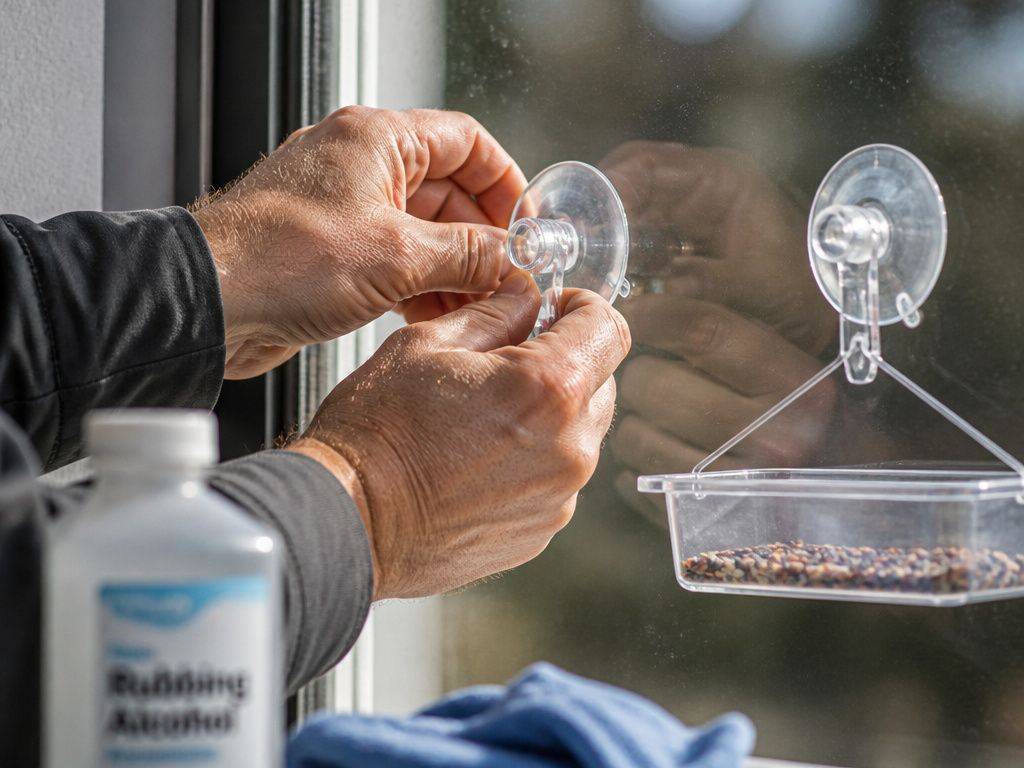
Three things decide whether a suction cup holds: glass temperature, surface cleanliness, and cup softness. Get any one of them wrong and the feeder comes down.
- Wipe the glass with alcohol and let it flash off. Skip this and an invisible oil film lets the cup creep down the pane.
- Warm the cups before mounting. Nature Anywhere’s own instructions say to dunk them in boiling water for a few seconds, let them cool slightly, and attach while still warm. Cold rubber on cold glass loses its seal fast.
- Press each cup firmly and hold. A quick press traps a pocket of air under the cup, and that pocket is what pops loose later.
- Hang the feeder empty, then fill it. A loaded feeder that lets go takes the tray and the seed with it.
- Re-check the seal periodically. A marginal cup gives up when conditions change.
A cup that is about to fail makes a soft click, then a slow slide down the pane, then a thump on the sill.
Where this goes sideways: Textured, leaded, or dirty glass gives a suction cup nothing to grip. The feeder will drop within a day no matter how warm the cup was.
How Long Before Birds Use a New Window Feeder?
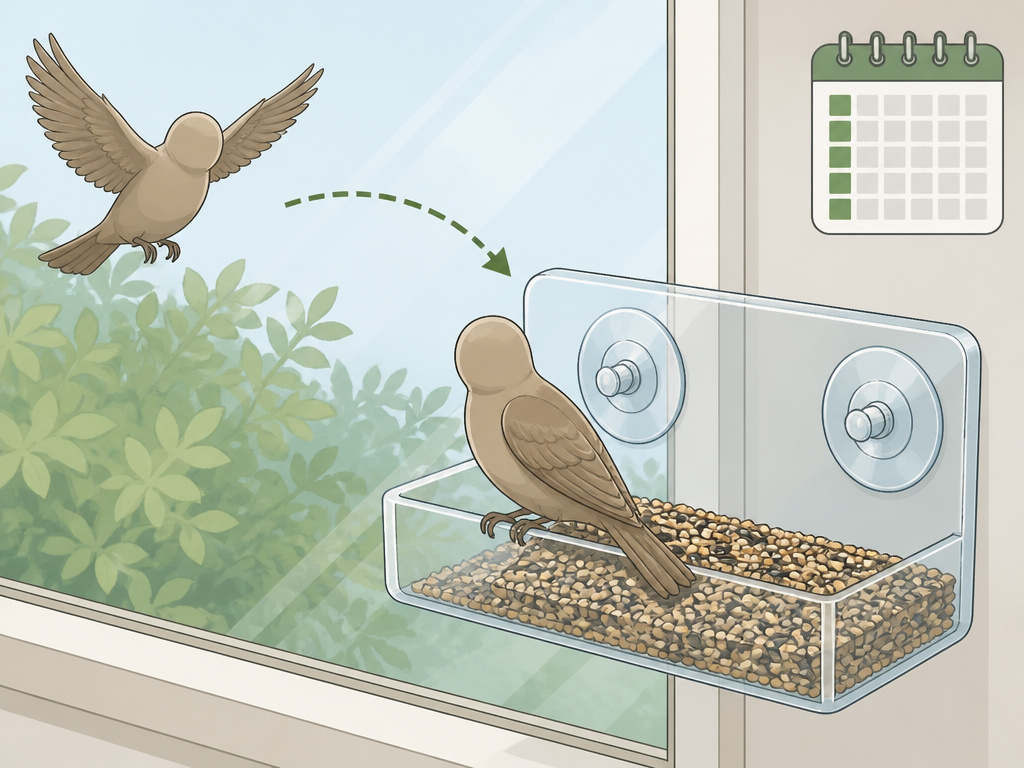
Cornell Lab says birds may take several days or more before they are ready to come that close to a house. Nature Anywhere’s instructions stretch the timeline to up to five weeks before birds learn to trust the feeder. Both are describing the same behavior at different levels of patience, and neither is wrong.
The variable is not the feeder. It is how much cover and traffic sits between the birds and that particular pane. A window over a quiet garden with a nearby shrub line gets discovered faster than one facing a driveway.
Patience is the whole method. Move the feeder during week two and the clock restarts at zero.
Cleaning: The Part That Actually Protects Birds
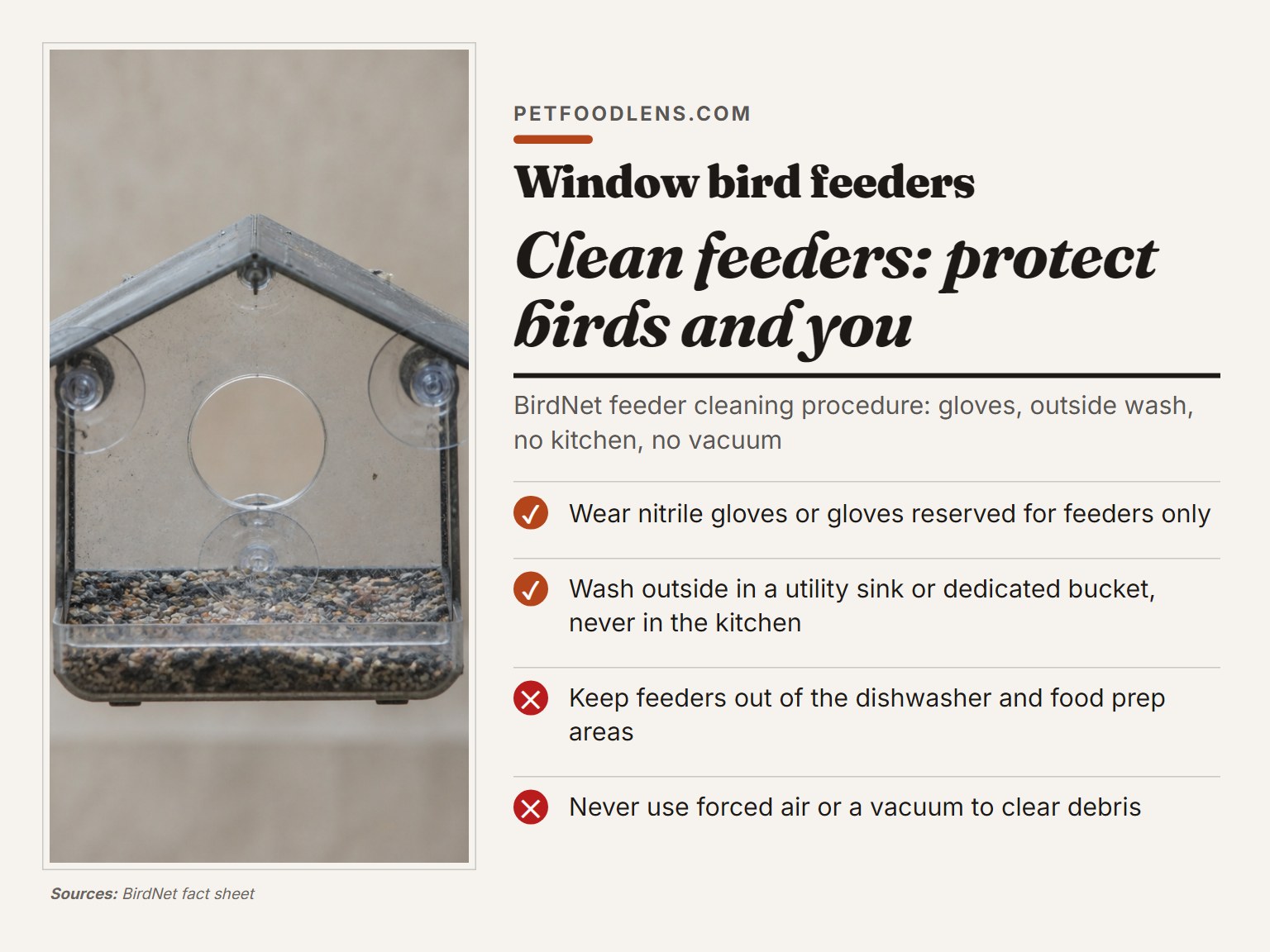
Feeders must be cleaned regularly to prevent the spread of pathogens and parasites, and the list of diseases linked to dirty seed feeders is longer than most owners expect. Salmonellosis and Mycoplasmosis have both been tied to seed feeders, with Mycoplasma transmission demonstrated from contaminated feeders to birds. Trichomonosis has been linked to feeders as well, and moist seed can drive Aspergillosis, a fungal respiratory disease.
The BirdNet feeder cleaning fact sheet sets out a full procedure. The short version:
- Wear nitrile gloves or a pair reserved for feeders only, and wash your hands after filling or cleaning.
- Wash outside in a utility sink or a dedicated bucket, never in the kitchen.
- Keep feeders out of the dishwasher and out of food prep areas. Consumer machines vary in efficacy, and pathogens can transfer to utensils on the next cycle.
- Never use forced air or a vacuum to clear debris, because both aerosolize pathogens.
- Use bleach plus dish soap and a scrub to clean the feeder thoroughly.
Wet seed in a tray smells like a damp basement, and the tray goes slick with a grey film well before you see any mold.
Never clean a feeder in the kitchen sink. Salmonellosis in humans has been linked to handling contaminated feeders, and a sink rinse puts that contamination on the same surface where you chop vegetables an hour later.
Frequently Asked Questions
Do window feeders really cause more window collisions?
The sources disagree. Kummer and Bayne 2015 recorded 94 collisions in feeder-present months against 51 in feeder-absent months, a 1.57 to 2.20-fold increase, though the authors call the result weak because it missed significance at P = 0.05. Klem et al. 2004 and Cornell Lab argue the opposite direction for feeders placed within 1 m of glass, and Hager et al. 2013 found no relationship between feeder presence and collision rate.
What is the safest distance to put a feeder from a window?
The sources do not agree. Klem et al. 2004 found within 1 m reduced collisions and 2 to 10 m increased them, while Kummer & Bayne 2015 found feeder presence raised collision risk. The Ornithology Center states there is no safe distance at all. Klem 2025 says reflective or transparent glass makes distance irrelevant, so the pane has to be treated either way.
Will birds actually use a window feeder?
Eventually. Cornell Lab advises patience and says birds may take several days or more to accept a feeder that close to the house. Nature Anywhere’s instructions allow up to five weeks. Moving the feeder mid-wait resets the process.
How do I stop a window feeder from falling off?
Clean the glass with alcohol, warm the suction cups in hot water for a few seconds, and press each one firmly while it is still warm. Hang the feeder empty first, then fill it, and re-check the seal after the first cold night.
How often should a window feeder be cleaned?
The BirdNet fact sheet says regularly, without a fixed interval, because the research on cleaning efficacy is recent. A tray that takes rain or holds damp seed needs attention far more often than one under a deep eave. Watch for a grey film on the tray, which shows up before visible mold.
Are window feeders squirrel proof?
No. Droll Yankees lists the Observer as Squirrel-Resistant: No on its own spec tab. Suction cups and a shallow tray offer nothing a squirrel cannot solve in a few minutes.
The Bottom Line
Here is the threshold that decides it: if the glass behind the feeder is untreated and reflective, no feeder placement fixes anything. Klem 2025 says exactly that, and it overrides every distance argument here. Treat the pane first, then argue about where the feeder hangs.
The first step this week is small. Wipe one window with alcohol, order a sheet of markers at 2 by 2 inches on center, and hang the feeder within 1 m of the treated glass rather than out at 5 m. That sequence costs you an afternoon and it puts the feeder on the safe side of the only variable you fully control.
One concession, because the evidence earns it. If you have a window with a known strike history and you cannot retrofit it, take the feeder down. A window feeder is worth owning, but not worth keeping if the window has a known strike history and you cannot retrofit it.
