
How to Attract Chickadees to a Feeder: Seed and Placement
This post contains affiliate links. As an Amazon Associate, we earn from qualifying purchases.
The short answer to how to attract chickadees to a feeder: hang it 5 to 6 feet off the ground, 6 to 8 feet from the nearest shrub, and fill it with black oil sunflower seed or suet. Chickadees take one seed at a time and carry it to cover, so escape cover within 10 feet matters too.
That one-seed-at-a-time habit explains why the how to attract chickadees to a feeder question can look abandoned for days. A chickadee grabs a sunflower seed, flies to a branch, wedges it into bark, hammers the hull open, then comes back for another. A feeder hanging alone in the middle of a mown lawn gets a fraction of the traffic of the same feeder set 6 to 8 feet off a hedge.
What follows covers the four things that decide whether chickadees show up: the seed, the feeder type, the placement, and the cleaning. On two of those, the published sources contradict each other, and I’ll show both positions instead of picking a winner for you.
Key Takeaways
- Hang the feeder 5 to 6 feet up and 6 to 8 feet from vegetation. Those numbers come from OSU Extension EC 1554, the only source with hard placement figures.
- Black oil sunflower does most of the work. Chickadees take sunflower, suet, and peanuts; a mix with little sunflower in it is mostly waste.
- Expect up to a week or longer before chickadees find a new feeder. That wait is normal, not failure.
- Cleaning schedules conflict. Chicago Botanic Garden says occasional soap and water; Iowa DNR says monthly with a 10% bleach solution. Pick one and hold it.
- Roasted peanuts only, per OSU Extension, which says raw peanuts contain toxins that can harm birds; Chicago Botanic Garden and Wild Birds Unlimited list peanuts with no roasted-only restriction.
What to Put Out to Attract Chickadees to a Feeder
Black oil sunflower, suet, and peanuts cover almost everything a chickadee wants from a feeder. Everything else on the shelf is either a supplement or a filler.
The black-capped chickadee takes sunflower seed, suet, and peanuts. It carries seed away from the feeder and wedges it into bark crevices for later retrieval, a caching habit that helps the bird survive winter. Only one chickadee feeds at a time, and the dominant bird of the group goes first.
I ran a straight black oil sunflower feeder next to a multi-species blend one fall, mostly to settle an argument with myself. Within a short time the sunflower side had cardinals, chickadees, titmice, and a blue jay working it in rotation. The blend had the longer ingredient list on the bag and fewer birds on the perches.
Flip the bag over. If sunflower isn’t near the top of the list, you’re paying for filler that most songbirds shove onto the ground. OSU Extension calls low-sunflower mixes wasteful and messy, though it also tells beginners to start with a seed mix, while Chicago Botanic Garden says to choose individual foods rather than mixes.
Black oil is the grade to buy. The hulls are thin, so a chickadee can wedge a seed into bark and crack it quickly. Black oil is the grade to buy.
Chickadees also cache. A bird takes a seed, flies to a crevice, jams it in, and comes back for another. That’s why a feeder near mature trees gets steadier traffic than one over open lawn.
For the field marks, the black-capped chickadee identification guide is the page I keep open. And if you’re stocking a feeder for small birds generally, this guide to seed for small birds covers the grades that fit small bills.
The 5-6 Foot Rule for Feeder Height and Distance
Five to six feet off the ground, 6 to 8 feet from the nearest vegetation, and escape cover within 10 feet. Those three numbers come from Oregon State University Extension’s EC 1554, and they’re the only hard placement figures in the published guidance I could find.
| Measurement | Value | Source |
|---|---|---|
| Feeder height | 5-6 ft off the ground | OSU Extension EC 1554 |
| Distance from vegetation | 6-8 ft | OSU Extension EC 1554 |
| Distance to escape cover | Within 10 ft | OSU Extension EC 1554 |
| Time to find a new feeder | Up to a week or longer | Chicago Botanic Garden |
My read on the height range: it puts the feeder above ground-level traffic and still within arm’s reach for refilling. OSU doesn’t spell out the reasoning, so treat that as my interpretation rather than theirs.
Why Escape Cover Within 10 Feet Matters
Chickadees don’t sit on a feeder and eat. They take a seed and retreat.
If the nearest shrub sits well beyond the recommended 6 to 8 feet, every seed is a longer round trip across open air. Cooper’s and sharp-shinned hawks hunt exactly that gap, and Iowa DNR lists feeders as hunting grounds for both.
Windows work the same way. Birds can’t see glass, so Iowa DNR’s fix is counterintuitive: put the feeder close to the window or far away from it. The middle distance is where a bird builds enough speed to hurt itself.
Then there’s the waiting. Chicago Botanic Garden puts the discovery window at up to a week or longer, which is worth knowing before you decide the feeder is broken. How birds discover a new feeder goes deeper on that first week. The full OSU Extension feed wild birds guide covers the rest of the placement and food rules.
Which Feeder Type Brings Chickadees In?
Suet cages and hopper feeders both work. So do tube feeders, with one caveat about port size.
- Hopper feeder with sunflower seed. Pulls chickadees along with cardinals, jays, and house finches. Buy one with a baffle and hang it where a squirrel can’t drop onto the roof.
- Suet cage. Woodpeckers, chickadees, and nuthatches. The cheapest way to add a second station.
- Tube feeder with small ports. Small ports help keep larger-billed birds from cleaning it out. Chickadees fit fine.
- Peanut feeder. Chickadees carry whole peanuts off to cache, so this one empties fast.
For peanuts specifically, the Wild Birds Unlimited EcoClean peanut feeder holds 1 1/4 quarts in a 19-inch tube, with an antimicrobial powder coating on the mesh. The antimicrobial powder coating is on the mesh tube.
For a plain sunflower tube, choose a feeder with small ports that keep larger-billed birds out. Check the port size before you buy, and feeders for small birds lines up the ones sized for chickadees.
One thing worth knowing about thistle. A thistle feeder’s tiny holes let thin-billed birds in and keep larger bills out, which is a clever design. But OSU’s chickadee food table doesn’t list Nyjer at all. Hang thistle and you’re feeding goldfinches and siskins, not chickadees.
If you’re starting from nothing, a backyard feeding station is the better build than three random hangers. And bird feeder types covers the shapes I skipped here.
Should You Use a Seed Mix or Single Seeds?
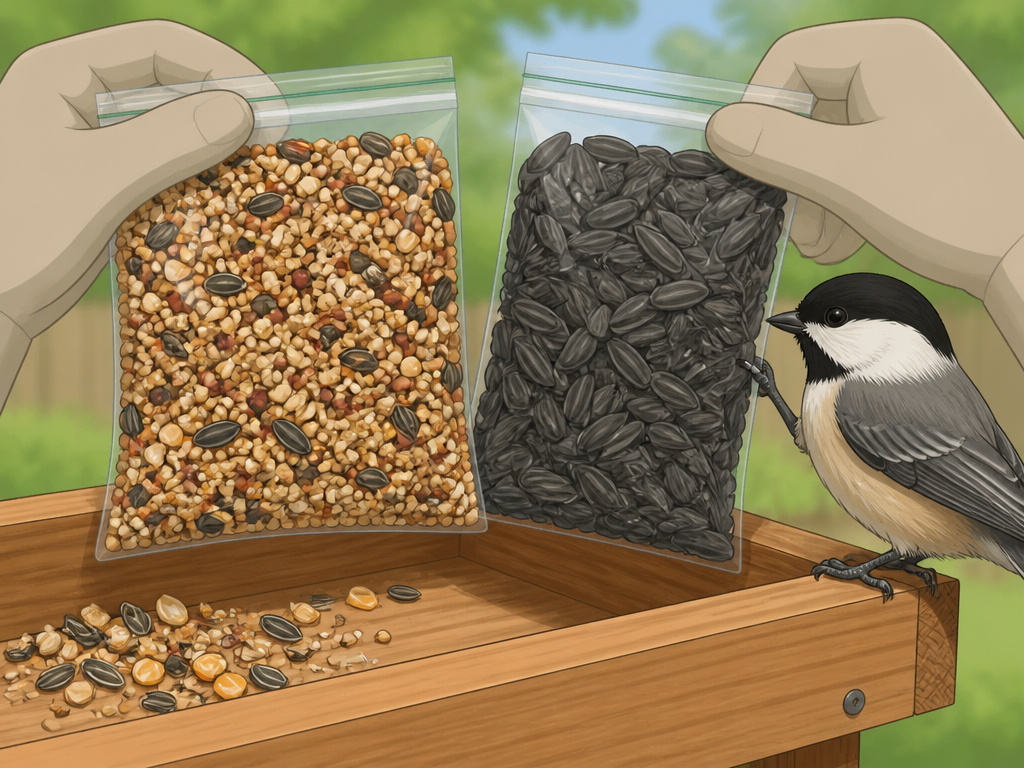
The bag with the longest ingredient list is usually the one the chickadees ignore. That’s the short version. The published guidance is more divided than that.
OSU Extension tells beginners to put out a seed mix in an open place first, watch which seeds get wasted or pushed aside, then move to separate feeding stations once birds arrive. Chicago Botanic Garden skips that step and says to choose individual foods rather than mixes.
| Topic | Position 1 | Position 2 |
|---|---|---|
| Seed mixes | OSU Extension: start with a mix, then move to separate stations | Chicago Botanic Garden: choose individual foods, not mixes |
| Raw peanuts | OSU Extension: roasted only, raw contain toxins | Chicago Botanic Garden and Wild Birds Unlimited list peanuts with no roasted-only restriction |
| Ground feeding | OSU Extension: a catch tray under the feeder is acceptable | Iowa DNR: seed on the ground mixes with droppings and molds |
Both positions have a logic to them. OSU’s advice assumes you don’t yet know which birds are in your yard, so a mix is a cheap survey. The Chicago Botanic Garden bird feeding guide assumes you’ve already decided what you want and would rather not buy filler.
Here’s where I land. Skip the multi-seed blend on your first bag. If you already know chickadees are around, a straight sunflower feeder answers the question sooner, and you skip the bag of milo entirely.
How Often Should You Clean a Chickadee Feeder?
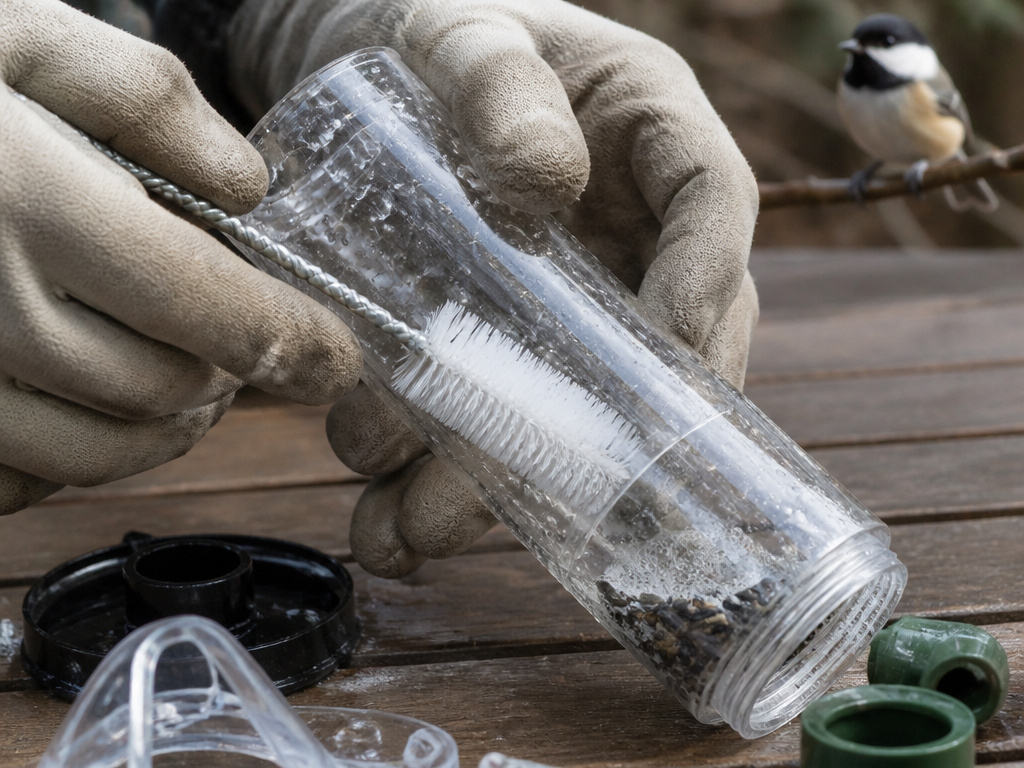
Tip a tube feeder after a stretch of wet weather and the seed at the bottom comes out in a grey clump. That clump is the whole reason this section exists.
Chicago Botanic Garden says to wash feeders occasionally with soap and water, dry them, then rehang. Iowa DNR gives a firmer schedule: once a month with a 10% bleach solution, and the feeder has to be dry before you refill it.
Both are defensible, and neither source contradicts the other outright. The DNR number is the one I’d write on the calendar, because a monthly date is easier to keep than “occasionally”. I check mine between scheduled cleanings too, and if the seed smells off, the whole tube gets emptied.
Mold is the thing you’re managing. Damp seed cakes, and a caked feeder is where moldy food sits. OSU Extension is blunt about it: birds can get sick and die from eating moldy food.
Where this goes sideways: Topping up a tube feeder without emptying it. Fresh seed poured over damp seed keeps the mold layer alive underneath, and the birds are eating from the bottom of that stack.
Two related jobs sit outside the feeder itself. Iowa DNR says to clean the ground underneath feeders periodically to prevent mold, and to replace birdbath water and scrub the bath with a 10% bleach solution once a week. The Iowa DNR bird feeding 101 release is the source for both schedules.
A feeder you never empty is a feeder you never actually clean. Emptying is the cleaning.
Suet, Peanuts, and the Seasonal Switch
Suet is rendered beef fat, and it pulls chickadees, woodpeckers, bushtits, and nuthatches hardest in winter when insects are scarce.
OSU Extension’s rule is to skip suet and other fats in hot weather because they spoil. Suet that’s turned goes soft and greasy in the cage.
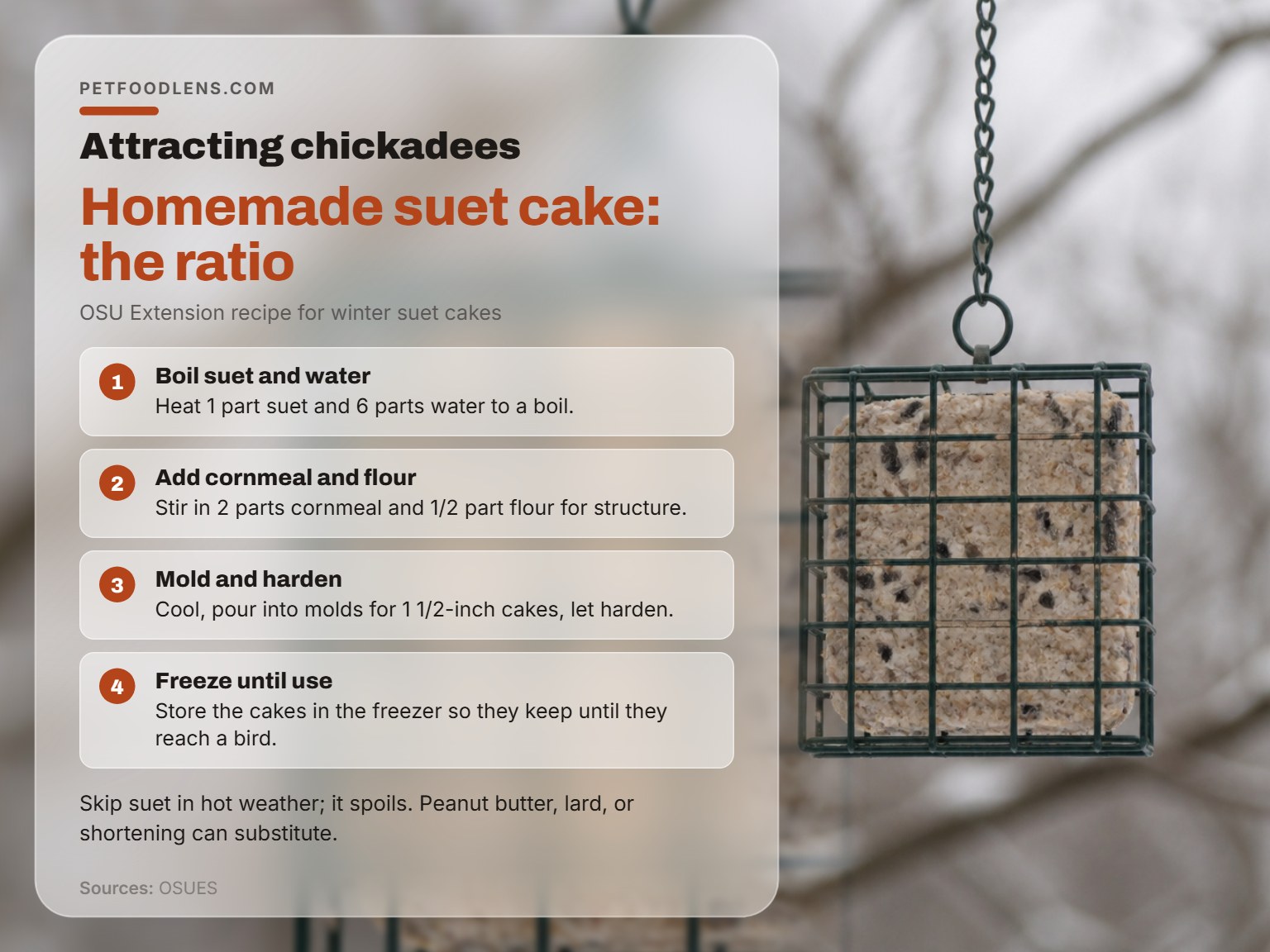
Homemade Suet Cakes: The Ratio
- Heat 1 part suet and 6 parts water to a boil.
- Stir in 2 parts cornmeal and 1/2 part flour. This is the structure.
- Cool the mixture, then pour it into molds for 1 1/2-inch cakes.
- Let the cakes harden, then store them in the freezer. Store the cakes in the freezer so they keep until they reach a bird.
- Substitute peanut butter, lard, or vegetable shortening if you’re out of suet. Same ratio, same result.
Peanuts: Roasted or Raw?
OSU Extension says roasted peanuts only, because raw peanuts contain toxins that could be harmful to birds and other animals. Chicago Botanic Garden lists peanuts for chickadees with no such restriction, and Wild Birds Unlimited calls peanuts the best single source of protein and fat you can offer.
Nobody else addresses raw peanuts at all, so that’s a single-source claim. I still buy roasted. Only one of the three raises the issue, and the downside of being wrong lands on the bird.
Two more small items from the OSU publication. Crushed eggshells supply calcium for nesting females, and they need drying in the oven at 200°F for an hour first to prevent salmonella. A tray of sand helps birds that use grit when snow covers the ground.
Storage matters too. Keep seed in a hard plastic or metal container with a tight lid, and a 5-gallon bucket on a shelf is the size OSU recommends. Rodents chew through bags.
Cats, Hawks, Windows, and Sick Birds
Have you ever had a feeder go dead quiet for a week in midwinter? Something usually caused it.
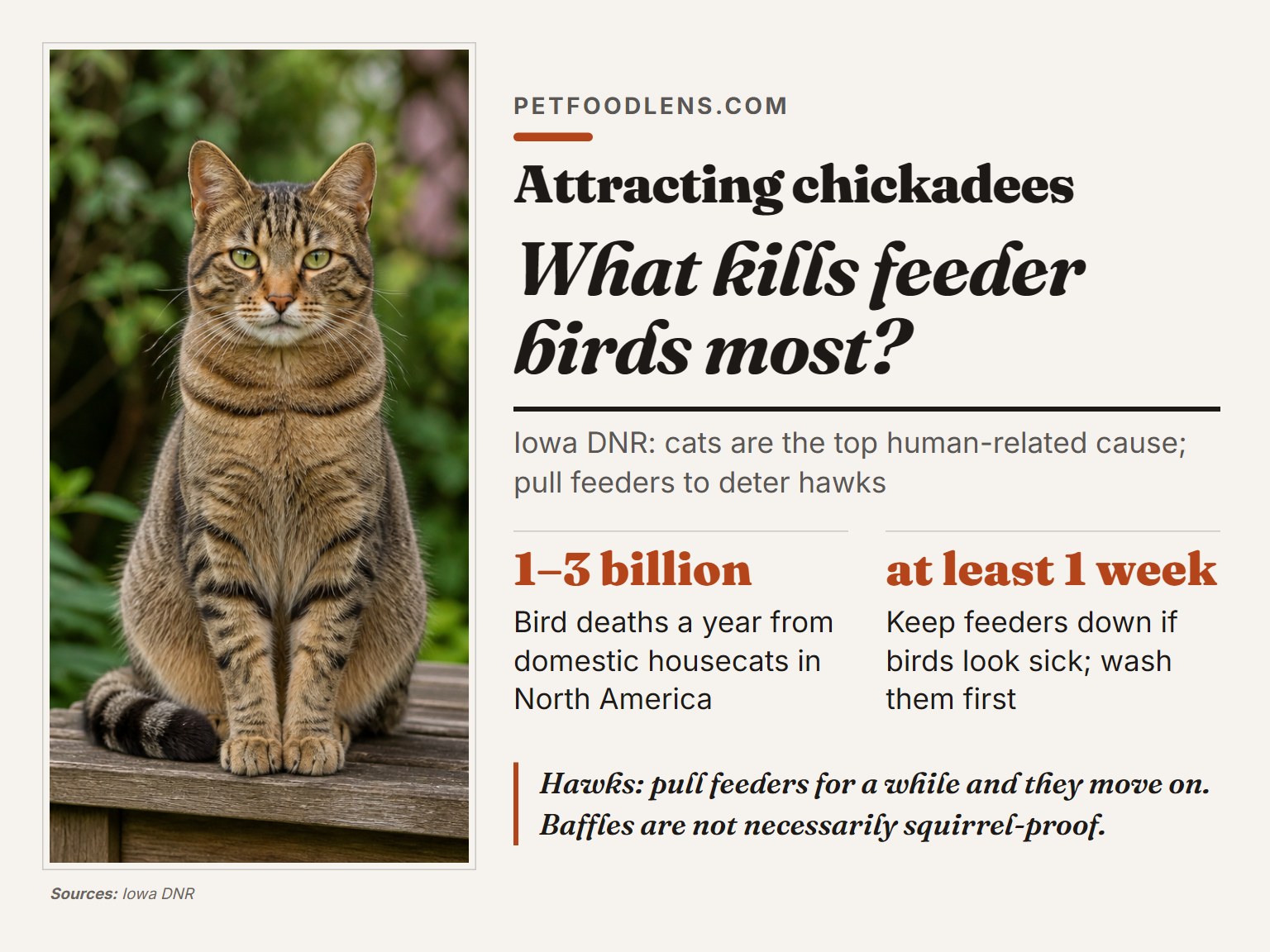
Cats come first. Iowa DNR calls domestic housecats the number one human-related cause of bird deaths in North America, at an estimated 1 to 3 billion birds a year. If your cat goes outside, your feeder is a cat feeder with extra steps.
Hawks are next, and Iowa DNR’s advice is simple: pull the feeders for a while and the hawks move on. Squirrels are the third. Chicago Botanic Garden notes that baffles are not necessarily squirrel-proof, and OSU points out that squirrels jump onto feeders from below the shield, so placement does as much work as hardware. Squirrel proofing covers the geometry.
The Sick-Bird Protocol
Iowa DNR’s instruction is specific. If birds look sick, take the feeders down, wash them, and keep them down for at least a week. That breaks the crowding that spreads disease.
Watch for two things in particular:
- Conjunctivitis, which shows as crusty or swollen eyes on a bird that’s still coming to the feeder.
- Birds that aren’t moving normally, sitting still on the perch or on the ground underneath.
Common mistake: Leaving feeders up because the sick bird “looked fine yesterday”. A week down costs you nothing. A respiratory or eye infection moving through a flock does not.
Frequently Asked Questions
What is the best seed to attract chickadees?
Black oil sunflower is the one to start with, with suet and peanuts close behind. OSU Extension’s chickadee food table marks sunflower, white millet, peanuts, and suet, and it doesn’t mark Nyjer. Black oil beats striped sunflower because the thinner hull is easier for a small bird to crack.
How long does it take chickadees to find a new feeder?
Chicago Botanic Garden puts it at up to a week or longer. That range is normal. Chickadees work a daily route and your feeder has to become part of it, so a quiet first week says nothing about whether the setup works.
Do chickadees use a thistle or Nyjer feeder?
Rarely. Thistle feeders have tiny ports designed for thin-billed birds like goldfinches and siskins, and Nyjer isn’t on OSU’s chickadee food list at all. If you want chickadees, spend the feeder slot on sunflower or suet instead.
Should I stop feeding chickadees in summer?
OSU Extension calls winter, roughly October through April, the ideal season, because natural food is scarce then. Chicago Botanic Garden says to keep feeders filled until middle to late spring. Neither source says you must stop in summer, and some birds visit year-round.
Can I put bread or crackers out for chickadees?
No. OSU Extension is explicit about bakery goods: bread, donuts, cookies, and crackers mold easily, and birds can get sick and die from moldy food. Bakery goods also mold easily, and birds can get sick and die from moldy food.
Why did my chickadees suddenly disappear?
Three usual causes. A hawk has moved in, a sick bird needs the feeder taken down for a week, or natural food has become abundant and the feeder dropped down the priority list. Check for sick birds first, then look up.
The Bottom Line
One job for this week: if your feeder has been hanging a long time without being emptied, take it down and wash it before you buy another bag of seed. Caked, damp seed at the bottom of a tube is a likelier explanation for a feeder that went quiet than the birds moving on.
The rest of it is straightforward once you stop reading the front of the bag. Black oil sunflower, a hopper or a suet cage, 5 to 6 feet up and 6 to 8 feet off a hedge, and a cleaning date on the calendar.
If you want one answer to how to attract chickadees to a feeder, take that setup and then leave it alone for a while. The waiting is the part nobody enjoys.
One concession, because it’s honest: I work from published guidance and my own feeder counts, not from a controlled study. Where OSU, Chicago Botanic Garden, and Iowa DNR disagree, I’ve told you who says what rather than smoothing it into a single rule. On raw peanuts especially, you’re trusting one source.
