
Millet for Birds Guide: White Proso, Red, and Sprouts
This post contains affiliate links. As an Amazon Associate, we earn from qualifying purchases.
Any millet for birds guide should start with white proso (Panicum miliaceum). Cornell’s Seed Preference Test found most ground-feeding species prefer white millet or red milo to black-oil sunflower, and most birds pick white proso over red. Offer it low, and treat it as one part of a mixed diet; note that the USFWS advises against tubes or small-perch elevated feeders, while Cornell’s guidance carries no such restriction.
That ranking holds for Cornell’s ground-feeder results, though the USFWS work names white proso millet as the best seed for attracting small seed-eating species while Cornell calls sunflower the overall favorite, a point any millet for birds guide should note. It also explains something the bag never prints: white proso is a small, pale, round seed built for birds that pick food off the ground, and it behaves badly in equipment built for clinging birds.
What follows is the practical version. Which birds actually eat millet, where Cornell and the USFWS disagree about mixes and feeders, how to sprout a batch without rotting it, and the point where millet stops being useful and starts being a liability.
Key Takeaways
- White proso beats red millet for most birds, per Cornell’s Seed Preference Test. Red millet is Japanese millet (Echinochloa frumentacea), a separate species.
- Millet suits ground feeders. Cornell found ground-feeding species prefer white millet or red milo to black-oil sunflower, while tree-feeders lean sunflower.
- Proso is not a complete diet. UW Extension’s analysis lists no vitamin D, no B12, and 0.05 percent calcium.
- Skip millet in sparrow-heavy yards. Safflower has limited appeal for House Sparrows and starlings, while millet is highly attractive to House Sparrows.
- Sprout it in about 24 hours with the two-parts-small-millet-to-one-part-canary-grass method, rinsing two or three times a day, or allow 24 to 48 hours as FAO describes.
Which Birds Actually Eat Millet?
Ground-feeders, mostly.
Cornell’s guidance splits the audience cleanly. Doves take corn, milo, and millet. Blackbirds take corn. Small finches go for nijer. Safflower has limited appeal for starlings and House Sparrows.
Cornell’s Seed Preference Test results split by feeding style. Most ground-feeding species chose white millet or red milo over black-oil sunflower seed. Many tree-feeding species chose sunflower. Sunflower remains the overall favorite across the full species list Cornell tested.
| Bird group | Seed that wins | Notes |
|---|---|---|
| Ground-feeding species | White millet or red milo | Beats black-oil sunflower in Cornell’s test |
| Tree-feeding species | Black-oil sunflower | Clinging birds, not tray birds |
| Doves and pigeons | Corn, milo, millet | Whole kernel corn suits the larger bill |
| Small finches | Nijer (thistle) | Needs fine mesh or tiny ports |
| Cardinals | Safflower | Starlings and House Sparrows mostly skip it |
That table is the whole argument for stocking more than one seed.
The types of bird seed you keep on hand decide which of those groups bothers to show up.
White Proso vs Red Millet: One Preference, Two Different Questions
Panicum miliaceum is the seed the preference work keeps pointing at, and it travels under three names on three different bags.
White proso, proso millet, and white millet are the same thing. Red millet is a different species altogether, Japanese millet (Echinochloa frumentacea), and treating the two as color variants of one seed is where the confusion starts.
Cornell is direct on the bird side: most birds prefer white proso over red.
Wisconsin’s extension adds a wrinkle that gets misquoted constantly. Birdfeed buyers accept and prefer large, bright, or red seed, and premiums get paid for quality. That’s a buyer preference measured at the counter.
Two different axes. Merge them and you land on the wrong conclusion, which is that red millet must be what birds want because red millet is what sells.
I’ve stopped treating red millet as a cheat. It’s a real seed with a real place in a cheap mix, and some birds do eat it. What irritates me is a panel that lists millet twice, once white and once red, so the ingredient list looks more substantial than the bag actually is.
The University of Wisconsin millets page is where the market-quality detail lives. It’s worth reading before you decide the red-white question is closed.
If your yard runs mostly to finches, the best bird seed for finches is a narrower question than the general one, and millet is only part of the answer.
Sunflower or Millet? The Two Authorities Don’t Agree
Two credible sources name two different “best” seeds, and both are correct about different birds.
Cornell calls sunflower the overall favorite. The USFWS work sitting behind most extension handouts names white proso millet as the best seed for attracting small seed-eating species.
| Question | Cornell Lab | USFWS / VCE 420-006 |
|---|---|---|
| Best single seed | Sunflower, overall favorite | White proso millet for small seed-eaters |
| Buying mixes | Offers a DIY 25/10/10 recipe | Buy sunflower and millet separately, in bulk |
| Millet in tube feeders | No stated restriction | Not for tubes or small-perch elevated feeders |
| Red vs white millet | Birds prefer white proso | Silent; the market prefers bright or red seed |
Read the two columns as answers to different questions. Cornell describes what birds choose when a feeder offers variety. The USFWS summary describes what a person should buy to pull in a target species.
The Cornell Lab of Ornithology feeding guide is the softer of the two positions. It notes that commercial mixtures may carry a high percentage of filler seeds, then hands you a recipe to replace them.
That recipe is the closest thing to consensus in this argument: one 25-pound bag of black-oil sunflower, one 10-pound bag of white proso millet, and one 10-pound bag of cracked corn, mixed in a clean trash barrel.
Buy components. Mix them yourself. Then you know the ratio.
How Do You Offer Millet Without Wasting Half the Bag?
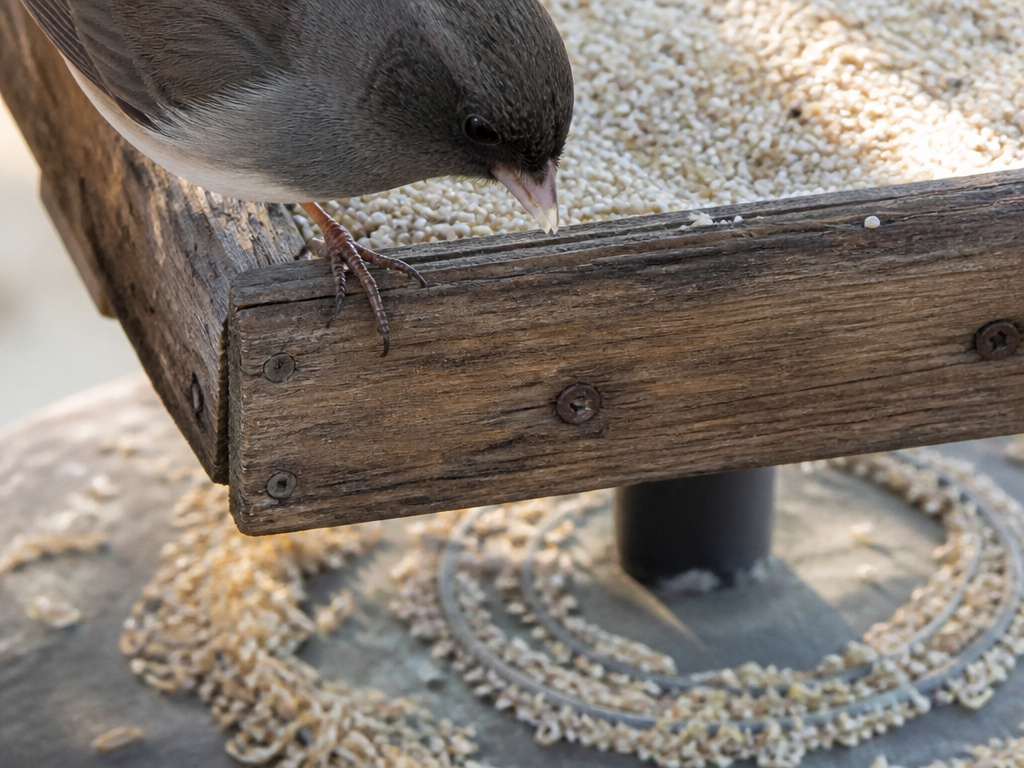
Picture a platform feeder in the morning, juncos working the tray, and a pale ring of husks under the pole by noon.
That ring of husks tells you everything. Millet gets eaten on the ground or close to it, and the birds that want it are built to scratch, not to hang.
Before you start: Seed that smells musty or shows fuzz is already growing mold, and Cornell warns that moldy food may harm birds. A documented case report describes a budgerigar owner whose asthma attacks came on during cage cleaning, with skin tests positive to millet.
Platform and Ground Feeding
Tray feeders, platform feeders, and a clean swept patch of ground all work. The common thread is a flat surface the bird can stand on while it picks.
A swept concrete pad under the feeder is underrated. It makes the husk ring visible, so you can see what’s being rejected instead of guessing.
The Tube-Feeder Question
This is where the two sources part company. The USFWS guidance is blunt: white millet should not go in tubes or other elevated feeders with small perching surfaces. Cornell’s table carries no such restriction.
The physical reason comes down to port size and perch design. Tube feeders are built for clinging birds with pointed bills. Small millet seed can spill through large ports and land in the grass.
Put millet where it can be picked up.
I’ve watched a full tray of loose millet vanish into a lawn quickly. The spray form at least keeps the seed attached to something, and the millet spray vs loose millet comparison covers when each one earns its place.
What “Filler Seeds” Actually Means on a Seed Panel
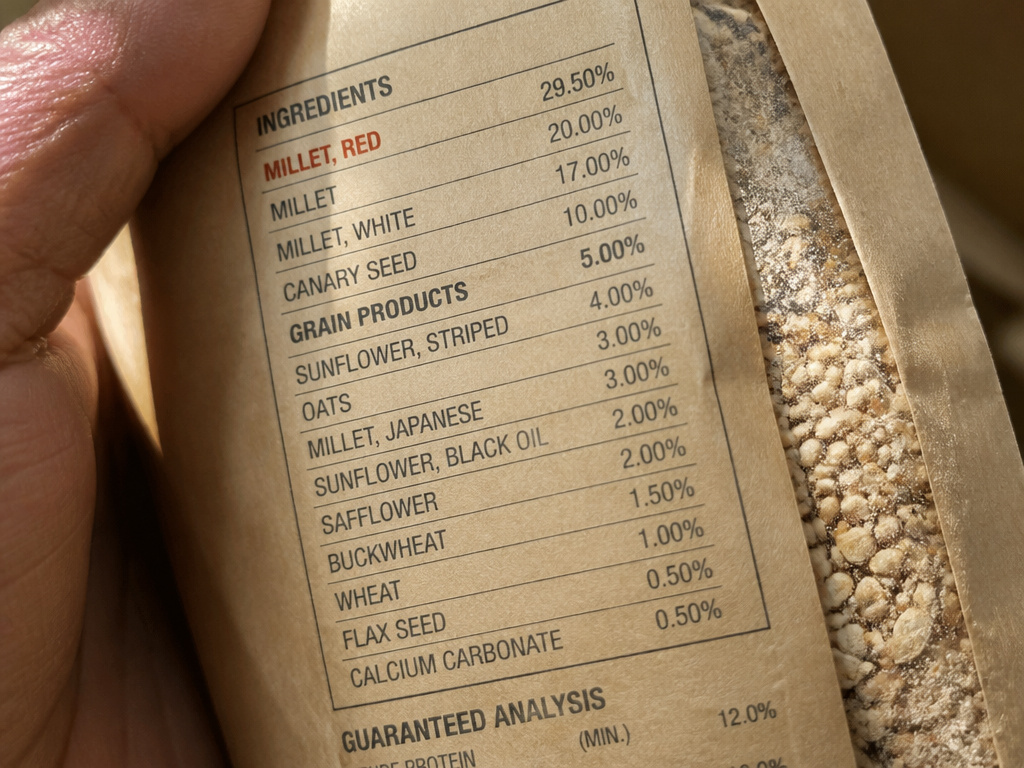
Filler describes seed that’s there to add weight and sit cheaper than the seed beside it.
Cornell warns that commercial mixtures may have a high percentage of filler seeds. FAO is more direct about where that material comes from: components of bird food are often rejects for human or animal consumption, or rejects from the seed industry.
That doesn’t make a bag dangerous. It does mean the panel deserves a read.
Read the back first. Here’s what to look for:
- Red millet listed ahead of white. High volume, low bird interest.
- Wheat and oat as headliners. Useful in a sprouting mix, poor as the main event.
- “Grain products” as a catch-all. No species named, no ratio given.
- Dyed or flavored pieces. Color aimed at the buyer.
- Millet listed twice under two names. The panel looks longer than it is.
A filler-heavy mix leaves a fine pale dust in the seam of the bag and a layer of it at the bottom of the hopper.
Bottom line: buy bird seed without fillers and set your own ratio, or accept that someone else set it for you.
Sprouting Millet: 24 Hours, Two Ratios, and a Rot Risk
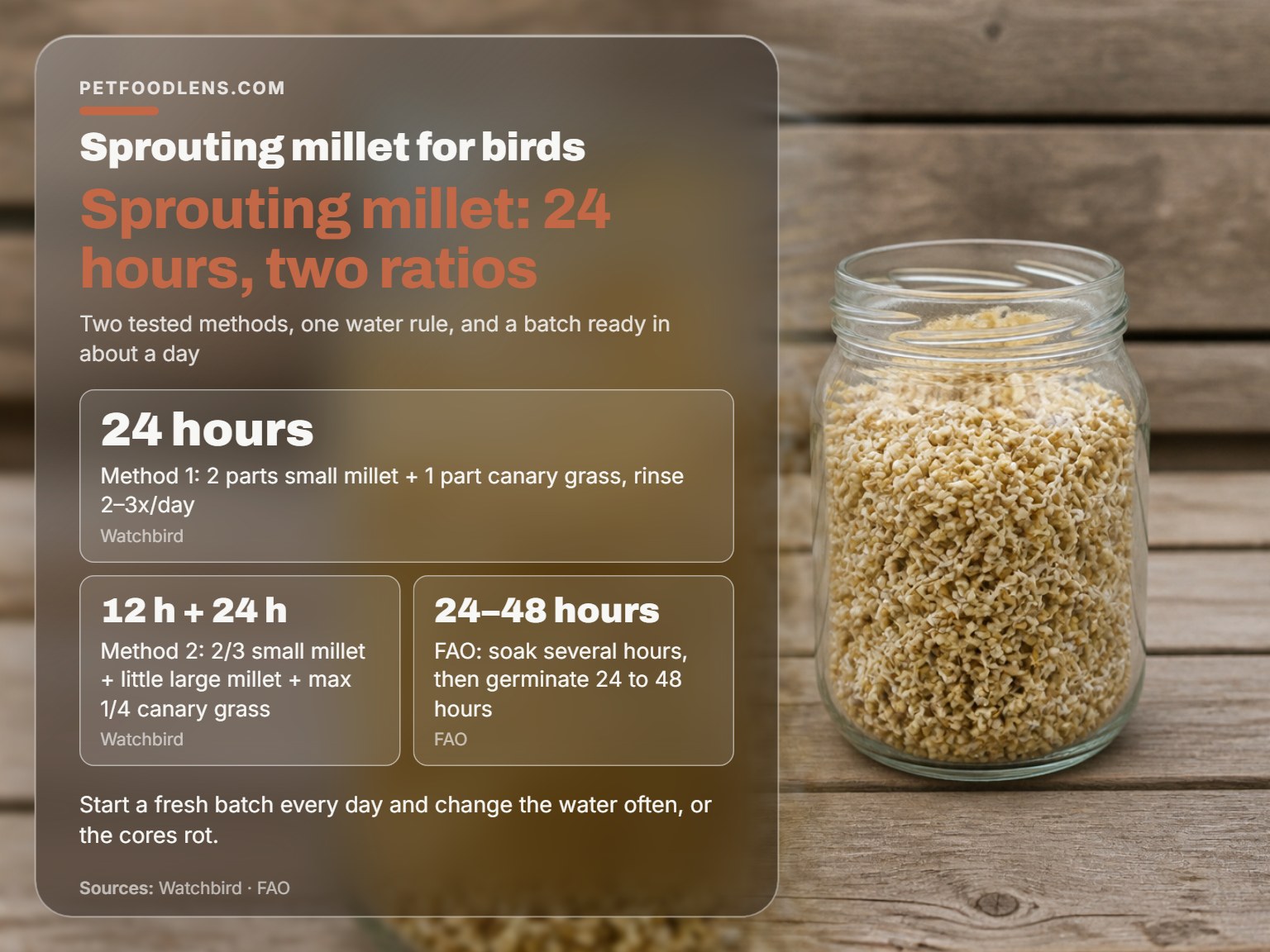
Two tested methods, one rule about water, and a batch that’s ready in about a day.
Sprouting changes the seed. FAO describes the process as soaking for several hours and then germinating for 24 to 48 hours. The Feeding Finches the Conventional Way methods are more specific and more useful.
Method One: Two Parts Millet, One Part Canary Grass
- Mix two parts small-grained millet with one part canary grass seed in a large pot. Sift the dust out first, because undersized seed sprouts unevenly.
- Add water and let the seed swell. A warm room speeds this up, and a radiator works well.
- Tip the seed into a sieve and rinse under running water two or three times a day. Skip a rinse and the batch sours.
- Return the seed to the pot with fresh water. After 24 hours it’s ready.
- Dry it lightly on a clean towel before it goes in the dish. Wet sprouts spoil faster once they’re out.
Method Two: The Two-Thirds Blend
Mix two-thirds small-grained millet, a little large-grained millet, and no more than one quarter canary grass seed. Soak 12 hours, rinse thoroughly, then let it sit another 24 hours before feeding.
A sprout batch is a daily commitment, not a weekly chore. Start a new one every day and change the water often, or the cores rot and you’ve grown something you shouldn’t feed.
Watchbird’s warning about millet spikes is the step people skip. Change the water frequently, discard it after 24 hours, and stand the spikes upright in a glass on a radiator for another day until the sprouts show.
Where this goes sideways: Rinsing once and leaving the pot covered. The batch heats up, smells sour, and by the second day it’s a loss.
A batch going wrong smells like a sour dishcloth. Catch it at that point and compost it.
Sprouts carry vitamin E, which Watchbird flags as particularly important during the mating season. That’s the underrated half of this category. Dry seed is convenient; sprouted seed is a different nutrient profile for the price of a sieve and a daily rinse.
Check the packing date before any of this. Watchbird’s rule is not to buy packages more than half a year old.
When Millet Is the Wrong Seed
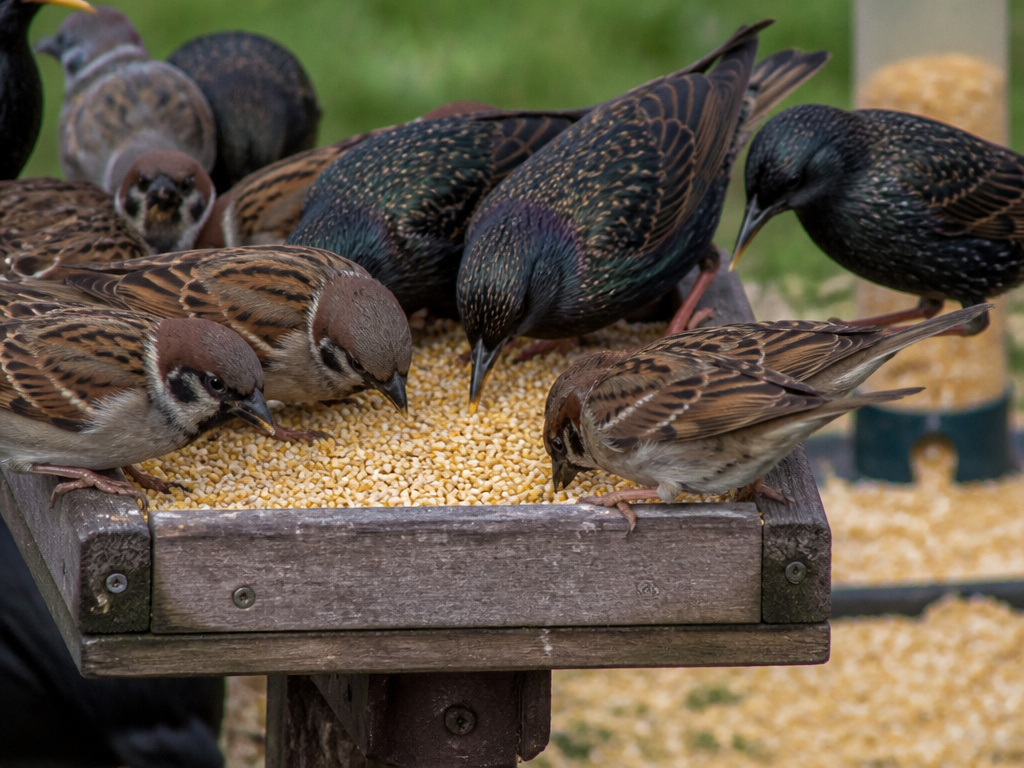
Skip millet entirely in a sparrow-heavy yard.
House Sparrows are the problem. Cornell notes that safflower has limited appeal for starlings and House Sparrows, both non-native species. Millet is the opposite. Research summarized in the fact sheet found House Sparrows strongly prefer millet over native prairie seed, framed as a conservation concern rather than a feeding tip.
So a millet-heavy mix in a sparrow yard gets dominated. The millet goes first, the sparrows stay, and the native seed sits there.
If sparrows are what you actually want, that’s a different brief. The best bird seed for sparrows is a legitimate target rather than a problem to solve.
Signs millet is the wrong call:
- Sparrows and starlings own the tray by mid-morning.
- The ground under the feeder is a carpet of pale husks. Something is sorting.
- You’re running a tube feeder and the millet ends up in the grass.
- The seed smells musty or clumps together in the bag.
That last one isn’t a preference issue. Cornell is explicit that food offered to birds must not be moldy, because it may harm them.
There’s a human side too. An immediate-type millet allergy case report describes a 21-year-old budgerigar owner whose asthma attacks came on while cleaning the cage. Skin tests flagged millet, and immunoblot work found specific IgE against a 60-kd protein in birdseed millet. The attacks stopped when he stopped cleaning the cage.
Immediate-type allergy to millet is rare. The case report counts about 10 cases of anaphylaxis after millet ingestion since 1981, and identifies the implicated commercial mix as Vitakraft Budgerigar Twitter Mixture, which held about 8 different seeds.
Rare is not the same as impossible. If cage cleaning sets off wheezing, get it looked at.
How Much Millet Belongs in a Bird’s Diet?
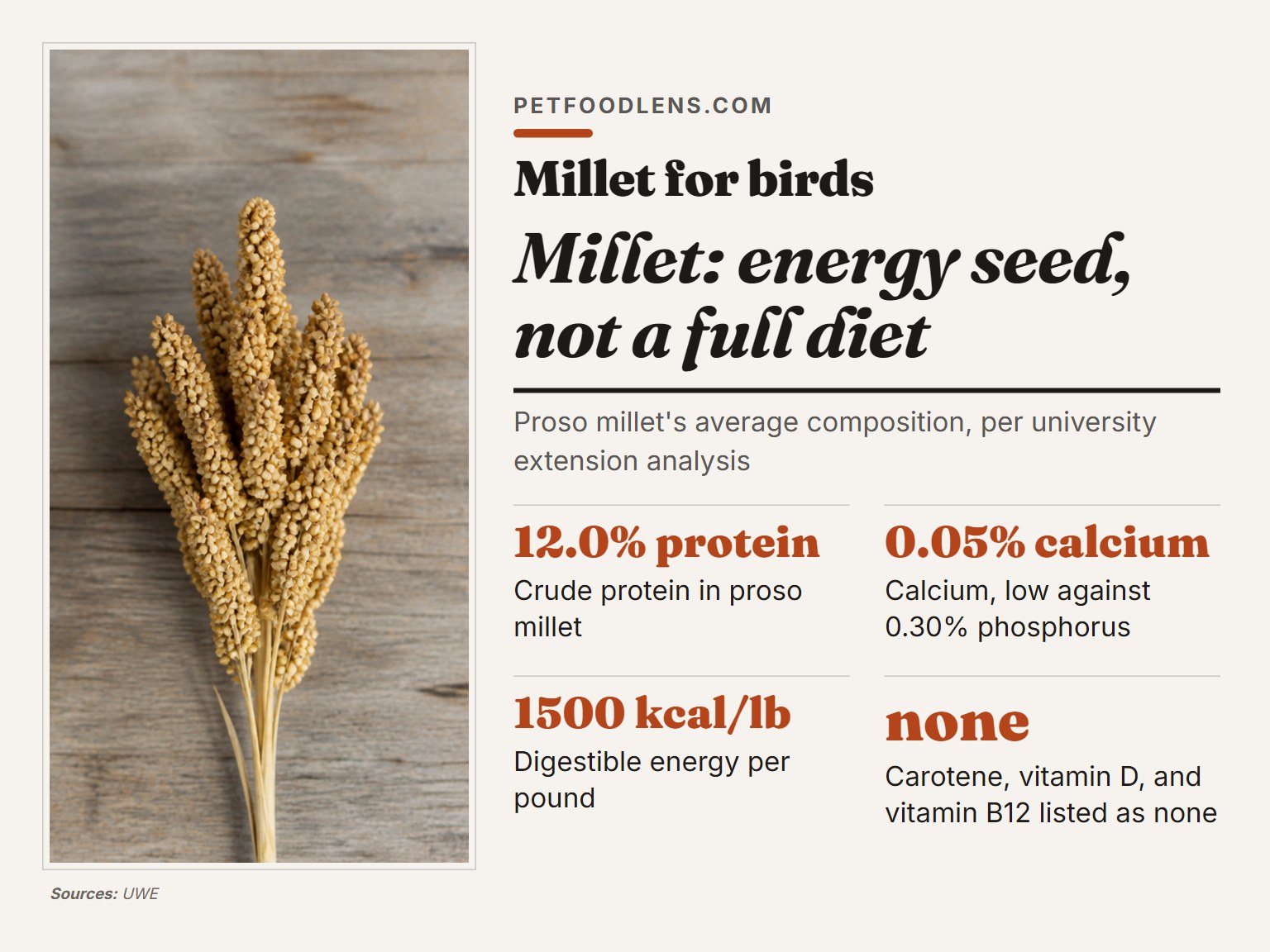
Proso millet runs about 12 percent protein, 8 percent fiber, and 4 percent fat, with 1,500 kcal per pound.
Those numbers look respectable until you read the rest of the same table. Proso carries 0.05 percent calcium and 0.30 percent phosphorus, no carotene, no vitamin D, and no vitamin B12.
That’s the shape of a seed. It’s storage tissue for energy and phosphorus, built to get a seedling started, not to keep an animal alive indefinitely. Calcium and vitamin D are the two that go missing first, and a bird on seed alone has no route to either.
What Millet Doesn’t Provide
- Vitamin D, listed as none in the UW analysis.
- Vitamin B12, also none.
- Carotene, the precursor birds convert to vitamin A. None.
- Calcium, at 0.05 percent, low against the phosphorus figure beside it.
The FAO agricultural seeds guide PDF lands in a similar place for caged bird food generally: 12 to 16 percent protein, 12 percent fat, 6 to 10 percent fibre, and a maximum of 11 percent moisture. That’s a feed specification, not a complete diet.
So millet is a component. It belongs in a mix, in a treat, or in a foraging toy, alongside a formulated diet.
For budgies and small parrots, a formulated pellet diet covers what millet can’t. Millet spray is the one I’d hand a new finch keeper, because the stalk form slows the bird down and turns feeding into work.
I’m a mammal-diet person by training, and avian nutrition has its own literature that I don’t pretend to own. The composition numbers above are the part I trust, because they’re printed in a university extension table and not on a bag.
Common mistake: Topping up the dish when it’s already full of husks. The bird has eaten and left the shells, and a topped-up dish reads as plenty when it’s mostly chaff.
Here is the practical takeaway: millet is a tool for training, foraging, and getting a shy bird to eat. It is not a base diet.
That’s also why millet treats work as a reward and fail as a staple. If you’re building a mix rather than buying one, the whole grains for birds breakdown covers what else belongs in the bowl.
Frequently Asked Questions
Is millet good for birds?
Yes, for the species that eat it. Cornell’s Seed Preference Test found most ground-feeding species prefer white millet or red milo to black-oil sunflower. It’s a useful seed with a real place in a mix, and a poor stand-in for a complete diet.
Should I feed white or red millet?
White proso, for most birds. Cornell states that most birds prefer white proso over red. Red millet is Japanese millet, a separate species, and its appeal is largely to the buyer’s eye rather than the bird’s.
Can birds live on millet alone?
No. UW Extension’s analysis of proso lists no vitamin D, no vitamin B12, no carotene, and 0.05 percent calcium. A bird on seed alone is missing things that seed cannot supply, no matter how much you offer.
How do I stop millet ending up on the ground?
Use a platform or tray feeder, or feed on a clean swept patch. The USFWS guidance is explicit that white millet should not go in tubes or elevated feeders with small perching surfaces.
Is sprouted millet safe for birds?
Yes, if you handle it properly. Watchbird’s methods call for rinsing two or three times a day and starting a fresh batch daily. A batch that smells sour has already gone off and should be composted.
Does millet attract House Sparrows?
Strongly. A 2015 Bird Study paper found House Sparrows prefer millet over native prairie seed. Where sparrows and starlings already dominate, safflower is the better choice because both species largely ignore it.
The Bottom Line
The threshold I’d use: if most of what’s under your feeder is pale husk, the mix is wrong for your yard. Birds don’t sort for entertainment. They sort because the seed they want is buried in seed they don’t.
None of this changes for a single caged budgie on a formulated diet. Millet in that setup is a treat and a training tool, and the ratio question barely applies. The stakes climb in a wild-bird setup, where the ground is the feeding surface and the wrong mix feeds the wrong species.
This week, buy one bag of plain white proso and one bag of black-oil sunflower and mix them yourself. Cornell’s own advice is to experiment and see what your birds take. That’s the cheapest test in this whole category, and it beats any millet for birds guide written by someone who has never seen your yard.
