
Large Breed Puppy Food Pros and Cons: What Labels Hide
This post contains affiliate links. As an Amazon Associate, we earn from qualifying purchases.
Large breed puppy food pros and cons come down to controlled growth: these diets carry a lower maximum calcium and lower calorie density than standard puppy food, which cuts developmental orthopedic risk, but they cost more, the terms on the bag aren’t regulated, and the right switch date is genuinely disputed.
“Large breed puppy” has no legal definition, so the phrase on the front of a bag tells you nothing you can hold a manufacturer to. The enforceable signal sits in the small print of the AAFCO nutritional adequacy statement, where one word separates a diet built for a 90-pound adult from a diet that quietly excludes him.
What follows walks that label line by line: the wording that matters, the places where the sources disagree, how much to feed a puppy headed past 70 pounds, and the cases where a large breed diet is the wrong tool entirely.
Key Takeaways
- The AAFCO statement is the only enforceable claim on the bag. “Including growth of large-size dogs” and “except for growth of large-size dogs” describe two different products.
- AAFCO’s large-size provisions start above 70 lb adult weight. The clinical sources use 50 lb, and that gap matters for a retriever mix.
- Rapid growth and excess calcium are the two big risks. Extra calories drive the first one, and it’s the more common of the two.
- Feed to a body condition score of 4/9 and weigh every two weeks. Caloric restriction changes how fast a puppy matures, not how big it ends up.
- Skip the calcium supplements on a complete diet. Adding minerals on top works against the entire reason you bought the bag.
What Large Breed Puppy Food Actually Changes
A large breed puppy diet is a standard growth diet with two levers pulled back: calcium and calories. Everything else on the label is roughly the conversation you’d have about any puppy food.
Large-size growth provisions under AAFCO set a lower maximum calcium allowance than standard growth diets and recommend, without requiring, a narrower calcium-to-phosphorus ratio of 1-1.3:1 against 1-2:1 for ordinary growth diets. The 2016 revision gave manufacturers up to two years to comply, and the enforceable signal sits in the nutritional adequacy statement.
The calcium lever carries the regulatory weight. AAFCO requires the lower maximum for diets intended for large-size growth, and the narrower calcium-to-phosphorus ratio is a recommendation rather than a rule. That distinction matters when you weigh the large breed puppy food pros and cons, because a bag can advertise a ratio it was never obligated to hit.
The calorie lever is where the evidence gets loud. In the Labrador study cited in the veterinary proceedings, puppies fed free choice had over two times the rate of hip dysplasia as sex-matched littermates fed 75% of their intake. Caloric restriction was also associated with a significantly longer lifespan, 18 to 24 months, without added illness, which is a key point in the large breed puppy food pros and cons.
And restriction didn’t shrink the dogs. It changed how long they took to reach adult size.
That’s the whole case for a large breed diet in three sentences: slower growth, less calcium, same adult dog at the end.
A bag of kibble that’s been open a long time smells flat and faintly rancid, like cooking oil left near a warm stove. The fat is going over, and it’s one reason to buy the smaller bag and finish it.
If you’re starting from scratch, the large breed puppy food shortlist is the place to compare formulas side by side.
The Two Words on the Label That Change Everything
Early in this work I skimmed past a nutritional adequacy statement and reviewed a food as though it were a complete diet. It was labeled for supplemental feeding. I caught it on a second pass, and now that statement is the first thing I read on any bag or can.
Since 2016, AAFCO has required foods labeled for growth or all life stages to state whether they include or exclude growth of large-size dogs, defined in the provision as 70 lb or more as an adult. Manufacturers got up to two years to comply, so a label printed before 2018 can be vaguer than a current one.
| Label wording | What it means | Fits a big puppy? |
|---|---|---|
| “including growth of large-size dogs (70 lbs or more)” | Formulated for large-size growth | Yes |
| “except for growth of large-size dogs (70 lbs or more)” | Legally excludes large-size growth | No |
| No large-size wording at all | Pre-2016 label, or a maintenance claim | Check the life stage first |
Here’s what I actually check, in this order:
- The life stage line, because “all life stages” and “growth” are not the same claim.
- The word after “all life stages,” because “including” and “except for” flip the meaning.
- Whether the statement cites a nutrient profile or a feeding trial, since those are different levels of proof.
- The guaranteed analysis, read against the calories per cup rather than on its own.
Worth knowing: AAFCO doesn’t test or regulate pet food. That work happens at the state level, and AAFCO writes the model language the states adopt.
Common mistake: Reading the front panel and stopping there. “Large breed puppy” isn’t a regulated term, so the phrase can sit on a bag whose own statement excludes large-size dogs entirely.
Where the Sources Disagree on Weight, Age, and Calcium
Ask what counts as a large breed and the answers split: AAFCO draws the line at 70 lb adult weight, while the clinical sources draw it at 50.
Today’s Veterinary Nurse uses over 50 lb (23 kg), and puts giant breeds at 100 lb (45 kg) or more. The dvm360 proceedings use over 50 lb. The AKC manual says large-breed puppies weigh more than 50 lb full grown. Only the AAFCO provision sits at 70.
| Question | Position A | Position B |
|---|---|---|
| Adult weight for “large breed” | AAFCO: above 70 lb | TVN, dvm360, AKC: above 50 lb |
| Calcium guidance | TVN: 0.8-1.2% DM as a target band | AAFCO: a lower maximum, not a target |
| Calcium-to-phosphorus ratio | TVN: 1.1:1 to 2:1 | Clinical article: 1-1.3:1 for large breeds |
| Switch to adult food | dvm360: can begin at 1 year | Polish review: 15-18 months, 24 for giant breeds |
| Added supplements | Clinical article: unnecessary on a complete diet | dvm360: may add glucosamine, omega-3, chondroitin |
The calcium row is the one people merge by accident. A target band and a ceiling are different instructions, and the published nutritional problems of large breed dogs review treats the large and giant breeds as having a narrower optimal calcium range than small breeds, which is a third way of saying it again.
On timing, the honest answer is that nobody agrees. The AKC manual advises bigger breeds switch at 12, 13, even 14 months and adds that it’s better to stay on puppy food too long than not long enough. The Polish review pushes large breeds to 15-18 months and giant breeds to 24. PetMD says at least the first year, sometimes two.
The large breed dog food guide covers the adult side of that handoff in more detail.
How Much Should You Feed a Large Breed Puppy?
Meal feeding, not free feeding, is the approach the dvm360 proceedings recommend, though feeding frequency guidance varies by source. The dvm360 proceedings put it plainly: puppies should always be meal-fed rather than allowed to eat at will.
Before you start: Don’t change foods and add a supplement in the same week, because you’ll have no idea which one caused the loose stool. Don’t free-feed a puppy that’s gaining faster than the growth chart, since the extra calories go into bone before they go into fat. And don’t treat a limp in a fast-growing puppy as a stage he’ll grow out of.
The routine that works:
- Weigh the puppy every two weeks during growth, on the same scale, at the same time of day.
- Score body condition by hand. At 4/9 you feel the ribs under a thin layer without pressing, and you see a waist from above.
- Adjust the portion, not the food, unless the food itself is wrong.
- Recheck in two weeks. Growth rate moves faster than most owners expect between 3 and 6 months.
The 3-to-6-month window is the one to watch, because that’s when large breed puppies grow fastest. It’s also when an overfed puppy looks impressive rather than overweight, which is exactly the trap.
| Age | Meals per day | Source |
|---|---|---|
| 6-12 weeks | 4 | AKC |
| 3-6 months | 3 | AKC |
| 6-8 months | 2 | PetMD |
| 6-12 months | 2 | AKC |
Two other numbers belong in the same conversation. Treats should stay under 10% of daily calories, which is less than most people hand out in a training session. And after spay or neuter, caloric intake should drop by roughly 30% to match the lower energy need.
Dry, Wet, or All-Life-Stages: Which Wins Where
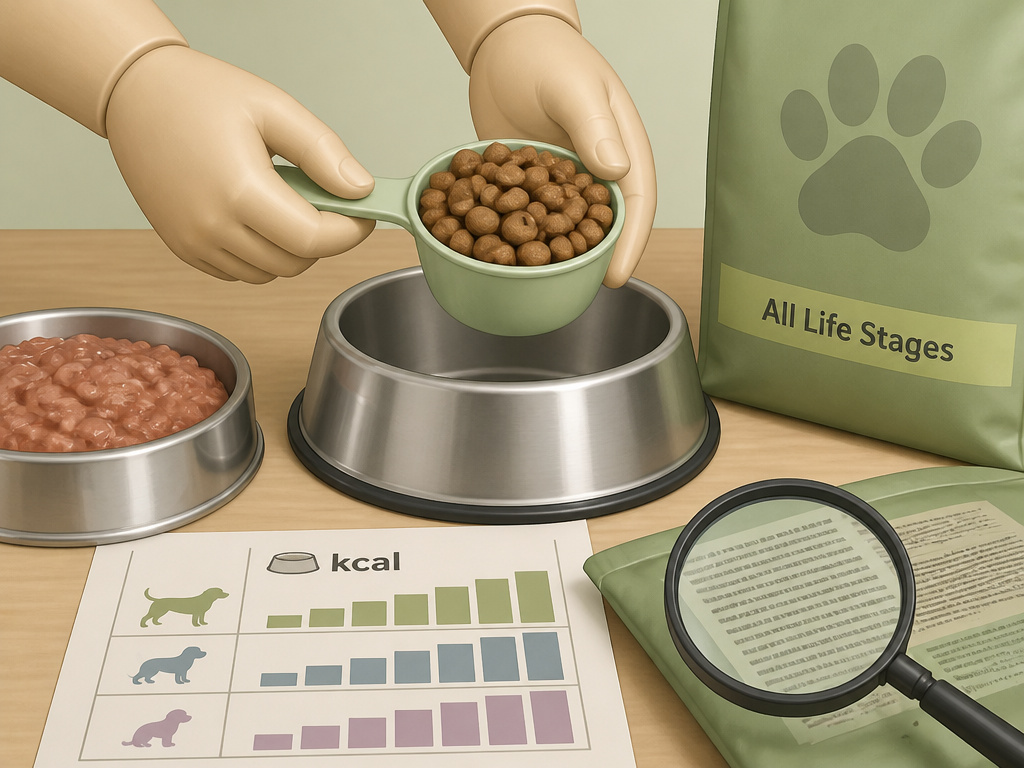
All-life-stages food sounds like it covers everything. For a big puppy, it covers too much.
Dry Kibble for Large Breed Puppies
Dry wins on portion control, because you can measure it and the calories per cup are printed on the bag. It also wins on cost per day, which matters over a 12-to-24-month growth period. For most homes I’d start with a dry large breed formula and read the statement before anything else, which is why the dry kibble for large breed puppies comparison is worth a look.
Wet Food for Large Breed Puppies
Wet food wins on water intake and on palatability, and it loses on calories per gram, which means bigger portions and a shorter shelf life once opened. It’s a reasonable mixer for a puppy who won’t eat, and a poor base for a dog you’re trying to grow slowly. The wet food for large breed puppies options are worth knowing if you’re feeding a reluctant eater.
If chicken is a problem, the chicken-free puppy food list is the place to start rather than guessing from the front of a bag.
All-Life-Stages Diets
This is where I’d push back hardest. The dvm360 proceedings describe all-life-stages foods as puppy diets designed to also feed lactating bitches and adult dogs, and note they often carry excessive calories and potentially inappropriate calcium for large and giant breed puppies. One bag for the whole household is a convenience purchase, not a nutritional strategy.
I’d rather see an owner buy a mid-priced large breed diet with an explicit “including” statement than a boutique bag with a wolf on the front and no large-size wording at all. The statement is the part that has to be true.
Do Large Breed Puppies Need Supplements?
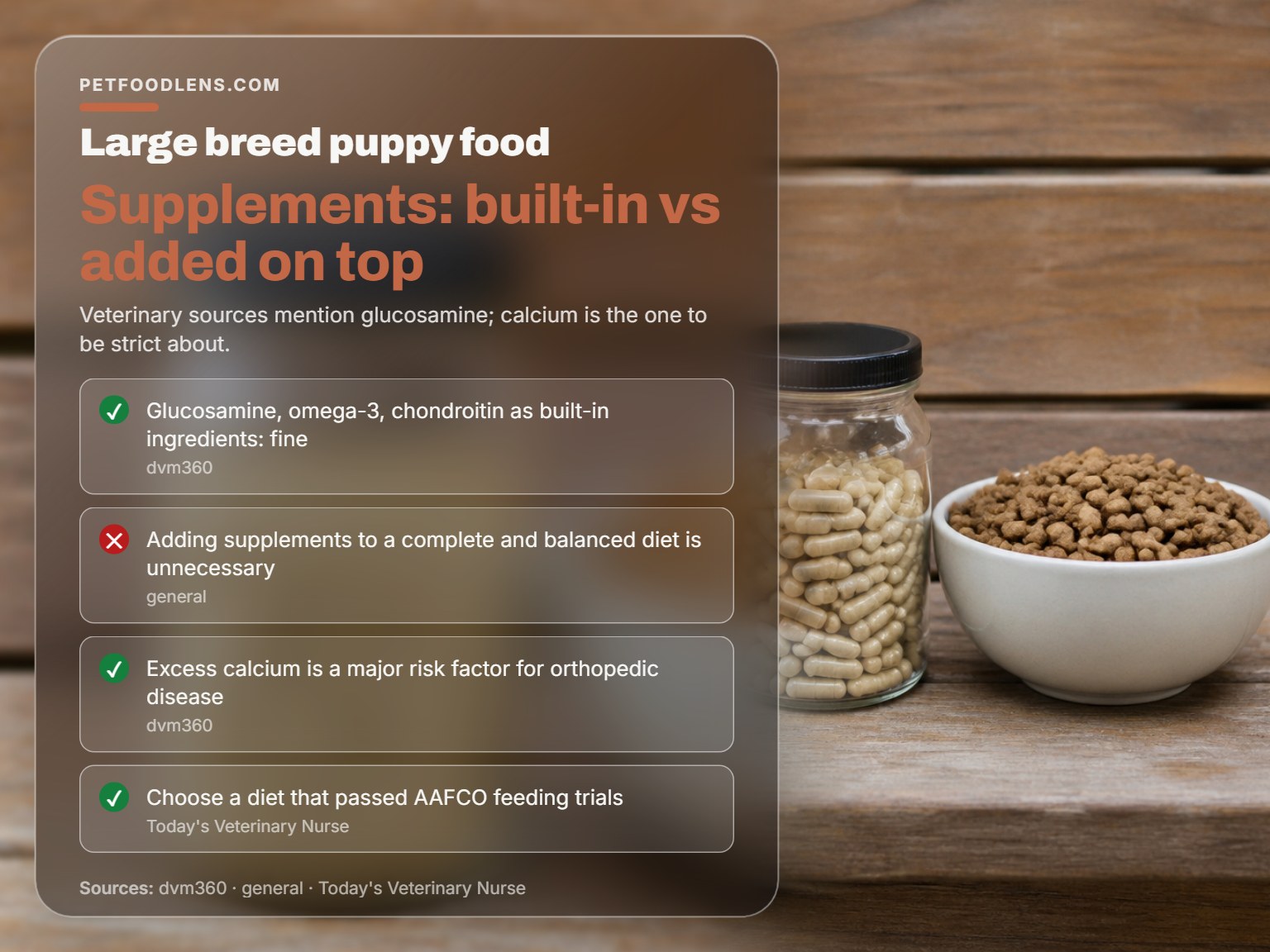
The glucosamine question splits the veterinary sources down the middle, and both sides have a point worth hearing.
The dvm360 proceedings say large breed puppy diets may be supplemented with glucosamine, omega-3 fatty acids, and chondroitin for potential orthopedic benefit. The clinical article in the same literature says providing additional supplements to a complete and balanced diet is unnecessary. PetMD lands in the middle, listing glucosamine and chondroitin as ingredients worth seeing in the food itself.
Read those together and the practical answer falls out: as ingredients built into a complete diet, fine. As a jar you add on top, unnecessary.
Calcium is the one to be strict about. Excess calcium intake is one of the two major nutritional risk factors for developmental orthopedic disease, alongside rapid growth, and the bag has already been formulated around that ceiling.
Where this goes sideways: Adding calcium, bone meal, or dairy to a complete large breed diet. You’ve now fed past the maximum the formulation was built to respect, and the puppy’s skeleton pays for it during the fastest growth window he’ll ever have.
If the bag says complete and balanced and you’re adding a mineral on top, you’ve stopped feeding the diet the manufacturer tested.
For the protein side of the same argument, the high-protein dog food breakdown covers where extra protein helps and where it just adds calories.
When a Large Breed Diet Is the Wrong Answer
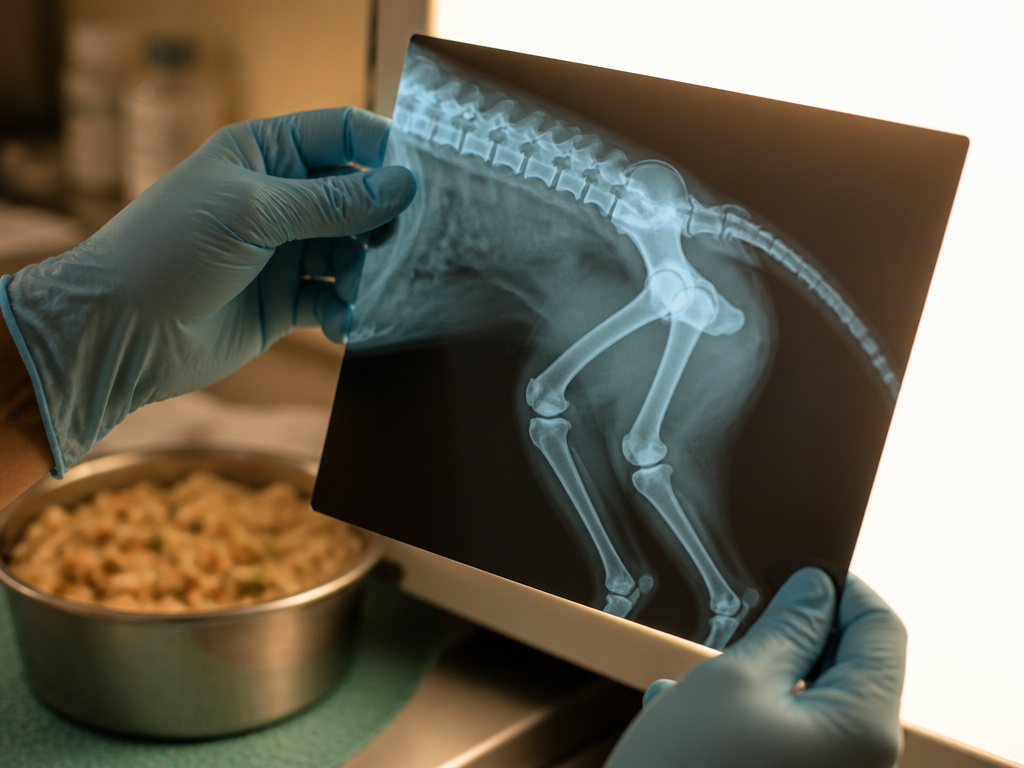
A six-month-old Giant Schnauzer was referred with a month of lameness and difficulty walking. The diet was homemade and unbalanced, imaging showed compression fractures, and nutritional secondary hyperparathyroidism was suspected. The dog improved on a corrected diet.
That case is the mirror image of the usual warning. Too little calcium breaks a growing skeleton just as surely as too much, and a home-cooked recipe built by feel is the fastest route there. The published large breed puppy compression fractures case is worth reading if you make your own food.
Three other situations where the standard advice bends:
- Unknown parentage. The dvm360 proceedings say that for larger puppies of unknown parentage, or mixes prone to orthopedic disease, it’s likely safest to meal feed a large breed food and keep them lean.
- Giant breeds. The growth window runs longer, and the giant breed puppy food question is really a question about how long to stay on a growth diet.
- Therapeutic diets. A food written for another condition isn’t automatically built for growth, and a prescription label doesn’t change that.
One more thing nobody prints on the bag: there’s no requirement that a large breed puppy diet be tested in large breed puppies. The dvm360 proceedings state it directly. A feeding trial claim tells you the food was tested, not who it was tested on.
Frequently Asked Questions
Is large breed puppy food necessary for a mixed breed?
It depends on the expected adult weight, not the breed name. If the mix is likely to finish above 50 lb, the clinical sources treat that as large breed, though AAFCO’s large-size provisions start above 70 lb adult weight. Below that, a standard puppy food is fine. The dvm360 guidance for unknown parentage is to meal feed a large breed food and keep the puppy lean, which is the cautious side of the line.
When should I switch my large breed puppy to adult food?
The AKC manual suggests 12 to 14 months for bigger breeds, the dvm360 proceedings say a transition can begin at 1 year, and the Polish review puts large breeds at 15-18 months and giant breeds at 24. Body condition and growth rate are better guides than the calendar alone.
Can I feed an all-life-stages food to a large breed puppy?
You can, and it’s a common choice in multi-dog homes. The catch is that all-life-stages diets are puppy diets designed to also feed adult dogs and nursing bitches, and the dvm360 proceedings note they often carry excessive calories and potentially inappropriate calcium for large and giant puppies. Check the statement for the “including” wording before you rely on one.
Does my large breed puppy need a calcium supplement?
No, if the diet is complete and balanced. Excess calcium is one of the two major risk factors for developmental orthopedic disease, and the formulation already accounts for it. The clinical guidance is that additional supplements to a complete diet are unnecessary. A puppy on an unbalanced homemade diet is a different case and needs a vet or a board-certified nutritionist.
How do I read the AAFCO statement quickly?
Read the last line first. If it says “including growth of large-size dogs,” the food is formulated for a big puppy. If it says “except for growth of large-size dogs,” it isn’t, regardless of what the front of the bag says. Then check whether the claim rests on a nutrient profile or a feeding trial, since those are different levels of proof.
The Bottom Line
Here’s the first thing to do this week: photograph the AAFCO statement on your current bag and read the last line. If it says “except for growth of large-size dogs,” that food isn’t built for a puppy headed past 70 lb, and the swap is worth making before the next bag arrives.
The concession is real, though. If your puppy is a mix you expect to top out around 45 lb, most of this article is somebody else’s problem, and a standard puppy food with a growth statement is a perfectly good answer.
What I’d defend hardest is the direction of the error. I’d rather see a big puppy stay on a large breed growth diet two months too long than come off it early to save a bag. Slower growth costs you nothing at the end. The adult dog is the same size either way.
